

The end of giant warehouses? Robots, cold storage zones & record times: Amazon's new secret weapon for last-mile delivery
Xpert Pre-Release

Available in 27 languages 📢
Prefer Xpert.Digital on GoogleⓘPublished on: September 15, 2026 / Updated on: September 15, 2026 – Author: Konrad Wolfenstein
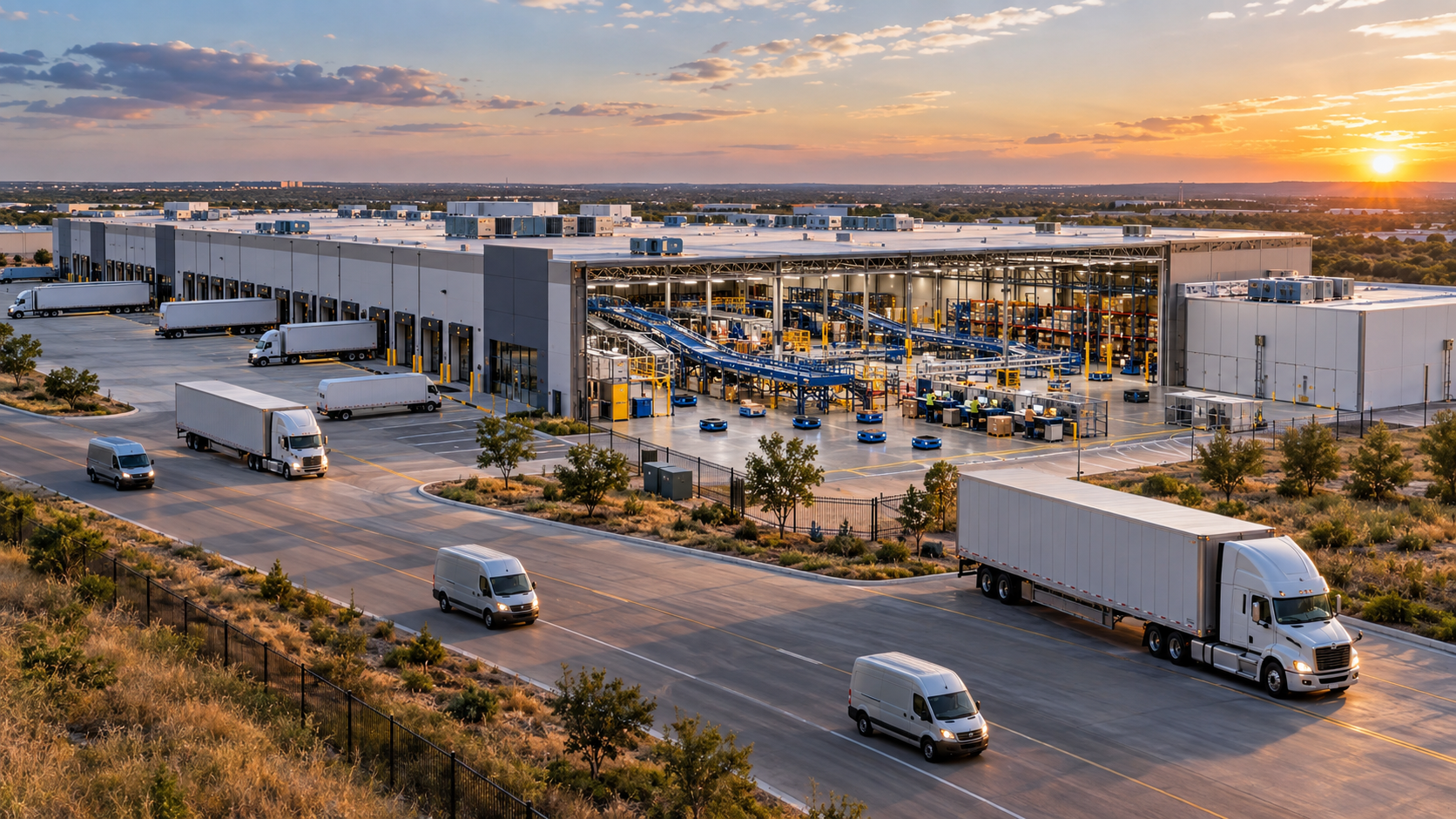
The end of giant warehouses? Robots, cold storage zones & record times: Amazon's new secret weapon for last-mile delivery – creative image on the topic, with AI: Xpert.Digital
Same-day delivery as standard: How an unassuming warehouse is accelerating Amazon's network
The $48 million bet: Why Amazon is now focusing on specialized locations instead of giant warehouses
Despite high vacancy rates: Why Amazon is investing millions in a new building in Texas
An unassuming new building in Georgetown, Texas, marks a strategic turning point in global e-commerce. With an area of approximately 23,100 square meters and a stated construction value of $48 million, Amazon's new logistics center appears at first glance to be a manageable regional project – a far cry from the gigantic, multi-million-dollar warehouse complexes of recent years. But appearances are deceiving: The facility is the physical heart of a profound network transformation. Instead of building ever-larger spaces for endless product ranges, Amazon is moving closer to the customer with highly automated "sub-same-day" (SSD) locations. Equipped with intelligent robotics, integrated refrigeration zones, and data-driven algorithms, the focus here is no longer on maximum storage capacity, but on radically reducing delivery times. This analysis shows why the project makes perfect economic sense despite high local property vacancy rates, what new challenges it brings for municipal infrastructure, and why in modern commerce it is no longer the one who owns the largest warehouse who wins, but the one with the fastest network.
Amazon's $48 million bet on Georgetown: It's not the biggest arena that wins, but the fastest
Amazon's planned logistics center in Georgetown appears at first glance to be a regional construction project of manageable scale. With a stated construction cost of $48 million and a floor space of just under 23,100 square meters, it remains far below the dimensions of those multi-million-dollar mega-centers that have characterized the expansion of American e-commerce in the past decade. Economically, however, the project is remarkable. It represents the transition from the largest possible centralized warehouse complexes to a more finely meshed network of highly automated, urban-adjacent locations, whose most important performance metric is not maximum storage capacity, but rather the reduced time to delivery.
This is precisely where the strategic importance of the project lies. Amazon is not simply investing in additional space, but in speed, local product availability, and a closer integration of storage, order picking, sorting, and last-mile delivery. The Georgetown facility should therefore be understood less as a traditional warehouse and more as the physical computing unit of a data-driven distribution system. Algorithms determine which items must be available on-site, robotics shortens distances within the building, and its location in the northern growth corridor of the greater Austin area reduces the distance to the customer. The site is not intended to stock every product, but rather to keep the right products in sufficient quantities as close as possible to anticipated demand.
The clear perspective, therefore, is this: the project is not evidence of an undifferentiated return to the logistics space boom. Rather, it is a targeted investment in a specific type of building that can be economically viable despite high regional vacancy rates. Amazon is not building there because Georgetown lacks sufficient warehouse space, but because the location requires a specially configured, network-enabled facility. This distinction is crucial to avoid underestimating the investment as mere real estate news or overstating it as automatic proof of a new general warehouse boom.
From file entry to the decisive construction phase
The project is listed in the documents as SUS3 SSD Facility. Amazon.com Services LLC is named as the developer, and AECOM as the design firm. A new sorting facility is planned for 104 Wittera Way in Georgetown, Williamson County. The facility will have a footprint of 248,687 square feet, or approximately 23,100 square meters. The registered value is $48 million, which equates to a cost of approximately $193 per square foot, or about $2,080 per square meter.
This figure, however, must be interpreted with caution. A project value stated in a building permit or approval document does not necessarily represent the total investment costs up to operational readiness. Land, financing, extensive conveying and sorting technology, mobile robots, information technology, security systems, start-up costs, inventory build-up, and subsequently added operating resources may be wholly or partially outside the reported construction value. Conversely, without a detailed cost breakdown, it is impossible to determine which technical equipment is already included. The 48 million US dollars therefore provide a reliable indication of the scale, but not a fully itemized total budget.
The official schedule stipulated a construction start date of August 24, 2026, and completion by July 30, 2027. This start date was missed by mid-September 2026. However, this does not automatically mean that construction is delayed or has already fully commenced. A registration date reflects a plan, not a complete, real-time record of mobilization, earthworks, or building construction. Publicly available reports to date primarily confirm the planned start date; a clear, independently verifiable statement regarding the actual start of construction is not apparent.
The factually correct status is therefore: The project has moved beyond the initial planning stage and is at least in the planned mobilization and construction start-up phase, but the actual progress on the site remains insufficiently documented publicly. This distinction is relevant for market observers and potential suppliers. The phase in which fundamental decisions regarding the location, building concept, and main planning are still being made is largely complete. However, opportunities may still exist for technical lots, subcontractor services, and subsequent integration packages.
A compact location with strategic importance
The planned warehouse is not exceptionally large by Amazon's standards. That's precisely what makes it interesting. Older e-commerce networks were heavily reliant on large fulfillment centers where a wide range of products was consolidated and distributed over vast areas. This model remains important for slower-moving goods, a broad product range, and national inventory consolidation. However, it's no longer sufficient when customers increasingly expect same-day delivery, delivery within a few hours, or delivery within narrowly defined time windows.
A sub-same-day distribution center follows a different economic logic. It keeps a more limited selection of particularly high-demand items closer to the sales market and combines several process steps under one roof. This not only reduces the distance traveled on the final leg of the journey, but also minimizes internal transfers, intermediate storage, and sorting steps. The building becomes a buffer against speed: While it requires capital and ongoing expenses, it ideally prevents more expensive express shipments, stockouts, delayed deliveries, and unnecessary package handling elsewhere in the network.
A smaller footprint is not indicative of lesser technical importance. Such a location can place higher demands on conveyor technology, software, cooling, security, and process density per square meter than a typical distribution center. While a conventional building primarily provides space, gates, load-bearing capacity, and traffic areas, a high-speed fulfillment hub must be optimized for short lead times. Therefore, the economically decisive factor is not just the quantity stored, but the throughput per square meter, per working hour, and per dollar invested.
This also shifts the assessment of the project. Those who only compare the warehouse size to Amazon's massive distribution centers underestimate its role within the network. Conversely, those who describe every new location as a revolutionary technological leap overestimate it. Georgetown is one component in a broader densification of the delivery infrastructure. Its value only emerges in conjunction with upstream fulfillment centers, regional inventory management, package transport, delivery stations, drivers, and digital demand forecasting.
Georgetown is growing within Amazon's reach
Georgetown lies north of Austin in one of Texas' most dynamic residential and economic regions. Its proximity to Interstate 35 and Texas State Highway 130 improves access to both the regional market and interregional trade flows. This combination is particularly valuable for a fast-track distribution hub. It must be located close enough to growing residential areas, but not so deep within the dense urban area that land costs, traffic congestion, lack of expansion space, or land-use conflicts drive up operating expenses.
Strong population growth is structurally changing local demand. New households not only require more consumer goods, but they also create a denser delivery area, allowing for more stops per route and shorter distances between recipients. This density is crucial for the last-mile economics. Fast delivery is expensive in a dispersed rural area because vehicles cover long distances for a small number of packages. In a growing suburban corridor, the same vehicles can deliver more packages over a similar distance, thus reducing the cost per package.
Added to this is Austin's economic appeal. Technology companies, semiconductor investments, corporate relocation, and residential construction have expanded the region's demand potential, even if the cycle is not perfectly uniform. Georgetown benefits from its location on the northern edge of the metropolitan area. The site not only serves its own city but, depending on the specific network planning, can also provide faster service to parts of the northern Austin metropolitan area.
At the same time, conflicting objectives arise. Strong growth increases property values, strains roads and infrastructure, and intensifies competition for skilled workers. Logistics centers generate truck, van, and commuter traffic at times when residential and commercial populations are already growing. Therefore, location quality cannot be assessed solely based on a highway map. Crucial factors include actual travel times, intersection congestion, shift changes, access design, power supply, and the capacity of the local infrastructure to accommodate further growth.
Why high vacancy rates are not a counterargument
The industrial real estate market in the greater Austin area is undergoing a correction phase in 2026. Following a strong development wave, a significant amount of new space has entered the market, while demand has not been able to absorb the supply at the same pace everywhere. Depending on the market definition and data collection method, analyses show vacancy rates well into the double digits. In the Georgetown submarket, the reported vacancy rate even exceeded 27 percent at times. Simultaneously, asking rents declined in parts of the market, giving tenants more bargaining power.
At first glance, a new building in such an environment seems contradictory. Why would Amazon invest $48 million in another warehouse when large areas are already available in the region? The answer lies in the difference between interchangeable real estate space and specialized operational infrastructure. While an empty, speculative warehouse may offer a roof, flooring, and doors, it doesn't automatically meet the requirements for site location, traffic flow, ceiling height, power supply, refrigeration, robotics layout, security zones, and the process flow of a sub-same-day operation.
Leasing an existing building would still be a viable economic alternative. In a tenant-friendly market, Amazon could negotiate more favorable terms, expansion subsidies, and shorter deployment times. The fact that a specifically planned project is being pursued suggests a high value placed on the particular location and configuration. However, it doesn't prove that new construction is always more cost-effective. Other possibilities include long-term secured land rights, prior planning, specific network requirements, or a preference for ownership and control.
The project sends a mixed signal to the region. On the positive side, a major owner-occupier is committing capital and planning to build a modern facility, even though the overall real estate market is weak. This could stabilize the perception of the location. At the same time, a purpose-built warehouse doesn't necessarily absorb the existing vacancies of other owners. The Amazon building, therefore, doesn't resolve the oversupply in this submarket. Rather, it demonstrates that the market is becoming increasingly differentiated: standard properties compete on price and concessions, while customized facilities are justified by location, technology, and network value.
Same-day delivery is becoming the operating system of commerce
Delivery speed has transformed from an additional service in online retail to a key competitive factor. For many everyday products, customers are less willing to wait several days when brick-and-mortar stores offer the same goods immediately or other platforms deliver within a few hours. Amazon is responding to this with a combination of regionalized warehousing, faster delivery locations, improved forecasting, and a denser delivery network.
The business challenge lies in not buying speed at an exorbitant cost. Theoretically, a package can almost always be moved faster by using additional vehicles, personnel, air freight, or special deliveries. This is only sustainable, however, if the cost per order is controlled simultaneously. Sub-same-day centers aim to mitigate this contradiction. They relocate frequently requested inventory closer to customers, shortening the delivery route even before the specific order is placed.
This makes the accuracy of forecasts extremely important. If too little of an item is stored locally, the promise of fast delivery remains unfulfilled. If too much is stored, Amazon ties up capital, consumes scarce space, and risks write-offs or returns. The center therefore relies on precise pre-selection. The actual performance arises from the interplay of data on local demand, order history, seasonality, weather, promotions, delivery capacity, and inventory positions across the entire network.
Economically, this turns the warehouse into an options portfolio. Every locally available item offers the possibility of fulfilling an order particularly quickly and cost-effectively. This option has value as long as the probability of demand is high enough. For rarely ordered products, however, the storage and capital commitment costs quickly outweigh the benefits. This explains why fast-track locations typically do not carry the entire product range of a large national fulfillment center, but rather maintain highly curated inventories.
Robotics condenses space and time
The planned robotics and sorting zone is the core of operational productivity. Goods-to-person systems bring containers or shelves to the workstation, eliminating the need for employees to travel long distances through warehouse aisles. This reduces travel times, increases the number of units processed, and facilitates more compact storage. This time saving is particularly important with short delivery windows, as an order cannot be delayed for hours before entering the packaging and shipping process.
Robotics doesn't simply eliminate human labor; it changes its composition. Tasks like transporting, positioning, and repetitive movement of goods can be automated, while humans continue to handle exceptions, assess damaged items, manage complex products, maintain equipment, and resolve quality issues. During the initial phase, the need for technical expertise often increases because mechanics, sensors, software, and operational processes must be coordinated.
The economic benefits depend on capacity utilization and availability. An expensive system doesn't pay for itself simply by being installed. It must process sufficient volumes, achieve minimal downtime, and respond flexibly to peak demand. If a key conveyor section fails, the high degree of technical integration can prove to be a risk. Redundancy, spare parts inventory, preventative maintenance, and rapid fault diagnosis are therefore becoming essential components of reliable delivery.
Furthermore, robotics shifts costs from variable to more fixed components. Instead of proportionally increasing manual labor for each additional unit, the operator invests upfront in equipment and software. With high utilization, the cost per unit can decrease significantly. Conversely, with consistently low utilization, depreciation places a heavy burden on the site. For Georgetown, this means that success depends not only on technological advancements but also on whether local and regional order volumes can adequately support the capacity over many years.
Your intralogistics experts

Consulting, planning and implementation of complete solutions for high-bay warehouses and automated storage systems - Image: Xpert.Digital
More information here:
The hidden costs of turbo delivery: What Amazon's network restructuring really means
Cold storage turns packages into shopping baskets
The planned refrigerated storage area is particularly insightful from a strategic point of view. Temperature-controlled products expand the addressable market from durable consumer goods to include food and other sensitive products. This potentially increases order frequency significantly. Customers rarely buy a television or a piece of furniture, but they buy groceries and everyday necessities regularly. Monitoring these recurring orders provides more customer interactions, more data, and better opportunities to integrate additional products into the same delivery.
Refrigeration, however, increases complexity. Temperature zones require additional technology, energy, monitoring, hygiene, and quality control processes. Spoilage, interruptions in the cold chain, and fluctuating demand can all negatively impact profit margins. Furthermore, grocery baskets are often price-sensitive, while order picking and delivery remain relatively expensive. Therefore, fast food delivery is not automatically profitable simply because demand exists.
The network effect can improve the cost. If a delivery vehicle already serves a residential area, shelf-stable products, fresh produce, and other everyday goods can be transported together. Larger baskets and better vehicle utilization spread the last-mile costs across more revenue. This requires that delivery windows, temperature control, and packaging are coordinated without excessive additional effort.
For Georgetown, demographic trends point to a growing volume of regularly needed items. However, it remains unclear how large the cold storage area will actually be and which product groups it will cover. The mere mention of cold storage doesn't imply a fully-fledged food distribution center or a specific delivery range. Only the strategic direction is certain: Amazon apparently doesn't intend to limit the location to traditional package sorting, but rather to accommodate a broader, time-sensitive product range.
The return is generated across the entire network
A purely real estate-based calculation falls short in this project. The return on investment for a high-speed logistics facility isn't solely reflected in a hypothetical rent or the building's value. It arises from lower costs per order, faster delivery speeds, additional sales, improved customer loyalty, fewer package handling interactions, and more efficient use of other network nodes. A single location may appear expensive but still be profitable within the overall system.
Capital costs remain a key factor. $48 million in construction costs ties up resources before the first operating revenue is generated. Added to this are technical equipment, start-up losses, and ongoing fixed costs. The investment must therefore either generate additional order volume or handle existing volume more cost-effectively and reliably. Ideally, it achieves both. Faster delivery increases the attractiveness of the offering, while local inventory reduces transportation distances and processing steps.
The system is sensitive to even minor operational changes. Slightly improved inventory placement can significantly reduce transportation costs when dealing with millions of units. Conversely, poor forecasting, low capacity utilization, or numerous split shipments can negate these benefits. When a shopping cart needs to be fulfilled from multiple locations, it generates additional packaging, transport movements, and delivery contacts. Therefore, the goal should not only be to keep as many items as possible in-house, but also to intelligently manage combined orders.
Speed itself is not unlimited in value. Some customers need an order immediately, while others accept a later delivery date. A commercially sound platform therefore differentiates based on demand, product, time of day, capacity, and customer commitments. Georgetown is likely to be most effective if it doesn't prioritize speeding up every single order, but rather focuses on those where local fulfillment offers the greatest network benefit.
Jobs balancing quantity and quality
Amazon has promised new local jobs, but no firm number has been publicly stated. Therefore, any concrete job promises would be speculative. What is certain is that construction, commissioning, and subsequent operation will require various groups of workers. During the construction phase, trades such as earthworks, concrete work, steel construction, electrical work, HVAC, security, and installation will benefit. Later, jobs will be created in goods receiving, order picking, packaging, sorting, maintenance, IT support, security, and management.
The employment impact of an automated plant is ambivalent. Relative to its throughput, it may require fewer manual labor hours than a conventional hall. At the same time, it creates technical jobs with higher qualification requirements and can enable additional volume that would not be economically viable to process at the site without automation. The crucial question, therefore, is not only how many jobs are created, but also what wages, working hours, career advancement opportunities, and qualification profiles are associated with them.
For a rapidly growing location, a large employer can have a stabilizing effect. Regular wages flow into local consumption, services, and housing demand. However, this same demand can, in the case of a tight labor supply, drive up wages at other logistics, retail, and manufacturing companies. This is positive for employees but a burden for smaller employers. Shift work and seasonal peaks also increase the need for transportation connections, childcare, and flexible services.
Another important point is sustainability. Construction jobs are temporary, while manufacturing jobs are more long-term. At the same time, automation and process design are constantly evolving. A sound regional assessment should therefore not focus on a single number of jobs, but rather on the quality and adaptability of the local labor market. Training partnerships in mechatronics, automation, electrical engineering, and maintenance could significantly increase regional benefits, as these skills are also applicable in other industrial sectors.
Municipal profit is not automatic
For Georgetown and Williamson County, the facility can generate additional economic activity, property values, and indirect demand. Construction companies, maintenance providers, transportation firms, and local suppliers can secure contracts. Furthermore, a well-known tenant enhances the visibility of an industrial park and can attract other businesses, especially those that value efficient transportation and utility infrastructure.
These costs are offset by public and external expenses. Increased delivery and commuter traffic puts strain on roads, intersections, and security services. Large sealed surfaces increase the demands on stormwater management and drainage. Cooling, conveying technology, and charging infrastructure require reliable energy. If public authorities pre-finance access roads, pipelines, or traffic measures, the long-term fiscal benefits must justify the burden.
The decisive factor is the specific tax and funding structure, which is not entirely transparent to the public. A high project value does not automatically translate into equally high municipal revenues. Tax breaks, depreciation, the responsibilities of different local authorities, and the valuation of individual assets all influence the outcome. Furthermore, online sales are not necessarily taxed where the goods are physically processed.
From a local political perspective, the project should therefore be treated neither as a free gift to growth nor as an inherently harmful large-scale development. A comprehensive cost analysis over many years is advisable. This includes road maintenance, traffic safety, water and electricity capacity, emergency services, environmental regulations, and the potential future use of the building. The more specialized the technical equipment, the more valuable it is to Amazon, but the more difficult it may become to find an alternative use for the building should the network change later.
Local small and medium-sized businesses face both opportunities and pressure
The project opens up several business opportunities for regional companies. During the construction and integration phase, specialized services are needed for electrical supply, building technology, fire protection, cooling, network technology, security, conveyor systems, and commissioning. During ongoing operation, recurring needs arise for maintenance, cleaning, spare parts, fleet service, occupational safety, training, and technical inspections.
Given the planned start of construction, the largest main contracts are likely already largely structured or awarded. However, this does not mean that the procurement market is closed. Large-scale technical projects are often finalized in several phases. Subcontractors change, detailed plans are modified, equipment is ordered later, and unforeseen requirements arise during commissioning. Services requiring local responsiveness and not feasible from a great distance are particularly interesting.
Market access remains challenging. Amazon and large general contractors expect robust safety certifications, insurance coverage, documentation, adherence to deadlines, and scalability. A small supplier won't win with a low price alone. They must demonstrate the ability to avoid disruptions, react quickly, and integrate into standardized procurement processes. References in automated industrial plants, refrigeration technology, or critical infrastructure enhance credibility.
At the same time, Amazon is intensifying competitive pressure on local retailers and logistics providers. Faster deliveries and a wider range of everyday goods are putting brick-and-mortar stores under pressure. Their response doesn't have to be to copy Amazon's speed. Opportunities lie in consultation, immediate availability, service, assembly, local specialization, and personal customer relationships. The new location is therefore changing not only the B2B procurement market but also the competitive landscape in regional retail.
Supply chains are becoming more regional, but not simpler
Consolidation through local rapid distribution centers shortens supply chains on the customer side, but increases the demands on upstream planning. More regional inventory locations mean more decisions about which goods are transported where and when. Incorrect distribution can lead to an item being present in the overall network but in the wrong location. This results in relocations, longer delivery times, or split shipments.
Regionalization reduces certain risks. A local location can handle peak demand more quickly and decrease dependence on a single, distant major center. At the same time, it creates new dependencies on regional energy supply, road capacity, technology, and personnel. Resilience, therefore, does not automatically arise from more buildings. It arises from alternative routes, flexible inventory allocation, technical redundancy, and the ability to redirect volume to other hubs in case of disruptions.
Georgetown's location on major transport routes is an advantage, but can become a bottleneck during traffic jams or roadworks. Fast delivery models, in particular, offer less time buffer. A one-hour delay, barely noticeable in a two-day delivery process, can jeopardize a promise of several hours' delivery time. Therefore, the continuous management of departures, routes, and order processing is becoming increasingly important.
For overall logistics, the project does not mean abandoning large distribution centers. Rather, a multi-tiered architecture is emerging. National and regional hubs consolidate breadth and inventory, rapid local centers hold selected high-demand items, and delivery stations handle last-mile delivery. This system will only be economically successful if each building type fulfills a clearly defined task and unnecessary transfers are avoided.
Energy and transport are becoming bottlenecks
A highly automated warehouse with refrigerated areas requires a continuous power supply. Conveyor systems, robotics, servers, lighting, air conditioning, chargers, and refrigeration units create a load profile that can be significantly higher than that of a typical warehouse. The project value says little about the required power output or the planned energy efficiency measures. However, these factors are increasingly determining operating costs and site resilience.
The roof surfaces of large logistics buildings generally offer potential for photovoltaics. On-site generation can cover part of the daily demand, especially if vehicles and batteries are charged flexibly. However, without storage and grid connection, it cannot replace a reliable 24/7 power supply. Cooling and operational reliability also necessitate emergency plans. The combination of efficiency, load management, solar power, battery storage, and tariff-optimized procurement is what makes it economically attractive.
On the transport side, the environmental impact depends heavily on network effects. A closer location can reduce the kilometers driven per package. However, if very narrow delivery windows are served with underutilized vehicles, the number of trips can increase. Electric delivery vehicles reduce local emissions, but they don't solve congestion or reduce space requirements. Therefore, the relevant metric is not just the drive system, but the number of successfully delivered packages per kilometer driven.
For Georgetown, traffic planning should take shift changes, truck access, and delivery van departures into account early on. Separated traffic flows, safe turning lanes, and sufficient waiting areas can limit conflicts with residential and commuter traffic. If these aspects are only addressed after operations have begun, costs and acceptance problems will increase.
The greatest risk lies in incorrect capacity utilization
The project faces several risks. Construction costs, delivery times for technology, and a shortage of skilled workers can all impact the schedule. Integrating robotics, software, cooling, and building technology can take longer than the actual building construction. Therefore, a completed building is not yet a fully operational site. Between structural completion and stable performance lie testing, training, troubleshooting, and a phased ramp-up.
The greater strategic risk is incorrect sizing. If regional demand falls short of expectations, the high fixed costs are spread across too few units. If demand grows faster than planned, hall layout, access roads, or cooling capacity can become bottlenecks. Flexibility in interior design and scalable technology are therefore valuable, even if they initially incur additional costs.
Added to this is technological change. Automation systems are developing rapidly, while buildings are used for decades. A system should not be so narrowly tailored to a single generation of robots that later modifications become disproportionately expensive. Standardized interfaces, modular areas, and sufficient technical reserves protect long-term value.
The market for fast delivery remains highly competitive. Customers value speed but are also sensitive to prices and membership costs. Competitors from retail, food logistics, and platform businesses can expand their own networks or use existing stores as local warehouses. Amazon has advantages in terms of volume, data, and technology, but must justify its high investments through sustained use.
The true value lies beyond 48 million
Georgetown is neither an insignificant regional project nor a gigantic turning point economically. The facility is a precise component in Amazon's attempt to evolve online retail from rapid package delivery to the near-instantaneous supply of everyday goods. The combination of its urban location, robotics, sorting, specialized storage, and refrigeration suggests a site intended to combine speed and product range in a compact format.
The investment is particularly plausible because it is being pursued despite a weak regional real estate market. While high vacancy rates reduce the attractiveness of new construction in general, they do not negate the need for a tailor-made industrial facility. The warehouse is not being built primarily as a speculative real estate investment. Its value derives from its function within the Amazon network and its ability to bring inventory closer to growing customer segments.
For Georgetown, the opportunities outweigh the risks, provided infrastructure, transportation, and municipal costs are professionally managed. New jobs, contracts, and increased brand recognition are realistic benefits, but not a guaranteed recipe for prosperity. Without published employment figures, funding details, and operational parameters, any precise regional assessment would be premature. The municipality should therefore monitor measurable impacts rather than relying on the investor's brand name.
For the logistics industry, the most important lesson is this: the next productivity boost won't come solely from larger buildings. It will come from better inventory management, streamlined processes, automated movements, and intelligent last-mile coordination. Georgetown embodies this transformation on a comparatively small scale. This is precisely why the project is so significant. It demonstrates that in modern e-commerce, it's not the warehouse with the largest floor space that wins, but rather the network that most accurately predicts demand and delivers goods to the customer in the fewest steps.
Your global marketing and business development partner
☑️ Our business language is English or German
☑️ NEW: Correspondence in your native language!

Konrad Wolfenstein
I and my team are happy to be available to you as your personal advisor.
You can contact me by filling out the contact form here [email protected]:or simply call me at +49 7348 4088 965. My email address is
I'm looking forward to our joint project.










