Google I/O 2026: The end of traditional search and what comes next – When the algorithm no longer searches, but decides
Xpert Pre-Release

Available in 27 languages 📢
Prefer Xpert.Digital on GoogleⓘPublished on: May 20, 2026 / Updated on: May 26, 2026 – Author: Konrad Wolfenstein
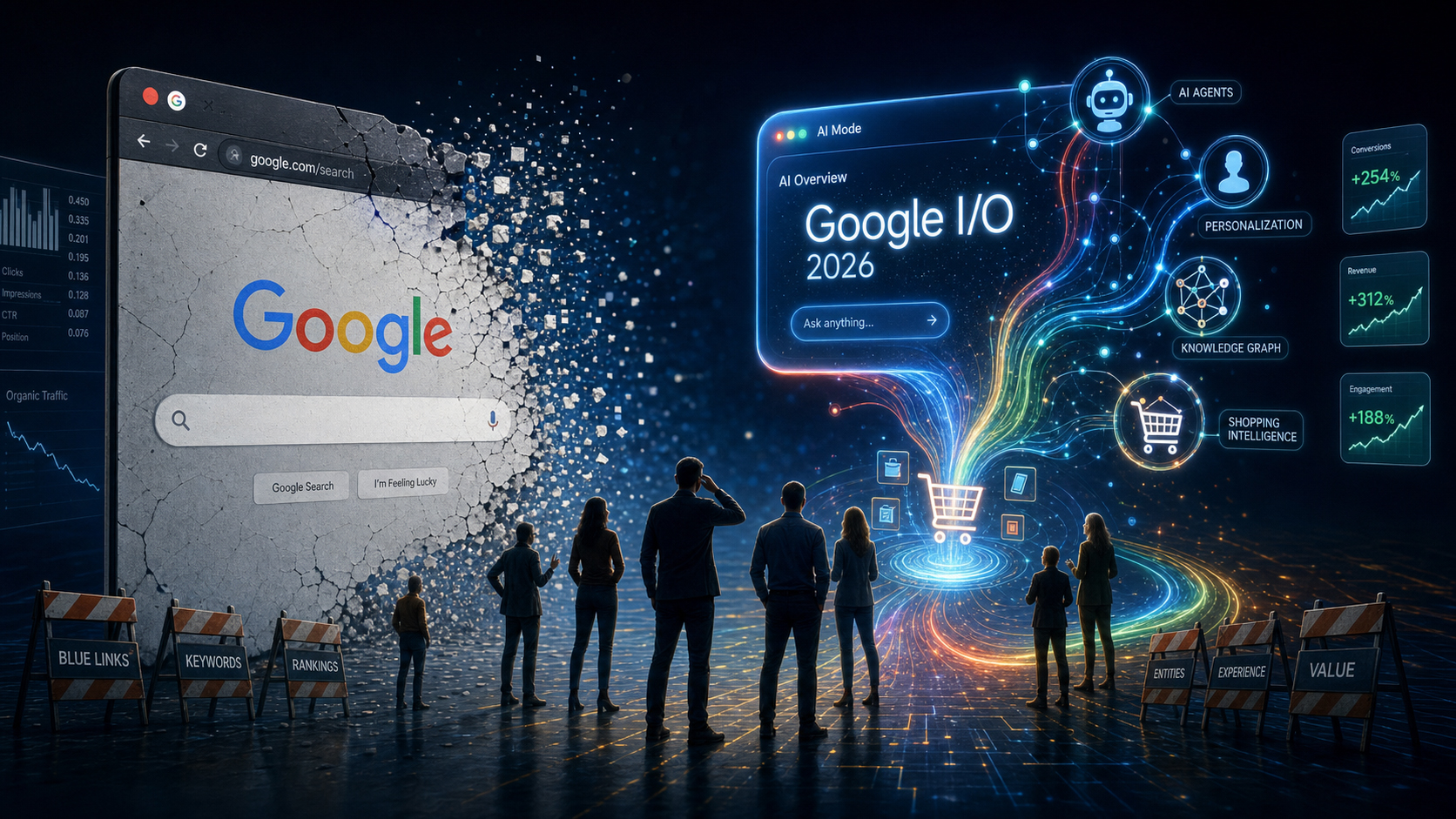
Google I/O 2026: The end of traditional search and what comes next – When the algorithm no longer searches, but decides – Image: Xpert.Digital
The end of blue links: How Google's "Generative UI" is changing the internet forever
The Economics of Invisibility: Google's Secret Master Plan for Your Business
AI as a margin killer: How Google's new "Universal Cart" threatens small and medium-sized businesses
Google I/O 2026 marks a historic turning point: The classic search engine, as we've known it for over a quarter of a century, is being systematically phased out. It will be replaced by an AI-driven infrastructure in which autonomous agents will no longer just filter information, but will independently make decisions, compare prices, and make purchases. For millions of website operators, publishers, and small and medium-sized enterprises (SMEs), this development is akin to a tectonic shift. Traffic drops of up to 40 percent due to the so-called "zero-click" phenomenon are just the beginning. When the open web disappears as a sales channel and is replaced by Google's new "Generative UI" and the cross-platform "Universal Cart," traditional SEO will lose its effectiveness. The following article analyzes the new economy of invisibility—and shows which concrete strategies, such as Generative Engine Optimization (GEO) and the expansion of direct customer relationships, companies must now adopt to survive in the new era of AI agents.
Related to this:

SEO was yesterday: Why you urgently need to focus on Generative Engine Optimization (GEO) now
Google I/O 2026: Why the search box is disappearing and autonomous agents now dominate the web
On May 19, 2026, at its I/O developer conference in Mountain View, Google presented a package of announcements that went far beyond the usual incremental updates. What was presented on stage as technological progress is, in its economic impact, a paradigm shift: Google is systematically transforming the open web as a distribution channel – with direct consequences for millions of companies, website operators, and SEO professionals worldwide. Sundar Pichai himself described this development as the beginning of the "Agentic Gemini Era," in which AI systems no longer merely respond to queries but independently plan, act, and execute transactions. This phrase is not a marketing slogan. It is a structural policy statement.
What was on stage: The product architecture of the new Google world
Those who view I/O 2026 merely as a product showcase are missing the crucial point. Behind the individual announcements lies a coherent infrastructure logic: Google is building a complete layer between the user and the content.
Intelligent search interface: The biggest redesign in a quarter of a century
The search box – virtually unchanged for over 25 years – is undergoing a fundamental redesign. It expands dynamically, allows for long, complex queries, and accepts not only text but also images, files, videos, and Chrome tabs as input. At the same time, the new autocomplete feature goes far beyond previous suggestions: it anticipates user intent and actively helps formulate questions. Liz Reid, head of Google's search business, openly described it as "the biggest upgrade to our iconic search box since its debut over 25 years ago." The technical foundation is Gemini 3.5 Flash – which Google says is four times faster than comparable Frontier models and available at less than half the cost.
Generative UI: The search results page as a real-time application
Even more disruptive than the new search interface is the introduction of the so-called Generative UI. Search can now generate customized layouts, interactive visualizations, simulations, tables, and charts in real time – directly as an answer to a search query. Someone asking how a clockwork mechanism works will no longer receive a list of links, but an interactive animation. Someone wanting to build a fitness tracker will receive a fully functional mini-application with real-time data from the web. According to Google, this Generative UI will be rolled out to all users free of charge in the summer of 2026. The implications for website operators are profound: their content will no longer be linked – it will be integrated into a new interface that the user never leaves.
Information agents: Permanent background surveillance
With its "Information Agents," Google is introducing a new class of AI tools that scour the web around the clock in the background. Users can create precise search profiles—for example, searching for an apartment with specific features, a stock price correction, or the next sneaker drop by a favorite artist—and will be automatically notified when relevant events occur. These agents are not a passive function. They fundamentally streamline search behavior: users no longer search; they delegate the search. This eliminates the need for regular, active visits to information sources, which have traditionally been the most important traffic driver for publishers and information providers.
Universal Cart and Agentic Commerce: The AI Agent as a Buyer
The most commercially far-reaching product at I/O 2026 is the Universal Cart. It works across platforms in Google Search, the Gemini app, YouTube, and Gmail – products can be added directly to a shared shopping cart from any of these services. This cart operates in the background: it monitors prices, reports on deals, and warns of product incompatibilities. The underlying Universal Commerce Protocol (UCP) – developed jointly with Shopify, Etsy, Wayfair, Target, and Walmart, and supported by Mastercard, Visa, PayPal, Stripe, Zalando, and over 20 other companies – creates a standardized communication layer between AI agents, merchant systems, and payment providers. The Agentic Commerce Protocol (AP2) ultimately enables AI agents to independently process payments within the user's defined parameters. The user specifies once which brands and products they prefer and up to what price a purchase may be triggered automatically. The agent takes care of the rest.
Gemini Spark, Antigravity and the new infrastructure layer
Alongside its search engine, Google is introducing Gemini Spark, a personal AI agent that runs continuously in the background on dedicated Google Cloud servers. It organizes files, schedules meetings, monitors email inboxes, and explicitly obtains user consent before critical actions. The technical foundation is Antigravity 2.0 – an agent-first development platform that, in a live test, coordinated 93 sub-agents to write a complete operating system within twelve hours. This is complemented by first-generation Google Glass with Gemini integration (developed jointly with Warby Parker, Gentle Monster, and Samsung), Gemini Omni for multimodal video and image generation, and SynthID with Content Credentials, which has now tagged more than 100 billion AI-generated images and videos.
The Economics of Invisibility: What Zero-Click Means for Businesses
The core economic problem for companies that rely on Google traffic can be summarized in two figures: Since Google AI Overviews were introduced in Germany in March 2025, websites in German-speaking countries have seen an average decline in clicks of 17.8 percent – with some sites experiencing losses of up to 40 percent. Despite increased visibility in the AI Overviews, Apotheken Umschau (a German pharmacy magazine) lost around a third of its traffic. Large US media companies have lost approximately half of their organic search traffic over the past three years.
These figures reflect the introduction of AI Overviews—a feature that is still relatively limited compared to Generative UI and information agents. A study by Ahrefs measured a 58 percent drop in the click-through rate (CTR) to the top organic result for search queries with AI Overviews. Pew Research documented a click-through rate of 8 percent with AI Overviews versus 15 percent without—a relative decrease of approximately 47 percent. Seer Interactive tracks the longest time series and documents a decline in CTR from 1.76 percent to 0.61 percent—with a possible stabilization in early 2026.
The structural displacement of the click
The fundamental problem is not technical, but logical: if an AI answers a question completely, the incentive to click disappears. The model on which the entire ad-supported web is based—the user arrives at the website, sees an ad, buys a product—loses its central mechanism. Generative UI dramatically accelerates this process because it no longer just handles simple informational questions, but allows complex planning tasks, product comparisons, and purchasing decisions to be handled entirely within the Google interface. The classic organic search results list with ten blue links is already obsolete in many segments—it still exists, but plays an increasingly marginal role.
SMEs caught in the price comparison whirl: The universal cart as a margin killer
For small and medium-sized enterprises (SMEs), the Universal Cart is perhaps the most dangerous single development presented at I/O 2026. This AI system automatically searches for the lowest prices and special offers for all items in the shopping cart. It checks compatibilities, suggests alternatives, and compares prices across all participating retailers. What means convenience for consumers translates into constant price pressure for SMEs: those who don't offer the lowest price are simply ignored by the agent – without the customer actively deciding or even noticing. Brand building, building trust, and local customer loyalty are all diminished by algorithmic price optimization when the agent automatically selects the cheapest provider before every purchase. European, and especially German-speaking, SMEs are thus competing directly against EU-wide and global providers, without geographical proximity offering any advantage. This effect is particularly painful for Swiss and Austrian SMEs, which traditionally rely on local customer loyalty.
🎯🎯🎯 Data-driven B2B industry hub as a quasi-in-house solution

The quasi-in-house solution: How Xpert.Digital closes operational gaps in B2B marketing and sales – Smart Content-Driven Business - Image: Xpert.Digital
Xpert.Digital is a data-driven B2B industry hub led by Konrad Wolfenstein . The company acts as an external, quasi-in-house solution for industrial partners, closing operational gaps in marketing, content, and sales – without requiring additional resources on the client side.
More information here:
How Google agents are rewriting the digital visibility game — and what companies need to do now
Data sovereignty in the era of agents
US infrastructure as a structural dependency
Each of the described services runs on US infrastructure. Gemini Spark runs on dedicated Google Cloud servers. The Universal Cart aggregates purchase intentions, price negotiations, and payment transactions on Google servers. Information agents continuously collect data about users' preferences and interests. What is searched for, purchased, and compared via online shops ends up in Google's infrastructure—and thus under the jurisdiction of the US CLOUD Act, which, under certain conditions, can grant US authorities access to data stored worldwide by US companies. This is not a theoretical risk, but a structural governance problem that the GDPR does not fully resolve.
EU AI Act and GDPR: The regulatory counterpart
The European Union is responding to this development with the EU AI Act, which will fully come into force on August 2, 2026. High-risk AI systems will then have to meet strict requirements – yet, according to current figures, over half of German companies have not even created a complete AI inventory. The tension is obvious: On the one hand, a US platform is rapidly rolling out AI agents into all areas of life. On the other hand, a European regulatory system imposes strict transparency and documentation obligations on high-risk AI systems. AI agents that independently make purchasing decisions and authorize payments are likely to fall into the highest risk category – whether Google has already taken this into account in its architecture remains to be seen.
What legal action publishers can take
The media industry has not remained passive. The Alliance of Media and Digital Industries filed a complaint with the German Federal Network Agency in September 2025. The Independent Publishers Alliance appealed to the European Commission. In the US, Penske Media Corporation (Rolling Stone, Billboard) sued Google. The central argument: Google is using its dominant market position to utilize publisher content for AI-generated results without paying adequate compensation – and publishers cannot object without risking their visibility in traditional search results. A regulatory resolution to this dilemma is significantly more likely in Europe than in the US – the only question is whether it will come quickly enough.
SEO in structural change: What still works
From keyword optimization to mandatory structured data
SEO isn't dead, but the rules of the game have fundamentally changed. AI agents don't read persuasive advertising copy—they process structured data. Schema markup, clean pricing data, availability information, product specifications—these are the signals that determine whether a brand even appears in the agent ecosystem. Those who don't deliver clean, structured data are eliminated from the comparison before a user has even had a chance to decide for or against a provider. AI Mode has reached over one billion monthly users within a year of its launch, with queries more than doubling quarterly since then. At the same time, the total number of Google searches reached an all-time high last quarter—an apparent contradiction that resolves itself when you understand: there's more searching, but fewer clicking.
Generative Engine Optimization: The new discipline
The new discipline that needs to emerge is Generative Engine Optimization (GEO): the targeted optimization of content and data structures for processing by AI systems, not just for traditional algorithms. This requires different skills: instead of keyword density and backlink profiles, semantic precision, structural uniqueness, data completeness, and the quality of source references now count. Agent search favors content from which AI systems can directly extract information—not content optimized for human readability. For many SEO agencies, this represents a reinvention of their core business.
Direct channels as a strategic survival strategy
The conclusion from these developments is clear: those who want to survive in the long term must actively reduce their dependence on Google traffic. According to available data, Focus Online generates over 70 percent of its page views through direct access to its website or app – a model that enables stability despite declining search traffic rates. Newsletters with registered users, community formats, premium content with genuine uniqueness – such as local reporting, investigative journalism, and in-depth analysis – as well as proprietary AI-powered services are the paths leading out of Google dependence. Cloudflare is developing a marketplace where publishers can individually control AI crawlers and charge fees. TollBit enables digital toll booths for AI access. These are initial steps toward post-Google monetization – but structurally still far from compensating for the losses incurred.
Technological mega-architecture and its price
Google's infrastructure investment as a power signal
What's particularly striking about I/O 2026 is the sheer scale of the investments. Alphabet plans to spend around $190 billion on capital expenditures in 2026 – compared to $31 billion in 2022. The majority of this is going into data centers and its own AI chips (Tensor Processing Units), the eighth generation of which – TPU 8t for training and TPU 8i for inference – was unveiled at I/O. Google says it processes around 3.2 quadrillion tokens per month. Its APIs process approximately 19 billion tokens per minute. These figures aren't marketing statistics – they're an indication of the technological barrier to entry that Google has erected for competitors. According to Gartner, global AI spending will reach €2.59 trillion in 2026 – a 47 percent increase year-over-year, with over €1.4 trillion earmarked for infrastructure alone.
SynthID and Content Credentials: Regulatory Policy through Infrastructure
An often overlooked strategic dimension of I/O 2026 is the expansion of SynthID and C2PA Content Credentials. SynthID has now tagged over 100 billion pieces of AI-generated content. OpenAI, Eleven Labs, and Kakao have committed to integrating SynthID into their own systems. Google is thus effectively creating a global standard for AI content authentication—and positioning itself as the guardian of authenticity in the digital information space. This is not a philanthropic gesture. It is platform politics: Whoever controls the infrastructure for verifying authenticity also controls information sovereignty in the medium term.
Strategic options for action: What companies can do now
The selection of strategic responses to Google I/O 2026 is real – and is becoming increasingly urgent as the rollout progresses.
First: Prioritize structural data immediately. Schema.org markup for products, services, local businesses, prices, and availability is no longer an optional SEO measure – it is the fundamental requirement for AI agents to be able to identify and recommend a brand at all.
Second: Evaluate UCP compatibility. The Universal Commerce Protocol is designed as an open standard and doesn't necessarily bind companies to Google. At the same time, adopting UCP is the entry ticket to the agentic commerce ecosystem. For merchants who want to remain visible via Google Commerce, integration is unavoidable in the medium term. The question isn't whether, but under what conditions.
Third: Treat direct customer relationships as a strategic asset. Newsletter subscribers, app users, registered customer accounts – these are the only touchpoints that function without intermediaries. Every investment in this channel now has a structural added value that didn't exist a year ago.
Fourth: Actively assess data privacy risks. Anyone processing customer data via Google services – be it Shopping, Search Agents, or Workspace – must reassess the GDPR compliance and CLOUD Act exposure of their setup. This is not purely a legal question, but a strategic one: Customers in Germany and Austria will increasingly consider data sovereignty as a purchasing factor.
Fifth: Focus your content strategy on depth and uniqueness. What AI systems cannot easily replicate is local expertise, proprietary data, personal perspectives, and unique access to primary sources. Generic informational content is being replaced by generative UI. Specific, in-depth, and source-based content remains attractive as a citation basis for AI systems—and thus as a source of referral traffic.
A final assessment: Google's silent monopoly is growing
Google I/O 2026 is not a search engine update. It's the announcement of a new commercial infrastructure in which Google positions itself between users and providers – with AI as the intermediary layer. This layer controls which brands are visible, which prices are compared, which content is displayed, and which transactions are executed. Those not present in this layer are economically invisible – without the user having actively chosen this.
The user numbers speak for themselves: AI Overviews has 2.5 billion monthly active users, AI Mode has surpassed the one billion mark, and the Gemini app has grown from 400 million to 900 million users. Google is not about to lose its market dominance – it is rebuilding it into a new layer of infrastructure that is even harder to circumvent than the classic search engine.
For businesses, especially small and medium-sized enterprises (SMEs) in Germany, Austria, and Switzerland, this represents a historic crossroads. The reflex to pour even more SEO budget into outdated mechanisms is becoming increasingly counterproductive. Building alternative channels, structured data pipelines, and direct customer relationships is not a defensive reaction—it is the only offensive strategy that still has any impact in a Google-dominated AI infrastructure.
The open web as a sales channel, where visibility was achieved through quality and optimization, is undergoing structural and permanent change. What comes next is not a better web. It is a different one – one in which platform access is the new currency.
Your global marketing and business development partner
☑️ Our business language is English or German
☑️ NEW: Correspondence in your native language!

Konrad Wolfenstein
I and my team are happy to be available to you as your personal advisor.
You can contact me by filling out the contact form here simply call me at +49 7348 4088 965. My email address is [email protected]:or
I'm looking forward to our joint project.
☑️ SME support in strategy, consulting, planning and implementation
☑️ Creation or realignment of the digital strategy and digitization
☑️ Expansion and optimization of international sales processes
☑️ Global & Digital B2B trading platforms
☑️ Pioneer Business Development / Marketing / PR / Trade Fairs
B2B support and SaaS for SEO and GEO (AI search) combined: The all-in-one solution for B2B companies

B2B support and SaaS for SEO and GEO (AI search) combined: The all-in-one solution for B2B companies - Image: Xpert.Digital
AI search changes everything: How this SaaS solution will revolutionize your B2B ranking forever.
The digital landscape for B2B companies is undergoing rapid change. Driven by artificial intelligence, the rules of online visibility are being rewritten. For companies, it has always been a challenge not only to be visible in the digital mass, but also to be relevant to the right decision-makers. Traditional SEO strategies and managing local presence (geo-marketing) are complex, time-consuming, and often a battle against constantly changing algorithms and intense competition.
But what if there were a solution that not only simplified this process but also made it smarter, more predictive, and far more effective? This is where the combination of specialized B2B support with a powerful SaaS (Software as a Service) platform comes into play, specifically designed for the demands of SEO and GEO in the age of AI search.
This new generation of tools no longer relies solely on manual keyword analysis and backlink strategies. Instead, it leverages artificial intelligence to more accurately understand search intent, automatically optimize local ranking factors, and conduct real-time competitive analysis. The result is a proactive, data-driven strategy that gives B2B companies a decisive advantage: they are not only found, but perceived as the leading authority in their niche and location.
Here's the symbiosis of B2B support and AI-powered SaaS technology that transforms SEO and GEO marketing, and how your company can benefit from it to grow sustainably in the digital space.
More information here: