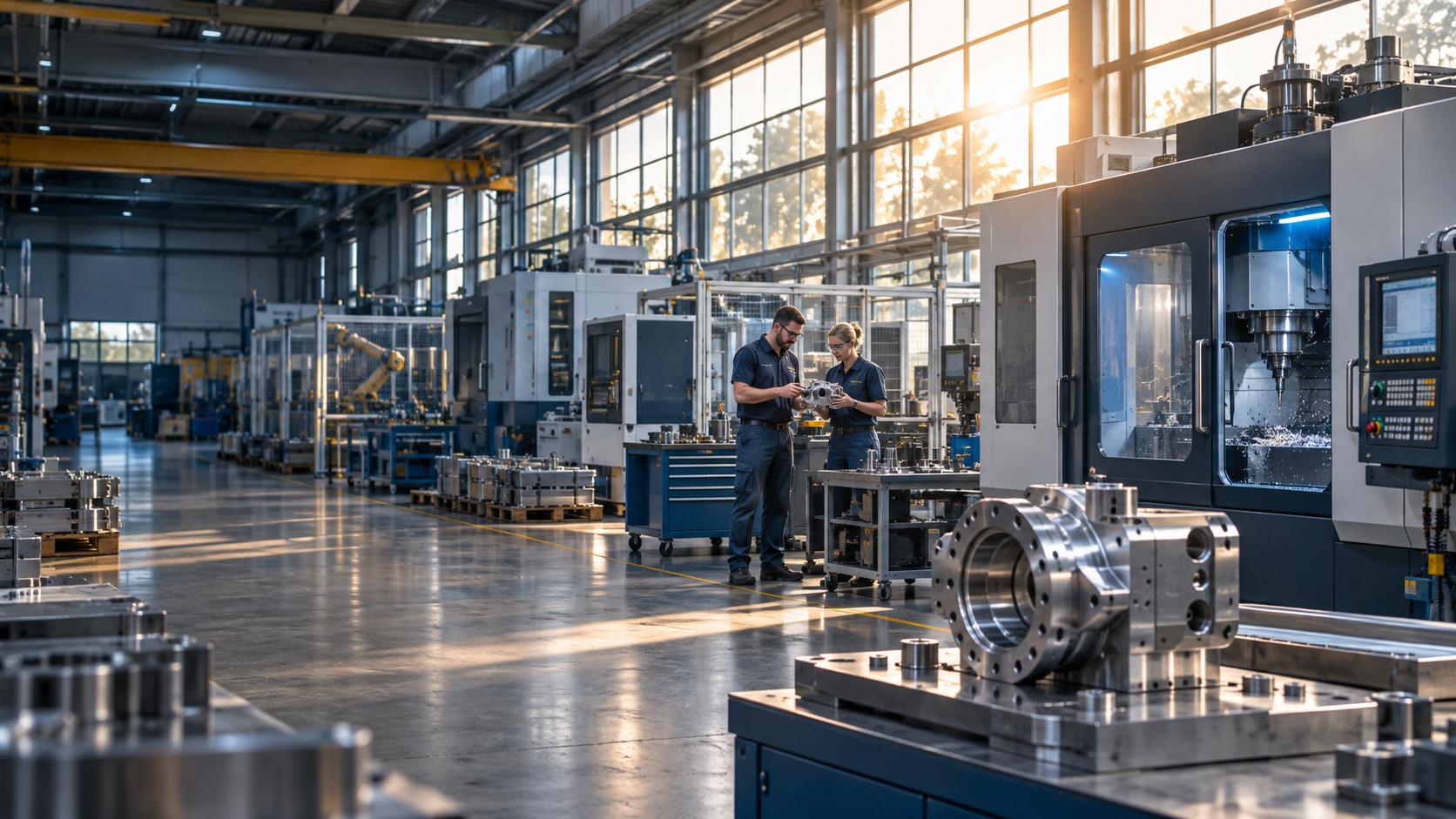
Germany's SMEs between growth elite and location crisis: It's not the economy that's defeated – the successful ones play by different rules – Creative image on the topic, with AI: Xpert.Digital
Germany's SMEs in crisis? These companies are still growing strongly
17.2 percent revenue growth: What Germany's most successful medium-sized companies do differently
Mechanical engineering sector remains strong despite investment slump: What the figures reveal about medium-sized businesses
Germany's economy is under pressure: Weak demand, high costs, and subdued investment activity are weighing on many companies. At the same time, a select group of medium-sized businesses is growing strongly and achieving high operating margins. The key figures are remarkable: The 100 companies in this top group recorded average annual revenue growth of 17.2 percent and an average EBIT margin of 18.1 percent. This is based on a selection of more than 8,000 German medium-sized companies with annual revenues between ten million and one billion euros.
However, this track record of success is no proof that the location problems have been overcome. A small leading group does not represent the entire Mittelstand (SME sector) – and good results in themselves do not reveal how sustainable they are or what led to them. Rather, the figures show that companies within the same economy can develop very differently. Crucial factors include their markets, business models, and whether they create irreplaceable value for their customers. A closer look reveals what can actually be deduced from the results – and where their significance ends.
Germany's economy is faltering – these medium-sized companies show where growth is still possible
Germany's economic weakness and the success of individual medium-sized companies are not contradictory. Rather, they demonstrate how differently companies can develop within the same economy. While some businesses suffer from weak demand, high costs, and a reluctance to invest, others are opening up new markets, increasing their added value, and achieving exceptional results. The crucial question, therefore, is not whether the Mittelstand (SMEs) is strong or weak. It is which business models, under which conditions, can combine growth and profitability.
The key figures presented here for a top group of 100 companies are remarkable: an average annual revenue growth of 17.2 percent and an average EBIT margin of 18.1 percent. The analysis is based on a selection of more than 8,000 German medium-sized companies with annual revenues between ten million and one billion euros. Revenue growth and operating profitability each contribute equally to the evaluation. The financial data considered spans from 2021 to the respective available financial statements for 2024 and 2025.
These findings warrant attention, but not a premature all-clear for the economic situation. A leading economic group is neither a representative cross-section of small and medium-sized enterprises (SMEs) nor a reliable leading indicator for the entire economy. However, it can reveal which forms of entrepreneurial value creation remain viable even under difficult conditions.
The most convincing perspective therefore lies between two exaggerations. Neither is the entire German Mittelstand (SME sector) in decline, nor can structural location problems be refuted by a few exceptionally successful companies. In fact, both developments can occur simultaneously: A high-performing corporate elite expands its position, while conditions deteriorate for a significant portion of the rest of the economy.
The crucial dividing line runs through the companies, not between optimists and pessimists
Macroeconomic indicators condense millions of economic decisions into a few key figures. While indispensable, they mask differences between industries, markets, and business models. A company primarily supplying German construction firms operates in a different demand environment than a specialist supplier of international production equipment. Both may belong to the industrial SME sector, yet their economic prospects can diverge significantly.
Furthermore, a company's headquarters says little about where the demand originates. A company can concentrate its development and administration in Germany but sell the majority of its products abroad. Its revenues then depend not only on German investment decisions but also on the economic performance of numerous sales markets.
Even within a single industry, significant differences exist. A manufacturer of interchangeable standard components faces competitive pressure, among other things, compared to a supplier whose technology enables a critical production step. The former may compete primarily on price and delivery capacity. The latter can additionally differentiate itself through process expertise, reliability, certifications, or technical performance.
Entrepreneurial success therefore arises from the interplay of market conditions and company-specific capabilities. A good strategy does not eliminate weak demand. However, it can influence which demand weaknesses a company is exposed to, how strongly it needs to react to them, and what alternatives are available to it.
This is precisely where the analytical value of the growth peak lies: it does not make the economic cycle meaningless, but rather reveals the differences between business models.
What the peak values actually measure – and what questions remain unanswered
The relationship between growth and EBIT margin is more meaningful than a simple revenue ranking. A company can increase its revenue through aggressive price reductions, high sales expenses, or economically problematic acquisitions. Growth alone, therefore, does not prove value creation. Conversely, a high margin can occur with stagnant sales if a company is relying on its existing market position but neglecting its future viability.
The equal weighting of both factors is intended to limit these biases. It favors companies that expand their business activities while remaining operationally profitable. This is a sensible starting point, but not a complete judgment of a company.
EBIT stands for earnings before interest and taxes. An EBIT margin of 18.1 percent means, simply put, that for every €100 of revenue, an average of €18.10 remains as operating profit. However, this does not directly indicate how much money is available for dividends, debt repayment, or additional investments.
Further information is needed: What is the level of debt? How much capital is tied up in inventories and receivables? What replacement investments are planned? How capital-intensive is the business model? And how heavily do the results depend on individual large orders?
Even the averages themselves require caution. Without information on the distribution, it remains unclear whether most companies achieve similar results or whether individual outliers significantly skew the average. Equally important is whether company values are weighted equally or aggregated according to revenue size. An average of successful companies is not automatically the margin of their combined business.
The figures thus demonstrate the exceptional performance of the selected group. However, they neither fully explain the reasons for this nor guarantee its continued success.
Why a top selection is not a health certificate for the entire middle class
With an initial sample size of over 8,000 businesses, 100 companies represent less than 1.25 percent of the companies surveyed. The analysis therefore focuses on a small, top-performing segment. This is precisely what makes it interesting – and precisely why it is not suitable as a direct description of the overall situation.
When companies are selected based on growth and profitability, high scores within the selected group are initially a consequence of the selection process itself. This does not diminish the companies' achievements. However, it does change the conclusion: The figures show that exceptional success is possible. They do not show how likely this success is for an average company.
A comprehensive assessment would therefore require comparative data. How are sales, profits, investments, and employment developing across the entire group of companies under investigation? How large is the gap between the top performers and the middle performers? And is this gap widening?
A widening gap could indicate several developments. Successful providers may be gaining market share from weaker competitors. Capital and skilled labor are concentrating on particularly attractive companies. Or individual sectors are benefiting from exceptional economic periods while others are experiencing structural decline.
Furthermore, the revenue range used is not identical to all common definitions of medium-sized businesses. It encompasses very different company sizes and excludes smaller businesses. Ownership, family control, and long-term company loyalty cannot be derived from revenue alone.
The economic policy challenge, therefore, lies in understanding the strength of the top without making the burdens on the rest of the business landscape invisible.
17.2 percent growth: Impressive, but incomplete without further analysis
An annual revenue growth of 17.2 percent is substantial. However, to assess its economic quality, it is necessary to understand how it was achieved. Generally, higher sales volumes, increased selling prices, a changed product mix, exchange rate effects, and company acquisitions can all contribute to increased revenue.
These growth components have different meanings. If a company sells significantly more products to additional customers, this indicates a growing market position. Conversely, if revenue increases primarily due to higher prices, the actual business expansion may be considerably smaller. When competitors are acquired, the corporate group grows without generating a corresponding increase in demand.
Especially when considering a period starting in 2021, the initial situation is also important. Following exceptional disruptions, catch-up effects can occur. Orders are delivered later, supply chains normalize, and postponed investments are implemented. Part of the growth can then represent a recovery from a previously impaired starting point.
This is not worthless. Those who capitalize on a recovery better than their competitors demonstrate operational strength. Nevertheless, such an effect differs from a sustained increase in market potential.
The precise calculation of annual growth is also relevant. The average of individual annual growth rates is not the same as the average annual growth rate calculated over the entire period. With highly fluctuating sales, the two figures can differ significantly.
A reliable analysis would therefore consider nominal and real growth, organic expansion and acquisitions, as well as volume and price effects separately. Only this breakdown reveals how much of the reported success is based on a sustainably stronger competitive position.
High operating margins only translate into economic strength through capital discipline
An EBIT margin of 18.1 percent generally opens up room for maneuver. A profitable company is more likely to be able to invest from its own resources, cushion setbacks, and develop new business areas. However, the actual scope depends on how much capital the business model ties up and what financial obligations exist.
A simplified example illustrates the difference: Two companies generate the same revenue and operating margin. One requires extensive production facilities, large inventories, and long payment terms. The other operates with minimal fixed assets and receives early customer payments. Despite identical EBIT margins, the financing burden and return on capital differ significantly.
Therefore, operating margin, return on capital, and free cash flow should be considered together. A high margin can be achieved through high capital investment. Conversely, a company with a lower margin can be economically attractive if it uses its capital very efficiently.
Growth can also strain liquidity. Additional orders require materials, personnel, and upfront financing. Receivables increase before customer payments are received. Especially with long production cycles, a rapidly growing company can therefore be both profitable and financially strained at the same time.
Furthermore, the quality of how the results are generated must be considered. Sustained high margins should be evaluated differently than temporary advantages from favorable procurement conditions, exceptionally high capacity utilization, or delayed price adjustments.
The crucial economic question is therefore not just how much operating profit is generated. It is how reliably this profit translates into financial flexibility and whether the resources used generate an appropriate return.
The mechanical engineering sector is disproving its own reputation for crisis – but not its problems
With 29 companies, the mechanical engineering sector represents a particularly large share of the top-performing group. Compared to the previous 23 companies, this represents an increase of six companies, or six percentage points, within the top 100. This ensures the continued strong presence of an industry often associated primarily with weak investment, order problems, and international competitive pressure.
This finding is significant, but must be interpreted precisely. It shows that numerous mechanical engineering companies are among the fastest-growing and most profitable medium-sized enterprises. It does not prove that the entire mechanical engineering sector is developing similarly or that its average business model has become crisis-proof.
The actual relative success also depends on the industry share within the initial group. Without this comparison, it is impossible to definitively assess how overrepresented the mechanical engineering sector is among the top companies.
The fact that successful specialists and a challenging industry environment can coexist is demonstrated by the investment demand. In Germany, investment in equipment was down 5.5 percent in 2024, adjusted for inflation; for machinery and equipment, the decline was 6.7 percent. Such a development puts a strain on industrial sales, but does not affect all suppliers equally.
A company can grow despite weak domestic demand if its customers invest abroad, if it gains market share, or if its facilities solve particularly urgent problems. Its economic strength then lies less in the general label of mechanical engineering than in the specific function of the product.
The crucial question is whether the machine merely creates additional capacity for the customer, or whether it reduces costs, quality risks, energy consumption and staffing shortages so significantly that its purchase pays off even under difficult conditions.
Specialization creates pricing power when it solves an expensive customer problem
Specialization is one of the plausible explanations for the success of many medium-sized companies. However, its economic impact is not automatic. A narrow product range alone does not constitute a competitive advantage. Specialization becomes attractive when it generates capabilities that are valuable to customers and difficult for competitors to replicate.
This can include a deep understanding of specific manufacturing processes. Equally relevant can be specialized material knowledge, precise control technology, high reliability, or many years of application experience. The supplier then not only sells a product, but also alleviates an economic problem for their customer.
This changes the pricing logic. If a component represents only a small share of the total costs of a plant, but its failure causes significant production losses, the lowest purchase price is not necessarily the deciding factor. Reliability, availability, and proven performance can carry more economic weight.
This situation can give rise to pricing power. It is not based on arbitrary pricing, but on a comprehensible relationship between product price and customer benefit.
However, specialization has a downside. Companies heavily reliant on a single application, technology, or a few major customers face the risk of market concentration. A technological shift can devalue a previously attractive niche. A key customer might change their procurement practices or take over certain services themselves.
The robust approach, therefore, is not maximum narrowing of focus. It consists of a clear core competency that can be applied to multiple customers, regions, and, ideally, related applications. Successful specialization combines in-depth expertise with economic agility.
Our EU and German expertise in business development, sales and marketing


Our EU and German expertise in business development, sales and marketing - Image: Xpert.Digital
Industry focus areas: B2B, digitalization (from AI to XR), mechanical engineering, logistics, renewable energies and industry
More information here:
A thematic hub offering insights and expertise:
- Knowledge platform covering global and regional economies, innovation and industry-specific trends
- A collection of analyses, insights, and background information from our key areas of focus
- A place for expertise and information on current developments in business and technology
- A hub for companies seeking information on markets, digitalization, and industry innovations
Specialization as the key to growth
Internationalization protects against national weakness and creates new dependencies
International sales markets can explain why companies headquartered in Germany continue to grow even during a weak German economy. They distribute their demand across different economies, investment cycles, and customer industries. This opens up opportunities that a company focused solely on the domestic market does not have.
Internationalization is more than just exporting. With increasing market presence, local sales organizations, service capacities, spare parts warehouses, or production sites may become necessary. Customers expect short response times, technical support, and reliable availability. A supplier must therefore decide which parts of its value chain should remain centralized and which should be shifted closer to the sales market.
These decisions alter the risk profile. Exchange rates, trade barriers, political conflicts, and differing regulatory requirements are gaining in importance. Therefore, high international sales alone are not proof of resilience.
The key is risk diversification. Companies that generate a large portion of their business in a single foreign market may have merely shifted their dependence geographically. True diversification only occurs when sales, customer structure, and supply chains are not simultaneously exposed to the same disruptions.
For Germany, this leads to an important distinction: The success of a company headquartered in Germany does not automatically translate into additional domestic production. A group can expand globally while its production or employment share in Germany declines.
The assessment must therefore distinguish between two levels. From a business perspective, an international location decision can be advantageous. From a macroeconomic perspective, it remains to be examined which functions, investments, and value-added shares will remain permanently within the country.
Customer proximity only becomes valuable when it enables better decisions
Customer proximity is often described as a strength of medium-sized businesses. However, it only becomes economically relevant when it leads to better products, faster problem solving, or more resilient business relationships.
A company that has a thorough understanding of its customers' processes can identify investment needs earlier. It may have a better grasp of which machine malfunctions are particularly costly, which quality requirements cause difficulties, or which operating problems increase personnel costs. This knowledge can lead to solutions for which customers are willing to accept a more economical price.
This relationship becomes particularly valuable when insights from individual projects are transferred into standardized products. This creates a scaling effect: The company learns from concrete applications but doesn't have to develop every solution from scratch.
This is also where a typical limit lies. Too much customer-specific custom development can increase complexity, tie up development resources, and strain margins. A high order volume may then mask the fact that too many variants are being produced with too little reuse.
The challenging task is to combine customer proximity with industrial repeatability. Modular product architectures, common technical platforms, and clearly defined customization options can help achieve this.
Digital services also fit into this logic. Maintenance information, condition monitoring, or process analyses can increase customer value. However, they are only economically convincing if they solve specific problems and justify their ongoing provision costs through corresponding revenues or stronger customer loyalty.
Not every digital add-on constitutes a viable business model. The crucial factor remains whether it generates measurable improvements.
Acquisitions can accelerate growth – and obscure its quality
In rapidly growing companies, a distinction must always be made between organic expansion and acquired revenue. Both can be beneficial, but they follow different economic mechanisms.
Organic growth arises from within the existing company, for example through additional customers, new products, or greater market penetration. Acquisition-related growth results from the purchase of other companies. An acquisition can accelerate access to technologies, skilled workers, customer relationships, and regional markets.
This can create real competitive advantages. A specialist supplier expands its product portfolio, a corporate group closes gaps in service, or a manufacturer reaches a market that would take a long time to develop on its own.
However, additional revenue does not automatically equate to additional company value. Purchase price, financing, and integration are crucial. If the acquisition is overpriced, rising operating results can be accompanied by an insufficient return on invested capital.
The EBIT margin alone does not reflect all acquisition risks. Interest expenses are lower than EBIT. A heavily leveraged acquisition can therefore show an attractive operating margin while still reducing financial resilience.
Furthermore, there are integration tasks: IT systems must be merged, responsibilities clarified, and customer relationships maintained. Expected synergies do not arise automatically.
To assess the growth peak, it would therefore be particularly interesting to know how much of the revenue increase comes from existing business, what returns acquisitions generate, and whether debt remains sustainable in relation to profitability. Only this information distinguishes successful consolidation from mere expansion into larger companies.
49 new or returning companies demonstrate competition instead of perpetual dominance
The fact that 49 companies are new to the top 100 or returning after a hiatus highlights the shifts within the leading group. Nearly half the composition is changing. However, this does not automatically imply a crisis among the existing top companies or a complete upheaval in the SME sector.
A company can drop out of a ranking even if it remains financially sound. It may be growing more slowly, temporarily investing more, or being overtaken by other companies. Similarly, changes in data availability, varying levels of financial reporting, and shifts in the reporting period can all affect the ranking.
The high churn rate is nevertheless an important indicator: top positions are not permanently secure. Competitive advantages must be renewed. What is particularly profitable at one time can later come under price pressure. Competitors catch up technologically, customers change their requirements, or attractive markets draw in additional providers.
Therefore, repeated membership in a top group should be assessed differently than a single high ranking. However, continuity should not become an end in itself. A company can deliberately sacrifice short-term margins to develop a new business area.
Long-term quality is demonstrated by the ability to create value across different market phases. This includes sound finances, a product base capable of renewal, a sustainable customer base, and the willingness to evolve successful business models in a timely manner.
A ranking is therefore a snapshot of economic performance. It is not yet a company history.
Five East German companies do not explain an entire economic region
The fact that only five East German companies are among the top 100 is a striking finding. However, its interpretation requires a suitable benchmark. Without knowledge of the regional composition of the initial group studied, it is impossible to determine how underrepresented East Germany is.
Furthermore, a map of company headquarters primarily shows the geographical distribution of headquarters. It does not reflect the total regional production, employment, research, or value creation. A company headquartered in West Germany may operate significant sites in East Germany. Conversely, an East German headquarters may be linked to internationally distributed production.
The distinction is economically relevant because headquarters and production sites fulfill different functions. A headquarters can be the central hub for strategic decisions, financing, and overarching development functions. Production sites, on the other hand, may account for large portions of industrial employment and material value creation.
A reliable regional analysis would therefore require several levels of analysis: company headquarters, production sites, employee numbers, investments, research activities, and ownership structures. Only together do they provide a complete picture.
The minimum revenue threshold also influences visibility. A region with many smaller, innovative companies may appear weaker in a selection process with annual revenues starting at ten million euros than its technological dynamism would warrant.
The finding should therefore neither be downplayed nor overinterpreted. It provides an opportunity to examine the regional distribution of larger, independent corporate headquarters. It is not sufficient evidence for a generally low economic performance of East Germany.
Strategy changes the impact of the economy, but it does not replace it
The idea that a good strategy can fundamentally beat the economy contains a kernel of truth. Companies decide on their target markets, products, cost structures, and investments. They are not entirely at the mercy of economic developments.
However, the formula remains too simplistic as a general explanation. An outstanding company can come under pressure in a shrinking market. An averagely managed supplier can temporarily benefit from a surge in demand. Observed success therefore always includes influences that lie outside the company's direct control.
Furthermore, there is a methodological problem: It is not easy to deduce from a selection of successful companies which characteristics caused their success. Many companies can be specialized, international, and customer-focused without achieving comparable results.
To more reliably identify the causes of success, one would need to compare similar companies over a longer period. What differences existed before the growth? What role did industry developments, initial size, debt, and acquisitions play? And what measures actually preceded the improvement?
Nevertheless, one clear conclusion remains for business practice: Strategy is particularly valuable when it consciously manages dependencies and creates alternatives. A company cannot control the global economy. However, it can decide whether it remains overly dependent on a single customer, product, or region.
Strategic quality is therefore not demonstrated by the absence of external risks, but by a better handling of them.
The real test lies in today's investments
Short-term profitability and long-term competitiveness can coincide, but they don't have to. A company can temporarily increase its margin by limiting development spending, delaying staff expansion, or postponing necessary modernizations. This may improve the current bottom line, but it weakens the future foundation.
Conversely, high future expenditures can negatively impact current results and still be economically sound. New products, additional service capacities, more efficient production processes, and employee training require capital before they generate returns.
Therefore, a high operating margin should always be considered in conjunction with innovation performance. What new products are being developed? How is productivity changing? Are existing plants simply being operated or are they being strategically modernized? And is the company succeeding in retaining and developing relevant knowledge?
The overall economic context underscores the importance of these questions. A survey published in early 2025 put German business investment in the third quarter of 2024 at 6.5 percent below the level at the end of 2019. Private investment in equipment was even 10.5 percent lower. While this does not provide a complete picture of the current situation, it does demonstrate the weakness in investment over a significant portion of the period under consideration.
Successful companies can distinguish themselves precisely by continuing to invest despite a weak environment. However, whether this explains the observed peak values would need to be examined based on their actual investment data.
What matters is not the highest investment rate, but the quality of the use of capital.
Corporate strength and location quality must be considered together
The successes of individual medium-sized companies should not be used as an argument to dismiss location-related problems as unimportant. Companies operate under different conditions and have different resources to compensate for challenges. A highly specialized provider is better able to absorb higher costs than a company in a price-sensitive mass market.
It would be equally wrong to let entrepreneurial opportunities disappear behind general complaints about the location. Not every weak profitability is caused by external circumstances. Unclear positioning, inefficient processes, excessive product variety, or delayed adjustments can exacerbate problems.
A sound economic policy perspective must connect both levels. Companies need freedom and incentives to invest, innovate, and develop new markets. At the same time, they must design their business models in such a way that they remain viable even under changing conditions.
This does not mean that the state has a duty to emulate specific top-ranked companies or to permanently protect individual business models. More important are the conditions under which productive companies can grow: reliable infrastructure, functioning capital markets, suitable qualifications, and predictable regulations.
Competition is key. Economic renewal doesn't just come from strengthening existing leading companies. It also requires new providers, spin-offs, and the opportunity for better solutions to challenge established positions.
A high-performing location is therefore not defined by the fact that its most successful companies remain permanently unassailable. It is characterized by the emergence of new, high-performing companies and the ability of existing companies to further develop their capabilities.
The growth elite provides a model for renewal, not an acquittal for the status quo
The combination of 17.2 percent average annual revenue growth, an 18.1 percent EBIT margin, and a strong presence in the mechanical engineering sector is an encouraging sign. It shows that industrial and technological business models headquartered in Germany can generate significant profitability even under challenging economic conditions.
The crucial message, however, goes beyond the numbers. Success apparently doesn't stem solely from size or industry affiliation. Rather, business models that combine clear customer value with irreplaceable skills, international market access, and disciplined execution are more plausible. Which factors were decisive in each individual case remains to be examined separately.
Equally important are the limitations of this finding. A select group of top performers does not represent the entire SME sector. High revenue growth must be analyzed in terms of prices, volumes, and acquisitions. Operating margins require further analysis, including return on equity, cash flow, and debt. Company headquarters alone do not provide a comprehensive picture of regional economic strength. And a strong ranking position does not guarantee sustained competitiveness.
It is precisely these limitations that make the results economically interesting. They prevent real successes from becoming a convenient narrative.
Germany's strength in small and medium-sized enterprises (SMEs) does not lie in the fact that every company survives every crisis. It lies in the ability to transform knowledge into economic value and to continually develop new competitive advantages from it. This ability exists, but it is unevenly distributed and by no means a given.
The central task, therefore, is not to celebrate the growth elite as proof against the economic crisis. It is to understand their economic mechanisms, to take their limitations seriously, and to improve the conditions so that individual success stories can generate broader investment and innovation momentum.
🎯🎯🎯 Data-driven B2B industry hub as a quasi-in-house solution


The quasi-in-house solution: How Xpert.Digital closes operational gaps in B2B marketing and sales – Smart Content-Driven Business - Image: Xpert.Digital
Xpert.Digital is a data-driven B2B industry hub led by Konrad Wolfenstein . The company acts as an external, quasi-in-house solution for industrial partners, closing operational gaps in marketing, content, and sales – without requiring additional resources on the client side.
More information here:
Your global marketing and business development partner
☑️ Our business language is English or German
☑️ NEW: Correspondence in your native language!

Konrad Wolfenstein
I and my team are happy to be available to you as your personal advisor.
You can contact me by filling out the contact form here wolfenstein@xpert.digital:or simply call me at +49 7348 4088 965. My email address is
I'm looking forward to our joint project.