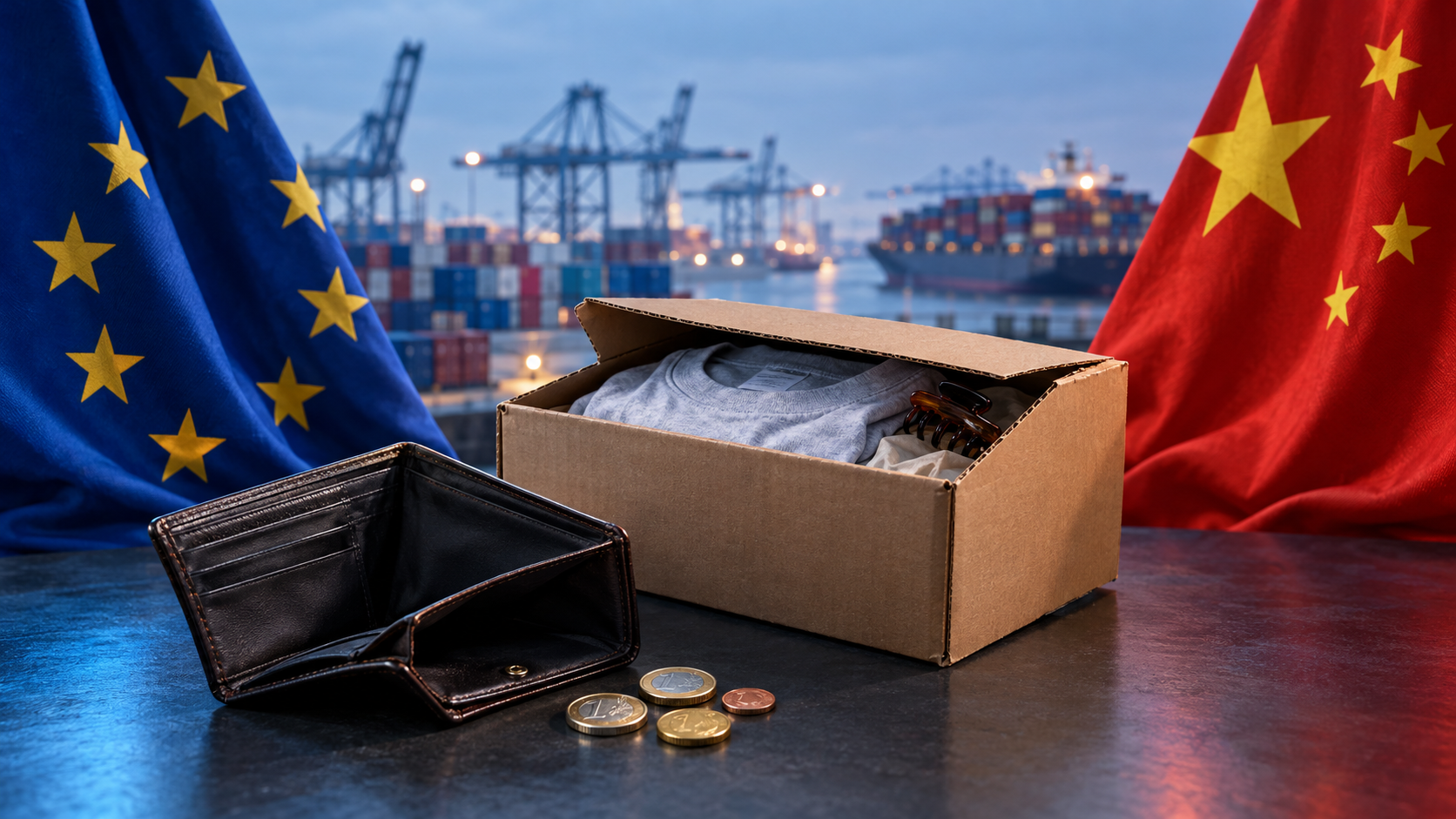
China delivers the bargains, Europe delivers the markups – and the citizen pays for both business models – Creative image on the topic, with AI: Xpert.Digital
New EU duties on small shipments: More product safety or simply higher prices?
Small shipments from China are becoming more expensive: What the new fees mean for consumers
Cheap direct orders from China could become significantly more expensive for consumers: Since July 1, 2026, a flat customs duty of three euros per product category applies to certain small shipments below the 150-euro threshold. Since November 1, 2026, a processing fee of two euros per item has been added. This fixed surcharge is particularly significant for very inexpensive products. For an item costing two euros, these fees can already considerably exceed the price of the goods.
“We are caught between the lesser of two evils: on the one hand, a system that burdens citizens and businesses with disproportionate taxes; on the other, a Chinese export strategy that consistently exploits its advantages – often at the expense of our economy. In the end, neither system seems to be truly designed for us citizens.”
The EU justifies the measures with the need for fairer competition and the costs of monitoring the growing number of parcels from third countries. For consumers, however, the overall price is paramount – and the question of whether the additional costs will actually lead to more effective controls and greater security. Cheap imports are not automatically problematic, nor is a new levy simply good economic policy because it is easy to collect.
The crucial questions are how the costs are calculated and passed on, which suppliers and goods are particularly affected, and whether consumers actually see any improvements. A closer look reveals that fixed fees hit inexpensive individual purchases relatively harder than higher-priced goods. At the same time, customs duties, processing fees, and sales tax are distinct charges that should not be confused. The debate, therefore, revolves not only around bargains from China, but also around fair competition, product safety, and the question of who ultimately foots the bill.
Between cheap imports and a tax-paying state: Who is really presenting the bill to Europe's consumers?
A cheap product is not automatically a good buy. But an additional tax is also not automatically good economic policy. The conflict surrounding the new levies on small shipments from countries outside the European Union lies between these two insights. What is politically justified as creating fair competition and financing necessary controls is initially experienced by consumers as an increase in the cost of everyday purchases. At the same time, the attractiveness of direct Chinese imports is based on an economic model whose advantages for European households are visible in the short term, while potential subsequent costs for companies, employment, and economic dependencies only become apparent later.
Since November 1, 2026, a processing fee of two euros per item has been charged for corresponding direct orders. This supplements the flat customs duty of three euros per goods category for small shipments below the relevant 150-euro threshold, which has been in effect since July 1, 2026. This significantly alters the economic conditions, especially for very inexpensive goods. Crucially, it is not only the amount of the duty that matters, but also how it is calculated: a fixed amount places a considerably heavier burden on a two-euro item than on a product costing 80 euros.
The exaggerated notion that consumers must choose between an intrusive European tax system and a self-serving Chinese export strategy therefore reflects a real conflict of interest. However, it is insufficient as a complete explanation. Europe is neither a uniformly acting bureaucracy of fees, nor can Chinese competitive advantages be reduced solely to state support. Likewise, retailers, platforms, producers, and consumers do not pursue identical goals.
The economically decisive question is therefore not which side is inherently good or bad. It is which rules actually improve competition, security, and prosperity – and which merely shift costs, protect established business models, or create new revenue streams.
Why a few euros can change the business model of cheap imports
For low-priced direct orders, fixed taxes act as an economic barrier to entry. As long as these additional government costs are levied regardless of the value of the goods, particularly inexpensive individual products lose a disproportionate amount of their appeal.
For an item with a merchandise price of two euros, under the aforementioned assumptions, a flat customs duty of three euros for the relevant product category and a processing fee of two euros may be added. This initially amounts to seven euros before any further shipping costs or tax implications are taken into account. The additional five euros represent 250 percent of the original merchandise price. The total amount is therefore three and a half times the initial value.
For an item costing €20, the same €5 surcharge represents a 25 percent increase. For goods worth €100, it's five percent. This simple comparison demonstrates that the regulation doesn't function like a uniform percentage tariff. It alters the competitive position of different price categories very differently.
The frequently used exaggeration that a two-euro order automatically becomes a ten-euro purchase is therefore unreliable without a precise definition of the shopping cart. Ten euros in additional charges can arise, for example, if a package contains two items from two different product categories: six euros for customs duties and four euros for processing. If the combined price of the goods is two euros, this results in twelve euros before any other potential costs. If each item costs two euros, the corresponding total is fourteen euros.
This is more than just a minor mathematical detail. Anyone who wants to assess the political impact of costs must differentiate between the value of goods, the number of items, the number of product categories, shipping costs, and taxes. Otherwise, accurate individual pieces of information will result in misleading overall prices.
The new cost structure primarily affects business models that combine very low unit prices, frequent individual orders, and direct delivery from third countries. Higher-priced products are affected relatively less. This doesn't simply make all online retail more expensive. Rather, it shifts the economic boundaries between spontaneous small purchases, bundled orders, and locally available goods.
Customs duties, fees, and sales tax are different charges
For an objective assessment, three instruments must be considered separately. Customs duties are a foreign trade levy on imported goods. The processing fee is intended to help finance the costs of customs control and monitoring of the significantly increased volume of parcels. Value-added tax (VAT), on the other hand, generally burdens consumption and is not exclusively a tool used against foreign suppliers.
This distinction is important because the previous customs exemption for certain small consignments did not mean that such purchases were generally tax-free. The VAT exemption for commercial imports up to €22 was abolished on July 1, 2021. At the same time, the Import One Stop Shop (IOSS) was introduced, a procedure that simplifies the declaration and payment of VAT on corresponding distance sales with a value of up to €150.
For consumers, this means that VAT cannot be automatically added a second time to a purchase price that has already been taxed. Whether additional payments are required depends, among other things, on how the sale is processed, what components are included in the displayed price, and whether the necessary tax procedures are correctly followed.
Conversely, a particularly low displayed price is not a reliable indicator of the actual final cost. An offer may initially appear inexpensive, even though shipping, taxes, or other processing fees only become apparent later.
Therefore, from an economic perspective, it makes sense to consider the total final price. For political evaluation, it is also necessary to ask what purpose each individual price component serves. A control fee cannot be justified solely on the grounds that foreign goods are cheap. It must be measured against plausible control costs. Conversely, a customs duty should not be presented as a mere technical administrative fee if it simultaneously alters competition and trade flows.
Europe's parcel problem is real, but its solution must remain proportionate
The scale of cross-border small-value shipments explains why European policymakers are intervening at all. In 2024, around 4.6 billion low-value e-commerce shipments were imported into the EU. Approximately 91 percent of these originated in China. This equates to an average of more than twelve million shipments per day.
At these scales, a comprehensive physical inspection of each individual shipment is practically not a realistic basis for the system. Authorities must work with electronic information, risk profiles, random sampling, and targeted inspections. The larger the volume becomes, the more important reliable product data and clearly identifiable market participants become.
The problem, therefore, is not only about potentially lost taxes. It also concerns whether the responsible authorities can identify which products are being imported, whether the information provided is plausible, and who can be contacted in case of violations.
A European retailer who regularly imports, stores, and resells goods typically has different organizational responsibilities than a less transparent supplier who delivers directly to individual households from a third country. If obligations are not enforced equally, a distortion of competition arises that has little to do with productive efficiency.
This means that an intervention is generally justifiable. However, it does not follow that every specific fee is appropriate. A flat-rate charge can easily be levied without being particularly targeted. A harmless, small item and a technically complex product can trigger the same processing fee, even though their control risks differ significantly.
Proportionality therefore means weighing administrative simplification against actual risks. A well-functioning system should not generate as many payments as possible, but rather prevent illegal or dangerous products from entering the market as effectively as possible with the least possible effort.
Those who pay the taxes do not necessarily bear them themselves
Formally, the responsibility for customs formalities and corresponding payments lies with the relevant companies or platforms. The reformed rules are specifically designed to prevent consumers from having to assume the entire administrative responsibility for individual direct imports.
However, this does not yet decide who will bear the financial burden. There is a fundamental difference between the party legally obligated to pay and the party actually bearing the costs.
A platform can pass on additional costs through higher product prices. It can increase shipping costs, reduce discounts, or introduce minimum order values. It can also try to shift the burden onto manufacturers and retailers. Finally, it can absorb some of the costs itself if it wants to defend its market position or attract new customers.
Which option prevails depends on competition, profit margins, and alternatives. If buyers immediately switch to alternatives at the first sign of small price increases, the burden can only be passed on to a limited extent. If comparable products become more expensive everywhere or are difficult to replace, the scope for passing on the costs increases.
The time horizon is also important. In the short term, platforms can absorb additional costs for strategic reasons. However, in the long term, a business model that consistently sells below its total costs has limited viability. At some point, prices, purchasing conditions, product offerings, or logistics will need to be adjusted.
The political statement that a levy would be paid by businesses and not consumers is therefore economically incomplete. It is only true that businesses initially process the payment. Whether the public ultimately pays more cannot be deduced from this.
Why fixed surcharges can have socially unequal effects
An identical fee formally treats every item the same. However, it can have very different consequences for households with different incomes and shopping habits.
Those on a tight budget often focus heavily on the immediate purchase price. If a simple accessory or small household item becomes significantly more expensive due to fixed markups, the loss of a cheaper source can be noticeable. More affluent households can more easily switch to higher-priced products, local suppliers, or larger shopping baskets.
However, the counter-argument that any price increase for direct Chinese imports automatically affects only low-income individuals would also be too sweeping. A portion of purchases consists of dispensable add-ons or spontaneous orders. Furthermore, households regardless of income benefit when unsafe products are more effectively excluded.
Therefore, understanding the overall social impact requires more than just looking at individual purchase prices. Relevant data would include information on which household groups order how frequently, which product categories they buy, and what alternatives are actually available.
Another distribution issue arises between differently organized buyers. Those who can plan and consolidate purchases are better able to spread fixed costs. Those who need a single, inexpensive product at short notice are less flexible. Therefore, the new structure can have different effects not only based on income, but also on time, information levels, and purchasing organization.
A socially convincing economic policy would have to take these differences into account. It should not focus solely on the average consumer, but on the actual burden placed on different household groups.
China's low prices are not solely due to government support
China's export economy benefits from a combination of industrial efficiency, large production volumes, dense supply chains, and government influence. Those who reduce all price advantages to subsidies underestimate the true competitiveness of many companies. Those who completely ignore government support also paint an incomplete picture.
For standardized consumer goods, specialized production networks can offer significant advantages. When toolmaking, component manufacturing, assembly, packaging, and shipping work closely together both spatially and organizationally, coordination efforts and lead times are reduced. Large production runs distribute development costs across many units.
Digital distribution channels can also shorten traditional trade stages. A direct supplier does not necessarily need the same combination of European wholesalers, brick-and-mortar stores, and local warehousing as a conventional trading company.
In addition, state industrial policy plays a significant role. For prioritized Chinese industries, subsidies, tax breaks, more favorable loans, and subsidized land are among the measures described. An international economic policy assessment estimates the corresponding fiscal equivalents for prioritized sectors in 2023 at approximately four percent of China's gross domestic product. However, this figure does not specifically refer to suppliers of inexpensive small shipments and should not be applied across the board to every single product.
This limitation is crucial. The existence of extensive industrial policy does not mean that every hair clip, every T-shirt, and every household accessory is exported below its economic production costs.
A sound competitive analysis must therefore differentiate between productive efficiency, differing cost structures, government subsidies, and regulatory violations. Only then can it be determined which price advantages constitute legitimate competition and against which distortions targeted action would be justified.
The Chinese export model also comes at a price for China
From a European perspective, Chinese export surpluses often appear to be a clear strategic success. Producers gain sales markets, industrial capacities remain fully utilized, and European companies come under pressure. Within China, however, this model is by no means equally advantageous for all parties involved.
A strong focus on investment and production can go hand in hand with comparatively weak domestic demand. If domestic demand does not grow sufficiently, exports become more important. This increases dependence on open markets and the willingness of other economies to accept corresponding imports.
The economic policy challenge, therefore, lies in driving growth more strongly through private consumption and services. At the same time, improved social security and reduced uncertainty about future spending can increase households' willingness to actually spend their income. The necessity of such a transition away from excessive dependence on exports and investments is explicitly emphasized.
This structure has a mixed effect on European consumers. In the short term, they can benefit from favorable offers. In the long term, strong external imbalances can contribute to trade conflicts and political countermeasures.
Chinese companies are not automatically winners either. Fierce price competition can squeeze margins and lead to market share being defended only at the cost of lower profitability. A high export volume is therefore not sufficient proof of overall economic prosperity.
A more accurate description is: The model creates efficient production capacities and significant competitive advantages, but can also generate pressure to adapt both domestically and internationally. These tensions cannot be permanently resolved by ever-increasing sales volumes in foreign markets.
Our EU and German expertise in business development, sales and marketing


Our EU and German expertise in business development, sales and marketing - Image: Xpert.Digital
Industry focus areas: B2B, digitalization (from AI to XR), mechanical engineering, logistics, renewable energies and industry
More information here:
A thematic hub offering insights and expertise:
- Knowledge platform covering global and regional economies, innovation and industry-specific trends
- A collection of analyses, insights, and background information from our key areas of focus
- A place for expertise and information on current developments in business and technology
- A hub for companies seeking information on markets, digitalization, and industry innovations
China's export model: Advantages and disadvantages for Europe
Cheap imports increase purchasing power but can also cause adjustment costs
For the individual household, a cheaper import is initially a real advantage. If a functionally comparable product costs less, money remains for other expenses. This increase in purchasing power should not be dismissed as mere illusion.
The analysis becomes problematic only when the individual purchase price is equated with the overall economic impact. Import competition can put pressure on sales, investments, and employment in affected industries. Whether this results in overall economic damage depends on how quickly labor and capital can shift to other productive activities.
The same person can therefore benefit as a buyer and lose out as an employee. For a household, job insecurity cannot simply be offset by making certain consumer goods cheaper.
Conversely, it would be wrong to permanently protect every displaced business activity through import barriers. Competition forces companies to improve their products, processes, and prices. If this pressure is completely eliminated, consumers may end up paying more permanently without any corresponding productivity gains.
The crucial distinction lies between fair pressure to adapt and distorted competition. Lower costs due to more efficient production must be assessed differently than advantages gained through disregarded safety requirements or targeted government subsidies.
A successful European response would have to consider both sides: maintaining household purchasing power while simultaneously ensuring that companies compete under comparable rules. This is more challenging than a blanket price increase, but more economically sustainable.
European trade does not automatically mean European production
In public debate, European traders, European production, and European value creation are often conflated. These are distinct categories.
A European retailer can import goods from China, store them in an EU warehouse, and then sell them to customers. If ordering directly from the foreign supplier becomes more expensive, their competitive position may improve. However, this does not automatically mean that the product will be manufactured in Europe in the future.
The additional value creation can instead arise in import management, warehousing, delivery, customer service, and returns processing. These services are economically relevant. However, they are not equivalent to a reshoring of industrial production.
This distinction is essential for evaluating new levies. If policymakers want to protect or develop European industry, they must demonstrate the mechanism by which additional fees actually stimulate production investment.
Price protection at different stages of the supply chain can have quite different effects than a strategy to strengthen industrial expertise. In the worst-case scenario, existing distribution structures are primarily protected, while production remains unchanged abroad.
This doesn't mean that local retailers don't offer added value. Advice, accessible contacts, short-term availability, and reliable complaint handling can justify higher prices. However, these services should be clearly identifiable. The mere fact that a supplier is located within the EU doesn't replace proof of its economic benefit to the customer.
EU warehouses change logistics, not the origin of the goods
If a product has already been properly imported into the EU and is subsequently delivered from a European warehouse to the customer, this delivery is not normally considered another direct small consignment from a third country. However, the upstream import and its associated costs do not disappear; they are simply shifted to another stage of the supply chain.
For online marketplaces, it may therefore become more attractive to import goods in bulk and distribute them within Europe. Such a model can shorten shipping times and simplify the organization of returns. At the same time, however, it creates new costs for storage space, inventory, and tied-up capital.
The sales risk is particularly important. Direct shipping after receiving a customer order eliminates the need to pre-finance European inventory to the same extent. However, those who store products in advance must estimate which items will be in demand and in what quantities.
The new tax structure can therefore lead to a selective Europeanization of warehousing: standard products that sell well are located closer to the customer, while less frequently requested variants remain in direct shipping or disappear from the product range.
This could change the range of products offered, as well as the price. A local warehouse doesn't make a Chinese product a European one. However, it can strengthen economic responsibility and logistical processes within Europe.
For policymakers, the crucial question is whether they want to achieve a more efficient import organization or actually increase production in Europe. Both goals require different instruments.
Why larger shopping carts only offer limited help against surcharges
Bundling orders initially sounds like a simple cost-saving strategy. However, its effectiveness depends on which cost component is being considered.
For customs duties, grouping similar items together can be advantageous if they belong to the same relevant product category. Multiple different categories, however, each trigger their respective flat rate. The processing fee of two euros per item remains item-specific, even with multiple items. A larger order does not automatically eliminate it. The official calculation method explicitly distinguishes between the number of product categories and the number of items.
A simplified example illustrates the difference. Three items from the same relevant category result in a flat customs duty of three euros and a processing fee of six euros, totaling nine euros. Three items from three different categories, however, result in a flat customs duty of nine euros and a processing fee of six euros, totaling 15 euros.
These examples only reflect the aforementioned charges. Shipping costs, actual pricing, tax treatment, and specific classification are not fully included.
Bundling can also be economically disadvantageous if additional products are purchased solely to meet shipping requirements or to obtain a perceived discount. An unnecessary item remains an additional expense, even if its calculated shipping cost decreases.
The sensible comparison metric is therefore not the largest possible shopping cart, but the lowest total price for the products actually needed. Especially with very small purchases, a local supplier can be cheaper overall despite a higher listed price per item.
Product safety requires effective controls, not just higher prices
Safety should not be treated as a blanket pretext for isolation, nor as a secondary problem. Depending on the product, faulty materials, inadequate electrical safety, or inaccurate information can have serious consequences.
A particularly low price, however, does not prove a lack of safety. Likewise, a higher price does not guarantee compliant goods. Therefore, a price quote does not replace inspection.
A control fee only becomes economically effective if it actually enables better control. This includes usable product information, a risk-appropriate selection of tests, and enforceable consequences for violations.
A flat-rate payment, however, can also become a mere access fee: The provider pays and then resells under largely unchanged control conditions. This generates additional revenue, but no corresponding increase in security.
The new responsibilities of platforms are therefore a more important approach than simply considering the amount of the fee. When large market participants are held accountable for complete disclosure and compliance with their obligations, the economic incentive to monitor their offerings changes.
Here, too, enforcement is key. A formally strict set of rules with infrequent consequences can be less effective than clear, digitally supported enforcement with transparent sanctions. The decisive factor is not how comprehensive a regulation sounds, but how likely and costly a violation actually becomes.
Environmental impacts cannot be seen in the price of goods
The ecological assessment of small direct orders is more complex than the equation that cheap goods from a great distance are necessarily particularly harmful to the environment.
Relevant factors include manufacturing processes, materials used, means of transport, capacity utilization, packaging, service life, and disposal. The question of whether a product is actually used or discarded after a short time also influences the overall balance.
A business model based on frequent small purchases can incur additional packaging and transport costs. Low prices can also lower the barrier to spontaneous and ill-considered purchases. However, this does not mean that every single direct import performs worse than any goods from a European warehouse.
Local storage initially changes the distribution channel, but not necessarily the manufacturing process. A product manufactured in China and subsequently stored in Europe remains part of an international supply chain.
A fixed levy can reduce the number of certain orders. However, it only very imprecisely reflects the actual environmental costs of individual products. A durable small spare part can trigger the same item-related fee as a short-lived decorative product.
When ecological goals are paramount, durable design, repairability, accurate product information, and the proper handling of environmental costs are more precise starting points. Simply increasing the price of cheap goods is not sufficient proof of successful environmental policy.
Additional government revenue does not necessarily translate into increased prosperity
Taxes generate visible revenue. This can easily create the impression that an economic problem is simultaneously solved and made financially viable. This view is too simplistic.
When a consumer pays an extra five euros, these five euros don't completely disappear from the economy. Part of it goes to public budgets or is used to finance administration. However, this money is no longer available to the buyer for other expenses.
Whether the overall effect is positive depends on the benefits the financed service provides and which economic activities are prevented by the burden. Effectively intercepting dangerous products and reducing antitrust violations can generate a societal benefit. However, if the primary goal is revenue generation and the creation of additional bureaucracy, the outcome will be different.
Companies also incur adaptation costs. They have to change IT systems, product data, and billing processes. Large platforms can potentially spread these costs across a very large number of transactions. Smaller providers have fewer economies of scale.
A regulatory framework that nominally treats everyone equally can increase market concentration. If only a few large providers can efficiently manage the complex process, competitive intensity may decrease.
The political assessment should therefore not stop at revenue expectations. It must consider administrative costs, market structure, consumer prices, and measurable safety effects together. High revenue receipts are no substitute for demonstrable economic benefits.
Small consignment taxes will not solve Europe's location problems
The burden of direct imports can alter certain competitive relationships. However, it cannot replace what European companies need for sustained competitiveness.
These include productive investments, available skilled workers, reliable infrastructure, and predictable processes. Where companies are hampered by slow approvals, unnecessary reporting requirements, or difficult-to-calculate framework conditions, a surcharge on foreign goods will not eliminate these disadvantages.
At best, a transitional rule buys time to address structural weaknesses. At worst, it reduces the pressure for reform because it creates the political impression that the problem can be solved with a higher import price.
A particularly critical development would be one in which European suppliers expand their pricing flexibility without correspondingly improving quality, productivity, or service. Consumers would then pay more without receiving an equivalent additional benefit.
Economic resilience does not mean producing as many products as possible, regardless of cost. It means maintaining key capabilities, diversifying risks, and remaining competitive internationally.
Therefore, a European strategy needs not only effective market supervision but, above all, a convincing supply-side strategy. Simply making the competition more expensive will not improve one's own economy. Lasting prosperity arises from higher productivity, not from merely restricting cheap sources of supply.
The transitional rule must not become a convenient permanent state of affairs
The three-euro flat rate is designed as a temporary solution. It is initially intended to run from July 1, 2026, to July 1, 2028; an extension remains possible. Once the new European customs data system is operational, the regular product-specific customs duties will replace the transitional flat rate. The processing fee is to be distinguished from this as a separate instrument.
This temporal structure is economically significant. A blanket interim solution can be justified by administrative urgency. However, the longer it persists, the more its accuracy must be measured.
A high-performance digital system could enable more differentiated treatment. This requires complete data, common standards, and clear responsibilities. However, digitization itself does not guarantee lower costs or less bureaucracy.
The crucial question is whether existing procedures will actually be replaced and simplified, or whether new technical requirements will arise in addition to old processes. Digitization can streamline administration. But it can also simply continue complicated procedures electronically.
A credible transitional rule therefore requires verifiable milestones. These include the actual functionality of the data system and an evaluation of its effects to date. Without such criteria, there is a risk that a temporary simplification will become a permanent instrument whose original justification is hardly ever reviewed.
A convincing answer combines fair competition with affordable supply
Between unrestricted cheap imports and across-the-board price increases lies a broad spectrum of sensible policy. The starting point should be that consumers need both affordable prices and safe products.
This includes, first and foremost, the consistent enforcement of the same fundamental requirements. Those who sell products in the EU should not be able to gain an economic advantage through a lack of accessibility, incomplete information, or inadequate processing.
Equally important is transparent pricing. Buyers should be able to see what unavoidable costs will be incurred before completing an order. A low introductory price followed by subsequent markups makes healthy competition difficult.
Third, control instruments should be aligned as closely as possible with actual risks and demonstrable administrative costs. Simplicity is a legitimate aim, but it does not automatically justify every blanket burden.
Fourth, Europe needs a location policy that critically examines its own costs and procedures. The demand for fair conditions towards foreign suppliers will only be convincing if the burdens within Europe are also examined for their necessity.
Finally, the political debate should clearly distinguish between everyday consumption and strategic dependency. The availability of an inexpensive accessory is not the same as the availability of critical industrial components. Mixing these two categories easily leads to exaggerated justifications and inappropriate instruments.
It is not the intention that matters, but the verifiable effect
The statement that nobody wants what's best for the citizens primarily describes a loss of trust. It cannot be substantiated as a general factual assertion. From an economic perspective, it's more helpful to consider what incentives the actors involved have and what the resulting outcomes are.
Chinese producers and platforms want sales, market share, and economic stability. European companies want competitive conditions and sufficient margins. Public authorities pursue interests in control, revenue, and protection. Consumers want good products at low overall costs. These goals partially overlap and partially contradict each other.
The rational perspective, therefore, lies neither in a romantic defense of every bargain nor in blanket approval of every new tax. Favorable imports can increase purchasing power. Unequal rules can distort competition. Controls cost money. Fixed surcharges can be disproportionate. All four statements can be true simultaneously.
Whether the reform will be convincing will have to be demonstrated by concrete results: complete price disclosure, effective monitoring, fairer accountability, and acceptable overall costs. If these improvements fail to materialize, while final prices in particular rise, criticism of a poorly balanced tax policy would be justified.
The economic benchmark is therefore clear: Europe should not defend cheap purchases at any cost, but neither should it celebrate higher prices as a political victory. The crucial question is whether citizens actually receive greater security, better market conditions, and a more efficient economy in return for their additional expenditure.
🎯🎯🎯 Data-driven B2B industry hub as a quasi-in-house solution


The quasi-in-house solution: How Xpert.Digital closes operational gaps in B2B marketing and sales – Smart Content-Driven Business - Image: Xpert.Digital
Xpert.Digital is a data-driven B2B industry hub led by Konrad Wolfenstein . The company acts as an external, quasi-in-house solution for industrial partners, closing operational gaps in marketing, content, and sales – without requiring additional resources on the client side.
More information here:
Your global marketing and business development partner
☑️ Our business language is English or German
☑️ NEW: Correspondence in your native language!

Konrad Wolfenstein
I and my team are happy to be available to you as your personal advisor.
You can contact me by filling out the contact form here wolfenstein@xpert.digital:or simply call me at +49 7348 4088 965. My email address is
I'm looking forward to our joint project.