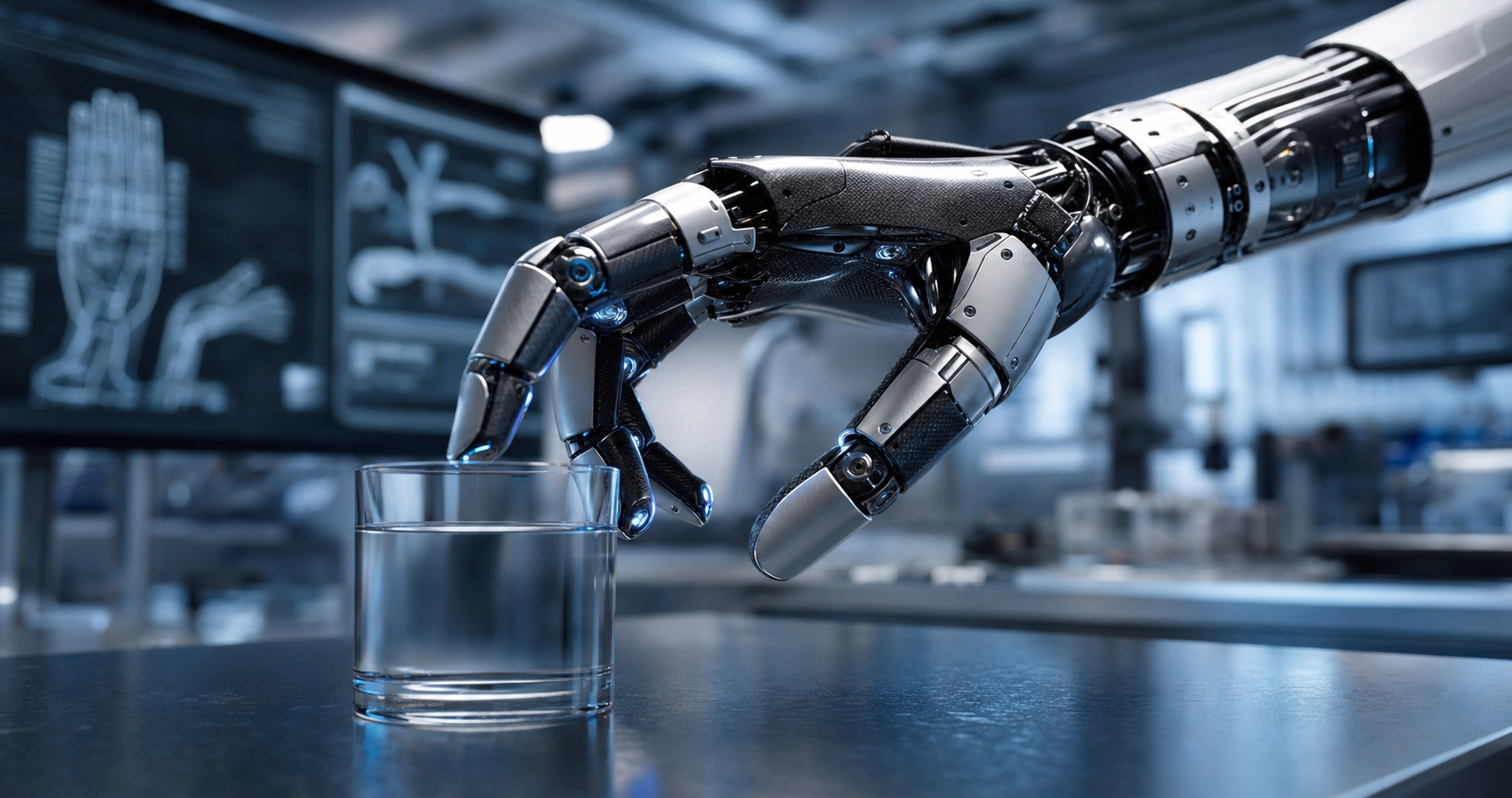
The robot hand as the Achilles' heel of the humanoid industry: The multi-billion dollar race to solve robotics' biggest unsolved problem – creative image on the topic, with AI: Xpert.Digital
Why the most expensive component of the humanoid robot is also its greatest risk of failure
The most expensive component: Why the market leader prefers to sell its robots without hands
Clever, durable, or affordable? The unsolvable dilemma of the humanoid industry
Humanoid robots are considered the next major technological revolution – yet their success hinges largely on a body part we take for granted in everyday life: the hand. While legs in industry have long been replaced by a century-old invention like the wheel, replicating human grasping ability remains a monumental challenge. The robot hand is not only by far the most complex and expensive component of the machines, but also their greatest risk of failure. A lack of training data, extremely high material wear, and exorbitant development costs continue to force designers to make painful compromises. The problem is so serious that even market leaders sometimes prefer to deliver their robots without functioning hands altogether, while other impressive capabilities are actually remotely controlled by humans wearing sensor gloves. The following article explores why grasping a simple glass of water pushes an entire multi-billion-dollar industry to its limits, how German giants like Bosch and Schunk intend to solve the problem, and why the hand remains the true Achilles' heel of the humanoid robot industry.
Tesla, Bosch & Co.: The multi-billion dollar race to solve robotics' biggest unsolved problem
A glass of water as an engineering problem
Anyone who has ever stood in front of a glass of water with a hand in a cast knows the feeling of unexpected helplessness. Grasping the bottle, perceiving the resistance, subtly adjusting the force as the weight shifts with every tilt – a healthy hand does all this effortlessly, every second, without conscious awareness. With a cast on their hand, this very grip suddenly becomes a technical problem that needs solving. And it is precisely this problem that an entire industry is currently working on, attempting to replicate human gripping ability in machines.
The human hand consists of 27 bones, more than 30 muscles, over 20 degrees of freedom, and achieves gripping forces of over 400 Newtons while weighing only 400 to 500 grams. The real trick isn't in the hand itself. The strongest muscles are located in the forearm and are connected by tendons, which keeps the hand light and agile. In addition, around 17,000 tactile fibers in the palm constantly provide information about whether something is slipping, giving way, or about to break. This biological design has been optimized over millions of years, and that's precisely why it's so difficult to replicate it technically.
Why legs are replaceable, but hands are not
The manufacturers' central argument for why humanoid robots even need a human-like form is that the built environment is designed for the human body. This is undoubtedly true for reach, gripping height, and two arms that can simultaneously hold and connect. However, for legs, a tried-and-tested industrial alternative with a century-long history already exists: the wheel. For the hand, there is no comparable alternative. So, if the leg design is a gamble open to discussion, then the hand is the gamble that absolutely must pay off. And ironically, the hand is the least resolved part of the entire system.
Parallel grippers and suction cups have been automating structured tasks with rigid objects for decades, and they do this exceptionally well. However, they fail precisely where human labor truly shines: with deformable objects, frequent tool changes, and anything where tactile feedback is crucial. Plugging in a cable, closing a zipper, cracking an egg – these are typical examples where rigid grippers regularly fall short. Anyone aiming to build a universal robot cannot avoid the need for a universal hand.
The lack of data is slowing down the entire industry
The reason this task is so difficult can be summed up in a phrase coined by the robotics industry itself: Robotics has no internet. Gigantic datasets have been created over decades for speech and images. But for what actually happens during a grasping process, nothing comparable exists. Force, yielding, slippage – none of this is captured in any dataset because no one has systematically recorded it. And anyone attempting to transfer human movements to a simple two-finger gripper loses most of this information because a gripper grasps fundamentally differently than a hand.
The severity of this data problem is evident in a separate sub-market. An entire supplier industry has sprung up around companies like MANUS, manufacturing specialized gloves to capture the actual movements of human hands. Camera-based tracking fails precisely at the most critical moments: when fingers overlap or a grip obscures the fingertips. Therefore, these gloves measure directly on the body rather than externally, and people use them to remotely control robotic hands, generating training data. Much of what appears autonomous in demonstration videos is, in reality, just that: a person in gloves dictating the movement.
The extent of this effort is demonstrated by an ETH Zurich spin-off. In mid-July, mimic robotics presented a second device alongside its own robotic hand – an exoskeleton made of rigid limbs instead of a glove. It allows the wearer's hand only those movements that the robotic hand can perform, supplemented by tactile sensors, joint encoders, and a camera on the wrist, all precisely calibrated to the machine.
The second answer to the same data gap is simulation. Instead of painstakingly collecting data, it is artificially generated. In environments like NVIDIA's Isaac Sim, thousands of virtual robots practice simultaneously, producing more trials overnight than a real machine could manage in years. This approach works surprisingly well for walking. The catch, however, has its own name: the sim-to-real gap. Every simulation is ultimately an assumption about how a material behaves, and the closer you get to actual contact, the more uncertain this assumption becomes. How far a screw slips in a fingertip, how a seal yields, how a cable bends—these are among the most difficult variables to predict. When walking, a controller can still compensate for such errors; the robot recovers on its own. When grasping, however, there is no way to correct: the object is either held or it lies on the ground.
Both methods, recording and simulation, ultimately lead back to the same point. A movement can be filmed, and it can be calculated. However, what exactly happens between the fingertip and the workpiece remains largely elusive to both methods to this day.
The unsolvable triangle of skill, durability, and price
An ideal robot hand would need to be dexterous, have a reliable grip, and be affordable, and research has shown for years that every existing design sacrifices at least one of these three aspects. Those who prioritize precision integrate the motors directly into the joints, making the hand large and expensive, while the gearboxes overheat under continuous load. Conversely, those who want to build compact, human-sized robots rely on tendon drives, and these tendons stretch, fray, and eventually break. The design that enables dexterity is also the one that wears out the fastest. Those who want to reduce costs reduce degrees of freedom and tactile resolution. The classic industrial gripper freed itself from this dilemma decades ago by foregoing dexterity. Two fingers suffice, but it offers five million cycles, a 24-month warranty, and a moderate price.
To compare the cost structure of a typical humanoid robot, it is worth taking a look at the much-cited analysis by Morgan Stanley of a Tesla Optimus Gen 2 model, which shows a total bill of materials of around 55,000 US dollars.
| module | Cost share | comment |
|---|---|---|
| hands | 17.2 percent, approximately 9,500 US dollars | most expensive single assembly relative to its size |
| Legs and feet together | approximately 38.6 percent | Transportation dominates the total costs |
| hip and shoulder | approximately 28.4 percent | connecting joints with high component complexity |
| Head | 3.8 percent | Computer chips and cameras, cheaper than a single elbow joint |
| Battery pack | 0.5 percent | largely commodified component |
According to industry estimates, hands account for between 15 and 25 percent of a humanoid robot's total parts list, depending on its features; for models with a particularly high number of degrees of freedom, this figure can exceed 30 percent. Unlike traditional industrial robots, hands are an essential component of the machine, and in fact, they are required in duplicate, as each robot needs two. The demand for hands thus scales directly with the production volume, and the costs scale accordingly.
🎯🎯🎯 Data-driven B2B industry hub as a quasi-in-house solution

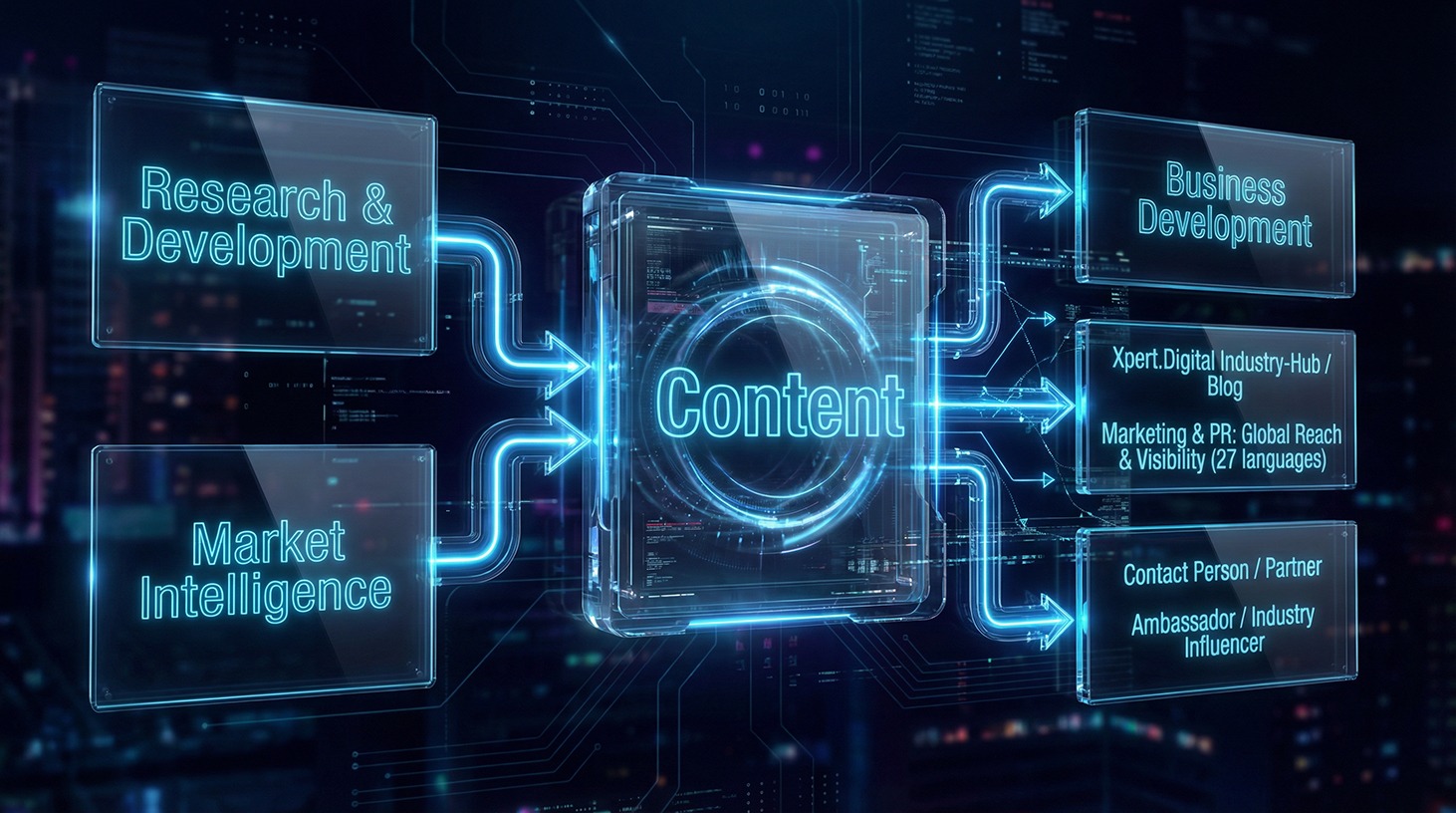
The quasi-in-house solution: How Xpert.Digital closes operational gaps in B2B marketing and sales – Smart Content-Driven Business - Image: Xpert.Digital
Xpert.Digital is a data-driven B2B industry hub led by Konrad Wolfenstein . The company acts as an external, quasi-in-house solution for industrial partners, closing operational gaps in marketing, content, and sales – without requiring additional resources on the client side.
More information here:
The battle for the humanoid hand: Why major German industries are now pushing into the market
German heavyweights are entering the market
Anyone who thinks this field belongs solely to startups overlooks who is now entering the market and with what resources. Schunk, based in Lauffen am Neckar, is the world market leader in gripping and clamping technology, a third-generation family business. According to the company, it has been researching human-like hands for around twenty years – long before a market for them even existed. In January 2026, this research was spun off into an independent company with the goal of mass production, and since June it has been operating in partnership with Bosch Robotics. So far, only one prototype has been announced; a cycle count, as is standard practice on the gripper datasheets from the same company, has not yet been disclosed.
At Bosch ConnectedWorld in June 2026, a humanoid robot hand from Schunk already took a beverage from the shelf and placed it on the counter – a simple task with considerable technical depth behind it. Schunk contributes its expertise in flexible gripping and automation technology, while Bosch adds precision mechanics, electronics, and competence in series production and software. The human hand, with its approximately 27 degrees of freedom, stands in stark contrast to conventional industrial grippers, which typically have only one or two degrees of freedom – a measure of the size of the technological gap that still needs to be closed.
Competing design philosophies in comparison
In mid-July 2026, mimic robotics from Zurich presented a hand explicitly designed for continuous industrial use, its construction based almost entirely on wear considerations. The motors are located in the forearm and pull the fingers via tendons, similar to human tendons. Instead of running the tendons through guide sleeves, they are guided by bearings and rollers, because sliding friction causes material wear, while rolling friction is significantly gentler. The number of joints was reduced based on real industrial data; every joint with little benefit was eliminated to maximize lifespan. The published datasheet reads accordingly, like that of a conventional supplier, with specifications for return torque, backlash, and continuous load.
1X specifically mentions a cycle count: over two million load cycles, supplemented by IP68 protection and food-grade certification. The catch is in the fine print. The two million cycles apply to the wrist. For the tendon-driven fingers, it merely states that assemblies have undergone millions of test cycles, without specifying a concrete number. Precisely where wear is actually determined, the information remains vague, and all values are provided by the manufacturer itself, not by independently verified field data.
Sharpa is optimizing in a different direction, focusing on sensitivity. The hand, equipped with over a thousand tactile points per fingertip and driven by fine gears instead of tendons, received an award at CES. Sharpa also cites a figure – over one million gripping cycles – also as a self-reported claim. How this performs in actual shift work is something no one outside the company knows yet. At NVIDIA GTC in the spring, the hand was remotely controlled via data gloves in a much-discussed demonstration, including the catching of a thrown ball.
A recent comparison between Tesla's Optimus Gen 3 hand with 22 independently driven joints and 1X's new Neo hand shows that both systems now boast over two million operating cycles on the wrist and IP68 certification. It is noteworthy that these figures are no longer considered a competitive advantage, but rather a basic requirement for being considered a serious competitor.
| Manufacturer | Design principle | stated shelf life | Special feature |
|---|---|---|---|
| Schunk and Bosch | Five-finger gripping hand, wrist integration | No cycle count published | approximately 20 years of preliminary research, series production target |
| mimic robotics | Tendons over bearings and rollers, reduced number of joints | No specific number, focus on datasheet metrics | custom exoskeleton wearable for training data |
| 1X | Tendon drive, IP68, food-safe | Over 2 million cycles on the wrist, fingers vaguely | This number does not apply to the most wear-prone components |
| Sharpa | fine gears instead of tendons, high tactile resolution | Over 1 million gripping cycles, according to the manufacturer | Over 1,000 tactile points per fingertip |
Why this is more than just a technical detail
The truly remarkable aspect of this development becomes apparent when compared to the manufacturer with the highest production volume. Unitree's cheapest humanoid model costs $4,900 and comes with rigid fists that cannot grasp anything. Hands cannot be ordered for this model at all. They only become available with the developer model starting at $10,500, and even then only as an optional extra. Even the large flagship model comes standard with dummy hands that merely complete the silhouette and serve no functional purpose. The company does not disclose how many machines are ultimately shipped with functional hands.
This observation provides the real economic crux of the entire development. The most expensive and, at the same time, most vulnerable component is located precisely where the humanoid robot's core product promise hinges – and the market leader in terms of units sold simply omits it when in doubt. What remains is an expensive gripper mount, which has yet to be convincingly solved.
For market observers and investors, this means that progress reports on humanoid robots must be critically examined to determine whether they refer to the entire machine or specifically to the hand. Purchasing decisions based on demonstration videos should question whether the displayed dexterity was generated autonomously or resulted from telepresence by a human operator. And those evaluating growth forecasts for the industry should consider that while the overall cost curve for actuators is declining, reliability data for hands, in particular, remains conspicuously incomplete.
The next two to three years will show whether collaborations like that between Schunk and Bosch, which combine traditional industrial expertise with new mass production logic, can actually deliver reliable, independently verified cycle counts, as are already standard in classic gripping technology. Until then, the robotic hand remains the most expensive unfulfilled promise in the entire humanoid industry.
Your global marketing and business development partner
☑️ Our business language is English or German
☑️ NEW: Correspondence in your native language!

Konrad Wolfenstein
I and my team are happy to be available to you as your personal advisor.
You can contact me by filling out the contact form here wolfenstein@xpert.digital:or simply call me at +49 7348 4088 965. My email address is
I'm looking forward to our joint project.
☑️ SME support in strategy, consulting, planning and implementation
☑️ Creation or realignment of the digital strategy and digitization
☑️ Expansion and optimization of international sales processes
☑️ Global & Digital B2B trading platforms
☑️ Pioneer Business Development / Marketing / PR / Trade Fairs
📈🚀 From visibility to trust 👀🤝 Your scalable path with Xpert.Digital


From visibility to trust: Your scalable path with Xpert.Digital - Image: Xpert.Digital
In industrial B2B, sustainable business relationships rarely emerge overnight. They develop step by step – through visibility, professional relevance, recurring touchpoints, and growing trust. Xpert.Digital's 4-stage model addresses precisely this: It offers a structured path that begins with a manageable entry point and can evolve into deeper collaboration in business development if needed.
Instead of relying on loud marketing promises, this model puts the relationship at the forefront. Companies start with clearly defined, easily calculable measures and then decide, based on their own experience, how far they want to expand the collaboration. A key factor for this undisturbed trust-building process: The platform completely avoids annoying advertising ads, so the editorial focus remains solely on the companies' expertise.
More information here: