Whoever controls the flow of materials in a few square meters will control billions of dollars in future investments in logistics centers
Xpert Pre-Release

Available in 27 languages 📢
Prefer Xpert.Digital on GoogleⓘPublished on: October 19, 2026 / Updated on: October 19, 2026 – Author: Konrad Wolfenstein
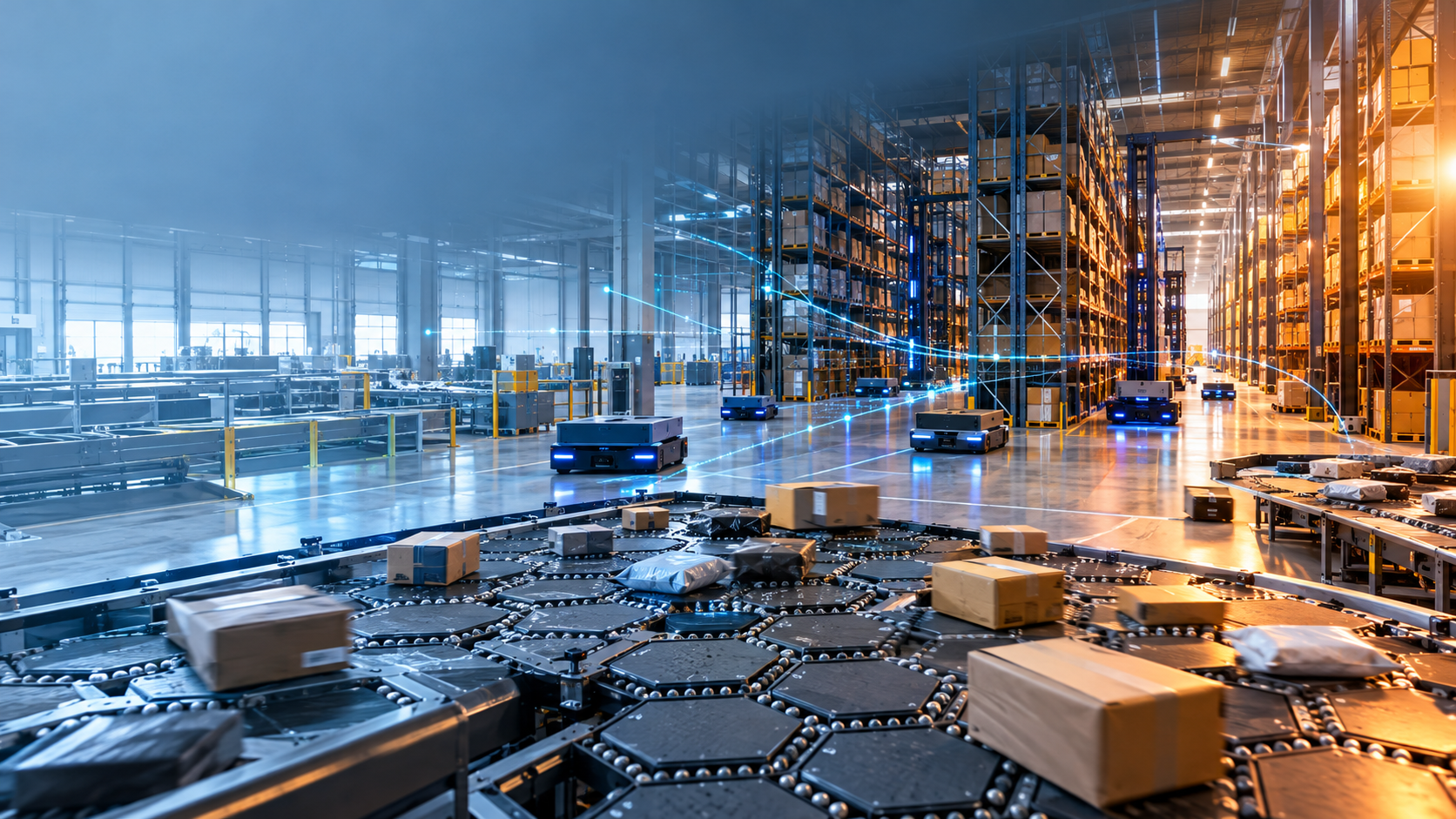
Whoever controls the flow of materials in a few square meters will control billions of euros in investments in logistics centers in the future – creative image on the topic, with AI: Xpert.Digital
The battle for Europe's warehouse floor: German warehouse technology for the global market
Less space, more speed: What Symbotic plans to do with the acquisition of cellumation
At first glance, the acquisition seems manageable: The US automation group Symbotic is buying the Bremen-based company cellumation, which has just over 70 employees. But behind the transaction lies a larger strategic bet. Symbotic is securing a technology that can move, rotate, sort, and distribute goods in confined spaces – thus addressing one of the crucial bottlenecks of modern warehouses.
The celluveyor, cellumation's modular conveyor system, is designed to combine multiple functions in a compact footprint. This could help warehouse operators better utilize limited space, increase throughput, and adapt systems more flexibly to new material flows. For Symbotic, the acquisition also represents a step towards a more comprehensive automation platform. The company aims to offer not only large-scale warehouse solutions but also to integrate as many material flow processes as possible.
The acquisition also raises some questions: Can Symbotic scale the technology globally without sacrificing its flexibility? Will cellumation remain an attractive partner for independent system integrators? And will Bremen truly become a European center of excellence? The crucial factor is not what the technology promises under ideal conditions, but whether it proves itself in the demanding everyday environment of a warehouse.
From Bremen start-up to strategic building block: Symbotic acquires cellumation – The new battle for Europe's warehouse space
The acquisition of Bremen-based cellumation GmbH by the US automation specialist Symbotic appears at first glance to be a relatively small transaction in a global technology market. The purchase price was not disclosed, cellumation employs just over 70 people, and the company, founded in 2017, is significantly smaller than its new owner. Nevertheless, the transaction is economically remarkable. It combines a highly specialized German conveyor technology system with a financially strong provider that no longer views warehouse automation as a collection of individual machines, but rather as a comprehensive, software-controlled infrastructure.
The focus is therefore not simply on adding two product catalogs together. Symbotic is acquiring a technology that addresses a particularly critical point in automated warehouses: the sorting, distribution, rotation, alignment, and consolidation of goods in the smallest possible space. Bottlenecks often occur precisely at these transition points. A high-bay warehouse can operate at peak speed, and a mobile robot can navigate with remarkable intelligence – but if packages, boxes, or containers are not sorted, aligned, or sequenced quickly enough at the inbound and outbound stages, the entire system loses efficiency.
Cellumation, in turn, gains access to financial resources, an international sales organization, larger customer projects, and industrial scaling capabilities. The company will retain its name, its headquarters in Bremen, and its management team. Founders Hendrik Thamer and Claudio Uriarte will remain on board as Managing Director and Chief Technology Officer, respectively. This continuity is crucial because the value of a young automation company lies not solely in patents and hardware. A significant portion is tied to the developers' expertise, the control software, the motion planning algorithms, project data, and the ability to reliably integrate unconventional technology into real-world systems.
The structure as an independently operating subsidiary demonstrates that Symbotic does not intend to simply integrate the acquired provider into its own organization. Cellumation will continue to sell directly to customers, collaborate with system integrators, and simultaneously supply components for Symbotic's overall solutions. This creates a hybrid model comprising an independent product business and an internal technology platform. If this balance is achieved, Cellumation can expand its market without losing access to existing partners. If it fails, conflicts between the open integrator model and the parent company's vertically integrated strategy are likely.
The square meter becomes a strategic resource
The economic logic of this technology begins with space consumption. In modern distribution centers, floor space is not just a construction cost factor, but a productive resource. Every square meter needed for long conveyor lines, curves, intersections, buffers, or mechanical sorting switches is unavailable for storage, order picking, value-added services, or additional shipping capacity. In expensive metropolitan areas, inner-city micro-depots, and existing buildings, the bottleneck may lie less in the investment budget than in the physical expandability.
Traditional conveyor technology often relies on fixed, predefined paths. A track transports goods in one direction, switches distribute them to specific outputs, curves alter the route, and additional functions require additional modules. This principle is robust and economical for stable processes. However, it becomes inflexible when sorting logic, product range, packaging formats, or outputs change frequently. Modifications cause downtime, require new mechanical components, and necessitate renewed safety inspections. Especially in e-commerce, parcel logistics, and highly variable production environments, the initially optimal setup can relatively quickly transform into a limitation.
The celluveyor replaces some of this mechanical specialization with a flat, modularly assembled surface. Numerous hexagonal cells with individually controllable, omnidirectional wheels move objects forward, sideways, or diagonally, and can simultaneously rotate and orient them. The functionality thus arises not only from the hardware arrangement but also, and crucially, from the software. This transforms conveyor technology into a programmable motion surface.
Depending on the application, Cellumation advertises significant space savings of up to 95 percent compared to conventional solutions. Such maximum figures cannot be applied universally to every project. They depend on the comparable system, the size of the facility, the number of inputs and outputs, buffer requirements, the safety concept, and the required throughput. Nevertheless, the fundamental economic benefit is plausible: When multiple functions are combined on a compact surface, the need for separate curves, switches, alignment stations, and long transfer lines decreases. In a documented application at DHL, approximately 3,500 shipments per hour were sorted on an area of around 2.7 square meters, while the previous system achieved approximately 2,000. This is not a universally applicable performance benchmark for every configuration, but it demonstrates that the technology is more than just a vivid prototype in real-world operation.
For operators, the benefits thus arise on several levels. Reduced space requirements can lower construction or rental costs. Higher throughput can eliminate the need for additional shifts, parallel lines, or expansion projects. Software-based functional changes can reduce conversion costs and downtime. However, this also increases reliance on sensors, cameras, control software, and qualified maintenance. Therefore, improved space productivity is not achieved without cost; it comes at the price of increased technological complexity.
Conveyor technology is becoming a software-defined system
The real innovation lies less in the hexagonal shape than in the shift from mechanics to software. Traditional conveyor technology defines a large part of its function physically. A curve remains a curve, a switch remains a switch, and an alignment station fulfills a clearly defined task. With a software-defined interface, the same hardware can execute different motion profiles depending on the programming. It can distribute, merge, rotate, center, singulate, or provide objects in a specific sequence.
Economically, this shift resembles developments in other industries. Machines aren't necessarily becoming simpler, but their function is increasingly determined by software, data, and updates. This also shifts the value chain. One-time hardware sales remain important, but configuration, simulation, system optimization, remote monitoring, maintenance software, and continuous improvements are gaining in significance. For suppliers, this potentially creates recurring revenue and stronger customer relationships. Conversely, for customers, the risk of technological dependency increases if interfaces, spare parts, or software support are not secured in the long term.
The ability to move multiple objects simultaneously along different paths is particularly relevant. A conventional sorter often operates with a serial logic: goods move one after the other along a defined main path and are diverted at specific points. An intelligent surface can spatially coordinate movements, thereby enabling parallel processes. This doesn't automatically increase throughput in every situation, but it opens up new layout possibilities. Sources and sinks don't need to be arranged as strictly along a single line. In existing facilities, this can be crucial because columns, gates, fire protection zones, ceiling heights, and existing conveyor technology limit the design options.
That's precisely why this technology is attractive for retrofitting. The European market isn't solely comprised of newly built, fully automated large warehouses. A significant portion of existing facilities have evolved organically over years, combining older warehouse management systems with different generations of conveyor technology. Operators often want to eliminate specific bottlenecks without redesigning the entire building. A compact module that performs multiple functions is fundamentally suited to this phased modernization approach.
However, a distinction must be made between technical flexibility and operational simplicity. The more tasks a surface takes on, the more demanding motion planning, error handling, and prioritization become. Varying cardboard qualities, damaged packages, soft shipping bags, unstable goods, or unusual dimensions can complicate control. Therefore, what matters is not only what is possible under ideal conditions, but also how stable the performance remains with dirty surfaces, changing loads, incomplete data, and unforeseen situations. The industrial maturity of such a solution is primarily demonstrated by its availability over thousands of operating hours and the speed with which malfunctions are detected and resolved.
Symbotic is building a platform instead of a machine
Symbotic's clear goal is to control as many critical goods movements as possible within and around the warehouse. The company has grown primarily through highly automated systems for large retailers and wholesalers. Its robots transport and store cartons in high-density structures, while software plans the flow of goods. This core business addresses large, complex distribution centers with high volumes and long project durations.
However, the most recent expansions go beyond this core. The acquisition of Walmart Advanced Systems & Robotics added technology for local and store-level order fulfillment. Fox Robotics brings autonomous forklifts for loading dock operations and pallet handling. ARMS Innovations expands the portfolio with software for the comprehensive optimization of automated and manual warehouse processes. Cellumation now fills a gap in compact conveyor and sorting technology. Taken together, this paints a picture of a company that aims to evolve from a provider of a large automation system to an orchestrator of diverse warehouse technologies.
This strategy has a clear economic logic. A provider that covers multiple process stages can capture a larger share of the customer's investment budget. They gain access to more operational data, can reduce interfaces, and position their software as the central control layer. Furthermore, smaller, independently marketable products open access to customers for whom a complete Symbotic system would be too large or too expensive. An autonomous forklift, a compact sorting module, or optimization software can serve as an entry point. Additional components can be sold later.
For Symbotic, this diversification is particularly important because the company has historically been heavily dependent on a few major customers. In fiscal year 2025, Walmart accounted for approximately 85 percent of its revenue. Its order backlog of roughly $22.5 billion was also largely tied to Walmart and its joint venture, GreenBox. Such concentration offers planning security but creates significant risks. Investment decisions by a single customer, delays in deliveries, or changes in the strategic relationship can significantly impact the supplier's performance.
Cellumation won't eliminate this concentration risk in the short term. The Bremen-based company is simply too small. However, it can still be strategically beneficial because it brings relationships with parcel delivery services, manufacturers, e-commerce companies, and integrators. Its value, therefore, lies not only in the immediately anticipated revenue but also in access to new applications and European customers. The crucial factor will be whether Symbotic can translate these contacts into larger projects without overshadowing Cellumation's existing business.
Bremen will become a European bridgehead
For a North American supplier, Europe is not a homogeneous market. Technical standards, labor costs, building sizes, integrator landscapes, languages, and procurement habits differ significantly. Many European warehouses are smaller and older than typical North American distribution centers. At the same time, the density of established automation companies is high. Suppliers such as Dematic, SSI Schäfer, KNAPP, Vanderlande, TGW, Körber, BEUMER, Interroll, and AutoStore have strong customer relationships, service organizations, and reference installations.
Expansion solely through the export of a large North American system would therefore be slow and expensive. Cellumation provides Symbotic with an immediate location, a local engineering team, existing customer contacts, and practical experience with European systems. Bremen also makes logistical sense. The city is situated in a region with a port industry, aerospace, the automotive sector, research institutions, and established intralogistics expertise. Cellumation originated from the Bremen Institute for Production and Logistics and thus embodies the transfer of applied research into a marketable product.
The location also serves a symbolic function. When it comes to critical infrastructure, European customers evaluate not only product performance, but also response times, spare parts availability, data protection, compliance with standards, and long-term support. A local organization reduces the perceived distance to the supplier. It can adapt projects to European requirements and build trust that cannot be replaced by an international brand name alone.
Symbotic simultaneously gains a platform from which to expand partnerships with European system integrators. This is important because the automation market doesn't rely solely on direct manufacturer-customer relationships. Many systems are built as combinations of specialized components. An integrator handles planning, interfaces, assembly, commissioning, and overall responsibility. Cellumation has deliberately marketed its products to various industries through such partners. If this channel remains open, Symbotic can increase its reach without having to integrate every application itself.
The downside lies in potential conflicts of interest. Integrators might become more hesitant if they see cellumation as part of a potential competitor. They need to be able to trust that technical information, customer data, and project opportunities will not be used to benefit the parent company. Symbotic therefore needs a credible separation between its open component business and its own complete systems. Mere formal independence is insufficient; transparent sales rules, reliable interfaces, and a willingness to supply competing integrators are essential.
A growth market with a harsh reality check
The general conditions for warehouse automation are favorable. Labor shortages, rising wages, shorter delivery times, smaller order sizes, and increasing product range diversity are putting pressure on operators. At the same time, retailers and manufacturers are demanding greater transparency regarding inventory and goods movements. As a result, automation is being viewed less as a mere cost-cutting measure and more as a prerequisite for reliable delivery and scalability.
Market studies predict double-digit growth rates for European warehouse automation in the coming years. The specific figures vary considerably depending on the definition used. Some analyses consider only hardware, software, and services within the warehouse, while others include transport automation, robotics, and more comprehensive logistics solutions. For investors and companies, therefore, the direction is more important than the seemingly precise market size: the proportion of automated processes is growing, and software-based systems are gaining importance more rapidly than purely mechanical solutions.
Robotics data also underscores Europe's industrial base. In 2024, approximately 85,000 industrial robots were installed in Europe. With nearly 27,000 units, Germany was by far the largest European market and one of the leading locations worldwide. Although the number declined compared to the record year of 2023, it remained at a historically high level. These figures do not refer exclusively to warehouse robotics, but they demonstrate the high level of readiness for automation and the available pool of technical expertise.
Nevertheless, growth is not guaranteed. Many operators postpone projects when interest rates, construction costs, or economic prospects are unfavorable. Automation ties up capital and creates long planning and amortization periods. Furthermore, a new system not only competes with other technologies but also with organizational improvements, temporary workers, outsourcing, or the extension of existing facilities. A compelling product, therefore, must not merely be technically superior. It must offer a measurable economic advantage in practical operation and be integrable into existing processes.
Especially with innovative conveyor technology, there's a chicken-and-egg problem. Large customers demand solid references and proof of availability, but such references only come about through larger installations. A financially strong owner can break this cycle by securing pilot projects, providing warranties, and professionalizing service. The acquisition by Symbotic could therefore change the risk perception of potential customers more than the technology itself.
Our EU and German expertise in business development, sales and marketing

Our EU and German expertise in business development, sales and marketing - Image: Xpert.Digital
Industry focus areas: B2B, digitalization (from AI to XR), mechanical engineering, logistics, renewable energies and industry
More information here:
A thematic hub offering insights and expertise:
- Knowledge platform covering global and regional economies, innovation and industry-specific trends
- A collection of analyses, insights, and background information from our key areas of focus
- A place for expertise and information on current developments in business and technology
- A hub for companies seeking information on markets, digitalization, and industry innovations
The business case is decided in the overall process
The business case is decided in the overall process
For warehouse operators, the decisive factor is not the purchase price of a conveyor component, but the overall cost calculation over its service life. This includes planning, installation, building space, energy, maintenance, spare parts, software, downtime, personnel, modifications, and residual value. A compact, modular solution may be more expensive per square meter of technology but still prove more economical if it saves space, increases throughput, or prevents costly expansion.
This technology is particularly attractive where multiple bottlenecks occur simultaneously. A parcel center with limited space, fluctuating destination ratios, and high peak volumes can benefit more from a flexibly programmable sorting area than a factory with a constant product, fixed cycle time, and ample space. Similarly, an existing warehouse with a complex geometry can achieve greater benefits than a new building designed from the outset around conventional conveyor technology.
The payback period depends significantly on the avoided alternative costs. If a compact unit replaces two conventional machines, eliminates the need for additional conveyor lines, or enables a significant increase in throughput without expanding the production hall, the economic benefit is substantial. Conversely, if it merely replaces a well-functioning standard diverter valve, the added value is likely to be less. Therefore, blanket statements about a generally faster payback period should be treated with caution.
Added to this is the value of adaptability. Warehouse investments are often used for ten years or more, while product mix, packaging formats, and customer requirements change much more rapidly. Flexibility thus has an option value: The operator pays today for the ability to react in the future without major restructuring. This value is real, but difficult to quantify. It depends on how likely changes are and whether the software can actually implement them without new hardware.
For Symbotic, this also opens up the possibility of designing the cells not in isolation, but as part of an optimized overall system. If warehouse management software knows early on which goods are needed at which output, it can plan transport, buffering, sequencing, and sorting together. This could increase the performance of the celluveyor beyond local machine control. The greatest synergy effect, therefore, may not lie in cheaper components, but in better coordination between storage decisions and physical movement.
Openness as an opportunity and a field of conflict
Cellumation is intended to fulfill two roles simultaneously. On the one hand, the company will remain an independent provider, selling its technology directly and through partners. On the other hand, it will become an internal supplier for Symbotics solutions. This model can be very economically efficient. The independent business expands the customer base, while internal projects generate volume, references, and economies of scale.
For it to work, the technology must remain open enough to interoperate with different warehouse management, control, and conveyor systems. Customers generally want to avoid a situation where a single component forces them to switch vendors entirely. Standardized interfaces, documented programming interfaces, and clear lines of responsibility in case of malfunctions are therefore crucial factors in their purchasing decisions. The more Symbotic tries to tie the technology exclusively to its own platform, the less attractive it could become for independent integrators.
Conversely, openness must not lead to Symbotic merely financing development while other system providers capture the lion's share of the added value. The company will strive to create exclusive integration advantages, for example, through closer data linkage, joint simulation, predictive maintenance, or coordinated security functions. The crucial strategic point, therefore, is not whether Cellumation remains open or closed, but rather at what level differentiation occurs. The hardware can be widely available, while the deepest optimization is only achieved in conjunction with Symbotic's software.
For Cellumation's existing partners, pricing is also a relevant factor. A large parent company can reduce purchasing costs and expand production capacity. It could translate these advantages into lower prices to gain market share. Likewise, it could enforce higher prices if the brand, service, and performance promise become stronger. Without a published purchase price and without information on revenue or profitability, it's impossible to assess the growth pressure on the company.
Therefore, retaining the Bremen name is more than just a communicative gesture. It protects the company's positioning as a specialized technology provider and can alleviate fears of complete takeover. In the long run, however, market behavior is what counts. If products, support, or sales channels are gradually geared solely towards Symbotic projects, formal independence will lose its significance.
Scaling is more difficult than inventing
Many robotics and automation companies fail not because of the technical idea, but because of the industrialization. A prototype can be convincing under controlled conditions. A mass-produced product, on the other hand, must function reliably in different buildings, climates, and process environments. It requires documented quality standards, readily available spare parts, trained service technicians, reproducible assembly processes, and a supply chain that remains stable even with sharply increasing demand.
For cellumation, the acquisition therefore represents an opportunity to transcend the boundary between an innovative mid-sized company and a globally scalable technology provider. Symbotic has experience with large-scale installations, long project durations, and industrial procurement. In the third quarter of fiscal year 2026, the company generated revenue of approximately US$721 million, 22 percent more than in the same period of the previous year, and reported a net profit of US$55 million. At the same time, 77 systems were under implementation. This scale demonstrates that the new owner can mobilize significant operational resources.
However, scaling brings new risks. A rapidly growing number of installed cells increases the need for quality control and field service. Small error rates can lead to significant outages across thousands of modules. Software versions and security updates also need to be monitored across numerous customer installations. The more integrated the technology is into critical supply chains, the more costly each operational downtime becomes.
Another challenge is vertical integration. If key components are sourced from only a few suppliers, bottlenecks or price increases can negatively impact margins. Conversely, excessive in-house production ties up capital and hinders flexible scaling. Symbotic must decide which parts should be strategically protected and which can be standardized or outsourced. For a product whose performance relies on the interaction of many identical cells, unit costs are particularly important. Even small savings per cell add up significantly in larger systems.
Corporate cultures must also be compatible. A publicly traded US corporation operates with different reporting requirements, target systems, and decision-making speeds than a German startup. Too much corporate control could slow development and drive away key talent. Conversely, too much independence could stifle synergies. While the founders remaining in their roles improves the starting point, it doesn't guarantee a smooth integration.
Competitive advantage only with reliable performance
The intralogistics market is dominated by established companies offering complete systems, shuttle systems, mobile robots, sorters, conveyor technology, and software. Specialized startups and rapidly growing robotics providers also play a role. Cellumation, therefore, does not compete with any single technology. Depending on the application, the alternative could be a classic crossbelt sorter, a tilting tray sorter, a roller conveyor with switches, an autonomous mobile robot, a robotic arm, or simply a manually assisted process.
The most important advantage of the celluveyor is its high functional density in a small footprint. Its modular structure can also facilitate repair and adaptation, provided individual cells are quickly replaceable and the software efficiently manages configurations. Another advantage lies in its visual clarity: movement in all directions can be clearly demonstrated, generating significant interest at trade fairs and pilot plants. This visibility facilitates market access but does not replace the need for long-term proof of operating costs.
Competitors can respond in several ways. Traditional conveyor technology providers can develop more compact modules, expand software functionality, or offer their own omnidirectional concepts. System integrators can embed the technology in overarching solutions and control end-customer interaction. Mobile robots can handle certain material flows without fixed conveyor routes. In some cases, a simpler mechanical system may remain more economical despite its reduced flexibility.
Therefore, lasting protection arises from several elements: patents, control knowledge, installation data, application experience, production costs, and a growing network of integrators and customers. Data on how a wide variety of objects behave on the cells is particularly valuable. It can improve motion algorithms, fault detection, and simulation. The larger the installed base, the greater this learning effect can be.
Symbotic adds an extra layer to this. When the movement area is linked with data from warehouse management, robotics, and order planning, a system advantage is created that is more difficult to replicate than a single mechanical cell. The competition then shifts from the best conveyor component to the best orchestration of the entire material flow.
Work, safety, and regulation change the equation
Automation is often portrayed as the answer to labor shortages. Indeed, systems can take over physically demanding, monotonous, and hard-to-fill tasks. Sorting, repacking, aligning, and moving goods are among the areas where high repetition rates and shift work make recruitment difficult. Rising wages and demographic changes therefore improve the business case for automated solutions.
The impact on employment is nevertheless nuanced. Automation doesn't simply eliminate jobs, but rather changes their structure. The need for manual routine tasks can decrease, while maintenance, plant monitoring, data analysis, and process engineering become more important. Companies must develop these skills, even though skilled workers in robotics, control engineering, and industrial IT are also in short supply. A plant that theoretically saves on personnel can be disappointing in practice if qualified technicians are lacking and repairs take too long.
From January 2027, the new Machinery Directive will be fully applicable in the European Union. It takes autonomous and digitally networked machines more seriously than the previous legal framework and places greater emphasis on cybersecurity, software modifications, and risk assessment. For intelligent material flow systems, this means additional documentation and testing efforts. At the same time, the regulation can benefit established, professionally organized suppliers, as customers place greater value on verifiable conformity and long-term update capability.
Cybersecurity is becoming an immediate production risk. When software controls movement, cameras capture objects, and systems are connected to warehouse platforms, a digital attack can disrupt physical operations. Therefore, protective measures must be part of the architecture from the outset. These include access rights, secure updates, network segmentation, logging, and a clear approach to security vulnerabilities. For European customers, additional requirements regarding data storage and access from third countries apply.
Symbotic's size can offer advantages in certification, security organization, and update processes. At the same time, a unified platform increases the potential attack surface. A single error or vulnerability can affect many systems. Decentralization, safe failure modes, and the ability to isolate individual modules therefore become key economic factors, not just technical details.
What the takeover means for Germany
The transaction reveals two sides of Germany's innovation landscape. On the positive side, university research in Bremen has given rise to an internationally applicable technology, a growing company, and skilled jobs. The fact that the headquarters, brand, and management remain in Bremen suggests that the location is to be strengthened first. Additional investments could expand development, manufacturing, sales, and service.
At the same time, a promising German technology company is being acquired by a US corporation before it has even reached global scale. This points to a well-known structural weakness in Europe: research and early technology development are often strong, but US companies frequently have the advantage when it comes to later growth financing, international sales, and rapid market scaling. The economic assessment therefore depends on where high-value functions, intellectual property, production, and profits will be located in the future.
A foreign owner is not automatically a loss. If Symbotic provides capital, expands employment, and develops Bremen into a European center of excellence, regional value creation can increase significantly. The company could grow faster than would have been possible with limited internal resources. A problematic scenario, however, would be a gradual relocation of core knowledge, a devaluation of local decision-making, and a reduction of the location to a sales or development niche.
A sobering lesson emerges for German industrial policy: Promoting research and start-ups is insufficient if the capital for global expansion is later lacking. Larger growth funds, innovation-friendly public procurement, faster approvals for pilot plants, and improved conditions for industrial mass production are needed. At the same time, openness to international investors must not be replaced by blanket resistance. The crucial factor is whether transactions create additional value and further develop strategic competencies within the country.
Bremen can benefit from the acquisition if a larger ecosystem of suppliers, integrators, research institutions, and skilled workers develops around Cellumation. For this to happen, the location must offer more than just the company's history. University collaborations, testing facilities, professional development opportunities, and a high-performance digital infrastructure can help ensure that growth is not just reflected in the company's balance sheet, but is actually regional.
The undisclosed purchase price itself speaks volumes
The fact that no financial details were published limits the assessment of the transaction. Without the purchase price, revenue, order backlog, and earnings of Cellumation, it is impossible to determine whether Symbotic acquired a key technology at a bargain price or paid a high strategic premium. It also remains unclear whether part of the consideration is tied to revenue, development, or retention targets.
The lack of a forecast suggests that short-term earnings contributions are not the primary focus. For a company with quarterly revenues in the high hundreds of millions, cellumation is likely to be financially small initially. The acquisition should be understood more as a technology and market access decision. Symbotic is buying development time, patents, an established team, references, and a European base.
Precisely for this reason, the transaction should not be judged solely on short-term revenue effects. Other key performance indicators will be crucial in the coming years: the number of productive installations, continuous availability, the share of recurring software and service revenues, the development of unit costs, new integrator partnerships, and the scope of larger Symbotic projects in Europe. It is also important to consider whether cellumation attracts customers outside its existing focus and whether the technology in Symbotic's input and output systems actually delivers measurable savings in space and capital.
Symbotic faces the risk of having to integrate several emerging technologies simultaneously. The acquisitions of Fox Robotics, ARMS Innovations, and cellumation are rapidly expanding its portfolio. However, breadth alone does not create a platform. Interfaces must be standardized, sales teams trained, service processes established, and product strategies aligned. Too many parallel integration projects can tie up management resources and slow down implementation.
Success therefore depends on disciplined prioritization. Symbotic must clearly decide in which applications the celluveyor offers a genuine advantage over standard technology. A widespread deployment driven by strategic enthusiasm would be risky. A more sensible approach is targeted scaling in processes where compactness, parallelism, and flexible movements have high economic value.
Europe's warehouse automation is entering a new phase
The acquisition marks a major shift in intralogistics. Competition is increasingly focused not just on faster individual machines, but on the intelligent integration of storage, transport, sorting, robotics, and human labor. Data and software determine whether individual components merely function side-by-side or achieve higher performance as a coordinated system.
Cellumation brings an unusually compact and programmable form of material flow to this competition. Symbotic contributes capital, expertise in large-scale projects, customer relationships, and a comprehensive automation platform. The combination is strategically compelling, but by no means without risk. Maximum technical performance must be proven across numerous installations. Despite the corporate affiliation, open collaboration with integrators must remain credible. The Bremen site must grow without losing its speed and engineering-driven culture.
Should the integration succeed, a specialized conveyor technology could evolve into a globally deployed building block for software-defined warehouses. The economic benefits would be considerable: less unproductive space, higher throughput density, more flexible reconfiguration, and closer coordination between digital planning and physical movement. For Symbotic, this would represent a further step away from being a supplier of individual large-scale systems and toward a platform that increasingly controls more and more aspects of the flow of goods.
If integration fails, the opposite could happen. Cellumation could be caught in the crossfire between its independent product business and internal corporate priorities. Integrators might withdraw, scaling could become more expensive than expected, and the promised synergies might be limited to a few demonstration projects. The technology would then remain interesting, but strategically overvalued.
The rationale is therefore positive, but not euphoric. The transaction aligns with the structural requirements of the market and complements Symbotic's portfolio in a meaningful way. The greatest value lies not in Cellumation's current revenue, but in the ability to transform scarce storage space into programmable productivity. Whether this translates into a sustainable competitive advantage will not be determined at the trade fair or in the acquisition announcement, but rather through years of trouble-free operation with real customers.
The provocative core message is therefore this: The next power shift in logistics won't take place in high-bay warehouses, but rather on just a few square meters of warehouse floor. Whoever can simultaneously move, rotate, sort, and intelligently distribute goods there will influence the throughput of the entire system. Symbotic has recognized this bottleneck and secured a technologically sound solution with cellumation. Now, this German invention must become a global industrial standard without losing its openness, quality, and European core on the path to scale.
🎯🎯🎯 Data-driven B2B industry hub as a quasi-in-house solution

The quasi-in-house solution: How Xpert.Digital closes operational gaps in B2B marketing and sales – Smart Content-Driven Business - Image: Xpert.Digital
Xpert.Digital is a data-driven B2B industry hub led by Konrad Wolfenstein . The company acts as an external, quasi-in-house solution for industrial partners, closing operational gaps in marketing, content, and sales – without requiring additional resources on the client side.
More information here:
Your global marketing and business development partner
☑️ Our business language is English or German
☑️ NEW: Correspondence in your native language!

Konrad Wolfenstein
I and my team are happy to be available to you as your personal advisor.
You can contact me by filling out the contact form here [email protected]:or simply call me at +49 7348 4088 965. My email address is
I'm looking forward to our joint project.