
The 3.6 trillion euro offensive: Germany's sleeping capital and ten trillion euros in the inflation trap
Xpert Pre-Release

Available in 27 languages 📢
Prefer Xpert.Digital on GoogleⓘPublished on: March 25, 2026 / Updated on: March 25, 2026 – Author: Konrad Wolfenstein
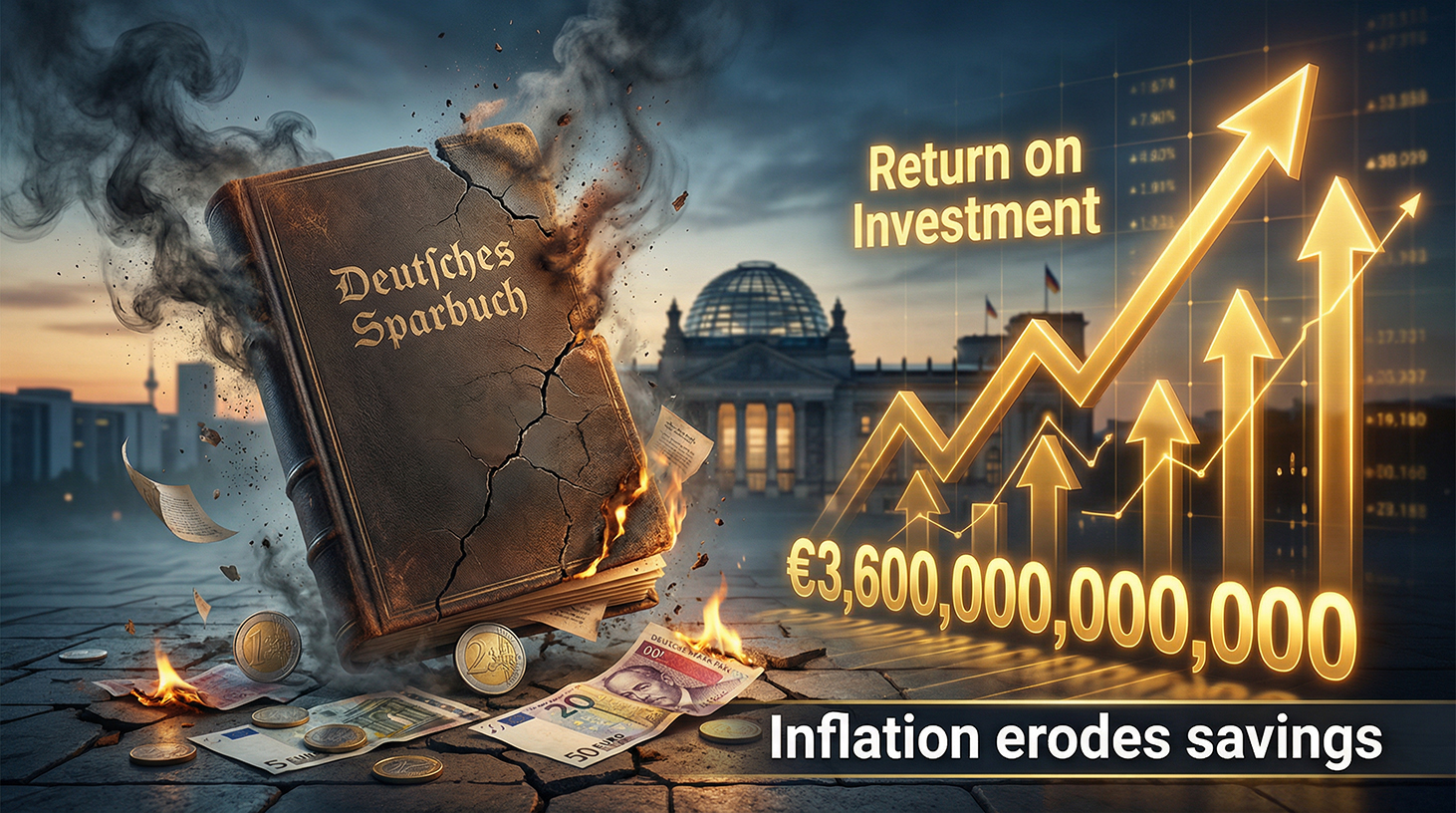
The 3.6 trillion euro offensive: Germany's sleeping capital and ten trillion euros in the inflation trap – Image: Xpert.Digital
New retirement savings account from 2027: A brilliant idea or the next expensive cost trap?
The savings account trauma: Why German security-mindedness is costing us massive prosperity
Pensions on the brink of collapse: How the demographic time bomb is blowing up our pension system
Germany sits on a sleeping treasure of ten trillion euros in private financial assets – but instead of putting it to work, millions of savers are burning through their money day after day in unprofitable checking and savings accounts. While inflation quietly but relentlessly erodes purchasing power, the statutory pension system is hurtling towards collapse due to demographic change. With the planned retirement savings account, policymakers are now taking a long-overdue step towards a stronger equity culture, modeled on the Swedish system. But the path from a nation of interest-bearing savers to a nation of investors is fraught with obstacles: hidden fees, a lack of financial literacy, and biased financial advice threaten to severely undermine the reform. This is a thorough analysis of missed returns, decades of political negligence, and the urgent need to finally invest our money profitably.
The figure of approximately €10 trillion describes the total financial assets of private households in Germany – that is, all financial investments combined, such as bank deposits, securities, funds, and claims from life insurance policies. The roughly €3.6 trillion, on the other hand, refers only to the portion of these assets held as deposits in accounts, such as savings books, current accounts, money market accounts, and fixed-term deposits, which generate hardly any return and are eroded by inflation. While the €10 trillion figure illustrates the overall size of households' financial reserves, the €3.6 trillion represents that "dormant" liquidity pool which many stakeholders would prefer to channel more effectively into productive investments such as the capital market and retirement savings, rather than leaving it largely interest-free in accounts.
The paradox of austerity in the welfare state – or: Why security is the greatest threat
The paradox is so obvious it almost seems absurd: Germany is one of the richest countries in the world, and its citizens are diligently accumulating wealth – according to DZ Bank Research, the private financial assets of German households will reach ten trillion euros in 2025. And yet, millions of people allow their savings to erode their purchasing power year after year because they keep them in non-interest-bearing checking accounts, money market accounts, or traditional savings accounts. Around 2.2 trillion euros are sitting in checking and money market accounts alone, or hidden under the proverbial mattress – money that could generate significant returns even at minimal interest rates, but simply doesn't.
This collective passivity is no accident. It is the result of decades of misguided political incentives, a deeply ingrained cultural aversion to risk, and an education system that systematically ignores financial literacy. The fact that Lars Klingbeil, SPD party leader and Federal Finance Minister, is now promoting the capital market as a solution is both remarkable and requires explanation – because the SPD bears a significant share of the blame for today's predicament.
Related to this:

The silent disaster: Trillions caught in the inflation trap – How inflation is silently destroying your savings
Those who save for decades in a savings account pay an invisible tax: inflation. Consumer prices in Germany rose by an average of 3.1 percent in 2021, 6.9 percent in 2022, 5.9 percent in 2023, and 2.2 percent in both 2024 and 2025. Compounded over these five years, this results in a loss of purchasing power of approximately 21.9 percent. To put it plainly: someone who left ten thousand euros safely in their account in 2020 would have had the purchasing power of just under 7,800 euros in today's prices in 2025. The capital is nominally still there, but in real terms, a considerable portion has been destroyed.
Households in Germany can afford, on average, one-fifth less than three years ago, as Volker Wieland, Professor of Monetary Economics at Goethe University Frankfurt, soberly observed. Nevertheless, Germans, historically influenced by two hyperinflationary periods and a deep cultural orientation towards security, cling tenaciously to the concept of saving in the narrow sense. The need for security has even increased: According to a Kantar survey commissioned by the Association of German Banks, in 2024 only 19 percent of respondents were open to taking on higher investment risks for higher returns – compared to 33 percent a year earlier.
The economic consequences of this mass passivity are significant. Money slumbering in savings accounts does not circulate as productive capital in the economy. It does not finance innovation, infrastructure, or businesses. It does not grow, it does not work. It waits – and in doing so, it shrinks quietly and steadily.
The pension system on the brink: The demographic time bomb
The real driving force behind Klingbeil's initiative is not romantic notions of the capital markets, but demographic arithmetic. The German pension system is based on the generational contract: those currently employed finance the pensions of today's retirees. This pay-as-you-go system works as long as the ratio of contributors to pensioners remains stable. It ceases to function when demographics shift – and that is precisely what is happening right now.
While in 2022 there were 2.15 working people for every pensioner, this number will fall to just 1.5 in 2030 and to a mere 1.3 in 2050. The federal government already contributes around 20 percent of its budget to the pension fund, and forecasts predict this contribution will increase by another 25 percent by 2028. A widely cited study by the ifo Institute calculated that if the current limits for pension levels and contribution rates are maintained, the federal government will have to allocate 60 percent of its budget to pensions in the future. This scenario is no longer compatible with any other fiscal policy.
The pension package 2025, passed by the CDU/CSU and SPD in December 2025, maintains the pension level at 48 percent of the average wage until 2031, but it fails to address the structural causes. It buys time, but doesn't solve the problem. A real solution requires strengthening funded pension systems – a paradigm shift that other nations have long since implemented.
Decades of political paralysis: The chronicle of failures
The SPD bears a special historical responsibility for the predicament that Klingbeil now wants to rectify. It was the pension-reforming coalition under Konrad Adenauer that, in 1957, set a course with the switch to the pay-as-you-go system, a decision Ludwig Erhard already described as a mistake at the time: "The blindness and intellectual negligence with which we are heading towards a welfare state can only lead to our downfall." Later reforms under social democratic leadership, especially the expansion of pension entitlements in the 1970s under Federal Labor Minister Walter Arendt, caused significant structural cost increases.
The Riester pension, introduced in 2001 under the red-green coalition, was intended to be the private solution to the structural pension gap. The concept was theoretically sound: the state partially withdraws from the pension guarantee and instead subsidizes private investments. But its implementation was a disaster – and a predictable one at that. Instead of creating a streamlined, affordable, and citizen-friendly system, policymakers largely left the design to the insurance industry. The result: according to an analysis by Finanzwende, almost one in four euros paid into an average Riester contract goes toward fees. For a number of providers, this figure is even three times the already high government estimate. In 2023, the Federal Court of Justice struck down key fee clauses as illegal – but by then, many savers had already been paying through the nose for years.
The fact that Olaf Scholz, Klingbeil's predecessor as Chancellor and previously Finance Minister for many years, left his money in a savings account earning no interest until the very end was not a private quirk, but a political signal: With precisely this behavior, the political leadership was signaling to citizens that a focus on security and risk aversion are not flaws, but virtues. Anyone who then tries to change the mentality of the population must be asked: Why only now?
The Swedish model: What's possible when done correctly
The reference to Sweden in this debate is not a cliché, but a serious economic policy benchmark. Sweden recognized as early as the 1990s that a purely pay-as-you-go pension system was not demographically viable and comprehensively reformed its pension system. Since 2000, Swedish employees have contributed 16 percent of their gross salary to the traditional, pay-as-you-go pension system – and an additional 2.5 percent automatically and mandatorily to capital market-based products. The choice of funds is left to the individual; those who do not actively choose end up in the state-run AP7 Aktienfond, a lean, broadly diversified, and cost-effective investment fund.
The result is impressive: Swedish pensioners receive 65.3 percent of their last income as a net pension, while German pensioners receive less than 50 percent. An average Swedish earner with a net income of €3,500 receives a pension of €2,286 – their German counterpart has to make do with €1,750, a difference of €536 per month, which adds up to €128,640 over a 20-year pension period. 128 percent of Sweden's economic output is tied up in funds as retirement capital and actively finances the Swedish economy.
The decisive success factor of the Swedish model is not the capital funding itself, but its specific design: The AP7 fund is managed with clearly defined return targets, government influence on individual investment decisions is structurally limited, costs are minimal, and transparency for savers is high. This is precisely where Germany's challenge lies.
Klingbeil's initiative: The retirement savings account and its pitfalls
Klingbeil's reform plans are ambitious, but contain precisely the pitfalls that distinguish genuine progress from the next German bureaucratic monster. The new retirement savings account, slated for introduction in 2027, is based on Christian Lindner's earlier concept: an account without guarantees, also offered as a simple standard product, into which investors can invest, primarily in ETFs, with government subsidies. The tax incentives are to be simplified and geared towards small investors.
That sounds better than Riester. But there's a key weakness: the cost cap. The current draft legislation stipulates a cost cap of 1.5 percent per year for the mandatory standard product. This figure is dramatically too high by international standards. For comparison, Vanguard, one of the world's largest index fund providers, has reduced the average costs of its ETFs to around 0.06 percent. Finanztip, one of the leading independent consumer organizations for financial issues, called for a maximum cap of 0.5 percent annually in a position paper. The argument is irrefutable: "Only with low costs can government subsidies be used efficiently."
The difference between 0.5 and 1.5 percent in annual costs may sound like a minor technicality. However, over a 30-year investment period, it is devastating. Assuming a gross return of 7 percent per year and a monthly deposit of 200 euros, a cost difference of one percentage point translates into tens of thousands of euros for the saver after 30 years. This amount goes directly into the pockets of the financial industry.
Klingbeil himself seems aware of the criticism: Before the first Bundestag debate, he signaled openness to tightening the cost cap. This is encouraging, but not enough. Structurally, there is a risk that the insurance and financial sectors will design the new investment portfolio to their advantage, just as they did with the Riester pension scheme. The CDU's Economic Council also warned that Klingbeil could politically influence the fund selection for the planned early retirement pension – a risk that would compromise an otherwise excellent instrument.
Our EU and German expertise in business development, sales and marketing

Our EU and German expertise in business development, sales and marketing - Image: Xpert.Digital
Industry focus areas: B2B, digitalization (from AI to XR), mechanical engineering, logistics, renewable energies and industry
More information here:
A thematic hub offering insights and expertise:
- Knowledge platform covering global and regional economies, innovation and industry-specific trends
- A collection of analyses, insights, and background information from our key areas of focus
- A place for expertise and information on current developments in business and technology
- A hub for companies seeking information on markets, digitalization, and industry innovations
Saving returns, reforming advice: What a real retirement plan needs
Early retirement: When six-year-olds save for old age
An innovative element in Klingbeil's package is the so-called early-start pension. The state would pay ten euros per month into an individual, capital-funded retirement savings account for each child from age six to 18. The accumulated capital would be protected from government seizure and only paid out upon retirement. Assuming a return of six percent, around 36,320 euros would be available on the 67th birthday – of which only 1,440 euros were paid in, while 34,880 euros would come from compound interest. This vividly illustrates the power of long-term capital market interest: capital invested over decades does not multiply linearly, but exponentially.
The idea is good. The potential implementation risk lies once again in fund selection and possible political influence. If the state decides which funds to invest in, and doesn't rely solely on the most cost-effective, broadly diversified index funds, but instead introduces politically motivated criteria – such as ESG requirements that favor structurally more expensive products or exclude certain sectors – then returns will suffer. And with returns, the retirement savings of young people will suffer.
Related to this:

The real problem: Interest-driven financial advice
Behind this entire debate lurks a structural pathology that is rarely named: the failure of the German financial advisory market. The German commission-based advisory model, in which advisors are paid not by the client but by the product provider, is structurally designed to create conflicts of interest. Those who receive a commission on every insurance contract sold have no business incentive to recommend the cheapest product to their client. They are motivated to sell the product with the highest commission.
The Riester pension debacle is the most striking example of this systemic dysfunction. Financial advice that acts in the client's best interest is structurally underdeveloped in Germany. Fee-based advice—where the advisor is paid directly by the client and therefore has no incentive to sell expensive products—is legally permissible, but remains a niche market. The vast majority of savers thus end up in the networks of intermediaries whose incentive structure compromises their interests. A genuine reform of retirement provision worthy of the name must therefore also reform the advisory model—and rely on transparent, unbiased advice, as is already mandated in countries like the Netherlands and the UK.
Productive capital for Germany: The economic lever
Beyond the individual benefits for investors, mobilizing German savings capital has a macroeconomic dimension that is too rarely addressed in public debate. Germany has a serious capital allocation problem: while savings lie dormant in interest-free accounts, innovative companies are starving for capital.
Only 23 percent of German tech startups consider the capital available in Germany to be sufficient, according to a Bitkom survey. On average, startups need €2.5 million in fresh venture capital over the next two years, and by the end of 2025, venture capitalists in Germany had raised around 30 percent less capital than in the previous year. Germany ranks only in the middle of the pack in Europe in terms of venture capital volume as a percentage of GDP, while the US and China have many times more capital available for young, research-intensive companies.
Herein lies the true economic promise of capital market reform: If a significant portion of German savings flows into broadly diversified funds that co-finance German and European companies, a productive cycle is created. Capital that has previously languished in bank accounts drives innovation, creates jobs, and strengthens the competitiveness of the country. This is not a romantic economic fairy tale, but the fundamental principle of functioning capital markets, practiced for decades in countries like the USA, Sweden, and Australia.
The Mathematics of Missed Returns
To understand the scale of this collective misallocation, one need only look at the figures from the capital markets. Those who invest in a broadly diversified stock index over the long term achieve substantial real returns. The DAX, for example, delivered an average annual return of 8.8 percent to long-term investors over 30 years. Even in the worst 30-year period, the annual return was still 6.8 percent, and in the best, 10.9 percent. Those who contributed monthly to the DAX via a 20-year savings plan could have achieved an average annual return of 8.3 percent; even in the worst case, the annual return was 4.7 percent. Historically, market-level stock indices offered an inflation-adjusted return of 6 percent annually – meaning a real doubling of the initial investment in less than twelve years.
In contrast, the real return on savings accounts during periods of inflation is negative. Therefore, anyone who has consistently saved in a savings account or money market account for 20 or 30 years instead of investing in broadly diversified index funds has not only missed out on returns but actively destroyed wealth. The societal consequences of this behavior are evident in extreme wealth inequality: According to the Bundesbank, the wealthiest ten percent of Germans – around four million households – hold approximately half of all private financial assets. A key reason for this is that this group invests more heavily in stocks and funds, while the vast majority of the population relies on low-yielding savings options.
The shareholder ratio as a measure of the problem
Another sobering statistic: In 2024, only 17.2 percent of Germans aged 14 and over owned stocks, equity funds, or ETFs – roughly 12.1 million people. By comparison, around 60 percent of the population in the US owns stocks. The rate in Germany is remarkably low, considering the country's wealth and economic importance. However, by 2025, the number had risen to 14.1 million – almost one in five people aged 14 and over was investing in the stock market, confirming the long-term positive trend. Nevertheless, the number of pure shareholders, those who invest directly in individual stocks, fell to just 4.18 million, or 5.9 percent of the population.
The reason these rates are so low is one key factor: a lack of financial literacy. According to a study by ING-DiBa, half of all Germans admitted to having no understanding of finance, placing Germany second to last in Europe. At the same time, a survey by the German Banking Association revealed that 80 percent of 14- to 24-year-olds had learned little or nothing about economics and finance at school. Twenty-seven percent of respondents couldn't even explain what a stock is. This is the fundamental problem: those who don't understand the basic mechanisms of the capital market won't use it – regardless of any government support offered.
In a 2024 assessment of financial literacy in Germany, the OECD found that while financial competence is generally good by international standards, it also identified clear gaps in certain subject areas and population groups. To date, an effective national financial literacy strategy, as recommended by the OECD, is still lacking.
What a genuine reform would have to achieve
A truly transformative reform of the German investment culture would require several concerted measures that go beyond retirement savings accounts.
The primary goal is the creation of a cost-effective, state-managed standard product modeled on the Swedish system. A cost cap of no more than 0.5 percent, as demanded by Finanztip, is non-negotiable. Every additional basis point is not a technical detail, but a real pension cut for millions of savers.
Equally essential is a fundamental reform of the financial advisory market. The commission-based model must be phased out in favor of transparent fee-based advice. Those who trust their advisors because they know they are acting in their best interests are more likely to be active in the capital markets. Establishing this trust is a top political priority.
Financial literacy must be introduced as a compulsory subject in the curricula of all school types. This is not a cosmetic measure, but a structural investment in the economic sovereignty of the next generation. If 27 percent of young people don't know what a stock is, no amount of government funding will change that.
Furthermore, tax advantages for long-term capital market investments—such as complete tax exemption on capital gains after a minimum holding period of ten years or tax-advantaged children's investment accounts—would be an effective way to create investment incentives without generating bureaucratic red tape. Taxing long-term capital gains at the same rate as short-term speculation is a systematic perverse incentive that needs to be corrected.
The political moment and its risks
It would be dishonest not to consider Klingbeil's initiative in the context of political expediency. For decades, the SPD framed stocks as capital for the wealthy, culturally stigmatized the capital market, and simultaneously kept alive a pension system whose demographic unsustainability had long been known. The realization that capital-funded elements are indispensable comes late – very late.
The change of direction is nonetheless welcome, and without romanticizing it. Anyone waiting for a better pension policy until a politically untarnished party offers it will be waiting a long time. The crucial factor is not who initiates the reform, but whether it is structurally sound and institutionally protected from perverse incentives. The danger lies not in Klingbeil's intentions – it lies in the political process distorting the right course of action before it can take effect. Too many lobby interests, too many bureaucratic reflexes, too many partisan compromises lie in wait on the path from draft legislation to reality.
The Swedish model doesn't work despite government participation, but because of clear institutional boundaries: The AP7 fund has a clearly defined return target, is politically independent in its management, and is transparent and accessible to every citizen. If Germany is serious about this approach, it must create these institutional guarantees – not just promise them.
Capital that works for us – instead of against us
At the end of this debate lies a simple economic truth that brooks no ideological embellishment: capital that lies idle loses. Capital that invests grows. Germany has ten trillion euros in private financial assets – a resource of world-historical proportions. The vast majority of it is not working, not growing, not circulating. It is waiting. And it is shrinking.
The political challenge is not to mobilize this resource by creating more bureaucracy or giving the financial sector better fee structures. The challenge is to remove the structural barriers: financial illiteracy, biased advice, perverse tax incentives, and the cultural legacy of a risk aversion that once existed for good reason but now destroys prosperity.
A well-designed, cost-effective, and transparently managed funded pension system would not be a gift to the financial sector – it would be an act of sound economic judgment. It would make millions of savers true co-owners of the German and global economy. It would secure pensions, finance innovation, and reduce wealth inequality in the long term. It would transform the fear associated with savings accounts into investment confidence.
This is possible. But it's not a given. It depends on whether politicians, at this historic moment, have the courage to act structurally rather than symptomatically – and whether they rein in the financial sector instead of allowing it to manipulate them. The first step has been taken. The more difficult one is yet to come.
Your global marketing and business development partner
☑️ Our business language is English or German
☑️ NEW: Correspondence in your native language!

Konrad Wolfenstein
I and my team are happy to be available to you as your personal advisor.
You can contact me by filling out the contact form here or simply call me at +49 7348 4088 965. My email address is: [email protected]
I'm looking forward to our joint project.
☑️ SME support in strategy, consulting, planning and implementation
☑️ Creation or realignment of the digital strategy and digitization
☑️ Expansion and optimization of international sales processes
☑️ Global & Digital B2B trading platforms
☑️ Pioneer Business Development / Marketing / PR / Trade Fairs
🎯🎯🎯 Data-driven B2B industry hub as a quasi-in-house solution

The quasi-in-house solution: How Xpert.Digital closes operational gaps in B2B marketing and sales – Smart Content-Driven Business - Image: Xpert.Digital
Xpert.Digital is a data-driven B2B industry hub led by Konrad Wolfenstein . The company acts as an external, quasi-in-house solution for industrial partners, closing operational gaps in marketing, content, and sales – without requiring additional resources on the client side.
More information here:










