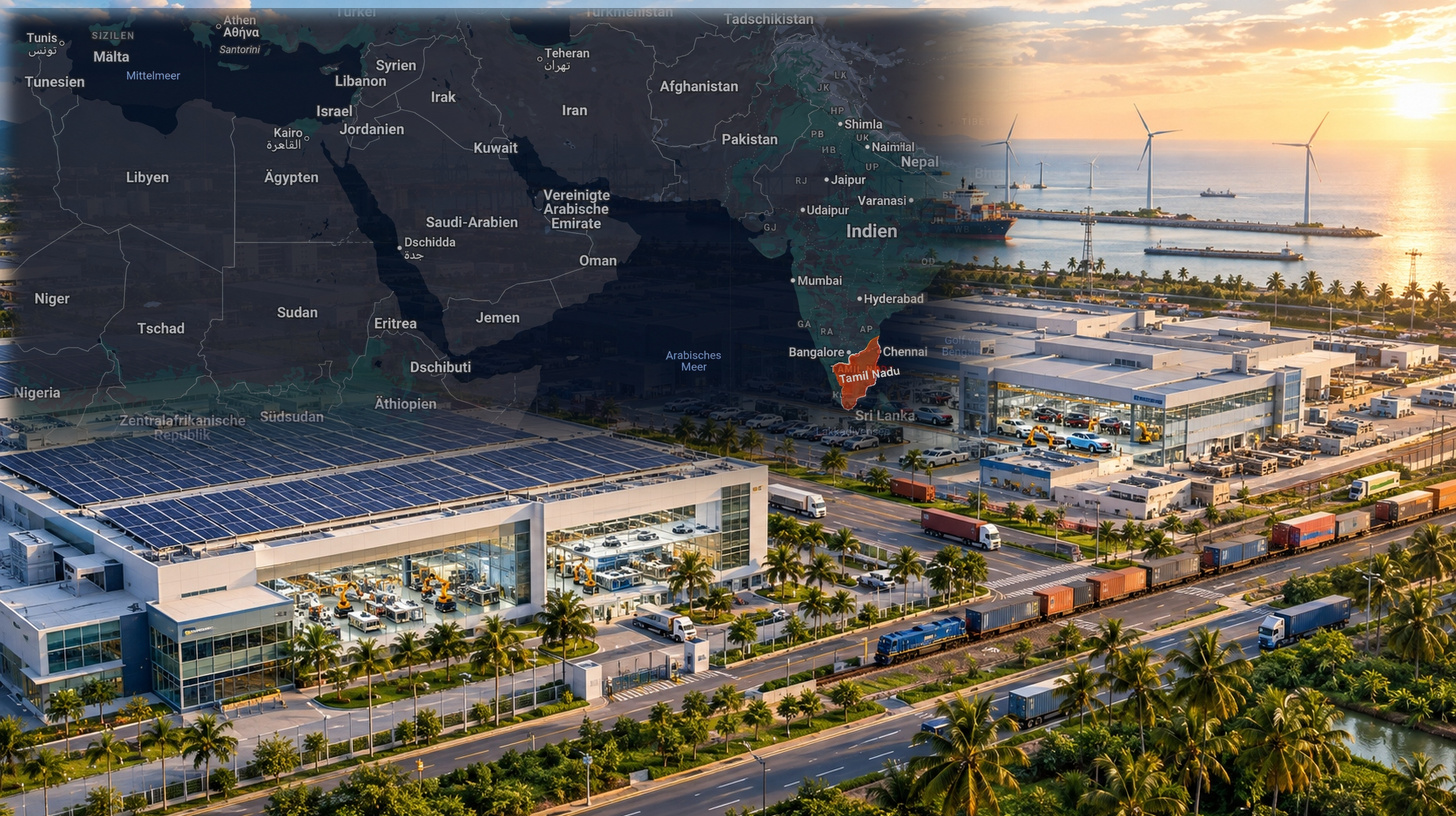
Tamil Nadu's industrial belt: How SIPCOT is rewiring India's workbench – When the state organizes – Creative image on the topic, with AI: Xpert.Digital
How Tamil Nadu is mastering global competition through industrial parks
Tamil Nadu: India's emerging industrial center in focus
SIPCOT: The engine for Tamil Nadu's industrial transformation
Tamil Nadu has established itself as one of India's most promising industrial locations, offering a unique combination of infrastructure, skilled workforce, and government support. At the heart of this industrial revolution is the State Industries Promotion Corporation of Tamil Nadu (SIPCOT), which acts not only as a land developer but also as a strategic instrument for pooling investment and fostering economic activity. The state benefits from a remarkable concentration of industries, ranging from automotive manufacturing and electronics to textiles. This diversity, coupled with targeted government support, makes Tamil Nadu attractive to international investors seeking a stable and dynamic market. The following sections will explore how Tamil Nadu is building on its industrial strengths to thrive as an innovation hub in the global economy while addressing the challenges of a rapidly evolving industrial environment.
From manufacturing to innovation: Tamil Nadu's path to economic strength
When the state organizes: India's industrial boom will not be left to the market – Tamil Nadu is building it according to plan
Tamil Nadu is one of the few locations in emerging markets where industrial diversity, export capability, a skilled workforce, urban service centers, and state-developed production facilities already interact on a large scale. This makes the southern Indian state more attractive to international investors than regions that primarily promote themselves with low costs, individual large-scale projects, or tax breaks. Tamil Nadu's decisive advantage is not an isolated factor, but rather the density of a system that has grown over decades. Automotive manufacturers, electronics producers, textile companies, leather processors, mechanical engineering firms, and chemical and pharmaceutical companies rely on specialized suppliers, engineers, ports, airports, universities, and industrial services.
At the heart of this location architecture is the State Industries Promotion Corporation of Tamil Nadu, or SIPCOT for short. This state-owned company develops industrial parks, growth centers, and special economic zones, provides developed land, and links land allocation with permits, infrastructure, and financial incentives. Its role thus extends far beyond that of a land developer. SIPCOT is an industrial policy instrument through which Tamil Nadu spatially concentrates investments, deepens value chains, and strategically directs economic activity from overburdened core areas to new districts.
The model is economically remarkable because it addresses a classic conflict of objectives. Companies want locations with existing networks, reliable infrastructure, and short distances. The government, on the other hand, wants to distribute growth regionally, create jobs outside the major cities, and limit land prices. Tamil Nadu is attempting to reconcile these two interests through tiered subsidies, specialized parks, and new transport corridors. The success of this strategy will determine whether the state remains merely a large manufacturing hub or evolves into a higher-value, innovation-driven industrial center.
An economy with industrial substance
Tamil Nadu's economic output is estimated at around 35.29 trillion rupees for the 2025/26 financial year, making it India's second-largest economy. Even more important than its absolute size is its structure: at constant prices, the manufacturing sector contributes around a quarter of gross value added, significantly more than the Indian average. For investors, this means that industrial policy here does not have to contend with a predominantly agrarian or purely service-oriented economic structure. It can build on a broad foundation.
Growth momentum is also considerable. Tamil Nadu recorded real growth of more than eleven percent in 2024/25; the manufacturing sector expanded even more strongly. Such figures should not be uncritically extrapolated into the future, as base effects, price developments, and the investment cycles of individual sectors all play a role. Nevertheless, they demonstrate that the region is not solely reliant on its historical industrial base. New capacities in electronics, automotive manufacturing, renewable energies, defense, aerospace, and data-intensive services are broadening the economic foundation.
The state also boasts India's largest number of registered factories. For 2024/25, 41,221 production facilities were reported, representing more than 15 percent of all registered Indian factories. Tamil Nadu also leads in industrial employment, accounting for nearly 15 percent of the workforce employed in India's registered manufacturing sector. However, in terms of its share of the country's industrial gross value added, Tamil Nadu lags behind Maharashtra and Gujarat. This presents a key economic policy challenge: the high number of factories and jobs must be translated into increased productivity, greater local development, larger companies, and higher value added.
This difference is crucial for a dispassionate location assessment. A large industrial employment base is an advantage, but it can also indicate labor-intensive production structures, fragmented supply networks, and limited automation. Tamil Nadu must therefore manage two developments simultaneously. On the one hand, labor-intensive industries such as textiles, apparel, leather, and assembly must remain competitive. On the other hand, the region must expand further into sophisticated electronics, precision manufacturing, research, software integration, and industrial services. The industrial parks will thus become sites of technological structural change, not merely places where land is provided.
SIPCOT as the operating system of industrialization
SIPCOT was established in 1971 to develop industrial complexes and provide businesses with basic and advanced infrastructure. In an earlier phase of development, the network comprised 24 industrial complexes in 15 districts, along with six industry-specific special economic zones, covering a total of approximately 35,043 acres. The platform has since grown considerably. By 2026, SIPCOT had 54 industrial parks, including eight special economic zones, in 27 districts, encompassing approximately 50,060 acres. These parks housed some 3,596 industrial units, which had triggered investments of around 2.47 trillion rupees and created roughly 960,000 jobs.
This expansion demonstrates that SIPCOT should not be viewed as a static park portfolio. The company functions as a scalable network, developing new industrial corridors and expanding existing clusters. An additional 14,840 acres at 30 locations had been identified for new parks; more than 33,600 acres were in the acquisition process for 44 additional projects. This scale also highlights the associated risks. Land acquisition, development, environmental impact assessments, water and electricity supply, and transportation connections must be coordinated. A large land holding does not automatically translate into industrial productivity if connections are lacking or permits delay the start of production.
The economic logic of the SIPCOT model lies in reducing transaction costs. A foreign company that would have to independently acquire land from numerous owners, build access roads, organize utility lines, and apply for permits from various authorities would face significant time, legal, and project risks. A pre-developed industrial park consolidates these tasks. This makes costs more predictable, projects more financially viable, and timelines more reliable. For medium-sized investors without extensive local infrastructure, this difference can be decisive in their market entry.
SIPCOT also acts as a central hub for the approval and disbursement of structured funding packages for large industrial projects. These include exemptions from stamp duties, incentives for future-oriented industries, and special procedures for foreign companies exceeding defined investment thresholds. From an economic policy perspective, this creates a system encompassing land, infrastructure, administration, and funding. While this consolidation is efficient, it also carries governance risks. The more investment decisions are coordinated by government agencies, the more crucial transparent criteria, reliable deadlines, and a comprehensible prioritization of scarce land become.
Clusters instead of indiscriminate factory development
The industrial park network spatially reflects Tamil Nadu's industrial diversity. Ranipet combines leather processing with mechanical engineering, chemicals, and pharmaceuticals. Hosur has developed into a center for electrical engineering, electronics, vehicles, pharmaceuticals, and other export-oriented activities. Pudukottai focuses on plastic bags, iron and steel foundries, and general mechanical engineering, among other things. Manamadurai combines the electrical and electronics industry, plastics processing, textiles, zippers, graphite, and general engineering manufacturing.
The density of industrial activity is particularly high in the greater Chennai area and along the northern industrial corridors. Gummidipoondi is home to steel, chemicals, mechanical engineering, automotive suppliers, component manufacturers, and plastics processors. Irungattukottai combines automotive manufacturing, the automotive supply industry, engineering, and electronics; affiliated sub-parks focus on apparel, footwear, and shoe components. Pillaipakkam and its associated supplier park serve vehicles, components, mechanical engineering, and electronics. Sriperumbudur combines float glass, electronics, and automobiles, while Oragadam is dedicated to vehicles, electronics, and tires. Thervoy Kandigai complements this profile with tire, automotive, and electronics production.
This concentration is no accident. An automotive or electronics cluster gains efficiency with each additional supplier. Tools, molds, packaging, maintenance, quality control, logistics, and recruitment can all be sourced locally. Employees move between companies, knowledge spreads, and specialized service providers reach economic scale more quickly. For a new investor, such an environment reduces the risk of a single supply chain disruption crippling the entire production. At the same time, however, it creates a high dependence on the same roads, substations, water sources, and ports.
South and west of the capital region, the parks have different focuses. Thoothukudi combines chemicals, marine products, salt, spices, cold storage, plastic packaging, and textiles with a major seaport. Cuddalore is characterized by chemicals, pharmaceuticals, petrochemicals, and mechanical engineering. Nilakottai offers space for agriculture, biotechnology, medicinal plants, and food and fruit processing. Bargur combines mechanical engineering, chemicals, food processing, granite, and horticulture. Perundurai is a significant location for textile and hosiery processing, dyeing, foundries, leather, mechanical engineering, and chemicals.
Gangaikondan combines textiles, light industry, granite processing, and mineral-based production. Cheyyar focuses on light machinery, vehicles, footwear, and plastics. Mappedu, as a dry port, plays a key logistical role. Vallam-Vadagal is dedicated to electronics and vehicle components and also houses an aviation park. The Siruseri IT Park, in turn, demonstrates that the model is not limited to traditional heavy industry: software, hardware, electronics, IT products, and IT-supported services can be integrated with the region's industrial base there.
Special economic zones as export machines with borders
The special economic zones established by SIPCOT deepen specialization. The high-tech zone in Sriperumbudur targets electronics companies, while Oragadam accommodates electronic hardware. Bargur focuses on granite. Perunduari and Ranipet have engineering zones, and Gangaikondan has a special economic zone for transportation technology, including tires and hoses. The instrument aims to geographically concentrate export production, simplify customs and administrative processes, and integrate companies into international supply chains.
Special economic zones can accelerate investment, but their effectiveness depends on their real integration into the regional economy. A zone that primarily assembles imported components and re-exports finished products will generate employment and trade volume, but only limited local value creation. Greater economic benefits arise when intermediate goods, machinery, software, testing services, and development increasingly originate within Tamil Nadu itself. The key indicator, therefore, is not solely the export value, but the share of local value added.
Tamil Nadu's strong electronics development highlights this ambivalence. Electronics exports reached nearly US$20 billion in 2025/26, accounting for more than 41 percent of India's total electronics exports. Large contract manufacturers and smartphone supply chains have made the state India's leading electronics exporter. This position is strategically valuable because it generates economies of scale and attracts new suppliers. However, it remains vulnerable as long as key semiconductors, displays, manufacturing equipment, and core components are imported. The next step in development involves increasing component manufacturing, product development, industrialization expertise, and intellectual property.
The new electronics clusters in Manallur and Pillaipakkam are intended to contribute to this. The sites cover approximately 474 and 379 acres respectively and are being developed with a combined investment of more than ten billion rupees. Their quality will not be measured by how quickly space is occupied, but rather by whether a deeper ecosystem of toolmaking, printed circuit boards, enclosures, power supplies, sensors, testing technology, and research emerges. Only then will an export-oriented assembly base become a sustainably resilient technology hub.
From car center to broad mobility economy
Tamil Nadu is often called the Detroit of India. Manufacturers such as Hyundai, BMW, and Renault-Nissan, along with a dense network of suppliers, have created a powerful automotive cluster in the greater Chennai area, including Oragadam, Sriperumbudur, Irungattukottai, and Hosur. The economic value of this cluster extends beyond assembled vehicles. It encompasses foundries, tires, electronics, metalworking, plastics manufacturing, logistics, engineering, testing services, and increasingly, software.
However, the global shift to electromobility is changing the rules of the game. Electric motors require fewer moving parts than combustion engines; batteries, power electronics, software, and thermal management are becoming increasingly important. For traditional suppliers, this can lead to a gradual decline in established product lines. Tamil Nadu's support policies for electric vehicles and battery manufacturing are therefore not only a tool for attracting new businesses but also for safeguarding existing industrial capital.
SIPCOT parks can facilitate the transition by offering shared testing facilities, reliable high-power power connections, recycling solutions, and hazardous materials management areas. Equally important are training programs for employees from the traditional automotive industry. The transformation will be economically successful if existing expertise in metalworking, electrical engineering, quality control, and series production is transferred to new mobility products. Simply replacing old companies with new investors, on the other hand, would incur high social and fiscal costs.
Beyond electromobility, the proximity between automotive manufacturing, electronics, aerospace, and defense opens up additional opportunities. The Vallam-Vadagal Aerospace Park and the Tamil defense corridor, with hubs in Chennai, Tiruchirappalli, Coimbatore, Salem, and Hosur, can foster precision manufacturing, composite materials, avionics, and safety-critical software. These markets demand high certification standards and long-term supply relationships. They therefore offer higher barriers to entry but also more stable margins than simple assembly.
Your intralogistics experts

Consulting, planning and implementation of complete solutions for high-bay warehouses and automated storage systems - Image: Xpert.Digital
More information here:
The importance of special economic zones in Tamil Nadu
Textiles, leather and chemicals remain systemically important
Public attention is heavily focused on electronics and vehicles. However, traditional industries remain vital for employment, regional development, and export diversification. Tamil Nadu accounted for approximately one-third of India's textile exports in 2025/26. Centers such as Perundurai, Coimbatore, Tiruppur, and Erode combine spinning, processing, dyeing, garment production, machinery, and trade. Ranipet and other locations have similar networks in the leather and footwear industries.
These industries are under intense pressure regarding costs and sustainability. Water consumption, wastewater, chemicals, energy prices, and international due diligence obligations all impact access to customers. Industrial parks offer an advantage here because shared wastewater treatment, recycled water, centralized energy supply, and controlled waste disposal can be organized more efficiently than in scattered, individual facilities. If these systems are consistently modernized, environmental infrastructure can transform from a regulatory burden into an export advantage.
Conversely, the risks are considerable. Chemical production, dye works, tanneries, and petrochemical plants can strain local water and soil resources. The acceptance of new parks decreases when communities bear environmental costs without sufficiently benefiting from jobs, infrastructure, and revenue. Environmental impact assessments are therefore not a minor administrative procedure, but rather an integral part of economic viability.
Tamil Nadu distinguishes between different categories for development projects. Category A projects require prior environmental approval from the central government. Category B projects generally fall under the jurisdiction of the state or union territory; B1 projects require an environmental impact assessment, while B2 projects do not. Thervoy Kandigai is classified as Category A, while Pillaipakkam, Vallam-Vadagal, the aviation park there, and Vaipur-Mathur are classified as B1 and B2 sites, respectively. For investors, this classification influences the timeline, assessments, project costs, and future expansion possibilities.
Land policy as a lever against regional inequality
Tamil Nadu's support architecture divides the districts into three groups. Category A includes the highly developed core areas of Chennai, Chengalpattu, Kancheepuram and Tiruvallur. Category B includes Coimbatore, Erode, Karur, Krishnagiri, Namakkal, Nilgiris, Ranipet, Salem, Tiruchirappalli, Tirupattur, Tiruppur and Vellore among others. Category C includes a broad group of less industrialized districts including Ariyalur, Cuddalore, Dharmapuri, Dindigul, Kallakurichi, Kanniyakumari, Madurai, Nagapattinam, Pudukottai, Ramanathapuram, Sivagangai, Tenkasi, Thanjavur, Theni, Thoothukudi, Tirunelveli, Tiruvannamalai, Villupuram and Virudhunagar.
For projects in Category A and B districts, SIPCOT can grant a subsidy of ten percent of land costs. In Category C districts, the subsidy can reach 50 percent. The government is thus attempting to significantly increase the cost advantage of peripheral locations. Additional rules apply to specialized programs. In the Vallam-Vadagal Aviation Park, for example, the land cost subsidy can amount to 20 percent. Independent research and development projects registered with the relevant research authority can also receive support.
The logic is understandable, but a high land discount doesn't automatically compensate for structural disadvantages. Companies assess the total costs over several years: transport time, electricity quality, water, availability of skilled workers, housing, schools, suppliers, and management accessibility. If a location, despite cheap land, consistently incurs higher logistics and operating costs, the subsidy loses its effectiveness. The 50 percent relief in category C is therefore only truly beneficial when combined with infrastructure investments and capacity building.
Overly generous subsidies also carry the risk of windfall gains. Companies can receive subsidies even though they would have invested anyway, or reserve land without quickly putting it into productive use. Tamil Nadu therefore needs clear milestones for investment, employment, and the start of construction, as well as mechanisms for reclaiming funds in case of non-compliance. The most economically beneficial subsidy is not the highest, but rather the one that triggers additional, sustained activity.
Land allocation: between speed and proof requirements
The formal target time for land allocation in a SIPCOT park is 60 days. The average processing time reported was 48 days, but in individual cases, the process could take up to 244 days. For investment-related incentives, the average was 99 days, while the maximum duration reported was 172 days. This range shows that standardized cases can be processed relatively quickly, but complex projects take considerably longer.
The application is submitted via Tamil Nadu's central digital portal. Companies must provide a brief project report, proof of incorporation and registration, a company agreement and articles of association, as well as verified information on management, shareholders, or partners. Existing companies must also submit audited annual financial statements, a balance sheet, and a profit and loss statement. Furthermore, registration for goods and services tax, a rough building layout confirmed by a civil engineer, any necessary approvals from the environmental authority, proof of financing, and, for foreign direct investments, the relevant permits are required.
The processing fee was set at 10,000 rupees plus tax and was non-refundable. In addition, there was an initial, refundable deposit of 10,000 rupees per acre if no land was allocated. In absolute terms, these fees are low for large industrial projects. The real hurdle lies in the quality and consistency of the documentation, as well as in coordinating financing, construction planning, and permits.
For international investors, the average cost is less important than the reliability of a binding project timeline. A manufacturer can plan for a delay if it is foreseeable early on. More problematic are unclear responsibilities, subsequent requirements, or interdependent permits without a coordinated sequence. Tamil Nadu's digitized administration improves transparency but does not replace institutional cooperation. A true one-stop shop system must not only receive applications but also actively resolve conflicts between authorities.
Logistics determines real competitiveness
Industrial parks are only as efficient as their connections to sourcing and sales markets. Tamil Nadu benefits from a long coastline, multiple ports, international airports, and important road and rail corridors. Chennai, Kamarajar, and Kattupalli serve the northern industrial belt; the V.O. Chidambaranar port in Thoothukudi opens the south to international trade. This multi-port structure reduces dependence on a single gateway but does not eliminate local bottlenecks.
Tamil Nadu's logistics policy envisions 50 measures over ten years and an initial investment of approximately 630 billion rupees for three priority freight corridors. A multimodal logistics park is being built on 182 acres in Mappedu, near Chennai, with an estimated cost of 14.23 billion rupees. Additional land is required for rail connections and shunting areas. Another multimodal center is planned near Thoothukudi.
Such hubs can consolidate transport, shift containers from road to rail, and increase the reliability of port connections. However, the economic benefits only materialize if the interfaces function properly. Different operators, customs processes, terminal times, and a lack of digital data connections can negate the advantages of modern infrastructure. Predictable transit times are crucial, not just nominal capacities.
The expansion of Thoothukudi broadens the industrial prospects of the south. Investments in road and rail connections, port capacity, digitalization, renewable energy, battery storage, green hydrogen, and potentially future green fuels can attract new chemical, energy, and export industries. At the same time, it should not be overlooked that large-scale projects are capital-intensive and demand forecasts remain uncertain. Port, energy, and park development must therefore proceed in realistic phases, rather than anticipating capacities based on speculative expectations.
Energy, water and climate as a location assessment
Tamil Nadu boasts a high share of renewable energy in its installed electricity capacity and is one of India's key wind and solar markets. This advantage is gaining value for export-oriented companies, as international customers and corporations increasingly demand lower-emission supply chains. A factory located in a SIPCOT park can improve its competitive position by gaining access to renewable electricity, storage, load management, and reliable consumption documentation.
However, the share of renewable energy capacity does not equate to a 24/7 green energy supply. Wind and solar power fluctuate; grid expansion, flexible generation, and storage must keep pace. Electronics, chemicals, data centers, and automated manufacturing are sensitive to interruptions and voltage fluctuations. Therefore, the quality of the electricity supply remains just as important as its price and its accounting origin.
Water is the more critical bottleneck in many industrial areas. Semiconductor-related processes, chemicals, textile finishing, leather, and food production require large quantities and high quality standards. At the same time, industry, agriculture, and cities compete for limited resources. New water parks should therefore not be planned based on theoretical connection volumes, but rather on reliable water balances, wastewater recycling, stormwater management, and clear rules for dry periods.
Climate risks exacerbate these requirements. Tamil Nadu is affected by heat and water scarcity as well as heavy rainfall, flooding, and cyclones. For investors, drainage, elevated construction, redundant power supplies, emergency logistics, and insurance coverage must be factored into the site selection. A modern industrial park must be not only efficient but also resilient. Otherwise, short-term savings on development costs can be far outweighed later by production losses.
People decide on the next stage of the value chain
Tamil Nadu's large industrial employment base is a key advantage. The state boasts universities, technical institutes, and a skilled workforce in manufacturing, engineering, and IT. The connection between Chennai as a service and technology hub and the industrial clusters facilitates the integration of software, automation, and data-driven production. For Industry 4.0, this combination is more important than labor costs alone.
SIPCOT has established innovation centers in its parks, designed to bring together technical infrastructure, expertise, and product development. Such facilities can provide smaller suppliers in particular with access to testing equipment, prototyping, and consulting. However, their success depends on their use by companies and universities. An innovation center without qualified personnel, open programs, and industrially relevant equipment quickly becomes a mere showpiece rather than a driver of productivity.
Increasing automation is changing the labor market. New factories do not necessarily create a proportional number of jobs to the amount of investment. Electronics assembly and textiles can still generate significant employment effects, while highly automated chemical, battery, or precision engineering plants are more capital-intensive. Economic policy should therefore not consider employment figures in isolation. Quality, wages, further training, female participation, safety, and career advancement opportunities are equally relevant to the societal impact.
The regional expansion of industrial parks, in particular, demands social infrastructure. Employees need affordable housing, public transportation, healthcare, and schools. Long commutes increase employee turnover and reduce productivity. Companies benefit when new industrial parks are planned not as isolated production islands, but as integrated economic hubs.
The investment argument – and its weaknesses
For foreign investors, Tamil Nadu offers a rare combination: a large domestic market, export ports, established industries, specialized suppliers, and government-developed land. More than 300 US companies with hundreds of projects and billions of dollars in investment underscore its international integration. City partnerships and institutional relationships can facilitate contacts but do not replace due diligence.
Its greatest strength is diversification. A location that combines automotive, electronics, textiles, leather, chemicals, pharmaceuticals, aerospace, IT, and food is less dependent on a single industry cycle. At the same time, overlaps enable new products, such as vehicle electronics, industrial software, technical textiles, or precision components for aerospace and medical technology.
The biggest weakness lies in the potential overload of successful corridors. Land prices, traffic, water demand, and housing costs are rising, particularly in the greater Chennai area. Therefore, expansion into Category B and Category C districts is economically necessary. However, it must not be imposed administratively, but rather made attractive through real infrastructure and competence clusters.
Further risks arise from global trade conflicts, changing subsidy regulations, import dependency on technology components, and competition from other Indian states. Gujarat, Maharashtra, Karnataka, Telangana, Uttar Pradesh, and Andhra Pradesh are developing their own industrial parks and incentive programs. Tamil Nadu cannot permanently win this competition through land discounts alone. Decisive factors will be speed of implementation, skilled labor, supplier base, energy quality, and institutional reliability.
From site developer to productivity manager
SIPCOT's next development phase should be measured less by the number of new acres and more by their economic performance. Relevant indicators would be the actual productive area, investment per acre, local value creation, export intensity, water reuse, renewable electricity consumption, wage growth, and the number of skilled jobs. This would prevent conflation of land occupancy with development success.
Equally important is an active supplier program. Large investors should be systematically connected with small and medium-sized enterprises, universities, and technology centers. Local businesses need support with quality standards, financing, digitalization, and international certifications. The more suppliers move up to higher quality levels, the greater the regional multiplier effect of an investment.
The park management can also organize shared services: wastewater recycling, energy procurement, rooftop solar panels, storage, hazardous materials logistics, fire services, training centers, and digital traffic management. Such platforms reduce costs and facilitate compliance with higher environmental standards. They are particularly valuable for medium-sized companies that could not operate such systems economically on their own.
Ultimately, Tamil Nadu needs consistent support for its existing businesses. While the spectacular establishment of a new large-scale factory garners political attention, expansion investments by existing companies are often faster, less risky, and more locally rooted. A park system that identifies problems faced by existing businesses early on and provides expansion areas protects the industrial base better than simply promoting new businesses.
Tamil Nadu's real bet
Tamil Nadu is betting that state-coordinated industrial sites, private investment, and established clusters will together enable a new level of industrialization. The starting point is strong: a multi-billion-dollar economy, India's largest factory base, leading positions in industrial employment and electronics exports, and a broad portfolio ranging from vehicles to textiles. SIPCOT has developed a nationwide network from individual industrial complexes, supporting hundreds of thousands of jobs and trillions of dollars in investment.
But size alone does not guarantee a lasting advantage. The crucial question is whether Tamil Nadu can generate more technology from export assembly, more productivity from factory numbers, and genuine regional development from land promotion. To achieve this, parks must become integrated production systems where logistics, energy, water, innovation, skills development, and housing are planned together.
If this transition succeeds, SIPCOT can become a model for the next phase of Indian industrial policy: not as an isolated special zone, but as an interconnected ecosystem with a regional supply base and global market access. If it fails, overstretched infrastructure, subsidized land reserves, and costly competition for interchangeable assembly projects are likely.
The reasoned outlook is therefore positive, but not euphoric. Tamil Nadu possesses better industrial prerequisites than most competing locations in South Asia. Its advantage is based on decades of accumulated expertise and is real. However, it will only last if the state improves the quality of its infrastructure faster than the complexity of its economy grows. SIPCOT is not merely an administrator of industrial parks. The company is where it will be decided whether Tamil Nadu's industrial mass translates into lasting economic power.
Your global marketing and business development partner
☑️ Our business language is English or German
☑️ NEW: Correspondence in your native language!

Konrad Wolfenstein
I and my team are happy to be available to you as your personal advisor.
You can contact me by filling out the contact form here wolfenstein@xpert.digital:or simply call me at +49 7348 4088 965. My email address is
I'm looking forward to our joint project.