

Solar power on the runway: Why SOF Connect at Sofia Airport is making its own energy transition a business strategy

Available in 27 languages 📢
Prefer Xpert.Digital on GoogleⓘPublished on: September 22, 2026 / Updated on: September 22, 2026 – Author: Konrad Wolfenstein
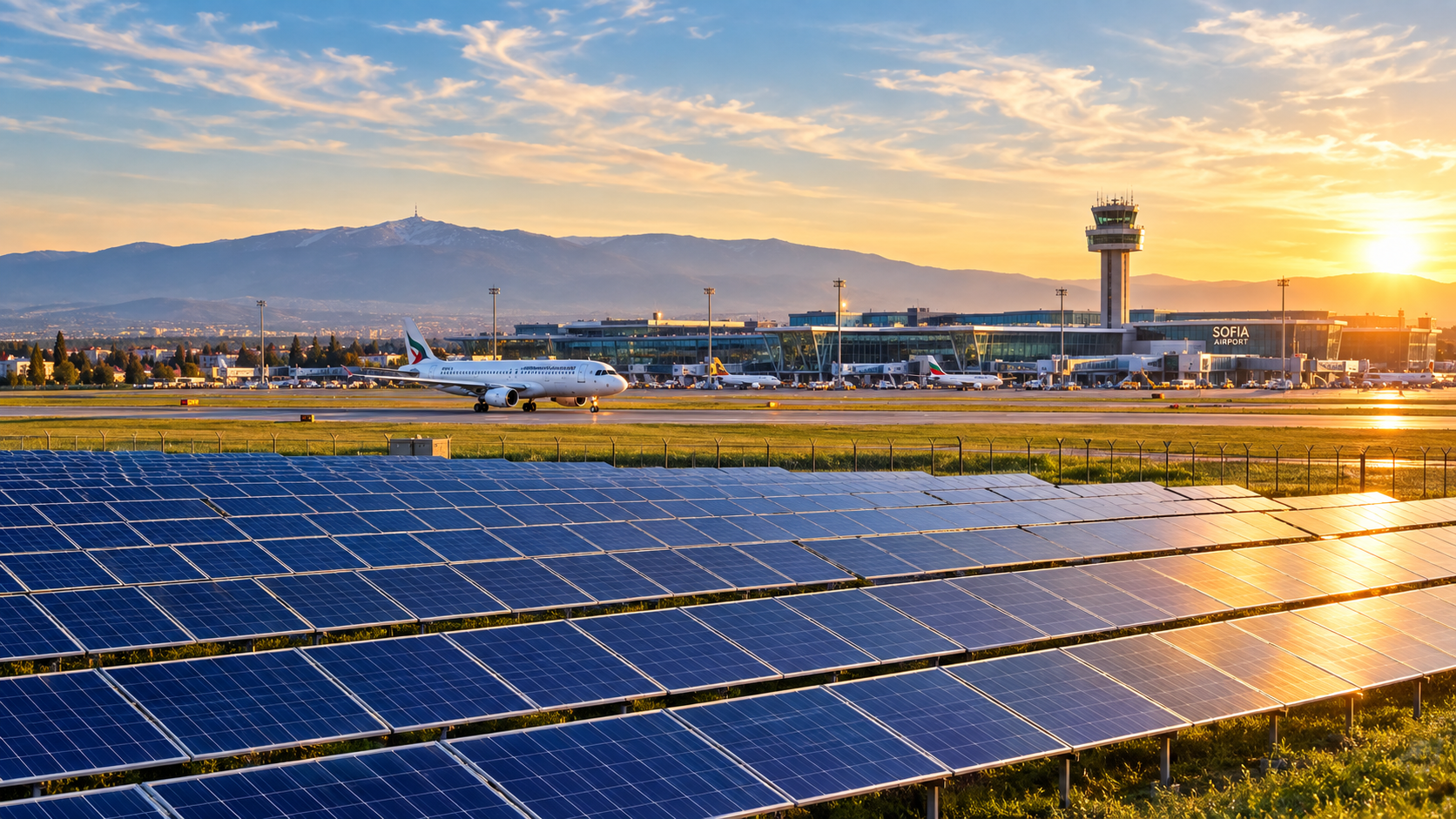
Solar power on the runway: Why SOF Connect at Sofia Airport is making its own energy transition a business strategy – Creative image on the topic, with AI: Xpert.Digital
More than just a green image: The clever solar strategy at Sofia Airport
Protection against price explosions: Why Sofia Airport is building a huge solar park
5 megawatts for self-consumption: How Sofia Airport is reducing its electricity costs
At Sofia Airport, it's not just planes that are rolling, but also excavators for a local energy transition: With the construction of a 5-megawatt solar park, the operating company SOF Connect is embarking on a path that goes far beyond mere sustainability pledges for the PR department. Given volatile electricity prices and growing grid congestion in the Bulgarian market, the airport's own green infrastructure is becoming a hard economic calculation. But why is the plant initially significantly smaller than originally planned by the consortium? A closer look at the project reveals how closely the interests of international investors, local construction expertise, and strategic brand management are intertwined – and why the consistent decision for purely on-site consumption is an exceptionally smart, profit-driving move.
A 5-megawatt solar park serves as a litmus test to see whether green infrastructure is more than just a PR promise
At Sofia's Vasil Levski International Airport, operator SOF Connect began construction in September 2026 on its own 5-megawatt photovoltaic plant. The plant, covering approximately 50,000 square meters of airport-owned land, will consist of 8,300 solar modules and an intelligent, real-time monitoring and control system. The electricity generated will not be fed into the public grid but will be used exclusively for the airport's own consumption, covering a significant portion of its energy needs. Completion is scheduled for the end of 2026. The project is being carried out by the Bulgarian company Hydroenergy Company AD, which, according to its own statements, has over 19 years of experience in solar construction in 21 countries across six continents.
Behind this seemingly unremarkable announcement lies a highly interesting economic development. It combines the business logic of an energy-intensive infrastructure operator with the dynamics of one of Europe's fastest-growing solar markets, the price realities of a volatile electricity market, and the strategic interests of international infrastructure investors. Those who view this development merely as a symbolic green project underestimate its economic substance. Those who consider it solely as a return-on-investment calculation overlook the regulatory and brand-strategic drivers. The truth, as is so often the case with infrastructure decisions, lies in the interplay of both levels.
The operator and his interests
To understand the decision, one must understand who SOF Connect is and under what contractual conditions the company operates. SOF Connect AD is the concession company that has operated Sofia Airport for 35 years since April 2021. The sole owner of the capital is currently the French infrastructure fund Meridiam, while Munich Airport contributes its expertise as the operational operator. The Austrian construction company Strabag was originally also part of the consortium, and the European Bank for Reconstruction and Development acquired an indirect stake in 2021. In a highly competitive bidding process in 2019, the consortium prevailed against bidders such as Aéroports de Paris, Fraport, and the Manchester Airports Group, even though it did not offer the highest concession fee, but instead impressed with an ambitious investment and modernization plan.
This constellation is crucial for understanding the solar project. Meridiam is not a short-term-oriented financial investor, but explicitly pursues long-term, sustainability-focused investment strategies with holding periods extending over decades. Munich Airport, in turn, operates its home base with its own ambitious climate program and brings with it technical standards designed for CO₂ reduction and energy efficiency. Both owners therefore have a vested interest in developing Sofia Airport not only from a business perspective, but also in terms of environmental, social, and governance (ESG) criteria. The concession agreement obligates SOF Connect to invest at least €624 million over its term, including the construction of a new Terminal 3 within the first ten years, as well as environmental, health, and safety improvements. The solar park is thus not an isolated project, but rather a component of a contractually enshrined transformation program.
Added to this is a financial obligation that increases the pressure to reduce operating costs. SOF Connect pays the Bulgarian state an annual concession fee of 32 percent of revenue, or at least €24.5 million, as well as a one-time upfront payment of approximately €281 million. With such a high proportion of revenue flowing out of the country, any sustained reduction in operating costs directly impacts profitability. In September 2026, Bulgarian Prime Minister Rumen Radev and Meridiam's management met to discuss concession payments and investments, with the government emphasizing that the deferral of concession fees granted during the pandemic was no longer justified given the resurgence of passenger numbers. The environment is therefore characterized by a certain degree of fiscal tension, in which a project that reduces energy costs in the long term is also politically well-positioned.
Why solar power now of all times?
The business logic behind the project only becomes clear when viewed against the backdrop of Bulgarian electricity prices. Bulgaria is no longer among the countries with particularly cheap electricity in Europe. On the day-ahead wholesale market, prices in September 2026 ranged from €150 to over €210 per megawatt-hour on some days, with daily averages sometimes exceeding €200. The 30-day average hovered around €164 per megawatt-hour. In January 2026, the country recorded some of the highest prices in the region, peaking at around €282 per megawatt-hour, significantly higher than neighboring Greece on the same day.
This price trend has tangible industrial policy consequences. Vasil Velev, Chairman of the Bulgarian Industrial Capital Association, described electricity costs for domestic manufacturers as many times higher than for competitors in the US and China. For an airport whose electricity consumption is driven by air conditioning, lighting, baggage handling systems, security technology, and an increasingly electric ground handling fleet, these are not abstract figures. Every kilowatt-hour generated on-site, without relying on the grid, replaces a kilowatt-hour that would otherwise have to be purchased at these volatile and generally rising market prices, plus grid fees and levies.
This is precisely where the economic leverage of the self-consumption model lies. Unlike a solar park that feeds into the grid and whose revenues are tied to fluctuating market prices or negotiated power purchase agreements, self-consumed electricity does not compete with the wholesale price, but with the full end-customer price, including all markups. Given the grid and distribution charges applicable in Bulgaria, which are added to the energy price, the financial outlook for self-generation improves significantly. Market analyses for Bulgaria indicate that the amortization period for grid-connected systems under 200 kilowatts is less than six years at end-customer tariffs. A significantly larger system on private land, dedicated entirely to self-consumption, should perform similarly or even better, provided that the generated electricity is largely consumed on-site.
A rough economic estimate
Since SOF Connect has not disclosed the investment amount, the return on investment can only be roughly estimated. The following analysis is intentionally intended as a guideline and not as an exact calculation, because key parameters such as actual construction costs, self-consumption rate, and future electricity price trends are not publicly available.
For a rooftop or ground-mounted solar power plant of this size in Southeast Europe, construction costs typically range from roughly €600 to €900 per kilowatt of installed capacity, which corresponds to an investment of approximately €3 to €4.5 million for a 5-megawatt plant. Bulgaria enjoys high solar irradiance, averaging 2,000 to 2,600 hours of sunshine per year, making an annual specific yield of around 1,300 to 1,500 kilowatt-hours per kilowatt realistic. This results in an annual production of roughly 6.5 to 7.5 million kilowatt-hours.
| parameter | Assumed order of magnitude | basis |
|---|---|---|
| Installed power | 5 MW | Project details |
| Area | approximately 50,000 m² | Project details |
| Module | 8,300 units | Project details |
| Annual yield (specific) | 1,300–1,500 kWh/kWp | Radiation Bulgaria |
| Annual production | roughly 6.5–7.5 GWh | rough calculation |
| Avoided electricity price | above the wholesale level, which was temporarily above EUR 200/MWh in 2026 | Market prices 2026 |
Even with conservative calculations, this results in annual avoided electricity purchases in the low single-digit millions of euros, assuming the full end-customer price. Against this backdrop, amortization within a few years seems plausible, although the actual profitability depends crucially on the proportion of self-consumed electricity. Since an airport has a consistent base load consumption throughout the day, the conditions for a high self-consumption rate are significantly better here than in many other solar applications. This is precisely why the planned second expansion phase with a battery storage system makes so much sense, as it allows the afternoon solar surplus to be shifted to the evening and night hours when electricity prices are highest.
New: Patent from the USA – install solar parks up to 30% cheaper and 40% faster and easier – with explanatory videos!

New: Patent from the USA – Install solar parks up to 30% cheaper and 40% faster and easier – with explanatory videos! - Image: Xpert.Digital
The core of this technological advancement is the deliberate departure from conventional clamp mounting, which has been the standard for decades. The new, more time- and cost-effective mounting system addresses this with a fundamentally different, more intelligent concept. Instead of clamping the modules at specific points, they are inserted into a continuous, specially shaped support rail and held securely in place. This design ensures that all forces – whether static loads from snow or dynamic loads from wind – are distributed evenly across the entire length of the module frame.
More information here:
The network bottleneck as a hidden driver of returns
The network bottleneck as a hidden driver of returns
One aspect that is often overlooked in public reporting deserves special attention because it truly explains the self-consumption strategy. Bulgaria's solar market has grown explosively in just a few years. Installed photovoltaic capacity rose from just over one gigawatt at the beginning of 2021 to almost six gigawatts at the end of 2025, with around 1,416 megawatts added in 2025 alone – the third consecutive year with more than one gigawatt of new capacity. An auction in November 2024 awarded 3 gigawatts of new solar rights at €55 per megawatt-hour, around 30 percent below the previous feed-in tariff.
This rapid growth, however, is pushing the power grid to its physical limits. The 110-kilovolt grid can only accommodate approximately 12 gigawatts nationwide, while solar power is heavily concentrated in the south. This forced the grid operator ESO to curtail up to 15 percent of peak photovoltaic output in the summer of 2024. This curtailment cost producers an estimated 8 million euros and triggered force majeure clauses in several power purchase agreements. For an operator looking to invest in a grid-connected solar project, this curtailment risk would significantly reduce returns.
SOF Connect's decision to produce exclusively for its own consumption elegantly circumvents this problem. Those who consume their own electricity downstream of the grid connection point are largely independent of curtailment, feed-in tariffs, and grid congestion. The airport thus transforms a market risk into a calculable cost saving. In a country where further expansion increasingly depends on grid capacity and storage capabilities, this self-consumption solution is not only an environmentally sound but also an exceptionally shrewd business decision. It demonstrates that those responsible have a thorough understanding of the structural weaknesses of the Bulgarian electricity market.
The sustainability brand and its measurable value
Beyond pure cost accounting, reputation and regulatory aspects play a central role. Sofia Airport is the first airport in Bulgaria to achieve Stage 4, "Transformation," of the International Airport Carbon Accreditation, placing it among a small group of approximately ten European airports at this level. This accreditation requires a binding commitment to absolute emission reductions and a detailed carbon management plan aligned with the IPCC's two-degree pathway. SOF Connect has set the stated goal of fully decarbonizing the airport by 2036, roughly 14 years earlier than the industry-wide net-zero target for European airports by 2050.
That this positioning also pays off in terms of communication and business is indicated by a marketing analysis showing that an accompanying B2B campaign for the airport's solar initiative improved brand perception in the business customer segment by around 15 percent. For an airport competing for airlines, cargo customers, retail partners, and real estate investors, a credible sustainability record is no longer a soft factor, but increasingly a hard bargaining chip. Airlines themselves are under pressure from the European ReFuelEU regulation and other climate targets and prefer locations that do not negatively impact their own carbon footprint. In this sense, the solar park is also an investment in the airport's attractiveness as a business location and in its negotiating position with business partners.
A cautious first step or a retreat from the grand plan?
At this point, a critical, nuanced examination is warranted, one that goes beyond the success story. The current 5 megawatts are considerably less than the original plan envisioned. Earlier announcements and concession documents spoke of a 20-megawatt solar park with extensive battery storage, intended to ensure self-sufficiency for a large portion of the electricity demand by the mid-2030s, with the first 5 megawatts originally planned for completion before 2025. The 2023 sustainability report described a three-stage expansion starting in 2026, with a total of 20 megawatts of generation capacity and an additional 20 megawatts of battery storage.
The fact that construction will only actually begin in September 2026 with an initial capacity of 5 megawatts allows for two interpretations. The more charitable interpretation emphasizes the pragmatic, risk-minimizing nature of the project: SOF Connect is starting with a manageable first phase, gathering operational experience, verifying the actual self-consumption rate, and only expanding the storage and further capacities once the first phase has proven its economic viability. This gradual scaling is quite common among infrastructure investors and economically sound because it conserves capital and allows for adjustments to falling module prices as well as the development of the new Terminal 3 construction.
A critical interpretation points out that the original timelines have been significantly missed and that the ambitious 20-megawatt plan is only being implemented in stages and with delays. For an airport with a record 8.4 million passengers in 2025 and continuing traffic growth, a 5-megawatt plant will only cover a portion of the electricity demand, even if SOF Connect claims it will cover a substantial share. The increasing passenger volume, the planned construction of Terminal 3, and the growing electrification of ground operations are expected to further increase electricity consumption in the coming years, making the first expansion phase more of a start than a solution. The credibility of the 2036 decarbonization target will be measured by whether and how quickly the subsequent phases are actually implemented.
The local value creation effect
An often overlooked but economically significant aspect is the choice of construction company. SOF Connect has partnered with Hydroenergy Company AD, a Bulgarian provider with international experience that has completed solar projects in 21 countries across six continents. This is no coincidence, but rather part of a larger picture: In less than five years, Bulgaria has transformed itself from a region perceived as peripheral to one of the most dynamic solar markets in Europe, boasting its own generation of entrepreneurs who have made the leap from the national to the European stage.
Fourteen Bulgarian companies presented their products and services at Intersolar Europe 2026 in Munich, underscoring the industry's increased international visibility. For the Bulgarian economy, awarding a prominent flagship project to a domestic provider is more than just a symbolic gesture. It strengthens local value creation, employment, and serves as a benchmark. SOF Connect had already pledged to contribute to the Bulgarian economy when the contract was signed, and investments of more than €1.2 billion are expected over the concession period. The solar park fits into this framework by combining international capital with local technical expertise.
What the project reveals about the market
This project is a microcosm of the broader development of the Bulgarian energy market. The market is moving away from pure capacity expansion towards smarter structures: hybrid projects, the combination of photovoltaics with battery storage, self-consumption models, and resilience-oriented designs are gaining importance. Market forecasts predict an increase in installed solar capacity from 5.29 gigawatts in 2026 to 9.07 gigawatts by 2031, corresponding to an annual growth rate of approximately 11.35 percent, although some observers consider this forecast conservative given the actual dynamics.
In this environment, the decision of a large, energy-intensive consumer to build its own generation capacity and couple it with storage is practically prototypical for the next market phase. Sofia Airport exemplifies how large industrial and infrastructure consumers are responding to the combination of high electricity prices, grid congestion, and climate regulations by internalizing part of their energy supply. Bulgaria's national energy and climate plan calls for 27 percent renewable energy by 2030, which requires approximately 5 gigawatts of additional solar capacity beyond the 2024 level. Projects like the airport's contribute to this goal without further straining the already tight grid capacity, because the generated electricity is consumed directly after the meter.
The downsides and open questions
A balanced analysis cannot ignore the risks and uncertainties. First, the lack of transparency regarding the investment amount remains a significant drawback, making a reliable external assessment of the return on investment impossible. Second, the actual profitability depends heavily on how high electricity prices remain in the medium term. Should the massive expansion of solar power in Bulgaria permanently depress wholesale prices during the sunniest midday hours, the value of the avoided electricity purchase will decrease precisely during those hours when the company's own system is producing the most. This phenomenon, known as the cannibalization effect, transforms the planned battery storage not into a nice addition, but into a strategic necessity to shift the generated electricity to the more expensive evening hours.
Third, the delay compared to the original plans signals that implementing such projects is more complex than announced. Permits, grid connection issues, and coordination with the concurrent construction of Terminal 3 could cause further delays. Fourth, it remains to be seen whether the battery storage system and subsequent expansion phases can be realized at competitive costs, as battery storage systems remain capital-intensive despite falling prices. Fifth, the ambitious goal of complete decarbonization by 2036 is contingent on the fact that an airport generates a large portion of its emissions indirectly through airlines, suppliers, and passenger traffic, which are outside the operator's direct control. The solar power plant primarily addresses Scope 2 emissions from purchased electricity and its own energy efficiency, but not the far larger carbon footprint of air traffic itself.
Solar power at the airport: Why the 5-megawatt project must only be the beginning
Overall, the solar park at Sofia Airport is an economically sound, strategically well-conceived, and cautiously dimensioned project. It combines the business logic of cost reduction in a high-priced electricity market with the mitigation of structural grid risks through on-site consumption, the reputational gain of a credible climate strategy, and the long-term interests of infrastructure investors who plan for decades. The decision to start with 5 megawatts and develop storage and further capacity in subsequent phases is understandable from a risk perspective, even if it falls short of the original ambitions.
The real test lies in the future. If SOF Connect successfully operates the first phase, adds the battery storage system in a timely manner, and actually achieves the originally announced 20 megawatts within a reasonable timeframe, then this solid individual project will become credible proof that green infrastructure and economic viability are not mutually exclusive. However, if it remains at a symbolic 5 megawatts while electricity consumption continues to rise due to Terminal 3 and increasing passenger numbers, then the gap between ambition and reality will become apparent. For a location like Bulgaria, which aims to position itself as a business, nearshoring, and logistics hub in Southeast Europe, the project sends a positive signal: It demonstrates that international investors are willing to invest in sustainable infrastructure and that local companies possess the technical expertise to implement such projects. This very combination of capital, expertise, and a clear understanding of market mechanisms will determine whether Sofia Airport can fulfill its promise of complete decarbonization by 2036.
Your partner for business development in the fields of photovoltaics and construction
From industrial rooftop PV to solar parks and larger solar parking lots
☑️ Our business language is English or German
☑️ NEW: Correspondence in your native language!

Konrad Wolfenstein
I and my team are happy to be available to you as your personal advisor.
You can contact me by filling out the contact form here [email protected]:or simply call me at +49 7348 4088 965. My email address is
I'm looking forward to our joint project.





