
35 million Euro solar park Wiesa in the Ore Mountains on 66 hectares (federal road B95) with 100,000 modules planned
Xpert pre-release

Available in 27 languages 📢
Prefer Xpert.Digital on GoogleⓘPublished on: September 11, 2025 / Updated on: September 11, 2025 – Author: Konrad Wolfenstein
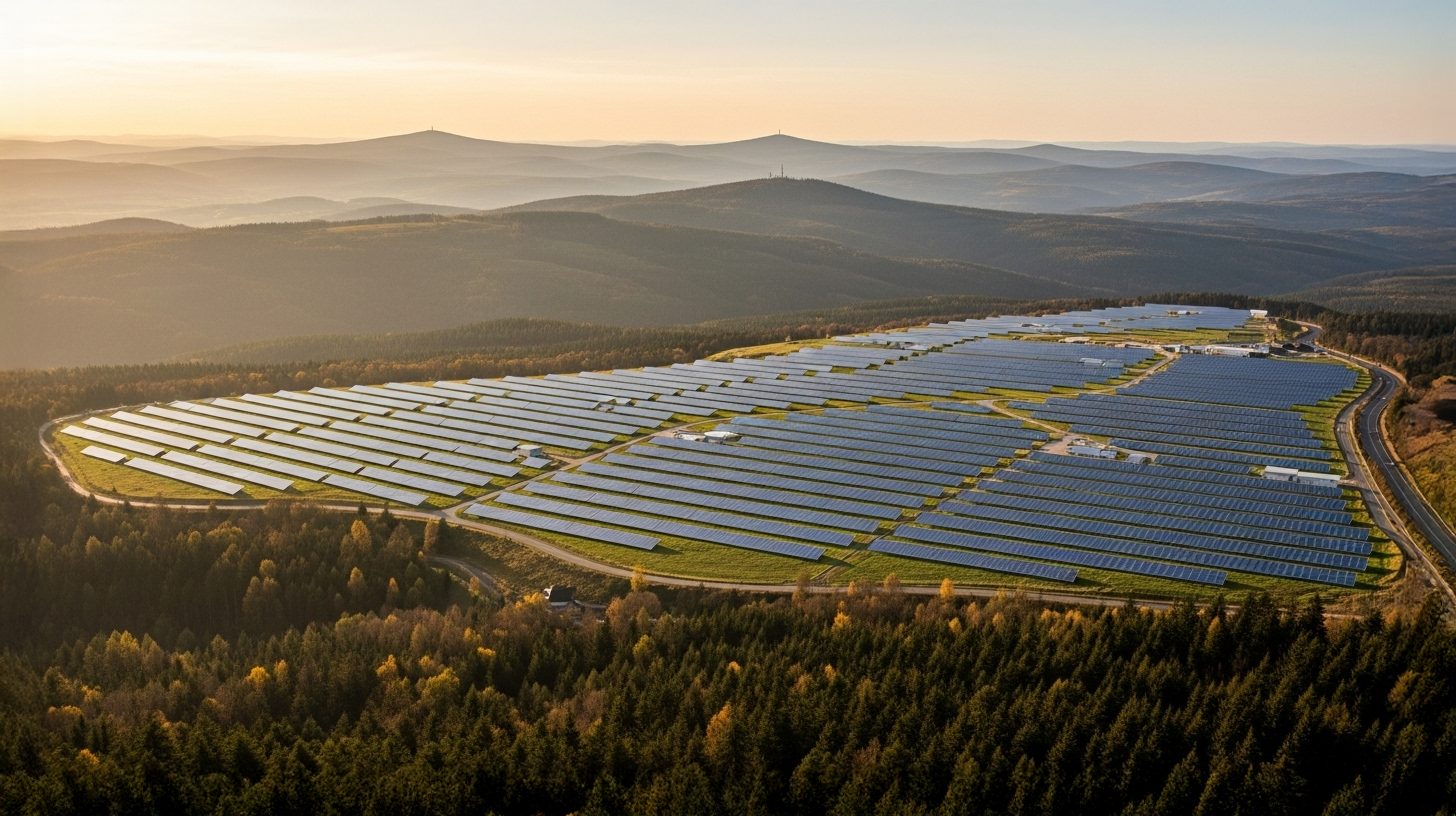
A 35 million euro solar park in the Ore Mountains on 66 hectares (federal highway B95) with 100,000 modules is planned in Wiesa – Creative image: Xpert.Digital
Electricity for thousands of households: Why this 66-hectare solar field in the Ore Mountains is now causing controversy
Large solar project in the Ore Mountains: Citizen participation decides on 35-million-euro project
The municipality of Thermalbad Wiesenbad is launching a comprehensive public participation process for a planned solar park between Wiesa and Annaberg-Buchholz. The €35 million project, by the company Solarsan, will comprise more than 100,000 solar modules on an area of 66 hectares, making it one of the largest photovoltaic projects in the Ore Mountains. Residents from all districts will be able to learn about the project and express their opinions during four public hearings.
The solar park project in detail
The company Solarsan plans to build a large-scale photovoltaic plant on a 66-hectare site near the B95 federal highway. The plant will comprise over 100,000 solar modules and generate a significant amount of electricity, enough to supply several thousand households. The investment volume of €35 million underscores the magnitude of this project for the region.
The planned site is located in the southeastern part of the Wiesa district and covers several parcels of land in the Wiesa and Annaberg districts. Its strategic location near the B95 offers excellent conditions for grid connections and infrastructure. The project was already approved at the municipal council meeting on May 28, 2024, and the preliminary draft of the project-related development plan was approved on October 1, 2024.
Legal framework and approval procedures
The implementation of open-space photovoltaic systems of this size requires a multi-stage approval and planning process. First, a municipal development plan must be drawn up in accordance with the Federal Building Code, designating the area as a special zone for solar energy use. This is followed by the building permit process in accordance with the Saxon Building Code with the responsible building permit authority.
The entire process can take between six and twelve months and includes extensive assessments of environmental impact, nature conservation, and other public concerns. The project-specific development plan is prepared in a two-stage process, including an environmental report, ensuring a thorough assessment of all impacts.
Citizen participation as a central component
The municipality of Thermalbad Wiesenbad is committed to comprehensive public participation to promote acceptance of the project and address residents' concerns. Four information events in all districts will ensure that everyone interested can learn about the project and express their opinions. The event will kick off in Schönfeld, with further events to follow in the other districts.
Public participation in solar projects has proven to be a key success factor, as it increases transparency and reduces potential reservations. By involving the public early on, concerns can be addressed and solutions found that meet both economic and societal needs.
Economic advantages for the community
Solar park projects offer municipalities various economic benefits. Under Saxony's new Renewable Energy Sources Revenue Sharing Act, which came into force on June 29, 2024, municipalities receive a mandatory share of the revenue from ground-mounted photovoltaic systems. For systems with a capacity of one megawatt or more, operators pay at least 0.1 cents per kilowatt-hour generated to the host municipality.
For a project of this magnitude, the annual revenue for Wiesenbad Thermal Baths can add up to a considerable amount. These funds can be used for municipal purposes such as infrastructure, schools, clubs, or other public facilities. In addition, trade tax revenues flow into the municipal coffers.
Energy transition and climate protection in the Ore Mountains
The planned solar park fits into Saxony's broader efforts to increase the share of renewable energy. The Free State's Energy and Climate Program envisions increasing the share of renewable energy in gross electricity consumption to 65 percent by 2030. Ground-mounted photovoltaic systems play an important role in this, complementing rooftop systems and other renewable energy sources.
The Erzgebirge district already has experience with larger solar projects. For example, a solar park with 5.4 megawatts of power and over 22,000 modules was commissioned in Scheibenberg in 2012. These projects have demonstrated that solar parks are technically feasible and can contribute to the regional energy supply.
Challenges and concerns
Despite the benefits, there are also critical voices regarding the project. Concerns concern the impact on the landscape, tourism, and the UNESCO World Heritage Ore Mountains Mining Region. Critics argue that large-scale solar farms could impair the appearance of the traditional Ore Mountains landscape.
Further points of discussion include the long-term impacts on agricultural use of the land and the question of what will happen to the facility after the end of its planned operating life of approximately 30 years. Binding decommissioning agreements are important here to ensure that the land can be returned to its original use after the end of operations.
New: Patent from the USA – Install solar parks up to 30% cheaper and 40% faster and easier – with explanatory videos!

New: Patent from the USA – Install solar parks up to 30% cheaper and 40% faster and easier – with explanatory videos! - Image: Xpert.Digital
At the heart of this technological advancement is the deliberate departure from conventional clamp fastening, which has been the standard for decades. The new, more time- and cost-effective mounting system addresses this with a fundamentally different, more intelligent concept. Instead of clamping the modules at specific points, they are inserted into a continuous, specially shaped support rail and held securely. This design ensures that all forces occurring—be they static loads from snow or dynamic loads from wind—are evenly distributed across the entire length of the module frame.
More about it here:
Wiesa Solar Park: Citizen participation, regional added value and environmentally friendly technology for the energy transition
Successful examples from the region
Positive experiences with citizen participation in solar projects have already been achieved in other parts of Saxony. The Tannenhübel community solar park, run by the Neue Energien Ostsachsen energy cooperative, demonstrates how such projects can be successfully implemented. Over 40 people aged 2 to 73 participated there, raising a total of €252,500.
RWE also demonstrated how municipalities and citizens can benefit from solar projects with the Schönau solar park in Wildenfels. The city receives a climate bonus of 0.2 cents per kilowatt hour generated, generating additional revenue of approximately €42,000 per year. A DKB citizen savings certificate was also offered, providing savings opportunities for over 50 interested parties.
Financing options and participation
There are various models for financing solar projects. Regional financial institutions such as Erzgebirgssparkasse offer special financing solutions for renewable energies. These include both investment loans for companies and modernization loans for private households who want to install their own solar systems.
Citizen participation models can take various forms, from cooperative shares to crowdfunding to direct participation. These models allow residents to participate financially in the project and benefit from the proceeds. At the same time, they strengthen acceptance and a sense of shared ownership of the project.
Technical aspects and innovation
Modern solar parks utilize highly efficient technologies to maximize electricity yield. Bifacial modules, which can utilize both direct sunlight and reflected light from the back, significantly increase energy yield. Such innovative approaches could also be used in the planned Wiesa solar park.
The combination of optimal south-facing orientation and modern tracking systems that allow the modules to follow the sun can further increase power production. Additionally, battery storage systems can be integrated to improve grid stability and make energy available even when the sun isn't shining.
Environmental impacts and nature conservation
Extensive environmental assessments are required when planning solar parks. The environmental report, which is part of the development plan process, examines the impacts on flora, fauna, and the landscape. Often, appropriate design can even achieve positive effects on biodiversity, for example, by planting flowering strips between the rows of modules.
Solar parks can also be combined with extensive grazing, creating a dual use of the land. This so-called agri-photovoltaics makes it possible to generate electricity while continuing agricultural activities. Such innovative concepts are already being successfully implemented in other parts of Saxony.
Regional added value and jobs
Solar park projects not only create jobs during the construction phase but also generate long-term regional added value. Local companies can be involved in the planning, construction, and maintenance of the plant. This strengthens the regional economy and ensures that a portion of the investment remains in the region.
The maintenance and operation of a solar farm of this size requires skilled workers, which can create additional permanent jobs. Services such as cleaning, security, and administrative tasks also offer employment opportunities for the local population.
Grid integration and energy infrastructure
Integrating a large solar farm into the existing power grid requires careful planning and potentially investments in grid infrastructure. The proximity to the B95 highway and the existing power lines in the region provide good conditions for efficient grid connection.
Smart grid solutions and storage technologies can help balance fluctuating solar power production and ensure grid stability. This is especially important as the share of renewable energy in the power grid continues to rise.
Transparency and communication
The municipality of Thermalbad Wiesenbad relies on transparency and open communication to gain the trust of its citizens. The public display of the planning documents from November 6 to December 6, 2024, will allow all interested parties to obtain detailed information about the project and submit their comments.
This transparent approach is crucial to the project's success. Only if citizens are fully informed and their concerns are taken seriously can the necessary acceptance for a project of this magnitude be achieved.
Transparency and participation: This is how the Wiesa solar park could be created
The next steps depend largely on the results of the public consultation. Following the information sessions and the public consultation, all comments received will be carefully reviewed and considered. The municipal council will then decide on the next steps.
If the project receives approval, construction could begin as early as the next few years. Its realization would make an important contribution to Saxony's energy transition and make the Wiesenbad thermal spa a pioneer in the use of renewable energy in the Ore Mountains.
The decision regarding the Wiesa solar park will be groundbreaking for the further development of renewable energies in the region. It demonstrates the importance of citizen involvement in major infrastructure projects and how transparent communication and fair participation can successfully shape the energy transition locally.
Look, this little detail saves up to 40% installation time and costs up to 30% less. It's from the USA and patented.

NEW: ready -to -mount solar systems! This patented innovation accelerates your solar construction massively
The heart of ModuRack 's innovation is its departure from conventional clamp fastening. Instead of clamps, the modules are inserted and held in place by a continuous support rail.
More about it here:
Your partner for business development in the field of photovoltaics and construction
From industrial roof PV to solar parks to larger solar parking spaces
☑️ Our business language is English or German
☑️ NEW: Correspondence in your national language!

Konrad Wolfenstein
I would be happy to serve you and my team as a personal advisor.
You can contact me by filling out the contact form or simply call me on +49 7348 4088 965 (Munich) . My email address is: wolfenstein ∂ xpert.digital
I'm looking forward to our joint project.







