

Mai Dubai and Kave demonstrate how smart warehouses are revolutionizing the entire business model
Xpert Pre-Release

Available in 27 languages 📢
Prefer Xpert.Digital on GoogleⓘPublished on: September 18, 2026 / Updated on: September 18, 2026 – Author: Konrad Wolfenstein
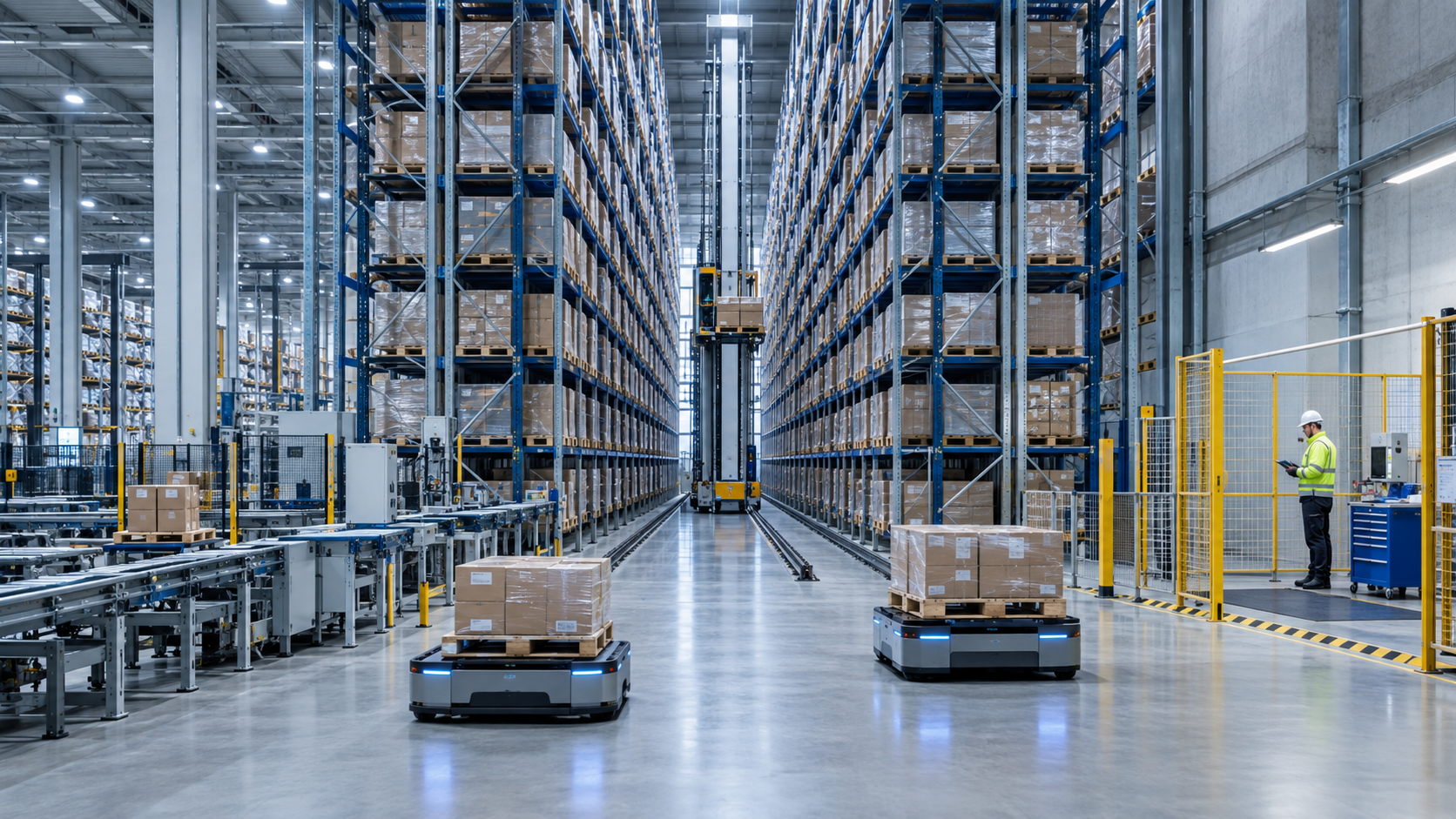
Mai Dubai and Kave demonstrate how smart warehouses are revolutionizing the entire business model – creative image on the topic, with AI: Xpert.Digital
Hybrid systems: Why robots and high-bay warehouses are only truly economical as a team
Warning about the cost trap: Why bad data is ruining your automated warehouse
More than just staff reductions: The unvarnished truth about automated high-bay warehouses
Automated high-bay warehouses are often seen as a simple, technical solution to the shortage of skilled workers and rising wages. But this view falls short. Modern intralogistics is no longer an isolated rationalization measure, but rather the strategic backbone of entire business models. Two recent major projects—the high-volume production logistics of beverage manufacturer Mai Dubai and the complex omnichannel network of the international furniture brand Kave—demonstrate how profoundly automation changes a company's capital commitment, scalability, and delivery capability. At the same time, tragic incidents such as the fatal workplace accident in a warehouse in Crailsheim serve as a reminder that efficiency must never come at the expense of safety and maintenance. This article examines the true economic success factors and risks of automated warehouses and explains why data quality, system availability, and hybrid technologies are crucial for tomorrow's competitiveness.
Automated high-bay warehouses as strategic infrastructure
Those who only cut staff are automating and missing the real problem
Automated high-bay warehouses are often described as a technological solution to rising labor costs, labor shortages, and increasing shipping volumes. However, this explanation falls short. In their economic impact, modern warehousing and order picking systems are not isolated rationalization machines, but rather long-term infrastructure decisions. They alter a company's capital commitment, location logic, delivery capability, inventory management, and risk structure. Therefore, they affect not only logistics, but the entire business model.
The projects by Swisslog for the beverage manufacturer Mai Dubai and by TGW Logistics for the Spanish furniture and home decor specialist Kave illustrate two different manifestations of the same development. At Mai Dubai, the focus is on high-volume pallet logistics closely integrated with production. At Kave, on the other hand, the system is a complex omnichannel solution designed to manage small packages, bulky furniture, pallets, roll cages, and various customer and sales channels within a single material flow. The fatal workplace accident in a high-bay warehouse in Crailsheim also demonstrates that the economic evaluation of automated systems remains incomplete if safety, maintenance, troubleshooting, and human intervention are treated merely as peripheral issues.
The central thesis is therefore: The benefit of an automated high-bay warehouse does not arise from the maximum number of manual steps saved, but from the ability to manage volume, product variants, inventory, data, and risks as a cohesive system. A project is economically successful if it delivers high availability, controllable unit costs, and strategic adaptability over many years. A system can be technically impressive yet economically weak if it is built in the wrong location, for unsuitable processes, or with unrealistic assumptions.
The market is growing, but not evenly
The global market for warehouse automation is structurally on a growth trajectory, but the picture is less straightforward than some forecasts suggest. Order intake for 2025 was projected to increase nominally by around seven percent. However, part of this rise was due to higher steel, labor, and project costs. Furthermore, the growth was disproportionately driven by a few very large investors. This leads to an important distinction: a rising market value does not automatically mean that more systems or more actual automation capacity have been ordered across the board.
Globally, average annual growth of approximately six percent is expected for the years leading up to 2030. In Europe, the Middle East, and Africa, the forecast is slightly higher at around seven percent than in the Americas and the Asia-Pacific region. Particularly relevant are general trade in goods, the production of durable goods, the food and beverage industry, and, in the long term, parcel logistics. These sectors are either under intense pressure to increase volume and costs or require exceptionally high process stability.
In parallel, the importance of mobile robotics is increasing. In 2024, approximately 102,900 professional service robots for transport and logistics tasks were sold worldwide. More than half of all professional service robots were thus used in this application area. Around 81,800 units were mobile robots for internal transport tasks. These figures show that classic, permanently installed high-bay racking systems and flexible mobile systems should not be seen as opposites. In many new systems, the greatest benefit arises precisely from their combination.
The market structure remains cyclical. High interest rates make financing capital-intensive projects more expensive. Uncertain demand complicates project sizing. Trade conflicts increase material prices and lengthen procurement routes. At the same time, declining new construction activity can put pressure on individual suppliers, even though the long-term need for automation is growing. The market is therefore both a growth and a concentration market: Large suppliers with software expertise, integration capabilities, service organizations, and sufficient balance sheet strength have advantages over companies that only supply individual components.
Capital replaces space and improvisation
A high-bay warehouse creates economic value primarily through better utilization of existing or newly created space. A conventional warehouse requires a significant amount of floor space for aisles, safety clearances, and manual access. An automated system can be built higher, denser, and with narrower aisles. Expensive land is thus partially replaced by steel structures, conveyor technology, storage and retrieval systems, and software. Especially in densely populated areas or production sites with limited space, this increased density can be more important than direct personnel savings.
However, the investment shifts the cost structure. Variable personnel costs become long-term fixed costs for capital, energy, software, maintenance, and spare parts. The company pays less for each additional manual transport operation but must finance a high base load. Profitability improves if volume and capacity utilization remain consistently high. It deteriorates if the system is oversized, demand collapses, or the product range changes more rapidly than anticipated.
A simple comparison of investment sum and saved wages is therefore insufficient for a reliable assessment. Crucial factors include the net present value over the entire useful life, expected capacity utilization, availability, residual values, and the costs of downtime. Furthermore, there are effects that are more difficult to quantify, such as shorter lead times, lower error rates, less damaged goods, higher inventory accuracy, and improved delivery capability. For high-growth companies in particular, the greatest benefit may lie in simply being able to process additional sales.
Automation thus appears as a real option for growth. A company pays today for the ability to process a higher volume tomorrow with controlled marginal costs. However, this option only has value if the system is scalable and the adjacent processes can keep pace. A high-performance high-bay warehouse will not solve a bottleneck if receiving, packaging, shipping, IT, or transportation capacities remain limiting.
May Dubai combines production and storage
The system implemented by Swisslog for Mai Dubai exemplifies production-oriented automation with high pallet throughput. The project comprised an automated high-bay warehouse for raw materials and packaging, as well as a spatially separated finished goods warehouse. The finished goods warehouse was designed with ten aisles and 17,560 pallet positions. The raw materials and packaging warehouse has six aisles and 5,592 pallet positions. Both areas are connected by stacker cranes, conveyor technology, and an electric monorail system with 44 vehicles, creating a continuous material flow.
The scale of the project is remarkable. The order value exceeded €20 million, or approximately US$21 million. The finished goods warehouse reaches a height of about 25 meters, while the raw materials warehouse is around 14 meters high. An electric monorail connects the storage areas, existing production lines, and shipping zones along a transport route of approximately one kilometer. This allows the warehouse to operate not as a secondary storage area, but as an integral part of the factory.
Synchronization is economically crucial. A beverage manufacturer produces large quantities of standardized products at high speed. A bottling plant can produce up to 86,000 bottles per hour. If downstream palletizing, storage, or preparation for shipping cannot keep pace, production output is reduced. The bottleneck shifts from bottling to intralogistics. In this case, automation not only prevents additional personnel costs but also protects the utilization of expensive production facilities.
The supply of materials for production is equally important. Bottle blanks, closures, labels, films, and other packaging materials must be available as needed. Providing materials too early wastes space and creates inventory chaos, while providing them too late leads to production downtime. A data-driven warehouse management system can link inventory levels, transport orders, and production requirements. This reduces the need to compensate for uncertainty with large buffers.
The Mai Dubai plant also demonstrates why automation can be economically viable in regions with supposedly low labor costs. Wage costs are just one factor. In hot climates, with high production volumes, limited suitable industrial space, and demanding quality standards, process stability, hygiene, speed, and reproducible processes become increasingly important. An automated system also reduces the number of manual interfaces where goods can be damaged, mislabeled, or delayed.
The real value lies in the throughput
For highly standardized products, profitability is largely determined by throughput and plant availability. A pallet of water has a limited value relative to its weight and volume. Logistics costs must therefore be kept low. Every unnecessary transport route, every waiting time, and every manual transfer reduces the margin. The business model does not require maximum flexibility in picking individual items, but rather a reliable flow of large, homogeneous quantities.
This logic favors permanently installed technology. Storage and retrieval machines and conveyor systems can operate with high repeatability over long periods. The high-bay warehouse consolidates inventory and reduces transport distances. An electric monorail partially decouples pallet transport from floor traffic. The software coordinates storage, replenishment, and shipping. Taken together, this creates a system whose marginal costs increase more slowly with growing volume than in a purely manual warehouse.
However, this does not mean that every additional level of automation is worthwhile. For standardized processes, a high degree of technical complexity can be economically attractive because the investment is spread across a large number of identical movements. As soon as product formats, pallet types, or process requirements vary significantly, integration effort and susceptibility to disruption increase. The appropriate level of automation therefore depends not on technical enthusiasm, but on the stability and repeatability of the process.
The claims that the project has doubled production and storage capacity and reduced labor costs are plausible, but should be interpreted with a nuanced business perspective. Doubling capacity is not the same as doubling sales. Additional capacity initially generates depreciation and fixed costs. Only when demand increases and the plant is operating at sufficient capacity does it translate into productivity and a greater contribution to profits.
Kave automates the diversity
TGW Logistics' project for Kave in Tordera, near Barcelona, follows a different logic. Kave sells furniture and home accessories through e-commerce, brick-and-mortar retail, franchise, and B2B channels. Their product range extends from small packages measuring approximately 400 by 300 millimeters to bulky units of up to 2,400 by 1,200 millimeters. Such a wide range precludes the simple standardization possible with beverage pallets.
The distribution center, planned for completion by the end of 2028, therefore combines several technologies. It will feature an automated small parts warehouse, a high-bay pallet warehouse, a double pallet warehouse, energy-efficient conveyor technology, mobile Quba robots, automated palletizing and depalletizing processes, and ergonomically designed picking workstations. Goods from different storage areas will be consolidated in a shared palletizing zone. There, the system must form shipping-ready units from heterogeneous items for various recipients and channels.
Once operational, the platform is expected to process up to 21,000 packages per day and offer 93,000 pallet positions. This would more than double the storage capacity compared to current levels. The second expansion phase of the site will increase the total logistics area to approximately 90,000 square meters. This phase is projected to require an investment of around €45 million.
This expansion is understandable given the company's growth. Kave achieved a turnover of €321.2 million in 2025, approximately 23 percent more than in the previous year. Turnover had already increased by 33 percent to €262 million in 2024. Around 70 percent of revenue is generated outside Spain. The company operates in approximately 80 markets and had a total of 159 points of sale at the end of 2025. This growth is not only increasing in volume but also in geographical and operational complexity.
The logistics platform is therefore not merely a cost-cutting project. It is a prerequisite for internationalization. With each new market, the number of delivery routes increases, as do the requirements for packaging and labeling, the differences in service commitments and returns, and the need for consistent inventory data. A non-scalable warehouse would stifle growth, lengthen delivery times, and degrade the customer experience.
Omnichannel requires a common inventory
Omnichannel logistics is often reduced to the simultaneous delivery to online customers and brick-and-mortar stores. In reality, the complexity lies much deeper. Each channel has different requirements regarding order size, packaging, speed, and sequencing. An end customer might order a table and two chairs, a retail store requires a mixed restock for multiple product groups, a B2B customer expects project-specific quantities, and a franchise partner demands consolidated pallets for a specific delivery time.
When each channel is served by separate inventories and processes, safety stocks, duplicate structures, and low transparency result. A shared inventory can reduce capital tied up in inventory and improve product availability. However, this requires reliable prioritization from warehouse management and order control. The system must decide which order is fulfilled from which inventory, at what time, and via which material flow.
For Kave, the consolidation of different storage areas into a shared palletizing zone is therefore strategically important. It allows small and large items to be consolidated into a single order. At the same time, this creates a critical hub. If consolidation fails, several upstream systems can continue operating without producing any orders ready for shipment. The economic evaluation must therefore consider not only the performance of individual components but also the bottleneck effect of shared transfer points.
The planned capacity of 21,000 packages per day should not be viewed as an isolated peak figure. The crucial factor is the conditions under which this capacity can be achieved. Relevant questions concern the order structure, the proportion of bulky items, the number of order lines, the distribution throughout the day, staffing requirements at the workstations, and the efficiency of the shipping bays. A theoretical maximum capacity is less valuable from a business perspective than a consistently achievable throughput on both normal and seasonally busy days.
LTW Intralogistics Solutions

LTW Intralogistics – Engineers of Flow - Image: LTW Intralogistics GmbH
LTW offers its customers not individual components, but integrated complete solutions. Consulting, planning, mechanical and electrotechnical components, control and automation technology, as well as software and service – everything is networked and precisely coordinated.
In-house production of key components is particularly advantageous. This allows for optimal control of quality, supply chains, and interfaces.
LTW stands for reliability, transparency, and collaborative partnership. Loyalty and honesty are firmly anchored in the company's philosophy – a handshake still means something here.
Related to this:
Flexibility through hybrid automation systems
Flexibility arises through hybrid technology
The Kave project represents a new generation of hybrid automation. Fixed high-bay warehouses provide density and predictable performance. Mobile robots create flexible transport connections. Automated small parts warehouses accelerate the retrieval of small items. Robots handle standardized palletizing movements. Humans perform tasks where perception, dexterity, and situational decision-making remain advantageous.
This division of labor makes economic sense because no single system can efficiently cover the entire spectrum of tasks. A system based solely on conveyor technology would be inflexible when layouts change. A pure AMR (Autonomous Mobile Robot) concept could require too many vehicles, traffic areas, and loading cycles for very high volumes. Fully automated gripping is challenging for furniture and decorative items due to their varying shapes, surfaces, weights, and packaging. The hybrid system assigns the appropriate technology to each task.
Flexibility, however, should not be confused with arbitrariness. Mobile robots also require defined traffic rules, transfer points, charging infrastructure, and software integration. An automated small parts warehouse demands suitable containers and master data for the items. Robot palletizing only functions reliably if dimensions, weights, stability, and packing rules are correctly stored. The more automated the physical system becomes, the greater the economic importance of accurate data.
True scalability arises from the interplay of mechanics and software. Additional vehicles can expand material flow, provided the traffic routes and control systems still have capacity. Further storage aisles can create additional capacity if the building and interfaces are properly prepared. New algorithms can improve priorities without requiring a complete system overhaul. Conversely, poor software can turn powerful hardware into an expensive bottleneck.
Data quality becomes a production factor
Automated warehouses rely on digital data. In a manual process, an experienced employee can identify a mislabeled pallet, correct a crooked package, or improvise a replacement for a missing barcode. An automated system, on the other hand, processes the information it has. If dimensions, weights, loading equipment, inventory levels, or blocking tags are incorrect, malfunctions or incorrect decisions occur.
Data quality is therefore not a supporting administrative task, but a production factor. Item master data must be complete and up-to-date. Pallets and containers require controlled geometries. Interfaces between inventory management, warehouse management, material flow control, and machine control must function consistently. Changes to the product range must not only become apparent after a system malfunction.
The economic benefits of good data extend beyond preventing technical errors. Accurate inventory levels reduce safety margins. Reliable lead times improve delivery commitments. Condition data enables predictive maintenance. Energy consumption can be attributed to individual processes or load profiles. Simulations help test seasonal peaks, product range changes, or new shipping rules before implementation.
However, with increasing connectivity, dependence on IT and cybersecurity also grows. A failure of the warehouse management system can paralyze an entire site, even if mechanical equipment and personnel are available. Inadequately secured remote maintenance access, outdated control components, or poorly isolated networks increase the risk. From a business perspective, cyber resilience must therefore be treated like fire protection or mechanical security: as a necessary prerequisite for asset availability.
The business case needs stress tests
A sound business case begins with the current process, not with a desired robot. It records volumes, order profiles, travel distances, personnel hours, errors, damage, peak loads, inventory, and space utilization. Several future scenarios are then modeled. In addition to an expected growth trajectory, a weak scenario, a strong scenario, and structural changes to the product range must be considered.
The key performance indicator is the net present value of all expected cash flows. These include investment, financing, depreciation, maintenance, software licenses, energy, spare parts, insurance, and personnel. On the benefits side are reduced activities, avoided space costs, lower damage, higher inventory accuracy, faster processing, and additional contribution margin through deliverable growth. The frequently cited amortization period is helpful, but too broad on its own because it ignores cash flows after the amortization point and the cost of capital.
A sensitivity analysis is particularly important. What happens if the throughput is 20 percent below target? What is the impact of a six-month delay in commissioning? What are the consequences of lower technical availability? What is the cost of a multi-day shutdown during peak season? How much do maintenance costs increase after the warranty and service packages expire? Such questions are uncomfortable, but they are more informative than a presentation of the theoretical maximum performance.
The ramp-up phase must also be realistically assessed. A complex system rarely reaches its planned performance on the first day of operation. Employees need to be trained, master data needs to be cleaned up, interfaces need to be stabilized, and exceptions need to be handled. Parallel operation and manual fallback options incur additional costs. If this transition is not factored in, the project will appear cheaper in the investment calculation than it actually is.
Availability is an economic indicator
The technical availability of an automated warehouse determines whether the planned productivity is achieved in daily operations. A nominally fast system with frequent, short-term disruptions can perform worse than a slower, robust system. Components without redundancy are particularly critical. If a central lift, a main conveyor line, a palletizing zone, or a software service fails, the entire process chain can grind to a halt.
High availability comes at a price. Redundant computers, alternative material supply chains, spare parts inventories, standby services, and preventative maintenance initially increase expenses. Their benefits are realized in avoided downtime. The optimal solution is not maximum redundancy, but rather a risk level that aligns with the business model. A company with perishable goods, highly integrated production processes, or fixed delivery windows requires more safeguards than a business with fluctuating, less time-sensitive demand.
For Mai Dubai, the connection to production is particularly sensitive. If pallets are not transported or materials are not provided, bottling can be disrupted. At Kave, a shutdown impacts multiple sales channels and international markets. In both cases, the consequential costs exceed the immediate repair costs. Lost revenue, contractual penalties, additional transport, overtime, customer dissatisfaction, and reputational damage must be factored into the risk assessment.
Service contracts should therefore be evaluated based on repairability, not just the scope of maintenance. Response time, guaranteed spare parts supply, remote access, on-site expertise, and clear escalation channels are crucial. Internal knowledge is equally important. Outsourcing every single malfunction to the manufacturer reduces staffing needs in the short term, but increases dependency and the risk of downtime in the long run.
The accident in Crailsheim sets a limit
On May 11, 2026, a 23-year-old employee died in a workplace accident at a high-bay warehouse in Crailsheim. He was trapped while working for reasons that are still unclear and died at the scene. The criminal police have launched an investigation, and an expert has been called in. Until the investigation is complete, it would be irresponsible to speculate about the exact sequence of events, a technical failure, or individual negligence.
The case is nevertheless relevant for economic analysis. High-bay warehouses often separate people from moving equipment during normal operation. This can reduce many classic risks of manual transport. However, disruptions, maintenance, cleaning, inspection, modifications, and rescue situations remain critical. In these exceptional circumstances, people enter areas that are inaccessible during regular automated operation.
Troubleshooting is particularly dangerous because it can involve a combination of time pressure, unclear system conditions, and difficult-to-reach locations. Pallets may be damaged, shifted, or not picked up correctly. Loads can move during acceleration or braking. Adjacent storage and retrieval machines or conveyors can create additional crushing, shearing, and falling hazards. A minor technical fault can thus escalate into a complex human intervention.
Economic pressure must not dictate the order of events in such situations. First, energy sources must be safely shut down, movements prevented, access controlled, and responsibilities clarified. Only then may the malfunction be rectified. A minute of supposedly gained production time is disproportionate to the risk of a serious or fatal accident.
Safety is part of productivity
Occupational safety is often treated as a legal requirement in investment calculations. Economically, however, it is an integral part of plant performance. A system that only achieves high availability when employees regularly intervene in hazardous areas is not productive, but rather poorly designed. The same applies to systems whose maintenance points are difficult to access or whose fault diagnosis does not provide clear information.
For high-bay warehouses, clear troubleshooting procedures must exist. These must be based on the operating manual, translated into work instructions, and subject to practical training and regular review. Before any hazardous interventions, affected storage and retrieval machines and adjacent systems must be shut down and secured against being restarted. In case of a risk of falling, suitable anchor points, personal protective equipment, and rescue options are required. Working alone in hazardous situations necessitates special monitoring measures.
A rescue plan shouldn't just be filed away in a folder. It must be tailored to the specific facility, take available rescue equipment into account, and be regularly practiced. In a 25-meter-high warehouse, general first-aid knowledge isn't sufficient. Access routes, communication channels, de-energization procedures, and cooperation with external rescue services must be clearly defined before an incident occurs.
Ergonomics remains important. Automation can reduce long walking distances, heavy lifting, and monotonous transport. At the same time, new strains can arise at stationary workstations if cycle times, reach zones, or information density are poorly designed. Good automation doesn't remove people from the process altogether, but rather shifts them to tasks for which safe and ergonomic working conditions must be created.
Employment is changing rather than disappearing
Automation reduces the need for certain manual tasks, particularly repetitive transport, storage and retrieval, and standardized order picking. However, this does not automatically lead to a proportional reduction in overall employment. Growing companies often use automation to handle additional volumes with a slower increase in staff. In tight labor markets, technology partially replaces positions that are already difficult to fill.
At the same time, new roles are emerging. There is a demand for plant operators, maintenance personnel, automation technicians, data managers, process analysts, and IT specialists. These positions require higher qualifications and often closer collaboration between logistics, production, and information technology. This transformation can offer opportunities for employees, but only if further training begins early.
A problematic model arises when companies automate processes but leave all knowledge with the system provider. Internal employees then become mere observers of a black box. In case of malfunctions, they lack diagnostic expertise, improvements take longer, and their negotiating power with the supplier diminishes. Therefore, an economically sustainable project requires a deliberate development of expertise within the operator.
The social quality of the implementation also influences the ramp-up. If employees are only informed shortly before commissioning, uncertainty and resistance arise. Involving experienced employees in process analysis, testing, and workplace design allows practical knowledge to be integrated into the system. This not only increases acceptance but can also prevent costly planning errors.
Energy efficiency is more than just an engine value
Automated systems consume electricity for storage and retrieval machines, conveyor technology, robots, IT, sensors, lighting, and air conditioning. At the same time, they can reduce energy consumption per moving unit by optimizing travel distances, acceleration, and idle times. Energy recovery during braking or lowering, lightweight vehicles, and intelligent order bundling further improve the overall efficiency.
The system boundary is crucial. An energy-efficient storage and retrieval machine alone does not create a sustainable warehouse. Compact storage can reduce building and land requirements. Shorter internal routes lower transport energy consumption. Precise inventory levels prevent overproduction and write-offs. On the other hand, steel structures, electronics, and batteries generate significant upstream emissions. The system must be used extensively and for a long time to offset these material costs.
For mobile robots, battery life, charging losses, and fleet utilization also come into play. Too many vehicles generate unnecessary capital and energy consumption, while too few lead to waiting times. With permanently installed technology, an oversized system can operate continuously in an unfavorable partial load range. Sustainability and economic efficiency therefore converge in the most appropriate sizing.
Site-specific energy also plays a role. High electricity prices impact operating costs, while on-site photovoltaics, storage, and intelligent load management can offer advantages. Automated warehouses often have large roof areas, but technical, structural, and property-related conditions determine how far this potential can be utilized. Therefore, an integrated energy concept should be developed as early as the planning phase.
Suppliers become long-term partners
A complex automation project often ties up operators and integrators for decades. The physical system, the control software, and the spare parts supply cannot be easily replaced later. Therefore, the purchase is less like acquiring individual machines and more like choosing a long-term technological platform.
When selecting a provider, references, financial strength, integration expertise, software architecture, and regional service capabilities are crucial. A low initial price can be offset by high costs for modifications, licensing, or maintenance. Proprietary interfaces, which complicate future expansions, are equally problematic. Operators should clarify data ownership, access rights, update procedures, and support options for switching providers.
The projects by Swisslog and TGW demonstrate the growing importance of the general integrator. Both concepts combine mechanics, conveyor technology, robotics, and software. The customer is no longer simply buying equipment, but a guaranteed system performance. This also shifts the logic of the contract. Acceptance criteria must reflect real-world order profiles, availability, fault handling, and peak loads, not just the speed of individual components.
A fair distribution of risk improves project outcomes. If the integrator bears all the risk associated with changes, the bid price and potential for conflict increase. If the operator can pass on unclear requirements or poor data without consequence, there is no incentive to prepare. Successful projects define responsibilities, decision-making processes, and joint testing early on.
Regional strategies differ
In the Middle East, population growth, industrial policy, supply security, and the expansion of modern consumer goods production are driving the demand for automated logistics. Large greenfield projects allow for integrated planning of buildings, production, and material flow. At the same time, climate, dust, energy requirements, and the availability of specialized service personnel pose particular challenges. The Mai-Dubai project fits this logic: high production volumes, a redesigned material flow, and long-term capacity planning.
In Europe, high labor costs, land scarcity, occupational safety, and demographic constraints play a more significant role. Many projects, however, are not built from scratch but rather as expansions of existing sites. This increases integration efforts and the need for a phased conversion. Kave's expansion in Tordera combines an established logistics site with a new, automated expansion stage.
For medium-sized companies, the investment hurdle is particularly high. Large corporations can pool resources, secure financing, and build their own teams of experts. Smaller operators require more modular solutions, standardized interfaces, and potentially usage-based models. The strong growth in robotics as a service demonstrates that financing and operating models are evolving, even though traditional outright purchase still dominates.
A complete democratization of high-bay warehouse automation is not to be expected. Large, permanently installed systems still require significant volumes and long-term planning certainty. Mobile robotics and standardized subsystems lower the entry barrier, but do not always replace the performance of a consistently planned high-bay warehouse.
The crucial mistakes occur early on
Many problems that arise later are already present in the concept phase. An overly optimistic growth plan leads to over-dimensioning. Conversely, an overly narrow planning horizon creates new bottlenecks early on. Uncorrected master data distorts simulations. Unforeseen special cases are relegated to manual auxiliary processes that require space and personnel. A lack of maintenance access makes every malfunction more expensive and dangerous.
Automating inefficient processes is particularly risky. If unnecessary transfers, unclear priorities, or unstable packaging standards are simply replicated technically, the rate of waste increases. Before automating, processes should be simplified, variants limited, and responsibilities clarified. Technology should scale a good process, not entrench a bad one.
Another mistake is focusing solely on peak performance. Systems are often advertised with impressive container, pallet, or package throughput. In practice, however, the overall system is what counts. If goods receiving isn't prepared, packaging materials are missing, or there are no trucks at the loading docks, the technical capacity remains untapped. The correct key performance indicator (KPI) is therefore the reliably fulfilled customer order, not the isolated movement of a machine.
Finally, the period after acceptance is often underestimated. Product ranges, customer requirements, software environments, and safety standards change. A warehouse is not a static structure, but rather an operating system requiring ongoing maintenance, comprised of steel, mechanics, electronics, data, and human expertise. Budgets for updates, modifications, and training are not unplanned additional costs, but an integral part of the lifecycle.
Automation becomes part of the competitive architecture
Mai Dubai and Kave represent two different but complementary development paths. Mai Dubai uses automation to synchronize high-volume production with raw material storage, finished goods inventory, and shipping. Kave is building a hybrid platform designed to manage international expansion and heterogeneous omnichannel orders. Both examples demonstrate that modern high-bay warehouses do more than just store goods; they coordinate business models.
The economic benefits arise from four essential factors: the optimal use of space and tied-up capital, the reliable stabilization of complex processes, the unconditional continuity of system data, and the foresight to seamlessly adapt technology to people and the overarching corporate strategy.
Consulting - Planning - Implementation

Konrad Wolfenstein
I would be happy to serve as your personal advisor.
You can contact me at wolfenstein∂xpert.digital or
Just call me on +49 7348 4088 965 .
Your intralogistics experts

Consulting, planning and implementation of complete solutions for high-bay warehouses and automated storage systems - Image: Xpert.Digital
More information here:










