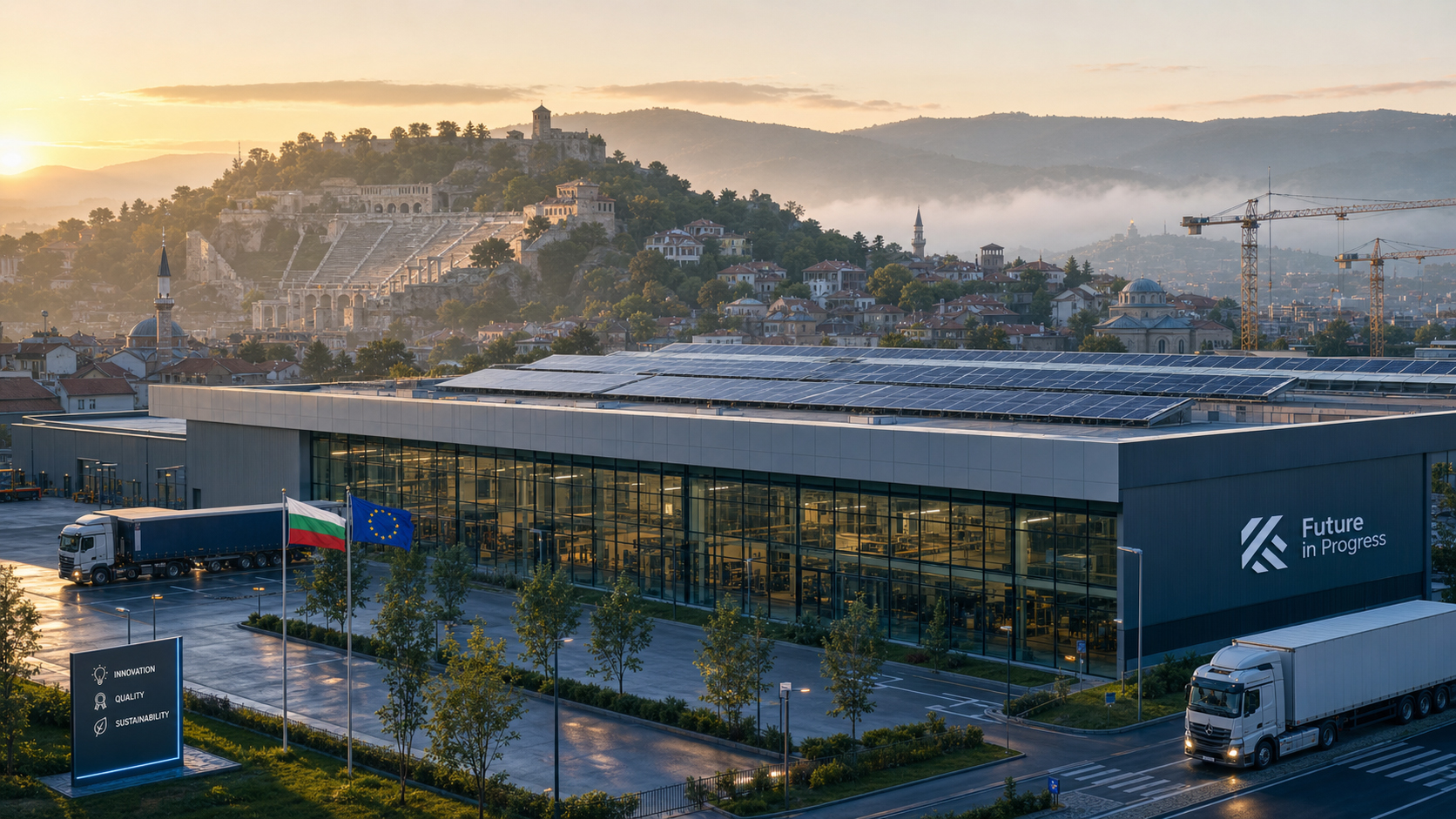
Plovdiv: Airbus parts instead of refrigerators – How a Bulgarian metropolis is becoming the second workbench for German SMEs – Creative image: Xpert.Digital
Billions in investments: Why German corporations are massively investing in this unknown Balkan location
Europe's hidden industrial giant: Why this 8,000-year-old city is outperforming western locations
Record construction times and tax advantages: How Bulgaria's most important industrial zone is leaving the competition behind
When the reindustrialization of Europe and emerging economic markets are discussed, attention usually turns to Poland, Romania, or the Czech Republic. But the real rising star of European industry lies in southern Bulgaria: Plovdiv. With over 8,000 years of history, this oldest continuously inhabited city in Europe has undergone an unprecedented transformation in the past two decades – from a traditional extended workbench for simple assembly work to a state-of-the-art high-tech center. Where once cost reduction was the sole motivation, industry giants like Liebherr are now investing in the production of complex aerospace components and reducing capacity in Germany. Benefiting from a strategically valuable geographical location, smart infrastructure projects like the Trakia Economic Zone, a corporate tax rate of just ten percent, and a dual vocational training system modeled on the German system, the region is attracting billions in investment. But is this enormous growth truly sustainable, or merely a temporary phenomenon that will dissipate with rising wages? The following analysis sheds light on the secret of success of the boomtown Plovdiv, its soft location factors and the structural challenges that accompany this rapid rise.
How an 8,000-year-old city became the pacesetter of European reindustrialization
When people talk about economic growth in Southeast Europe, most immediately think of Romania, Poland, or the Czech automotive industry. Bulgaria, and with it the southern Bulgarian metropolis of Plovdiv, usually remains in the shadows of this public perception. However, anyone who looks at the actual investment flows, business location decisions, and growth figures of the past two decades has to revise this image. Plovdiv has developed into one of the most dynamic industrial centers in the entire EU, with a growth rate that now clearly surpasses many Western European regions.
The city itself has around 800,000 inhabitants in its greater metropolitan area and is considered the oldest continuously inhabited city in Europe, with a settlement history spanning more than 8,000 years. This historical depth stands in fascinating contrast to the present, where high-tech factories for automotive electronics, aerospace components, and mechatronics are now concentrated on the same hills once inhabited by Thracian settlers. This fusion of millennia-old continuity and cutting-edge industrial technology gives the city a character that differs significantly from other Eastern European investment locations, most of which were built from scratch.
The central economic question raised by this rise is whether Plovdiv is experiencing a temporary cost-arbitrage phenomenon that will disappear with rising wages and increasing convergence, or whether a structurally sustainable industrial region is actually emerging here. This analysis examines this question by considering the key economic drivers, the institutional framework, and the specific investment decisions of international companies.
Location factors as the foundation of a new industrial map
The location choices of internationally operating companies rarely follow a single criterion, but rather result from the interplay of several mutually reinforcing factors. In the case of Plovdiv, geographical advantages, a specific cost profile, and institutional security combine in a way that appears particularly attractive to investors from Western Europe.
Geographically, Plovdiv lies on one of the most important east-west transport corridors in the Balkans, with direct access to motorway connections to Istanbul in the southeast and, via Sofia, onward to Serbia and Central Europe in the northwest. This position makes the city a natural logistical hub between the European Union and Turkey, a market of considerable economic weight and growing trade volume. For companies seeking to serve both the EU single market and adjacent markets in Asia Minor and the Middle East, this offers a strategic advantage that far outweighs purely cost-based location decisions.
The wage level in Bulgaria remains significantly below the Western European average, although the wage gap has narrowed considerably in recent years due to real economic growth and a shortage of skilled workers. Crucially, however, this cost advantage is linked to Bulgaria's EU membership, which it has held since 2007. This translates into duty-free trade within the single market for investors, legal certainty through European competition and contract law, and access to European funding programs and structural funds. Furthermore, NATO membership represents a significant security argument, particularly in a geopolitically tense global climate marked by the war in Ukraine and growing security uncertainties in Eastern Europe. Investors view this dual institutional anchoring as a safeguard against political risks, which are more pronounced in non-EU countries in the region, such as Serbia or Turkey.
Furthermore, the tax system is among the most investment-friendly within the European Union. The uniform corporate tax rate of ten percent is among the lowest in the entire EU and offers companies a degree of predictability that is invaluable given the volatility of tax systems in other European countries. Combined with low non-wage labor costs, this creates an overall cost environment that attracts a significant number of manufacturing companies from high-wage countries such as Germany, France, and Austria.
From refrigerator factory to aerospace manufacturer: How German corporations are shaping the transformation
No other foreign company has shaped the industrial development of the Plovdiv region as profoundly as the German engineering group Liebherr. The history of this commitment reads like a textbook example of systematic, gradual, and in-depth site development that extends far beyond a single investment decision.
The investment began in 1999 with the establishment of Liebherr household appliances in Radinovo near Plovdiv, initially focusing on the production of refrigerators and freezers. What started as a classic production relocation for cost optimization developed over the following two decades into one of the Group's most important industrial sites outside of Germany. Today, several thousand employees work at the Radinovo site, and annual production amounts to several hundred thousand refrigerators and freezers, which are shipped from there to the entire European market.
What is remarkable is the continuous diversification of Liebherr's operations. The company gradually expanded its Bulgarian presence to include the production of air conditioning and heating systems, as well as a dedicated plant for the manufacture of concrete mixer trucks. Each of these expansion decisions was made at a time when the company already possessed extensive experience with the local labor market, administration, and supplier networks. This gradual deepening of operations, rather than a single large investment, is economically significant because it demonstrates that the location has proven itself in practice and was not merely attractive on paper.
The most recent and economically significant development involves the relocation of aerospace component manufacturing to Plovdiv. Liebherr-Aerospace has announced the construction of a new, considerably larger production facility that will manufacture highly complex components such as primary flight control actuators, drive shafts for high-lift systems, and landing gear actuation systems for aircraft, with Airbus and Embraer as end customers. This investment marks a qualitative leap, as aerospace supply is among the most technologically demanding and heavily regulated industrial sectors. The fact that a corporation like Liebherr is willing to relocate such sensitive and high-quality manufacturing processes to Bulgaria signals a confidence in the skills of the local workforce that goes far beyond simple labor cost advantages.
At the same time, the concurrently announced relocation of the production of concrete mixers and mixing plants from the company's headquarters in Bad Schussenried to Plovdiv highlights the downside of this development from a German perspective. The gradual reduction of several hundred jobs in Baden-Württemberg as a result of this relocation makes it clear that Plovdiv's rise is not a zero-sum game, but rather directly correlates with the loss of industrial sites in traditional German regions. This shift raises fundamental questions about the future of German SMEs in cost-intensive manufacturing segments and demonstrates that Bulgaria's attractiveness as a business location does not arise in an economic vacuum, but must be understood as a reaction to structural competitive disadvantages in established industrialized nations.
In addition to Liebherr, another major German player, the retail group Kaufland, has established itself in the region. Its logistics facility, operating since 2005, is one of the largest in the retail sector in the entire Balkans, with a cumulative investment volume of well over €120 million. This investment underscores Plovdiv's significant importance not only for export-oriented manufacturing but also as a logistics hub for supplying Southeast European markets.
This entrepreneurial commitment is supported by institutional structures such as the German-Bulgarian Chamber of Industry and Commerce and the Office of the Honorary Consul of the Federal Republic of Germany in Plovdiv. These institutions act as intermediaries between German SMEs and the local economy, reduce information asymmetries, and significantly facilitate new business establishments – an often underestimated but economically important soft location factor.
The Trakia Zone as a blueprint for coordinated industrial development
A key factor in Plovdiv's development success lies in the systematic consolidation of industrial sites and infrastructure within the so-called Trakia Economic Zone. Established in 1996, this economic zone unites six different industrial areas surrounding the city and serves as a central point of contact for companies interested in establishing operations there, thereby significantly reducing bureaucratic hurdles.
The basic principle of this zone is to offer investors already developed sites with existing transport, electricity, and water infrastructure, thus drastically reducing the time from investment decision to commencement of operations. For internationally operating corporations that often have to make location decisions within tight timeframes to synchronize production relocations with market cycles, this time factor is of considerable economic importance. While in many Western European countries, permitting processes for industrial development alone can take several years, comparable processes in the Trakia zone can be completed in a fraction of that time.
The cumulative figures impressively demonstrate the effectiveness of this model. Since its inception, the zone has attracted more than 200 companies, with greenfield investments now amounting to well over two billion euros. With over six million square meters of available industrial space, the region also possesses considerable expansion reserves, enabling further intensification of industrial activity in the coming years without land scarcity becoming a limiting factor, as is already the case in many Western European metropolitan areas.
The diversity of the companies located here deserves special attention, as it demonstrates that Plovdiv is not focused on a single industry, but has developed a broad industrial ecosystem. In addition to Liebherr and Kaufland, companies such as ABB, the French automotive supplier Latecoere, the copper processor Aurubis, the American electronics manufacturer Sanmina, the sensor specialist Sensata Technologies, Schneider Electric, and the German electronics component manufacturer Würth Elektronik have established themselves in the region. This range extends from automotive electronics and aerospace supplies to metal processing and industrial automation technology. This diversification significantly reduces the concentration risk for the local economy, as an economic downturn in a single sector does not automatically jeopardize the entire regional economic development.
Also noteworthy is the increasing internationalization of the investor base beyond its German core. Recent establishments by Japanese packaging manufacturers, as well as the continuous expansion by Schneider Electric and Bulgarian companies like Smart Power Grid, demonstrate that Plovdiv's attractiveness as a business location is now recognized globally and no longer depends on a single country of origin or industry.
Education as a strategic lever: How Plovdiv is systematically combating the skills shortage
One factor often underestimated in the public debate about Eastern European investment locations is the systematic interlinking of the education system and industrial demand. Plovdiv has developed a strategy in this area that goes far beyond conventional business development policies and instead focuses on the long-term development of an independent pool of skilled workers tailored to local industry.
With over 9,200 students enrolled in science and technology-oriented classes, and nearly 1,000 apprentices in dual vocational training programs based on Central European models, the city has established a system clearly modeled on the German vocational training system. This dual training, which combines practical on-the-job training with classroom instruction, is by no means standard practice in Eastern Europe and was specifically developed in Plovdiv in close cooperation with local industrial companies. This allows them to directly influence the curriculum and secure their future skilled workforce needs early on.
This system is complemented by a network of eight universities with a total of more than 35,000 enrolled students, whose studies focus specifically on engineering, foreign languages, and information technology. The combination of technical and language training is particularly valuable to international investors, as professionals possessing both engineering expertise and foreign language skills can be immediately deployed in communication with foreign corporate headquarters and in international project teams without requiring extensive further training.
The existence of ten research centers operating in direct collaboration with local companies completes this educational ecosystem and indicates a gradual shift from pure production to higher-value creation through research and development. Should this trend continue, Plovdiv could, in the long term, not only function as an extended workbench for Western European corporations but also increasingly develop its own independent innovation capabilities – a development path already observed in other Central European reform states such as the Czech Republic and Poland, where it has led to a significant enhancement of the local value chain.
Find a partner in Bulgaria 🇧🇬 🔍🤝 and become a partner ➕


Bulgaria - Find and become a partner - Image: Xpert.Digital
Bulgaria is transforming from an underestimated EU market into a strategic nearshoring hub for European industrial SMEs. With low location costs, EU legal certainty, access to the Eurozone, and strong logistics networks on the Black Sea, the country offers robust alternatives to Asian supply chains.
At the same time, Bulgarian companies also benefit from this growing economic network, which serves as a strong springboard for their own expansion into Germany, Europe and global markets.
More information here:
A thematic hub offering insights and expertise:
- Knowledge platform covering global and regional economies, innovation and industry-specific trends
- A collection of analyses, insights, and background information from our key areas of focus
- A place for expertise and information on current developments in business and technology
- A hub for companies seeking information on markets, digitalization, and industry innovations
Investment engine Plovdiv: Between aviation and high-tech
The service sector as a second pillar of growth alongside industry
While traditional manufacturing shapes Plovdiv's public image, a significant service sector has developed in parallel, further diversifying and stabilizing the region's economic base. As the second-largest center for information technology and outsourced business processes in Bulgaria, the sector already employs over 7,000 people in several hundred local and international companies.
This sector differs fundamentally from traditional industrial development, as it depends less on physical infrastructure and more on the availability of a skilled, multilingual, and digitally savvy workforce. The city's young population and vibrant expat community of approximately 20,000 permanent residents create a favorable environment that supports international companies in recruiting personnel for customer service, software development, and administrative back-office functions. Forecasts predict that this sector will grow by an additional 5,000 jobs and attract further international companies over the next three to five years, thus continuing the already strong growth trajectory of this industry.
Economically significant is the fact that this service sector tends to pay higher wages than traditional manufacturing, thus contributing to the city's attractiveness to well-educated young people who might otherwise migrate to other Western European countries. This retention of talent within the region is a necessary prerequisite for ensuring that the parallel growth of industry has a sufficient number of qualified personnel in the long term, because without attractive employment prospects in the high-wage sector, the migration of young professionals to other EU countries would undermine the region's demographic and economic foundation.
Culture, quality of life and demographic pull
Plovdiv's economic success story cannot be viewed in isolation from the soft location factors that are crucial for attracting and retaining both international professionals and local young people. Being named a European Capital of Culture in 2019 marked a significant turning point in the city's international perception and, for the first time, drew considerable attention to the region from European investors and tourists.
The old town, built on three hills with its millennia-old architecture, and the recently revitalized Kapana creative district, which has become a popular meeting place for young creatives and the growing expat community, give the city an urban quality of life that clearly distinguishes it from purely functional industrial locations. This cultural appeal is not merely a tourist attraction, but a tangible economic factor, as highly qualified international professionals, who can choose between different locations, increasingly consider the quality of life at their place of work when making their decisions.
The demographic figures impressively underscore this appeal. The population within a 30-minute drive of the city center exceeded 600,000 several years ago, with more than 24,500 new residents moving to the region in a single year. This dynamic immigration, fueled by both domestic and international migration, distinguishes Plovdiv from many other Eastern European regions suffering from progressive population decline and the emigration of young people. The continuously growing expat community, now comprising over 20,000 permanent residents, further intensifies the internationalization of the local labor market and creates a culturally diverse environment that, in turn, attracts even more international professionals – a self-reinforcing cycle of considerable importance for the region's long-term competitiveness.
Investment volume and growth dynamics in European comparison
The quantitative investment figures of recent years impressively demonstrate the region's exceptional economic dynamism. Between 2019 and 2021, investments of over three billion euros were made in the acquisition of tangible assets alone – a considerable sum given the region's relatively small size, illustrating that the local economic ecosystem proved resilient even during the global economic instability of the pandemic years.
This resilience to external shocks is economically significant, as it indicates that Plovdiv's attractiveness as a business location does not depend solely on a short-term economic cycle, but rather is based on structural advantages that persist even during crises. Investors making long-term production decisions particularly value this stability, since relocating production involves substantial sunk costs and therefore requires a certain degree of planning certainty across multiple economic cycles.
This trend has continued and even intensified in recent years. Bulgarian direct investment has recently shown double-digit year-on-year growth rates, with the Plovdiv region and, in particular, the Trakia Zone considered the key driver of this development. New large-scale investments in the aviation sector, the packaging industry, and renewable energy technology underscore the region's ongoing shift in its investment profile towards higher-value, technologically advanced production – away from pure cost arbitrage and towards strategic, technology-driven location decisions.
In a European comparison, Plovdiv is thus positioned in a similar phase of development to that which Czech regions around Pilsen or Brno, Polish regions around Wrocław, or Hungarian locations around Győr underwent some fifteen to twenty years ago. These regions have since transformed themselves from mere cost centers into integrated components of European value chains with significant intrinsic innovative capacity. Should Plovdiv follow a similar development path, which seems quite plausible given the parallel investments in education and research, the region would face a long-term revaluation that extends far beyond its function as a mere manufacturing hub.
Risks and structural challenges of rapid development
An objective economic analysis cannot ignore the challenges and potential risks of this development. A key risk lies in the progressive convergence of labor costs. With increasing economic development and rising demand for skilled workers, wages in the region are also rising steadily, gradually diminishing the initial cost advantage over Western Europe. Should this trend continue without a comparable increase in the productivity and value creation of local industries, the region's attractiveness for purely cost-driven investment decisions could decline in the medium term.
Another structural risk concerns the skilled labor market itself. Despite impressive investments in vocational training and university education, there is a risk that demand for qualified engineers, technicians, and IT specialists will exceed supply in the future, particularly if further major investments, such as Liebherr's announced aircraft manufacturing plant, tie up additional skilled workers. An excessively tight labor market could accelerate wage increases while simultaneously increasing the risk that companies will have to delay or abandon their expansion plans altogether due to a shortage of skilled workers.
Bulgaria's overall demographic development also represents a significant uncertainty. While the Plovdiv region itself is growing through internal migration and immigration, Bulgaria as a whole has experienced a marked population decline for years, due to low birth rates and the continued emigration of young, well-educated people to wealthier EU countries. Should this nationwide demographic shrinkage accelerate, it could, in the long term, limit the Plovdiv region's ability to meet its growing demand for skilled workers solely from within Bulgaria, even though the region itself has fared relatively well so far.
Finally, the question of political stability remains a latent uncertainty. Bulgaria has repeatedly experienced political instability in recent years, with frequent changes of government and new elections. Although macroeconomic policies regarding taxes and investment incentives have shown remarkable continuity across different governments, persistent political fragmentation could weigh on investor confidence in the long term, particularly if fiscal constraints, such as those arising from planned Eurozone accession preparations, lead to cuts in investment incentive programs.
Structural change instead of short-term cost arbitrage
A comprehensive review of the available data and developments suggests that Plovdiv's success story is not a fleeting cost arbitrage phenomenon, but rather a structural economic catch-up process resting on several mutually reinforcing foundations. The combination of a favorable geographical location, institutional anchoring in the EU and NATO, a location profile that remains attractive by European standards but is no longer purely cost-based, and a deliberately pursued education initiative distinguishes Plovdiv from traditional low-wage locations, which quickly lose their appeal as prosperity increases.
Particularly noteworthy is the development of Liebherr's involvement, which has evolved from simple household appliance production to highly complex aerospace supply. This increase in vertical integration suggests that Plovdiv is already making the critical transition from a mere extended workbench to an integrated component of European high-tech supply chains. Should this trend continue, the region is likely to remain economically relevant even after the foreseeable erosion of its pure labor cost advantage, because it will then possess independent technological expertise and an established pool of skilled workers that cannot be replicated elsewhere without considerable effort.
At the same time, it must be noted that this development is not without its losers. The relocation of production capacities and jobs from traditional German industrial regions, occurring in parallel with Plovdiv's expansion, illustrates that the economic catch-up process of Eastern Europe and the relative weakening of core industrial regions in Western Europe are two sides of the same coin. For Germany and other Western European industrialized nations, this results in the strategic necessity of defending their own competitiveness through innovation, automation, and higher added value, rather than relying on the continuation of previous cost advantages, which are increasingly being lost to locations like Plovdiv.
Overall, Plovdiv's development exemplifies how the economic landscape of Europe is shifting as integration progresses, without necessarily resulting in a zero-sum game between East and West. Rather, an increasingly specialized European production network is emerging, in which regions like Plovdiv contribute specific expertise and cost advantages, while Western European locations concentrate on research, development, and higher-value manufacturing processes. Whether this model remains sustainable in the long term will depend significantly on Plovdiv's ability to consistently pursue the transition it has begun from purely cost-driven production to developing its own technological expertise.
🎯🎯🎯 Data-driven B2B industry hub as a quasi-in-house solution


The quasi-in-house solution: How Xpert.Digital closes operational gaps in B2B marketing and sales – Smart Content-Driven Business - Image: Xpert.Digital
Xpert.Digital is a data-driven B2B industry hub led by Konrad Wolfenstein . The company acts as an external, quasi-in-house solution for industrial partners, closing operational gaps in marketing, content, and sales – without requiring additional resources on the client side.
More information here:
Your global marketing and business development partner
☑️ Our business language is English or German
☑️ NEW: Correspondence in your native language!

Konrad Wolfenstein
I and my team are happy to be available to you as your personal advisor.
You can contact me by filling out the contact form here wolfenstein@xpert.digital:or simply call me at +49 7348 4088 965. My email address is
I'm looking forward to our joint project.