
Robots instead of a research team? OpenAI is disbanding its robotics team: Why this doesn't have to be a retreat
Xpert Pre-Release

Available in 27 languages 📢
Prefer Xpert.Digital on GoogleⓘPublished on: November 15, 2026 / Updated on: November 15, 2026 – Author: Konrad Wolfenstein
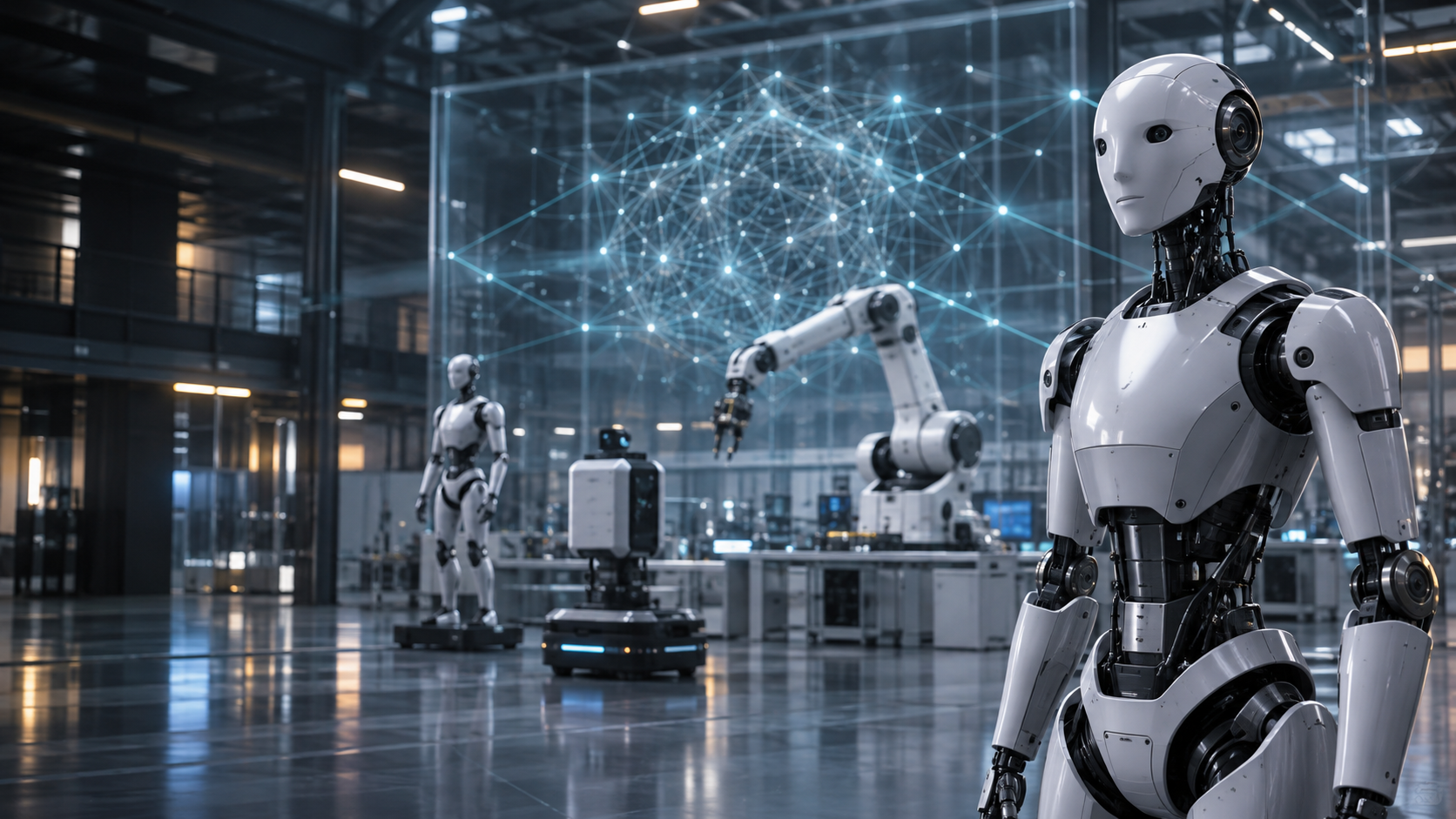
Robots instead of a research team? OpenAI is disbanding its robotics team: Why this doesn't have to be a retreat – Creative image on the topic, with AI: Xpert.Digital
OpenAI is pursuing a new AI strategy: Will OpenAI become the brain of future robots? The new strategy explained
OpenAI is reorganizing its robotics – with consequences for the entire industry
The end of specialized robotics? OpenAI relies on general AI models
OpenAI is dissolving its independent robotics team and redeploying its employees to other business units. At first glance, this sounds like a withdrawal from one of the most exciting future fields of artificial intelligence. However, the reorganization could signal a different course: Instead of treating robotics as a separate research discipline, OpenAI apparently intends to more closely integrate its general AI models with the development of robots.
Behind this lies a far-reaching gamble. Until now, controlling robots often required specialized models, proprietary datasets, and considerable technical expertise. OpenAI now appears to be placing greater emphasis on the ability of large models, capable of processing speech, images, and other information, to also perform tasks in the physical world. This could change who develops the crucial technology for robots in the future – and whether specialized providers or large AI platforms will dominate the industry.
A withdrawal from robotics is therefore not necessarily implied by the restructuring. Rather, it could indicate that OpenAI views intelligence for robots as an extension of its core AI models. Whether this approach will prove viable in practice, however, remains to be seen: Robots must not only deliver convincing demonstrations but also function reliably, safely, and economically in real-world environments. OpenAI's decision thus raises a broader question: Will robotics become the domain of less powerful AI platforms in the future – or will it remain an independent discipline where specialized knowledge is crucial?
The key turning point: When a language model becomes a robot brain
OpenAI has dissolved its standalone robotics team and redeployed its employees to other areas of the company. At first glance, this appears to be a withdrawal from one of the most visible future fields of artificial intelligence. In reality, however, it is more of a strategic reorganization: Robotics research is being integrated into central model development, while applied robotics and hardware are being placed within the broader product and application area. The message is clear: OpenAI no longer views robots primarily as an independent research discipline, but rather as an application area for its general AI models.
This decision is of great economic and technological significance. It marks a potential turning point for the entire robotics industry. For decades, controlling physical machines was considered a highly specialized problem requiring dedicated models, datasets, simulation environments, and engineering teams. This very assumption is now being challenged by one of the world's most influential AI companies. If large, generically trained models can directly control robots, the value shifts from being solely in specialized robotics software to increasingly encompassing the underlying foundation models, the computing infrastructure, the data economy, and the ability to reliably deploy models in the physical world.
The provocative subtitle question is therefore: Will robotics become a mere accessory for the large AI corporations?
A restructuring with symbolic power
In 2024, OpenAI established a dedicated robotics team and simultaneously announced a partnership with the robotics startup Figure. The goal was to develop AI models for humanoid robots. This collaboration ended in February 2025 after Figure announced its intention to develop its own robot AI models. OpenAI, for its part, stated that it was working on its own humanoid robot. Reports indicate the company is aiming for a first public demonstration in 2027.
The now-announced dissolution of the independent team is therefore not a sudden event. It is part of a longer development in which OpenAI has repeatedly adjusted its robotics strategy. Back in 2020, the company shut down an earlier robotics group. At that time, limited robot data and the realization that large language models might be the faster path to powerful general artificial intelligence played a significant role. A new team was established in 2024, and now there is another redistribution of expertise.
The robotics researchers will henceforth work in the central research organization under Chief Research Officer Mark Chen. The applied robotics and hardware teams will move to the Applied organization under President Greg Brockman. This separation is revealing. It shows that OpenAI distinguishes between two levels: fundamental modeling research, which will also develop robotic capabilities in the future, and practical implementation in hardware, control, integration, and products.
A company spokesperson emphasized that this does not signify a withdrawal from robotics. Robotics remains part of the company's long-term vision. At the same time, the restructuring is portrayed as an acceleration. Researchers are to be more closely integrated with general model development, instead of working on specialized robotics models in a separate organization. Whether this portrayal fully reflects economic reality remains to be seen. Dissolving an independent team always involves a prioritization: resources, attention, computing power, and leadership expertise are pooled.
The short-term nature of the decision
The timing is noteworthy. OpenAI had registered a booth for the CoRL conference in Austin. The Conference on Robot Learning is one of the most important scientific gatherings for robotics and machine learning research. An appearance there would not only have been a PR move, but also a signal to researchers, investors, talent, and potential partners.
But the booth remained empty. There was neither visible OpenAI branding nor demonstrations. This discrepancy between planned presence and actual withdrawal shows how short-term the decision apparently was. It can be interpreted as a sign of a rapid strategic reassessment. Perhaps internal experiments had shown that the company's general models handled robotic tasks better than expected. Perhaps OpenAI wanted to reallocate resources. Perhaps organizational efficiency, cost control, or preparation for future capital market activities also played a role.
From an economic perspective, the short-term nature of these technologies is crucial. Companies with limited computing resources, highly paid researchers, and enormous investment needs cannot work indefinitely on all promising technology fields simultaneously. Every decision for one field is simultaneously a decision against, or at least in favor of, another. Robotics is capital-intensive, time-consuming, and uncertain. Models, software, and cloud services scale more quickly. A humanoid robot, on the other hand, requires mechanical development, sensors, actuators, power supply, safety, manufacturing, maintenance, and regulatory approval.
OpenAI therefore seems to be considering whether it should treat robotics as an application of its core competence, rather than building it as a separate vertical technology platform.
The hypothesis of general models
At the heart of the new strategy lies a technological hypothesis: General models trained for language, code, images, and potentially video could also serve as the foundation for embodied AI. Embodied AI refers to systems that not only process information but also perceive their environment via sensors, make decisions, and act in the physical world via actuators. Robots, autonomous vehicles, drones, industrial manipulators, and household assistance systems fall into this category.
Traditional robotics was long based on a highly fragmented approach. Perception, path planning, control, manipulation, object recognition, language, and task planning were typically developed separately. A robot might be very good at performing a specific grasping operation, but unable to react flexibly to new objects, changing environments, or unforeseen disturbances. Generalization was limited. Every new task often required new data, new models, or complex programming.
Large AI models are changing this logic. They can understand language, interpret visual information, break down tasks, generate code, and apply knowledge about the physical world. A robot instructed to take a dirty cup from the table and put it in the dishwasher doesn't just need to move a gripper. It needs to recognize what a cup is, how to grip it, what obstacles are present, what movement makes sense, and what to do in case of an error. A general model could potentially connect this chain of perception, language, planning, and action.
OpenAI reported that its researchers initially assumed that advances in robotics would primarily build upon work such as the video generation model Sora. Sora requires a certain understanding of the physical world, including movement, objects, space, causality, and temporal sequences. However, the company's more recent Frontier models have demonstrated their more direct applicability to robotic tasks. This realization appears to have been a key driver of this shift in focus.
Why robotics is so difficult
The expectation that general models could control robots sounds plausible. However, it shouldn't obscure the fact that the physical world is technically and economically more complex than the digital one. A language model can generate an error in a text without causing immediate material damage. A robot that grasps incorrectly can break glass, injure people, damage production facilities, or disrupt expensive processes.
Robotics combines several difficult problem areas. First, perception is incomplete. Cameras provide images, but shadows, reflections, occlusions, changing lighting conditions, and moving objects complicate interpretation. Touch sensors, force sensors, depth cameras, and lidar can help, but they increase complexity and costs. Second, control is precise. An arm must know not only where to grasp, but also with what force, speed, and in what sequence. Third, the environment is variable. A laboratory, a factory, or an apartment is never entirely predictable. Fourth, safety and reliability are crucial. A system with a 95 percent success rate might be impressive in a digital application, but economically unusable in a factory if one in five tasks fails.
Added to this is the data problem. The internet contains enormous amounts of text, images, videos, and code. However, it contains far less high-quality data about how robots behave in real-world environments. Data on forces, friction, gripping forces, contact points, material behavior, endurance, errors, and corrections would be particularly valuable. Such data must either be collected in expensive real-world experiments or generated in simulations. Simulations are scalable, but they never fully represent real-world physics. The transition from simulation to reality remains one of the central hurdles in robotics.
The economic logic behind the decision
OpenAI's move can be understood as a response to a fundamental economic dilemma. The company possesses exceptional modeling capabilities, enormous computing resources, and global access to talent. At the same time, developing its own robot hardware is expensive, slow, and capital-intensive. The question, therefore, is: Should OpenAI become a complete robotics company or provide the AI layer that will power robots from other manufacturers in the future?
The dissolution of the independent team points to the second option. OpenAI apparently doesn't necessarily want to own all the components of a robotic ecosystem itself. Instead, it's focusing on what it does best: developing powerful, general-purpose models. These models could serve as a cognitive layer for robots, while hardware manufacturers, integrators, industrial customers, and specialist vendors handle the physical implementation.
This would be a similar business model to that in the software industry. An operating system or cloud platform is not necessarily offered with every end device. Rather, the platform operator provides the central intelligence, while hardware manufacturers, application developers, and service providers distribute the added value. In robotics, OpenAI could assume the role of a robotics AI provider in the future: models, interfaces, development tools, security features, cloud-based inference, and potentially license-based billing models.
The economic appeal lies in its scalability. A voice-based or multimodal model, once developed, can be delivered to many customers via APIs, cloud services, or licensing agreements. The marginal costs per additional user or robot are comparatively low. A physical robot, on the other hand, must be manufactured, transported, installed, maintained, and eventually replaced. Each device ties up capital, supply chains, service personnel, and inventory.
Therefore, it would be rational for OpenAI to control the model intelligence and either develop the hardware itself, albeit to a limited extent, or to work with partners. A dedicated humanoid robot could serve as a reference platform. It would demonstrate the capabilities of the models, generate its own data, and create a market for future collaborations. However, it doesn't necessarily have to become a mass-produced end product.
The power of the platform economy
The most important economic question is not whether OpenAI can build robots. The crucial question is who controls the central platform of embodied AI. If general models do indeed form the basis for robot control, a power structure similar to that found in mobile operating systems, cloud infrastructure, or large language models will emerge.
A robotics manufacturer might possess excellent mechanics, sensors, and actuators. However, if the crucial model, development tools, data pipeline, and cloud infrastructure come from a large AI provider, the value chain shifts. The hardware manufacturer may become the integrator, while the model provider enjoys the highest margins, strongest customer loyalty, and most control over the technology stack.
This explains why OpenAI's decision is relevant far beyond the company itself. Figure, Tesla, Boston Dynamics, Agility Robotics, 1X, Apptronik, Unitree, and many other companies are working on humanoid or specialized robots. Some are pursuing the approach of developing their own robot AI. Others are relying on collaborations with large AI providers. The strategic tension lies in the fact that a strong AI partner brings acceleration today, but can also create dependency in the long run.
For robotics startups, the message is ambivalent. On the one hand, development costs for cognitive capabilities may decrease because powerful foundation models are becoming available. A startup no longer needs to develop a language, vision, and planning model from scratch. On the other hand, the opportunity for differentiation diminishes when the crucial intelligence is controlled by a few large providers. Competition then shifts to hardware, security, reliability, manufacturing, sales, service, and industry-specific integration.
Data as a new scarce resource
In digital AI, data access has long been a crucial competitive advantage. Vast amounts of text and images exist on the internet. In robotics, the data situation is different. Real-world interaction data is scarce, expensive, and difficult to standardize. Every robot has different sensors, actuators, body geometries, and tasks. Data collected with a specific robotic arm cannot simply be transferred to a humanoid robot.
Therefore, the ability to generate one's own data is becoming increasingly important. A company that operates robots in factories, logistics centers, homes, or laboratories collects valuable information about real-world actions, errors, corrections, and user reactions. This data can be used to improve models. It creates a learning cycle: more deployments lead to more data, more data improves the models, better models increase operational capability, and higher operational capability leads to more deployments.
OpenAI could build this cycle through partnerships, APIs, developer platforms, or its own pilot projects. In this sense, a humanoid robot from the company would not only be a product but also a data source. It could demonstrate how models fail in the physical world, where additional training data is needed, and what safety mechanisms are required.
At the same time, data protection, ethical, and geopolitical questions arise. Robots in homes, care facilities, factories, and public spaces may record movement profiles, faces, voices, locations, and behavioral patterns. Whoever owns, processes, and uses this data for model training gains considerable influence. The economic power of embodied AI will therefore arise not only from computing power and models, but also from data sovereignty and trust.
🎯🎯🎯 Data-driven B2B industry hub as a quasi-in-house solution

The quasi-in-house solution: How Xpert.Digital closes operational gaps in B2B marketing and sales – Smart Content-Driven Business - Image: Xpert.Digital
Xpert.Digital is a data-driven B2B industry hub led by Konrad Wolfenstein . The company acts as an external, quasi-in-house solution for industrial partners, closing operational gaps in marketing, content, and sales – without requiring additional resources on the client side.
More information here:
Impact of new robotics models on industry and SMEs
From research team to product ecosystem
The separation between research and applied development is not merely an organizational detail. It demonstrates how OpenAI intends to approach robotics in the future. Researchers under Mark Chen will presumably work on improving general models for perception, planning, spatial understanding, language, and action. The applied organization, led by Greg Brockman, will translate these capabilities into concrete systems: hardware integration, control software, safety, testing, pilot projects, and potentially commercial products.
This division of labor can be efficient because it avoids duplication of effort. A separate robotics team might develop its own models, even though the central research organization already possesses comparable expertise. Integration allows advances in language models, multimodal perception, code generation, and world modeling to be directly applied to robotics applications. This reduces friction and accelerates the transfer of research into products.
At the same time, integration carries risks. Robotics is not just an application of AI. It requires specific knowledge of mechanics, control engineering, sensor fusion, real-time systems, materials science, safety, and manufacturing. If robotics researchers become solely absorbed in large model teams, there is a risk that this specialized knowledge will lose its significance. The result could be models that perform well in benchmarks but fail in real-world environments.
The economic challenge lies in finding the right balance. Too much separation leads to inefficiency and duplicated investments. Too much centralization can underestimate the specific requirements of the physical world. OpenAI must therefore ensure that robotics expertise is not only retained but also effectively integrated into model and product development.
The significance of the humanoid robot
OpenAI is reportedly working on its own humanoid robot. Sam Altman is said to be aiming for a first public demonstration in 2027. A humanoid robot is not necessarily the most economically efficient form of machine. For many industrial tasks, specialized arms, vehicle-like systems, mobile robots, or stationary automation solutions are cheaper and more reliable. Using humans as a model is not always the best technological solution.
Why are companies still investing in humanoid robots? The main reason lies in the universality of the environment. Factories, warehouses, offices, hospitals, and living spaces are predominantly built for humans. Stairs, door handles, tools, shelves, switches, machine control panels, and work surfaces are designed for human body dimensions and movement patterns. A humanoid robot can potentially work in existing environments without requiring a complete redesign.
This can reduce implementation costs. Instead of redesigning a factory for specialized automation, a humanoid robot could be integrated into existing processes. It could transport materials, operate machines, perform simple assembly tasks, support quality control, or work in hazardous areas. However, whether this is economically viable depends heavily on the cost per hour, reliability, maintenance requirements, and the actual range of tasks.
For OpenAI, a humanoid robot could also serve as a strategic demonstration object. It would prove that their models can not only generate text, images, or code, but also handle complex physical tasks. A compelling demonstration in 2027 could convince investors, customers, and talent. It could also boost the market for robot AI licenses. However, a demonstration is not yet a mass-market product. The real test lies in whether robots can operate reliably, safely, and economically over several months.
The danger of overgeneralization
The idea that general-purpose models can replace specialized robotics models is tempting. It promises fewer teams, less duplication of development, and faster scaling. But it can also lead to an underestimation of specialization. The physical world is not simply another modality alongside text and image. It has its own inherent laws: friction, weight, inertia, elasticity, wear and tear, safety, energy consumption, and unpredictable disturbances.
A general-purpose model might understand that an object needs to be grasped. However, it may struggle to determine the correct gripping force for fragile glass, a slippery workpiece, or a hot piece of metal. It can understand language, but cannot reliably assess whether a sensor is faulty, an actuator is overheating, or whether a movement poses a danger to people. These capabilities often require domain-specific models, control systems, and safety architectures.
The more likely development, therefore, is not a complete replacement, but a division of labor. General-purpose models could form the cognitive layer: understanding language, interpreting tasks, recognizing objects, creating plans, and handling exceptions. Specialized components would continue to be responsible for real-time control, motor control, force control, safety shutdown, sensor fusion, and reliable hardware. The crucial question is how these layers are connected.
For OpenAI, this means that the dissolution of the robotics team does not necessarily mean the end of specialized knowledge. It could also mean that this knowledge is integrated into other structures. Whether this succeeds will be shown by whether the company develops robotic systems that not only deliver impressive demonstrations but also function reliably under real-world conditions.
Consequences for the labor market
The restructuring also has consequences for the job market. Robotics is an interdisciplinary field. It combines mechanical engineering, electrical engineering, computer science, cognitive science, materials science, control engineering, and artificial intelligence. Until now, specialized robotics researchers were often organized in their own departments or startups. When large AI companies integrate robotics into their model teams, career paths, skill sets, and compensation structures will change.
Researchers with experience in reinforcement learning, computer vision, embodied AI, simulation, control, and multimodal models could become more valuable in the future. At the same time, traditional robotics engineers could come under pressure to expand their skills to include machine learning, software development, and data infrastructure. The line between AI researcher, robotics engineer, and product developer is blurring.
For talented individuals, integration into a large AI company can be attractive. They gain access to computing power, data, model architectures, and global distribution channels. However, for the industry, this can also lead to consolidation. A few companies control the most important models, the largest computing resources, and a significant portion of the top talent. Startups then have to focus more on niches, hardware, regional markets, specialized applications, or proprietary data.
Impact on industry and SMEs
The potential shift to more general robotics models could democratize automation. Until now, advanced robotics has often been limited to large corporations with the capital, engineering teams, and long implementation cycles. Small and medium-sized enterprises (SMEs), craft businesses, hospitals, logistics providers, and farmers have often struggled to implement automation economically.
If a general model can understand tasks via language, recognize objects, and plan actions, smaller companies could benefit from standardized robotics solutions. A warehouse worker could explain to a mobile robot in natural language which pallets should be moved. A lab manager could instruct a robot to perform repetitive sample handling tasks. A small business could use a mobile assistant for material transport, inspection, or simple assembly tasks.
This wouldn't necessarily lead to an immediate and explosive increase in demand for robotics. The hurdles remain high: acquisition costs, integration, training, maintenance, liability issues, cybersecurity, and employee acceptance. In the long term, however, the combination of general AI, decreasing hardware costs, and improved reliability could open up new markets. Tasks that are dangerous, monotonous, physically demanding, or where personnel is scarce would be particularly attractive.
At the same time, there is a risk of a new dependency. Companies that use robot AI as a service may relinquish data, process knowledge, and operational control to platform operators. Whoever controls the models can influence prices, availability, functionality, and future developments. For critical infrastructure, healthcare, and manufacturing, technological sovereignty is therefore an increasingly important issue.
Geopolitical dimension of embodied AI
Robotics is not just a market, but also a strategic sector. Robots play a role in manufacturing, defense, logistics, agriculture, healthcare, and critical infrastructure. If the cognitive control of robots depends on a few global AI providers, new dependencies arise. Governments and companies must clarify which models may be used, where data is stored, how security vulnerabilities are addressed, and who is liable in case of errors.
The United States boasts strong AI companies, large data centers, and leading chip designers. China is investing heavily in robotics, manufacturing, and AI. Europe possesses industrial expertise, automotive suppliers, automation technology, and strong research institutions, but lags behind in the development of large foundation models and computing infrastructure. These imbalances could worsen as robotics becomes increasingly reliant on general AI models.
For European companies, relying solely on models from foreign platform operators would be strategically risky. At the same time, developing every model and component in-house would be unrealistic. A more sensible strategy would be one that relies on open interfaces, European computing power, industrial data sovereignty, security standards, and strong integration expertise. Europe could play a particularly important role in reliable, safe, and regulated robotics for industry, healthcare, and public infrastructure.
What investors should expect
From an investor's perspective, OpenAI's decision is a signal, but not definitive proof. It shows that a leading AI company is treating robotics not as an isolated field of research, but as an extension of its modeling strategy. This could put pressure on the market for specialized robotics AI startups. At the same time, it could accelerate the entire sector, because large models could reduce development costs and time to market.
Investors should distinguish between two levels. The first level concerns the model and platform economy. Here, large AI providers could win because they control computing power, data, talent, and distribution channels. The second level concerns physical implementation. Here, hardware manufacturers, sensor companies, actuator specialists, integrators, security providers, and service companies remain relevant. A powerful model alone does not build a robot.
Companies that occupy one of the following positions could be particularly interesting: They possess proprietary operational data, develop reliable hardware for specific environments, have regulatory approvals, are skilled in integrating their systems into existing industrial processes, or offer security and maintenance services. These factors are harder to replicate than a software interface or a demo.
OpenAI's real bet
OpenAI is betting that the boundary between digital and physical thinking is shrinking, more so than many experts have previously assumed. If a model can combine language, images, code, video, and spatial action in a single system, then robotics may no longer be defined by specialized models, but rather by the quality of its general intelligence.
This bet is bold, but not unrealistic. The history of artificial intelligence repeatedly shows that general-purpose approaches can displace specialized solutions once they reach a critical performance threshold. Speech recognition, image recognition, translation, and code generation were initially treated as separate problems. Large multimodal models have partially blurred these boundaries. It would be logical for robotics to follow as the next field.
However, the physical world is the toughest test. A robot must not only appear plausible; it must act reliably, react safely, operate economically, and be serviceable long-term. Therefore, the decisive metric will not be the elegance of a demonstration, but rather the cost per task completed, the error rate, availability, safety, and speed of scaling.
A potential new market for robot AI
If OpenAI's hypothesis proves correct, a new market will emerge: robot AI as a service. Companies could license models to equip their robots with perception, planning, speech, and adaptability. Billing could be based on API usage, per-robot license fees, cloud capacity, or revenue sharing.
This would change the value chain. Hardware manufacturers would continue to build robots, but most of the high-margin intellectual property would reside with the model operators. System integrators would adapt applications, develop security architectures, and integrate robots into existing processes. Customers might no longer buy individual robots but instead obtain robotics as a service.
Such a market would offer significant economies of scale. A single model, once developed, could theoretically control many types of robots. It could be used in a factory, a warehouse, a hospital, or a home. Adaptation would no longer be achieved solely through new mechanics, but rather through data, fine-tuning, safety rules, and domain-specific interfaces.
At the same time, this would increase concentration. Companies with the largest models, the most data centers, and the best access to interaction data could build a strong network effect. Robotics would then be shaped less by many small, specialized AI providers and more by a few platforms controlling the cognitive foundation.
Why withdrawal is not synonymous with giving up
The dissolution of a standalone robotics team can be interpreted as a retreat. In OpenAI's case, however, this interpretation is too simplistic. The company explicitly states that robotics remains part of its long-term vision. The transfer of research to the central organization and applied work to the Applied organization suggests integration rather than a complete abandonment.
The crucial question is whether OpenAI views robotics as a core product or as an application area for its core products. In the first case, the company would invest heavily in manufacturing, supply chains, sales, and service. In the second case, it would primarily offer models, interfaces, development tools, and possibly reference hardware. The current decision suggests the latter approach.
This makes economic sense. OpenAI can potentially create more value with its general models by controlling the intelligence layer, rather than simultaneously building a capital-intensive hardware business. Developing a proprietary robot can still be beneficial, however, as it serves as a test platform, data source, and strategic signal. But it doesn't have to be the core business model.
The risks of the new strategy
The greatest danger lies in underestimating the complexity of robotics. General models can demonstrate impressive capabilities, but robotic systems must function reliably in the real world. A wrong decision can trigger safety risks, liability issues, reputational damage, and regulatory conflicts. Especially in industry, downtime, precision, and repeatability are crucial.
Another risk is the dependence on computing power. Robots often require real-time decisions. If every perception, planning, or correction process runs through a cloud connection, latency, network dependency, and security issues arise. Future systems may therefore need to execute some of the intelligence directly on the robot. This requires efficient models, specialized chips, and robust offline capabilities.
Finally, there is a risk that focusing on general models diminishes the importance of domain-specific knowledge. A model that performs well in a benchmark is not yet a robot for a factory, a hospital, or a household. The successful providers will be those that combine general intelligence with deep industry knowledge, security architecture, and reliable hardware.
What will now decide the fate of the industry
The central question for the coming years will not be whether robots need AI. That is now largely undisputed. The crucial question is which architecture prevails. Will specialized robotics models continue to dominate because they are more reliable, efficient, and safer? Or will general foundation models form the cognitive basis for most robotic applications?
The answer will likely lie somewhere between these two extremes. General-purpose models will handle the upper levels of perception, language, planning, and task decomposition. Specialized systems will continue to be needed for real-time control, security, sensing, and hardware integration. Therefore, competition will not simply be between "general-purpose" and "specialized." It will determine who controls the interfaces, data flows, development tools, and distribution channels.
With its restructuring, OpenAI has taken a clear stance. It is banking on its general models being able to directly perform robotic tasks. This shifts robotics from an isolated field of research to the core of its modeling strategy. This is not a capitulation to the physical world, but rather an attempt to conquer it through the means of digital scalability.
Whether this endeavor succeeds will not be measured by press releases or conference booths. It will be measured by whether robots one day not only impress audiences but also work reliably in factories, warehouses, hospitals, and homes. Until then, OpenAI's decision remains an important, but not yet definitive, signal: Robotics may not disappear. However, it will increasingly become part of major AI platforms.
📈🚀 From visibility to trust 👀🤝 Your scalable path with Xpert.Digital

From visibility to trust: Your scalable path with Xpert.Digital - Image: Xpert.Digital
In industrial B2B, sustainable business relationships rarely emerge overnight. They develop step by step – through visibility, professional relevance, recurring touchpoints, and growing trust. Xpert.Digital's 4-stage model addresses precisely this: It offers a structured path that begins with a manageable entry point and can evolve into deeper collaboration in business development if needed.
Instead of relying on loud marketing promises, this model puts the relationship at the forefront. Companies start with clearly defined, easily calculable measures and then decide, based on their own experience, how far they want to expand the collaboration. A key factor for this undisturbed trust-building process: The platform completely avoids annoying advertising ads, so the editorial focus remains solely on the companies' expertise.
More information here:
Your global marketing and business development partner
☑️ Our business language is English or German
☑️ NEW: Correspondence in your native language!

Konrad Wolfenstein
I and my team are happy to be available to you as your personal advisor.
You can contact me by filling out the contact form here [email protected]:or simply call me at +49 7348 4088 965. My email address is
I'm looking forward to our joint project.









