
Isento Robotics | A humanoid robot from a 3D printer? This German project “pib” makes it possible for everyone – and affordable

Available in 27 languages 📢
Prefer Xpert.Digital on GoogleⓘPublished on: September 1, 2025 / Updated on: September 1, 2025 – Author: Konrad Wolfenstein
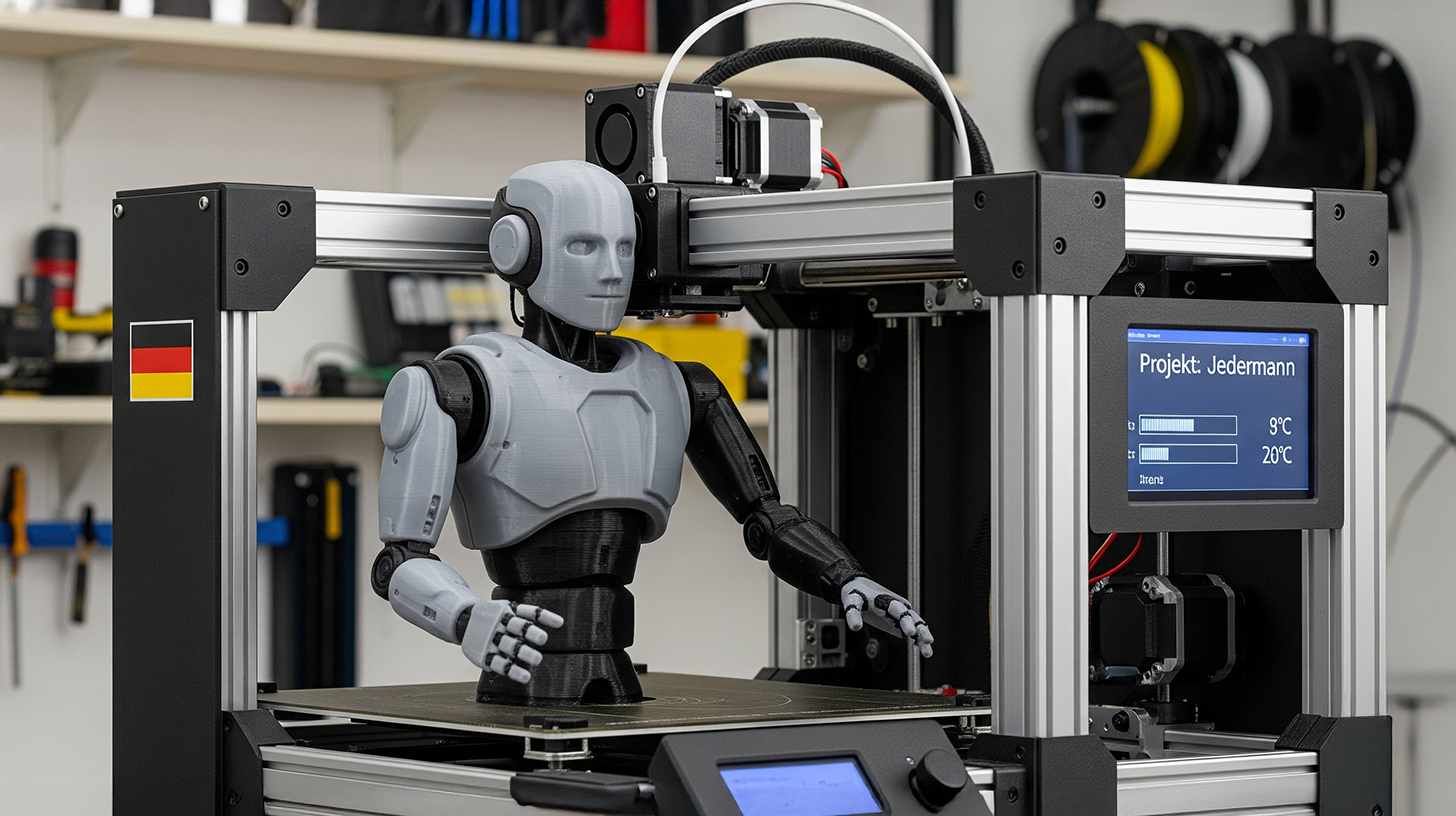
Robots from a 3D printer? This German project makes it possible for everyone – and affordable – Creative image: Xpert.Digital
Forget Boston Dynamics: This humanoid costs only a fraction of the price and comes from a printer
### The next STEM revolution? How 3D-printed robots are already changing classroom teaching ### Your next household helper comes from the printer: The vision of the humanoid robot for everyone is becoming reality ### No more expensive technology needed: How open source is revolutionizing the world of humanoid robots ###
From file to finished robot: Insights into the project that could change robotics forever
The idea of a personal, humanoid robot that helps in one's own home long seemed reserved for science fiction – a vision of the future dominated by multi-million-dollar prototypes from global corporations. But this era of exclusive high technology is now undergoing a fundamental revolution, driven by an idea that is as simple as it is ingenious. A German company called Isento Robotics is breaking down these barriers with its "pib" (printable intelligent bot) project, pursuing a radically new vision: a highly advanced humanoid robot whose blueprints are freely available to everyone and whose parts can largely be manufactured with a standard 3D printer.
This open-source approach not only democratizes access to advanced robotics but also reduces costs from tens of thousands of euros to a fraction, unleashing the innovative power of a global community of developers, students, and enthusiasts. The pib is more than just a machine; it symbolizes a paradigm shift, demonstrating how the convergence of 3D printing, collaborative software development, and affordable hardware is redefining personal robotics. The following text comprehensively explores how this technological synergy works—from innovative cycloidal drives and transformative applications in schools to the tangible vision of a smart helper in every home.
Humanoid robots from the 3D printer: The revolution of personal robotics
The world of robotics is undergoing a remarkable transformation through the merging of 3D printing technology with the development of humanoid robots. The innovative company Isento Robotics, with its "pib" (printable intelligent bot) project, has created a new approach that makes it possible to design humanoid robots cost-effectively and accessibly. This development marks a significant turning point in how we think about robotics and how we can integrate this technology into our daily lives.
The breakthrough of accessible robotics
Traditional robotics development has been characterized by high costs, complex manufacturing processes, and limited availability. Humanoid robots from large companies like Boston Dynamics or Tesla often cost tens of thousands of euros and are unaffordable for the average consumer or smaller educational institutions. The German company Isento, based in Nuremberg, recognized this problem and developed a revolutionary solution: a fully 3D-printable humanoid robot that can be manufactured for a fraction of the conventional cost.
The concept behind pib is based on the open-source philosophy, which allows anyone to download the blueprints, build the robot with a standard 3D printer, and customize it to their own specifications. This democratization of robotics represents a paradigmatic shift that not only reduces costs but also fosters innovation through a global community.
Technical innovation and design
The pib robot embodies an impressive synthesis of advanced technology and accessible design. At approximately 80 centimeters in size, it is ideally sized for use in various environments, while its modular design allows for easy maintenance and customization. The latest version of the robot has undergone continuous development and now features more powerful motors in its arms, enabling more precise movements and the lifting of heavier objects.
The technical setup includes a powerful Raspberry Pi 5 at the heart of the system, responsible for controlling and processing sensor data. The browser-based control software has been completely redesigned and now supports natural language communication, pose saving, and intuitive graphical programming. These improvements make pib accessible not only to experts but also to beginners.
Particularly noteworthy is the development of a digital twin that can be used for simulations and machine learning. This innovation allows developers to test and optimize algorithms before implementing them on the physical robot, significantly reducing development time and increasing safety.
The power of 3D printing technology in robotics
The application of 3D printing technology in robotics opens up entirely new possibilities for design and functionality. Unlike conventional manufacturing processes, 3D printing enables the production of complex geometries that would be impossible to achieve with traditional methods. This is particularly relevant for robot joints and moving parts that require precise tolerances and specific mechanical properties.
Material selection plays a crucial role. PLA (polylactic acid) has established itself as the preferred material for prototypes and less stressed parts because it is easy to print and derived from renewable resources. For structurally important components, ABS (acrylonitrile butadiene styrene) is used, which offers higher strength and heat resistance. PETG represents an excellent alternative, as it combines the advantages of both materials and is also chemically resistant.
The cost of 3D printing materials is significantly lower compared to traditional manufacturing methods. One kilogram of high-quality filament costs between 20 and 40 euros, which makes it possible to produce a complete robot for a fraction of the cost of industrial manufacturing.
Revolutionary gearbox technology
A particular focus is on the development of special cycloidal gearboxes, which form the core of the motion mechanics. These gearboxes are characterized by exceptionally high torque in a compact design and have been specifically optimized for the requirements of 3D printing. A total of 22 of these precision-manufactured gearboxes enable the robot to perform complex movements while ensuring both speed and precision.
Developing these gearboxes was one of the project's greatest technical challenges, as they had to meet mechanical requirements while also being cost-effectively 3D-printable. The result is an innovative design that challenges traditional manufacturing methods and sets new standards for robotics development.
Open-source community and collaborative development
The strength of the pib project lies not only in its technical innovation but also in the vibrant ecosystem that has grown up around the robot. Its open-source philosophy allows a global community of developers, researchers, and enthusiasts to continuously contribute to improving and expanding the system. All 3D printing templates, assembly instructions, program code, and a comprehensive knowledge base are freely available.
This collaborative approach has already led to remarkable innovations. For example, the community has driven the Dockerization of the software ecosystem, which significantly simplifies installation on different platforms. Such improvements often emerge during hackathons and other community events, where developers work together on new features and optimizations.
Using cloud-based CAD tools like Onshape allows interested developers to collaborate directly on design files and contribute their own suggestions for improvement. This transparent and open development model fosters innovation and ensures that the best ideas can be implemented quickly.
Educational revolution through practical robotics
The integration of pib into educational institutions represents one of its most promising applications. Over 35 schools and educational institutions are already using the robot in their lessons to create a hands-on learning environment and introduce students to complex topics such as CAD, artificial intelligence, robotics, physics, bionics, and programming across disciplines.
The pib@school program offers teachers comprehensive support and materials to successfully integrate the robot into their lessons. This initiative addresses the urgent need for hands-on STEM education and helps to spark students' interest in technical careers at an early age. The opportunity to build, program, and control a real robot creates an emotional connection to technology that cannot be achieved through traditional teaching methods.
The use of robots in education not only promotes technical understanding but also important soft skills such as problem-solving, teamwork, and creative thinking. Students learn to break down complex tasks into smaller, solvable parts and to work systematically on problems.
A new dimension of digital transformation with 'Managed AI' (Artificial Intelligence) - Platform & B2B solution | Xpert Consulting

A new dimension of digital transformation with 'Managed AI' (Artificial Intelligence) – Platform & B2B solution | Xpert Consulting - Image: Xpert.Digital
Here you will learn how your company can implement customized AI solutions quickly, securely and without high entry barriers.
A managed AI platform is your all-inclusive, worry-free solution for artificial intelligence. Instead of dealing with complex technology, expensive infrastructure, and lengthy development processes, you receive a ready-made solution tailored to your needs from a specialized partner – often within just a few days.
The key advantages at a glance:
⚡ Rapid implementation: From idea to ready-to-use application in days, not months. We deliver practical solutions that create immediate added value.
🔒 Maximum data security: Your sensitive data stays with you. We guarantee secure and compliant processing without sharing data with third parties.
💸 No financial risk: You only pay for results. High upfront investments in hardware, software, or personnel are completely eliminated.
🎯 Focus on your core business: Concentrate on what you do best. We take care of the entire technical implementation, operation, and maintenance of your AI solution.
📈 Future-proof & scalable: Your AI grows with you. We ensure continuous optimization and scalability, and flexibly adapt the models to new requirements.
More information here:
Cost-effective robots for everyone: The technological transformation through open-source and additive manufacturing
Costs and efficiency
The cost structure of the pib robot represents a radical departure from the traditional pricing models of the robotics industry. While commercial humanoid robots often cost between €50,000 and €100,000, a pib robot can be built for a fraction of that amount. The material costs for 3D printing amount to a few hundred euros, while the required electronic components are standardized parts available at any electronics retailer.
This drastic cost reduction is made possible by several factors. 3D printing eliminates the need for expensive molds and tools required in traditional manufacturing. The use of open-source software significantly reduces licensing costs. Modular design allows for the cost-effective replacement of defective parts instead of having to replace the entire robot.
Compared to other cost-effective robotic solutions, pib offers exceptional value for money. While the UC Berkeley Humanoid Lite costs around $5,000, material costs for pib can be kept significantly lower because many components can be manufactured using 3D printing.
Materials science and printing technology
The successful implementation of a 3D-printed robot requires a deep understanding of material properties and their optimization for specific applications. PLA is ideally suited for prototype development and less stressed components due to its ease of processing and biocompatibility
Biodegradability. The printing temperature is between 190 and 220 degrees Celsius, making it suitable for most desktop 3D printers.
ABS is preferred for structurally important components due to its superior strength and heat resistance up to 100 degrees Celsius. The combination of acrylonitrile, butadiene, and styrene gives the material an excellent balance between strength, toughness, and processability. Post-treatment with acetone vapor allows for a smooth surface that is both aesthetically pleasing and functional.
PETG represents an innovative alternative that combines the advantages of PLA and ABS. It offers high transparency, chemical resistance, and is food-safe, which can be beneficial for certain applications. Its lower printing temperature compared to ABS makes it easier to process, while its mechanical properties are sufficient for most robotic applications.
Challenges and solutions
The development and production of 3D-printed robots is not without its challenges. One of the biggest difficulties lies in maintaining consistent quality across different printing processes. Variations in temperature, humidity, and printing speed can lead to differing mechanical properties, which can affect reliability.
The speed of additive manufacturing is another critical factor. While 3D printing is ideal for prototypes and small production runs, manufacturing larger quantities can be time-consuming. Advances in printing technology, such as parallel printheads and optimized printing strategies, are working to overcome this limitation.
Post-processing of 3D-printed parts often requires manual labor, increasing costs and time. Automating these processes through robotics and intelligent material handling systems is an active research area with the potential to significantly improve efficiency.
International developments and competition
Interest in cost-effective humanoid robots is not limited to Germany. The University of California, Berkeley, has pursued a similar approach with the Berkeley Humanoid Lite, developing an 80-centimeter-tall, 16-kilogram robot largely manufactured using 3D printing. Material costs are around US$5,000, and the system is based entirely on open-source technology.
In China, the company Unitree Robotics is driving the development of cost-effective humanoid robots. The Unitree G1, priced at US$16,000, demonstrates that commercial providers have also recognized the trend toward more affordable solutions. These developments are intensifying competition and driving innovation across the entire industry.
German industry has also become active. The company igus has introduced the Iggy Rob, a humanoid robot priced at €47,999, specifically designed for industrial applications. These developments demonstrate that the market for cost-effective humanoid robots is maturing rapidly.
Future prospects for household applications
Isento Robotics' vision goes far beyond the current state of pib. In three years, a turnkey version of the robot capable of independently performing household tasks should be available. This development would represent a significant step towards the automation of daily life.
The integration of artificial intelligence will play a central role. Modern household robots must be able to understand their environment, make decisions, and adapt to changing conditions. The development of machine learning systems and the integration of sensor technology will be crucial for the success of these applications.
Experts predict that humanoid robots will be increasingly used in households in the coming years. They can assist with cooking, put away dishes, or even provide companionship. Their human-like form allows them to integrate better into environments designed for humans than conventional robots on wheels or rails.
Industrial applications and market potential
Alongside their development in household applications, promising opportunities are also emerging in industry. Humanoid robots can automate up to 40 percent of tasks that were previously performed manually, and they are particularly well-suited for use in assembly, logistics, and maintenance. The flexibility of humanoid systems makes them ideal for environments originally designed for human workers.
The payback period for industrial humanoid robots is estimated at less than a year, making them an attractive investment for companies. This short repayment period results from the possibility of using the robots around the clock while simultaneously eliminating potential sources of human error.
Cost trends are positive. While the first market-ready models will cost around US$80,000 in 2025, experts predict a decline to approximately US$55,000 by 2030. This cost reduction is made possible by increasing competition, technological efficiency improvements, and economies of scale in mass production.
Societal impacts and ethical considerations
The democratization of robotics through 3D printing and open-source development has far-reaching societal implications. The ability to make advanced technology affordable can help reduce the digital divide and foster innovation in regions that have traditionally had less access to high technology.
At the same time, new questions arise regarding security, data protection, and the impact on the labor market. The standardization and certification of open-source robots will be a significant challenge in ensuring both security and quality.
The educational aspects are particularly significant. Access to affordable robotics technology enables educational institutions worldwide to better prepare their students for an increasingly automated future. This is especially important in developing countries where traditional, expensive robotics solutions are unavailable.
Open-source innovation: How 3D printing and AI are democratizing robotics
The convergence of 3D printing, open-source software, artificial intelligence, and humanoid robotics represents a significant technological convergence with the potential to transform multiple industries. Developments at Isento Robotics and similar projects demonstrate that the boundaries between professional and personal robotics are increasingly blurring.
The next few years will be crucial for the maturation of these technologies. Improvements in 3D printing speed, material quality, and automated post-processing will increase scalability. Advances in artificial intelligence will enable more autonomous and capable robots. The standardization of open-source platforms will improve interoperability and accelerate development.
The vision of a future where every household has access to a personalized, intelligent humanoid robot is becoming more tangible thanks to projects like pib. This development will not only change our daily lives but also create new forms of human-machine interaction and potentially fundamentally shape our understanding of technology and society.
The success story of pib and similar projects demonstrates that innovation doesn't only happen in large corporations, but can also arise through open collaboration, creative problem-solving, and the courage to challenge established paradigms. In an era where technology is becoming increasingly centralized and proprietary, open-source robotics projects offer an alternative path that prioritizes transparency, accessibility, and collective innovation.
EU/DE Data Security | Integration of an independent and cross-data-source AI platform for all business needs

Independent AI platforms as a strategic alternative for European companies - Image: Xpert.Digital
AI Game Changer: The most flexible AI platform - Tailor-made solutions that reduce costs, improve your decisions and increase efficiency
Independent AI platform: Integrates all relevant company data sources
- Rapid AI integration: Tailor-made AI solutions for businesses in hours or days, instead of months
- Flexible infrastructure: Cloud-based or hosting in your own data center (Germany, Europe, free choice of location)
- Maximum data security: its use in law firms is irrefutable proof
- Deployment across a wide variety of enterprise data sources
- Choice of own or different AI models (DE, EU, USA, CN)
More information here:
We are here for you - Consulting - Planning - Implementation - Project Management
☑️ SME support in strategy, consulting, planning and implementation
☑️ Creation or realignment of the AI strategy
☑️ Pioneer Business Development

Konrad Wolfenstein
I would be happy to serve as your personal advisor.
You can contact me by filling out the contact form below or simply call me on +49 7348 4088 965 (Munich) .
I'm looking forward to our joint project.
Write to me

Xpert.Digital - Konrad Wolfenstein
Xpert.Digital is a hub for industry focusing on digitalization, mechanical engineering, logistics/intralogistics and photovoltaics.
With our 360° Business Development solution, we support renowned companies from new business to after-sales.
Market intelligence, smarketing, marketing automation, content development, PR, mail campaigns, personalized social media and lead nurturing are part of our digital tools.
You can find more information at: www.xpert.digital - www.xpert.solar - www.xpert.plus
Keep in touch









