

Recurrent Energy: A Race Against Time – What the 695 Million Million “Cobalt Solar” Project Reveals About the Energy Transition
Xpert Pre-Release

Available in 27 languages 📢
Prefer Xpert.Digital on GoogleⓘPublished on: September 18, 2026 / Updated on: September 18, 2026 – Author: Konrad Wolfenstein
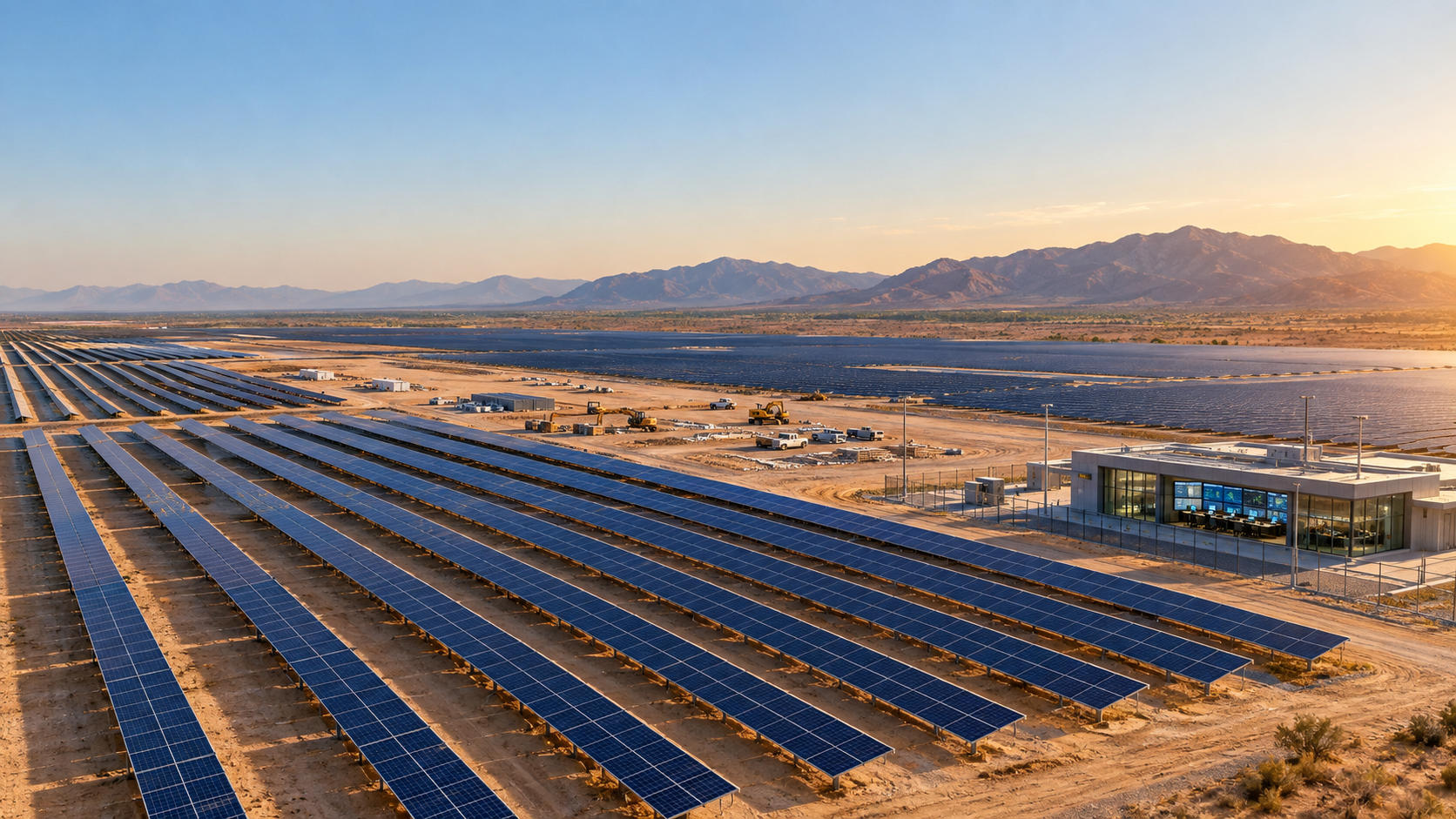
Recurrent Energy: A Race Against Time – What the 695 Million Million “Cobalt Solar” Project Reveals About the Energy Transition – Creative Image on the Topic, with AI: Xpert.Digital
$695 million for 330 megawatts: Why money is no longer the biggest solar problem
The new era of the energy transition: Why grids and storage are more important than solar modules today
The solar paradox: California is building mega power plants – and often has to throw away the electricity
The 330-megawatt Cobalt Solar power plant in California has raised an impressive $695 million in funding. At first glance, this appears to be another classic success story of the booming photovoltaic industry – but behind this gigantic investment lies a profound transformation of global electricity markets. While the transaction proves that capital is available worldwide for the energy transition, it simultaneously exposes the true bottlenecks of our time.
While solar panels are becoming increasingly affordable and efficient, the infrastructure is reaching its limits. The dreaded "solar paradox" is already causing massive amounts of green electricity to be curtailed in California because it is produced when the grid cannot absorb it. The Cobalt Solar case exemplifies this: the future of the energy transition no longer hinges on the sheer number of installed solar panels. Those investing billions today must confront the real challenges – intelligent storage, lengthy permitting processes, overloaded power grids, and the ability to deliver energy precisely when it is most economically valuable.
$695 million for 330 megawatts: What Cobalt Solar reveals about the new economics of the energy transition
California's energy transition and bottleneck are not due to a lack of capital – but to a lack of grid
The financing of the 330-megawatt Cobalt Solar project in California is far more than just another success story from the photovoltaic industry. Recurrent Energy, a subsidiary of Canadian Solar, has raised a total of $695 million in debt financing and tax equity for the power plant, which is already under construction. Of this, approximately $484 million is a debt financing package led by Mitsubishi UFJ Financial Group and Nord/LB, and $211 million is tax equity from Wells Fargo. The project is located about 32 kilometers west of Blythe in Riverside County and is scheduled to begin commercial operation by the end of 2027.
The transaction demonstrates that large solar farms in the United States remain bankable despite high financing costs, trade uncertainty, increasing grid congestion, and changing subsidy conditions. However, it does not prove that every large photovoltaic project is automatically profitable or that additional solar capacity alone will solve California's supply problems. Particularly in an electricity market with significant solar generation surpluses at midday, a project's quality is increasingly determined not only by its installed capacity but also by its location, grid connection, contractual guarantees of its revenues, commissioning date, and its ability to provide electricity during valuable hours.
Cobalt Solar therefore exemplifies a new phase of the energy transition. The first phase focused primarily on making solar modules cheaper and projects larger. The now crucial phase centers on the economic integration of large quantities of weather-dependent generation into an overloaded and sometimes inflexible electricity system. The capital is available if risks appear manageable through contracts. However, the real bottleneck shifts to grids, storage facilities, permits, supply chains, and reliable power purchase agreements.
Financing with political and strategic signaling effect
The figure of US$695 million is, first and foremost, a clear vote of confidence from institutional investors. MUFG, Nord/LB, and Wells Fargo are not among the investors who finance projects solely based on optimistic growth forecasts. Project financing typically focuses not primarily on the sponsor's overall balance sheet, but rather on the individual project's ability to generate sufficiently stable cash flows over many years. Banks examine construction costs, the timeline, grid connection, technical design, insurability, revenue contracts, counterparty risks, tax implications, and the expected debt service capacity.
Having several established financial institutions assume different parts of the capital structure reduces concentration risk and distributes tasks according to their respective specializations. The banks provide construction and long-term debt financing, bridge financing for the tax equity, and credit lines or guarantee facilities. Wells Fargo, as a tax equity investor, assumes part of the project's tax position. This structure is more complex than a traditional corporate loan, but it reflects the logic of the US renewable energy market, where tax incentives form a significant part of the project's economics.
The transaction is also politically significant. It comes at a time when US energy policy is increasingly balancing the desire for increased electricity generation, industrial policy control of supply chains, and a more restrictive approach to wind and solar incentives. For developers, this increases the value of projects that are already approved, under construction, and have a realistic commissioning date. An advanced project is no longer just a technical facility, but a tightly bundled package of land rights, permits, grid connection, tax position, supply contracts, and a head start.
What the 695 million US dollars actually mean
Dividing the total financing volume by the nominal output of 330 megawatts yields a calculated value of approximately US$2.11 million per megawatt. However, this figure should not be equated with the pure construction costs of the solar park. The published sum describes the completed financing components and not necessarily the entire investment budget. Financing may include bridge loans, reserves, guarantees, construction interest, transaction costs, or amounts that are drawn down at different times and refinanced later. Furthermore, it is not publicly stated whether the stated output is defined as alternating current (AC) or direct current (DC) power.
The debt financing package of approximately $484 million represents nearly 69.6 percent of the published total. Tax equity of $211 million accounts for roughly 30.4 percent. This breakdown illustrates the significance of tax values for the financing but does not provide a direct indication of the sponsor's economic equity ratio. Tax equity is neither a conventional bank loan nor traditional equity capital. The investor receives economic rights whose value derives primarily from tax credits and depreciation benefits. The legal structure can therefore differ considerably from the simple notion that Wells Fargo owns approximately 30 percent of the power plant.
Comparisons with general cost benchmarks must also be approached with caution. For large US solar power plants, pure system costs in recent years have often been reported at around one million US dollars per megawatt of DC power, depending on the measurement method, location, grid connection, procurement, and timing. Cobalt Solar, however, may have a significantly higher overall budget or financing volume. Reasons for this could include expensive grid connection work, transformers, high-voltage infrastructure, project-specific construction costs, reserves, development expenses, financing costs, or a large difference between DC and AC power output. Without a disclosed investment calculation, claiming that the project is particularly expensive or particularly inexpensive would be economically unsound.
The business model behind tax equity
Tax equity is one of the most distinctive features of US renewable energy financing. A developer can generate substantial tax credits and accelerated depreciation but may not always have sufficient taxable profits to fully utilize these benefits in the short term. A large financial institution with a high tax burden can leverage this position economically and, in return, inject capital into the project company. This reduces the sponsor's immediate financing needs and makes government funding convertible into investable project capital.
The economic benefits depend on numerous conditions. These include the tax-deductible cost base, the choice between production- and investment-related credits, potential surcharges, labor law requirements, deadlines, documentation obligations, and clawback risks. The tax equity investor therefore examines not only the technical quality of the solar park but also the reliability of the tax assumptions. If tax benefits are later reclaimed, the funds are used improperly, or there is a deviation from the agreed-upon conditions, compensation and liability mechanisms may apply.
The $211 million from Wells Fargo is therefore a strong indication that the project structure is well advanced and verifiable from an investor's perspective. However, it is not proof that all risks have disappeared. Tax equity can reduce financing costs, but at the same time increases contractual complexity. The interests of the sponsor, lenders, and tax equity providers must be aligned in a so-called waterfall structure. In a crisis, it is crucial who has the authority to decide on distributions, additional contributions, operational decisions, insurance payouts, and a potential sale.
The race to the end of 2027
The planned start of operations by the end of 2027 is not merely a technical target. Due to the changed tax policy framework, it carries strategic weight. The technology-neutral tax credits for clean energy generation, introduced after the Inflation Reduction Act, were subsequently significantly restricted in their duration for new wind and solar projects. For certain projects, both verifiable construction commencement and commissioning by December 31, 2027, play a crucial role. A project that is already fully approved and visibly under construction is in a considerably stronger position than an early development option without a guaranteed grid connection.
Cobalt Solar is scheduled to go into operation by the end of this crucial year. This does not automatically mean that the deadline is solely motivated by tax considerations, nor that the project will lose its funding if it is not met. The specific tax treatment depends on the actual start of construction, the chosen tax credit, the project structure, and other factors. Nevertheless, it is clear that delays today can cause greater financial damage than under a more stable funding regime. A delayed transformer, a problem with the grid connection, or an interruption in construction can not only generate additional interest but also potentially alter the entire tax basis of the calculations.
This increases the value of an experienced EPC service provider. Blattner Energy is responsible for engineering, procurement, and construction. The EPC contract is a key mechanism for transferring and limiting risks. Fixed prices, schedules, performance commitments, penalties, warranties, and force majeure clauses determine how additional costs are distributed between the project company and the contractor. Especially in an environment with volatile material prices, long lead times for high-voltage technology, and potential trade restrictions, contract quality becomes almost as important as the technical efficiency of the modules.
Why banks can finance Cobalt Solar
Bankability is not solely determined by installed megawatts. A lender requires a verifiable chain of evidence, from solar irradiance and technical electricity production to available cash flow. This includes reliable yield assessments, realistic assumptions regarding module degradation, availability guarantees, operating and maintenance costs, insurance coverage, and a sufficient buffer for years with low solar irradiance. The decisive metric is not the theoretical production under ideal conditions, but rather the conservatively expected revenue after losses, curtailment, and operating costs.
The sales side is particularly important. The current project notification does not specify a power purchaser, nor the duration and pricing structure of a potential power purchase agreement. This represents a significant information gap for a complete economic evaluation. A long-term contract with a creditworthy utility, a municipal procurement organization, or a company can generate stable revenues and thus enable substantial debt financing. A project with a high proportion of unsecured market price revenues would be considerably more exposed to Californian price profiles, negative midday prices, and curtailment.
The fact that the lenders are nevertheless providing a large package suggests that significant revenue and project risks have been adequately hedged in the unpublished documentation. However, the precise quality of this hedging cannot be assessed without access to the contract details. Neither the electricity price nor any potential indexation, minimum purchase volumes, compensation for curtailment, or regulations regarding grid disruptions are publicly known. An objective analysis must acknowledge these limitations instead of deriving a guaranteed return solely from the financing agreement.
California's Solar Paradox
California needs additional clean energy generation, yet the state already produces more solar power in some hours than the grid can economically handle. In 2024, approximately 3.4 million megawatt-hours of wind and solar power were curtailed in the area managed by the California Independent System Operator. This was 29 percent more than the previous year. Around 93 percent of the curtailment was due to solar energy. The peak is often in the spring, when solar irradiance is high but cooling demand is still relatively low.
This solar paradox is changing project economics. The levelized cost of electricity (LCOE) for a solar park can be very low, while the market value of the generated electricity simultaneously decreases. What matters is not just how much a plant produces over the year, but also when and at which grid node the production occurs. An additional megawatt-hour at midday on a sunny day can fetch a low or even negative market price. Conversely, a megawatt-hour on a hot evening is significantly more valuable, but a solar park will not deliver it after sunset.
Cobalt Solar must therefore be evaluated in the context of grid capacity, location, and potential flexibility. The site near Blythe has excellent solar resources and is situated in a region with extensive energy infrastructure. At the same time, its proximity to other solar projects could lead to local concentration. Whether Cobalt Solar will be more frequently affected by bottlenecks depends on its specific grid connection point, committed transmission rights, regional expansion projects, and contractual rules. These details are not included in the public announcement.
The central economic question, therefore, is not whether California still needs solar energy. It is about what type of solar capacity, in what location, and with what complementary systems will have high system value. Projects with favorable grid connections, storage options, flexible feed-in, or consumers with suitable load profiles will gain importance compared to isolated systems at congested grid points.
New: Patent from the USA – install solar parks up to 30% cheaper and 40% faster and easier – with explanatory videos!

New: Patent from the USA – Install solar parks up to 30% cheaper and 40% faster and easier – with explanatory videos! - Image: Xpert.Digital
The core of this technological advancement is the deliberate departure from conventional clamp mounting, which has been the standard for decades. The new, more time- and cost-effective mounting system addresses this with a fundamentally different, more intelligent concept. Instead of clamping the modules at specific points, they are inserted into a continuous, specially shaped support rail and held securely in place. This design ensures that all forces – whether static loads from snow or dynamic loads from wind – are distributed evenly across the entire length of the module frame.
More information here:
Recurrent Energy: From developer to long-term infrastructure holder
Storage devices are being added to the system component
Battery storage has become the most important tool in California for shifting solar power from midday to evening hours. The installed battery capacity in the CAISO area increased from approximately 8.0 to 11.6 gigawatts in 2024 alone. Typical systems charge when solar production is high and prices are lower, and release the energy four to eight hours later. This allows them to reduce curtailment, meet evening peaks, provide balancing power, and improve the utilization of existing grid connections.
The published project description for Cobalt Solar makes no mention of an associated battery storage system. This is noteworthy because Recurrent Energy has a large global storage pipeline, and California has a high demand for time-shifted energy generation. However, this should not be interpreted as meaning the project will remain permanently without storage. Possibilities include a later retrofit, a separate storage facility at the same grid connection point, or a contractual combination with other flexible resources. It is also possible that a long-term offtake agreement already adequately mitigates the revenue risks associated with the pure solar energy portfolio.
A storage system doesn't automatically improve every economic analysis. It increases investment costs, causes conversion losses, ages with the number and depth of charging cycles, and requires its own revenue model. Its value depends on price differences between charging and discharging times, capacity payments, grid services, tax treatment, and connection requirements. Furthermore, in a market with many similarly managed batteries, daily price differences may diminish. The correct conclusion, therefore, is not that every solar project necessarily needs a storage system, but rather that the value of solar power is structurally under pressure without temporal flexibility.
Growing electricity demand as a counterforce
On the demand side, several developments point towards additional generation. The electrification of transport, the expansion of electric heating systems, new industrial developments, water infrastructure, and data centers are increasing electricity demand. Data centers and AI infrastructure, in particular, can generate large, relatively constant loads. However, they do not automatically improve the value of solar power because their demand is constant and they often place particularly high demands on security of supply and grid quality.
For developers, rising demand opens up new opportunities for long-term power purchase agreements (PPAs). Large technology companies and other corporations can procure renewable electricity, certificates of origin, or structured delivery profiles. At the same time, competition for suitable grid connections is intensifying. A new large load and a new power plant can complement each other on the same regional grid, but both require timely transmission capacity. Therefore, building additional generation capacity without parallel grid expansion can lead to increased curtailment, while new loads without guaranteed generation exacerbate supply constraints.
Cobalt Solar is projected to generate enough electricity for approximately 82,000 households per year. This figure illustrates the scale of the project but is not a technical guarantee of a continuous supply for 82,000 households. It compares the expected annual production with typical annual household consumption. Production and consumption do not always coincide. Households also need electricity at night, while the solar park does not generate power in darkness. Therefore, for system planning, hourly profiles, peak load contributions, and available flexibility are more meaningful than a simple household equivalent.
Benefits and limitations of local value creation
Riverside County expects to generate approximately $14 million in property tax revenue over the project's lifetime. This revenue can bolster local budgets, public services, and infrastructure without requiring the county to fund the project itself. Additional revenue will come from temporary employment during the construction phase, contracts for local service providers, and potential expenses for accommodation, dining, transportation, and maintenance.
The figure of US$14 million should nevertheless be put into perspective. Relative to the published financing volume, it represents approximately two percent, but this is spread over the entire lifespan of the project. Since neither the assumed operating period nor the precise payment schedule is specified, no reliable annual impact can be derived from this. Furthermore, the financing volume is not a suitable substitute for the tax base. The local benefit may therefore be relevant, but remains limited in relation to the capital intensity and the supra-regional significance of the project.
The employment impact also varies significantly depending on the project phase. Large solar parks require many workers during the planning and construction phases, but comparatively few personnel during continuous operation. Automated monitoring, standardized maintenance, and centralized operations management reduce long-term labor intensity. Therefore, it is crucial for the local economy whether construction contracts, training, maintenance, and procurement are truly rooted in the region or predominantly handled by external specialists.
In addition, land-use conflicts and ecological requirements arise. Desert regions may appear empty at first glance, but they contain sensitive ecosystems, habitats, and water constraints. Full approval means that the project has completed the required procedures; it does not mean that all ecological or social impacts disappear. Therefore, economically viable projects must not only generate electricity but also consider soil protection, habitat management, dust control, decommissioning obligations, and local acceptance.
Recurrent Energy is being transformed from developer to infrastructure holder
Recurrent Energy is not just a project developer, but is increasingly pursuing a model in which selected solar and storage plants are held and operated long-term. This model changes the risk profile. A pure developer generates a significant portion of its profit from the sale of projects ready for construction or completed. A long-term owner, on the other hand, receives recurring electricity and operating revenues, but ties up more capital and bears market, operational, counterparty, and residual value risks for decades.
The company figures mentioned in the project announcement illustrate the industrial scale. As of that date, Recurrent Energy had developed, built, and connected 12 gigawatt-peak solar projects and more than 5 gigawatt-hours of storage capacity. The global pipeline comprised approximately 23 gigawatt-peak solar power and 73 gigawatt-hours of storage capacity as of September 30, 2025, excluding China. Furthermore, more than 14 gigawatts of solar and storage projects were under operation and maintenance contracts.
The reference point for these figures is important. The financing was announced in August 2026, but some of the portfolio data cited refers to September 2025. Therefore, it should not be considered entirely up-to-date as of the financing closing date. Pipelines are constantly changing due to sales, permits, delays, resizing, and progress to later stages of development. Furthermore, an early pipeline entry does not have the same economic value as a financed project under construction.
For Recurrent Energy, Cobalt Solar is therefore more than just another entry in a large project list. The financing agreement transforms development rights into a real asset. It demonstrates to banks, investors, customers, and suppliers that the company can structure complex US transactions. This repeatability can facilitate the financing of future projects, provided Cobalt Solar is built as planned and delivers the expected cash flows.
Canadian Solar between production and capital commitment
For Canadian Solar, Cobalt Solar strengthens its vertical positioning, from module manufacturer to developer, owner, and operator of large energy plants. This integration can create advantages. The group understands procurement, technology, project development, construction coordination, storage solutions, and plant operation. It can support projects across multiple value chain stages and, depending on capital requirements, sell, refinance, or hold them long-term.
At the same time, this model increases balance sheet complexity. Solar module production is cyclical, capital-intensive, and subject to strong price pressure. Holding power plants long-term also ties up capital but promises more stable returns. Project financing at the individual company level can relieve the burden on the consolidated balance sheet and mitigate risks, but it does not eliminate all obligations. Sponsor guarantees, completion commitments, equity contributions, and potential additional funding obligations may still be relevant.
From a corporate perspective, large financing is therefore both a growth signal and a disciplinary mechanism. Banks demand detailed reporting, collateral, dividend restrictions, and financial ratios. As long as the project meets the agreed conditions, this model can create attractive long-term value. However, in the event of construction delays, tax shortfalls, or weaker revenues, the rigid capital structure can limit the scope for action. Strategic success therefore depends less on the maximum size of the pipeline than on the quality of the commissioned plants and the speed of capital recycling.
Interest rates, inflation and supply chains remain real risks
The successful completion of the project refutes the claim that higher interest rates have brought the market for large-scale solar projects to a standstill. However, it does not demonstrate that interest rates have become irrelevant. Renewable power plants have high initial investments and comparatively low ongoing fuel costs. A large portion of electricity costs therefore stems from capital costs. If the discount rate or loan interest rate rises, the project must generate higher revenues, achieve lower construction costs, or invest more equity.
During the construction phase, interest on capital that is not yet productive can significantly increase costs. Delays have a twofold impact: the project generates revenue later, while construction interest, personnel, insurance, and provision costs continue to accrue. A term loan structure reduces the refinancing risk after completion but requires that technical and economic acceptance criteria are met. Bridge financing bridges the time gap between construction expenditures and the inflow of taxable equity. This precise timing is precisely what makes professional project management indispensable.
Supply chain risks also come into play. Modules are only one part of the system. Inverters, transformers, switchgear, cables, trackers, steel, protection technology, and grid control technology can all impact the timeline. High-voltage transformers, in particular, have long lead times in tight markets. Trade tariffs, certificates of origin, import restrictions, and requirements for domestic components can alter costs and procurement strategies at short notice. Therefore, a seemingly low module price does not protect a project from rising overall costs.
Inflation also has a mixed effect. Higher wages and material prices increase construction costs, while long-term, partially indexed electricity contracts can stabilize revenues. If the purchase price is nominally fixed, its real value decreases during periods of high inflation. If it is heavily indexed, the buyer's risk increases, and potentially the initial contractual price as well. The economic viability of a project therefore depends on the balance between cost, debt, and revenue profiles, not on a single inflation assumption.
Network expansion is becoming the real driver of returns
The most important structural lesson from Cobalt Solar concerns the electricity grid. Solar modules can be produced and installed relatively quickly. New transmission lines, substations, and permits, on the other hand, often take many years. This creates a growing gap between the speed of generation investment and the speed of grid expansion. Grid connection rights are becoming a scarce asset that can influence a project's value more than minor differences in module efficiency or construction costs.
California is attempting to better utilize surplus solar power through regional electricity markets, battery storage, flexible demand, and additional transmission capacity. In the Western Energy Imbalance Market, more than 274,000 megawatt-hours of otherwise potential curtailment were avoided in 2024. The expanded day-ahead market aims to improve trading across a wider area. Such market mechanisms can geographically distribute solar power but do not replace physical transmission lines. If a local bottleneck exists between a solar farm and the regional grid, a larger trading market offers only limited help.
For investors, grid analysis is therefore crucial. Average Californian electricity prices or nationwide solar forecasts are insufficient. Relevant factors include local marginal prices, loss factors, curtailment history, planned transmission line projects, grid connection priority, and the contractual allocation of grid risks. As a result, two technically identical solar parks can have completely different economic values.
Cobalt Solar is already fully approved and under construction. This suggests that key grid connection issues are well advanced. Nevertheless, actual grid availability remains an operational risk both before and after commissioning. A completed solar park only creates value if it can transport and sell its electricity. The energy transition is therefore increasingly limited not by the cheapest generation technology, but by the most expensive and slowest necessary system component.
The outlook for electricity customers
For consumers, the construction of a large solar park does not automatically translate into lower end-customer prices. Generation costs are only one component of the electricity bill. Grid expansion, capacity reserves, storage, procurement, distribution, public levies, forest fire prevention, and the financing of existing infrastructure also influence the final price. Cheap solar power at midday can be accompanied by high costs for evening capacity and grid reinforcement.
Nevertheless, cobalt solar can contribute to price stabilization. The system requires no fuel and thus partially protects against fluctuations in gas prices. Long-term contracts can ensure predictable generation costs. During hot periods, solar energy often produces a lot of electricity during the day, precisely when air conditioners are generating high loads. However, the benefit decreases as soon as the critical peak in system demand shifts to the hours after sunset.
A fair valuation must therefore differentiate between generation value and system costs. A simple comparison of electricity generation costs can underestimate the costs of grids, storage, and reserve capacities. Conversely, it would be wrong to attribute all integration costs to a single solar power plant. Conventional power plants also require grids, fuel infrastructure, reserves, and environmental regulations. The relevant question is: Which overall portfolio of solar energy, storage, flexible power plants, imports, demand-side management, and transmission achieves the desired security of supply at the lowest overall cost?.
Which the transaction does not prove
The financing does not prove that Cobalt Solar would be economically viable without government subsidies. Rather, the high tax equity ratio demonstrates that tax incentives are a key component of the capital structure. This is not unique to renewable energies; conventional energy sources also benefit from tax regulations, infrastructure, and political frameworks. Nevertheless, it is important for valuation purposes not to confuse market performance with the impact of subsidies.
The transaction also does not prove that the expected return is high. Banks prefer predictable repayments and limit their risk of loss through collateral, reserves, and contractual obligations. A bankable project may offer a moderate return for the sponsor. Conversely, an attractive return on equity may be associated with higher risks. Without information on construction costs, electricity prices, project duration, expected production, curtailment, operating costs, and capital interest, the project's return cannot be reliably calculated.
Nor can it be inferred from the 82,000 household equivalents that the project will correspondingly increase regional energy security. In Californian reliability models, additional solar power during critical evening hours has only a limited capacity value. Storage systems make a significantly greater contribution at these times, provided they are charged and available. Cobalt Solar significantly increases the annual amount of clean electricity; its contribution to guaranteed peak power is another question.
Ultimately, this outcome doesn't prove that all large solar projects will continue to be easily financed. Cobalt Solar is large, approved, under construction, and backed by an experienced international corporation. Early-stage projects, those with weak grid infrastructure, unclear supply chains, or uncertain customers may face significantly less favorable terms. Therefore, the financing is more indicative of market selectivity and maturity than of unlimited capital availability.
A turning point for the economics of large solar parks
Cobalt Solar embodies the transition from a technology-driven to a system-driven solar economy. Photovoltaics has proven its fundamental technical and financial scalability. The next challenge is to integrate the generated electricity into the system in such a way, both temporally and spatially, that it remains economically valuable. This puts grids, storage, flexible loads, and regional markets at the forefront.
The project's strength lies in its advanced stage of development. It has received permits, is under construction, has an experienced EPC partner, and has secured complex financing with three major financial institutions. The planned start of operations at the end of 2027 positions it within a politically and fiscally sensitive timeframe. The anticipated property tax revenues will generate local benefits, while the annual production is calculated to meet the consumption of approximately 82,000 households.
The weakness of the publicly available information lies in the economically crucial contract details. Customers, electricity price, contract duration, curtailment rules, investment budget, storage strategy, and expected returns are not disclosed. Therefore, a conclusive assessment of profitability is not possible. The financing agreement is a strong indicator of quality, but it is no substitute for transparency.
The clearly reasoned perspective is this: Cobalt Solar is a significant and likely well-structured infrastructure project, whose financing confirms the continued attractiveness of large-scale US solar installations. Its long-term economic viability, however, will be measured less by whether 330 megawatts of modules are installed on time, but rather by how much electricity actually reaches the grid and at what prices. The project demonstrates that capital remains mobilizable for the energy transition. It also shows that the next bottleneck doesn't necessarily have to lie in the financial markets. Without faster grid expansion, intelligent storage integration, and a more precise valuation of electricity's value over time, California risks financing ever more solar power whose additional kilowatt-hours are worth the least precisely when they are being generated.
Your partner for business development in the fields of photovoltaics and construction
From industrial rooftop PV to solar parks and larger solar parking lots
☑️ Our business language is English or German
☑️ NEW: Correspondence in your native language!

Konrad Wolfenstein
I and my team are happy to be available to you as your personal advisor.
You can contact me by filling out the contact form here [email protected]:or simply call me at +49 7348 4088 965. My email address is
I'm looking forward to our joint project.







