

How the F127 frigate project exposes the limits of German arms procurement: Will the Bundeswehr's next mega-deal fall through?
Xpert Pre-Release

Available in 27 languages 📢
Prefer Xpert.Digital on GoogleⓘPublished on: September 2, 2026 / Updated on: September 2, 2026 – Author: Konrad Wolfenstein
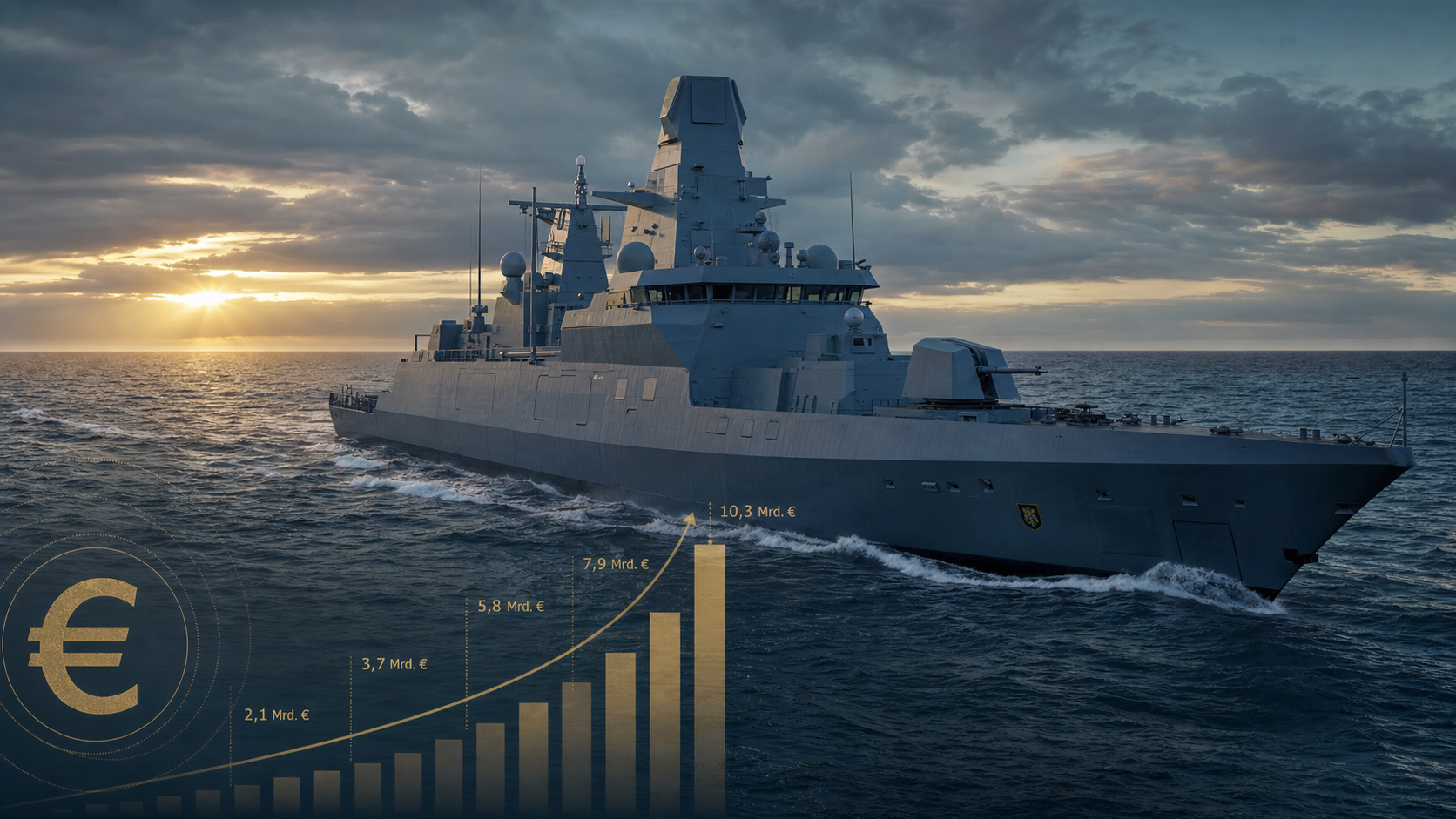
How the F127 frigate project exposes the limits of German arms procurement: Will the Bundeswehr's next mega-deal fall through? – Creative image on the topic, created with AI: Xpert.Digital
After the F126 cancellation: 40 billion shock for the Navy – Will the F127 super-frigate become the next billion-dollar money pit?
Price explosion to 40 billion euros: Will the ministry also pull the plug on the F127?
Dangerous US dependence: Why the American weapons system makes the German frigate unaffordable
The German Navy is facing the most expensive and ambitious procurement project in its history – and simultaneously an unprecedented financial risk. Just weeks after the Ministry of Defense unexpectedly pulled the plug on the F126 frigate project due to extreme cost overruns, the far more complex successor project, the F127, is now threatened with another billion-euro disaster. The construction of eight planned anti-aircraft ships could cost an unimaginable 40 billion euros. At the heart of this cost explosion is a highly complex American weapons system that is driving Germany into an expensive technological dependency. Can the Federal Republic even afford this gigantic armaments project anymore – or will the price for the undeniably necessary air and missile defense become politically explosive? A deep dive into the abyss of German arms procurement.
Related to this:

When the price of security becomes politically explosive
The F127 project is under particular pressure to meet expectations and justify its existence. Just in June 2026, the Ministry of Defense terminated the already advanced F126 program after its costs for six large multi-purpose frigates had ballooned to more than €18 billion, coupled with significant schedule and project risks. Now, with the F127, the next major naval project is already threatening to spiral out of control financially.
The initial estimate for the eight planned F127-class air defense and missile defense frigates was approximately €26 billion. According to recent media reports, the total cost could now exceed €40 billion. This would equate to more than €5 billion per ship. However, this does not constitute a binding final figure: The Ministry of Defense points out that no binding offers have yet been received for the national shipbuilding contract or for parts of the equipment procured through the American Foreign Military Sales (FMS) program.
If realized, the F127 would be by far the most expensive procurement project in the history of the German Navy. The contrast to the F126 is politically striking: while the Ministry pulled the plug on the older project due to costs, delays, and risks, the F127, despite a significantly larger budget, is intended to provide the capability for sea-based air and missile defense. The crucial question, therefore, is not only whether Germany needs this capability, but also whether it is financially feasible and manageable from a procurement perspective in its current form.
The immediate warning sign: The demise of the F126
The escalation of the F127 project is particularly significant because the German government had only just a few weeks earlier completely terminated another major project of the German Navy. On June 24, 2026, the Ministry of Defense halted the procurement of the six planned F126-type multi-purpose frigates. The reasons given were considerable delays, enormous cost increases, and project risks that could not be reliably calculated.
The F126 was planned as the largest new construction project of the German Navy and was intended to supplement, or eventually replace, the F123 Brandenburg class. Instead of the originally expected costs, reports indicated that the total expenditure threatened to rise from approximately ten billion euros to more than 18 billion euros. At that point, around 2.3 billion euros had already been invested in the program. The cancellation thus demonstrates that even advanced naval projects are not politically unassailable if costs, deadlines, and risks are no longer deemed acceptable by the Ministry.
As a replacement for the F126, four smaller frigates of the MEKO A-200 DEU type are to be procured initially; an option exists for four further units. The first four ships are estimated to cost around €6.3 billion, while the option for four more could amount to approximately €5.3 billion. The Ministry is thus opting for a more standardized and already export-proven design, rather than the particularly large and complex F126 concept.
A warship, the most expensive naval project in German history
The Type 127 frigate is intended to eventually replace the three aging Sachsen-class F124 anti-aircraft frigates and, for the first time, provide the German Navy with a robust sea-based ballistic missile defense capability. The first delivery is targeted for the first half of the 2030s. The project, currently known as Next Generation Frigate – Air Defence, was initially budgeted at approximately €26.2 billion.
Eight units, ranging in size from approximately 10,000 to 12,000 tons, are planned. The ships are to be based on a design similar to the MEKO A400 AMD, which originated from the industrial environment of ThyssenKrupp Marine Systems and NVL. The F127 would be significantly larger than current German frigates. Its primary mission would not be traditional naval operations, but rather the protection of naval units and potentially critical infrastructure against modern aerial threats, cruise missiles, and ballistic missiles.
Recent reports indicate that the vertical missile armament could consist of up to 96 Mk-41 launchers. However, the final configuration procured depends on the pending contract and equipment decisions. Changes, particularly regarding the number of launchers, radar and guidance components, and the specific missile mix, could significantly impact the price, operational capability, and industrial complexity.
While expanding the fleet to eight units increases maritime availability and facilitates the distribution of fixed costs across multiple ships, it simultaneously raises the absolute financial requirement to a level that is politically and fiscally difficult to bear, even within the rapidly growing defense budget. Should the reported estimate of more than 40 billion euros prove accurate, the calculated average price would exceed five billion euros per frigate. This figure would include not only the ships themselves, but also, presumably, weapons, sensors, training, logistics, infrastructure, integration, and other procurement components.
The American system package: a key factor, but no confirmed final price
A significant cost and complexity driver is the American systems package planned for the F127. In April 2026, the US State Department approved a potential sale to Germany under the Foreign Military Sales Procedure, with a maximum value of up to US$11.9 billion. The package includes Aegis-based components for eight ships, SPY-6 family radar and fire control systems, Mk-41 launch systems, guided missiles, as well as training, logistics, and support services.
This approval, however, is neither a binding purchase agreement nor necessarily the final price to be paid. FMS notifications regularly indicate a possible maximum value. This can include extensive options, spare parts, training, documentation, technical support, and risk buffers. Which components Germany ultimately procures and under what final conditions depends on subsequent government agreements and national procurement decisions.
It is nevertheless plausible that the package would account for a significant portion of the overall expenditure. Germany would not merely be acquiring a radar, but a highly integrated air and missile defense system, including sensors, effectors, command and control components, and long-term logistical support. Aegis is among the world's most established and widely deployed systems for integrated air and missile defense at sea.
According to publicly available information, the American architecture is to be combined with the German maritime command and control architecture. The Canadian Combat Management System (CMS) 330 is also mentioned as part of the planned system architecture. Such a combination can expand technical flexibility and national integration possibilities. However, it also increases the development, certification, and interface effort, because several highly complex systems must interact reliably, securely, and under real-time conditions.
Hub for Security and Defense - Advice and Information

Hub for Security and Defense - Image: Xpert.Digital
The Security and Defence Hub offers expert advice and up-to-date information to effectively support companies and organizations in strengthening their role in European security and defence policy. Working closely with the SME Connect Defence Working Group, it particularly promotes small and medium-sized enterprises (SMEs) that wish to further develop their innovative capacity and competitiveness in the defence sector. As a central point of contact, the Hub thus creates a crucial bridge between SMEs and European defence strategy.
Related to this:
Security policy meets industrial policy: The Kassel region's dependence on the arms sector
Expensive dependency, but no evidence of a targeted US price increase
The question of whether the United States is deliberately setting the price of Aegis so high that a German purchase becomes unattractive cannot be answered with publicly available information. There is no reliable evidence of a targeted political strategy to increase prices. A combination of technological market power, low production volume, complex integration, and the specific rules of the US FMS procedure is more likely.
Firstly, an integrated maritime air and missile defense system is a highly specialized market with very few suppliers. The Aegis, SPY-6, Mk 41, and their associated missile families are not freely interchangeable standard products. Procurement, certification, integration, training, and logistical support form a cohesive system. The smaller the number of users and the smaller the procurement series, the more difficult it is to spread development, production, and support costs across large quantities.
Secondly, the Foreign Military Sales (FMS) process follows its own administrative and financial rules. It is a government-controlled, intergovernmental mechanism that can cover not only materiel but also management, export clearances, training, technical support, documentation, and other services. For Germany, this provides formally secured procurement through the US government. However, it also limits the possibilities of negotiating individual components completely independently or decoupling them from US export control regulations.
Third, US export controls, particularly ITAR regulations, can limit national sovereignty over the operation and modification of sensitive components. This does not necessarily mean a complete impossibility of national maintenance, but rather tiered access and release rights for software, cryptographic components, deep system modifications, and further developments. This dependency affects not only acquisition but potentially also spare parts, updates, upgrades, and lifecycle costs over decades.
Fourth, general market conditions are intensifying price pressure. Since the start of Russia's war of aggression against Ukraine, international demand for air defense, sensor, and missile technology has risen sharply. Limited production capacities, strained supply chains, raw material and energy prices, inflation, and exchange rate fluctuations between the euro and the US dollar can further increase costs. A weaker euro directly increases German financing requirements, particularly for components denominated in US dollars.
The economic conclusion is nonetheless uncomfortable: Germany has no fully equivalent European alternative in the short term that could provide the same maturity, interoperability, and missile defense architecture in a short period. This gives American industry a structurally strong negotiating position. While not necessarily an expression of political intent, it creates real price and dependency risks.
Related to this:

A pattern of costly procurement
The F127 is not an isolated case. German defense procurement is regularly confronted with a complex interplay of ambitious capability requirements, lengthy development cycles, shifting political frameworks, and uncertain long-term financing. Large-scale projects, in particular, combine research, system integration, specific national requirements, military certification, IT security, long-term maintenance, and international supply chains. Even minor changes to performance requirements can therefore trigger substantial follow-up costs.
A fundamental problem lies in the time lag between procurement and budget management. Complex armaments projects are developed, built, and implemented over ten to fifteen years or more. However, the federal budget is generally drawn up annually. If a reliable funding stream is lacking for several legislative periods, industry, procurement agencies, and the armed forces are forced to make subsequent adjustments. This increases planning risks and can lead to costly replanning, delays, and additional price increases.
The F126 demonstrates that this risk is not abstract. A project can appear militarily sound and yet fail if construction progress, contracts, industrial capabilities, and cost and schedule forecasts no longer align. Due to its combination of a large platform design, US system integration, ballistic missile defense, sophisticated missiles, and long-term support requirements, the F127 would be even more complex than many previous German naval projects.
The political challenge, therefore, is not to interpret every price increase as mismanagement. Some costs reflect real security requirements and a tight global market. The crucial question, however, is whether requirements are stabilized early on, risks are quantified transparently, contracts are equipped with robust price and delivery mechanisms, and dependencies are actively managed throughout the entire lifecycle. Without this discipline, what was once a strategic necessity risks becoming a chronic budgetary problem.
Doubts about feasibility and political consequences
In light of the reported cost developments, the project is being intensively reviewed by the Ministry of Defense. The Ministry is refraining from making a binding statement regarding the final price, pointing out that the financial requirements comprise several components: the shipbuilding contract, American systems and weapons to be procured through FMS, and other contributions from the contracting authority. Until binding offers are received for key components, any total figure remains provisional.
This creates a political dilemma. If the size or technical equipment is reduced, the absolute financial requirement may decrease. At the same time, the fixed costs for development, integration, infrastructure, training, and certification can be spread across fewer units, thus increasing the cost per ship. Conversely, if the plan is to maintain eight highly equipped ships, the federal government must justify an exceptionally high financial requirement that will have an impact for decades.
The F126 decision exacerbates this situation. On the one hand, it proves that the Ministry is prepared to terminate a project if risks spiral out of control. On the other hand, it increases the burden of proof for F127: Before a final contract is signed, it would have to be convincingly demonstrated why the technical risks, industrial responsibility, cost structure, and timeline can be reliably managed this time.
Strategic necessity versus economic viability
From a security policy perspective, the F127 is of a different quality than the cancelled F126 project. The ships are intended to contribute to integrated air and missile defense within NATO, thereby closing a capability gap that cannot be fully covered by either conventional multi-purpose frigates or land-based systems alone. Sea-based sensors and interceptor systems can be deployed flexibly, networked with alliance partners, and stationed in different maritime areas.
The F127 would complement, not replace, ground-based air and missile defense systems. Crucially, it possesses the ability to detect, track, and, if necessary, intercept threats at varying distances, altitudes, and flight phases. However, blanket statements claiming that a single system can reliably neutralize every form of hypersonic threat would be technically unfounded. Actual performance depends on sensor range, interceptor missiles, software versions, networking capabilities, operational geometry, and the specific threat profile.
This strategic importance alone does not automatically make the price acceptable. The German government must plausibly demonstrate that the desired capability can only be achieved with the planned scale and that alternatives – such as different production numbers, tiered armament, different integration models, or European cooperation approaches – could not achieve the same operational impact at a justifiable cost. Security policy urgency must not replace economic evaluation, but rather raise the bar for it.
The F126 as a red line for the F127
The political lesson from the F126 is that even strategically important naval programs can be halted if costs, schedule risks, and industrial effort become unmanageable. This is not an automatic predecision for the F127. Its strategic role is different: unlike the F126, the F127 is intended to provide highly integrated long-range air and missile defense capabilities, which are particularly valued by Germany and NATO.
Precisely for this reason, further review is likely to shift to the specific design details. Changes to the number of units, armament, scope of construction, level of integration, contract structure, or procurement sequence are all conceivable. While reducing the number of units would lower the absolute financial requirement, it could increase the costs of the remaining units. Conversely, a high number of units is only economically viable if the technical configuration is stabilized early on and secured through binding price, delivery, and performance agreements.
The F127 is therefore not just a naval project, but a test case for procurement capabilities in this new era. After the cancellation of the F126, the German government can hardly limit itself to pointing to security policy urgency. It will have to demonstrate that it can simultaneously manage capability scope, life-cycle costs, dependencies on US technology, and the risks of industrial implementation.
One thing is certain: the project lives on, but no final decision has been reached. The upcoming contract, budget, and equipment decisions will determine whether the F127 becomes a viable cornerstone of German and European air and missile defense – or the next symbol of the limits of large-scale German procurement.
Consulting - Planning - Implementation

Markus Becker
I would be happy to serve as your personal advisor.
Head of Business Development
Chairman SME Connect Defense Working Group
Consulting - Planning - Implementation
Konrad Wolfenstein
I would be happy to serve as your personal advisor.
You can contact me at wolfenstein∂xpert.digital or
Just call me on +49 7348 4088 965 .





