
Market analysis Pennsylvania: Target industries for mechanical engineering and automation technology
Xpert Pre-Release

Available in 27 languages 📢
Prefer Xpert.Digital on GoogleⓘPublished on: July 9, 2025 / Updated on: July 9, 2025 – Author: Konrad Wolfenstein

Market analysis Pennsylvania: Target industries for mechanical engineering and automation technology – Image: Xpert.Digital
Why Pennsylvania is the perfect market for warehouse system providers from Germany
From steel state to tech hub: Industrial state Pennsylvania lures with a multi-billion dollar logistics revolution
This article provides a detailed market analysis of the US state of Pennsylvania, aiming to identify the most attractive sectors for suppliers of mechanical engineering, automated storage systems, and material handling technology. Pennsylvania presents itself not only as a major industrial state but also as a strategic hub in the heart of the strongest economic region in the USA. The analysis reveals a unique convergence of a massive, growing logistics infrastructure, a diversified industrial base, and a world-leading innovation ecosystem for robotics and automation. This convergence, actively fostered by a business-friendly state government, creates an exceptionally favorable environment for advanced automation solutions.
Suitable for:

Prioritized target industries
- Distribution, logistics, and e-commerce: This is by far the largest and most immediate market. Driven by the e-commerce boom and Pennsylvania's strategic location, there is a massive unmet need for automation solutions—from large distribution centers to specialized third-party logistics providers (3PLs).
- Pharmaceutical Industry & Life Sciences: A highly profitable sector with demanding, non-negotiable requirements for precision, traceability, and regulatory compliance (FDA). Automation needs are specialized and value-driven, particularly in sterile handling, packaging, and cold chain logistics.
- Food and beverage industry: A large, stable sector under constant pressure to modernize processes, improve hygiene standards, and counteract labor shortages through automation. The demand ranges from processing and packaging to palletizing.
- Metal products & mechanical engineering: This traditional sector offers significant long-term potential. The focus here is on modernizing existing plants to increase efficiency, safety, and global competitiveness through technologies such as robotic welding and automated machine loading.
Key geographical regions
The greatest opportunities are concentrated in three “corridors of possibility”:
- Lehigh Valley & Greater Harrisburg (Central/East PA): The undisputed epicenter for logistics and distribution, characterized by huge e-commerce and 3PL hubs along major highway corridors.
- Greater Philadelphia: The heart of the state's life sciences and pharmaceutical industries, home to global corporations and a dynamic biotech ecosystem.
- Pittsburgh Region (West-PA): The center of the robotics and AI innovation ecosystem, driven by Carnegie Mellon University, as well as a resurgent location for advanced manufacturing and multimodal logistics.
Key strategic insight
Success in Pennsylvania requires a strategy that understands the interplay of these elements. It's not about looking at individual industries in isolation, but rather about leveraging synergies. Logistics infrastructure drives demand in manufacturing, while Pittsburgh's innovation ecosystem provides the technological solutions and talent to meet that demand. The state government acts as an active facilitator, strategically directing investments to key sectors and supporting businesses.
Summary of recommendations
A phased market entry strategy is recommended. Phase 1 focuses on the logistics sector in eastern and central Pennsylvania to quickly acquire reference projects and market share. Phase 2 envisions expansion into the specialized food/beverage and life sciences sectors. Phase 3 should establish a technology and partnership base in the Pittsburgh area to leverage the robotics ecosystem and unlock long-term modernization opportunities in traditional mechanical engineering. Proactive collaboration with government agencies such as the Department of Community and Economic Development (DCED) and the Ben Franklin Technology Partners is critical from the outset to accelerate and de-risk market entry.
Pennsylvania as a business location: A strategic overview for mechanical engineering
To fully grasp Pennsylvania's potential for automation technology providers, the state must be viewed not as an isolated entity, but as a strategic hub within the North American economic area. Its geographic location, robust economy, and world-class infrastructure form the basis for the high demand for mechanical engineering and material handling technologies.
Geostrategic positioning in the Northeast Corridor
Pennsylvania occupies a unique geostrategic position on the US East Coast. The state offers one-day truck access to four of the ten largest US markets, including the metropolitan areas of New York City and Washington, D.C. This proximity to massive consumer centers is the fundamental driver of its dominance as a logistics and distribution hub. Pennsylvania acts as a critical link connecting the industrial heartland of the Midwest with the densely populated coastal regions and key import and export ports. For European companies seeking to enter the North American market, Pennsylvania provides an ideal bridgehead, enabling efficient distribution to the major economic centers.
Fundamental economic pillars
Pennsylvania's economy is broadly diversified and rests on several strong pillars directly relevant to mechanical engineering. Manufacturing is one of the state's three largest economic sectors, contributing $86.7 billion to the gross domestic product (GDP). Similarly, the healthcare and social assistance sector, which includes the thriving life sciences industry, is a driving force in both GDP ($87.7 billion) and employment (1.26 million people).
Crucially, the state government has recognized these strengths and enshrined them in its economic strategy. Five sectors have been identified as key industries for targeted investments and support: manufacturing, life sciences, agriculture, energy, and robotics & technology. This official prioritization provides companies with clear guidance on where to expect government support, accelerated permitting processes, and financial incentives.
The following table provides an overview of the major manufacturing subsectors in Pennsylvania, ranked by their contribution to GDP and their importance as employers. It illustrates the diversity of the industrial landscape and the associated range of market opportunities.
Pennsylvania's main manufacturing subsectors by GDP and employment
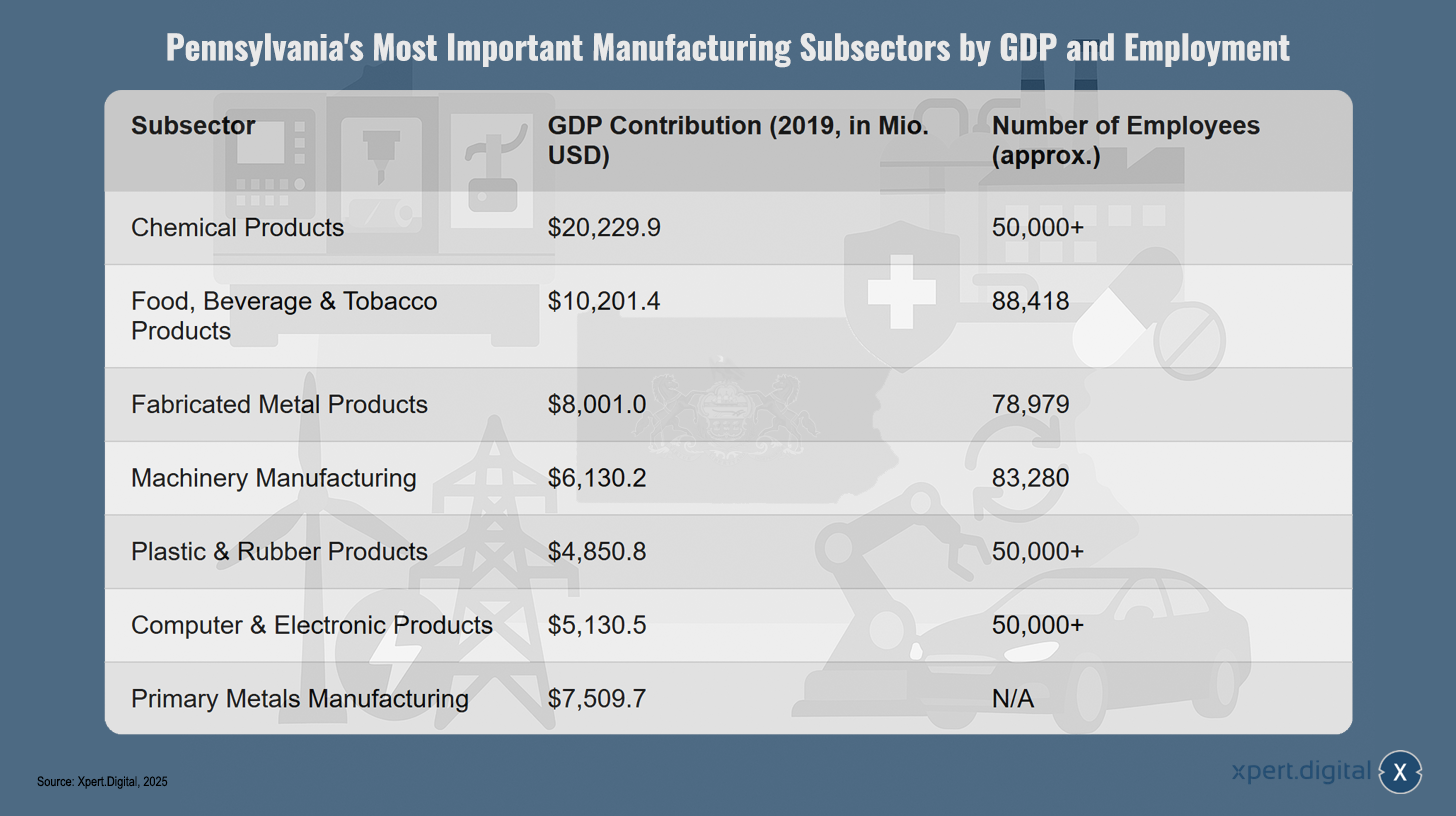
Pennsylvania's most important manufacturing subsectors by GDP and employment – Image: Xpert.Digital
Note: The employment figures come from a separate analysis and may refer to slightly different time periods, but they give an accurate order of magnitude.
These data paint a nuanced picture: While the chemical industry makes the largest contribution to GDP, the mechanical engineering, metal products, and food processing sectors are the largest employers. A high number of employees indicates a large number of businesses and a broad industrial base, implying diverse opportunities for automation projects of varying sizes and complexity.
Pennsylvania has a diversified manufacturing structure, with various subsectors contributing significantly to the gross domestic product (GDP) and employment. The chemical products sector is the largest GDP contributor, with $20,229.9 million in 2019, employing over 50,000 people. Metal manufacturing follows with a GDP contribution of $7,509.7 million. The food, beverage, and tobacco sector generates $10,201.4 million and employs 88,418 people, making it the largest employer among the listed sectors. Metal products contribute $8,001.0 million to GDP and provide 78,979 jobs. Machinery manufacturing generates $6,130.2 million and employs 83,280 people. Computers and electronic products, as well as plastics and rubber products, also make significant contributions to GDP, with USD 5,130.5 million and USD 4,850.8 million respectively, with both sectors employing over 50,000 people each.
Infrastructure: The backbone of automation
Pennsylvania's world-class infrastructure is not just a passive locational advantage, but acts as an active demand multiplier for automation. Every improvement in logistics capacity increases the pressure on the network's nodes—warehouses, distribution centers, and manufacturing facilities—to boost their efficiency through automation in order to handle the increased throughput.
road and rail network
A world-class network of interstate highways, including corridors I-81, I-83, I-78, and I-76, connects the state's major economic centers with each other and with the rest of the country. This is complemented by over 1,300 miles (approximately 2,092 km) of freight rail lines served by three Class 1 railroads (CSX, Norfolk Southern, and Canadian National). Intermodal terminals, such as Norfolk Southern's in the Pittsburgh area, are crucial for the smooth transportation of raw materials and finished goods.
Air and sea freight
Pittsburgh (PIT) and Philadelphia's international airports are major air freight hubs. Large logistics companies like FedEx, UPS, and Amazon operate significant sorting and warehousing facilities there. The strategic proximity of these eastern logistics hubs to the ports of Philadelphia, New Jersey, and New York is a crucial advantage for global trade. In the western part of the state, the Port of Pittsburgh, one of the largest inland port regions in the U.S., provides access to 200 miles of navigable waterways and over 200 river terminals, enabling cost-effective transportation of bulk goods and heavy loads.
Strategic investments
The state is continuously investing in expanding its infrastructure, which is a clear signal of its long-term commitment and future demand for automation. Examples include the construction of a new $1.4 billion terminal at Pittsburgh International Airport, scheduled to open in 2025, and an investment of over $857 million in the modernization of the Montgomery Lock and Dam. Such investments increase the capacity of the overall system and directly create the business case for automated loading and unloading, high-speed sorting, and automated storage and retrieval (AS/RS) systems in connected facilities.
Our recommendation: 🌍 Limitless reach 🔗 Networked 🌐 Multilingual 💪 Strong sales: 💡 Authentic with strategy 🚀 Innovation meets 🧠 Intuition

From local to global: SMEs conquer the global market with clever strategies - Image: Xpert.Digital
At a time when a company's digital presence determines its success, the challenge is how to make this presence authentic, individual and far-reaching. Xpert.Digital offers an innovative solution that positions itself as an intersection between an industry hub, a blog and a brand ambassador. It combines the advantages of communication and sales channels in a single platform and enables publication in 18 different languages. The cooperation with partner portals and the possibility of publishing articles on Google News and a press distribution list with around 8,000 journalists and readers maximize the reach and visibility of the content. This represents an essential factor in external sales & marketing (SMarketing).
More about it here:
From Amazon to Merck: Pennsylvania's automation boom in distribution and life sciences
Analysis of Primary Target Industries: Opportunities for Automation and Material Flow Technology
Pennsylvania's diverse economic structure offers numerous opportunities for automation technology. This analysis focuses on the sectors with the highest immediate need, the greatest value creation potential, and the strongest strategic support from the state. The opportunities fall into two main categories: "greenfield" projects in rapidly growing sectors with new equipment, and "modernization" projects in established industries that require retrofitting existing facilities. Successful market entry requires strategies tailored to both scenarios.
Suitable for:

The following table summarizes the profiles of the most important target industries and allows a direct comparison of their characteristic features and automation needs.
Profile of the most important target industries for automation in Pennsylvania
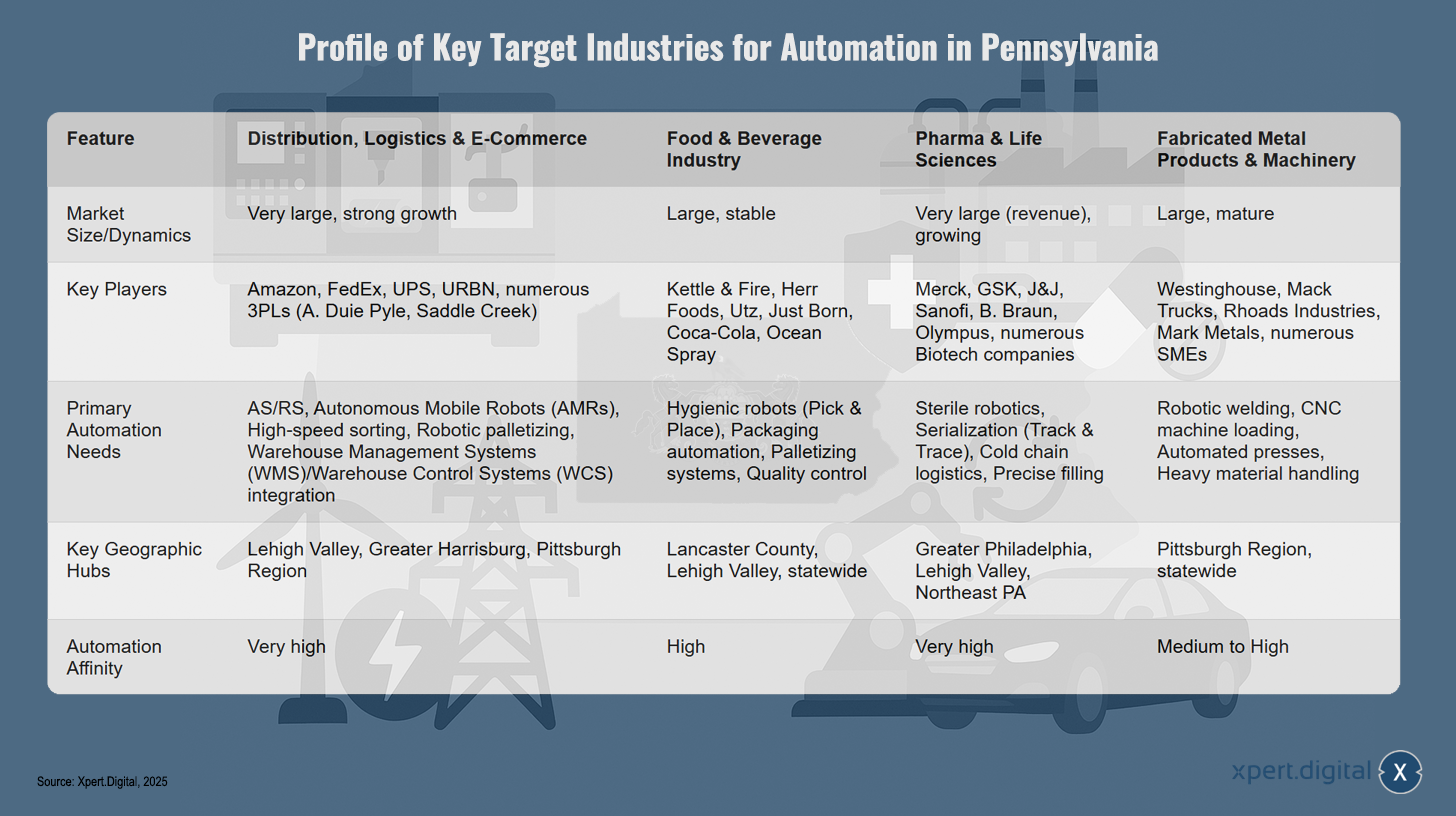
Profile of the most important target industries for automation in Pennsylvania – Image: Xpert.Digital
Pennsylvania offers four key target industries for automation solutions, each with distinct profiles and requirements. The distribution, logistics, and e-commerce sector is the largest and most dynamic, led by market leaders such as Amazon, FedEx, UPS, and URBN, as well as numerous third-party providers like A. Duie Pyle and Saddle Creek. Geographically concentrated in the Lehigh Valley, Greater Harrisburg, and the Pittsburgh area, this sector demonstrates a strong affinity for automation. Primary automation needs include automated storage and retrieval systems (AS/RS), autonomous mobile robots (AMRs), high-speed sorting, robotic palletizing, and the integration of warehouse management systems (WMS) and warehouse control systems (WCS).
The food and beverage industry presents itself as a large, stable sector with key players such as Kettle & Fire, Herr Foods, Utz, Just Born, Coca-Cola, and Ocean Spray. This industry is primarily located in Lancaster County and the Lehigh Valley, but extends nationwide and exhibits a high affinity for automation. Automation requirements focus on hygienic robots for pick-and-place applications, packaging automation, palletizing systems, and quality control.
The pharmaceutical and life sciences sector is characterized by very high revenues and continuous growth, with major companies such as Merck, GSK, J&J, Sanofi, B. Braun, Olympus, and numerous biotech firms. This industry is concentrated in Greater Philadelphia, the Lehigh Valley, and Northeast Pennsylvania and demonstrates a strong affinity for automation. Specific automation requirements include sterile robotics, serialization with track and trace functionality, cold chain logistics, and precision filling technologies.
The metal products and machinery industry represents a large, mature market, represented by companies such as Westinghouse, Mack Trucks, Rhoads Industries, Mark Metals, and numerous small and medium-sized enterprises. This industry is primarily located in the Pittsburgh area but extends nationwide and exhibits a medium to high affinity for automation. Automation needs are concentrated in robotic welding, CNC machine loading, automated presses, and heavy material handling systems.
Distribution, logistics and e-commerce
This sector represents the largest and most immediate opportunity for automation providers in Pennsylvania. The state has become one of the most important logistics hubs on the US East Coast, driven by the unstoppable rise of e-commerce and its strategic proximity to major consumer markets. The massive presence of Amazon, which employs 30,000 people in the state and operates numerous fulfillment and sorting centers, is the clearest indicator of the immense volume. In the Pittsburgh area alone, Amazon maintains a fulfillment center, two mid-range transportation facilities, four last-mile delivery hubs, and an air freight gateway. FedEx Ground is also headquartered in Pittsburgh, and UPS is investing heavily in its facilities in the state.
The automation needs in this sector are broad and demanding. They include high-speed sorting systems to handle millions of packages daily, large-scale automated storage and retrieval systems (AS/RS) to maximize storage density, fleets of autonomous mobile robots (AMRs) for flexible picking and transport processes, and robotic arms for automated palletizing and depalletizing. The seamless integration of this hardware through sophisticated warehouse management systems (WMS) and warehouse control systems (WCS) is crucial. Leading 3PL providers like Maple Logistics Solutions explicitly promote the use of automated processes and state-of-the-art scanning technology to increase their efficiency.
The geographical focus areas are clearly defined:
- Lehigh Valley (Allentown, Bethlehem, Easton): This region has developed into a mega-hub for national distributors and 3PLs. Companies like Derby Supply Chain Solutions, Sharp (pharmaceutical packaging), and Ocean Spray leverage its proximity to the ports of New York/New Jersey and its direct access to major metropolitan areas.
- Greater Harrisburg (Harrisburg, Carlisle, York): This corridor in central Pennsylvania is a critical hub at the intersection of major interstate highways. It is home to numerous distribution centers, including those of Acme Distribution, Allen Distribution, and D&D Distribution Services.
- Pittsburgh Region: With its excellent multimodal infrastructure (road, rail, air, water), western Pennsylvania is a burgeoning hub. In addition to FedEx and Amazon, the fashion company URBN has also built an 880,000 square foot (approx. 81,750 m²) distribution center here.
Manufacturing industry
Food and beverage industry
The food and beverage industry is one of Pennsylvania's largest and most stable manufacturing sectors. It contributes over $10 billion to GDP and, with over 88,000 employees, is the largest manufacturing employer. The state is a national leader in mushrooms, pretzels, potato chips, and ice cream. This sector faces constant pressure to increase efficiency, maintain strict hygiene standards, and address ongoing labor shortages, making it a prime candidate for automation.
The demand is focused on robust, hygienic (wash-down capable) automation solutions. These include robots for pick-and-place applications in primary processing, automated packaging lines for primary and secondary packaging (e.g., cartoners, box packers), and palletizing systems at the end of the line. Camera-based quality control systems for product inspection and packaging integrity verification are also increasingly in demand.
Key players include nationally recognized brands such as Utz Brands, Herr Foods, and DF Stauffer Biscuit Co. in the snack sector; Just Born (maker of PEEPS) in the confectionery segment; and major beverage manufacturers like Coca-Cola and Ocean Spray, which operate significant production facilities in the Lehigh Valley. The sector's dynamism is underscored by recent investments: Kettle & Fire, a rapidly growing food company, has constructed a new $19.1 million production facility in Lancaster County with $4 million in state government support. This is a prime example of a greenfield project, where state-of-the-art automation can be implemented from the ground up.
Pharmaceutical industry and life sciences
Pennsylvania, particularly the Philadelphia region, is a global hub for the life sciences industry. The sector is an economic powerhouse: wholesale pharmaceuticals, cosmetics, and toiletries, with a turnover of $86.4 billion, is the state's third-largest industry. The entire life sciences industry is valued at nearly $50 billion and comprises over 3,000 companies.
Automation requirements in this sector are extremely high and are determined by strict regulatory requirements from the FDA, the need for process validation, and the high value of the products.
- Manufacturing: Precise robotic handling in sterile cleanroom environments, automated filling and sealing systems, and high-speed tablet presses.
- Packaging: Sophisticated serialization and track-and-trace systems are essential to ensure product safety and combat counterfeiting. Automated cartoning and final packaging lines must meet these requirements.
- Logistics: Automated cold chain storage (e.g. AS/RS in refrigerated or frozen environments) and validated material handling systems are crucial for many products, especially biopharmaceuticals.
The most important clusters are:
- Greater Philadelphia: Known worldwide as “Cellicon Valley” for its leading role in cell and gene therapy. Global giants such as Merck (with 9,500 employees at its West Point site), GlaxoSmithKline (GSK), Johnson & Johnson, and Bristol Myers Squibb, as well as a multitude of innovative biotech companies, are based here. The Penn Center for Innovation at the University of Pennsylvania is a key driver of research and development.
- Lehigh Valley: A growing center with companies such as B. Braun Medical, which recently completed a $200 million expansion, Olympus (medical technology) and Sharp (specialized pharmaceutical packaging).
- Northeast PA: Home to large manufacturing facilities such as Sanofi Pasteur (vaccines, 3,000 employees in Swiftwater) and Endo Pharmaceuticals (3,500 employees in Malvern).
Metal products and mechanical engineering
These sectors form the traditional industrial foundation of Pennsylvania. Contributing $8 billion (metal products) and $6.1 billion (machinery) to GDP in 2019, and employing 79,000 and 83,000 people respectively, they remain of significant economic importance. The need for automation in these industries is primarily driven by modernization. Many companies must upgrade existing equipment to remain competitive, increase productivity, and improve workplace safety.
The demand is focused on robotic welding, automated machine setup (CNC machines, presses), robot-assisted grinding and deburring, and the automated handling of heavy and unwieldy materials such as sheet metal, bars, and castings. In Cumberland County, for example, advanced manufacturing companies are specifically seeking skilled workers who can operate robotics and modern manufacturing equipment.
The sector is more fragmented than the pharmaceutical industry, comprising a mix of large corporations and numerous small and medium-sized enterprises. Notable players include Westinghouse (components for the nuclear industry), Mack Trucks (vehicle assembly), US Steel, and a variety of metal fabricators such as Mark Metals in Reading and Remaly Manufacturing. A recent example of the potential in heavy industry is Rhoads Industries' nearly $100 million investment in expanding its shipbuilding and manufacturing operations at the Philadelphia Navy Yard, which will create 450 new jobs. This is a typical "brownfield" project, integrating automation into existing structures to increase capacity.
Chemical and plastics industry
The chemical industry is an economic powerhouse in Pennsylvania, contributing over $20 billion to GDP. The plastics and rubber industry adds another $4.8 billion. These sectors are important suppliers to other key industries such as life sciences, construction, and automotive.
While process automation in the chemical industry is highly specialized, there is a significant need for material handling technology. This includes robot-assisted palletizing of bags, drums, and other containers; the use of automated guided vehicles (AGVs) for the safe transport of materials in potentially hazardous environments; and automated packaging and wrapping systems at the end of the production line. Key companies include Air Products & Chemicals, headquartered in Allentown (3,500 employees), and East Penn Manufacturing, a leading battery manufacturer with 7,800 employees.
🎯🎯🎯 Benefit from Xpert.Digital's extensive, five-fold expertise in a comprehensive service package | BD, R&D, XR, PR & Digital Visibility Optimization

Benefit from Xpert.Digital's extensive, fivefold expertise in a comprehensive service package | R&D, XR, PR & Digital Visibility Optimization - Image: Xpert.Digital
Xpert.Digital has in-depth knowledge of various industries. This allows us to develop tailor-made strategies that are tailored precisely to the requirements and challenges of your specific market segment. By continually analyzing market trends and following industry developments, we can act with foresight and offer innovative solutions. Through the combination of experience and knowledge, we generate added value and give our customers a decisive competitive advantage.
More about it here:
Pennsylvania as an automation hotspot: Why the state is becoming a magnet for technology companies
The innovation ecosystem: Technology drivers and government funding
A key advantage of Pennsylvania is that the state not only offers a market for automation but also a rich and supportive ecosystem that can facilitate market entry and reduce investment risk. This ecosystem consists of two main pillars: a world-leading cluster for robotics and automation and a network of coordinated state support programs. For a foreign company, this ecosystem is not just a background feature but an active tool for sales, marketing, and strategic partnerships.
Robotics and Automation: The Epicenter Pittsburgh
The Pittsburgh region has become one of the world's leading centers for robotics and artificial intelligence. This concentration of talent, research, and commercial activity offers unique opportunities for partnerships, technology transfer, and the recruitment of skilled professionals.
Academic foundation
At the heart of the ecosystem is Carnegie Mellon University (CMU), which established the world's first Robotics Institute (RI) in 1979 and offered the first doctoral program in robotics. The Robotics Institute (RI) and its commercial arm, the National Robotics Engineering Center (NREC), work closely with industry to develop and commercialize technologies. To further strengthen this leadership position, CMU is currently constructing the Robotics Innovation Center (RIC), a 150,000-square-foot (approximately 13,900 m²) state-of-the-art research facility at Hazelwood Green, a former steel mill site.
Commercial ecosystem
The Pittsburgh area is home to over 140 robotics organizations, covering a wide range of automation solutions. These include:
- Warehouse and logistics automation: Seegrid (one of the pioneers of autonomous mobile robots), Onward Robotics (formerly IAM Robotics, specializing in autonomous picking robots) and Bossa Nova Robotics (robotics for retail).
- Industrial manufacturing automation: Premier Automation (a leading systems integrator), Gecko Robotics (inspection robots for critical infrastructures), Carnegie Robotics (rugged autonomous solutions for demanding environments), Hebi Robotics (modular robot components) and Finish Robotics (automation for the construction industry).
- Autonomous vehicles: Aurora and Stack AV, leading developers of self-driving technology for trucks.
Support network
The ecosystem is fostered by a dense network of support organizations. The Pittsburgh Robotics Network (PRN) serves as a central hub and advocacy group for the industry. InnovationWorks is one of the most active seed investors in the US, supporting startups with capital and mentoring. The Institute for Advanced Robotics in Manufacturing (ARM) is a nationwide public-private partnership based in Pittsburgh, focused on advancing robotics technology in manufacturing.
Government initiatives and funding programs
The Pennsylvania government under Governor Shapiro is pursuing a proactive economic strategy aimed at positioning the state as a leading manufacturing and technology hub. A number of agencies and programs have been established to support businesses in their investment, expansion, and skilled workforce training.
Lead Agency – Ministry of Community and Economic Development (DCED)
The DCED is the central coordinating body for economic development in Pennsylvania. Its Governor's Action Team serves as a concierge service for companies seeking to invest or expand in the state, assembling tailored support packages. The DCED's Office of International Business Development is specifically responsible for assisting foreign companies with establishing operations in Pennsylvania.
Important funding and support programs
The state government has launched a portfolio of programs specifically tailored to the needs of manufacturing companies and technology providers. Recent investment announcements from the Shapiro administration provide concrete evidence of how these programs are being implemented in practice
- Pennsylvania Industrial Development Agency (PIDA): Offers low-interest loans for the acquisition of land and buildings, construction and renovation costs, and the purchase of machinery and equipment. Recent examples include a $2.4 million PIDA loan to Premier Automation and a $4 million loan to Kettle & Fire.
- Pennsylvania's Manufacturing Innovation Program: A unique fellowship program that connects university students with manufacturers to solve real-world R&D challenges. This fosters the direct transfer of technology from academia to industry. The government recently invested $2.8 million in 42 new projects.
- Ben Franklin Technology Partners (BFTP): A nationally recognized model for technology-based economic development. BFTP provides seed capital investments and technical expertise to startups (Gecko Robotics received early seed funding here) and established manufacturers looking to innovate.
- Workforce Development: Programs such as the Pennsylvania Manufacturing Vocational Training Grant (MTTC) and WEDnetPA provide companies with funding to train new and existing employees in new technologies. This is a direct response to the skilled labor shortage. One example is a grant of nearly $200,000 to Northampton Community College for precision machining courses.
The following table provides a practical overview of the most important government funding programs.
Key government support programs for manufacturing and technology in Pennsylvania
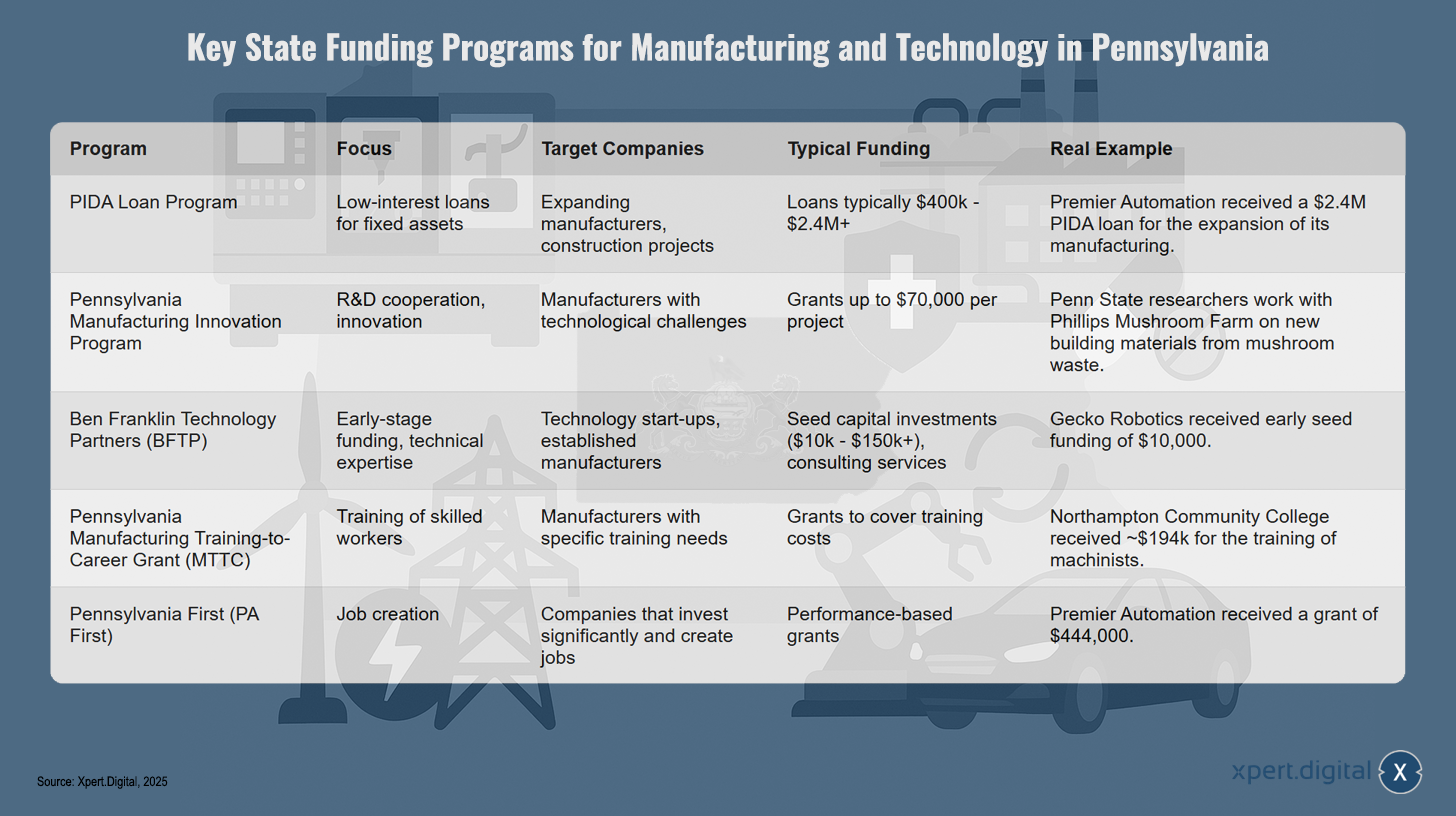
Key government funding programs for manufacturing and technology in Pennsylvania – Image: Xpert.Digital
Pennsylvania offers several important state funding programs for manufacturing and technology. The PIDA loan program provides low-interest loans for fixed assets and is aimed at expanding manufacturers as well as construction projects. Typical grants range from $400,000 to $2.4 million or more. A real-world example is Premier Automation, which received a $2.4 million PIDA loan to expand its manufacturing operations.
The Pennsylvania Manufacturing Innovation Program focuses on R&D collaboration and innovation for manufacturers facing technological challenges. It offers grants of up to $70,000 per project. For example, Penn State researchers are collaborating with Phillips Mushroom Farm on new building materials made from mushroom waste.
Ben Franklin Technology Partners (BFTP) provides early-stage funding and technical expertise to technology startups and established manufacturers. The program includes seed investments of $10,000 to $150,000 or more, as well as consulting services. Gecko Robotics received $10,000 in early-stage seed funding.
The Pennsylvania Manufacturing Training and Training Grant (MTTC) focuses on training skilled workers and is aimed at manufacturers with specific training needs. Grants are awarded to cover training costs. Northampton Community College received approximately $194,000 for the training of CNC machinists.
Pennsylvania First (PA First) focuses on job creation and supports companies that invest significantly and create jobs. The program offers performance-based grants, with Premier Automation receiving a grant of $444,000.
Proactively using these programs can make all the difference for a company. They not only reduce investment costs but also signal to potential customers that a project is supported by the state government, thus increasing credibility and trust.
Strategic synthesis and recommendations for action
The comprehensive analysis of the economic environment, target industries and supporting ecosystem in Pennsylvania enables the formulation of a clear, prioritized and actionable strategy for market entry and growth for a provider of mechanical engineering and automation technology.
Prioritizing market opportunities
The identified target industries offer different profiles in terms of market size, urgency of need, and value creation potential. Strategic prioritization is essential for focused and efficient resource allocation.
- Priority 1: Distribution, Logistics & E-commerce. This is the largest, most dynamic, and most immediate market. The sheer number of new and expanding greenfield distribution centers demands immediate, scalable automation solutions. Market entry here promises rapid revenue growth and the establishment of key references.
- Priority 2: Pharmaceutical Industry & Life Sciences. This sector offers the highest value creation potential. Automation requirements are highly specialized and offer high margins. Engagement requires in-depth industry expertise and the ability to deliver validated, compliant systems. The market is more concentrated, but customer relationships are long-term and profitable.
- Priority 3: Food & Beverage Industry. A large and stable market offering a mix of “greenfield” projects (like Kettle & Fire) and “modernization” needs. The need to meet hygiene standards and reduce labor costs creates a continuous demand for automation.
- Priority 4: Metal Products & Mechanical Engineering. This is a long-term strategic opportunity. The market is mature and consists mainly of modernization projects. The sales cycle is potentially longer and requires a consultative approach to demonstrate ROI for retrofitting existing equipment. However, the potential is substantial due to the size of the industrial base.
Recommended market entry strategy
Based on the prioritization, a three-phase strategy is recommended to gradually and sustainably develop the market:
Phase 1 (Years 1-2): Focus on Logistics & Distribution
- Goal: Rapid market penetration and establishment of an operational base.
- Actions: Establish a sales and service presence in the Lehigh Valley or Greater Harrisburg region. Focus on acquiring projects with large 3PLs, e-commerce companies, and retail distributors. The goal is to secure initial reference projects, generate cash flow, and build a reputation for reliable project execution in the highest-volume market segment.
Phase 2 (Years 2-4): Expansion into specialized sectors
- Goal: Diversification into higher-value market segments.
- Actions: Establish specialized sales and engineering teams for the food/beverage and life sciences sectors. Leverage the credibility gained in Phase 1. Consider a second presence or targeted sales activities in the Greater Philadelphia area to capitalize on proximity to the life sciences cluster. Develop industry solutions tailored to specific requirements (hygiene, FDA compliance).
Phase 3 (Years 3-5): Engagement in the innovation ecosystem and access to modernization markets
- Goal: To secure technological leadership and unlock long-term growth potential.
- Actions: Establishment of a small technology or R&D office in the Pittsburgh area. Active networking and building partnerships with local robotics companies (e.g., for components or specialized software) and Carnegie Mellon University. With the established market presence and cash flow from the first two phases, more complex modernization projects in the metal and mechanical engineering industries can now be tackled in a targeted manner.
Suitable for:

Utilizing the local ecosystem
Proactive integration into the local ecosystem is a crucial success factor. The following steps are recommended:
- Immediate action: Contact the DCED's International Business Development Office to introduce yourself as a potential foreign investor and explore the available support services. Simultaneously, seek a meeting with the regional representatives of Ben Franklin Technology Partners to leverage their network and expertise.
- In the short term: Membership in key industry associations such as the Pennsylvania Life Sciences Association (LSPA) and the Pittsburgh Robotics Network (PRN). Attending their events is the fastest way to make important contacts with potential customers, partners, and talent.
- In the medium term: exploring a research collaboration with one of the leading universities (e.g., Penn State, Lehigh University, Carnegie Mellon) within the framework of the Pennsylvania manufacturing innovation program. This can help develop tailored solutions for the local market while simultaneously gaining access to highly qualified graduates.
Summary of recommendations for action
Pennsylvania offers an exceptionally attractive environment for automation technology providers. The combination of massive logistics demand, a diversified industrial base, and a world-class innovation and support ecosystem creates a rare constellation of opportunities. The key to success lies in a strategic, phased approach that initially focuses on high-volume markets to establish a solid foundation and then gradually expands into higher-value, long-term segments. Proactively utilizing government support programs and integrating into the local innovation network will significantly accelerate market entry and sustainably strengthen competitive positioning.
The next concrete steps for management should be:
- Conducting targeted site visits in the logistics hubs of the Lehigh Valley and the Harrisburg region to gain a direct understanding of the market.
- Initiating official contact with the DCED to present one's own company and investment intentions.
- Identifying potential local partners – be they system integrators, specialized robotics companies or consulting firms – from the organizations mentioned in this report, in order to explore synergies for market entry.
XPaper AIS - R&D for Business Development, Marketing, PR and Content Hub
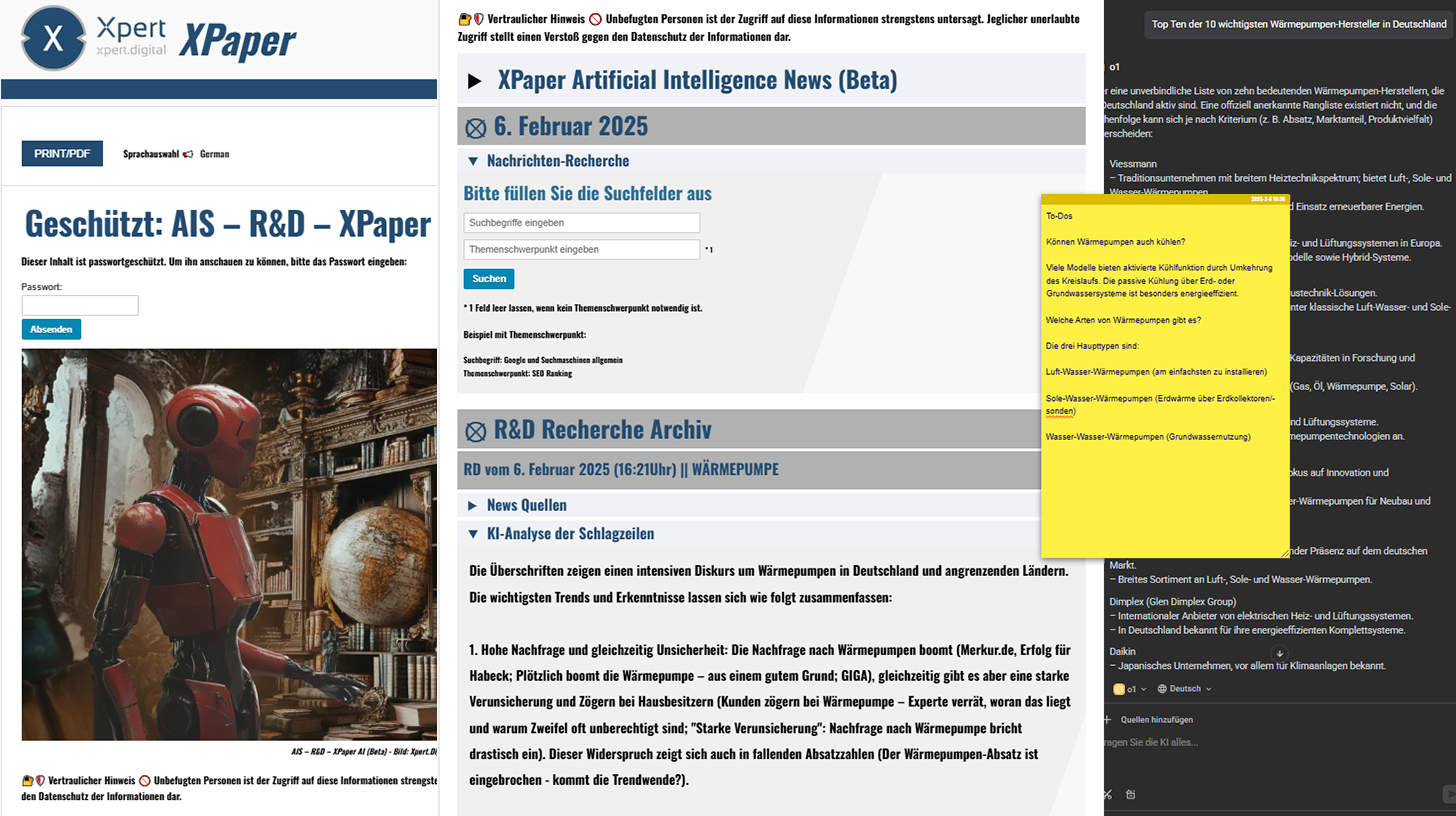
XPaper AIS application possibilities for business development, marketing, PR and our industry hub (content) - Image: Xpert.Digital
This article was handwritten. I used my self-developed R&D research tool, 'XPaper,' which I primarily use for global business development in a total of 23 languages. Stylistic and grammatical refinements were made to make the text clearer and more fluid. Topic selection, drafting, and the collection of sources and materials are all handled by an editorial team.
XPaper News is based on AIS ( Artificial Intelligence Search ) and differs fundamentally from SEO technology. However, both approaches share the goal of making relevant information accessible to users – AIS on the search technology side and SEO on the content side.
Every night, XPaper sifts through the latest news from around the world with continuous, round-the-clock updates. Instead of investing thousands of euros monthly in cumbersome and generic tools, I've created my own tool to stay up-to-date in my work in Business Development (BD). The XPaper system is similar to tools used in the financial sector, which collect and analyze tens of millions of data points every hour. At the same time, XPaper isn't just for business development; it's also used in marketing and PR – whether as a source of inspiration for the content factory or for article research. The tool allows you to evaluate and analyze all sources worldwide. No matter what language the data source speaks, it's no problem for the AI. Various AI models are available for this purpose. The AI analysis quickly and clearly generates summaries that show what's currently happening and where the latest trends lie – and XPaper offers this in 18 languages . XPaper allows for the analysis of independent subject areas – from general to specific niche topics, in which data can be compared and analyzed with past periods, among other things.
We are there for you - advice - planning - implementation - project management
☑️ Our business language is English or German
☑️ NEW: Correspondence in your national language!

Konrad Wolfenstein
I would be happy to serve you and my team as a personal advisor.
You can contact me by filling out the contact form or simply call me on +49 7348 4088 965 (Munich) . My email address is: wolfenstein ∂ xpert.digital
I'm looking forward to our joint project.










