
Marketopportunity USA: A strategic analysis of California leading industries for mechanical engineering and automated systems
Xpert pre-release

Available in 27 languages 📢
Prefer Xpert.Digital on GoogleⓘPublished on: July 9, 2025 / update from: July 9, 2025 - Author: Konrad Wolfenstein

Marketopportunity USA: A strategic analysis of California's leading industries for mechanical engineering and automated systems - Image: Xpert.digital
From Industry 4.0 to Smart Manufacturing: Strategic market opportunities for automation technology in California
Six key sectors identified: where European and German mechanical engineers can start in California
This article provides a comprehensive analysis of the Californian economy in order to identify and evaluate the most lucrative industries for providers of mechanical engineering and automated storage and material flow systems. California is not only a large market, but a number of pronounced, global industrial ecosystems. The analysis shows that the gross national product (GSP) of the state of around 4.1 trillion US dollars makes it the largest subnational economy in the world. If California were an independent nation, it would rank as the fourth largest economy in the world, still ahead of Japan and behind Germany.
Six priority target industries were identified due to their scope, their growth potential, their demand for automation and their investment capacity: aerospace & space travel & defense, automotive & electric vehicles (EV), semiconductor & electronics, medical technology & organic sciences, logistics & e-commerce fulfillment as well as food and drink processing.
The strategic recommendation of this article emphasizes the semiconductor and the EV sector as an immediate, high-growth opportunities. These are driven by massive investments at the federal and state levels that create an unprecedented demand for new, highly automated production facilities. At the same time, the logistics and medical technology industries offer stable, long-term growth that is carried by fundamental economic and demographic trends.
E European company can achieve a decisive strategic advantage by positioning its expertise in the area of "Industry 4.0" in the context of the US "Smart Manufacturing" frameworks. This approach enables not only to present yourself as a machine supplier, but as a strategic partner for the development of holistic, intelligent production systems - a promise of value that is perfectly tailored to the needs of the complex Californian industrial landscape.
The California economic landscape: a macroeconomic analysis for strategic investments
California's economy in a global context
In order to understand the extent of market opportunities in California, classification in the global context is essential. With a gross national product (GSP) of around $ 4.1 trillion in 2024, the California economy is the largest of all US states and the largest subnational economy in the world. If California were an independent nation, it would rank as the fourth largest economy in the world, right behind Germany and in front of Japan. This enormous economic output signals that a successful market presence in California is a globally significant achievement. The economy is not only large, but also dynamic, such as the quarterly growth figures of the Bureau of Economic Analysis (BEA) and the Federal Reserve, which show a nominal GSP of $ 4.123.6 million.
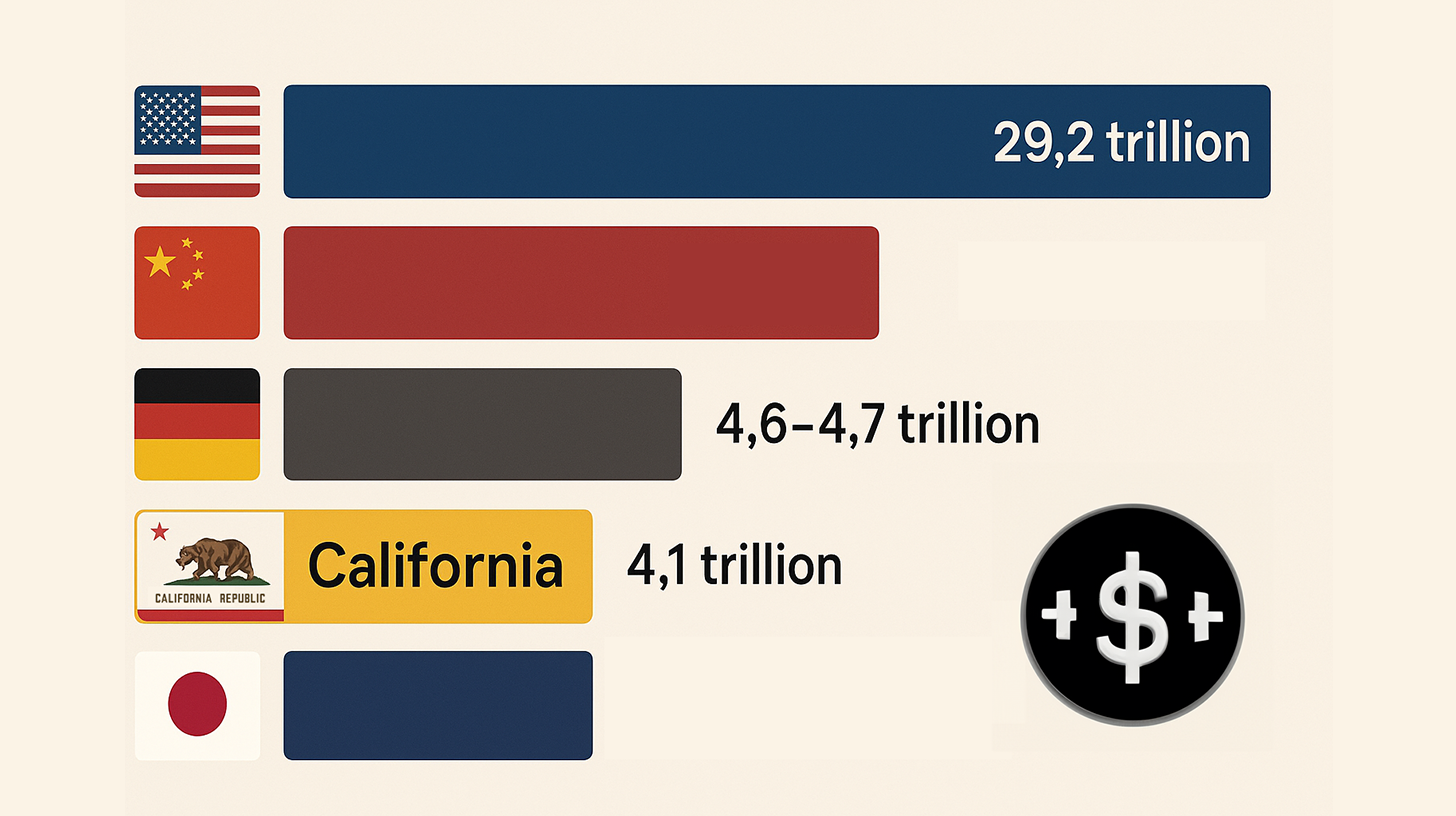
California's economy in a global context - Image: Xpert.digital
- USA (1st place): Nominal GDP (2024) $ 29.2 trillion
- China (2nd place): Nominal GDP (2024) 18.7 trillion
- Germany (3rd place): Nominal GDP (2024) 4.6–4.7 trillion
- California (4th place): Nominal GDP (2024) $ 4.1 trillion
- Japan (5th place): Nominal GDP (2024) 4.0–4.03 trillion
Suitable for:

Important economic indicators and sectoral contributions to the gross national product (GSP)
The California economy is powered by several dominant sectors. The biggest contributions to the GSP do the areas of freelance, scientific and corporate services with $ 548.9 billion, the information sector with $ 538.5 billion and the processing trade with $ 405.6 billion. The processing industry in particular is a power center and confirms the relevance of the examination for mechanical engineering. At $ 241.6 billion, the manufacture of long-lasting goods accounts for more than half of the contribution of the processing trade.
In addition, the highest sales of sales underline the need for automation. The wholesale of medicinal products, cosmetics and personal care products (201.7 billion USD), automotive wholesale ($ 193.9 billion) and wholesale with electronic parts and devices ($ 175.7 billion) are leaders. These sectors rely directly on highly efficient, automated logistics and storage systems in order to manage their enormous flows of goods.
Important industrial centers and labor market dynamics
Industrial activity in California focuses on several important economic zones. The cities with the highest employment in the processing of the trade are San Diego, San Jose (the heart of Silicon Valley), Los Angeles, Irvine and Femont. This geographical concentration forms the basis for the detailed cluster analysis in the following sections. Los Angeles County is the largest district in terms of industrial workplaces and houses 453,116 workers.
The large and diverse employment population of the state of over 19 million people is a double -edged sword. On the one hand, it offers a rich talent pool, on the other hand it leads to high labor costs and a complex regulatory landscape. However, these factors are strong drivers for investments in automation. Companies are looking for paths to increase efficiency, reduce costs and reduce the dependence on manual work, especially with repeating tasks.
Strategic implications
A deeper analysis of the economic data reveals two crucial strategic realities. First, California is not a single, homogeneous market, but a federation of first -class industrial economies. The GSP of the state exceeds this of most countries, and individual sectors such as the information or manufacturing sector are greater than the entire economies of many smaller nations. Specialized ecosystems such as the Silicon Valley for technology, the southern California aerospace cluster and the core agricultural land in Central Valley act as an independent, highly specialized units. A market entry strategy therefore does not have to target "California" as a whole, but on a specific industrial ecosystem, such as: B. the semiconductor market in the Silicon Valley or the logistics market in South California. An undifferentiated approach is doomed to fail.
Second, the high business costs in California are a primary, if not more obvious, drivers for automation. The environment with high wages and strict regulations creates a strong incentive to invest in automation technologies in order to maintain competitiveness. The Return on Investment (ROI) of automation is particularly convincing here, since it not only increases productivity, but also directly lowers the high labor costs and reduces the risks in connection with compliance with regulations. For a German automation provider, this means that the sales argument should not only be based on technological superiority, but also strongly on the tangible ROI by reducing labor costs, increased throughput and reducing compliance risks-all acute pain points for Californian companies.
Analysis of the core sectors: Identification of first -class possibilities for automation and mechanical engineering
Methodology for selection of sector
The selection of the six target industries analyzed in this article is based on a convergent methodology that takes into account several critical factors that were identified in the research. These criteria ensure that the selected sectors offer the highest potential for providers of mechanical engineering and automated systems:
- Economic importance: a significant contribution to the gross national product of the state, which indicates the size and stability of the sector.
- Growth course: Identification as a strong sector in market reports, which indicates future demand and expansion potential.
- Automation needs: A clear and current need for advanced machines, robotics and material flow systems to increase efficiency, precision and throughput.
- Investment capacity: the presence of large companies as well as significant risk capital or federal funds that ensure the ability to finance large automation projects.
- Industrial maturity: an established production base and supply chains that offer a stable environment for the integration of new technologies.
Overview of the six most important target sectors
Based on the above methodology, the following six sectors were selected as the main goals for a detailed analysis. Each of these sectors represents a unique and convincing opportunity:
- Aerospace & Defense: A sector in which traditional strength meets the innovation of the “New Space” age and focuses on precision and reliability.
- Automobil & electric vehicles: an industry that is in full technological change and is driven by state mandates and massive investments in electrification.
- Half -ladder & electronics: A sector that experiences a geopolitical and technological boom with unprecedented investments in new production capacities.
- Medical technology & biosciences: a precision-driven and non-discreet sector in which quality and regulatory conformity are the main drivers for automation.
- Logistics & E-Commerce: The indispensable, highly volume backbone of the modern economy, which is dependent on speed and efficiency.
- Food and beverage processing: A huge, traditional industry, which is forced to modernize and automation through scale effects and shortage of work.
First comparative snapshot
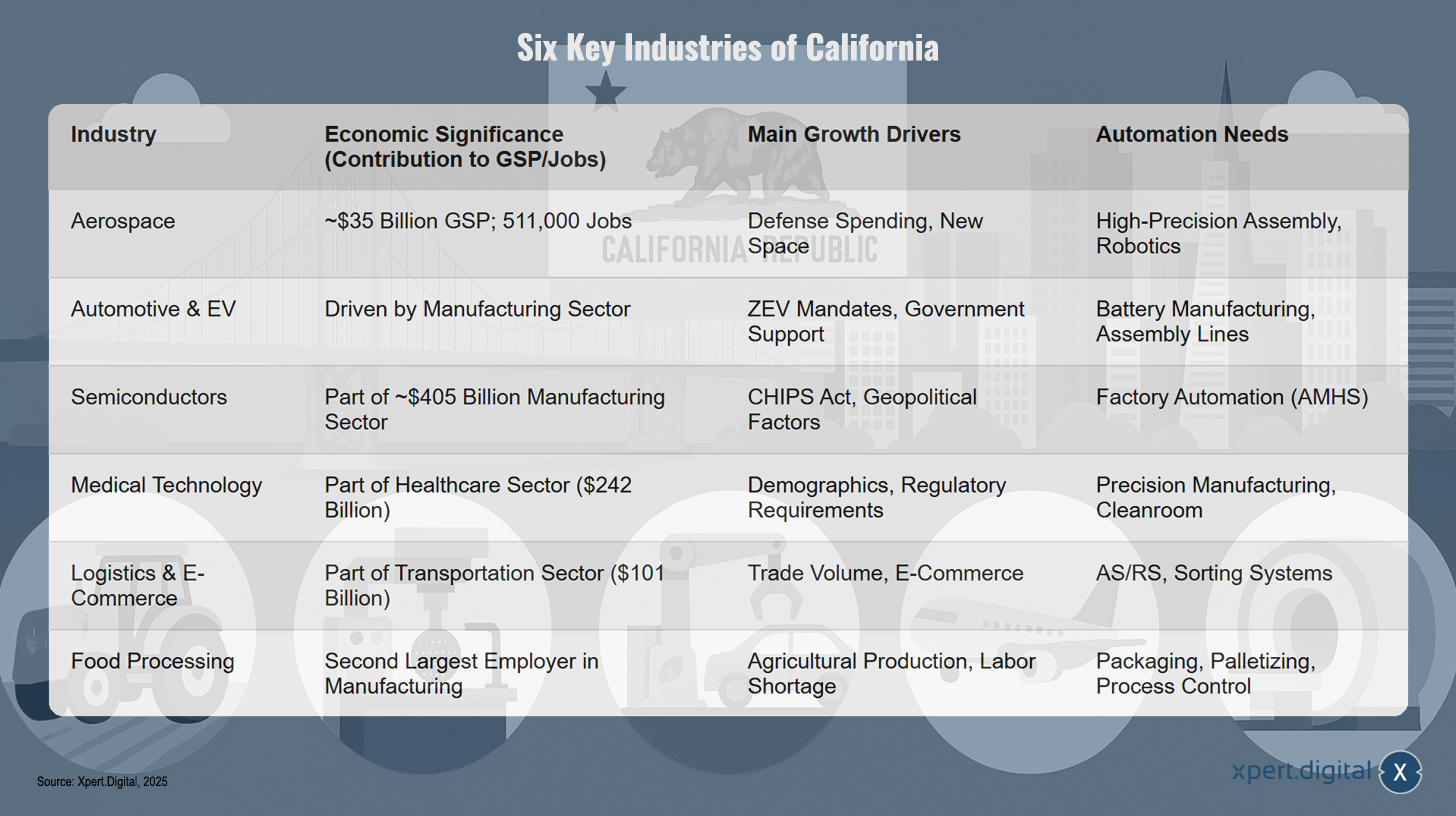
Six key industries of California - Image: Xpert.digital
The first comparative snapshot offers a quick overview of the most important key figures of the six industries considered and serves as a preview of the more detailed analysis in the following sections and the strategic synthesis below.
The aerospace industry contributes to gross national product at around $ 35 billion and employs 511,000 people. Their main growth drivers are defense spending and New Space initiatives, with the need for automation, especially in the case of high-precision assembly and robotics.
The automotive and electric vehicle sector is powered by the manufacturing sector, with ZEV mandates and government funding as the main growth driver. Automation focuses on battery supplies and assembly lines.
The semiconductor industry is part of the approximately $ 405 billion manufacturing sector and benefits from the chips act and geopolitical factors. The automation requirement is the factory automation, especially for automated material handling systems (AMHS).
The medical technology industry is part of the health sector comprehensive $ 242 billion and is promoted by demographic developments and regulatory requirements. Here the focus is on precision production and clean room technology.
Logistics and e-commerce are part of the $ 101 billion transport sector, driven by trading volume and e-commerce growth. Automation is carried out by automated warehouse and access systems (AS/RS) and sorting systems.
Food processing represents the second largest employer in the processing industry and is shaped by agricultural production and labor shortages. The automation requirement includes packaging, palletizing and process control.
Detail analysis: Aerospace & Defense- Precision, Scaling and the Future of Automated Manufacturing
Market size, economic effects and key sectors
The aerospace and defense industry is a load-bearing pillar of the California economy. The sector contributes an estimated $ 35 billion to the annual gross national product of the state and creates over 511,000 direct and indirect jobs. Its economic importance is comparable to agriculture and art and entertainment industry. The industry is divided into two main sub -sectors: aircraft construction as well as space travel, defense and satellites. The area of steering aircraft and spacecraft, in which employment has increased by over 64 % since 2004, has particularly strong growth, with most of this growth on Los Angeles County.
Geographical cluster analysis: The South California Aerospace Corridor
Industry is strongly concentrated in Southern California, especially in Los Angeles County, which historically housed 10 % of all US jobs in aerospace. This cluster is anchored by a number of important military and research institutions, including the Vandenberg Space Force Base, the US Space Systems Command on La Air Force Base, the Edwards Air Force Base and four NASA research centers, such as the Jet Propulsion Laboratory in Pasadena. Specific production locations in Burank, Sylmar and Mojave underline the concentration on South California. This geographical proximity of customers, suppliers and talents is a crucial competitive advantage and a reason why companies are settled in this region.
Profiles from key players (potential customers)
The aerospace ecosystem in California includes both established giants and disruptive innovators that are all potential customers for advanced automation solutions:
- Traditional industry leaders: This includes Northrop Grumman (with locations in Redondo Beach and El Segundo), Boeing (El Segundo), Raytheon (El Segundo) and Lockheed Martin (Sunnyvale). These companies have long established production lines and are important contractors for the government.
- Innovators of the “New Space”: SpaceX based in Hawthorne is a transformative force in the industry. With sales of $ 13.1 billion and around 13,000 employees, the company revolutionizes commercial space transport and production.
- Research and development centers: Institutions such as The Aerospace Corporation (El Segundo) and the Jet Propulsion Laboratory (Pasadena) are not pure manufacturers, but important research and development centers that shift the technological limits of the industry and also need specialized laboratory and prototype automation.
Primary automation drivers and opportunities
The demand for automation in the aerospace industry is determined by unique requirements for precision, complexity and reliability:
- Complex assembly in small series: In contrast to mass production in the automotive industry, the production of satellites and advanced aircraft high -precision robotics for tasks that are not manufactured in large quantities. This requires flexible and adaptable automation solutions.
- Advanced materials and processes: The use of composite materials and advanced metals requires specialized automated machines for cutting, shaping and checking. Additive manufacturing (3D printing) is a central innovation area that opens up new opportunities for automated production of complex parts.
- Digitization and AI: The industry moves towards ever more complex systems that integrate communication, autonomy, robotics and artificial intelligence. This requires highly developed automation and control systems to manage these networked components.
- Measurement technology and inspection: The guarantee of quality and compliance with the strictest specifications for defense and space applications require automated, highly precise inspection tools, such as: B. X -ray test systems that are integrated into the production process.
Strategic implications
The analysis of the aerospace sector shows that the automation market is divided into two different levels of opportunities: the modernization of existing systems and agile production in the “New Space” area. Established actors such as Northrop Grumman and Boeing have existing production lines and focus on their modernization to increase efficiency and to manage new programs. Your needs often lie in the retrofitting and integration of new automation into the existing infrastructure. In contrast, “New Space” companies such as SpaceX build new production paradigms from scratch. They are more willing to adopt radicals, fully integrated automation solutions and are less restricted by old systems. A successful market strategy therefore requires two different approaches: an advisory, integration-oriented approach for the established giants and a more disruptive approach to “Greenfield” solutions for the innovators.
In addition, the proximity to the South California cluster is a crucial success factor and no porridge. Aerospace companies expressly state that they are settled in Southern California because of the “proximity to customers and suppliers”. The ecosystem is closely integrated, with large actors, military bases and specialized suppliers, all of which are located in the same place. The complexity of the products requires close cooperation between the automation provider and the customer's engineering teams during the entire design, construction and implementation phase. A German company cannot effectively operate this market from a distance. The establishment of a physical presence with engineering and support staff in the Los Angeles or San Diego region is a prerequisite for building trust and the cooperation relationships necessary for success.
Our recommendation: 🌍 Limitless reach 🔗 Networked 🌐 Multilingual 💪 Strong sales: 💡 Authentic with strategy 🚀 Innovation meets 🧠 Intuition

From local to global: SMEs conquer the global market with clever strategies - Image: Xpert.Digital
At a time when a company's digital presence determines its success, the challenge is how to make this presence authentic, individual and far-reaching. Xpert.Digital offers an innovative solution that positions itself as an intersection between an industry hub, a blog and a brand ambassador. It combines the advantages of communication and sales channels in a single platform and enables publication in 18 different languages. The cooperation with partner portals and the possibility of publishing articles on Google News and a press distribution list with around 8,000 journalists and readers maximize the reach and visibility of the content. This represents an essential factor in external sales & marketing (SMarketing).
More about it here:
California's industrial revolution: How automated production lines shape the future from automobile to semiconductor
Detail analysis: automobile & electric vehicles - drive the future with automated production lines
The ZEV revolution: market dynamics and growth forecasts
California is at the forefront of the revolution towards emission-free vehicles (Vehicles Zevih, ZEVS), supported by significant state investments and proactive politics. The “Budget Act of 2021” provided for a multi-year investment of $ 3.9 billion to support the transition to ZEVS. Of this, $ 125 million in the financial year and a further $ 125 million in the financial year 2022-23 was provided especially for manufacturing in the federal state. This state advance creates a strong, non-cyclical demand for manufacturing capacities for electric vehicles, which partially decouples the sector on general market fluctuations, although it remains dependent on consumer demand.
The EV manufacturing ecosystem: from assembly to battery technology
The ecosystem of electric vehicle production in California is comprehensive and not only includes the final assembly of vehicles, but the entire supply chain. This includes the design and manufacture of battery packs by companies such as Lithos Energy, the development of charging infrastructure by companies such as ChargePoint and the production of specialized components. The state actively promotes this ecosystem through grants such as GFO-21-605 (ZEV Manufacturing) and Powerforward (Battery Manufacturing), which targeted strengthening local production capacity. An important aspect is that the production of an electric vehicle, in particular due to battery production, initially causes more pollution than that of a petrol -powered car. This increases the pressure to implement efficient, clean and highly automated manufacturing processes in order to minimize this ecological footprint.
Profiles from key players (potential customers)
California is home to a mixture of established market leaders and aspiring actors in the field of electromobility:
- Big OEM: Tesla is the undisputed anchor in the industry. The massive factory in Fremont with an area of 5.3 million square foot and 20,600 employees is the center of EV production in the state.
- Estimating OEMS: Companies like Faraday Future (Gardena), Greenpower Motor Company (Rancho Cucamonga) and Hyperion (Orange) represent the next wave of vehicle manufacturers that are pushing on the market.
- Special and industrial vehicles: Companies such as Karrior Electric Vehicles (Gardena) and Taylor-Dunn (Anaheim) concentrate on niche markets for electrical commercial vehicles and also offer opportunities for specialized automation solutions.
- Battery and component innovators: The heart of the EV ecosystem are companies such as Lithos Energy (San Rafael) that develop advanced battery packs, and Pyka (Oakland), which produce autonomous electrical aircraft and expand the limits of battery technology.
Primary automation drivers and opportunities
The automation needs in the EV industry are diverse and go beyond traditional vehicle assembly:
- High volume assembly: The core of the EV production is based on classic automotive automation such as robot welding, painting and final assembly.
- Automation of battery supplies: This is the most important growth area. It includes the automated handling of cells, the assembly of modules and packs, high-speed inspections and laser cutting/dipping. This process is highly precise, fast and potentially dangerous, which makes it ideal for automation.
- Automated material flow: The transport of heavy battery packs and large vehicle components through the factory requires robust driverless transport systems (FTS) and automated logistics systems.
- End-of-line tests: Automated systems are essential for quality control, the testing of the battery power and the final vehicle diagnosis to ensure security and reliability.
Strategic implications
The analysis of the California automotive sector shows that the greatest chance is not in the traditional automation of vehicle assembly, but in the specialized, high -technological automation of the battery store chain. While the main factory of Tesla is already highly automated, the “Greenfield” option there is lower. The state's targeted funding initiatives focus on ZEV components and in particular on battery supplies. This signals where the government sees the most critical need for domestic capacity. The advancement of specialized battery companies such as Lithos Energy and the need for high-speed battery battery and laser tools indicate an up-and-coming but quickly growing sub-industry. Since the battery is the central technological challenge and the largest value creation factor of an electric vehicle, the automation of this part of the process offers the greatest influence on costs, performance and security. A German mechanical engineering company should therefore develop a specialized offer that focuses on the automated battery modulus assembly, high-precision welding and integrated quality control and inspection systems in order to conquer the most valuable segment of this market.
In addition, state financial incentives act as a strong risk reduction mechanism for both the EV manufacturers and for their automation suppliers. The California Energy Commission (CEC) invests hundreds of millions directly in ZEV manufacturing projects. Programs such as the “Sales and Use Tax Exclusion (Ste)” of the California Alternative Energy and Advanced Transportation Financing Authority (CAAATFA) directly reduce the investment costs for buying new manufacturing systems. This state financing facilitates EV companies (especially start-ups) to secure capital required for investments in progressive automation. When addressing potential customers, in particular smaller or aspiring companies, the automation provider should therefore act as a strategic partner and actively support you in navigation and applying for these state incentives. This creates a stronger relationship and can be the decisive factor for the completion of a sale.
Detail analysis: semiconductor & electronics - the epicenter of high -tech, highly automated production
Market dominance and the effects of the chip act
California is the undisputed world market leader in the field of semiconductor design and innovation and is home to giants such as Nvidia, Intel, Broadcom and Qualcomm. The Silicon Valley remains the Center for Chip Design and Development. The cross -party “Chips and Science Act” from 2022 is the most important individual driver for new investments. He aims to move the advanced semiconductor production back to the United States in order to reduce supply chain risks and geopolitical threats. This has triggered a boom in the factory building, in which around 50 new factory investments of over $ 1 billion were announced nationwide between 2021 and 2023. California is a main benefit of this development and was selected as a location for the headquarters of the National Semiconductor Technology Center (NStC) in Sunnyvale.
Geographical cluster analysis: Silicon Valley and the rise of Greater Sacramento
The semiconductor industry in California focuses on two main clusters with different specializations:
- Silicon Valley (Santa Clara, San Jose, Fremont, Milpitas): This is the traditional heart of the industry and houses the headquarters of almost all large American semiconductor companies, including Intel, Nvidia, AMD, Applied materials, LAM Research and Kla. This region is the global center for research and development, design and entrepreneurial decision -making.
- Greater Sacramento (Folsom, Roseville): This region is becoming a decisive center for production. It is home to nine large semiconductor companies and specializes in chip production and the associated research and development. Bosch's massive investment of $ 1.9 billion in a new factory for silicon carbide chips (SIC) is located here and is to become the world's largest of its kind. Intel also maintains an important location in Folsom.
Profiles from key players (potential customers)
The customer landscape in the semiconductor industry is complex and complex:
- Fabless design leader: Companies such as Nvidia, Qualcomm, Broadcom and AMD do not operate their own factories, but are driving demand and specifications for the entire industry. They are decisive partners in the ecosystem.
- Integrated component manufacturer (IDMS): Intel is the prime example. The company designs and manufactures its own chips and is a main customer for factory automation.
- Giants for Wafer-Fab equipment (WFE) and materials: Applied materials, LAM Research and Kla are the companies that build the complex machines that are used in a factory. They are customers for mechanical engineering companies themselves because they need precision technology and automation to manufacture their own products. At the same time, they can also be potential partners or competitors.
- New market participants/major investors: Bosch's investment of $ 1.9 billion in an SIC FAB for electric vehicles in Greater Sacramento is a first-class “Greenfield” chance.
Primary automation drivers and opportunities
Automation in semiconductor production is extremely demanding and offers a wide range of options:
- Wafer-Fab automation: This is the heart of the industry. It includes highly automated material transport systems (AMHS) that transport wafer pods (foups) through the clean room, robotic arms for loading and unloading process systems and virtual PLC controls.
- Manufacture of process systems: The WFE companies (Applied Materials, LAM) need precision machine construction and automation to manufacture your own products-the complex machines that carry out separation, etching and lithograph. This is an opportunity to become a supplier for the suppliers.
- Measurement technology and inspection: Kla is a leader in this area. There is an immense demand for automated systems that Wafer can examine for defects at the nuclear level.
- Pure space environments: Each automation solution must be designed for ISO-certified clean rooms, which means that particle production and extermination must be minimized.
- Factory construction: The current construction boom creates a short -term opportunity for automation systems that are used in the construction and equipment of these huge new factories.
Strategic implications
The chips act has transformed the opportunities in the semiconductor sector from a replacement and modernization market into a massive “Greenfield” expansion market and thus created cross-generational demand for factory-related automation solutions. Before the Chips Act, the USA had lost its lead in progressive production, with the global capacity of 37 % to drop to 12 %. The chips act is a direct state intervention to build new, state -of -the -art systems from scratch. Companies such as Bosch recorded record investments in new factories that have not been seen for 30 years. The extent of the possibilities is unprecedented. Automation providers should concentrate on complete, integrated solutions at the factory level for these new buildings instead of selling individual machines. This is a multi-billion dollar chance that requires a strategic, long-term approach.
In addition, the semiconductor value chain has two different customer profiles for an automation company: the factory operators (e.g. Intel, Bosch) and the system manufacturers (e.g. Applied Materials, LAM Research). Factory operators are the end consumers of automated factories. You need integrated material handling, robotics and plant -wide control systems. Their main concerns are yield, throughput and operating time. Plant manufacturers are even OEMs. You need high -precision mechanical engineering, customer -specific robotics and control systems that are integrated into the process systems that you sell to the factory operators. Their main concern is the performance and reliability of your specific machine. These two customer types have different needs, sales cycles and technical requirements. A market entry strategy must therefore be divided into two: A team should concentrate on OEM solutions for the WFE giants in Silicon Valley, while another larger team should concentrate on factory integration solutions for the factory operators, especially in the growing cluster of Sacramento.
Detail analysis: medical technology & biosciences - automation in the service of health and innovation
Industry overview: a convergence of healthcare, technology and manufacturing
California has a unrivaled medical technology industry with important innovation centers. The sector is a convergence from technology and biopharmaceuticals, with a strong focus on research and development as well as precision production. The industry produces a wide range of products, from surgical robots and MRI devices to disposable articles and orthopedic implants. Important drivers are an aging population and the continuous need for more advanced and cheaper health solutions.
Geographical cluster analysis: Bay area, Orange County and San Diego Hubs
The medical technology industry in California is concentrated in several pronounced geographical clusters, each with its own strengths:
- Bay Area (Silicon Valley/Fremont, South San Francisco): known as the “place of birth of biotechnology”. The manufacturer such as Evolve Manufacturing (Fremont) and organic ibex giant such as Roche (South San Francisco) are located here. This region combines high technology with biotechnology.
- Orange County (Lake Forest, Irvine): An important center with companies such as Applied Medical, Alcon and Apria Healthcare, who have their headquarters in Lake Forest. Irvine is also one of the leading cities for jobs in the processing industry.
- San Diego: A world-famous bioscience cluster with a strong focus on research and development and proximity to the huge medical technology manufacturing cluster in Tijuana, Mexico. Companies like Pathway Medtech are based here (Santee).
Profiles from key players (potential customers)
The industry is characterized by a mixture of global corporations and specialized contract manufacturers:
- Global market leaders with great presence in California: Medtronic, Johnson & Johnson, Abbott, Roche and Alcon are important actors who maintain significant research, development and production facilities in California.
- Large private companies: Applied Medical based in Lake Forest is an example of a large, innovative company that is not listed.
- Specialized contract manufacturers (CMS): Evolve Manufacturing (Fremont), Pathway Medtech (Santee) and Roberson Machine Company (Sacramento) are decisive actors in the ecosystem. They are both potential customers and partners who offer access to a wide range of end customers.
Primary automation drivers and opportunities
Automation in medical technology is promoted by the need for precision, quality and strict regulation:
- Precision production and assembly: This is the core of the industry. It requires high-precision CNC processing, robot assembly for complex devices such as surgical robots and laser processing.
- Quality control and compliance with legal regulations: This is an outstanding driver. Automation is essential to meet the strict regulations of the FDA and the ISO standards (e.g. ISO 13485). Automated inspection and data protocol are of crucial importance to ensure traceability and conformity.
- Pure space and sterile environments: Many devices require the production and assembly in clean rooms of classes ISO 7 and ISO 8. Automation systems must be designed for these sterile conditions to avoid contamination.
- Kitting, packaging and labeling: Automated systems for packaging and labeling are crucial for efficiency and troubleshooting, especially for high -volume disposable items and test kits.
- Laboratory automation: Biotechnological and bioscientific research is strongly based on automated systems for tasks such as the extraction and analysis of DNA samples.
Strategic implications
In the medical technology industry, the main driver for automation is not the cost reduction, but the risk reduction - in particular the reduction of the risks of manufacturing errors and non -compliance with legal regulations. The industry is subject to the strict supervision of the FDA and international committees (ISO 13485). A single compliance error can lead to product returns, fines and reputation damage that is worth much more than all work savings. The products are often vital (implants, surgical instruments), so manufacturing precision and quality are not negotiable. Automation offers consistency and traceability that is impossible to achieve with manual processes. Case studies emphasize “proven quality processes”, “impeccable product quality” and the fulfillment of “strict standards”. The marketing and sales strategy for this sector must therefore focus on quality, precision, reliability and the ability to provide comprehensive data protocols for official audits. The message is: "Our automation protects your company and your patients", not only "Our automation saves you money".
In addition, manufacturer (Contract Manufacturers, CMS) are an important strategic entry point to the medical technology market. The industry relies heavily on specialized CMS such as Evolve, Pathway and Viant. These CMS operate a wide range of customers, from start-ups to global giants. A contract with a single CM can enable access to dozens of different product lines and end customers. CMS are experts in production and are constantly looking for a technological lead to win and keep customers. They are often more receptive to investments in the latest automation than a large, bureaucratic OEM. Instead of just concentrating on the large, known medical technology OEMs, a significant part of business development should be aimed at building partnerships with the most important contract manufacturers in the California clusters.
Detailed analysis: Logistics & E-Commerce Fulfillment-The backbone of the digital economy
Market size and the requirements of the omni-channel retail trade
California's massive population of 39.5 million people and its role as the main gate for trade between the United States and Asia create enormous demand for logistics and warehouse services. The rise of e-commerce has promoted the need for highly volume, fast omni-channel distribution centers, which can handle large retail deliveries (B2B) and direct deliveries to consumers (DTC). The facilities are huge: Ryder runs a campus of almost 2 million square foot in the City of Industry, and ideal fulfillment offers 1.8 million cubic feet storage space. This size underlines the immense need for automation to optimize space and processes.
Geographical cluster analysis: Hafennae Hubs and the Domestic Empire
The logistics industry in California focuses on strategic geographical clusters that are optimized for the flow of goods:
- La/Long Beach & Oakland Port Cluster: The proximity to the ports of Los Angeles, Long Beach and Oakland is crucial for import and export shops. Third-party logistics companies (3PLs) such as Weber Logistics and DCL Logistics place their fulfillment centers strategically near these ports and large airports (SFO, SJC) to accelerate the flow of goods.
- Inland Empire (Riverside/San Bernardino Counties): Although not explicitly detailed in the snippets, this region is the largest and most important logistics and distribution center of North America and serves the huge South California market.
- Los Angeles County (City of Industry): An important center for warehousing and fulfillment that houses large systems from companies like Ryder.
Profiles from key players (potential customers)
The main customers for warehouse automation systems are the large logistics service providers and retailers:
- Large 3PL providers: Weber Logistics, DCL Logistics, Ryder and Ideal Fulfillment are the main actors who are constantly looking for technological solutions to improve their services and reduce costs.
- Large retailers/senders: Amazon is a key player with over 170,000 employees in the state. Although Amazon develops its own automation technologies, the company drives the entire 3PL industry to automate to remain competitive.
- Specialized fulfillment providers: Companies that focus on specific needs such as food and drinks (with batch tracking) or kitting are also first-class goals for tailor-made automation solutions.
Primary automation drivers and opportunities
The demand for automation in logistics is powered by the need for speed, accuracy and efficiency:
- Automated warehouse and provision systems (AS/RS): It is essential to maximize the storage density in expensive properties and for quick access to the inventory.
- Robotic picking and packaging: The use of cobots or mobile robots to support or replace human pickers is an important investment area to increase speed and accuracy and to counter the shortage of workers.
- Supporting and sorting systems: High-speed conveyors and automated sorters are the arteries of each modern distribution center and essential for the transport of thousands of packages per hour.
- Material flow control software (toilet/WES): The “brain” that controls the hardware. The offer of a complete, integrated hardware and software solution is a large competitive advantage.
- Reverse logistics (returns): Managing the high volume of e-commerce returns is a significant operational challenge. Automated systems for sorting and processing returned goods are a growing need.
Strategic implications
The demand for warehouse automation in California is constant and is driven by a non -negotiable physical reality: the state is the main entry point for goods from Asia that are intended for the entire North American market. The ports of La and Long Beach are the busiest of the western hemisphere. Goods arrive here and have to be processed and distributed. Weber Logistics explicitly emphasizes its port logistics services, which transported goods from the Häfen La, Long Beach and Oakland to their distribution centers. The sheer volume of the goods that flow through this gate creates constant pressure, throughput, speed, speed and efficiency. This pressure is independent of short -term economic cycles. The logistics sector in California therefore represents a stable, long-term and continuously growing automation market. It is less susceptible to boom-and-bust cycles than the technology or defense industry. An investment here is a long -term annuity.
In addition, the 3PL market is highly competitive, which forces the providers not only to use automation for reasons of efficiency, but also to use as a competitive measure to gain and keep customers. 3PLs compete for price, speed and accuracy. DCL Logistics advertises with a punctual shipping and order accuracy of 99.8 %, while Ideal Fulfillment promises punctual processing of 99.9 %+. These key figures can only be reached by a high degree of automation. Customers (retailers, e-commerce brands) are demanding, and 3PLs have to meet strict retail conformity and routing requirements in order to avoid costly withdrawal. Automation is the key to ensuring conformity. 3PLS market their technological skills, such as: B. integrated customer portals and automated reports, expressly as important distinguishing features. The sales approach for 3PLs should therefore concentrate on how the automation solution can become a sales argument for you to your end customers. The automation provider not only sells a machine, but a competitive advantage in a murderous market.
Detail analysis: Food and beverage processing- Automize America's bread basket
Connection of agriculture and advanced production
California's agricultural industry has the highest production of all US states and is growing over half of the fruit, vegetables and nuts of the country. This massive agricultural production is the raw material for a huge food processing industry. The production of food and related products is the second largest industrial employment sector in the state and accounts for 13 % of workers. The industry increasingly turns to automation and AI to remedy a shortage of labor, improve efficiency and to meet strict hygiene standards.
Geographical cluster analysis: the Central Valley and the proximity to urban centers
The food processing industry in California is geographically positioned:
- Central Valley: As a heart of California agriculture, this region is a natural center for primary processing companies. AC Technology Solutions expressly indicates its location in the “fertile Central Valley” to support fruit, milk, cheese and vegetable companies.
- Urban outskirts (Bakersfield, Irvine, Cerritos, Oakland): The secondary processing, packaging and sales often take place closer to the large population and logistics centers. Automation providers such as Elite Automation (Bakersfield) and Food Automation Inc. (Irvine, Cerritos) have settled in these strategic zones. Pacific Farms is based in Oakland.
Profiles from key players and specialized automation providers
The market is characterized by a mixture of large food corporations and specialized automation providers:
- Large food and beverage companies: Although large processors are not as detailed as in other sectors, the presence of giants such as Pepsico and the sheer size of the market indicates the presence of all large national and global food companies.
- Specialty manufacturer: San Francisco is known for its craftsmanship with companies such as Blue Bottle Coffee and Anchor Brewing.
- Specialized automation providers: Food Automation Inc., Elite Automation & Electrical Services and AC Technology Solutions are key players who focus on this vertical industry.
- HPP (high-pressing processing) provider: a niche segment that grows with companies such as Calpack Foods and HPP Los Angeles.
Primary automation drivers and opportunities
Automation in the food industry is diverse and covers the entire production process:
- Process automation: Systems for CIP (Clean-in-Place), dosage and pasteurization are crucial. Robotics are used for cutting, escaping and sorting.
- Packaging and palletizing: This is the largest area of application for robotics in the food industry with a market share of 29.8 %. Scara and spider robots are used for high-speed-pick-and-Place processes.
- Quality control and hygiene: Automation is crucial to reduce human contact and risk of contamination and to ensure compliance with FDA regulations. Image processing and AI are used for inspection.
- Traceability (batch tracking): automated systems are required to pursue batches and expiry data, a decisive function for food safety and inventory management.
Strategic implications
The main driver for automation in the Californian food industry is the meeting of two strong forces: an immense range of production and a persistent shortage of workers. California's agricultural production is enormous and creates a massive and constant stream of raw materials that need to be processed. At the same time, the industry suffers from a growing lack of qualified workers repeating and demanding tasks. This is a structural problem that is not easy to solve. Automation offers a direct solution for this bottleneck, which enables companies to maintain and expand production without enlarging their workforce accordingly. The ROI is clear: automation reduces labor costs in the long term, increases throughput and ensures 24/7 operation. This is a needs -based market. The business case for automation is not speculative; It is a direct solution for a critical company bottleneck. The sales message should be: "We solve your work problem and open up your production capacity."
At the same time, the market for automation of food processing is highly specialized and requires deep specialist knowledge of food safety regulations (FDA, PMO) and specific processes (e.g. CIP, HPP). Companies like Food Automation Inc. expressly advertise with their expertise in FDA regulations and the Pasteurized Milk Ordinance (PMO). This is an important distinguishing feature. The materials used in the machines must be food -safe, and the design must enable easy and thorough cleaning to prevent contamination. Different types of food (e.g. meat, fruit and vegetables, drinks) have unique processing and handling requirements. An all-purpose automation provider cannot be successful in this sector. A German company that wants to enter this market must either acquire this special knowledge or work with a local expert such as Food Automation Inc. or Elite Automation. A special business unit with engineers who are trained in food science and regulatory conformity is essential.
🎯🎯🎯 Benefit from Xpert.Digital's extensive, fivefold expertise in a comprehensive service package | R&D, XR, PR & SEM

AI & XR 3D Rendering Machine: Fivefold expertise from Xpert.Digital in a comprehensive service package, R&D XR, PR & SEM - Image: Xpert.Digital
Xpert.Digital has in-depth knowledge of various industries. This allows us to develop tailor-made strategies that are tailored precisely to the requirements and challenges of your specific market segment. By continually analyzing market trends and following industry developments, we can act with foresight and offer innovative solutions. Through the combination of experience and knowledge, we generate added value and give our customers a decisive competitive advantage.
More about it here:
Strategic industry analysis: Automation investments in six key sectors of California
Strategic synthesis: Comparative analysis and recommendations for market entry
Comparative analysis of the target industries for automation investments
The following table serves as the heart of strategic analysis and offers a clear, data -based comparison of the six target industries based on important decision criteria. It enables decision-makers to visually weigh the advantages and disadvantages of each sector and to reconcile the chances of the specific skills of their company. This comparative presentation summarizes the previous detailed analysis in a single, clear format and facilitates a strategic discussion about resource allocation.
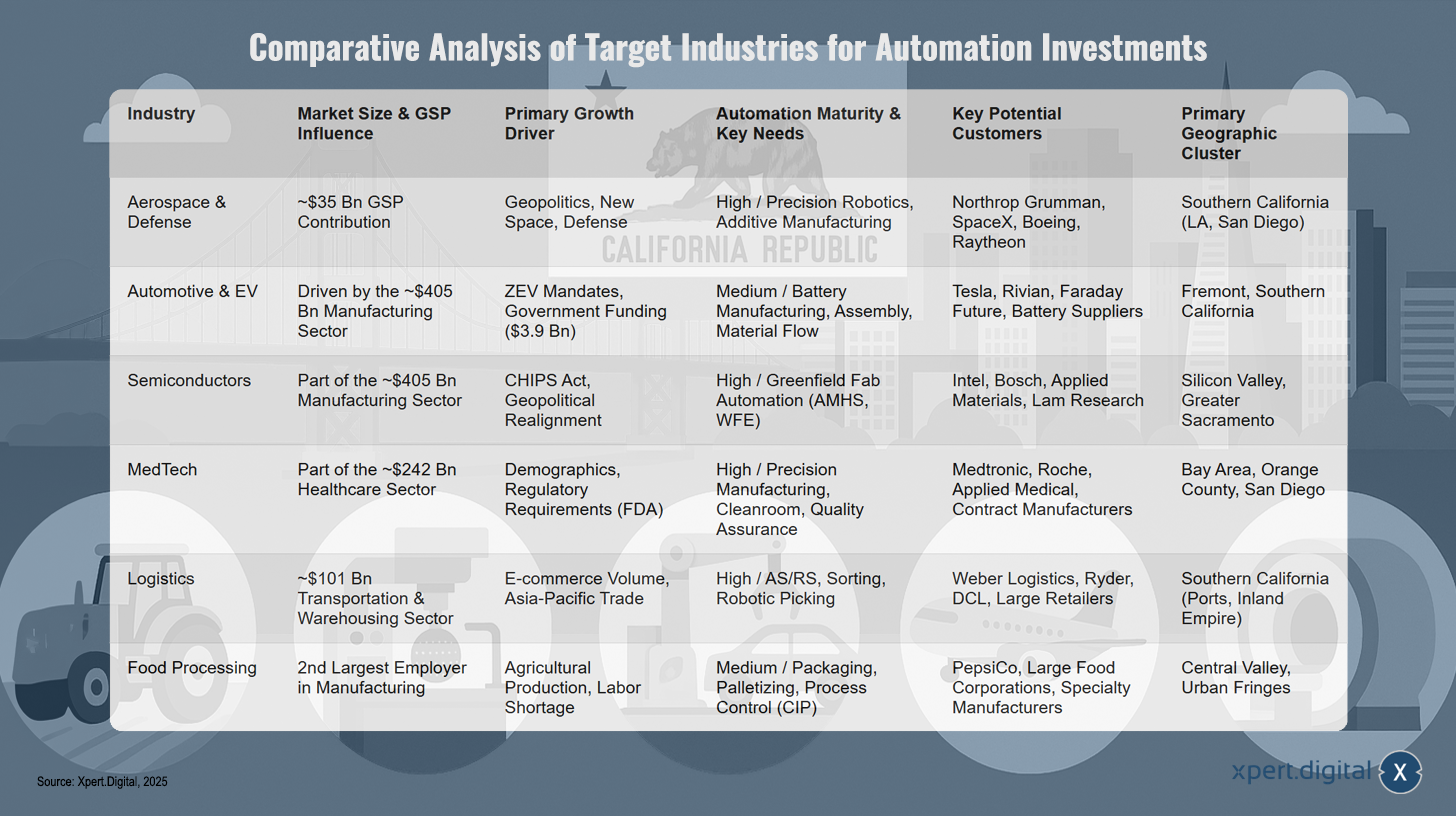
Comparative analysis of the target sectors for automation investments - Image: Xpert.digital
The comparative analysis of the target sectors for automation investments shows significant differences in market size, growth strikers and automation maturity. The aerospace industry contributes around $ 35 billion to the gross national product and is mainly driven by geopolitics, new space and defense. With high automation maturity, it focuses on precision robotics and additive manufacturing, with important potential customers such as Northrop Grumman, SpaceX, Boeing and Raytheon mainly located in Southern California (LA, San Diego).
The automotive and electric vehicle sector is powered by the approximately $ 405 billion production sector, with ZEV mandate and state funding of $ 3.9 billion acting as the main growth driver. With medium automation maturity, the focus is on battery, assembly and material flow. Tesla, Rivian, Faraday Future and battery supplier are important customers who concentrate in the Foreign and Southern California.
The semiconductor industry, part of the $ 405 billion production sector, benefits from the chips act and geopolitical realignment. With high automation maturity, it focuses on greenfield factory automation, including AMHS and WFE. Intel, Bosch, Applied Materials and Lam Research are important players in Silicon Valley and Greater Sacramento.
Medical technology as part of the $ 242 billion health sector is powered by demographic developments and regulatory FDA requirements. With high automation -ready maturity, it focuses on precision production, clean room and quality assurance. Medtronic, Roche, Applied Medical and Modderful are located in the Bay Area, Orange County and San Diego.
The logistics sector with a value of $ 101 billion in the transport and storage area is promoted by e-commerce volume and Asia-Pacific trading. With high automation maturity, it focuses on AS/RS, sorting and robotics communication. Weber Logistics, Ryder, DCL and large retailers are located in Southern California (ports, inland empire).
Food processing as the second largest employer in the processing industry is powered by agricultural production and shortage of workers. With medium automation maturity, the focus is on packaging, palletizing and process control (CIP). Pepsico, large food companies and specialty manufacturers are active in the Central Valley and urban outskirts.
Ranking of the industries for opportunities: short -term vs. long -term potential
A strategic evaluation of opportunities requires a distinction between short and long-term potential:
- Short-term (1-3 years): semiconductor and EV battery. These sectors are driven by massive, immediate capital feeding of federal and state governments. The Chips Act and the ZEV funding programs create urgent, large-scale “Greenfield” opportunities for the construction of completely new factories. Companies that act quickly and can offer comprehensive solutions for these new buildings have the chance of significant orders.
- Long -term (5+ years): logistics, medical technology and food processing. These industries are driven by more fundamental, structural economic forces - trading volume, demographic change and labor shortage. These factors ensure stable, continuous demand for automation for decades. The investments here are possibly more increment, but more steadily and less susceptible to political cycles. The aerospace industry is in between, with immediate defense projects and long-term destinations in space travel.
Strategic recommendation: Use of the “Industry 4.0” advantage in the US market for “smart manufacturing”
For a German company, there is a unique strategic advantage in positioning its expertise. The US initiative “Smart Manufacturing” and German “Industry 4.0” began as parallel efforts. However, analyzes indicate that the German approach is more comprehensive and system-oriented, while the US approach is often concentrated on specific technologies or applications. Germany plays a pioneering role in automation with the highest robot density in Europe, and German machines enjoy an excellent reputation in the USA, the most important export market for German mechanical engineering.
A German company should therefore not market itself as a pure machine seller. It should position itself as a strategic partner that brings the holistic, integrated vision of “Industry 4.0” to American customers. This includes advice on the convergence of operating technology (OT) and information technology (IT), data integration, digital twins and the structure of really adaptable, intelligent production systems. This approach distinguishes the company from US competitors who may only offer point solutions, and fits perfectly with the needs of companies that build complex new factories, such as: B. semiconductor factories.
Suitable for:

Tailor -made recommendations for market entry and expansion
Based on the entire analysis, the following specific steps for successful market entry or expansion to California are recommended:
- Prioritize: Concentrate the initial efforts on the semiconductor and EV battery sector to benefit from the current investment boom. These sectors offer the greatest short-term “Greenfield” opportunities.
- Building a physical presence: Open a sales, engineering and service office both in North California (to operate the Silicon Valley/Sacramento) and in South California (to operate aerospace, logistics and medical technology industry). The proximity to the customer is essential in these high -tech industries.
- Develop specialized teams: Form dedicated business units for the 2-3 most important target sectors, e.g. B. a team for “semiconductor factory automation” and a team for “medical technology compliance automation”. This ensures the required deep specialist knowledge.
- Use a partnership model: Work actively with local specialized integrators (especially in food processing) and support customers in securing state and state funding. This creates trust and lowers the entry barriers for customers.
- Market the “Industry 4.0” vision: position the company as a thought leader and strategic partner in building the next generation of “smart factories” and use the excellent reputation of German mechanical engineering to justify a premium value.
Xpaper AIS - R&D for Business Development, Marketing, PR and Content Hub
Xpaper AIS Ais Possibilities for Business Development, Marketing, PR and our Industry Hub (Content) - Image: Xpert.digital
This article was "written". My self-developed R&D research tool 'Xpaper' used, which I use in a total of 18 languages, especially for global business development. Stylistic and grammatical refinements were made in order to make the text clearer and more fluid. Section selection, design as well as source and material collection are edited and revised.
Xpaper News is based on AIS ( Artificial Intelligence Search ) and differs fundamentally from SEO technology. Together, however, both approaches are the goal of making relevant information accessible to users - AIS on the search technology and SEO website on the side of the content.
Every night, Xpaper goes through the current news from all over the world with continuous updates around the clock. Instead of investing thousands of euros in uncomfortable and similar tools every month, I have created my own tool here to always be up to date in my work in the field of business development (BD). The xpaper system resembles tools from the financial world that collect and analyze tens of millions of data every hour. At the same time, Xpaper is not only suitable for business development, but is also used in the area of marketing and PR - be it as a source of inspiration for the content factory or for article research. With the tool, all sources worldwide can be evaluated and analyzed. No matter what language the data source speaks - this is not a problem for the AI. Different AI models are available for this. With the AI analysis, summaries can be created quickly and understandably that show what is currently happening and where the latest trends are-and that with Xpaper in 18 languages . With Xpaper, independent subject areas can be analyzed - from general to special niche issues, in which data can also be compared and analyzed with past periods.
We are there for you - advice - planning - implementation - project management
☑️ Our business language is English or German
☑️ NEW: Correspondence in your national language!

Konrad Wolfenstein
I would be happy to serve you and my team as a personal advisor.
You can contact me by filling out the contact form or simply call me on +49 7348 4088 965 (Munich) . My email address is: wolfenstein ∂ xpert.digital
I'm looking forward to our joint project.











