
Polyamide 6 (PA6) from China is cheaper despite transport over 10,000 kilometers: What's behind the cost advantage?

Available in 27 languages 📢
Prefer Xpert.Digital on GoogleⓘPublished on: November 8, 2026 / Updated on: November 8, 2026 – Author: Konrad Wolfenstein
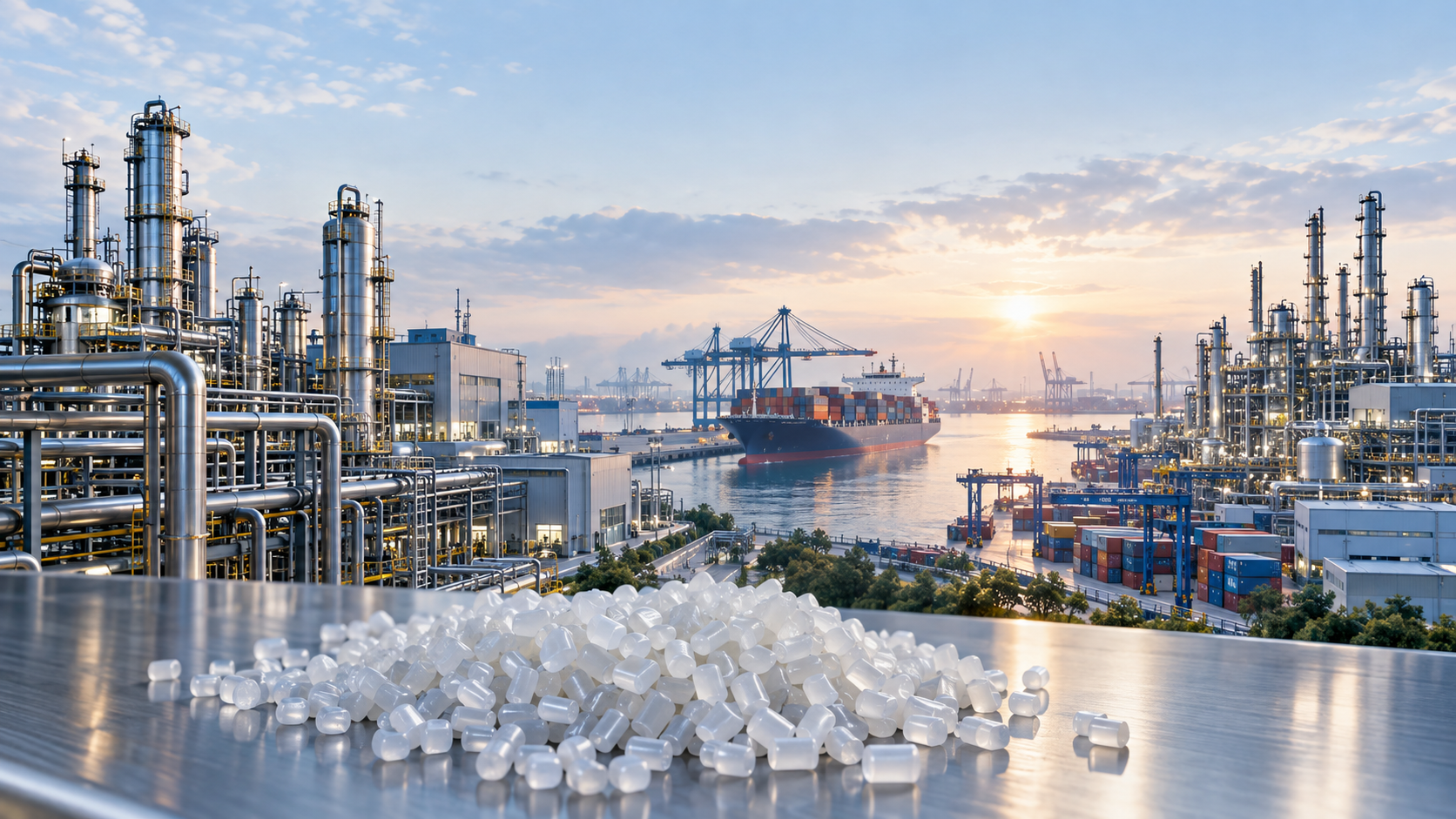
Polyamide 6 (PA6) from China is cheaper despite 10,000-kilometer transport: What's behind the cost advantage – Creative image on the topic, with AI: Xpert.Digital
China's chemical industry puts pressure on Europe's PA6 production
An €800 cost difference per ton: Why German PA6 manufacturers are falling behind
The problem isn't the wages: these costs make PA6 from China cheaper
A plastic can be manufactured in China, shipped thousands of kilometers to Europe, and still be offered here at a lower price than it can be produced in Germany. A model calculation for polyamide 6 (PA6) quantifies the difference at 800 euros per ton: 2,300 euros in production costs in Germany compared to 1,500 euros in China. If another 300 euros are added for export logistics, sea freight, distribution, and profit, the calculated price at the European port would be 1,800 euros – still 500 euros below the German production costs.
However, these figures do not prove that every Chinese plant is inherently superior or that every German PA6 production facility is uneconomical. They represent a model calculation whose validity depends on cost allocation, capacity utilization, raw material and energy prices, and actual delivery conditions. A significant portion of the difference arises from the raw material itself; wages, on the other hand, explain only a small part. Furthermore, questions arise that a simple comparison cannot answer: What import costs are still missing? How important is delivery time? And what significance do quality, security of supply, and long-term investments have?
The cost comparison makes one thing especially clear: anyone who wants to understand the competitiveness of the German chemical industry must consider the entire value chain. What matters is not individual factors, but their interplay – from raw material supply and energy to plant capacity and utilization, all the way to logistics and sales markets.
Raw materials, energy, capacity utilization: Why the German chemical industry can hardly compete with China
Germany's chemical industry under cost pressure: Why PA6 from China can be cheaper despite sea freight
A German company can manufacture the same plastic in China, ship it to Europe, and offer it there more cheaply than it could produce it in Germany. This is not an economic paradox, but rather the potential result of differing raw material markets, energy conditions, plant sizes, and industrial supply chains. A simplified model calculation for polyamide 6, or PA6 for short, illustrates the scale of the difference: production costs of €2,300 per ton in Germany contrast with €1,500 in China. Even after adding €300 for export logistics, sea freight, distribution, and profit, a calculated difference of €500 per ton remains.
The crucial insight, however, lies not solely in this price difference. The calculation primarily demonstrates why the widespread focus on wages and labor productivity falls short. Half of the modeled manufacturing cost disadvantage arises from the raw material. At the same time, the calculation does not imply a general superiority of Chinese production sites, nor does it establish the unprofitability of every German PA6 plant. For that, cost allocation, capacity utilization, product quality, delivery terms, and long-term investment viability must be examined more closely.
What the model calculation actually says
The production costs of €2,300 and €1,500 per ton, respectively, result in a difference of €800. Compared to the German baseline, the Chinese model location is therefore approximately 34.8 percent lower. Adding €175 for export logistics and sea freight, and €125 for distribution and profit, to the Chinese product results in a calculated offer price of €1,800 at the European port. This is approximately 21.7 percent below the German production costs.
This is explicitly a model calculation and not the actual costs of an identified company. The figures should not be interpreted as current market prices or as representative industry averages. Without information on the calculation date, production volume, plant technology, purchasing contracts, and capacity utilization, their representativeness cannot be verified. Their strength lies in making economic relationships visible and differentiating the magnitude of individual levers.
Even identical corporate affiliation doesn't eliminate the differences. A corporation can standardize technology, product specifications, and quality management internationally without necessarily achieving the same purchase prices and infrastructure costs everywhere. Therefore, identical quality standards are compatible with significantly different manufacturing costs. However, identical corporate affiliation does not automatically imply the same generation of equipment, the same operating methods, or the same level of vertical integration.
Why the comparison limit is crucial
The comparison examines different economic factors. On the German side, the focus is on pure manufacturing costs, excluding sales margin and external logistics. On the Chinese side, the focus is on a calculated sales price that includes certain transport services and a combined figure for sales and profit. The difference of 500 euros therefore initially represents a gap between these two calculated values and does not yet constitute a final purchasing advantage for the European processor.
A reliable location comparison must bring both alternatives to the same point of transfer. For example, a fully calculated price at the factory gate of a specific customer would be useful, assuming the same order quantity, payment terms, and delivery readiness. On the import side, this would potentially include customs duties, import clearance, additional port charges, onward transport, storage, and financing. On the German side, sales, delivery, and the necessary contribution to profitability must also be considered.
This correction does not automatically negate the modeled advantage. It merely prevents a seemingly impressive figure from being mistaken for a complete investment or procurement decision. The actual size of the difference remains unclear without the additional data. Both categorically eliminating the Chinese advantage and accepting it uncritically as the final savings would be methodologically flawed.
The raw material chain determines half the story
For raw materials, especially caprolactam, the model assumes costs of €1,600 per ton of PA6 in Germany and €1,200 per ton in China. The difference is €400, or 25 percent of the German raw material cost block. This item alone thus accounts for 50 percent of the total manufacturing cost gap. Raw materials theoretically make up approximately 69.6 percent of the German and 80 percent of the Chinese manufacturing costs.
The higher proportion of Chinese raw materials is easily misinterpreted. It doesn't indicate that raw materials are absolutely more expensive there. It arises because the other cost items in the model decrease even more sharply. Therefore, a company with a high proportion of raw materials must examine its competitiveness along the upstream value chain, and not solely at the final polymerization plant.
PA6 is produced industrially, among other methods, by the hydrolytic polymerization of caprolactam; this can be followed by extraction, recovery, and drying. The energy and resource efficiency of the precursors can therefore already be reflected in the purchase price of the caprolactam, while the polymerization process itself requires additional energy. Distinguishing between these two levels reveals why an isolated debate about electricity costs only partially captures the true cost structure.
Chemical parks are economic interconnected systems
Integrated production sites can share material flows, energy supplies, and infrastructure; at BASF, for example, byproducts from one plant are used as raw materials for other plants. This can result in reduced transport costs, better resource utilization, and economic advantages. Such synergies are not unique to China: German and other European chemical complexes also have integrated production structures.
The locational advantage therefore doesn't arise simply from the existence of a chemical park somewhere. What's crucial is which plants collaborate, how well their capacities complement each other, and whether downstream demand actually accepts their products. A larger network can reduce costs, but it can also create dependencies. If a key upstream stage fails or becomes unprofitable, several connected production lines may need to be reorganized.
Furthermore, identical valuation rules would be necessary to compare raw material costs. An internal transfer price for caprolactam is not directly comparable to an external purchase price. Only a consolidated view of the entire value chain reveals whether a cost advantage is actually generated operationally or arises partly from the internal allocation of profits.
China is changing market mechanics
China's capacity expansion affects not only the costs of individual plants but also the direction of international trade flows. In the caprolactam market, China switched from a net importer to a net exporter in 2024. In Hunan, the annual caprolactam capacity of a large production site was increased from 300,000 to 600,000 tons; however, this site expansion does not necessarily equate to a correspondingly large net increase in overall Chinese capacity.
For European manufacturers, such structural change alters the initial situation in two ways. Previous export opportunities may weaken, while additional quantities compete for customers in other sales markets. A low raw material price can then result from both an efficient production structure and intense competition and temporary supply pressure. The observed price alone does not separate these causes.
This is crucial for long-term location decisions. A company cannot simply extrapolate temporarily depressed raw material prices unchanged over the entire lifespan of a plant. Conversely, it would be negligent to dismiss capacity expansion with permanently altered trade flows merely as a short-term cyclical fluctuation. A distinction must be made between structural cost advantages, cyclical price declines, and strategically motivated market share expansion.
Energy causes direct and indirect stress
The direct energy cost component in the model amounts to €190 per ton in Germany and €75 in China. The difference of €115 corresponds to a reduction of approximately 60.5 percent and explains roughly 14.4 percent of the total production cost gap. This is significant, but considerably less than the raw material effect. Even a complete equalization of this direct energy cost component would only reduce the original gap from €800 to €685.
The economic significance of energy extends further, however. For the chemical industry, natural gas serves not only to generate heat and electricity, but also, in part, as a raw material. High upstream costs can therefore be passed on to downstream products via raw material prices. This does not mean, however, that all raw material price differences can also be attributed to energy: the model calculation does not provide sufficient data for such a causal decomposition.
International energy cost comparisons generally confirm competitive pressure, but they do not replace individual plant cost calculations. In its February 2025 report, the European Commission described industrial gas and electricity prices in the EU as being two to four times higher than those of major trading partners, despite some declines. This range does not automatically apply to every German PA6 plant compared to every Chinese competitor. Consumption profiles, on-site generation, contract duration, grid fees, and potential relief measures must be considered separately.
The wage argument misses the mark
The model assumes personnel and management costs of €100 per ton in Germany and €30 in China. The relative difference of 70 percent seems spectacular. In absolute terms, however, it amounts to only €70, thus explaining 8.75 percent of the total difference in production costs. Anyone who derives a debate about German wages primarily from this calculation is focusing on the wrong analytical point.
Even the unrealistic complete elimination of German personnel and management costs would only reduce production costs from €2,300 to €2,200. The Chinese offer of €1,800 at the European port would still be €400 lower. A wage reduction cannot close a gap in this model that is primarily due to raw material and structural factors.
This does not mean that work organization and productivity are unimportant. Qualified employees can improve the efficiency of several cost centers through higher availability, lower scrap, better process management, and faster problem-solving. These effects are more comprehensive than just the immediate impact on wages. A sound personnel strategy therefore evaluates the contribution to the overall performance of the plant and not solely the cost of an hour of labor.
Maintenance only saves money if it's available
Maintenance and operating supplies are estimated at €90 per ton in Germany and €45 per ton in China. This difference of €45 represents a halving of the costs and contributes approximately 5.6 percent to the manufacturing cost gap. Whether this translates into a genuine efficiency advantage cannot be determined without information on plant age, spare parts costs, maintenance strategy, and reliability.
Lower maintenance costs can be achieved, for example, with modern equipment or better-standardized spare parts. However, they can also result from postponing necessary work. A short-term cost advantage would then be offset by later downtime, repairs, or a reduced service life. Therefore, a cost comparison must consider both maintenance effort and technical availability.
The figures for quality, packaging, and internal logistics are similarly nuanced. Here, costs of €65 in Germany are contrasted with €45 in China. The savings of €20 represent approximately 30.8 percent of this cost block, but only 2.5 percent of the total gap. If an additional €175 is allocated for export logistics, the transitions between internal and external logistics must be clearly defined to prevent any service from being recorded twice or not at all.
Environmental costs are not a quality judgment
For environmental protection, occupational safety, and waste management, the model includes €65 per ton in Germany and €20 in China. The difference of €45 corresponds to approximately 69.2 percent of the German value and approximately 5.6 percent of the total production cost gap. This initially only reveals a difference in cost assumptions, but not the actual environmental or safety performance of the compared locations.
Identical product quality does not automatically imply identical manufacturing conditions. A plastic product can meet the same technical specifications even if energy sources, wastewater treatment, or occupational safety organizations differ. Conversely, lower reported costs do not necessarily indicate inferior standards. A modern facility, shared infrastructure, or a different distribution between capital expenditures and operating costs can also play a role.
Even societal damages are not automatically and fully reflected in corporate cost accounting. Economically, a distinction must therefore be made between paid protective measures and any remaining external burdens. An objective assessment requires measurable environmental and safety indicators, not assumptions about the country of origin. As a political conclusion, it would certainly be insufficient to attempt to restore competitiveness primarily by dismantling sensible protective standards: the relevant model group is simply too small for this purpose.
Fixed costs follow the actual capacity utilization
Depreciation and fixed costs are estimated at €190 per ton in Germany and €85 in China. The difference of €105 corresponds to approximately 55.3 percent and explains roughly 13.1 percent of the total production cost gap. Plant size and capacity utilization can play a significant role here. However, a single figure per ton does not reveal which of these factors is decisive.
A new large-scale plant can be technically efficient and simultaneously incur high depreciation. Conversely, an older plant, largely depreciated on the balance sheet, can show low book costs even though it requires significant modernization. Technological progress and low depreciation are therefore by no means the same thing.
A purely illustrative calculation example demonstrates the mechanism. If a truly unchanging annual fixed cost block at 90 percent capacity utilization corresponded to €190 per ton, its contribution to unit costs would rise to approximately €244 at only 70 percent capacity utilization. The deterioration of about €54 would be solely the result of the lower production volume. This example is not an assumption about the specific model plants, but rather a sensitivity analysis.
Real German chemical production was under considerable pressure in 2025: In the fourth quarter, capacity utilization of chemical plants was at 72.5 percent. Chemical production excluding pharmaceuticals declined by 3.3 percent for the year as a whole. Such industry data does not prove a specific PA6 cost gap, but it does demonstrate why capacity utilization should not be treated as a secondary operational indicator in a site analysis.
The dangerous cycle of decreasing quantities
Underutilization can be self-reinforcing. When less is produced, costs that cannot be reduced in the short term are spread across fewer tons. Rising unit costs, in turn, weaken the ability to accept orders at competitive prices. If further volume losses occur as a result, the cost position deteriorates again. This feedback loop explains why a purely short-term cost-cutting strategy may not be sufficient.
Higher capacity utilization is only economically beneficial if the additional revenue adequately exceeds the additional costs. Producing for inventory or aggressively selling below variable costs does not solve the problem. Conversely, it can be advantageous in the short term to accept orders below the calculated full cost if they make a positive contribution to covering fixed costs that would be incurred anyway. Therefore, business continuity and new investment follow different decision-making rules.
For an existing plant, short-term avoidable costs are crucial. For a new plant, additional costs such as investment, financing, start-up phase, and a risk-adjusted return on capital must be generated. Depreciation alone does not fully cover these requirements. A positive operating cash flow today does not guarantee that the same location justifies a replacement investment.
Our EU and German expertise in business development, sales and marketing

Our EU and German expertise in business development, sales and marketing - Image: Xpert.Digital
Industry focus areas: B2B, digitalization (from AI to XR), mechanical engineering, logistics, renewable energies and industry
More information here:
A thematic hub offering insights and expertise:
- Knowledge platform covering global and regional economies, innovation and industry-specific trends
- A collection of analyses, insights, and background information from our key areas of focus
- A place for expertise and information on current developments in business and technology
- A hub for companies seeking information on markets, digitalization, and industry innovations
The impact of declining production volumes on costs
The 800 euros completely disassembled
The manufacturing cost gap is distributed across seven categories: €400 is attributable to raw materials, €115 to energy, €70 to personnel and management, and €105 to depreciation and fixed costs. These four frequently highlighted categories together account for €690. The remaining €110 is comprised of €45 for maintenance and operating supplies, €45 for environmental protection and occupational safety, including waste management, and €20 for quality, packaging, and internal logistics.
This complete breakdown is important because otherwise an incomplete picture of the causes emerges. Raw materials, energy, and depreciation (or fixed costs) together explain €620, or 77.5 percent of the difference. Personnel, on the other hand, is a comparatively small, direct factor. At the same time, this breakdown does not imply that the cost categories can be changed independently of one another.
More efficient extraction can, for example, affect both raw material losses and energy consumption. A larger plant may change staffing requirements, maintenance organization, and logistics per ton. A reliable cost analysis for improvements must consider such interdependencies. Otherwise, savings will be counted multiple times or technical prerequisites will be overlooked.
CIF does not end at the customer's plant
CIF refers to a delivery clause where the seller organizes and pays for transport and insurance up to the named port of destination. Under CIF, the risk of loss or damage generally passes to the buyer upon loading onto the ship at the port of shipment. Therefore, paid transport to Europe does not equate to a completely risk-free delivery to the European customer.
The scope of insurance coverage also deserves attention. CIF generally only provides minimum coverage unless the parties agree on more extensive protection. Import formalities are generally the responsibility of the buyer; which unloading charges are included also depends on the transport contract. Therefore, the CIF designation does not replace a thorough examination of the services offered.
The €1,800 price tag for the model should therefore not be interpreted as the final price, fully cleared through customs and delivered. Furthermore, the €125 for distribution and profit is a business calculation assumption and not a margin mandated by CIF (Contract for International Payments). This total amount does not reveal either the company's net profit or the return on investment for the Chinese production.
Tariffs change the distance
Import duties are explicitly omitted from the model calculation. Their actual amount depends, among other things, on the classification of the goods, their origin, and the applicable customs law. Therefore, it would be irresponsible to apply a specific duty rate as a generally valid charge to every PA6 shipment from China without a concrete examination. The decisive factor is the rate actually applicable at the time of import.
The €500 difference provides a mathematical benchmark. If only an additional value-based customs duty were levied on a tax base of €1,800, a burden of approximately 27.8 percent would correspond precisely to this €500. This is explicitly a mathematical threshold and not an applicable customs duty rate. Subsequent transport, processing, and other import costs would reduce the remaining margin; additional costs associated with the German alternative could increase it again.
Import VAT should not be treated as a final cost surcharge. If the legal requirements are met, companies can deduct it as input tax. Potential financing effects and administrative costs remain relevant. Therefore, a sound calculation distinguishes between permanent economic burdens and temporary liquidity commitments.
Delivery time ties up capital
Longer international supply chains can necessitate additional inventory. The economic burden arises not only from storage space but also from tied-up capital, forecasting errors, and reduced short-term adjustment options. However, a longer transport time should not automatically be considered entirely as additional capital tied up by the buyer. Payment terms and the point in time at which the inventory is taken over are crucial factors.
Under a purely hypothetical assumption, the order of magnitude can be demonstrated: If €1,800 worth of goods were financed for an additional 60 days at an annual interest rate of 8 percent, this would amount to approximately €24 per ton over a 365-day period. This alone would not eliminate the €500 difference. However, in cases of highly fluctuating demand, write-offs of unsuitable inventory or short-term replacement procurement can be more important than this pure interest effect.
For PA6, proper moisture protection is also crucial; technical product information specifies appropriately protected packaging and suitable storage conditions. A procurement invoice must therefore also assess whether the goods arrive at the processor in the required condition. The decisive factor is not the cheapest ton shipped, but the economically usable ton within the production process.
Freight costs need a stress test
The stated rate of €175 for export logistics and sea freight is a model assumption and not a permanently guaranteed rate. In reality, international freight rates in 2024 and 2025 were characterized by significant volatility and geopolitically driven rerouting. Long-term location planning should therefore not be based solely on a single transport value.
A simple stress test illustrates the scale of the difference. If the total price were to double from €175 to €350, the Chinese comparison price would rise to €1,975. Compared to the unchanged German manufacturing costs, this would leave a difference of €325. If the price were to triple to €525, the difference would increase to €2,150, still a difference of €150, in each case before any additional import costs.
Assuming otherwise unchanged model conditions, the price would have to rise to €675 to reach exactly €2,300, including €1,500 in production costs and €125 in sales and profit. This threshold does not prove long-term supply chain stability. However, it does show that not every increase in freight costs automatically eliminates a substantial production cost advantage.
Consider exchange rates and price cycles
A comparison of costs in euros is always also a currency comparison. If a significant portion of Chinese costs is paid in renminbi, the exchange rate affects the conversion to euros. For internationally sourced intermediate goods or freight billed in US dollars, however, further currency interactions may come into play. Without knowledge of this structure, a proportional overall cost effect cannot be derived from a change in the exchange rate.
Companies can partially mitigate such risks through hedging transactions and appropriate contractual clauses. However, this does not automatically change their long-term cost position. Hedging initially stabilizes payments for specific quantities and periods. It does not replace a competitive supply of raw materials or a sufficiently utilized plant.
Equally important is comparability over time. A low Chinese spot price should not be compared without scrutiny to a German calculation based on older, more expensive commodity contracts. For a strategic assessment, the reference point and the calculation logic must be consistent. Only a comparison across several demand and commodity cycles reveals what portion of the gap is likely to persist.
Cheaper does not automatically mean dumping
An import price below German production costs does not, in itself, prove dumping. In trade policy terms, the decisive factor is the comparison with the product's normal value, typically the price in the market of origin or a correspondingly determined value based on costs. For trade policy measures to be justified, it is also necessary to demonstrate, among other things, damage and a causal link.
The model contains no reliable information on government subsidies, financing conditions, or the treatment of land and infrastructure. Such factors can be subject to further examination, but they may not subsequently be used as proven explanations. Likewise, the favorable price does not imply that all advantages are solely due to superior operational efficiency.
An economically sound approach is to examine productivity, market structure, and potential distortions of competition separately. Overcapacity can temporarily depress prices, but this does not necessarily fulfill all legal requirements for protective measures. An objective industry analysis must be able to acknowledge low costs while remaining open to demonstrating unfair conditions.
Product quality must be practically comparable
The comparison assumes the same plastic and the same quality standards. This establishes an important condition, but it is not yet fully operationalized. For example, viscosity, moisture content, and extractable components can be part of the product specification for PA6. For the processor, what matters is whether the delivered batches reliably meet their actual process requirements.
The cheaper raw material may be economically superior if it delivers the same performance without additional adjustments. However, it can also lose some of its price advantage if additional drying, stricter incoming inspections, or more frequent process corrections become necessary. Such disadvantages should not be assumed across the board; they must be demonstrated through trials, complaint data, and reliable operational performance indicators.
Conversely, a more expensive regional supplier can offer measurable customer benefits through rapid response times, small order quantities, and technical support. This benefit is not a license for arbitrary price increases. It must economically justify at least the relevant additional cost. This is often more difficult with standardized, stable large quantities than with customer-specific or time-critical applications.
Regulation differentiates instead of assessing across the board
Imported polymers are not simply outside the scope of European chemicals legislation. Polymers themselves are generally exempt from registration under REACH; however, registration obligations may exist for monomers and other substances used in their production. Therefore, responsibility within the specific supply chain must be examined, rather than attributing all compliance costs either to the German side or to no one at all.
Accuracy is also necessary for CO₂ border adjustment. The definitive CBAM operation, in place since 2026, covers selected goods from the cement, iron and steel, aluminum, fertilizer, electricity, and hydrogen sectors. For PA6, a general automatic border load cannot be derived from this that simply compensates for the modeled difference. The legally defined scope of goods and their specific classification remain crucial.
For ecological comparisons of locations, neither distance nor a general country factor is sufficient. Consistent system boundaries, energy sources used, and relevant upstream processes must be compared. A long transport route is an additional burden, but in itself does not prove that the transported product causes higher emissions over its entire production process. Conversely, cheap energy procurement does not replace a comprehensive environmental comparison.
Adaptation is more than relocation
Real-world business practice shows that change doesn't always follow a simple move from Germany to China. In 2023, BASF announced the closure of its caprolactam production in Ludwigshafen, citing sufficient capacity in Antwerp to meet domestic European demand and the open market. The investor presentation at the time explained the goal of reducing dependence on low-margin caprolactam exports and aligning capacity with core European demand.
This example illustrates two different adaptation paths: A company can consolidate its European production within Europe or additionally build new capacities in another region of the world. These two approaches should not be analytically equated. Similarly, the discontinuation of an upstream process does not automatically mean the end of all downstream plastics activities. What remains crucial is which material flows, facilities, and customer relationships are affected.
This example does not confirm the specific figure of 800 euros for the model calculation. Rather, it underscores why location decisions must be examined at the level of individual value chain stages. A comprehensive national analysis becomes inaccurate if it treats every production adjustment as a complete relocation. However, it becomes equally inaccurate if it classifies the loss of an important upstream stage as insignificant for the remaining industrial network.
Germany needs more than cost discipline
The model does not absolve companies of their own responsibility. Procurement, energy efficiency, plant availability, and product portfolio remain operational tasks. However, the scale of the problem demonstrates that management measures within a single plant cannot compensate for every structural gap. A company that has to offset a €400 raw material disadvantage needs different levers than additional cuts to a single personnel position totaling €100.
Politically, the competitiveness of industrial value chains should therefore be the focus. This includes a reliable and economical energy supply, efficient grids, usable infrastructure, and predictable permitting processes. Cost analysis does not lead to a single, definitive energy policy technology decision. Rather, it necessitates a comprehensive evaluation of security of supply, costs, and the capacity for transformation.
Differentiation is also necessary when it comes to government aid. Time-limited support can enable economically viable modernization. In contrast, permanent subsidies for unchanged structures can delay necessary adjustments and tie up scarce public funds. The decisive factor should be whether a measure creates a reliable outlook for investment and competitiveness, not solely whether it preserves existing volumes in the short term.
Specialization does not replace an industrial base
German production doesn't have to deliver every standardized ton at the lowest global price. For application-specific materials, consulting, development speed, reliable approvals, and customer proximity can be economically relevant. This perspective argues for a more precise product portfolio. However, it doesn't justify the blanket assertion that high-quality specialty materials can readily replace all lost volumes and composite functions.
Specialty products often require upstream processes, plant expertise, and industrial services. If large parts of a value chain are dismantled, remaining activities can lose some of their previous economic support. Conversely, continuing any upstream process, regardless of its future prospects, can financially burden the entire location. The crucial question, therefore, is which industrial functions are essential for a viable overall portfolio.
Technological development is also not a guarantee of permanent, exclusive protection for a location. In March 2025, BASF commissioned a commercial plant for recycled PA6 in Shanghai with an annual capacity of 500 tons. While this example does not demonstrate cost parity with conventional large-scale production, it does show that innovative circular economy technologies are also being industrialized outside of Germany. An innovation advantage remains economically effective only if development and scaling coincide sufficiently quickly.
Global division of labor requires robust options
For internationally operating companies, a combination of German and Chinese production sites can be economically advantageous. Standardized large quantities could be produced where raw materials, capacity utilization, and plant size are particularly well-matched. Other products might justify European manufacturing due to customer proximity, technical complexity, or short-term delivery requirements. This allocation should be based on verifiable product and customer data, not on origin labels.
At the same time, a complete focus on the most advantageous location in the short term would be an incomplete strategy. Geopolitical risks, trade restrictions, disruptions, and technological dependencies have economic value, even if they don't appear as a monthly bill. Regionally distributed capacities and genuinely qualified backup suppliers can therefore be beneficial. However, a second supplier that exists only on paper offers little protection if it requires the same critical intermediate stage or the same transport route.
The same decision can have different effects on a corporation and on Germany as a business location. Foreign production can strengthen a company's competitiveness, while domestic production value creation, employment, and certain industrial capabilities may decline. Therefore, the economic success of a German corporation should not be equated with the state of the German production base. Both perspectives must be evaluated separately.
Competition arises along the entire chain
The model calculation does not describe an inherent German disadvantage, but rather a verifiable economic challenge. The crucial difference lies not with the individual employee, nor solely with the electricity price. It lies in the interplay of raw material access, industrial integration, energy, capacity utilization, and capital productivity. The €500 difference after calculated shipping costs is therefore primarily a signal to examine the entire value chain.
A viable perspective combines corporate and political responsibility. Companies must be able to disclose which products are economically viable at which locations, based on a complete cost and risk analysis. Policymakers must create conditions under which efficient plants and new processes have a realistic prospect of investment. Neither blanket protectionism nor the hope for indefinitely resilient global supply chains can replace this work.
Germany's industrial future doesn't hinge on whether every ton of plastic is produced domestically. It hinges on whether sufficient competitive value creation, technical expertise, and scalable production remain. Transporting a product 10,000 kilometers can be economically sound. However, attempting to permanently explain and resolve a structural cost disadvantage with better engineers or lower wages would not.
🎯🎯🎯 Data-driven B2B industry hub as a quasi-in-house solution

The quasi-in-house solution: How Xpert.Digital closes operational gaps in B2B marketing and sales – Smart Content-Driven Business - Image: Xpert.Digital
Xpert.Digital is a data-driven B2B industry hub led by Konrad Wolfenstein . The company acts as an external, quasi-in-house solution for industrial partners, closing operational gaps in marketing, content, and sales – without requiring additional resources on the client side.
More information here:
Your global marketing and business development partner
☑️ Our business language is English or German
☑️ NEW: Correspondence in your native language!

Konrad Wolfenstein
I and my team are happy to be available to you as your personal advisor.
You can contact me by filling out the contact form here [email protected]:or simply call me at +49 7348 4088 965. My email address is
I'm looking forward to our joint project.