
Damning verdict from top managers: How Germany's building authorities are blocking the economic recovery – Home office as a toxic obstacle
Xpert Pre-Release

Available in 27 languages 📢
Prefer Xpert.Digital on GoogleⓘPublished on: May 27, 2026 / Updated on: May 27, 2026 – Author: Konrad Wolfenstein
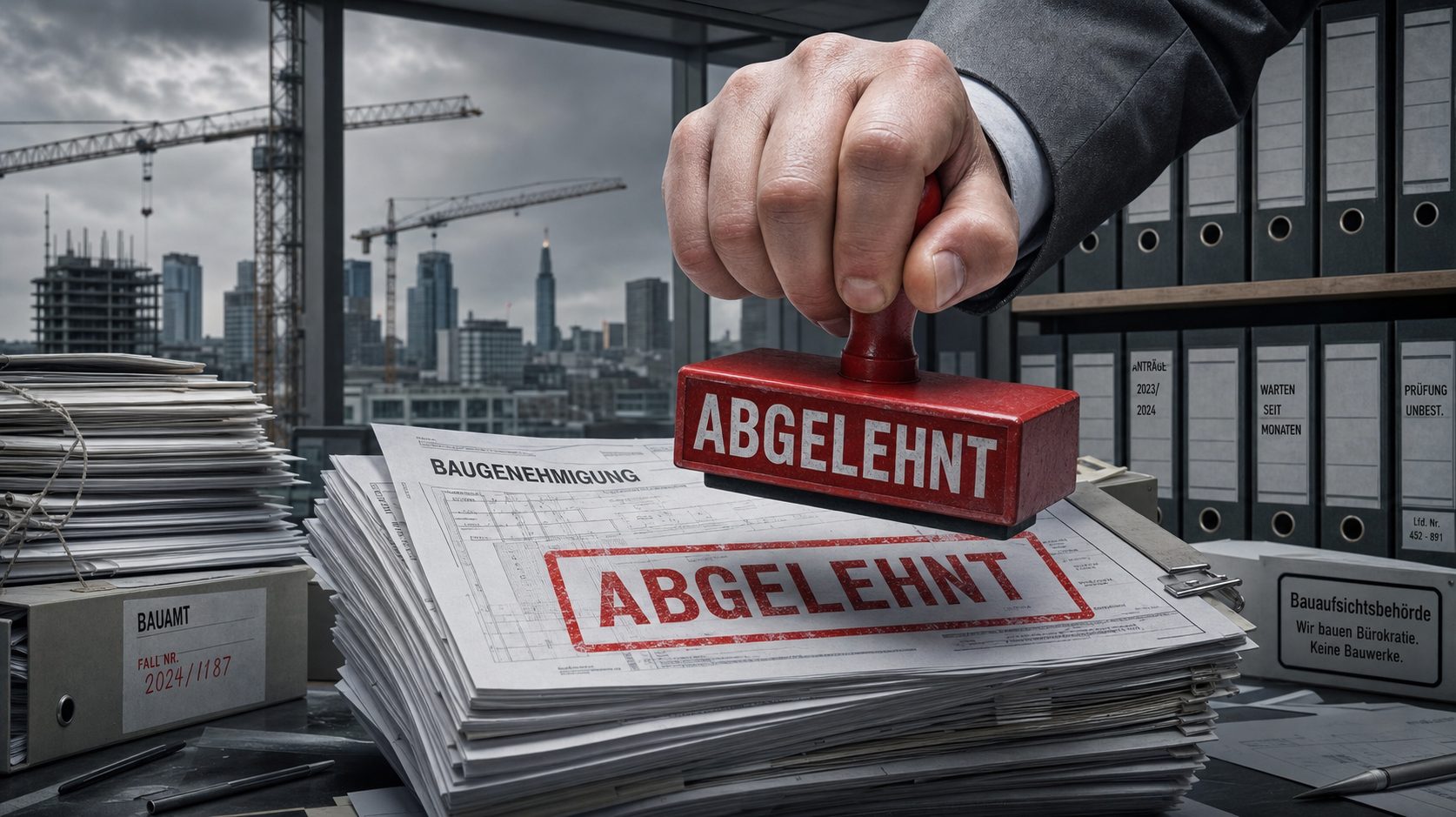
Damning verdict from top managers: How Germany's building authorities are blocking the economic recovery – Home office as a toxic obstacle – Image: Xpert.Digital
Bureaucratic madness at the building authority: Why the state is sabotaging the solution to the housing crisis
Working from home and mountains of paperwork: The bitter truth about Germany's construction crisis in 2026
"Obsters instead of enablers": 550 executives expose the systemic failure of the authorities
The German construction industry is mired in a deep structural crisis – and the state is largely to blame. This damning verdict comes from the latest "United Interim Economic Report 2026," which surveyed over 550 experienced interim managers. The result is a stark warning signal for both politicians and business leaders: a staggering 83 percent of the top executives surveyed perceive German building authorities primarily as "construction blockers." A lack of digitalization, a deficient service culture, federal jurisdictional squabbles, and, paradoxically, even the widespread implementation of working from home in government offices are acting as toxic brakes on the entire sector. Against the backdrop of a dramatic housing shortage and skyrocketing construction costs, the following report analyzes the systemic causes of this bureaucratic chaos. It unflinchingly reveals why, without radical reforms, uniform standards, and a completely new understanding of public administration, not only economic growth but also, increasingly, social cohesion in the country is at risk.
Germany's building authority crisis 2026
Bureaucracy instead of building permits: Why the state is getting in its own way
When experienced executives who have worked in dozens of companies and projects unanimously complain about one thing, it deserves special attention. This is precisely the conclusion of the United Interim Economic Report 2026, compiled by the management community United Interim (www.unitedinterim.com) based on a survey of over 550 interim managers. The verdict is damning: Germany's building authorities are considered one of the most significant obstacles to the country's economic growth. The following report analyzes the economic connections, examines the systemic causes, and places the findings within the broader economic context.
The construction complex as the economic backbone
Anyone who dismisses Germany's construction sector as a mere sub-sector overlooks its strategic importance to the overall economy. Construction investment accounts for roughly 13 percent of the gross domestic product, and with approximately 2.6 million direct employees, the sector is one of the country's largest employers. In terms of its economic leverage, the construction industry is quite comparable to the much-cited automotive industry: downturns in this sector have a rapid and immediate impact on suppliers, tradespeople, the materials industry, and service providers. In 2022, the construction industry contributed 5.7 percent to gross value added—a figure that underscores its central role in the economic structure.
The crisis that has unfolded in the German housing sector since 2022 clearly illustrates the painful nature of this dependence. In 2024, construction investment fell by 3.5 percent in real terms, and gross value added in the construction sector declined disproportionately by 3.8 percent—significantly more than the already weak overall economic growth. This marked the fourth consecutive year of decline. New residential construction is suffering particularly badly: its volume is expected to remain around 25 percent below the record level of 2021 even in 2026. What was once an engine of growth has become a structural burden on the gross domestic product.
What 550 interim managers diagnose
Interim managers occupy a unique observer role: They regularly move between industries, company sizes, and problem areas without falling into the trap of being stuck in the office. Their judgment is based on the sum of countless project experiences—and this is precisely why the survey on which the United Interim Business Report 2026 is based carries particular weight. In Germany, the interim management market has stabilized at a volume of approximately €2.7 billion, with around 12,500 active interim managers and an average daily rate of €1,317. In management theory, interim managers are considered the "premier league" of leadership because, unlike consultants, they not only develop concepts but also implement them within the company themselves—and are thus directly confronted with the consequences of their recommendations.
The picture painted by this experienced leadership elite of German building authorities is bleak. Three-quarters of the interim managers surveyed consider these authorities to be one of the biggest obstacles to Germany's economic growth. The assessment of the authorities' fundamental attitude is even more striking: a full 83 percent classify them as "more of a hindrance to construction than a promoter of it." This is no longer a fringe phenomenon, but a clear majority opinion among managers who work daily in the real world of business. The report itself speaks of a "catastrophic situation"—a term rarely found in serious economic analyses, and therefore all the more alarming.
Digitalization: Plans and reality diverge
It has been known for years that German authorities are lagging behind in digitalization. However, the discrepancy between aspiration and reality is particularly pronounced in the building authorities. 79 percent of the interim managers surveyed believe that, despite some progress, building authorities are still far too insufficiently digitized. Despite the Online Access Act, the construction and housing sector remains far from comprehensive digitalization. While the platform for digital building permits is being used increasingly—nearly 45,000 applications were submitted in the past twelve months—progress varies considerably from region to region and is often sporadic.
There are some bright spots: In some municipalities, processing times after successful digitization have dropped from six to twelve months to two to five months. In spring 2026, several municipalities, including Nordhorn and the Vogelsberg district, completely switched their systems to digital building permit processing. The EfA system for digital building permits, jointly operated by 13 federal states, is gaining traction. Nevertheless, it remains true that not all of the 943 building authorities in Germany are fully digitally connected. The heterogeneity of German federalism, which is actually intended to foster innovation, is proving to be a structural obstacle here: Each authority develops its own pace, its own systems, and its own standards.
The Federal Ministry for Housing, Urban Development and Building (BMSB) is relying on Building Information Modeling (BIM) as a key technology for planning and approval processes. However, even well-intentioned initiatives at the federal level are encountering the limitations of federal implementation. The complete end-to-end digitization of planning and approval processes, which the BMWSB itself describes as a crucial lever for increasing efficiency, remains a distant prospect in large parts of the country. Yet, in the current situation, time is of the essence: For every month a building application remains pending, developers incur real interest costs on tied-up capital—a silent but significant economic loss.
Lack of service culture: A structural problem of German administrative law
Besides the lack of digitalization, the most frequently criticized structural problem is the lack of service orientation. 78 percent of the surveyed managers cite the "lack of service orientation" in building authorities as a central problem. This criticism touches a cultural core: German administrative law is traditionally designed for control and legal certainty, not for service orientation towards the applicant. Building authorities primarily act as review bodies, not as enablers. This fundamental attitude is anchored in legal logic: Officials who make a mistake are personally liable—a powerful incentive for excessive caution and an extensive interpretation of regulations. That this mechanism comes at the expense of construction speed is a well-known, but largely unresolved, systemic issue.
Sixty-four percent of the managers surveyed also rated the authorities as "paralyzed by bureaucracy and turf wars." This points to another structural phenomenon: Complex construction projects often involve several authorities—building authority, historic preservation office, environmental agency, fire department, and sometimes even nature conservation authority. Coordination between these agencies rarely runs smoothly. A lack of clear responsibilities leads to lengthy rounds of approvals, inquiries are passed between authorities, and the applicant waits. The result: Processing times that would be unthinkable in particularly bureaucratic countries like the Netherlands or Denmark are the norm in Germany.
Furthermore, 52 percent of those surveyed criticize the lack of standardization between building authorities. While digital building applications are already standard practice in some municipalities, others still require multiple copies of paper documents. Even for identical construction projects, requirements, processing times, and the interpretation of regulations sometimes differ considerably between municipalities. This lack of harmonization is no accident, but rather the direct result of an administrative structure in which building law is a matter for the individual states, and the 16 federal states maintain different state building codes with sometimes significantly differing details. For project developers and building owners operating in multiple federal states, this means constant additional work and planning uncertainty.
Staff shortages and working from home: The double paralysis
At least a third of the surveyed executives—32 percent—acknowledge that some of the problems faced by building authorities can be explained by staff shortages. This assessment is statistically well-founded: Germany's public sector will be short more than 765,000 skilled workers by 2025, and this gap is expected to grow to one million by 2030. Building authorities are particularly affected by this trend, as they require technical specialists—civil engineers, architects, planning specialists—who are significantly better paid on the private job market than in the public sector. Vacancy periods for positions in the construction industry are already among the longest in the entire German labor market.
In addition to structural staff shortages, a relatively new problem has emerged: the expansion of working from home in public administration. From the perspective of many involved in construction projects, official work-from-home arrangements have proven to be a significant obstacle—not only because it's nearly impossible to find anyone on-site, but also because telephone accessibility has drastically decreased. Those working from home don't want to make work-related calls for personal reasons, and government phone lines are simply no longer answered at home. For the construction industry, where time-critical inquiries and short-notice coordination are part of daily business, this represents a real cost factor. Being unable to reach a case worker can mean a project is delayed by weeks and financing costs skyrocket. Here, the well-intentioned work-life balance policies of the public sector reveal an unintended side effect with concrete economic consequences.
Our EU and German expertise in business development, sales and marketing

Our EU and German expertise in business development, sales and marketing - Image: Xpert.Digital
Industry focus areas: B2B, digitalization (from AI to XR), mechanical engineering, logistics, renewable energies and industry
More information here:
A thematic hub offering insights and expertise:
- Knowledge platform covering global and regional economies, innovation and industry-specific trends
- A collection of analyses, insights, and background information from our key areas of focus
- A place for expertise and information on current developments in business and technology
- A hub for companies seeking information on markets, digitalization, and industry innovations
Construction costs, skilled workers, bureaucracy: The four key issues against the housing shortage
The housing shortage as a societal escalation
The economic dysfunctions of building authorities would be problematic in themselves. However, against the backdrop of a worsening housing shortage, they take on a social significance that far transcends purely economic considerations. The Federal Statistical Office confirmed in May 2026 that 11.7 percent of the population in Germany lived in overcrowded housing in 2025. This figure has risen steadily over the past five years—in 2020 it was 10.2 percent. The situation is particularly dire for specific social groups: the overcrowding rate is 30.8 percent for adults with foreign citizenship, 19 percent for minors, and 27.4 percent for people at risk of poverty.
The Pestel Institute estimates the nationwide housing shortage at around 1.4 million units. The Social Housing Monitor 2026 speaks of a record deficit, almost exclusively in the affordable and social housing segment. New construction completions fall far short of meeting this demand: in 2024, only 251,900 housing units were completed nationwide—and similarly low figures are expected for 2025. The GdW association, which represents socially oriented housing companies, alone reported a decline of around 40 percent in the number of completed apartments in 2025 compared to the previous year.
The discrepancy between demand and completion is structural: The German government's target of 400,000 new apartments per year has remained unmet for years and will continue to do so in the medium term. Even the modest glimmer of hope in rising permit figures—a total of 238,500 apartments were approved in 2025, an increase of 10.8 percent compared to the previous year—does not automatically translate into completions. In Germany, two to three years typically pass between permit approval and handover of the keys, during which time financing conditions, raw material prices, and labor market situations can change again. The construction industry itself expects a further decline in completion figures to around 215,000 units in 2026.
The construction cost problem: When the math no longer adds up
To be fair, it must be stated that building authorities are not the only, and in some respects not even the most significant, factor in Germany's construction woes. An honest economic analysis must consider the entire range of conditions. Since 2019, construction prices in Germany have risen by a good 40 percent, while consumer prices overall have increased by only 21.4 percent. The costs for construction work on new buildings have risen even more sharply since 2019, by 45.7 percent, and those for finishing work by almost 50 percent. In May 2025, prices for the construction of conventionally built residential buildings were 3.2 percent higher than in the same month of the previous year—a further increase in an industry already under extreme cost pressure.
Added to this are the financing costs: The sharp rise in interest rates since 2022 has fundamentally altered the profitability calculations of many construction projects. Projects that appeared profitable at an interest rate of one percent are no longer viable at four or five percent. The German Institute for Economic Research (DIW Berlin) has calculated that the price-adjusted construction volume declined by 3.7 percent in 2024—the fourth consecutive year of decline. While a slight recovery is emerging for 2026, even in the most optimistic scenario, the construction volume remains significantly below the peak levels of 2021.
The shortage of skilled workers in the construction industry itself is also a serious limiting factor. In March 2026, around 369,400 STEM (science, technology, engineering, and mathematics) jobs were vacant nationwide, and construction trades, with a skills gap of 26,400 people, were among the three largest bottlenecks in the STEM field. While the overall STEM skills gap decreased compared to the previous year, it actually increased by 900 people in the construction trades. In July 2025, 28.3 percent of companies in the main construction sector reported a shortage of skilled workers—a figure that continued to rise despite the weak economy. Stricter energy efficiency regulations and an excessive density of regulations complete the picture of a sector groaning under the weight of too many simultaneously occurring stressors.
The authorities as an obstacle: A systemic failure
And yet, all these external factors do not absolve public administration of its responsibility. Especially in a phase where private investors are already under pressure due to high costs and interest rates, permitting authorities have a particular task. They could act as enablers—through fast processing times, clear requirements, and a proactive approach to advising applicants. The fact that, instead, 83 percent of the surveyed executives perceive these authorities as "construction blockers" is not just a management problem, but a failure of the democratic understanding of the constitution: An authority that is supposed to serve the common good is actively preventing what the common good urgently needs.
Legislative responses are hesitant, but they do exist. In October 2025, the Federal Council approved a simplification of building permit procedures: Instead of five years for a zoning plan process, municipalities will be able to approve a construction project within three months. This temporary regulation is valid until the end of 2030. However, its effectiveness in practice depends crucially on the willingness of local authorities to implement it—and this is precisely where the cultural and structural obstacles described above lie. A law that theoretically allows for approval in three months is of little use if the responsible clerk is unreachable while working from home.
The AI-supported processing of building permit applications, which the Federal Ministry for Digital Affairs began promoting in April 2026 with free open-source modules, could provide relief in the medium term. This software automatically extracts information from application documents and checks them for formal completeness. This could at least accelerate the initial sorting – however, the real challenge, the substantive review by trained professionals, remains a human task and thus dependent on sufficient and available personnel.
Need for reform: What a systemic solution requires
The diagnosis is clear, and so is the need for action. A systemic solution would have to address several levels simultaneously. First, Germany needs a nationwide, binding standardization of building permit application procedures—not as a voluntary recommendation, but as a legal obligation. The federalism debate must not serve as a shield to leave local inefficiencies untouched. Second, the personnel capacities of building authorities must be substantially expanded, which, given the general shortage of skilled workers in the public sector, can only be achieved through higher pay, better working conditions, and easier entry opportunities for career changers.
Thirdly, a fundamental reorientation of bureaucratic culture is needed: from obstruction to enabling, from control to support. This is not a call to lower quality and safety standards. It is about administering the same legal framework with a different fundamental attitude—proactively, service-oriented, and with the awareness that every unnecessarily delayed building permit application generates real social and economic costs. Countries like Denmark demonstrate that digitally compatible laws and a service-oriented administration are possible even in a constitutional state. Their approach to digitalization—first reforming processes, then digitalizing, not the other way around—would be an instructive model for Germany.
Fourthly, and finally, the lessons of the interim management approach should be applied to public administration. Interim managers are employed because they can transform processes in a very short time, drawing on their external perspective and extensive experience. There is no fundamental reason why such approaches could not also be used temporarily in public authorities—as catalysts for transformation, breaking down entrenched structures, implementing digital solutions, and initiating cultural change. The fact that the very experts who regularly and successfully implement such transformations in the private sector are now publicly pointing out the structural deficiencies of building authorities is not just criticism—it is also an implicit offer.
Looking ahead: Fragile recovery subject to structural reservations
The outlook for 2026 is mixed. After hitting a historic low in 2024, building permit figures show a cautious recovery: a total of 238,500 apartments were approved in 2025, 10.8 percent more than the previous year. In November 2025, permits rose by 12.5 percent year-on-year. The DIW (German Institute for Economic Research) forecasts price-adjusted construction volume growth of two percent for 2026—modest, but at least a trend reversal after four years of decline. Interest rates have also fallen slightly, improving the financing of projects.
This recovery, however, is built on shaky foundations as long as the structural problems remain unresolved. Even if more housing permits are issued in 2026, these permits must translate into actual projects—and that is far from guaranteed. The construction industry continues to lament a lack of orders in the housing sector, and many companies are hesitant to invest as long as costs, interest rates, and bureaucratic hurdles jeopardize their calculations. The housing shortage will therefore worsen further in 2026 before any lasting relief can be achieved. The 1.4 million missing homes will not be built in a single year—but every year that passes without seriously addressing the structural barriers prolongs the social crisis for millions of people.
The United Interim Economic Report 2026 makes a valuable contribution to the public debate: It compiles the experiences of over 550 highly qualified executives and gives these experiences statistical weight. When three-quarters of these experts classify building authorities as a drag on economic growth and 83 percent perceive them as obstacles rather than enablers, this is not an isolated opinion, but a robust societal finding. Anyone who takes this finding seriously in the political arena must act—with consistency, resources, and the courage to fundamentally reform entrenched administrative structures.





