
Get out of the US cloud: Sovereign SaaS offers at overview + recommendations for action
Xpert pre-release

Language selection 📢
Published on: April 19, 2025 / update from: April 19, 2025 - Author: Konrad Wolfenstein

Get out of the US cloud: Overview of sovereign SaaS offers-Image: Xpert.digital
How the cloud act undermines trust in US technology (reading time: 43 min / no advertising / no paywall)
The need for digital sovereignty for European companies
The digital transformation is progressing unstoppable, and cloud computing, especially software-as-a-service (SaaS), has become an indispensable tool for companies of all sizes. It enables flexibility, scalability and access to innovative technologies. At the same time, this development has led to a significant dependence on a few, mostly US cloud providers.
Suitable for:

Problem: growing dependence on US cloud providers
The European cloud market is clearly dominated by the big US hyperscalers: Amazon Web Services (AWS), Microsoft Azure and Google Cloud Platform (GCP). These providers combine a large part of the global market share. Even leading European providers such as SAP or Deutsche Telekom in Europe only achieve small market shares in Europe. This concentration poses an inherent danger: a large part of the global and in particular the European cloud infrastructure is potentially subject to the jurisdiction of US laws. In European companies and increasingly also in public administrations, awareness of the risks associated with this dependency are growing. Causes regarding data protection, data security and the loss of control over critical data and processes are in the foreground. The question of digital sovereignty becomes a strategic necessity.
Relevance of data sovereignty and GDPR conformity
The General Data Protection Regulation (GDPR) is at the center of European concerns. Since 2018 it has been the strict legal framework for the protection of personal data in the European Union and regulates its processing and transmission in detail, especially in countries outside the EU. Compliance with the GDPR is not only a legal obligation for European companies, but also an important factor for the trust of customers and business partners. At the same time, the concept of digital sovereignty is gaining in importance. It describes the endeavors of Europe to regain or keep control of your own data, technologies and digital infrastructures. This is not only a question of data protection, but also an industrial policy goal to strengthen the European economy and competitiveness in a globalized digital world. For companies, this means the need to rethink cloud strategies and proactively search for solutions that are both legally compliant and trustworthy and ensure their own ability to act.
Suitable for:
Objective and structure of the report
This report is aimed at European business and IT decision-makers who are faced with the challenge of developing a future-proof and risk-conscious cloud strategy. He pursues the goal of creating a well -founded basis for decision by:
- The specific risks analyzed that arise from the use of US-based SaaS services for European companies, especially with regard to the conflict between GDPR and US laws such as the cloud act and FISA 702.
- Defines what is to be understood under “sovereign SaaS offers” in a European context and which criteria they have to meet.
- A market overview of European SaaS providers, which position themselves as sovereign alternatives, categorizes according to application areas.
- A comparison of important alternatives in key categories with regard to functions, pricing and, above all, the implementation of data sovereignty and GDPR conformity.
- Specialized solutions for sensitive sectors such as public administration, healthcare and finance.
- Present relevant EU initiatives (such as Gaia-X) and certifications (such as Eucs, BSI C5) that promote cloud sovereignty.
- A conclusion and recommendations for action for the strategic orientation of companies derives.
Risk analysis: US cloud services and the challenges for European companies
The use of cloud services, especially SaaS offers, from providers based in the United States, presents European companies with considerable legal and operational challenges. These result primarily from the fundamental conflict between the strict European data protection regulations and far-reaching US surveillance and data access laws.
The core conflict: GDPR vs. US monitoring laws
The General Data Protection Regulation (GDPR) forms the foundation of European data protection. It establishes high standards for the processing of personal data from EU citizens. Article 44 ff. GDPR that regulate the transmission of such data into third-country countries (countries outside the EU/EEA) are particularly relevant for cloud use. Such a transmission is only permitted if there is an “reasonable level of protection” in the third country (determined by an adequacy decision of the EU Commission) or if “suitable guarantees” (such as standard contract clauses or binding corporate rules) are available and enforceable rights and effective legal remedies are available for those affected. In addition, Article 48 GDPR explicitly prohibits the transmission of data to authorities of a third country due to their decisions or judgments if there is no international agreement, such as a legal assistance agreement. Several US laws are opposed to this European protection claim that grant US authorities far-reaching access rights to data, even if they are stored outside of the United States:
- The US Cloud Act (Clarifying LawFul Overseas Use of Data Act): This 2018, which is adopted in 2018, authorizes US criminal prosecution authorities and intelligence services to request the publication of data that are under their control-regardless of where this data is stored in the world. This explicitly includes data that is located in data centers within the European Union. The cloud act thus undermines the territoriality principle of data protection and is in direct contradiction to the requirements of the GDPR, in particular Article 48. It was created, among other things, in response to a lengthy legal dispute between Microsoft and the US government about access to emails stored in Ireland, and modernized older access regulations from September 2001, Like the Patriot Act. The cloud act mechanisms, according to which a provider can contest a issuing arrangement, if it violates the law of another state (such as the GDPR), but the practical effectiveness of these mechanisms, especially in the area of national security, is highly controversial and does not offer a reliable guarantee for European companies. Providers are therefore in conflict: If they follow a cloud act arrangement without an EU legal basis, risk massive GDPR; If you refuse to publish, citing the GDPR, threaten sanctions under US law.
- FISA Section 702 (Foreign Intelligence Surveillance Act): This provision, part of the FISA Amendments Act from 2008, allows US intelligence services such as the NSA, the targeted monitoring of electronic communication of non-US people who are outside the United States. The monitoring takes place to obtain “Foreign Intelligence Information”. FISA 702 obliges US providers of electronic communication services (Electronic Communication Service Providers-ECSPS), which include many large cloud and SaaS providers, to cooperate with the authorities. The scope of the potentially recorded data is very wide and, in addition to metadata, can also include communication content, even from uninvolved third parties who only mention one target person. The monitoring programs under FISA 702 (such as Prism and Upstream) were a central point of criticism in the Schrems II judgment of the ECJ (see below). The lack of effective legal remedies for affected EU citizens and the potential for mass surveillance are also criticized, even if US authorities deny this.
- Executive Order 12333 and others: In addition to Cloud Act and FISA 702, there are other legal bases, such as the Executive Order 12333, which grant the US intelligence services far-reaching powers for surveillance abroad, often without judicial control or specific legal restrictions on non-IPs.
This fundamental legal conflict creates a situation in which the use of cloud services from US providers for European companies carries inherent risks.
Concrete risks for European companies
The described legal conflict results in tangible risks for European companies that use US-based Saas services:
- Data protection violations & fines: The surrender of personal data to US authorities based on Cloud Act or FISA 702, without a valid legal basis under EU law (e.g. a legal assistance agreement), is a clear violation of the GDPR, in particular against Article 48. This can lead to sensitive fines of up to 4% of the global annual expenses, as well as to civil law claims of those affected. The use of a US cloud service alone cannot be rated as potentially not GDPR-compliant if the provider cannot guarantee that he does not publish data while violating the GDPR.
- Loss of data sovereignty & control: contractual assurance of US providers to only store data in EU data centers, do not offer effective protection against US access under the cloud act or FISA. US laws can undermine these assurances and also technical protective measures. Even encryption of the data is not a panacea if the US provider has control over the encryption keys because it could be forced to disclose them. Likewise, access control mechanisms can be avoided and audit protocols can be viewed without the knowledge of the data owner, which violates the transparency requirements of the GDPR. In fact, European companies in fact lose control of which circumstances accesses their data.
- Economic espionage & loss of business secrets: A particularly serious risk is the potential drainage of sensitive company data. This includes intellectual property, research and development data, prototypes, strategic plans, financial data or confidential customer data and communications. The concern that US authorities could also use their access rights for economic purposes (business espionage) is an essential driver for European companies to search for alternatives or to take additional protective measures. The loss of such information can lead to considerable financial losses, reputation damage and the loss of competitive advantages.
- Legal uncertainty & loss of trust: The unresolved conflict between European data protection law and US access rights creates considerable legal uncertainty for companies that use US services. This uncertainty complicates long-term planning and compliance efforts. In addition, the continued use of services in which data protection cannot be guaranteed can significantly undermine the trust of customers, employees and business partners.
- Geopolitical risks: Laws such as the cloud act are seen in the context of global trends towards increased state surveillance and a possible fragmentation of the Internet (“Splinternet”). Comparisons to similar laws in other countries such as China's National Intelligence Law are drawn. Excessive dependence on technology providers from a single non -European region also harbors strategic risks for the digital autonomy and resilience of Europe.
The risks of US cloud use thus go far beyond potential GDPR penalties. They include the loss of critical business data, reputation damage and the endangerment of competitiveness due to possible abuse of access rights for business espionage. These often difficult quantifiable, but potentially existential “collateral” risks are slightly underestimated on a pure focus on GDPR compliance.
The Schrems II decision and the Data Privacy Framework (DPF)
The legal uncertainty in transatlantic data traffic was massively tightened by the Schrems II judgment of the European Court of Justice (ECJ) in July 2020. The ECJ declared the then applicable EU Privacy Shield Agreement invalid. The reason: The US surveillance laws, in particular FISA 702 and the associated programs, allow interference in the fundamental rights of EU citizens (data protection, privacy), which are not limited to the mandatory level and do not offer equivalent protection as in the EU. In addition, there is a lack of effective legal remedies for those affected in the United States against such surveillance measures. The judgment confirmed the fundamental validity of standard contract clauses (Standard Contractual Clauses - SCCS) as an alternative instrument for data transfers. However, the ECJ made it clear that data exporters are not allowed to rely blindly on SCCs. As part of an individual case test (transfer impact assessment - TIA), you must check whether the right and practice in the target country (here the USA) ensure protection that is "essentially equal" in the EU. If this is not the case due to surveillance laws - which the ECJ suggested to the USA - additional measures (supplementary measures) must be taken (e.g. strong encryption in which the recipient has no access to the keys) to ensure protection. If this is not possible, the data transfer must be suspended. In this context, the cloud act was seen as a factor that further undermines the argument for equivalence in the level of protection. In response to the legal uncertainty caused by Schrems II and to put the flow of data between the EU and the United States on a solid basis, the EU Commission and the US government agreed on the EU-US Data Privacy Framework (DPF). This entered into force in July 2023 by a new appropriateness of the EU Commission. The DPF is intended to address the concerns expressed in the Schrems II judgment by providing additional protective measures on the US side: access through US intelligence services to data from EU citizens should be limited to the necessary and proportionate level, and a new, two-stage legal remedy (including the Data Protection Review-DPRC) was created for EU citizens. Companies in the USA can be certified for the DPF, and data transfers from the EU to these certified companies are then considered permissible without additional instruments such as SCCs or other measures. However, there are still considerable doubts and risks regarding the stability and effectiveness of the DPF:
- Basic US laws remain: The Cloud Act and FISA 702 have not been changed by the DPF. The basic powers of the US authorities for data access continue.
- Doubts about the ECJ strength: Many data protection experts and activists doubt that the protective measures provided for in the DPF and the new legal remedy mechanism would withstand a new review by the ECJ. In particular, the independence and assertiveness of the DPRC is questioned.
- Continuous monitoring required: According to Art. 45 Para. 4 GDPR, the EU Commission is obliged to continuously monitor developments in the USA and to regularly check the appropriateness. The first review took place in the summer of 2024. Recent developments, such as the extension and potential expansion of FISA 702, could endanger the basis of the DPF again.
- Risk for companies: Companies that rely exclusively on the DPF take a not inconsiderable risk. If the ECJ also invalidates the DPF in the future (a “Schrems III” scenario), data transfers on this basis would be unlawful again on this basis. Companies that then do not have a “plan B” (e.g. switch to EU providers or implementation of effective additional measures) cannot count on withdrawal.
The core conflict between US law on extensive data access and the EU's fundamental right to data protection remains under the DPF. The US laws that cause the problem are still in force. The DPF is more of a political and possibly temporary bridging than a final legal solution. The basic problem of potentially GDPR access by US authorities to data from European citizens and companies is not cleared.
Definition and criteria: What does “sovereign SaaS” mean?
In view of the risks described, European companies are increasingly looking for alternatives that offer them more control, security and legal conformity. In this context, the concept of “sovereign cloud” or “confident SaaS” often falls. But what exactly hides behind it, and which criteria does an offer have to meet in order to be considered sovereign in the European context?
Core elements of sovereignty in the cloud context
Digital sovereignty in the cloud environment is a complex concept that goes beyond the pure technical provision of services. It can be grasped using several core elements:
- Data sovereignty (Data Soverabnty): This is the central principle. It says that data is subject to the laws and regulations of the jurisdiction in which they are or have been raised. For Europe, this means above all the unrestricted validity of the EU data protection law (in particular the GDPR) and protection against access by authorities from third countries based on extraterritorial laws such as the US Cloud Act. The customer keeps full control over which conditions can access his data.
- Data residence and data localization:
- Data residence means that customer data (including metadata and backups) are guaranteed within a defined geographical region, typically of the EU or the EEA. This is a necessary prerequisite for data sovereignty in the EU context, but in itself not sufficient if the provider is subject to non-European laws.
- Data localization is a stricter requirement that stipulates that data is not allowed to leave the limits of a specific country. Such laws are rare within the EU, but can be relevant for specific national regulations or sectors.
- Operational sovereignty (operational sovereignty): This element refers to control over the operation of the cloud infrastructure and the services on it. Important aspects are:
- Operation through EU personnel and EU legal persons: It must be ensured that the personnel, the physical or logical access to the cloud environment and the customer data, has resident in the EU and is subject to EU law. Access from outside the EU must be prevented technically and organizationally or strictly controlled.
- EU corporate seat and structure: The cloud provider himself or at least the legal person responsible for the company in the EU should have their headquarters in an EU/EEA state and thus primarily subordinate to European law. It is also crucial that there are no dependencies on parent companies or branches in third countries (especially the United States), which could enforce a submission under their laws (such as Cloud Act or FISA).
- Transparency and auditability: Customers need transparency via the operating processes, the subcontractors used and the implemented security measures. The possibility of independent review and auditing of access and processes is an important characteristic of operational sovereignty.
- Technological sovereignty (Technological Sovergnty): This refers to the ability to understand, control, validate and ideally develop the underlying key technologies themselves. Aspects of this are:
- Use of open standards and open source software: Open standards and source-open software promote the interoperability between different providers and solutions, increase transparency (since the code can be checked), reduce the risk of a vendor lock-in and facilitate security audits. They often form the basis for European technology stacks such as the SOVEIGN Cloud Stack (SCS).
- Interoperability and portability: the ability to easily migrate data and applications between different cloud providers or back into your own infrastructure (on-premise) is a sign of independence and flexibility.
- Control over the technology stack: In the long term, technological sovereignty aims at reducing the dependence on proprietary hardware and software components from non-European sources and building their own European skills.
Suitable for:

Differentiation and misunderstandings
The term “confident cloud” is not legally protected and is often used by various providers as a marketing tool, whereby the underlying concepts and measures can vary greatly. It is therefore crucial for companies to check exactly what a provider means by sovereignty and what specific guarantees it offers. A common misunderstanding is that the storage of data in a data center within the EU is sufficient to ensure sovereignty. However, this is not the case. As explained in Section II, the US Cloud Act enables access to data from US companies regardless of the location. Data residence in the EU does not protect US access if the provider itself or his parent company is US or otherwise subject to the US Jurisdiction. Another prejudice states that sovereign cloud offers inevitably mean functional restrictions or a slower innovation speed compared to the global hyperscalers. While this may apply in some cases, since local providers often do not have the same scale effects and research budgets, the goal is not primarily the restriction, but the combination of the advantages of cloud computing (flexibility, scalability) with the requirements for control, security and compliance. Many European providers rely on open technologies to enable innovation and adaptability.
Criteria for sovereign SaaS providers from an EU perspective
Based on the core elements of sovereignty, concrete criteria can be derived from which European companies can evaluate SaaS providers:
- Data protection & compliance: The provider has been shown to meet the requirements of the GDPR. This should be documented by an order processing contract (AVV) in accordance with Art. 28 GDPR and suitable technical-organizational measures (TOMS). Compliance with further relevant EU and national regulations (e.g. for specific sectors) must be guaranteed.
- Data location & processing: It must be contractually guaranteed that all customer data, including metadata, configuration data and backups, are only saved and processed within the EU or the EEA.
- Operation & access control: The operation of the services and access to customer data must be carried out by personnel that is based in the EU and belongs to an EU legal personality. Strict technical and organizational measures must be implemented to prevent unauthorized access, especially from outside the EU.
- Company structure & jurisdiction: The provider should have its headquarters and its relevant legal control in the EU/EEA. There must be no social law interference or branch in third countries (especially the United States), which brings the provider under their jurisdiction and could potentially force data to surrender (e.g. by cloud act or fisa).
- Transparency: The provider should provide transparent information about its operating processes, the use of subcontractors, the locations of data processing and the implemented security measures. The possibility of auditing by the customer or independent third parties should be given.
- Technology & Interoperability: The preferred use of open standards (e.g. APIS) and/or Open Source Software facilitates integration, testing and potential change to other providers (avoidance of Vendor Lock-in).
- Certifications & tests: Recognized certifications and tests can serve as proof of compliance with security and compliance standards and create trust. ISO 27001, BSI C5 (in Germany) and the EUCs in the future are particularly relevant.
It becomes clear that digital sovereignty in the SaaS context is a multi-dimensional concept. It is not just about where data is stored, but also about who processes it, which law is subject to the provider and what technological basics are used. When choosing a provider, companies must therefore check which dimensions of sovereignty are priority for them and how well the provider meets these specific requirements. A pure data residence in the EU is often not sufficient to effectively mitigate the risks, especially through US laws. At the same time, companies are often faced with a area of tension: the desire for maximum sovereignty and control must be weighed up against potential disadvantages at functions, innovation speed or costs that can occur in some European or strictly sovereign providers compared to global hyperscalers. The use of open source software is seen by many European providers as a strategic way to ensure transparency, trust and adaptability, even if they may not be at the forefront of any latest technology development.
🎯🎯🎯 Benefit from Xpert.Digital's extensive, fivefold expertise in a comprehensive service package | R&D, XR, PR & SEM

AI & XR 3D Rendering Machine: Fivefold expertise from Xpert.Digital in a comprehensive service package, R&D XR, PR & SEM - Image: Xpert.Digital
Xpert.Digital has in-depth knowledge of various industries. This allows us to develop tailor-made strategies that are tailored precisely to the requirements and challenges of your specific market segment. By continually analyzing market trends and following industry developments, we can act with foresight and offer innovative solutions. Through the combination of experience and knowledge, we generate added value and give our customers a decisive competitive advantage.
More about it here:
Digital sovereignty: The best European SaaS alternatives at an overview
Market overview: Sovereign SaaS alternatives from the EU
The European Software-As-A-Service (SaaS) market offers a growing number of providers who position themselves as alternatives to dominant US players. Many of them put a special focus on data protection, GDPR conformity and digital sovereignty in order to meet the specific requirements of European companies and organizations.
Criteria for the selection of providers
The following overview focuses on SaaS providers that meet the following criteria:
- Origin: The company is headquartered in a member state of the European Union (EU), the European Economic Area (EEA) or Switzerland (CH), since Switzerland has an adequacy decision of the EU Commission and is often closely integrated into the European Economic Area.
- Positioning: The provider explicitly positions itself as a sovereign or data protection-compliant alternative or has essential features of digital sovereignty (e.g. exclusive hosting in the EU/EEA, demonstrable GDPR conformity, no submission under US laws such as cloud act/fisa, use of open source).
- Relevance: The provider was mentioned in the underlying research sources or is known as a relevant alternative in its category.
The providers are grouped for better clarity according to common SaaS categories.
Categorized overview of European SaaS providers
The following table provides an overview of selected European SaaS providers, in order according to functional areas. It serves as the starting point for a more detailed assessment.
Overview of European SAAS providers by categories
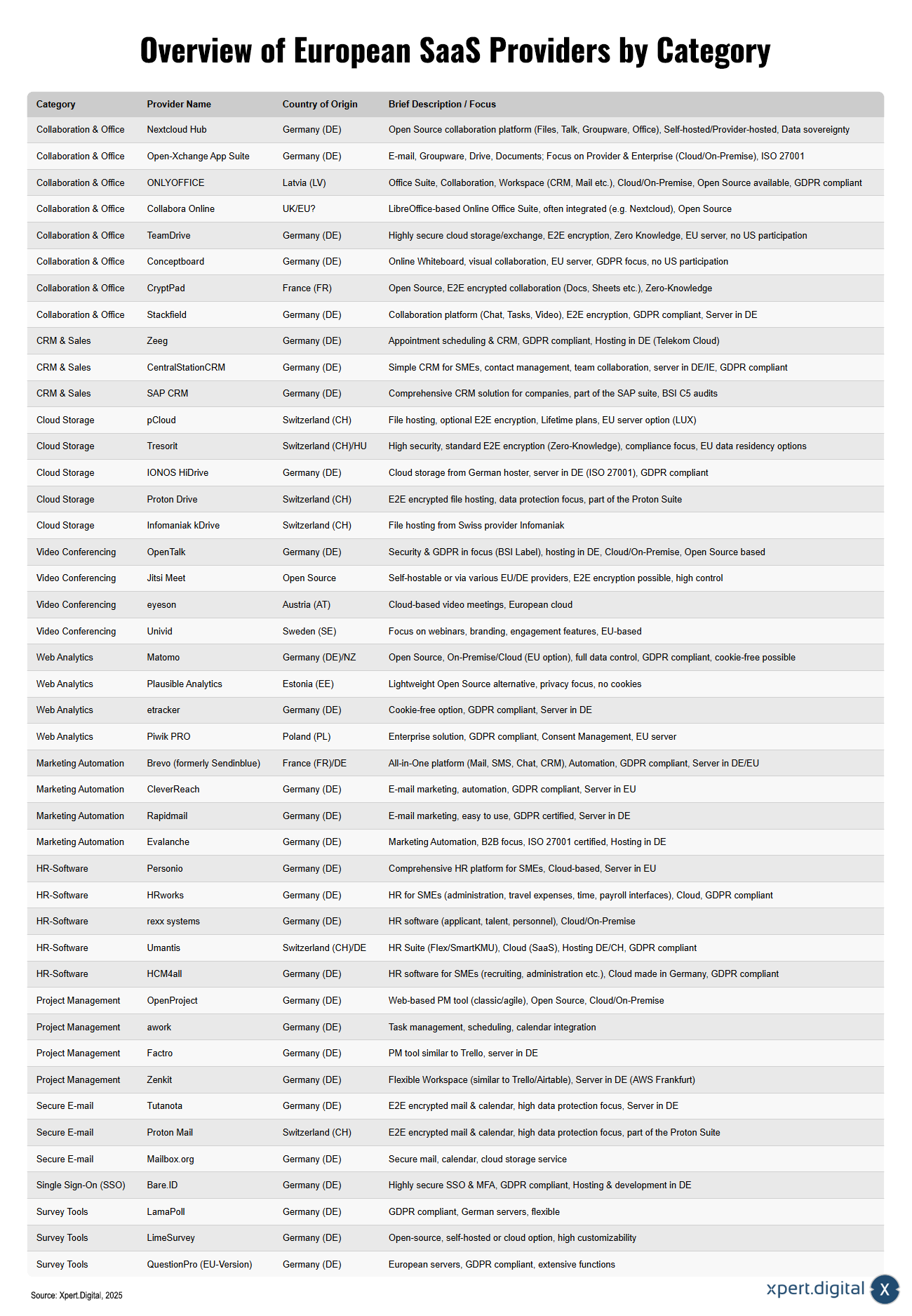
Overview of European SaaS providers by categories-Image: Xpert.digital
(Note: This table is a selection and does not claim to be complete. The information is based on the sources available and can change. A separate examination by the company is essential.)
The overview of European SAAS providers shows a variety of solutions that are ordered according to categories. In the area of collaboration & office, there are providers such as Nextcloud Hub from Germany with an open source platform for files, talk, groupware and office, which can be hosted both self-and provider and relies on data sovereignty. Open-XChange App Suite, also from Germany, offers a complete solution for email, groupware, drive and documents, especially for providers and companies, and fulfills ISO 27001 standards. ONLYOFFICE from Latvia delivers an Office Suite with collaboration options and a workspace (including CRM and email), it is both cloud and on-premise-capable and GDPR compliant. Collabora online, based on LibreOffice, is often integrated with platforms such as Nextcloud. Teamdrive from Germany focuses on high-proof cloud memory with end-to-end encryption and zero-knowledge principle. Conceptboard, also from Germany, offers an online shitboard for visual collaboration with EU servers and without US participation. Cryptpad from France combines open source and E2E-encrypted collaboration. Stackfield from Germany delivers a GDPR-compliant platform for chat, tasks and video.
In the area of CRM & Sales, ZEEG from Germany with GDPR-compliant schedule includes scheduling, while Centralstationcrm offers a simple CRM for SMEs. SAP CRM, as part of the SAP suite, is aimed at companies. In cloud storage solutions, providers such as PCLOUD from Switzerland stand out with optional E2E encryption and lifetime plans. Tresorite combines high security, zero knowledge and compliance for Europe. Proton Drive, also from Switzerland, offers encrypted filehosting. German providers such as Ionos HiDrive and international options such as Infomaniak KDRIVE complete the offer.
For video conferencing, Opentalk from Germany with a special focus on security and GDPR as well as the open source solution Jitsi Meet must be emphasized. Eyeson from Austria offers cloud -based video -based video, while univid from Sweden focuses on webinars. In web analysis, Matomo offers an open source option with full data control, plausible analytics focuses on easy usability and data protection, Etracker from Germany does without cookies and Piwik Pro.
Marketing Automation is covered by providers such as Brevo (formerly Sendinblue) with servers in Germany/EU and evalanche with B2B focus and ISO certification. In the case of HR software, Personio is a leader, a comprehensive platform for SMEs, supplemented by solutions such as HRworks and Rexx Systems that offer both cloud and on-premise models. OpenProject in project management is a German open source solution, while Zenkit scores with flexible workspaces. Safe email providers such as Tutanota and Proton Mail stand for data protection and end-to-end encryption. Single Sign-on is served by Bare.ID from Germany with GDPR-compliant security. For survey tools, Lamapoll and Limesurvey convince with adaptability and German server standards. QuestionPro in the EU version rounds off the list with extensive functions and GDPR conformity.
This overview illustrates the remarkable diversity and specialization in the European SaaS market. Especially in areas in which data protection and security traditionally play a major role-such as collaboration, safe communication, cloud storage and web analysis-there is a wide range of alternatives. Many of these providers are small or medium -sized companies (SMEs) or specialized niche players from different European countries. They often focus on compliance with the GDPR and the specific needs of the European market, which is expressed in characteristics such as EU hosting, German-language support or specific compliance certifications.
The strategic importance of open source software for many European providers is also striking. Especially in the areas of collaboration (NextCloud, Cryptpad), Office (ONLYOffice, Collabora), project management (OpenProject), web analysis (Matomo) and video conferences (Jitsi, Opentalk), source -open technologies often form the basis. This is more than just a technical detail; It is a conscious decision to promote transparency (through visible code), adaptability, auditability and avoiding dependencies (Vendor Lock-in). These aspects are central building blocks for digital sovereignty and enable European providers to offer trustworthy and flexible solutions without necessarily having to have the huge development budgets of global hyperscales. This gives customers more control and insight into the technology used.
Comparison of selected EU alternatives
According to the general market overview, there is now a more detailed comparison of selected, representative European SaaS alternatives in key categories. The focus is on core functions, price models, unique selling points and in particular the implementation of data sovereignty and GDPR conformity.
Methodology of the comparison
The selection of providers for the detailed comparison is based on their relevance and frequency of mentioning in the underlying sources and their positioning as direct European alternatives to known US services. The comparison is based on the information from the specific provider snippets and other relevant data points from the general snippets. The criteria include:
- Core functions: What does the software do in the core?
- Price model: What is the price structure (subscription, freemium, lifetime, on-premise)?
- Data location/hosting: Where are the data hosted (EU/DE guaranteed)? Are there self-hosting options?
- Encryption: Which encryption methods are used (in particular end-to-end, zero-knowledge)?
- Certifications/compliance: What are the relevant certificates (ISO 27001, BSI C5 etc.) and compliance commitments (GDPR)?
- Strengths/weaknesses regarding sovereignty: special features or restrictions in terms of data control, transparency and independence.
Comparison of details by categories
Detailed comparison of important EU-Saas alternatives
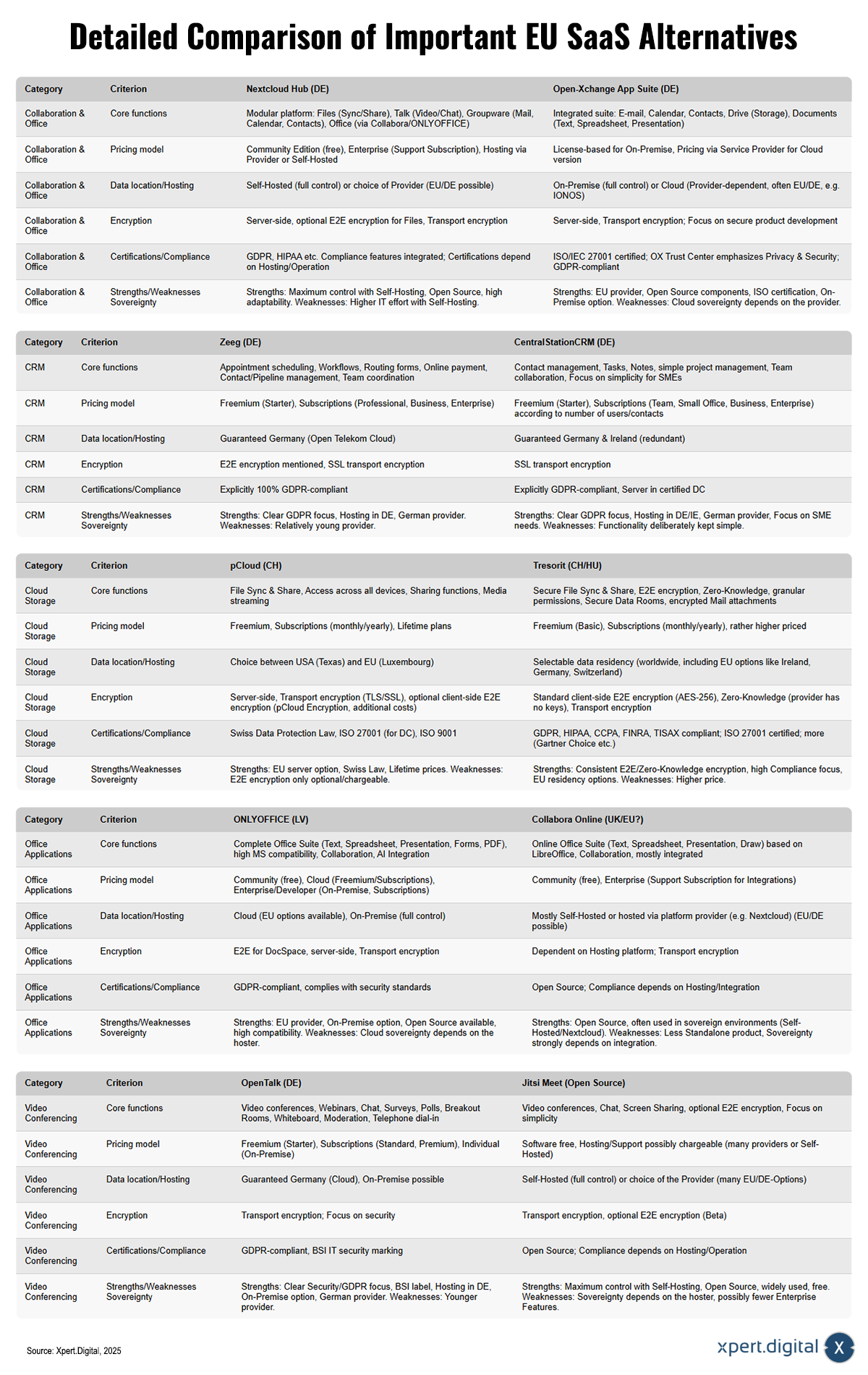
Detailed comparison of important EU Saas alternatives-Image: Xpert.digital
The detailed comparison of important EU Saas alternatives shows that Nextcloud Hub as a modular platform offers functions such as file synchronization and release, video conferences, groupware and office integration, while open-XCHANGE App Suite is focused on email, calendar, contacts and memory. NextCloud Hub enables complete control through self-hosting and offers optional end-to-end encryption, but has higher IT requirements for your own hosting. Open-Xchange stands out from an EU perspective through ISO certification and data protection, but is cloud-dependent from the provider. In the CRM area, ZEEG scores with clear GDPR conformity and hosting in Germany, while Centralstationcrm convinces with simplicity and SME focus. Both providers offer freemium models and guaranteed GDPR-compliant data locations. With cloud memory, PCLOUD with lifetime plans and EU memory options shows advantages in terms of flexibility, but E2E encryption is optional and for a fee, while Tresorite is scoring with consistent zero-knowledge encryption and high compliance, but is more expensive. ONLYOFFICE and COLLABORA Online offer extensive office alternatives with strong EU orientation and open source options, whereby Onlyoffice shines through MS compatibility and collaboration functions. Collabora Online is closely integrated into platforms such as Nextcloud and therefore less standalone focused. In the area of video conferences, Opentalk scores with functions such as webinars, surveys and a clear GDPR focus, while Jitsi Meet offers maximum self-control and simplicity as a free open source solution. Both solutions offer on-premise options and strong data protection features, whereby Opentalk stands out by the BSI IT security license plate.
The detail comparison underlines that there is rarely a single “best” European alternative. The selection depends heavily on the company's specific requirements and priorities. There are clear trade-offs, for example between maximum security and price (PCLOUD vs. safe) or between comprehensive control through self-hosting and the comfort of a managed SaaS solution (Nextcloud vs. ox app suite cloud). Companies have to weigh up which aspect - range of functions, user -friendliness, costs or the degree of sovereignty and security - is most important for them.
A decisive feature of many European providers is the flexibility in the operating model. Solutions such as Nextcloud, onlytalk or Jitsi offer both cloud-based (SaaS) and on-premise or self-hosted variants. This gives companies the opportunity to determine the degree of control and sovereignty themselves. You can choose the comfort of a SaaS solution for a trustworthy European provider or choose the maximum control over data and infrastructure by operating in your own data center. This choice addresses the core need after control, which drives the sovereign debate.
🎯📊 Integration of an independent and cross-data source-wide AI platform 🤖🌐 for all company matters

Integration of an independent and cross-data source-wide AI platform for all company matters-Image: Xpert.digital
Ki-Gamechanger: The most flexible AI platform-tailor-made solutions that reduce costs, improve their decisions and increase efficiency
Independent AI platform: Integrates all relevant company data sources
- This AI platform interacts with all specific data sources
- From SAP, Microsoft, Jira, Confluence, Salesforce, Zoom, Dropbox and many other data management systems
- Fast AI integration: tailor-made AI solutions for companies in hours or days instead of months
- Flexible infrastructure: cloud-based or hosting in your own data center (Germany, Europe, free choice of location)
- Highest data security: Use in law firms is the safe evidence
- Use across a wide variety of company data sources
- Choice of your own or various AI models (DE, EU, USA, CN)
Challenges that our AI platform solves
- A lack of accuracy of conventional AI solutions
- Data protection and secure management of sensitive data
- High costs and complexity of individual AI development
- Lack of qualified AI
- Integration of AI into existing IT systems
More about it here:
European alternatives: SaaS solutions for maximum digital sovereignty
Specialized solutions: sovereign SaaS for sensitive sectors
While the SaaS solutions considered so far can often be used across industries, there are sectors with particularly high demands on security, compliance and digital sovereignty. This includes in particular public administration, healthcare and the financial sector. Specialized offers and regulatory framework are developing here that promote or even prescribe the use of sovereign cloud solutions.
Public administration
The public sector in Germany and Europe has an inherent interest in digital sovereignty to ensure control over citizen data and critical state processes. The requirements often go beyond the standard GDPR conformity and include specific security standards such as BSI IT basic protection or the BSI C5 criteria catalog. Interoperability between different authorities and levels as well as a preference for open source software to avoid dependencies are also important aspects.
Several initiatives aim to create a sovereign cloud infrastructure for the administration:
- German Administrative Cloud Strategy (DVS): This strategy, driven by the IT planning council and the FitKO, pursues the goal of establishing a federal, safe, interoperable and sovereign cloud ecosystem for the federal, state and municipalities. It relies on open standards, a multi-cloud approach and the integration of public IT service providers (such as Dataport, AKDB, IT.NRW) that play a central role and enjoy a high degree of trust. External, DVC-compliant providers should also be integrated in perspective. A central element is the Cloud Service Portal (CSP) as a marketplace for standardized and tested cloud services.
- BundesCloud / IT operating platform BUND: The ITZBUND already operates cloud platforms (SaaS, PAAS) for federal authorities that are to be consolidated in 2025 and meet high requirements for safety and data protection.
- Center for digital sovereignty (Zendis): This facility specifically promotes the use of open source software in the administration and supports projects such as OpenSK, an open source alternative to Microsoft 365, which is specially developed for the public sector.
- GAIA-X and SOVEIGN Cloud Stack (SCS): These European initiatives provide important technical foundations and standards for the structure of sovereign cloud infrastructures, which are also to be used by the DVS. The SCS, an open source stack based on OpenStack and Kubernetes, is already used by several German providers (e.g. plus server).
Concrete sovereign SaaS offers for the administration come from public IT service providers (e.g. Conceptboard by IT.NRW, DDDATABOX BY DATAPRAT) as well as from specialized commercial providers who often have BSI C5 tests and are available via marketplaces such as Govdigital (e.g. Plus Server, Ionos, Ovhcloud). Open source solutions such as Nextcloud or Opendendk also play an important role.
Suitable for:

Healthcare
The healthcare system processes extremely sensitive personal data (health data in accordance with Art. 9 GDPR) that are subject to special protection. In addition to the GDPR and medical confidentiality, specific national laws such as the Patient Data Protection Act (PDSG) and recently the Digital Act (DIGIG) apply. Security, availability and confidentiality are of the utmost importance here.
A crucial driver for the use of sovereign cloud solutions in the German healthcare system is the Digital Act (DIDIG), which came into force in March 2024. The new § 393 SGB V expressly allows the processing of social and health data using cloud computing, but this is based on very strict conditions:
- Data processing only in the EU/EEA/CH or appropriateness-resolution country: The processing of the data may only be carried out in Germany, an EU/EEA state, Switzerland or a third country with an adequacy decision of the EU Commission.
- BSI C5 test is mandatory: From July 1, 2024, cloud service providers who have to process social or health data on behalf of service providers (doctors, hospitals, health insurers, etc.) must be able to show a valid BSI C5 test. A type 1 test (appropriateness of the controls) is sufficient until June 30, 2025, from July 1, 2025 a type 2 test is mandatory (proof of effectiveness over a period).
- Also applies to SaaS providers: This obligation not only affects infrastructure (IAAS) or platform providers (PAAS), but also explicitly also software-as-a-service (SaaS) providers whose applications are used cloud-based (e.g. hospital information systems (KIS), practice administration systems (PVS), appointment booking systems, Digas).
- Implementation of customer controls: The user institution (clinic, practice, etc.) must in turn implement the end user controls mentioned in the test report of the cloud provider.
This regulation significantly tightens the requirements for cloud services in the healthcare system and de facto makes the BSI C5 balance to the entry ticket for providers in this market. Cloud providers such as the Open Telekom Cloud, AWS (Frankfurt region), Azure, GCP or German providers such as Plus Server, Stackit and Ionos already have C5 tests for their infrastructures. Now the SaaS solutions for healthcare (KIS, PVS, EPA components, etc.) based on this must also provide this evidence. Examples of companies that are active in the health cloud environment and/or strive for relevant certifications are Gini, Doctolib or Kite Consult. The electronic patient file (EPA) itself is hosted on servers in Germany and the EU GDPR compliant.
Finance
The financial sector (banks, insurance companies, financial service providers) is also highly regulated and processes extremely sensitive data. Strict regulatory requirements of the Federal Financial Supervisory Authority (BaFin) in Germany (e.g. Bait, Kait, Vait, Zait) and increasingly harmonized European guidelines apply here. High demands on IT security, risk management, reliability and audit security are standard.
Important regulatory drivers for the use of safe and sovereign cloud solutions are:
- NIS2 directive: Banks and financial market infrastructures usually fall under the categories “essential” or “important” facilities in accordance with NIS2. You must therefore meet stricter requirements for risk management, safety of supply chains (including cloud provider), incident report and management responsibility.
- Dora (Digital Operational Resilience Act): This EU regulation specifically aims to strengthen digital operational resilience in the financial sector. It places detailed requirements for the management of ICT risks, the reporting of serious ICT-related incidents, tests of digital resilience and in particular to the management of risks by ICT third-party service providers, including cloud providers. Among other things, Dora demands clear contractual regulations with cloud providers and audit rights.
Cloud providers who want to serve financial institutions must prove that they can meet these regulatory requirements. This is often done by the detection of certifications such as BSI C5 or ISO 27001, specific contractual assurance and transparent exploration of your security architecture and processes. Providers such as Plus Server, T-Systems, Microsoft with his EU Data Boundary or AWS with the European Sovereign Cloud are specifically positioned for this regulated market.
In addition, there are specialized SAAS providers who offer compliance solutions for the financial sector, for example for money laundering prevention (AML), Know Your Customer (KYC), sanction list test, fraud detection or market abuse monitoring. Examples of providers with a European relationship or presence are Actico (DE), Pelican Ai (UK?), Sopra Financial Technology (DE/FR), Otris (DE) or VICLARITY (IE/US?).
In these highly sensitive sectors it becomes clear that the decision for sovereign cloud solutions is no longer just a question of risk minimization, but is increasingly driven by legal requirements and strict compliance requirements. The need to show certifications such as BSI C5 shifts the basis for the decision from a voluntary risk assessment towards a mandatory prerequisite for the market participation.
This presents SaaS providers in particular with new challenges. While so far the infrastructure provider (IAAS/PAAS) has often had the relevant certifications, regulations such as § 393 SGB V are now explicitly demanding evidence of SaaS providers such as the BSI C5 test. The costs and effort for the acquisition and maintenance of such tests are significant and could be a hurdle, especially for smaller, innovative SaaS companies, which could potentially lead to consolidation of the market in these regulated areas.
Suitable for:

Promotion of sovereignty: EU initiatives and certifications
In order to strengthen the digital sovereignty of Europe and create a trustworthy framework for cloud computing, various initiatives and certification standards were launched at the European and national level. These are intended to promote interoperability, harmonize security standards and increase trust in cloud services.
GAIA-X: Vision of a federated European data infrastructure
Gaia-X is one of the most prominent European initiatives to strengthen digital sovereignty. Started by Germany and France in 2019, numerous partners from business, science and politics from many European countries are now participating.
- Goals: The core destination of GAIA-X is the creation of a safe, fed and interoperable data infrastructure based on European values such as data protection (GDPR), transparency, trust and self-determination. It is intended to increase the digital independence of Europe from non -European providers, enable innovations through safe data exchange and strengthen the competitiveness of European companies.
- Architecture and approach: It is important to understand that Gaia-X itself is not a cloud provider and does not build its own “European super cloud”. Instead, GAIA-X defines a set of rules, common standards and architectural elements for a decentralized ecosystem of networked, interoperable data rooms and cloud infrastructure services. It is based on principles such as openness, transparency, modularity and the use of open standards and open source software. The GAIA-X Association for Data and Cloud (AISBL) develops specifications, rules, policies and a framework for checking conformity (GAIA-X Compliance), which is to be implemented by so-called GAIA-X Digital Clearing Houses (GXDCH).
- Components and projects: concrete building blocks and projects are created within the GAIA X frame. The SOEGEIGN Cloud Stack (SCS) is an important example: A standardized, open source-based technology stack (based on OpenStack, Kubernetes etc.) for the establishment of GAIA-X-compliant, sovereign cloud infrastructures (IAAS/PAAS). It is intended to serve as a technical basis for interoperable and confident cloud offers, also for the German administrative cloud.
- Application cases (use cases): In order to demonstrate the benefits of Gaia-X, concrete data rooms and applications are developed in various domains. Examples can be found in Industry 4.0 (e.g. Catena-X for the automotive industry), mobility, energy, finance, public administration and especially in healthcare. Projects such as Team-X, Health-X Dataloft or Gaia-Med aim to enable the safe and sovereign exchange of health data for improved care and research.
- Challenges: Despite the ambitious goals, Gaia-X is also faced with challenges and criticism. This includes the complexity of the project, slow progress in the practical implementation, sometimes unclear definitions and the fear that the initiative could be dominated by the established global hyperscalers. It was also criticized that the focus was too strong at the infrastructure level (IAAS/PAAS) and the application level (SaaS) was neglected.
EUCS: European cybersecurity certification scheme for cloud services
The European Cybersecurity Certification Scheme for Cloud Services (EUCS) is a certification framework that is developed under the EU Cybersecurity Act (CSA) by the European Agency for Cyber Security (EnISA).
- Purpose: The main goal is the harmonization of cyber security requirements and certifications for cloud services (IAAS, PAAS, SAAS) in the entire EU. A uniform standard is to be created to overcome fragmentation through different national certification schemes (such as Secnumcloud in France or C5 in Germany) and to strengthen the digital internal market. For cloud users, EUCs should create more transparency and trust by proving that certified services meet certain safety standards.
- Assurance Levels: The scheme defines three (or in previous designs four) safety levels ('Basic', 'Substantial', 'High' and possibly 'High+'), which reflect different risky levels and attacking skills. With increasing level, the requirements for the implemented security measures (e.g. network, memory, encryption security, penetration tests) and the strictness of evaluation by accredited conformity assessment agencies (Conformity Assessment Bodies-CABS).
- Voluntaryness vs. Mandatory: The certification according to EUCS is generally voluntary. However, the cybersecurity Act or the NIS2 directive allows the EU member states, for certain areas, in particular for “essential” or “important” institutions (criticism), to specify the use of certified ICT services. It is therefore likely that EUCs, at least in regulated sectors, will de facto become a mandatory requirement or an important criterion for tenders.
- Sovereignty debate: A central and controversial point in the development of the EUC was the question of specific sovereignty requirements, especially for the highest security level ('high' or 'high+'). Earlier designs provided that data localization within the EU is absolutely necessary for this level and that the provider must have its headquarters and global headquarters in an EU member state to ensure protection against non-European laws (such as the cloud act). However, these requirements were apparently removed or weakened in later designs (as of 2024). This met with violent criticism from European cloud providers (in particular SMEs), industrial associations and data protectionists who fear that this weakens the digital sovereignty of Europe, cementing the dependence on non-European hyperscalers and the data of European citizens and companies are exposed to increased risk. The debate about the final design of these requirements continues.
BSI C5: German standard for cloud security
The cloud computing compliance criteria Catalogue (C5) of the German Federal Office for Information Technology (BSI) is an established criteria catalog that defines specific minimum requirements for the information security of cloud services.
- Purpose and content: C5 should provide cloud customers orientation when choosing safe providers and create a basis for their risk management. It is based on internationally recognized standards such as ISO/IEC 27001, but complements them with cloud-specific requirements and attaches particular importance to transparency through so-called environmental parameters. These parameters provide information about aspects such as data locations, place of jurisdiction, certification and disclosure to state bodies, which is intended to help customers (e.g. through economic espionage or data protection violations). The catalog comprises 17 subject areas, including organizing information security, personnel security, asset management, cryptography, identity & access management, incident management and physical security.
- Testat (type 1 & type 2): Compliance with the C5 criteria is demonstrated by a testat, which is issued by an independent, qualified auditor. There are two types of tests: Type 1 certifies the appropriateness of the design and the implementation of the security checks into a certain key date. Type 2 also confirms the operational effectiveness of these controls via a defined examination period (usually 6 to 12 months). The type 2 test is considered more meaningful and is required for follow-up exams and in the healthcare system from July 2025.
- Relevance: C5 has developed into a de facto standard for safe cloud computing in Germany, especially for public administration and in heavily regulated industries such as the healthcare system and the financial sector. As already mentioned, a C5 test will be legally mandatory by the DIGIG for cloud services in the healthcare system from July 2024/2025. Many German and European, but also international cloud providers (for their EU regions) have C5 tests for their services.
Other relevant standards
In addition to the initiatives and certifications mentioned, established international standards also play an important role:
- ISO/IEC 27001: The globally recognized standard for information security management systems (ISMS). It defines a systematic approach to the management of sensitive company information to ensure their confidentiality, integrity and availability. ISO 27001 certification is often a basic requirement for cloud providers and serves as the basis for more specific standards such as C5.
- ISO/IEC 27017: This standard offers a guide (Code of Practice) with specific control measures for information security in cloud environments, in addition to ISO/IEC 27002.
- ISO/IEC 27018: focuses on the protection of personal data (personally identifiable information - PII) in public clouds that act as processors. It contains guidelines that are closely based on European data protection principles and can serve as a supplement to C5 that does not primarily cover data protection.
These different initiatives and standards are not necessarily seen as competitors, but can complement each other. GAIA-X provides the vision and the rules for a sovereign ecosystem, Eucs is supposed to harmonize the certification across the EU, and national standards such as BSI C5 already offer concrete, established requirements and test mechanisms. The challenge will be to integrate these approaches sensibly and to create a coherent framework that both meet the sovereignty claims in Europe and is also practical for providers and users. However, the current debate about the sovereignty requirements in the EUCS shows that political and technical details are still necessary here.
It is important for companies to understand that certifications such as BSI C5 or ISO 27001 are valuable trust anchors, create transparency and make it easier to prove security efforts. However, they are not a panacea and do not replace your own risk assessment and DUE diligence test by the customer. A C5 test for a US provider, for example, does not change its subdness among the cloud act. The shared responsibility (“Shared Responsibility”) remains between the provider and customer for the safety of cloud use, and companies must always check whether the measures of the provider are sufficient for their specific requirements and risks.
Suitable for:

Strategic advantages of switching to EU Saas providers
The analysis of the risks in the use of US-based cloud services and the investigation of the growing market for sovereign European SaaS alternatives allow a clear conclusion: for European companies, dealing with their cloud strategy is not only advisable from the point of view of digital sovereignty, but is increasingly a strategic necessity.
Summary of the results
The central findings of this report can be summarized as follows:
- Persistent risks among US providers: The use of SaaS services of companies that are subject to US Jurisdiction harbors significant and continuing risks for European companies. The fundamental conflict between the EU GDPR and US laws such as Cloud Act and FISA 702 leads to potential data protection injuries, high fines, the loss of data control and the risk of business espionage. Even the current EU-US Data Privacy Framework (DPF) does not dissolve this basic conflict and its long-term stability is uncertain (see section II).
- Sovereignty as a multidimensional concept: “Sovereign SaaS” in a European context means more than just storing data in EU computing centers. It includes compliance with European law (especially GDPR), protection against non -European access, the operation by EU entities and personnel as well as technological openness and interoperability to avoid dependencies (see section III).
- Growing market for EU alternatives: There is a diverse and growing market for SaaS providers with the seat and operating in the EU/EEA/CH. These offer solutions in numerous categories, often with a strong focus on data protection, security and local needs. Many rely strategically on open source to maximize transparency and control (see section IV and V).
- Regulatory pressure in sensitive sectors: In areas such as public administration, the healthcare system and the financial sector, the use of demonstrably secure and sovereign cloud solutions (often with BSI C5 tests or comparable evidence) is increasingly becoming a duty (e.g. Digig, Nis2) and strategic specifications (see section VI).
- Framework conditions through initiatives and standards: European initiatives such as GAIA-X and certifications such as the planned EUCS and established national standards such as BSI C5 create important framework conditions, promote interoperability and are intended to strengthen trust in sovereign cloud offers (see section VII).
Strategic advantages of EU-Saas alternatives
The change to or the primary choice of European SaaS providers who meet the criteria of sovereignty offers companies beyond pure risk minimization:
- Improved compliance & legal certainty: The use of providers that are subject exclusively and guarantees data in the EU significantly reduce the risk of GDPR violations and conflicts with non-European laws. This creates a more stable and predictable legal basis for data processing.
- Increased data control & security: European providers with a focus on sovereignty often offer a higher level of control over your own data. This can be achieved through self-hosting options, consistent end-to-end encryption (zero-knowledge), transparent operating processes and the exclusion of access by third-country authorities.
- Starked digital sovereignty: The decision for European providers reduces strategic dependencies on non -European technology groups. It supports the establishment of a resistant digital ecosystem in Europe and strengthens the local digital economy.
- Local support & cultural closeness: European providers can often offer more accessible and understandable customer service in the respective national language and time zone. They often have a deeper understanding of the specific requirements and customs of the European market, which can facilitate cooperation and contract negotiations.
- Trust formation: The use of demonstrably data protection and confident solutions signals customers, partners and employees a high level of commitment to data protection and security. This can become an important trust and competitive advantage.
Recommendations for action for European companies
In order to use the advantages of sovereign SaaS solutions and manage the risks of cloud use, European companies should consider the following steps:
- Perform individual risk analysis: Calder the currently used (especially US-based) SaaS services. Analyze the type of processed data (sensitivity, personal reference), the applicable regulatory requirements (GDPR, industry -specific requirements) and the potential effects of unauthorized data access or a failure of the service on your business.
- Define sovereignty requirements: Determine the degree of data sovereignty, operational control and technological independence for your company. Not every application requires the same level of sovereignty. Prioritize based on risks and strategic importance.
- Systematically evaluating the market for EU alternatives: Use market overviews (such as those in this report) and your own research to identify potential European SAAS providers that meet their functional and sovereignty-related requirements. Take into account provider size, specialization, references and future viability.
- Careful due diligence in the provider selection: Do not rely on marketing statements. Check the provider's information about data locations (including backups, metadata), operating staff, corporate structure (ownership, seat), subcontractors used, encryption technologies (especially E2E/Zero-Knowledge) and security measures. Request order processing contracts (AVV), technical-organizational measures (TOMS) and relevant certificates or tests (e.g. ISO 27001, BSI C5) and check them carefully.
- Develop a migration strategy and exit plan: Plan a potential change carefully. Take into account costs, technical effort for data migration, necessary adjustments to interfaces and change management for your employees. Pay attention to interoperability and define a clear exit strategy to enable future provider change or a return of the data (reversibility).
- Check open source as an option: Evaluate whether open source-based SaaS solutions, be it as a managed service of an EU provider or in-house (self-hosted), represent a suitable alternative in order to achieve maximum transparency, adaptability and control.
- Observe regulatory landscape: Stay about the developments in the transatlantic data traffic (DPF check), informed in European certification standards (EUCS) and relevant laws (NIS2, DORA, industry-specific regulations), since these can significantly influence your cloud strategy.
The decision for or against the use of certain cloud services, especially with regard to US providers versus European alternatives, is much more than a technical or pure compliance question. It is a strategic course with long -term effects on legal certainty, data security, control over critical business processes and ultimately the company's resilience and competitiveness in global digital competition. The analyzed risks of the dependence on non -European providers are substantial and are increased rather than weakened by the current geopolitical and legal mixture.
At the same time, switching to European alternatives is not a sure -fire success. Companies must carefully consider whether the advantages of compliance and control outweigh the potential disadvantages with regard to the range of functions, innovation speed or migration effort. A thorough analysis of your own needs, a realistic assessment of the available alternatives and careful planning of the transition are crucial for success. However, the European market offers increasingly sustainable and trustworthy options that enable companies to use the advantages of the cloud without jeopardizing their digital sovereignty.
We are there for you - advice - planning - implementation - project management
☑️ SME support in strategy, consulting, planning and implementation
☑️ Creation or realignment of the AI strategy
☑️ Pioneer Business Development

Konrad Wolfenstein
I would be happy to serve as your personal advisor.
You can contact me by filling out the contact form below or simply call me on +49 7348 4088 965 (Munich) .
I'm looking forward to our joint project.
Write to me

Xpert.Digital - Konrad Wolfenstein
Xpert.Digital is a hub for industry with a focus on digitalization, mechanical engineering, logistics/intralogistics and photovoltaics.
With our 360° business development solution, we support well-known companies from new business to after sales.
Market intelligence, smarketing, marketing automation, content development, PR, mail campaigns, personalized social media and lead nurturing are part of our digital tools.
You can find out more at: www.xpert.digital - www.xpert.solar - www.xpert.plus
Keep in touch











