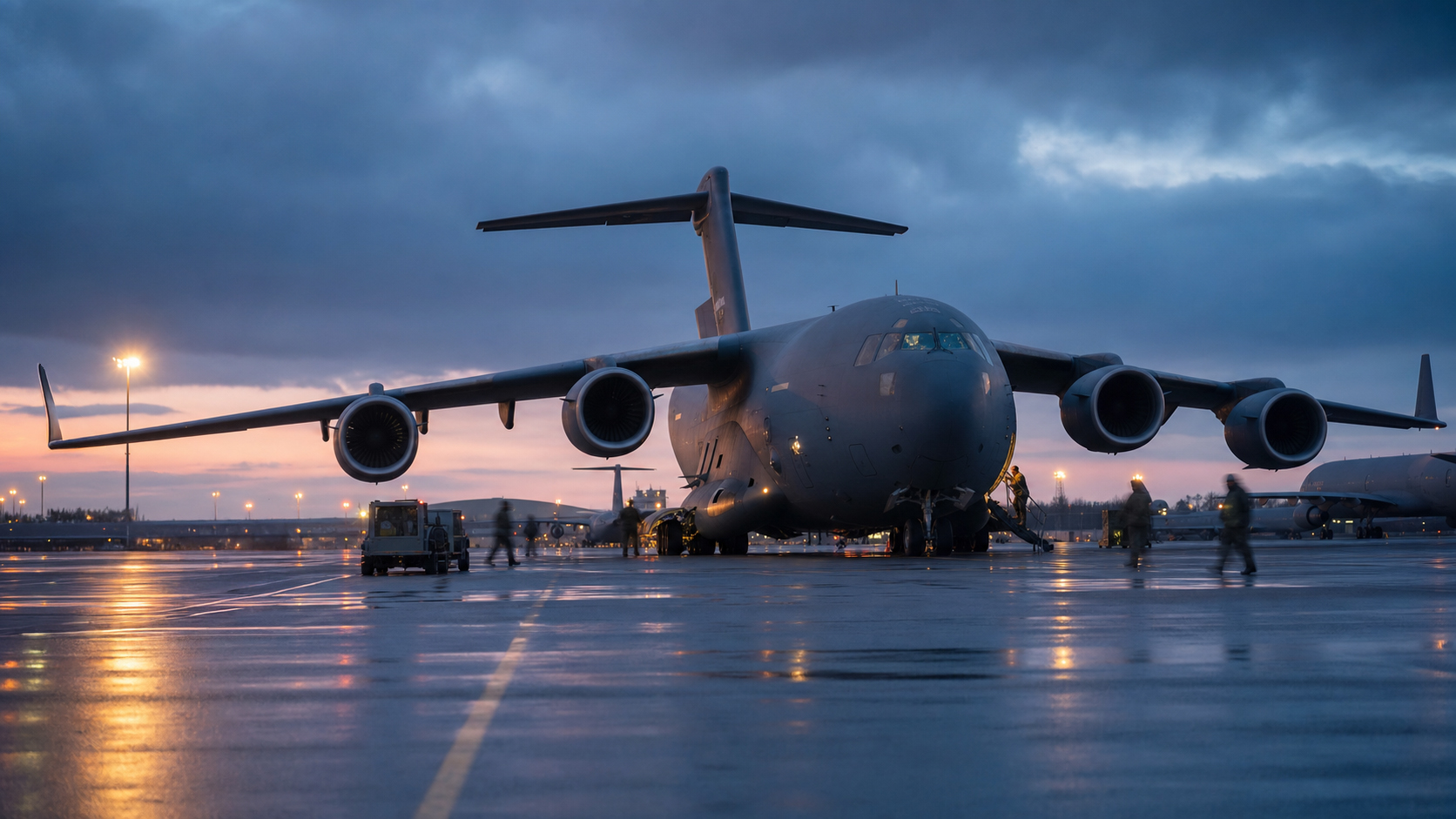
Operation “Epic Fury” – The Logistics Network: How Ramstein became the nerve center in the Iran war – Creative image: Xpert.Digital
Despite neutrality: Europe's secret key role in the Middle East war
Flight data reveals: The invisible routes of the US military to the Middle East
B-2 and B-52 in Europe: How Great Britain became a launching pad against Iran
Since the outbreak of open war between the US, Israel, and Iran in February 2026, European states have repeatedly asserted their political neutrality. However, a look at global flight data and the activities at Western European military bases paints a completely different picture: Without European infrastructure—above all, the US airbase in Ramstein, Rhineland-Palatinate, and strategic bomber bases in Great Britain—American warfare in the Middle East would be logistically almost impossible to manage. A massive, partly covert airlift, relay stations for lethal drone strikes, and the transshipment of bunker-buster weapons raise highly sensitive questions. How deeply are Germany and the United Kingdom actually involved in this conflict? And at what point does the mere provision of infrastructure become active participation in the war under international law? An in-depth analysis amidst obscure cargo manifests, economic interests, and the risky geopolitical role of bases like Fairford and Diego Garcia.
The logistics corridor of war: How Ramstein, Fairford and Diego Garcia became hubs of the American-Israeli war against Iran
Between neutrality and cooperation: Europe's silent role in the Middle East conflict
Since the outbreak of open military conflict between the United States, Israel, and Iran in late February 2026, a network of European military bases has become a central logistical backbone of American warfare. At the heart of this network are the US airbase in Ramstein, Rhineland-Palatinate, several British bases such as RAF Fairford, RAF Mildenhall, and RAF Lakenheath, as well as the island of Diego Garcia in the Indian Ocean, jointly operated by the US and the UK. While the Federal Republic of Germany and the United Kingdom repeatedly emphasize that they are not belligerent, the de facto use of their infrastructure for arms transport, refueling flights, and the control of drone strikes raises fundamental questions about international legal and political responsibility.
The operation, codenamed Epic Fury and directed by US Central Command, began on February 28, 2026, with joint American-Israeli airstrikes against Iranian missile sites and nuclear facilities. Weeks earlier, aerial observers had registered an unusual increase in air traffic at Western European military bases, which in retrospect can be interpreted as a preparatory phase for the offensive.
Ramstein as a logistical nerve center: Facts instead of speculation
Ramstein Air Base is considered the largest US air force base outside the United States and serves as the headquarters of the United States Air Forces in Europe as well as NATO's Allied Air Command. Since the end of February 2026, the base has experienced a dramatic increase in air traffic, at times occurring every minute, according to consistent reports from German and international media. An analysis by Sky News indicates that between February 23 and March 3, 2026 alone, at least 161 aircraft landed and took off at Ramstein and the neighboring Spangdahlem Air Base, while at least 246 aircraft departed from there.
The observed aircraft types include primarily strategic transport planes such as the Boeing C-17 Globemaster III with a payload of approximately 77.5 tons and the smaller Lockheed C-130 Hercules with a capacity of about 20 tons. This military air traffic is complemented by civilian cargo aircraft operating on behalf of the US military, including Boeing 747 freighters operated by Atlas Air. Furthermore, at the end of January 2026, a state-of-the-art electronic warfare aircraft, the EA-37B Compass Call, landed at Ramstein for the first time, suggesting a targeted preparation for jamming operations against Iranian air defenses and communications.
What exactly was transported on board these flights is, according to several sources, not publicly documented. The investigative news service EIR News states unequivocally that the specific cargo carried by the aircraft stationed in Ramstein is unknown. This statement is crucial for a reliable assessment: the existence of a massive logistical airlift is well documented, but the precise type and quantity of military supplies transported are not. Reports in the Wall Street Journal, confirmed by the German Federal Government, consistently describe Ramstein as a central supply hub for equipment, ammunition, and personnel within the framework of the American military operation against Iran, without, however, specifying particular quantities or lists of goods.
Ramstein is also of particular importance in the control of the war itself, not just in physical logistics. According to research by the Frankfurter Allgemeine Zeitung, data links and satellite relays run through the base, which are necessary for controlling American drones in the Middle East, since direct control from the United States would be too slow due to signal propagation delays. Ramstein thus functions as a technical relay station between American territory and the theater of war, a function that the German Federal Government considers unproblematic under international law as long as no systematic violations of the law can be proven by the controlled operations.
Great Britain as an active starting point for bombing raids
Unlike Germany, which primarily functions as a transit and relay point, Great Britain evolved into a direct launching point for combat operations during the course of the conflict. After initial reluctance, Prime Minister Keir Starmer authorized the use of British bases for so-called defensive operations against Iranian missile sites on March 1, 2026, a decision he initially limited to restricted, defensive purposes. According to the British government, the decisive factor in this change of course was a drone attack on a British military base in Cyprus.
Subsequently, several B-1B Lancer long-range bombers of the US Air Force landed at RAF Fairford in Gloucestershire, the only permanent forward base of the US Air Force for heavy bombers in Europe. According to BBC reports, at least four B-1B bombers had already arrived at Fairford by March 7, 2026, followed two days later by three B-52H Stratofortress bombers from Minot Air Force Base in North Dakota. Al Jazeera journalists documented on site how ground personnel loaded bunker-buster bombs with satellite-guided JDAM targeting systems onto the returning aircraft, a clear indication of the transition from purely defensive logistics to active offensive armament.
In March 2026, British Defence Minister Lord Coaker confirmed to the House of Lords that approximately 12,300 American military and civilian personnel were stationed at at least 15 bases in the United Kingdom. Besides Fairford, which, thanks to its nearly three-kilometer-long reinforced runway, can accommodate heavy bombers such as the B-1 and B-52, Mildenhall Air Base in Suffolk plays a crucial role in aerial refueling, with regular tanker flights to the eastern Mediterranean to supply aircraft en route to the Middle East. The largest American base in the country, RAF Lakenheath, also served as a hub for the transfer of fighter jets from the American mainland to the crisis region, while at the same time reports circulated about a possible return of American nuclear weapons to this location, which have neither been officially confirmed nor denied.
Diego Garcia and the strategic depth of the Indian Ocean
Another, less geographically visible but strategically important hub is the island of Diego Garcia in the Chagos archipelago, a British Overseas Territory, which houses a jointly operated American-British naval and air force base. The base can accommodate B-2 Spirit long-range bombers and is located approximately 4,000 kilometers from the Iranian mainland. On March 20, 2026, the British government officially authorized the shared use of Diego Garcia for American operations against Iranian missile sites threatening shipping in the Strait of Hormuz.
Just one day later, on March 21, 2026, Iran, according to Bloomberg reports, launched a failed missile attack on the base. While the attack caused no damage, it demonstrated a previously undisclosed Iranian missile range. In early April 2026, B-2 bombers flew a roughly 36-hour, non-stop mission from their home base, Whiteman Air Force Base in Missouri, covering approximately 11,000 kilometers, using 13.6-ton GBU-57 bunker-buster bombs to attack underground command structures of the Iranian Revolutionary Guard Corps. This operation was conceptually linked to the earlier Midnight Hammer operation against Iranian nuclear facilities in the summer of 2025.
Hub for Security and Defense - Advice and Information


Hub for Security and Defense - Image: Xpert.Digital
The Security and Defence Hub offers expert advice and up-to-date information to effectively support companies and organizations in strengthening their role in European security and defence policy. Working closely with the SME Connect Defence Working Group, it particularly promotes small and medium-sized enterprises (SMEs) that wish to further develop their innovative capacity and competitiveness in the defence sector. As a central point of contact, the Hub thus creates a crucial bridge between SMEs and European defence strategy.
Related to this:
Logistics of War: Between Geopolitical Strategy and Constitutional Issues
Scope of arms exports and financial dimension
Parallel to the physical redeployment of troops and equipment, the United States accelerated the formal sale of arms to regional partners in May 2026. Citing urgent national security circumstances, the State Department authorized arms sales totaling $8.6 billion, with Secretary of State Marco Rubio exempting Congress from the usual oversight under the Arms Export Control Act, citing a national emergency. Of this package, approximately $992 million was for advanced precision weapons systems for Israel, while Kuwait received $2.5 billion in combat management systems. Additionally, Patriot air defense systems and APKWS precision missiles were released to Israel, Qatar, Kuwait, and the United Arab Emirates after Iranian attacks significantly depleted regional defense stockpiles.
These figures explicitly refer to direct, contractually documented arms sales to third countries and are therefore clearly distinguishable from the unspecified cargo transported via Ramstein, Fairford, or Diego Garcia towards the Middle East. While the financial and quantitative dimensions of official arms sales are transparently documented, the specific composition of the transport flights handled via European bases remains unknown, according to several independent observers.
What flight tracking data actually shows and what it doesn't
Independent flight tracking platforms like Flightradar24 have documented detailed movement patterns of military transport aircraft between Europe and the Middle East in several waves. An analysis by the Misbar research team in cooperation with Al Araby TV recorded at least 13 flights of C-17A transport aircraft within twelve hours on April 5, 2026. Most of these flights departed from Ramstein Air Base and likely landed in Israel. A recurring pattern is striking: the aircraft deactivate their transponder signals upon entering Israeli airspace and only reactivate them after leaving the area, making it difficult to trace their final destinations.
In May 2026, the same research unit identified eight flights with call signs such as RCH303, RCH449, and MOOSE30, departing from Ramstein, Spangdahlem, and Trier airports bound for Beirut, Israeli territory, and other unknown destinations in the Middle East, accompanied by six westward return flights, including one from the Israeli city of Eilat back to Ramstein. This activity continued into July 2026: On July 9 and 10, 2026, the same team recorded 37 American military flight movements between Europe and the Middle East within just two days. This data unequivocally demonstrates a continuous and intensive airlift operation. However, it does not confirm the exact cargo on board the individual aircraft, as neither publicly available cargo manifests nor official confirmations of the loads on individual flights exist.
Legal and political controversies in Germany and Great Britain
The use of Ramstein Air Base for attacks against a third country has raised recurring constitutional questions in Germany for years. In the context of current events, the Federal Constitutional Court clarified that Germany would only be legally responsible if a clear connection to German state authority and a serious threat of systematic violations of international law could be proven, although the court deemed the second requirement insufficiently substantiated in the present case. Government spokesman Stefan Kornelius confirmed at a press conference in March 2026 that, in the Federal Government's assessment, the use of Ramstein was in accordance with international law. Nevertheless, initial doubts arose within the SPD (Social Democratic Party) as to whether Germany should continue to make the base available without restrictions.
German Defense Minister Boris Pistorius explicitly emphasized during an exercise in Berlin that Germany would not participate in the war, except perhaps in the context of protective or material support, while simultaneously advising restraint regarding further escalation through additional European naval operations in the Mediterranean. The debate is similar in Great Britain: The human rights organization Action on Armed Violence, in a comprehensive investigation, found that the British provision of bases, equipment, and materiel, despite the official limitation to defensive support, blurs the line between non-participation and indirect involvement in the war, particularly given the limited transparency regarding parliamentary oversight and target selection.
A telling example of European disunity is the contrast with other NATO partners. Spain explicitly forbade the United States from using two jointly operated bases and described any potential involvement as an unjustified and dangerous military intervention, while Italy denied American forces access to a base in Sicily for procedural reasons. This asymmetry within the Western alliance illustrates that the willingness to cooperate logistically is by no means a common denominator among NATO states, but rather depends on bilateral political considerations and historical ties such as the 74-year-old Churchill-Truman Communiqué between the US and Great Britain.
Economic impact of basic infrastructure
From an economic perspective, the current conflict highlights the enormous structural value that forward-stationed military infrastructure has for a major power's projection capabilities. Stationing bombers at Fairford significantly reduces flight times compared to missions from the American mainland, thereby lowering fuel costs, wear and tear on equipment, and the number of crew rotations required. In contrast, a single long-range mission by a B-2 bomber from Missouri, covering over 36 hours and approximately 11,000 kilometers, illustrates the immense additional logistical and financial costs that would arise without forward-stationed infrastructure, even if these missions were deliberately undertaken for reasons of secrecy.
The expedited approval of $8.6 billion in arms sales, bypassing regular congressional oversight, demonstrates how geopolitical crises can effectively override existing legal controls on arms export policy. For the arms manufacturers involved, which supply precision weapon systems, air defense technology, and combat management systems, the combination of wartime consumption and accelerated approval processes represents a significant short-term increase in demand, the long-term impact of which on global supply chains for precision munitions and missile defense systems will only become fully apparent as the war progresses.
For Germany and Great Britain as host countries, this presents both economic opportunities and risks. The intensified use of Ramstein, Fairford, and Mildenhall will lead to increased local economic activity in the short term due to supply, maintenance, and personnel requirements, but simultaneously carries the risk of making these sites targets for Iranian retaliatory attacks, as exemplified by the attempted missile attack on Diego Garcia in March 2026. European governments must weigh these security risks against the political and economic benefits of transatlantic alliance loyalty, a calculation that is becoming increasingly critical given the ongoing hostilities extending into the summer of 2026.
Conclusion regarding the evidence
The available evidence clearly supports the conclusion that since the end of February 2026, the United States has transported substantial quantities of military goods, personnel, and equipment via Ramstein Air Base in Germany, several British bases, and Diego Garcia in the Indian Ocean toward the Middle East to logistically support the war against Iran. Movements of strategic transport aircraft, long-range bombers, fighter jets, electronic warfare aircraft, and bunker-buster precision bombs have been documented. However, the exact total quantity or a complete list of all goods transported via these bases is neither documented nor, based on the current state of publicly available sources, reliably quantifiable, as neither official cargo manifests nor independently verified cargo data for the individual transport flights exist.
Consulting - Planning - Implementation

Markus Becker
I would be happy to serve as your personal advisor.
Head of Business Development
Chairman SME Connect Defense Working Group
Consulting - Planning - Implementation
Konrad Wolfenstein
I would be happy to serve as your personal advisor.
You can contact me at wolfenstein∂xpert.digital or
Just call me on +49 7348 4088 965 .