
Just one step away from junk bond status: Oracle as a seismograph of the AI bubble – When the debt machine runs faster than the cash flow
Xpert Pre-Release

Available in 27 languages 📢
Prefer Xpert.Digital on GoogleⓘPublished on: August 28, 2026 / Updated on: August 28, 2026 – Author: Konrad Wolfenstein
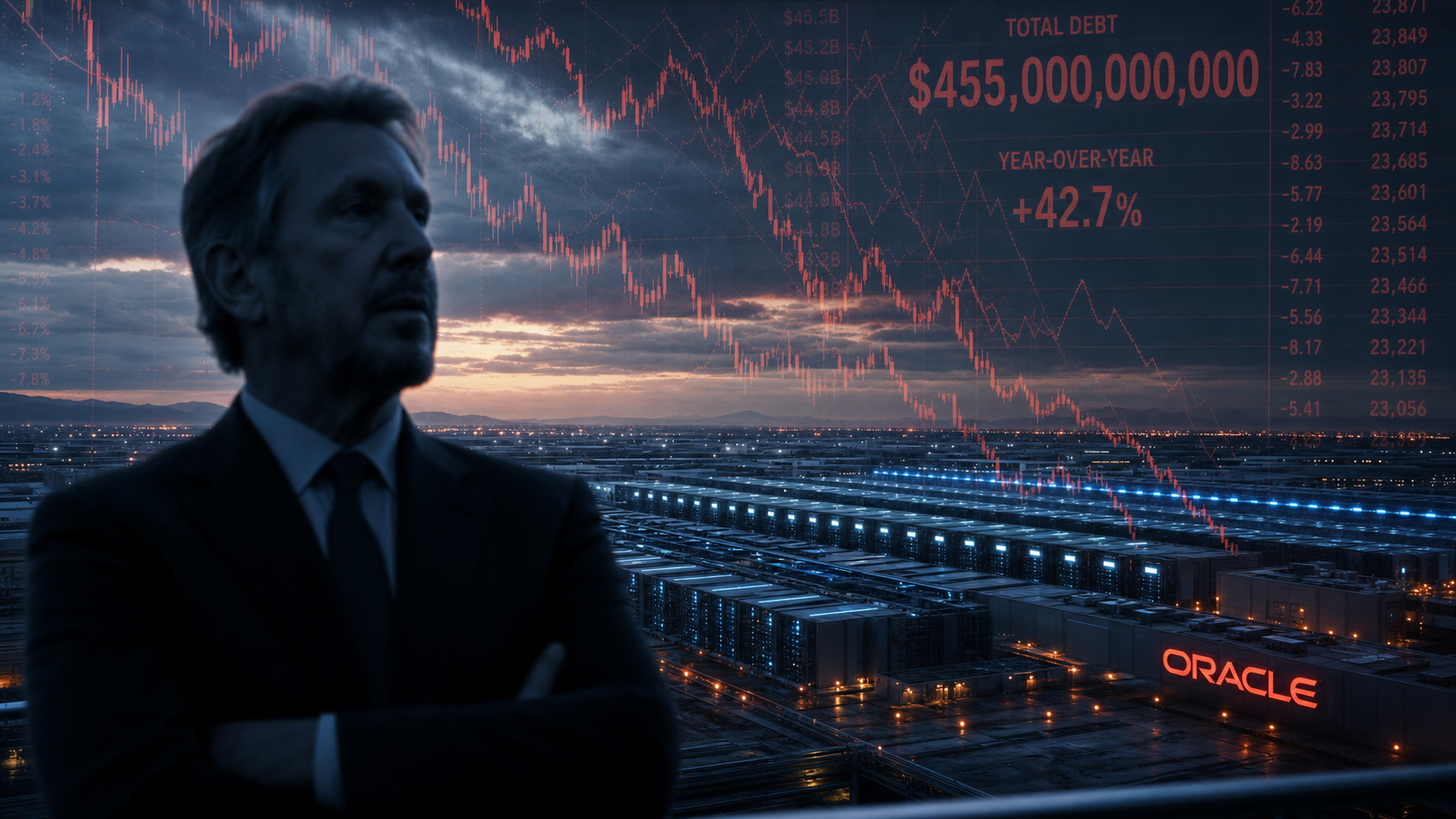
Just one step away from junk bond status: Oracle as a seismograph of the AI bubble – When the debt machine runs faster than the cash flow – Image: Xpert.Digital
Is Oracle gambling away its future with the AI hype? Credit shock at Oracle: Is the gigantic AI bubble about to burst?
From richest man to king of debt: Oracle's daring fall
Dependent on OpenAI: Larry Ellison's dangerous billion-dollar game
Oracle was once considered the undisputed beneficiary of the new AI age – but today the company is increasingly raising concerns on Wall Street. To build its gigantic artificial intelligence infrastructure, Larry Ellison's company has amassed an unprecedented debt burden in a very short time and become highly dependent on partners like OpenAI. While rating agencies are already pulling the plug due to the exploding costs, and a downgrade to junk status looms, a disturbing question is emerging in the financial markets: Is the former software giant the first unmistakable warning sign of the bursting of the global AI bubble?
Oracle's long-term rating was downgraded by S&P from BBB to BBB- on July 9, 2026 – the lowest level still considered "investment grade." Directly below, at BB+, lies the speculative category, colloquially referred to as "junk" or "junk," meaning Oracle is actually only one rating notch away from this status.
Oracle as a seismograph of the AI bubble: When the debt machine runs faster than the cash flow
At the beginning of 2025, Larry Ellison was considered a symbolic figure of a new technological age. When he stood next to Donald Trump in the White House in January of that year to present the gigantic infrastructure project Stargate, the rise of his company, Oracle, seemed limitless. The US president described him as an extraordinary personality and an outstanding businessman, while the announcement of $500 billion in investments in data centers sent the stock markets into a buying frenzy. For a short time, Ellison held a theoretical net worth of around $400 billion, making him the world's richest person. A year and a half later, a considerably more sobering picture emerges. Oracle has become a symbol of the growing nervousness with which investors are watching the technology industry's rampant investments in artificial intelligence.
From soaring high to crash landing on the stock market
In September 2025, Oracle stock reached its all-time high, and no other technology company rose as sharply in the months following the Stargate unveiling as the Austin, Texas-based firm. Ellison was briefly the wealthiest person in the world at that time. However, by the fall of 2025, market sentiment had begun to shift as investors increasingly questioned the financing of the company's massive construction plans. This skepticism proved justified: In the first half of 2026, the stock lost roughly a quarter of its value as concerns grew about the solvency of major customers. The figures now paint a clear picture of the financial strain. Oracle's total debt increased from $85.3 billion to $122.3 billion in a single year, while lease obligations more than doubled from $11.5 billion to $26.6 billion. In total, Oracle's liabilities grew from $147.4 billion to $218.7 billion in twelve months. In addition, there are approximately 260 billion US dollars in data center leasing contracts, which are not yet fully recorded as classic debt on the balance sheet, but have long been included in risk assessments by analysts.
A traditional company dares to make a radical change of course
Oracle was founded in 1977 by Larry Ellison and two co-founders as a specialist in database software and built a dominant position in the enterprise software market over decades. Ellison himself stepped down as CEO in 2014 after 37 years at the helm, but remained closely associated with the company as a major shareholder and chairman. In recent years, Oracle has increasingly become a direct competitor of cloud giants like Amazon Web Services and is now investing heavily in its own AI infrastructure. This transformation from a traditional software provider to a capital-intensive data center operator marks a fundamental strategic break with the company's historical business model. The rating agency S&P aptly describes this change as a development that is increasingly diluting the company's once strong and stable business risk profile.
The rating agencies are sounding the alarm
When Oracle announced in June 2026 that it would invest billions more in expanding its data centers, projecting net investments of around $70 billion for the current fiscal year alone, the financial markets reacted with marked caution. The stock plummeted 12 percent in a single trading day as investors increasingly questioned how such debt-fueled growth could be sustainable in the long term. On July 9, 2026, the rating agency S&P finally took action, downgrading Oracle's long-term credit rating from BBB to BBB-, placing the company just one notch above junk status. Analysts explained this move by stating that they had previously underestimated the scale of the necessary investments to expand the AI business and its impact on the company's creditworthiness. At the same time, S&P drastically revised its forecast for free cash flow in fiscal year 2027 downwards, now expecting a deficit of nearly $42 billion, significantly more than the previously projected $24 billion. For Henrik Karlsen, managing director of the Danish investment fund Horizon3, this development is a clear warning sign. It is unusual for such a large technology company to be so close to a speculative credit rating while simultaneously undertaking the largest investment spree in its entire corporate history. If the valuation falls further, certain institutional investors whose investment guidelines require investment-grade securities could be forced to sell their Oracle bonds.
🎯🎯🎯 Data-driven B2B industry hub as a quasi-in-house solution

The quasi-in-house solution: How Xpert.Digital closes operational gaps in B2B marketing and sales – Smart Content-Driven Business - Image: Xpert.Digital
Xpert.Digital is a data-driven B2B industry hub led by Konrad Wolfenstein . The company acts as an external, quasi-in-house solution for industrial partners, closing operational gaps in marketing, content, and sales – without requiring additional resources on the client side.
More information here:
The weak point of the AI industry: Why Oracle is operating at its limit
The risky symbiosis with Sam Altman's empire
At the heart of Oracle's financial future lies its close ties to Sam Altman and his company OpenAI, which also stood alongside Ellison at the Stargate presentation in January 2025. This intertwining is exceptionally tight: OpenAI needs Oracle's gigantic data center capacity, while the software giant simultaneously relies on profitably marketing its costly new infrastructure. In September 2025, the two companies signed a contract in which OpenAI committed to acquiring approximately $300 billion in computing power over a five-year period, beginning in 2027. What is remarkable about this agreement is the glaring mismatch between the commitments: at the time of the contract's signing, OpenAI generated only about $10 billion in annual revenue, yet owed Oracle an average of $60 billion per year. Henrik Karlsen strongly warns against this concentration, describing the business relationship between the two companies as one of the most concentrated customer relationships currently observed in the entire market. The fragility of this structure became apparent in March 2026 when both companies unexpectedly canceled the construction of a jointly planned data center in Texas because they could not agree on either financing or OpenAI's revised technical requirements for newer chip generations. This news immediately caused considerable turmoil on the stock markets.
A mountain of billions in orders without guaranteed payment options
To reassure investors, Oracle often points to its massive order backlog, which reached a record $638 billion at the end of fiscal year 2026, representing a year-over-year increase of 363 percent. According to reports in the Wall Street Journal, roughly $300 billion of this so-called Remaining Performance Obligation (RPO) is attributable to the OpenAI contract alone. However, the timing of these contracts is problematic: Oracle itself admits that it will only be able to convert about 12 percent of this backlog into revenue in the next 12 months, followed by another 34 percent in the subsequent two years. Wall Street analysts are increasingly questioning whether some of Oracle's largest AI customers have the financial resources to actually fulfill their contractual obligations, which, given the enormous debt Oracle has incurred to finance its expansion, could have disastrous consequences. This concern is by no means abstract: OpenAI itself is currently posting huge losses and is dependent on ever new rounds of funding in order to meet its multi-billion dollar obligations to infrastructure partners such as Oracle.
Why Ellison's company could be the breaking point of the AI industry
Business media and market analysts have been intensely debating for months whether the major US technology companies, together with their investors, have created a financially unsustainable AI bubble. The European Central Bank recently addressed this issue as well, renewing its warnings about the systemic risks of a potential bursting of this bubble. What makes Oracle particularly vulnerable is its unique position among the major hyperscalers: While competitors like Microsoft, Google, and Amazon can largely finance their AI investments from their own substantial operating cash flows, Oracle, due to limited equity reserves, is forced to finance its expansion primarily through debt and long-term leases. According to Oracle, its debt recently stood at 4.3 times its operating profit before interest, taxes, depreciation, and amortization (EBITDA), a figure that analysts at the rating agency S&P expect to rise to as high as 4.4 in the next two fiscal years. A ratio exceeding 4.5, according to the agency, would trigger a further downgrade of the company's credit rating and significantly increase its financing costs. Henrik Karlsen offers a nuanced perspective on this development: Should a bubble actually form in the AI sector, he doesn't believe Oracle will be its primary cause. Rather, the company is one of the first places where early warning signs of a potential failure would appear – essentially an early warning system for the entire industry.
The price of growth off the balance sheet
To at least partially close the massive funding gap, Oracle has already taken drastic measures in its operations. In fiscal year 2026, the company reduced its workforce by approximately 21,000 positions, representing about 13 percent of its total workforce, lowering its headcount from roughly 162,000 to about 141,000 employees. Analysts estimate that these savings could provide the company with additional cash flow of eight to ten billion US dollars per year – an amount that, however, only addresses part of the problem given the estimated 23.7 billion US dollar investment gap in the past fiscal year. At the same time, CFO Hilary Maxson announced plans to raise another 40 billion US dollars in fresh capital in fiscal year 2027 through a combination of new debt and a previously announced 20 billion US dollar capital increase. The five-year credit default swap, a common indicator of the cost of insuring corporate bonds against default, recently rose to around 219 basis points in connection with these developments. This is a clear indication that financial markets are now pricing in a significantly higher risk of the company's default than they were just a few months ago.
Between daring and warning signal
Oracle thus exemplifies a dilemma that is likely to plague the entire technology industry in the coming years: the conflict between the necessity of massive upfront investments in an uncertain AI future and the tangible risks of excessive debt financing in a rapidly evolving technological market. The central danger for Oracle lies in the time gap between the long construction times for data centers and the significantly shorter innovation cycles for computer chips, which could cause completed facilities to become technologically obsolete faster than the associated investments can be recouped. Whether Larry Ellison's bold gamble ultimately proves to be a visionary milestone or a cautionary tale of an overheated industry will likely be decided in the next two to three fiscal years, when Oracle must demonstrate that its gigantic order backlog can actually be converted into reliable, solvent revenues.
📈🚀 From visibility to trust 👀🤝 Your scalable path with Xpert.Digital

From visibility to trust: Your scalable path with Xpert.Digital - Image: Xpert.Digital
In industrial B2B, sustainable business relationships rarely emerge overnight. They develop step by step – through visibility, professional relevance, recurring touchpoints, and growing trust. Xpert.Digital's 4-stage model addresses precisely this: It offers a structured path that begins with a manageable entry point and can evolve into deeper collaboration in business development if needed.
Instead of relying on loud marketing promises, this model puts the relationship at the forefront. Companies start with clearly defined, easily calculable measures and then decide, based on their own experience, how far they want to expand the collaboration. A key factor for this undisturbed trust-building process: The platform completely avoids annoying advertising ads, so the editorial focus remains solely on the companies' expertise.
More information here:
Your global marketing and business development partner
☑️ Our business language is English or German
☑️ NEW: Correspondence in your native language!

Konrad Wolfenstein
I and my team are happy to be available to you as your personal advisor.
You can contact me by filling out the contact form here [email protected]:or simply call me at +49 7348 4088 965. My email address is
I'm looking forward to our joint project.









