

The $20 billion coup: How Nvidia cemented its AI monopoly with Groq – Jensen Huang's ingenious move against Google & Co.
Xpert Pre-Release

Available in 27 languages 📢
Prefer Xpert.Digital on GoogleⓘPublished on: March 18, 2026 / Updated on: March 18, 2026 – Author: Konrad Wolfenstein
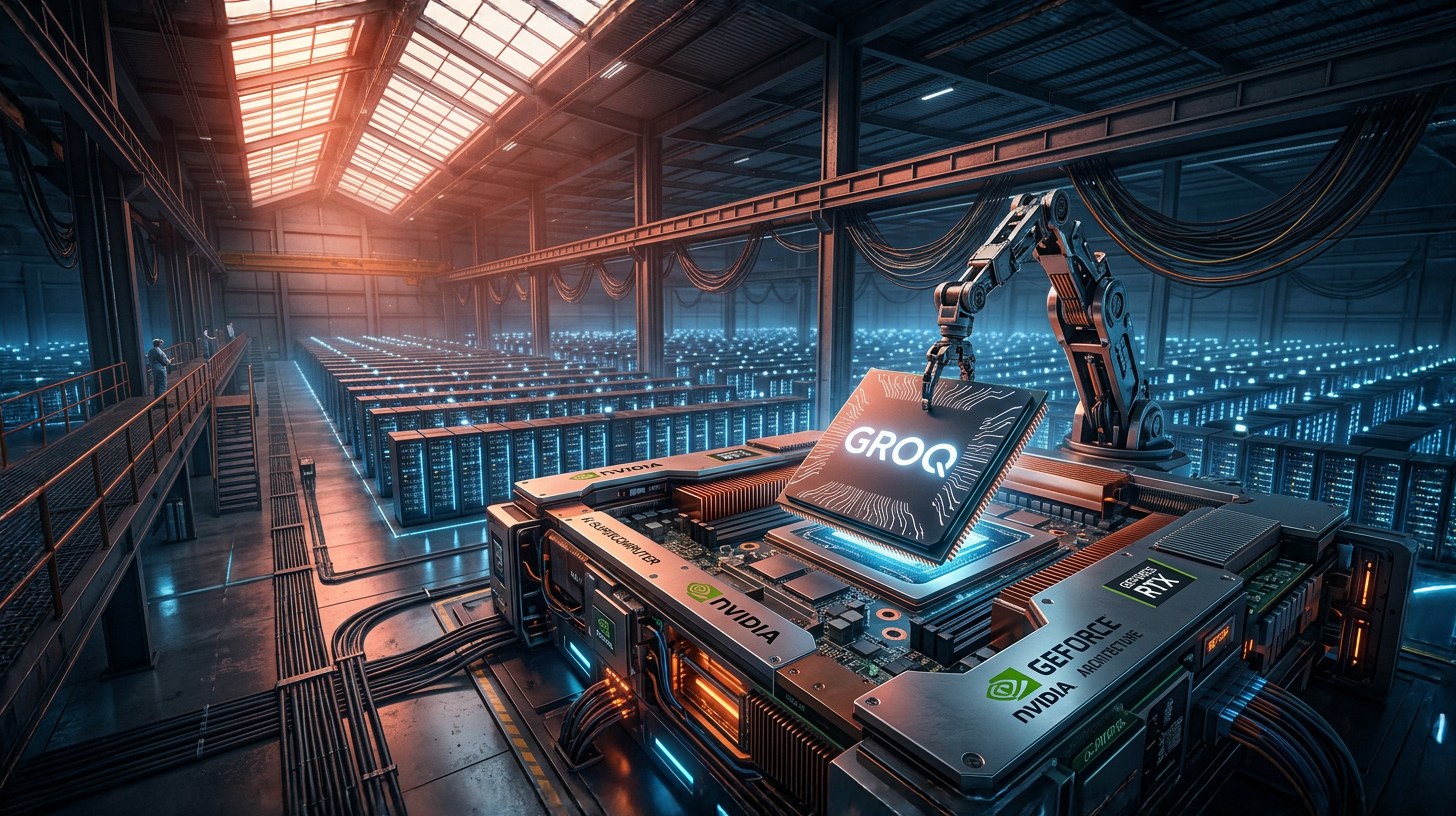
The $20 billion coup: How Nvidia cemented its AI monopoly with Groq – Jensen Huang's ingenious move against Google & Co. – Image: Xpert.Digital
Nvidia swallows Groq – and blows up the data center: The $20 billion integration
Hardware was yesterday: Why Nvidia's new master plan is shaking up the entire tech world
GTC 2026 marks a historic turning point in the technology industry: Nvidia is no longer just a chip manufacturer, but is building an unassailable AI empire before the eyes of the world. With a brilliant and unusual $20 billion move involving the inference startup Groq, CEO Jensen Huang is closing his company's biggest vulnerability. But that's just the tip of the iceberg: While Nvidia's CUDA software platform celebrates its 20th anniversary, the tech giant is cementing its absolute dominance with the new "Vera Rubin" GPU architecture, gigantic desktop supercomputers, and groundbreaking gaming innovations like DLSS 5. This article explores how Nvidia is not only defining the hardware of the coming years, but also completely shaping the data center of the future according to its own vision.
At the end of 2025, Nvidia acquired a stake in the AI chip startup Groq for around $20 billion, securing its inference technology and a large part of the team, while Groq formally continues to exist in a residual form.
This should not be confused with Grok, the AI chatbot from Elon Musk's company xAI: Grok is still owned by xAI, Nvidia is merely acting as a hardware supplier and investor – these are two completely different companies and products.
Jensen Huang is buying the future of inference – and doesn't call it an acquisition – "Not a classic takeover"
GTC 2026 was in many ways the most significant in-house trade show in Nvidia's history. Before more than 30,000 attendees from 190 nations, Jensen Huang presented one product announcement after another at the SAP Center in San Jose – a new GPU architecture with 336 billion transistors, a DGX Station desktop supercomputer with 20 petaflops, autonomous Disney robots, self-driving vehicle platforms for BYD, Hyundai, and Nissan, and a glimpse into AI data centers in space. But Nvidia had already announced its real strategic news in December 2025 with an unusually brief statement: the de facto acquisition of the AI chip startup Groq for $20 billion.
Related to this:

CUDA turns 20 – and has never been so relevant
Before understanding the Groq chapter, one must grasp the foundation upon which it is built. At GTC 2026, Nvidia's CUDA programming platform celebrated its 20th anniversary. Introduced in 2006 as a software interface that allowed developers to harness the massive parallel computing power of graphics processors for general-purpose numerical computations, CUDA has now become a cornerstone of the global AI infrastructure.
On the occasion of this anniversary, Jensen Huang characterized CUDA as a flywheel: the technological advances enabled by the platform have continuously attracted new users, and these new users, in turn, have developed new applications and ideas that have further expanded the ecosystem. This self-reinforcing effect is the core of Nvidia's market power. With over 400 libraries containing GPU-optimized implementations of algorithms from virtually every area of scientific computing and artificial intelligence, CUDA is now so deeply embedded in the workflows of researchers, developers, and businesses that switching to alternative hardware platforms would involve considerable costs. No other chip manufacturer has yet built a comparably dense software ecosystem.
But CUDA – powerful as it is – has a structural weakness that Jensen Huang is increasingly openly acknowledging: While Nvidia's GPUs are virtually unrivaled in the training phase of AI models, the pressure from specialized chips is growing considerably in the area of inference – the task of applying trained models quickly and energy-efficiently to new queries. Google is building its own Tensor Processing Units, Amazon is developing Trainium and Inferentia, and Microsoft is investing in custom silicon designs. It is in this context that Groq came into play.
The Groq deal: $20 billion for the future of inference
Groq is no stranger to the AI chip universe. Founded in 2016 by Jonathan Ross – a former Google engineer who played a key role in the development of the TPU – the startup made a name for itself with a radically different architectural approach. Its Language Processing Units, or LPUs, are specifically optimized for the extremely fast and energy-efficient execution of inference workloads and frequently outperformed traditional GPU architectures significantly in pure inference speed benchmarks. Groq's GroqCloud service offered developers access to these LPUs and became known in the developer community for its exceptional token generation speed.
The deal structure announced by Nvidia in December 2025 is legally unusual: Instead of acquiring Groq as a whole – which would have raised significant antitrust concerns given the market position of both companies – Nvidia signed a $20 billion licensing agreement for Groq's chip technology and simultaneously recruited the company's leadership team, including founder and CEO Jonathan Ross, as Nvidia employees. The licensing agreement is reportedly non-exclusive – Groq can technically continue to operate as an independent company with an inference cloud service. However, industry observers believe that Groq's AI chip innovation capabilities have been largely absorbed by the departure of its key personnel to Nvidia.
Jensen Huang himself drew an insightful historical comparison when announcing the deal: He saw Groq as similar to Mellanox – the networking technology company that Nvidia acquired for $6.9 billion in 2019, a move that proved transformative for the entire data center business. Mellanox brought Nvidia InfiniBand networking technology, which enables thousands of GPUs to be connected to form a gigantic, coherent computing cluster – a capability without which training today's standard large language models would be impossible. Groq is intended to provide the equivalent on the inference side: a specialized accelerator architecture that complements GPUs in serving models and dramatically improves the efficiency of the entire platform.
A new dimension of digital transformation with 'Managed AI' (Artificial Intelligence) - Platform & B2B solution | Xpert Consulting

A new dimension of digital transformation with 'Managed AI' (Artificial Intelligence) – Platform & B2B solution | Xpert Consulting - Image: Xpert.Digital
Here you will learn how your company can implement customized AI solutions quickly, securely and without high entry barriers.
A managed AI platform is your all-inclusive, worry-free solution for artificial intelligence. Instead of dealing with complex technology, expensive infrastructure, and lengthy development processes, you receive a ready-made solution tailored to your needs from a specialized partner – often within just a few days.
The key advantages at a glance:
⚡ Rapid implementation: From idea to ready-to-use application in days, not months. We deliver practical solutions that create immediate added value.
🔒 Maximum data security: Your sensitive data stays with you. We guarantee secure and compliant processing without sharing data with third parties.
💸 No financial risk: You only pay for results. High upfront investments in hardware, software, or personnel are completely eliminated.
🎯 Focus on your core business: Concentrate on what you do best. We take care of the entire technical implementation, operation, and maintenance of your AI solution.
📈 Future-proof & scalable: Your AI grows with you. We ensure continuous optimization and scalability, and flexibly adapt the models to new requirements.
More information here:
Forget everything you knew about Nvidia: The company's true plan has been revealed
The technical details: Groq 3 at the GTC 2026
At GTC itself, Nvidia presented concrete specifications for the integration of Groq's technology under the name Groq 3 LPU. The figures are impressive: 500 megabytes of SRAM, a memory bandwidth of 150 terabytes per second, 35 times higher inference throughput per megawatt compared to GPU-based alternatives, and 256 LPUs per rack with a total bandwidth of 40 petabytes per second. These specifications address precisely the bottleneck that is most painful in practice when mass-deploying LLMs: latency and power consumption when serving models to millions of concurrent users.
For Nvidia's customers—hyperscalers like AWS, Azure, and Google Cloud—this integration translates into significant efficiency gains. Google Cloud announced at GTC a 76 percent cost reduction through the use of optimized Nvidia infrastructure. This is no longer an incremental improvement; it's a redesign of the economics of AI services. In a world where LLM inference operating costs have become a significant expense for every major technology company, halving or even reducing these costs by three-quarters represents a competitive advantage of considerable strategic importance.
Related to this:

The GTC superlatives: 1 trillion dollars and Vera Rubin
In addition to the Groq chapter, GTC 2026 delivered a number of other announcements of historic proportions. Nvidia projected $1 trillion in purchase orders by 2027 – a figure that marks a new chapter even for a company with Nvidia's growth momentum. The new Vera Rubin GPU architecture, with 336 billion transistors – 1.6 times more than the current Blackwell generation – is slated for release in the second half of 2026 and will deliver 3.6 exaflops of FP4 computing power in a single NVL72 rack. This is a density of computing power in a single unit that, just a few years ago, would have been equivalent to an entire data center.
The Feynman architecture was announced for 2028: 14 times the performance of Blackwell, manufactured using TSMC's 1.6-nanometer process with silicon photonics, and scalable to the NVL1152 form factor. This means that Nvidia—even assuming that AI training and inference efficiency will be massively improved by specialized hardware like Groq—has laid out a detailed hardware roadmap for at least another three years. The strategic horizon is clear: Nvidia plans not only to dominate the current wave of AI but also to define the next two to three hardware generations.
The DLSS-5 scenario: A controversy as a side story
GTC 2026 also featured announcements relevant to a broad consumer audience. DLSS 5 – the latest version of Nvidia's Deep Learning Super Sampling for video games – promises full neural rendering in real time and is slated for release in fall 2026 with titles like Resident Evil, Hogwarts Legacy, and Starfield. Reactions to the announcement are mixed: some see DLSS 5 as a breakthrough that will elevate game graphics to a new level of quality. Critics, however, describe it as an added-on filter without any real technological benefit – a debate that reflects the underlying conflict between the gaming community and the AI-driven optimization logic of the semiconductor industry.
The announcement of the DGX Station – a desktop supercomputer with 20 petaflops, 748 gigabytes of coherent memory, and the ability to run models with one trillion parameters locally – is also relevant for private users and businesses in Germany and marks a potentially important shift in the accessibility of high-performance AI. Available in an air-gapped version for sensitive environments, this system addresses the growing segment of professional users who, for regulatory or data protection reasons, are required to run AI models locally.
The conclusion: Nvidia is no longer a chip manufacturer
What GTC 2026 reveals as a whole is a company in the systematic transition from a pure hardware provider to a full-stack AI infrastructure powerhouse. With the Groq integration, Nvidia is addressing the inference weakness of its GPU architecture. With NemoClaw and OpenClaw, it is claiming the agent middleware layer. With the Nemotron Coalition and $26 billion in investments in open-source AI models, it occupies the model layer. With cloud deals for over one million GPUs on AWS, the DGX Station line, and the Vera Rubin roadmap, it continues to dominate the hardware foundation.
The ability to address all these layers simultaneously and weave them together through deep integration between CUDA, NeMo, NIM, and the hardware architecture is Nvidia's true unique selling point in the current AI market. No other player—neither Google, nor Microsoft, nor Amazon, and certainly not OpenAI—possesses a comparably deep and consistent integration across all layers of the AI stack. The data center of the future, as GTC 2026 suggests, is essentially an Nvidia data center—in terms of the hardware, the software, the models, and the agent infrastructure that builds upon it all.
Your global marketing and business development partner
☑️ Our business language is English or German
☑️ NEW: Correspondence in your native language!

Konrad Wolfenstein
I and my team are happy to be available to you as your personal advisor.
You can contact me by filling out the contact form here or simply call me at +49 7348 4088 965. My email address is: [email protected]
I'm looking forward to our joint project.









