
Nvidia breaks all records – Why investors are still getting cold feet
Xpert Pre-Release

Available in 27 languages 📢
Prefer Xpert.Digital on GoogleⓘPublished on: May 22, 2026 / Updated on: May 22, 2026 – Author: Konrad Wolfenstein
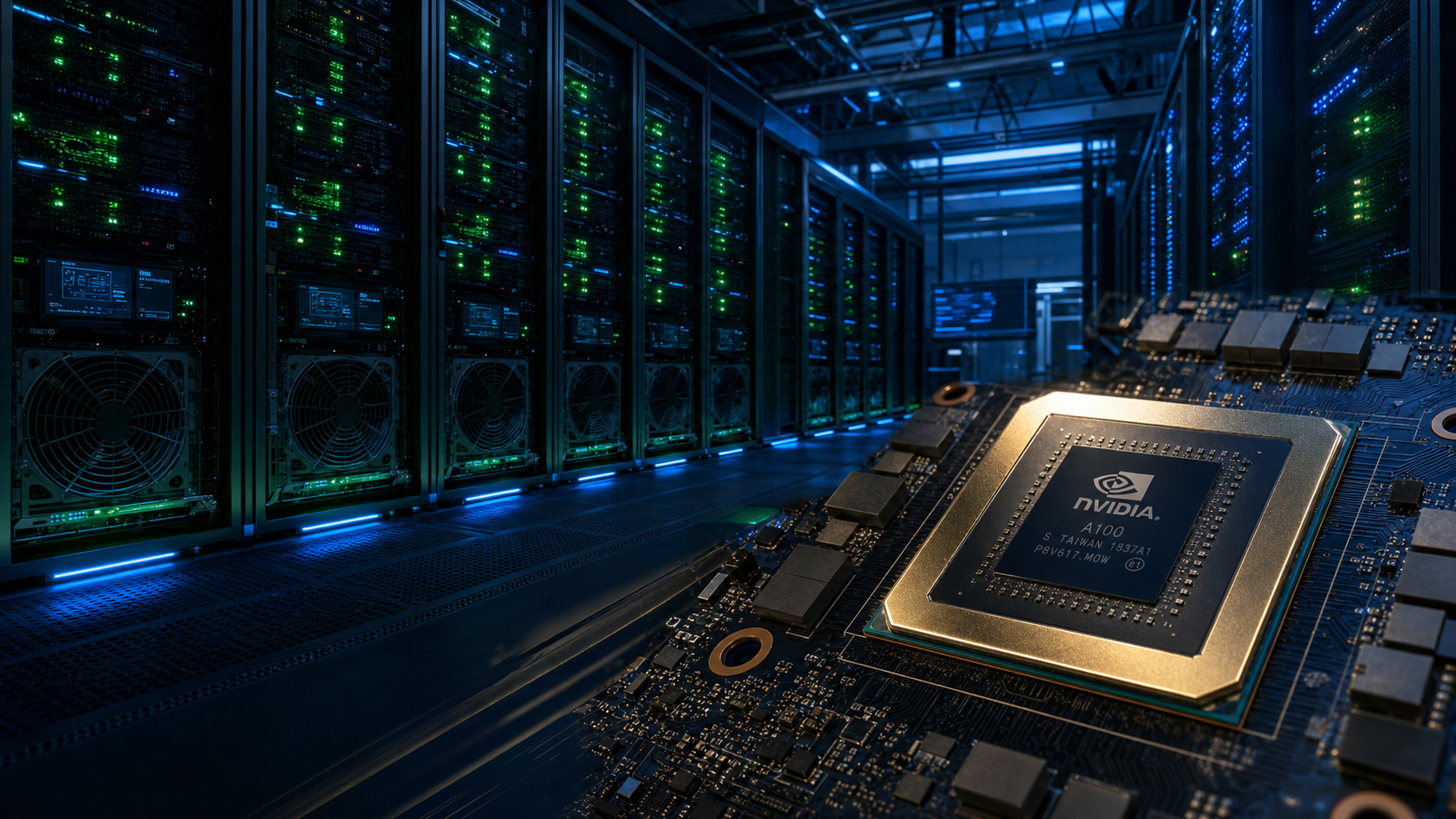
Nvidia breaks all records – Why investors are still getting cold feet – Image: Xpert.Digital
The $5.6 trillion trap: The two dangers that now threaten Nvidia's AI monopoly
The AI boom is reaching its limits: Why Nvidia's biggest problem isn't the competition
Warning sign despite record profits: Is Nvidia stock a ticking time bomb after this quarter?
Nvidia has reached a scale that defies all historical comparisons. With a market capitalization of $5.6 trillion, the Santa Clara-based company has not only surpassed industry giants like Apple and Google, but even exceeds the entire gross domestic product of Germany. Quarter after quarter, the corporation, under the leadership of Jensen Huang, delivers astronomical growth rates: most recently, revenue of over $81 billion and an almost threefold increase in operating profit. Nvidia is no longer just a chip manufacturer, but the architect and sole ruler of the global AI infrastructure.
Yet despite this unprecedented success story, the latest quarterly figures set off alarm bells for some observers – because the financial markets reacted surprisingly mutedly. The company has fallen victim to massive "expectation inflation." For a company growing so rapidly, stagnation at record levels is already a setback. Behind the glittering facade and the dizzying investment sums of the tech giants, however, very real structural risks are brewing: geopolitical tensions surrounding the crucial China business, enormous data centers pushing the limits of global power supply, and major customers like Meta, Microsoft, and Google feverishly developing their own chips in the background to break free from Nvidia's iron grip. Will Nvidia's undisputed market power, cemented by the powerful CUDA software platform, withstand these storms? An in-depth analysis of the world's most valuable company and its fragile crown.
Related to this:

Nvidia – The world's most valuable company and its fragile crown
Record growth alone is no longer enough to excite investors
Nvidia's latest quarterly results read like a timeless success story: $81.6 billion in revenue in the most recent quarter, an 85 percent increase year over year. Adjusted operating profit climbed nearly 150 percent to $53.5 billion. And yet, the market reaction was muted—a phenomenon that reveals deeper tensions within Nvidia's narrative. The company has become the benchmark for its own expectations, and that benchmark is now so high that even historically impressive figures barely elicit euphoria anymore.
When records become commonplace: The latest quarterly figures
Nvidia's market capitalization has increased more than 15-fold in the past five years – to its current value of $5.6 trillion. This makes the Santa Clara, California-based company the most valuable in the world, surpassing Google's parent company Alphabet, which is valued at $4.7 trillion. This figure is almost incomprehensible until you put it into perspective: Nvidia's market capitalization exceeds the gross domestic product of Germany – the world's third-largest economy – at $5.45 trillion.
The data center business, the company's dominant growth engine, generated $75.2 billion in revenue in the most recent quarter – nearly double the figure for the same period last year. CEO Jensen Huang announced an additional $80 billion share buyback program and significantly increased the quarterly dividend from $0.01 to $0.25 per share. The forecast for the current quarter is around $91 billion – again exceeding average analyst estimates.
And yet: Investors remained cool. This phenomenon, which observers might call "expectation inflation," is symptomatic of a company's history so steep that any flattening—even at an astronomically high level—is interpreted as a disappointment. The market is no longer pricing in the present, but rather an almost infinitely protracted future. And this is precisely where the doubts begin.
From graphics card to AI factory: How Nvidia is redefining its marketplace
Nvidia was once perceived as a manufacturer of graphics processors for the gaming market. This perception is now as outdated as the floppy disk. The company's true core business has long since shifted: Nvidia sells the infrastructure upon which the AI revolution of the entire global economy is built. The data center business now accounts for more than 90 percent of total revenue.
The Blackwell architecture, Nvidia's current generation of chips, marks a paradigm shift in the design of AI hardware. While previous generations consisted of individual GPUs connected to form clusters, Nvidia now thinks in terms of entire rack systems. The GB200 NVL72 combines 72 Blackwell GPUs and 36 Grace CPUs into a single compute domain that, thanks to NVLink connections, operates like a single, monolithically powerful GPU. A single rack of this type consumes around 86 kilowatts for the GPUs alone – many times more than traditional server infrastructure.
CEO Jensen Huang himself no longer refers to his products as chips or servers, but as "AI factories." This branding move is more than just marketing rhetoric: it signals that Nvidia is no longer selling hardware in the traditional sense, but rather turnkey production facilities for artificial intelligence. This conceptual shift is one of the most astute strategic repositionings in the history of Silicon Valley.
The true moat principle: Why CUDA is worth more than any chip
Public perception of Nvidia's strength focuses on hardware – on the sheer computing power of the H100 and Blackwell chips. But market experts know that the real competitive advantage lies elsewhere: in the CUDA software platform, short for Compute Unified Device Architecture. Andy Heinig, a chip expert at the Fraunhofer Institute for Integrated Circuits, puts it succinctly: "CUDA is the reason why no one has yet succeeded in seriously competing with Nvidia."
CUDA enables the parallelization of calculations on GPUs and was introduced by Jensen Huang as a strategic lever back in 2006 – long before the AI age began. Since then, developers worldwide have built vast amounts of code, libraries, models, and workflows on the CUDA platform over the past 19 years. The real competitive advantage, therefore, is not CUDA itself – it's everything built on top of it. The ecosystem now comprises more than 400 libraries, integrated into leading cloud platforms such as Amazon Web Services, Microsoft Azure, and Google Cloud.
Competitors like AMD rely on the open-source ROCm platform, Intel on oneAPI. Both are not only battling superior hardware, but also a decades-old ecosystem that massively increases switching costs for customers. A company that has optimized its training pipeline for CUDA pays an enormous price when switching to another chip manufacturer – in the form of development time, performance losses, and risk. This lock-in effect is Nvidia's true fortress.
The demand engine: When trillions in investment create tailwinds
Nvidia's growth isn't coming out of nowhere. The driving force is a massive, unprecedented wave of investment by global technology giants in AI infrastructure. Amazon, Google, Meta, and Microsoft—the world's four largest hyperscalers—plan combined capital expenditures of up to $725 billion for 2026, almost exclusively for AI infrastructure. This represents an increase of more than 60 percent compared to the already record-breaking spending of 2025.
The individual figures are staggering: Amazon plans $200 billion in capital expenditures for 2026 alone, Google between $175 and $185 billion, Meta between $115 and $135 billion, and Microsoft around $110 to $120 billion. This money flows primarily into chips, server infrastructure, and network technology – and a significant portion of it ends up with Nvidia.
Meta alone planned to deploy over 350,000 Nvidia H100 chips by the end of 2025—more than any other company worldwide. The sheer scale of these infrastructure programs explains why even analysts concerned about Nvidia's valuation find few arguments for a slowdown in the short term. Demand is not only high—it is structurally secured by multi-year investment commitments from the world's largest companies.
Geopolitical time bomb: The China dilemma and its multi-billion-dollar consequences
Nvidia's most significant uncertainty is not technological, but geopolitical. Its China business, most recently served by the H2O chip specifically designed for the Chinese market, has been the scene of escalating trade disputes for months. In April 2025, the Trump administration imposed export controls on the H2O chip to China, resulting in a $5.5 billion loss for Nvidia in inventory and purchase commitments.
This decision was not an isolated incident, but part of a long-term US strategy to deny China access to advanced AI chip technology. Under President Biden, gradual export restrictions had already forced Nvidia to develop scaled-down versions of its chips for the Chinese market – first the A800, then the H20. Ironically, these alternative products were also ultimately deemed too powerful. As a result, Nvidia will miss out on approximately $8 billion in expected Chinese revenue in the first quarter of the current fiscal year 2027.
According to the latest reports, Nvidia has instructed its suppliers to temporarily halt production of its H20 chip, while geopolitical tensions and internal Chinese regulatory concerns further complicate the situation. At the same time, Chinese tech giants like Tencent and ByteDance have been summoned by authorities regarding their H20 orders, citing security risks associated with sensitive data. This presents Nvidia with a structural dilemma: China is a huge market, but access to it hinges on the day-to-day political course in Washington – a risk that cannot be fully modeled in any balance sheet.
🎯🎯🎯 Data-driven B2B industry hub as a quasi-in-house solution

The quasi-in-house solution: How Xpert.Digital closes operational gaps in B2B marketing and sales – Smart Content-Driven Business - Image: Xpert.Digital
Xpert.Digital is a data-driven B2B industry hub led by Konrad Wolfenstein . The company acts as an external, quasi-in-house solution for industrial partners, closing operational gaps in marketing, content, and sales – without requiring additional resources on the client side.
More information here:
When AMD, Google & Co. will attack Nvidia's GPU monopoly and why AI expansion could fail due to power capacity limitations
The challengers: When AMD, Google, and their own customers become a real threat
Nvidia's market share in the AI accelerator segment for data centers lies between 80 and 92 percent – a dominance that is exceptional even in monopolistic technology markets. However, the erosion of this position is not a question of if, but when and to what extent. Two structural developments appear particularly relevant in this context.
First, traditional competition is intensifying due to AMD. With its MI350 chip generation and the MI400 announced for 2026, AMD is directly attacking Nvidia's Blackwell series. CEO Lisa Su has formulated clear growth targets and has already secured the MI350's place in Meta and xAI. AMD is relying on a combination of performance parity and an open-source software strategy (ROCm) to circumvent CUDA lock-in. Intel is also positioning itself as an alternative with the Gaudi 3: This chip trains certain AI models up to 50 percent faster than Nvidia's H100 while consuming less energy.
Second, and strategically far more significant, Nvidia's own largest customers are increasingly developing proprietary AI chips. Google is already using its own v5p-generation Tensor Processing Units (TPUs) at scale. Amazon has developed its own accelerators for AWS with Trainium and Inferentia. Microsoft is investing in its own chip designs. Meta is developing inference chips for its data centers. This movement is not a short-term cost-cutting measure—it is an attempt to emancipate itself from a strategically critical single point of failure. Amazon, Google, Meta, and Microsoft are expected to have invested around $350 billion in their own chip development and alternative infrastructure by the end of 2025. The central question, therefore, is no longer whether Nvidia's market share will erode, but how quickly—and whether the company is able to further develop its platform strategy in time to retain its central infrastructure role even in a more diversified competitive landscape.
Related to this:

Assessment between reason and vision: What analysts really think
For a company with a market capitalization of $5.6 trillion and year-over-year growth of 85 percent, the question inevitably arises whether its valuation is still justified by fundamental metrics – or whether it is based on pure speculation based on expectations. The answers are surprisingly diverse. Morningstar recently described Nvidia stock as "moderately undervalued" and raised its fair value estimate to $240, noting that while long-term concerns about AI funding are justified, 2026 is expected to be another strong year for AI. Fundamental analysis platforms like finanzen.net, however, see the stock as "significantly undervalued" based on its growth-to-valuation ratio, with a discount of around 37 percent compared to the normal price for its growth potential.
Analysts have issued an average price target of $255 for 2027 – roughly 36 percent above the current price, with the highest target reaching $454. The consensus among the 69 analysts who provided revenue forecasts for fiscal year 2026 is $217 billion in annual revenue – a figure that would have been considered an unrealistic fantasy just a few years ago. Total annual revenue for the past fiscal year 2026 already amounted to $215.9 billion, 65 percent higher than the previous year.
These figures form the backdrop to a fundamental valuation problem: Nvidia is not valued as a traditional industrial company, but rather as a platform operator with network effects and structural growth. A gross margin of over 70 percent—a figure more reminiscent of software companies than semiconductor manufacturers—underpins this view. As long as the company can defend its technological lead and the CUDA moat, the valuation premium is rationally justifiable. However, as soon as one of its major customers establishes a viable alternative or geopolitical headwinds intensify, the premium could correct very quickly and painfully.
Energy, infrastructure and sustainability: The physical limits of the AI boom
It would be incomplete to examine Nvidia's story solely from a financial market perspective. Behind every quarterly report lies a physical reality that is increasingly reaching its natural limits. AI data centers are not abstract data clouds—they are massive energy consumers. A single NVL72 rack with 72 Blackwell GPUs requires up to 100 kilowatts or more, and modern AI training clusters consist of thousands of such units. Traditional air cooling is no longer sufficient; liquid cooling and immersion cooling have become the standard.
In Germany, the industry will invest around €12 billion in data center capacity in 2025, with a projected energy demand of 21.3 billion kilowatt-hours – and this figure is expected to rise sharply. AI data centers in Germany are projected to quadruple by 2030. This development not only presents enormous challenges for municipal utilities and grid operators, but also brings the question of energy availability and sustainability to the forefront of strategic investment decisions. Those building AI infrastructure need reliable electricity – in a quantity and quality that is simply not available in many regions of the world.
For Nvidia, this indirectly represents an additional risk: if the expansion of data centers is hampered by energy shortages, the growth in chip demand will also fail. Morningstar and other analysts explicitly point to energy supply as a medium-term growth limiter for the AI sector. The industry association Bitkom estimates that AI applications will account for more than 50 percent of global data center traffic by 2027 – requiring the development of entirely new energy infrastructures and green energy sources that simply aren't available at this pace.
Related to this:

The structural paradox: Why Nvidia's strength is also its greatest vulnerability
There's a structural irony in Nvidia's success story that's rarely discussed openly: the company is so dominant that it's co-creating its own crisis. Its four largest customers—Amazon, Google, Meta, and Microsoft—are simultaneously the four biggest drivers of chip demand and the four biggest investors in alternative chip technologies. These customers have collectively earmarked up to $725 billion for AI infrastructure by 2026—and a significant portion of that budget is flowing into the development of alternatives to Nvidia.
The logic is understandable: No global player can permanently accept a strategic dependence on a single supplier whose chips are sold out, expensive, and geopolitically exposed. Customers continue to buy Nvidia hardware in record numbers because there is no viable alternative in the short term. In the medium term, however, they are systematically working to reduce this dependence. This contradiction—maximum demand today, targeted development of alternatives tomorrow—is the core structural dilemma behind the sober investor reactions.
Then there's the DeepSeek phenomenon, which briefly shook the markets in early 2025: When the Chinese AI company DeepSeek went public with a supposedly computationally efficient model, Nvidia's stock price fell sharply in the short term because investors feared that cheaper AI models could curb the demand for GPUs. The reaction demonstrated how sensitive Nvidia's narrative is to any news that challenges its seemingly relentless demand. Ultimately, the concern proved premature – but the trembling remained as a reminder of how quickly expectations can collapse.
Nvidia's next chapter: Ruby, Sovereign AI and the path to the infrastructure role
Nvidia isn't resting on its laurels. The next generation of chips after Blackwell is codenamed Rubin and is intended to further expand its performance leadership. Conceptually, Nvidia is moving away from simply selling chips towards a complete infrastructure role: The company is positioning itself as an operator and provider of "AI factories"—fully integrated data centers that can be delivered turnkey and operated as a software service platform.
Another growth vector that has received too little public attention is the concept of "Sovereign AI": states and regions that want to build their own AI capabilities to achieve technological sovereignty. Jensen Huang has recently been actively promoting this topic – including at the Hannover Messe 2026. Countries that don't want to rely exclusively on US or Chinese AI infrastructure are potential major customers for Nvidia systems. Europe, the Middle East, parts of Asia, and Latin America are actively pursuing such sovereignty programs. This demand base diversifies Nvidia's customer base beyond the traditional hyperscalers – and is likely to become a significant growth driver in the coming years.
Record numbers as the starting point, not the end point of the analysis
Nvidia's quarterly figures are impressive, almost unbelievable. $81.6 billion in revenue and $58.3 billion in net profit in a single quarter – these are figures that have catapulted the company into a league without historical precedent. And yet, it would be analytically naive to uncritically interpret these numbers as a guarantee for the future.
The risks are real: geopolitical export restrictions that structurally threaten the China business; a growing field of competitors attacking Nvidia's software moat with open-source alternatives; customers systematically investing in their own chip technologies; energy constraints that could limit the physical growth of AI infrastructure; and a valuation based on the assumption of uninterrupted hypergrowth. At the same time, the opposing view is equally valid: the AI investment cycle has only just begun. Demand is structurally underpinned by billion-dollar commitments from the world's largest companies. Nvidia's CUDA ecosystem offers a moat that no competitor can overcome in a few years. And the Blackwell architecture sets technological standards that AMD and Intel will be chasing for years to come.
The investors' subdued reaction to record quarterly figures is therefore not a sign of irrationality. It signals a market structure in which expectations are now so high that reality can hardly exceed them. Nvidia doesn't have to fail to disappoint its investors – it's enough if growth is somewhat slower than hoped. That is the real burden of the world's most valuable company.
Your global marketing and business development partner
☑️ Our business language is English or German
☑️ NEW: Correspondence in your native language!

Konrad Wolfenstein
I and my team are happy to be available to you as your personal advisor.
You can contact me by filling out the contact form here simply call me at +49 7348 4088 965. My email address is [email protected]:or
I'm looking forward to our joint project.









