
Vibe Coding and AI Coding Agents – Who Needs Programmers Anymore? The Inconvenient Truth
Xpert Pre-Release

Available in 27 languages 📢
Prefer Xpert.Digital on GoogleⓘPublished on: March 24, 2026 / Updated on: March 26, 2026 – Author: Konrad Wolfenstein
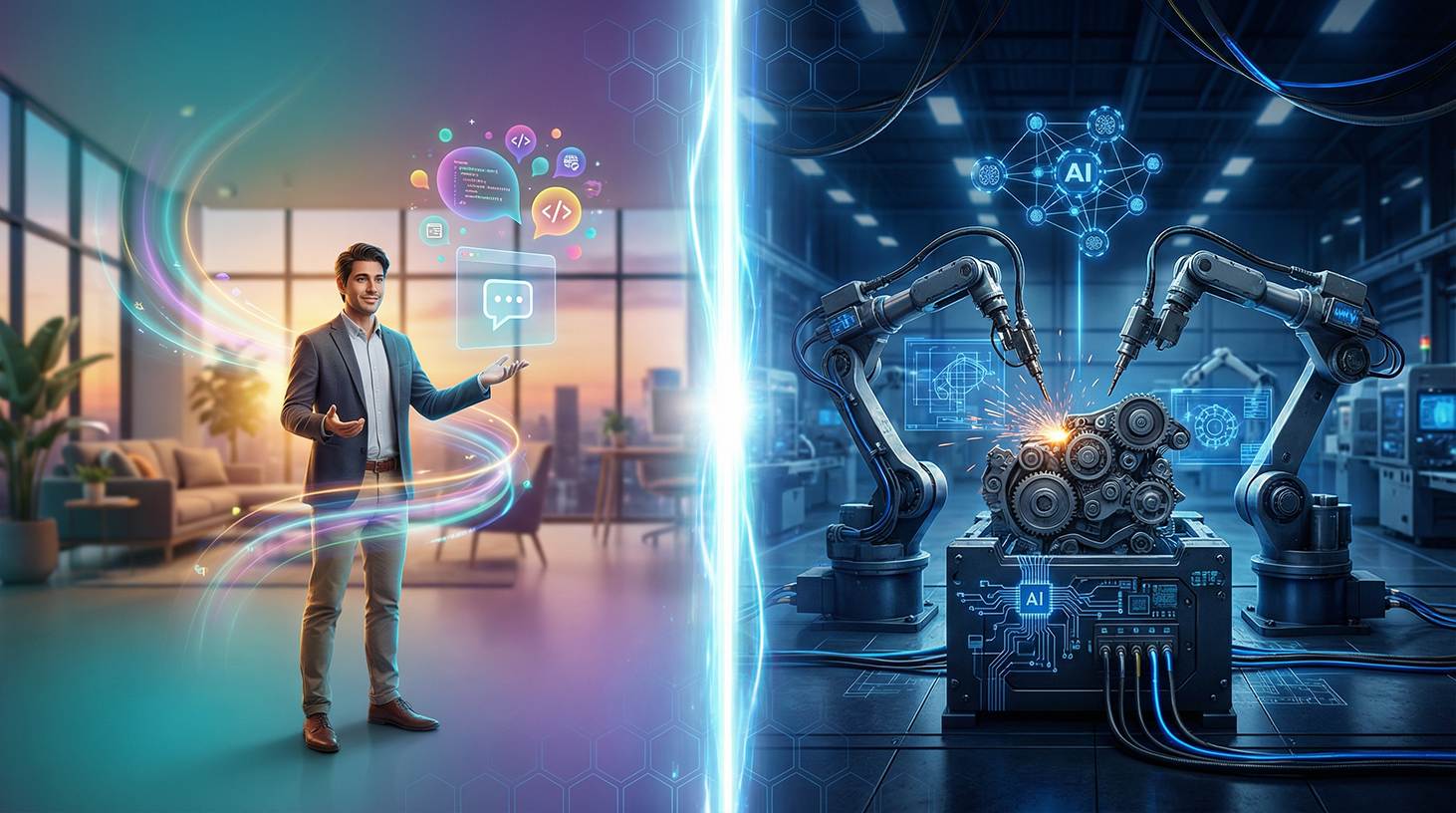
Vibe Coding and AI Coding Agents – Who Needs Programmers Anymore? The Inconvenient Truth – Image: Xpert.Digital
Not for industry: Why "vibe coding" can be life-threatening in mechanical engineering
AI isn't replacing developers – it's making them more expensive: The surprising truth about coding agents
Software development is facing the biggest turning point in its history: Manually typing lines of code is increasingly giving way to intuitive control by artificial intelligence. With "vibe coding" and autonomous AI coding agents, two revolutionary but fundamentally different development approaches are currently colliding. While vibe coding allows even those without technical expertise to "feel" software through simple voice commands and build rapid prototypes, AI agents act as independent digital colleagues that reliably orchestrate complex industrial workflows. However, the enormous hype – driven by explosive growth rates and billion-dollar valuations – also carries enormous risks: from a looming flood of technical debt to massive security and liability issues in regulated industries. For mechanical engineering and traditional manufacturing in particular, the strategic distinction between these two AI trends is crucial for survival. This article examines the technological foundations of both paradigms, analyzes their economic impact, and shows why AI will not replace experienced developers in the future, but rather make them more valuable than ever.
Related to this:

On the new age of AI-powered software development
Software development is currently undergoing one of the most profound transformations in its history. In February 2025, AI researcher and former OpenAI co-founder Andrej Karpathy coined the term "Vibe Coding"—a name for a new way of programming in which developers no longer write individual lines of code, but instead communicate to an AI system in natural language how the software should feel and what it should do. The concept spread so rapidly that it was included in the Merriam-Webster dictionary in March 2025 and named Word of the Year 2025 by the Collins English Dictionary. Parallel to this consumer-oriented development, so-called AI coding agents matured: autonomous systems that not only respond to prompts but also independently orchestrate entire development cycles—from planning and testing to delivery.
Both approaches are based on the same technological foundations, namely large language models (LLMs), and both fundamentally change the economics of software production. Nevertheless, they differ considerably in architecture, target audience, risk structure, and economic relevance—especially in industrial and mechanical engineering contexts. A differentiated analysis of these two trends is essential not only for technology managers but for every strategically minded business leader.
Definition framework: What really separates Vibe Coding from AI coding agents
Vibe coding describes a process in which humans relinquish all or most of their cognitive control over the actual code to an AI system. The user specifies a "vibe"—an intention expressed in natural language—and accepts the generated code without necessarily understanding or reviewing it. Platforms like Lovable, Bolt.new, Replit, and Cursor represent the most important commercial implementations of this approach. The target audience is deliberately broad: non-programmers, marketing and sales professionals, and founders without a technical background—all should be empowered to create functional software.
AI coding agents, on the other hand, operate at a fundamentally different level of autonomy. They plan independently, execute tasks, test results, and iterate in loops that are only monitored, but not actively controlled, by humans. Systems like Devin from Cognition, Claude Code from Anthropic, or Windsurf represent this category. An academic analysis from 2025 by Cornell University and the University of the Peloponnese precisely summarizes the key difference: Vibe coding emphasizes intuitive, human-guided interaction through conversational workflows, while agent coding enables autonomous software development through goal-oriented agents that plan, execute, test, and iterate with minimal human intervention. Thus, these are not two competing, but rather two complementary development paths addressing different problem spaces.
Market dynamics: Billion-dollar valuations and explosive growth rates
The economic dimension of both areas is impressive and hard to ignore. While vibe-coding startups were valued at around seven to eight billion US dollars in August 2024, this figure rose to over 36 billion US dollars within a single year – a growth of 350 percent. The combined annualized revenue of the leading platforms exceeded 800 million US dollars, coupled with exceptionally high valuation multiples: Devin from Cognition was valued at an ARR multiple of around 140x, Cursor at 45x.
Individual companies have become flagship examples of this growth dynamic. The Swedish startup Lovable achieved $400 million in annual recurring revenue by March 2026—with just 146 employees. Emergent, another player, reached an annual run rate (ARR) of $100 million within just eight months of its founding. Gartner predicts that by 2028, an estimated 40 percent of new enterprise software will be developed using Vibe coding techniques and tools. According to an IDC estimate, the low-code market alone will grow to $45.5 billion by 2025. These figures mark not just an investment phenomenon, but a structural shift in the entire software industry.
Architecture of Autonomy: How both systems function internally
The operating principles of the two paradigms differ significantly at the technical level. Vibe coding platforms essentially operate as conversational development environments: The user describes what they want in natural language, the LLM generates code, and the user evaluates the result in a feedback-style conversation. The development process remains reactive – the AI responds to human input. Platforms like Bolt.new deliver a working frontend prototype in under 30 minutes, Lovable excels with outstanding UI/UX quality, while Replit offers a broader ecosystem with backend features, authentication, and database connectivity.
AI coding agents, on the other hand, possess a proactive architecture: They receive a goal and independently develop an execution plan, call up tools, write and test code, resolve errors without human intervention, and document their steps. Siemens aptly describes this approach as a transition from the question-and-answer paradigm to systems that can autonomously execute complete industrial workflows. This orchestration of multiple specialized sub-agents by a higher-level instance—comparable to a master craftsman coordinating various specialists—enables the handling of tasks that would simply be too complex for a single prompting system.
Commonalities of both approaches: The connecting foundation
Despite their differences, both paradigms share a common technological and economic foundation. Both utilize large language models as a core component and benefit from their rapidly increasing capabilities. Both aim to democratize software development: Complex programming knowledge should no longer be a prerequisite for creating useful digital solutions. Both significantly increase development speed—a factor that translates directly into economic advantages in competitive markets. A 2025 PwC study based on nearly one billion job postings shows that productivity growth in AI-exposed industries has almost quadrupled since 2022—from seven percent to 27 percent.
Both approaches also promote the concept of "concurrent building and selling": companies can implement ideas in parallel and test them on the market without having to wait for complete product development. The Berlin-based company Blinkist already uses Vibe Coding specifically to prototype new product ideas in rapid iterations and present them directly to customers for feedback. Ultimately, both face the same fundamental challenges: code quality, security, maintainability, and regulatory compliance are issues that neither approach solves per se, but which must be addressed through accompanying governance structures.
Economic risks: Technical debt as a ticking time bomb
The downside of this rapid development is a growing burden of technical debt. Vibe coding inherently generates undocumented code that is often not fully understood by either the creator or their successors. New employees have no reference points, code reviews become time-consuming and risky, and the original design logic is forgotten after just a few months. A forecast being discussed across the industry estimates that the technical debt accumulated by the uncontrolled use of AI code will reach up to $1.5 trillion by 2027. Added to this is the so-called "SaaSpocalypse": By early 2026, approximately $300 billion in market capitalization had been wiped out at traditional software companies because AI agents fundamentally threatened their user-based business models.
Related to this:

AI coding agents present a different, but no less serious, risk dimension. Their lack of transparency—the inability of humans to trace every decision step—creates new liability risks. A hallucinating or misconfigured agent can unintentionally disclose sensitive customer data or compromise critical infrastructure components. The Veracode report from 2025 demonstrates that AI-generated code creates security vulnerabilities in 45 percent of all cases. Furthermore, a DORA study concludes that 30 percent of developers have little or no trust in AI-generated code—and that despite increased individual productivity, delivery instability at the system level is on the rise. The effect of AI acts as an amplifier: If the organizational foundation is solid, companies benefit enormously; if architecture, platform quality, and governance are lacking, the benefits are lost.
A new dimension of digital transformation with 'Managed AI' (Artificial Intelligence) - Platform & B2B solution | Xpert Consulting

A new dimension of digital transformation with 'Managed AI' (Artificial Intelligence) – Platform & B2B solution | Xpert Consulting - Image: Xpert.Digital
Here you will learn how your company can implement customized AI solutions quickly, securely and without high entry barriers.
A managed AI platform is your all-inclusive, worry-free solution for artificial intelligence. Instead of dealing with complex technology, expensive infrastructure, and lengthy development processes, you receive a ready-made solution tailored to your needs from a specialized partner – often within just a few days.
The key advantages at a glance:
⚡ Rapid implementation: From idea to ready-to-use application in days, not months. We deliver practical solutions that create immediate added value.
🔒 Maximum data security: Your sensitive data stays with you. We guarantee secure and compliant processing without sharing data with third parties.
💸 No financial risk: You only pay for results. High upfront investments in hardware, software, or personnel are completely eliminated.
🎯 Focus on your core business: Concentrate on what you do best. We take care of the entire technical implementation, operation, and maintenance of your AI solution.
📈 Future-proof & scalable: Your AI grows with you. We ensure continuous optimization and scalability, and flexibly adapt the models to new requirements.
More information here:
Hybrid architectures: How humans and agents can jointly build better machines
Industry and mechanical engineering: Where the paths fundamentally diverge
For the economy in general, and mechanical engineering in particular, the distinction between these two approaches is strategically crucial. Vibe coding has so far been largely irrelevant in traditional industry – and for good reason. Industrial control systems, SCADA applications, embedded software for machine controls, or safety-critical production logic cannot be built on undocumented, poorly understood code. Fraunhofer IESE explicitly warns that the risks associated with vibre coding increase exponentially with the complexity and criticality of the application. Anyone relying on poorly tested, AI-generated code in a manufacturing plant risks not only failures, but also personal injury and production stoppages costing billions.
AI coding agents, on the other hand, are already deeply embedded in mechanical engineering and are redefining the industrial value chain. At the Automate 2025 trade fair in Detroit, Siemens presented its AI agent system, which is integrated into the existing Industrial Copilot ecosystem and, according to the company, is expected to enable productivity increases of up to 50 percent for customers. At CES 2026, Siemens also deepened its partnership with NVIDIA with the goal of making AI the operating system of industry – including a "Digital Twin Composer" and nine specialized copilots for different production phases. With ELECTRIX AI 2026, WSCAD demonstrates how a control cabinet layout that used to take hours can now be created in two minutes – including routing, thermal calculations, and functional grouping.
Related to this:

Application areas in mechanical engineering: From design to quality assurance
AI agents in mechanical engineering now address a wide range of industrial use cases along the entire value chain. In the area of predictive maintenance, agents continuously analyze sensor data and maintenance histories to forecast machine failures early on – with measurable effects on downtime and operating costs. AI agents support sales staff in the customer-specific configuration of complex machines, taking into account production requirements, budgets, and technical compatibilities. Further areas of application include the automated generation of technical documentation in multiple languages by extracting data from CAD models and test reports, as well as the analysis of production data to identify inefficiencies.
Platforms like Synera demonstrate how AI agents in engineering can establish direct connections to CAD, CAE, and ERP systems and take over tasks ranging from automated CAD modeling and simulations to the creation of standards-compliant manufacturing documentation. At Hannover Messe 2025, Microsoft, in collaboration with Siemens, presented a basic AI model for industrial applications, running on Azure, designed to increase productivity in engineering and automation tasks. AI agents for engineering firms integrate into CAD, BIM, and AEC pipelines, automatically tag model changes, extract attributes for bills of materials, and prepare QA checklists. They become digital colleagues that independently perform routine tasks – around the clock.
Regulation and compliance: The most ignored risk of both paradigms
The regulatory dimension is an underestimated strategic factor for both paradigms. For AI agents in industrial applications—especially in critical infrastructures—the EU AI Act, the NIS2 Directive, and the new EU Machinery Directive are the relevant legal frameworks. The GDPR presents particular challenges here: Autonomous multi-agent systems decide independently at runtime which services to access, in what order, and with which data—a scenario that disrupts traditional data protection roles. The data processing agreement pursuant to Article 28 GDPR, a proven instrument for classic cloud services, is conceptually unsuitable for agentic systems that autonomously chain third-party services.
Vibe coding creates not only technical but also legal liabilities: licensing issues for generated code, copyright concerns, and data privacy issues remain unresolved. Furthermore, systematic testing and documentation are lacking—a situation that is virtually unacceptable in regulated industries such as mechanical engineering or pharmaceuticals. Companies relying on vibre coding without a governance framework today are building a liability time bomb into their system architecture. Modern agentic AI systems for the DACH region, on the other hand, are integrated with compliance requirements from the ground up: governance workflows are checked for EU AI Act and GDPR compliance before execution.
Labor market and employment: Is AI displacing the developer?
The question of the impact on the labor market is politically charged and economically complex. Vibe coding significantly lowers the barrier to entry: The market for non-technical developers is far larger than that for traditional programmers, opening up enormous market potential. In the short term, this could alleviate the acute shortage of skilled workers in software development—a problem that particularly affects medium-sized mechanical engineering companies in Germany. In the long term, however, the question of software quality and system responsibility becomes more pressing than ever.
The PwC study from 2025, based on the analysis of nearly one billion job postings, arrives at a more nuanced conclusion: In the sectors most exposed to AI, the number of layoffs did not increase, but rather the number of jobs and salaries – employees with AI skills earn up to 56 percent higher compensation. The Cologne Institute for Economic Research (IW) demonstrates that 82 percent of German companies already report productivity gains through generative AI – an average of 13 percent per year. However, the Accenture study from 2025 shows that only 8 percent of companies have fully integrated AI, while these pioneers are achieving up to 7 percent faster revenue growth and 11 percent cost savings. The message is clear: AI makes experienced developers more valuable, not redundant – but it fundamentally shifts the demands placed upon them.
Hybridization as a strategic future
The dichotomous contrast between vibe coding and AI coding agents is increasingly dissolving in practice. The research community is already discussing hybrid architectures that combine natural language interfaces with autonomous execution pipelines. Platforms like Replit are evolving in this direction: Replit Agent 3 is neither a pure vibe coding tool nor a fully autonomous coding agent, but rather a browser-based, full development environment with integrated agent automation. GitLab describes the path from vibe coding to agentic AI as a natural development roadmap: Vibe coding provides the foundation for human-AI interaction through natural language, while agentic systems build upon this foundation and evolve into self-directed development partners.
For industrial companies, a clear strategic recommendation is emerging: Vibe coding platforms can be used for internal prototypes, customer demos, non-critical front ends, and accelerating market validation processes—but never for safety-critical or production-relevant systems. AI coding agents, on the other hand, are already an indispensable tool for companies in mechanical engineering and industry, provided they are embedded in a robust governance framework, audited for GDPR compliance, and monitored by subject matter experts. Siemens' message from CES 2026—"Just as electricity once revolutionized the world, industry is now undergoing a profound transformation"—doesn't describe a distant future, but rather the current reality for those companies that are already taking action.
Structural comparison: Vibe Coding vs. AI Coding Agents
| feature | Vibe Coding (Platforms) | AI coding agents |
|---|---|---|
| Degree of autonomy | Moderate (human-led) | High (goal-oriented autonomous) |
| Target audience | Non-technical people, founders, marketing professionals | Companies, engineers, DevOps teams |
| Typical tools | Lovable, Bolt.new, Replit, Cursor | Devin, Claude Code, windsurf, copilot |
| Strengthen | Prototype speed, democratization | Enterprise automation, CI/CD, refactoring |
| Weaken | Maintainability, documentation, scalability | Lack of transparency, GDPR complexity |
| Industrial suitability | Low (not for critical systems) | High (with governance framework) |
| Market valuation (2025) | >36 billion USD (segment) | >10 billion USD (individual players) |
| Regulatory risk | Means (License, Copyright) | High (EU AI Act, GDPR, NIS2) |
| Relevance to mechanical engineering | Very low | Very high (CAD, CAE, Predictive Maintenance) |
The two approaches differ significantly: Vibe coding platforms are moderately autonomous and largely human-led, targeting non-technical users, founders, and marketing professionals, and utilizing tools like Lovable, Bolt.new, Replit, or Cursor. Their strengths lie in high prototyping speed and the democratization of software development, while weaknesses include maintainability, documentation, and scalability. Their suitability for industrial applications is limited—they are not suitable for critical systems—and the regulatory risk is considered moderate (due to licensing and copyright issues). The segment is projected to be worth more than USD 36 billion by 2025. Its relevance to mechanical engineering is very low. In contrast, AI coding agents offer a high degree of goal orientation and autonomy, primarily targeting companies, engineers, and DevOps teams, and employing tools like Devin, Claude Code, Windsurf, or Copilot. Their strengths lie in enterprise automation, integration into CI/CD processes, and refactoring. Weaknesses include a lack of transparency and complex GDPR issues. With a suitable governance framework, they are considered highly suitable for industrial applications. Individual players are valued at more than USD 10 billion in 2025, and the regulatory risk is high (EU AI Act, GDPR, NIS2). AI coding agents are particularly relevant for mechanical engineering, for example, for CAD, CAE, and predictive maintenance.
Your global marketing and business development partner
☑️ Our business language is English or German
☑️ NEW: Correspondence in your native language!

Konrad Wolfenstein
I and my team are happy to be available to you as your personal advisor.
You can contact me by filling out the contact form here or simply call me at +49 7348 4088 965. My email address is: [email protected]
I'm looking forward to our joint project.
☑️ SME support in strategy, consulting, planning and implementation
☑️ Creation or realignment of the digital strategy and digitization
☑️ Expansion and optimization of international sales processes
☑️ Global & Digital B2B trading platforms
☑️ Pioneer Business Development / Marketing / PR / Trade Fairs
🎯🎯🎯 Data-driven B2B industry hub as a quasi-in-house solution

The quasi-in-house solution: How Xpert.Digital closes operational gaps in B2B marketing and sales – Smart Content-Driven Business - Image: Xpert.Digital
Xpert.Digital is a data-driven B2B industry hub led by Konrad Wolfenstein . The company acts as an external, quasi-in-house solution for industrial partners, closing operational gaps in marketing, content, and sales – without requiring additional resources on the client side.
More information here:









