
New graphite sources for Europe: Why Canada could become so important for the battery industry
Xpert Pre-Release

Available in 27 languages 📢
Prefer Xpert.Digital on GoogleⓘPublished on: November 15, 2026 / Updated on: November 15, 2026 – Author: Konrad Wolfenstein
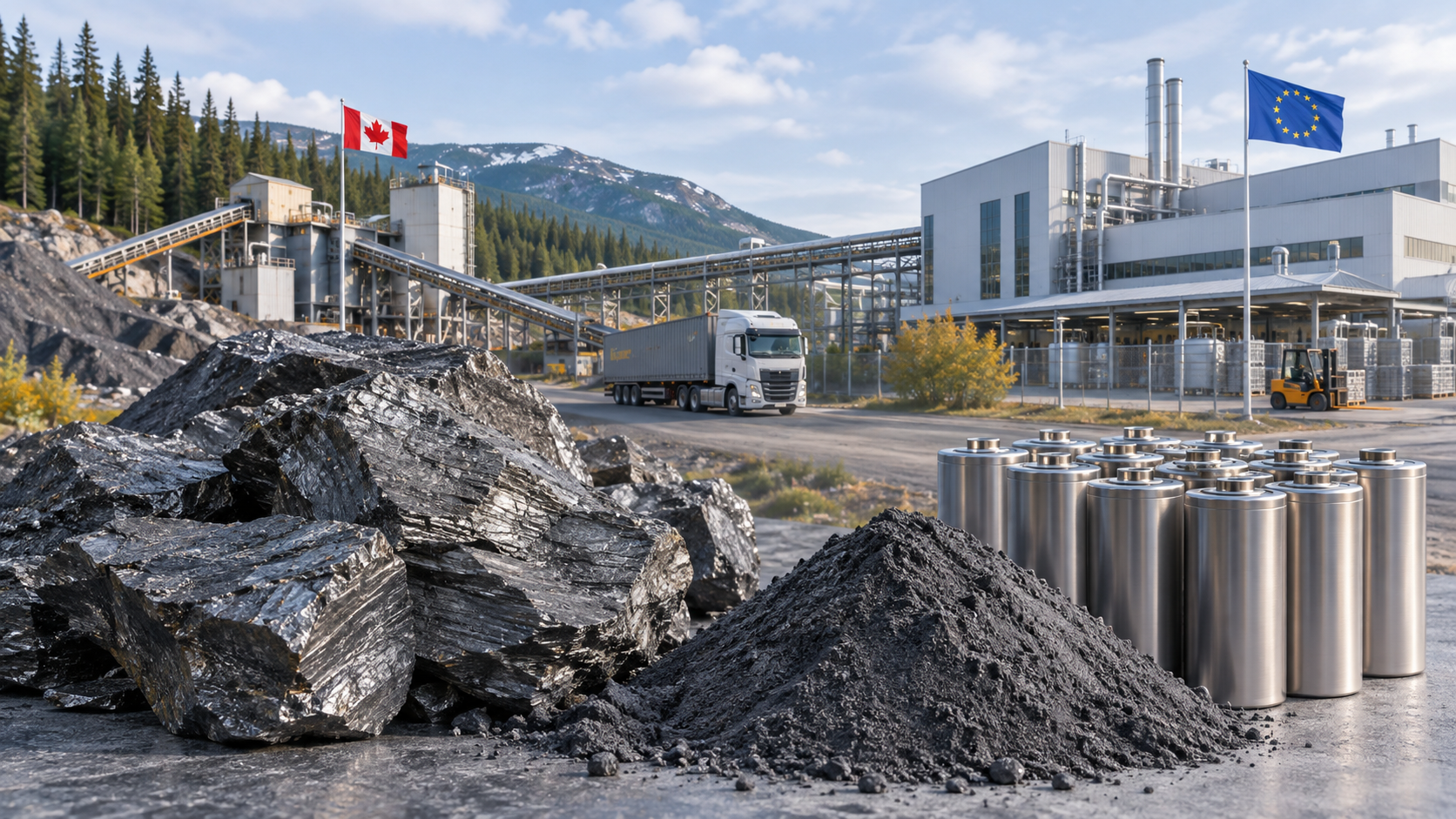
New graphite sources for Europe: Why Canada could become so important for the battery industry – Creative image on the topic, with AI: Xpert.Digital
Europe's battery industry dependent on China: Will graphite become the decisive bottleneck?
Batteries without graphite? Why Europe's factories depend on new supply chains
Canada instead of China: Can a new graphite partnership secure Europe's industry?
Europe's battery industry depends on a raw material that is barely visible in the finished electric car: graphite. This material is needed for the anodes of many lithium-ion batteries. If the supply fails, even modern cell factories and multi-billion-dollar production facilities could grind to a halt. According to one estimate, a complete trade disruption could jeopardize downstream production capacities worldwide outside of China, with an annual production value of more than US$300 billion. This is a potential damage scenario – not an actual loss or a forecast specific to Europe.
The dependency extends beyond mining. China dominates, in particular, the processing of graphite into materials that battery manufacturers can actually use. Therefore, simply developing new graphite deposits is insufficient: crucial factors include additional processing capacity, economic financing, and technical approval from industrial customers. Canada could play a key role for Europe in this regard. A framework agreement signed between the European Investment Bank and Canada at the end of October 2026 opens up new possibilities for supporting suitable projects with financing and technical assistance. However, whether this will result in a reliable alternative depends on more than just raw material deposits and political declarations of intent.
Europe's graphite risk: Why Canada could be crucial for industrial independence
Europe's industrial future depends not only on high-performance battery factories, competitive electric cars, and a reliable energy supply. It also depends on materials that are barely visible in the finished product. Graphite is one of these underestimated foundations of modern value creation. Many lithium-ion batteries cannot be manufactured without suitable anode material. Without this component, even state-of-the-art cell factories temporarily lose their economic viability.
The magnitude of the risk is considerable. A complete disruption of trade in battery-grade graphite could jeopardize downstream production capacities worldwide, outside of China, with an annual production value exceeding US$300 billion. Electric vehicles, battery cells, and stationary energy storage systems would be particularly affected. This figure, however, does not represent damage already incurred, nor does it represent losses attributable solely to Europe. Rather, it illustrates the significant industrial production value dependent on a highly concentrated supply of materials.
Against this backdrop, cooperation between Europe and Canada is gaining strategic importance. The framework agreement signed at the end of October 2026 between the European Investment Bank and Canada lays the foundation for supporting suitable Canadian projects with financing and technical assistance in the future. Critical raw materials are to be among the initial priorities. This creates an additional point of contact for bringing together European capital, Canadian raw material resources, and industrial demand. However, this does not yet constitute a financing commitment for individual companies.
The crucial economic question, therefore, is not whether Canada has graphite. It is whether a competitive, industrially viable, and readily available supply for European companies can be established from this supply in a timely manner. For this to happen, mining, processing, financing, and offtake agreements must be aligned. Individual deposits or successful laboratory tests are not enough.
The $300 billion figure describes a systemic risk, not a certain loss
The economic importance of graphite is often underestimated because the raw material value represents only a limited portion of the value of a finished car or energy storage system. However, this is precisely the characteristic of critical intermediate products: their share of the total costs can be relatively small, while their technical indispensability is very high.
A battery cell cannot be completed simply by replacing a missing anode material with additional quantities of other components. Production processes are tailored to specific material properties. If the supply of a crucial raw material is interrupted, production can grind to a halt despite the availability of machinery, labor, and other components. Furthermore, graphite supply offers only limited short-term substitution possibilities.
The more than 300 billion US dollars in at-risk annual production should therefore be understood as a stress scenario. This figure describes the potential exposure of downstream industries in the event of a complete trade disruption. It is not a forecast that this amount will actually be lost. Nor does it directly correspond to a decline in gross domestic product. Production value, operational value added, revenue, and macroeconomic damage are distinct metrics and should not be equated.
To assess a genuine disruption, the duration of the interruption, existing inventory levels, alternative supply options, and the companies' adaptability would also be crucial. A bottleneck lasting several weeks would have different consequences than a shutdown lasting several years. Some production volumes could be made up for, while other orders would be lost or go to competitors.
Furthermore, there is the risk of double counting: A battery cell can be considered an independent industrial product and later simultaneously a component of an electric car. Different stages of the value chain should therefore not be added together without verification. Nevertheless, the central conclusion remains valid: The economic impact of a graphite shortage extends far beyond the market value of the raw material.
The actual dependency arises between the mine and the battery cell
In public debate, raw material deposits and security of supply are often too closely linked. However, a deposit outside of China does not automatically guarantee an independent battery supply chain. What is crucial is where and using which processes the raw material is processed into a material that a cell manufacturer can actually use.
For natural graphite, the process begins with the mining of graphite-bearing rock. The graphite is then concentrated. For battery applications, further processing steps follow, including adjusting the particle size to suitable dimensions, shaping, extensive purification, and, if necessary, coating. The significant differences between concentrate and usable anode material are already evident in the various product stages of the Canadian development projects.
China's strategic position is therefore not solely based on mining. Processing is particularly important. According to current estimates, China's share of global production of processed or refined graphite exceeds 90 percent. While the precise definition of the respective statistics is important, the fundamental concentration is clear.
This has an uncomfortable consequence for Europe: Canadian graphite, which would first have to be transported to China for crucial processing, would only partially reduce the geopolitical risk. The mine's geographical diversification would be achieved, but industrial dependence elsewhere would remain.
A robust strategy must therefore be developed backwards, starting with the finished battery product. What material specifications are required? What processing steps are necessary? Where are the corresponding facilities located? Who owns the processes? What quantities can be supplied without interruption? Only the answers to these questions will reveal whether a supply chain actually becomes more resilient.
Why low market prices and high supply risks go together
A key misconception is automatically equating critical raw materials with persistently high prices. In fact, strategically important materials can be cheap for extended periods while simultaneously creating a dangerous dependency.
This combination is precisely what poses a problem for new suppliers. A mine or processing plant requires high initial investments and must be operated profitably for many years. Financing therefore depends not only on an expected increase in demand, but also on sufficiently reliable revenues.
When existing suppliers control large production capacities, low prices can hinder market entry for new competitors. Not every single price movement needs to be politically driven for this to happen. Economies of scale, existing infrastructure, established supply relationships, and an extensive processing network can already generate significant cost advantages. Accordingly, the Canadian-European raw materials debate emphasizes that fluctuating and depressed prices impede the financing of alternative projects.
This creates a coordination problem. European buyers want additional suppliers but ideally don't want to pay permanently higher prices for materials. Investors are expected to finance new capacities but need reliable revenue to do so. Governments, in turn, expect a reduction in dependency without being able to deploy unlimited public funds.
Under these conditions, security of supply takes on an insurance-like character. It may incur additional ongoing costs, but in return reduces the likelihood or the consequences of particularly costly production interruptions. Such protection is not economically sound at any price. Its benefits must be weighed against the additional procurement costs and the actual risk reduction.
What the new agreement with Canada can achieve
The framework agreement signed in Montreal on October 30, 2026, between the European Investment Bank and Canada is primarily an institutional step forward. It establishes the legal basis for the Bank to finance and advise on suitable projects in Canada. This includes, among other things, loans, guarantees, equity instruments, and technical assistance.
These instruments can address various financing obstacles. A long-term loan can stabilize a project's capital structure. A guarantee can limit certain risks for other investors. Technical consulting can help prepare projects for financing or systematically address complex requirements.
Of particular relevance is the potential reach along the value chain. The collaboration should not be limited to raw material extraction, but should also fundamentally include processing, refining, and recycling. This breadth is crucial for graphite, because a new mine without suitable downstream processing does not create an independent material supply.
At the same time, the political significance of the agreement should not be confused with a guaranteed industrial implementation. Each individual financing arrangement remains subject to the standard review and approval procedures of the European Investment Bank. A geologically attractive project can fail due to insufficient economic viability, unresolved environmental issues, or a lack of market prospects.
The real progress, therefore, lies in creating additional opportunities for action. Whether this leads to new European supply relationships will only be decided at the project level. Key factors will be investment decisions, reliable technical documentation, permits, and binding agreements with industrial customers.
Canada offers a reliable supplement, but not a replacement for any other source
Canada combines significant mineral resources with an established mining industry and an institutional environment that generally favors long-term investments. This is attractive for European companies because resource partnerships are based not only on geological potential but also on the reliability of legal and economic frameworks.
Quebec is particularly interesting. The province has graphite projects and access to hydropower. This can be an important foundation for energy-intensive processing methods. A high proportion of low-emission electricity opens up the possibility of improving not only the geographical origin but also the environmental profile of the material. However, whether this advantage actually materializes in a given project depends on the specific energy consumption and the entire production chain.
Canada should not be considered a risk-free alternative supplier. Projects need to be approved, financed, and built. Infrastructure may be lacking or require expansion. Even in a politically stable country, construction costs can rise, schedules can be delayed, or technical difficulties can arise.
Furthermore, a strategic balancing of interests is at play. Canada has a legitimate interest in not merely exporting unprocessed raw materials. Europe, in turn, wants to retain as much of the industrial processing and battery value chain as possible within its own economic sphere.
A viable partnership must reconcile these interests. A division of labor is conceivable, with certain processing steps taking place in Canada and others in Europe. The crucial factor is not maximizing the concentration of all stages in one location, but rather creating an economically sustainable overall system with transparent dependencies.
Lac Knife demonstrates the potential and limitations of individual projects
Focus Graphite's Lac Knife graphite project in Quebec illustrates why Canadian deposits are attractive to Europe. The updated 2023 feasibility study identifies probable mineral reserves of 9.31 million tonnes of ore with an average grade of 14.97 percent graphitic carbon. The underlying operating concept projects a 27-year lifespan and annual production of approximately 50,000 tonnes of graphite concentrate.
The high ore content is economically significant. Generally, with higher grades, less rock needs to be processed to extract a given amount of graphite. Lac Knife is projected to process approximately 365,000 tons of ore annually. This can offer advantages in terms of plant size and material handling, but it doesn't replace a comprehensive cost analysis. The overburden ratio, recovery rate, energy supply, personnel, and transportation also remain crucial factors.
The study estimates the initial capital requirement before production begins at approximately 236.9 million Canadian dollars. The calculated net present value (NPV) after taxes, using a discount rate of eight percent, is 284.8 million Canadian dollars. The internal rate of return (IRR) after taxes is reported as 22.6 percent. These figures are the results of a model based on certain assumptions and do not represent guaranteed returns.
Above all, such key figures should not be interpreted as a current construction or financing commitment. A study with a valuation date of 2023 must be reviewed for price assumptions, construction costs, financing conditions, and project scope before any subsequent investment decision. The technical study does not account for inflation in its described valuation and uses a fully equity-financed model.
Equally important is product definition. A planned annual production of 50,000 tons of concentrate does not automatically equate to the same quantity of marketable battery anode material. Further processing steps, yields, and customer specifications determine what proportion can ultimately be used in which application.
Large resources are not necessarily economically viable reserves
In addition to Lac Knife, Focus Graphite is developing the Lac Tétépisca project. A published resource estimate from 2022 indicates resources of 59.3 million tonnes with 10.61 percent graphitic carbon. This corresponds to approximately 6.3 million tonnes of graphite. Additionally, inferred resources of 14.9 million tonnes with 11.06 percent graphitic carbon, or approximately 1.6 million tonnes of graphite, were reported. These figures should be interpreted in the context of their assessment at the time.
For economic interpretation, the distinction between resources and reserves is essential. A resource describes a geologically investigated deposit with a certain degree of certainty. A reserve, in addition, requires that its economic extraction is sufficiently justified under the respective technical and other conditions.
The categories within a resource estimate are not interchangeable. Inferred resources have a lower level of geological certainty than indicated resources. Therefore, they must not be treated as if all the quantities they contain were already available for a bindingly planned industrial operation.
Large resources are nevertheless valuable for Europe. They can support long-term expansions, additional processing capacities, or the development of regional industrial networks. However, their strategic value initially lies in a future option.
Short-term security of supply will only improve substantially once this option becomes an approved, financed, and functioning operation. Therefore, the size of a deposit answers a different question than the availability of qualified material in the coming production year.
Our EU and German expertise in business development, sales and marketing

Our EU and German expertise in business development, sales and marketing - Image: Xpert.Digital
Industry focus areas: B2B, digitalization (from AI to XR), mechanical engineering, logistics, renewable energies and industry
More information here:
A thematic hub offering insights and expertise:
- Knowledge platform covering global and regional economies, innovation and industry-specific trends
- A collection of analyses, insights, and background information from our key areas of focus
- A place for expertise and information on current developments in business and technology
- A hub for companies seeking information on markets, digitalization, and industry innovations
Graphite purification technologies for the future
High purity is important, industrial mastery is even more important
A technologically interesting development step concerns the purification of graphite. Tests with material from Lac Knife in December 2025 achieved a purity of 99.9996% by weight. Additionally, analysis revealed an equivalent boron concentration of 2.03 parts per million. An electrothermal process without acids or halogen gases was used.
These results show that the material can, in principle, be further developed for demanding applications. However, especially with high-purity materials, the total carbon content alone is not the deciding factor. What impurities remain and how they affect the specific application are also relevant.
The equivalent boron concentration is an important evaluation parameter for certain nuclear applications. It summarizes the effect of various impurities on their neutron absorption in a comparable quantity. A favorable value can therefore be technically significant. However, it is not equivalent to the complete qualification of a ready-to-use reactor component.
The crucial economic factor is scalability. High purity must be achieved not only in a single sample, but consistently across larger quantities. This involves considering energy consumption, plant throughput, material losses, maintenance, and consistent quality.
Environmental assessment also requires differentiation. Avoiding certain aggressive process chemicals can offer advantages. However, a blanket statement about overall environmental compatibility would be premature. This would require considering factors such as power generation, mining, transportation, and byproducts.
The industrial breakthrough, therefore, does not lie solely in the highest published purity value. It lies in a process that reproducibly meets defined quality requirements at a sustainable cost.
Government funding can facilitate scaling, but it cannot guarantee a market
Focus Graphite has been awarded a non-repayable grant of up to 14.1 million Canadian dollars for the development and demonstration of a Canadian electrothermal graphite purification process. This grant supports the transition from technical proofs of concept to an advanced processing platform.
Such funding addresses a typical weakness of industrial innovation. Between laboratory scale and commercial production lies a phase in which significant investments are needed, even though technical and economic risks have not yet been completely eliminated.
Private investors may be hesitant during this phase. Some of the societal benefits, such as a more robust supply of raw materials, do not immediately appear in the profit and loss statements of individual companies. Government support can therefore be economically justifiable if it enables additional development and generates a demonstrable public benefit.
However, this does not entitle production to permanent subsidies regardless of its performance. Funding should support verifiable progress: higher throughput, lower costs, stable product quality, or successful customer qualification.
Furthermore, the overall project evaluation requires a separate assessment of various financing needs. Funding for cleaning technology does not automatically finance the construction of a mine, all downstream facilities, and the necessary working capital.
Success is therefore not solely measured by the amount of funding allocated. What matters is the actual additional industrial capability that results and whether this capability can be sustained economically after the development phase.
A patent opens up possibilities, but it does not replace a market-ready battery
Focus Graphite also pursues a technological approach in the further development of anode materials. On October 27, 2026, a patent was granted in Canada for a process and defined materials related to silicon-reinforced spherical graphite particles. The announcement was made in early November.
The underlying economic idea is understandable: A material with higher usable storage capacity could increase the value of an anode product and help a supplier to stand out from the competition for standardized raw material qualities.
For a tested material variant containing nine percent silicon, reversible capacities of approximately 605 milliampere-hours per gram were reported in laboratory button cells. For comparison, the theoretical specific capacity of conventional graphite, 372 milliampere-hours per gram, was used.
However, this comparison cannot be applied to the entire battery. A higher specific capacity of the anode material under investigation does not automatically translate into a correspondingly higher energy density for a complete vehicle battery. Other components and cell properties are crucial for this.
Similarly, a patent does not automatically prove the economic superiority of a process. It protects a defined technical object, but does not definitively answer questions about mass production costs, durability, and market acceptance.
Nevertheless, this approach is interesting for the European raw materials strategy. It shows that a Canadian supplier does not have to be limited solely to exporting concentrate. Combining deposit production, refining, and material development could enable additional value creation, provided the technical results are validated on an industrial scale.
For Germany, the approval of materials determines the actual benefit
From the perspective of the German automotive industry, not every additional ton of graphite is automatically a viable alternative. The crucial factor is whether the material can be approved for the specific cell chemistry, the respective production process, and the required quality standards.
Qualification therefore links raw material supply and industrial competitiveness. A European manufacturer cannot simply switch material suppliers at will based solely on a cheaper offer or a politically desirable origin. Product development, manufacturing parameters, and quality control must be aligned.
In 2025, Focus Graphite already sent battery-suitable material samples to potential partners for evaluation. These included coated spherical natural graphite with a stated purity of over 99.95 percent. Such sampling is an important development step, but not yet a guarantee of long-term series production orders.
This creates a practical need for action for German companies: Alternative materials should be examined as early as possible, not just during an acute supply shortage. Those who only begin the technical evaluation after a disruption may not be able to utilize available alternatives in time.
At the same time, the procurement strategy must be coordinated across multiple company levels. An automotive manufacturer may have a different view of supply risk than its cell supplier or the latter's anode material producer. Without transparency regarding these connections, the true dependency easily remains hidden.
Security of supply is therefore not achieved simply by adding more suppliers to a shopping list. It requires technically approved alternatives, contractually available quantities, and reliable operational implementation.
Defense and high technology have different requirements than the mass market
In addition to batteries, high-purity graphite materials are being developed for specialized industrial, nuclear, and aerospace applications. Defense-related fields of application are also among the targeted markets. However, these areas should not be lumped together as a single graphite market.
A battery manufacturer evaluates materials according to different criteria than a company that requires a high-temperature-resistant or particularly pure specialty material. Purity, particle structure, mechanical properties, and documentation requirements can differ significantly.
This diversity can be an opportunity for the economic development of a project. Different product qualities could serve various customer groups and broaden the revenue stream. However, this requires that the respective requirements are actually met and corresponding sales volumes are achieved.
At the same time, it would be misleading to conclude that a large, profitable market exists solely from individual, technically feasible specialized applications. High-priced niche markets can have small volumes. Battery sales, on the other hand, can require significantly larger quantities but are often subject to greater cost pressure.
From a security policy perspective, volume alone is not the only relevant factor. Even a small amount of material can be indispensable for a critical system. Therefore, the prioritization of public support should consider both the economic scope and the importance of individual applications.
Europe needs binding demand, not just political declarations of intent
Financing new capacity becomes significantly easier when future revenues are more predictable. Long-term offtake agreements can therefore form a crucial link between industrial demand and investment.
However, this presents a conflict of interest. The producer wants price and quantity certainty before investing. The buyer wants competitive conditions and wants to avoid committing too early to a material that is not yet fully proven.
One possible solution is phased agreements. Technical milestones, volume ramp-up, and pricing formulas can be linked. This avoids the need to eliminate all uncertainty at the outset. Instead, it defines the verifiable conditions under which further obligations arise.
Public funding can also be linked to such progress. A prerequisite would be careful risk distribution: the state should not bear all the disadvantages while potential benefits accrue exclusively to private stakeholders.
A price floor or similar safeguard can make new projects financially viable under certain conditions. However, it can also perpetuate inefficient cost structures. Therefore, limits, independent audits, and clear success metrics are essential.
The benchmark should not be to announce as many projects as possible. What matters is which projects can actually deliver additional, qualified, and sustainably available quantities with a reasonable investment of resources.
Security of supply must be assessed as an economic performance
The cheapest purchase price is not necessarily the most economically advantageous procurement method. If a supply chain has an increased risk of disruption, costs arise that are not included in the direct material price.
This includes potential production outages, additional warehousing, short-term adjustments, and the loss of customer orders. A complete assessment must therefore consider not only the price per ton, but also the expected follow-up costs of different procurement structures.
A simple comparison between the value of a single mine and the 300 billion US dollars at risk worldwide would be methodologically flawed. A single project cannot eliminate all international dependency. Its contribution depends on quantity, product quality, timing, and integration with other processing capacities.
What is economically relevant is the additional safety benefit. Does a project reduce the risk for specific European production lines? Does it eliminate a particularly critical processing step? Does it create a genuinely viable, independent alternative?
Businesses and policymakers should therefore also consider how interconnected different supply sources are. Several contractual partners may depend on the same refinery or technology provider. A large number of nominal suppliers is then less valuable than it initially appears.
The most important metric is not the number of sources of supply, but the ability of the entire supply chain to continue operating in the event of a failure.
Stockpiles, recycling and material innovation complement mining
New mines and processing facilities are not the only instruments for risk mitigation. Strategic stockpiling, recycling, and technological advancements can also contribute. Canadian-European cooperation explicitly pursues coordinated approaches to stockpiles and investments, as well as a joint analysis of battery value chains.
Inventory can bridge temporary disruptions. However, it does not replace a permanently reliable supply. Furthermore, stored materials must meet specific industrial requirements. A large stock of unsuitable materials offers only limited help to an affected manufacturer.
Recycling can unlock additional material sources. However, its contribution is always dependent on technical suitability, available input quantities, and the quality of the recovered product. Therefore, it should be evaluated as a complementary pillar, not as a blanket justification for foregoing new primary supply.
Material innovation can change the requirements per product unit or create additional technical possibilities. However, the example of silicon-reinforced graphite anodes also shows that innovation does not necessarily replace graphite completely. It can also lead to more sophisticated graphite products.
A robust strategy therefore combines different timeframes. Inventory primarily acts as a short-term buffer. Alternative suppliers and additional processing improve medium-term resilience. New storage facilities, recycling capacities, and material development expand long-term options.
Three development paths illustrate the economic consequences
Three analytical scenarios can be distinguished for further developments. These are not predictions, but rather illustrate what the success of the Canadian-European partnership depends on.
In the first scenario, coordinated diversification succeeds. European customers qualify new materials early, investors finance suitable projects, and processing capacities grow in parallel with mining. Canada then becomes an important additional supply pillar. China remains a significant market player but loses some of its position as a virtually irreplaceable bottleneck.
In the second scenario, progress remains fragmented. Individual mines, purification processes, or material projects advance, but industrial coordination is lacking. Capacities are created that do not align with customer needs in terms of timing or technology. Political cooperation improves the initial situation but only leads to a truly independent supply chain to a limited extent.
In the third scenario, low market prices, a lack of offtake agreements, and rising investment costs prevent the timely development of alternative capacities. While Europe retains ambitious industrial plans, it remains heavily dependent on a crucial intermediate product. A subsequent trade disruption would occur under less favorable conditions because new projects still require lead time.
The difference between these scenarios lies less in the existence of Canadian deposits than in coordination. Capital, technology, permits, and demand must all come together within a realistic timeframe.
Success must be measured by qualified delivery quantities
A fair assessment requires verifiable progress indicators. Political statements and abundant raw material resources are relevant, but say little about when European factories will actually be able to obtain additional materials.
Mining projects require, among other things, a solid permitting record, secured financing, and the ability to reliably commence operations. For processing plants, throughput, yield, product quality, and operating costs are crucial.
For battery applications, customer qualification is an additional step. A material must not only be manufactured but also approved by the specific industrial customer. Subsequently, delivery quantities and consistent quality must be verified during operation.
The independence of the supply chain should also be reviewed. Which processing steps remain within highly concentrated structures? Which critical plant components or processes are required? Where do common points of failure still exist?
Finally, public and private funds must be weighed against the results achieved. Funding is not successful simply because it has been disbursed. It is successful when it creates additional industrial capacity that would not have developed, or would have developed significantly later, without this support.
Europe's task is risk diversification, not resource self-sufficiency
The most economically compelling prospect lies neither in a complete decoupling from China nor in continuing to procure the cheapest possible, but highly concentrated, goods. Europe needs a targeted reduction of those dependencies that could disrupt entire production chains in a crisis.
Canada can make a significant contribution in this area. The new framework agreement with the European Investment Bank expands financing options. Projects like Lac Knife demonstrate concrete raw material potential. Advances in purification and materials development are opening up additional avenues for providing more than just unprocessed feedstock. However, these opportunities are at different stages of technical and economic development.
This leads to a clear priority: Europe should not only search for further graphite deposits, but also for robust supply chains from the deposit to the approved industrial product. Investments in processing and qualification are at least as important as access to the deposit.
The more than 300 billion US dollars in annual production at risk illustrate the scale of the problem. This justifies careful planning, but not the uncritical financing of every announced project. What is needed is an industrial policy that jointly assesses strategic benefits and economic viability.
Canada is therefore neither a quick fix nor simply another raw material exporter. The country can become an important partner in building a broader industrial supply base. Whether this opportunity is seized will not depend on summit declarations, but on functioning facilities, high-quality products, and reliably available supply volumes.
🎯🎯🎯 Data-driven B2B industry hub as a quasi-in-house solution

The quasi-in-house solution: How Xpert.Digital closes operational gaps in B2B marketing and sales – Smart Content-Driven Business - Image: Xpert.Digital
Xpert.Digital is a data-driven B2B industry hub led by Konrad Wolfenstein . The company acts as an external, quasi-in-house solution for industrial partners, closing operational gaps in marketing, content, and sales – without requiring additional resources on the client side.
More information here:
Your global marketing and business development partner
☑️ Our business language is English or German
☑️ NEW: Correspondence in your native language!

Konrad Wolfenstein
I and my team are happy to be available to you as your personal advisor.
You can contact me by filling out the contact form here [email protected]:or simply call me at +49 7348 4088 965. My email address is
I'm looking forward to our joint project.