
NEW & Revealed: Google Ranking Through User Signals, Google Chrome Data, and Website Popularity: What the Court Documents Say
Xpert pre-release

Available in 27 languages 📢
Prefer Xpert.Digital on GoogleⓘPublished on: September 6, 2025 / Updated on: September 6, 2025 – Author: Konrad Wolfenstein
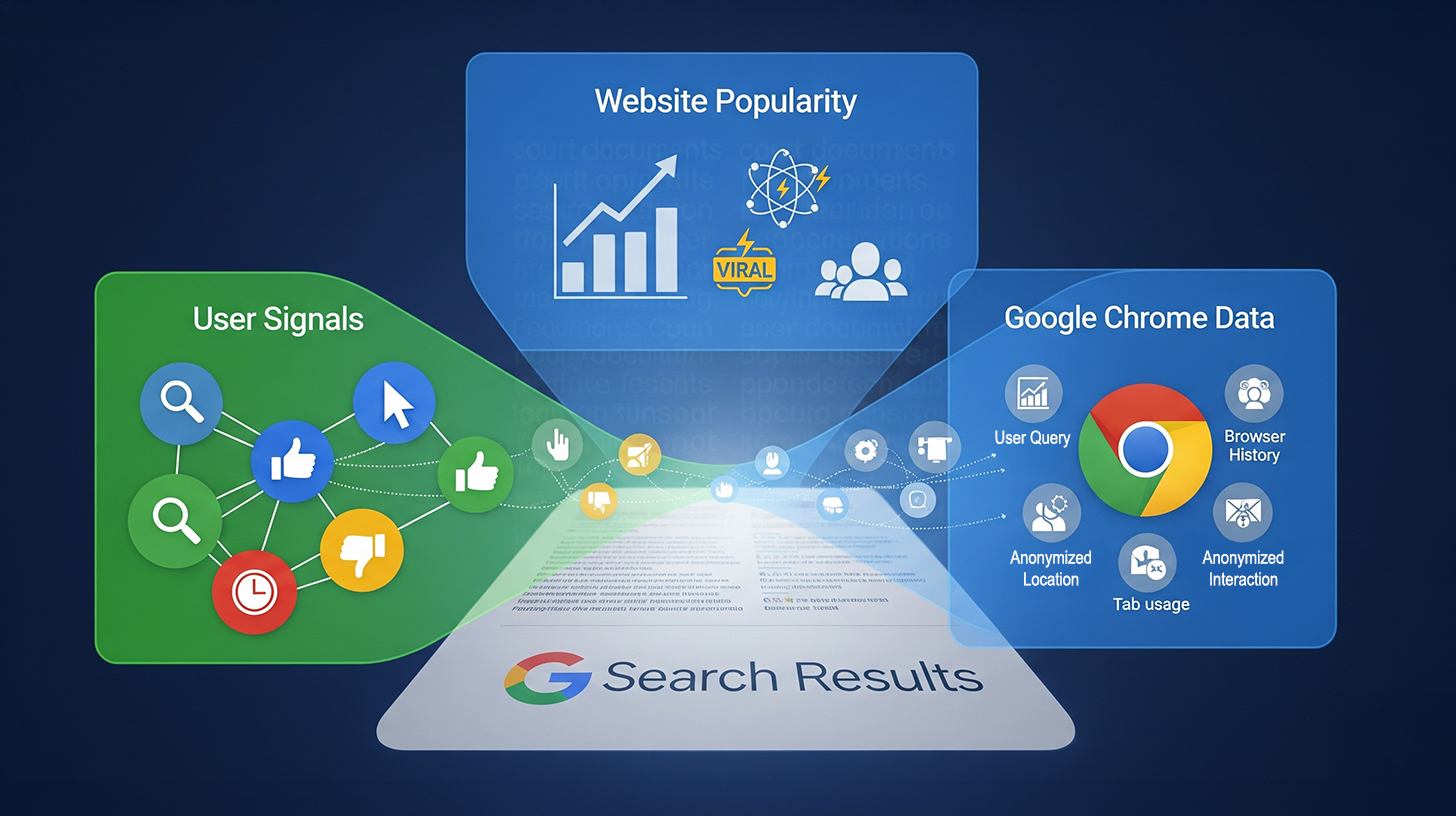
NEW & Revealed: Google ranking through user signals, Google Chrome data, and website popularity: What the court documents say – Image: Xpert.Digital
Google's expensive ongoing dispute with the EU: Now comes the next billion-dollar fine
How important are user signals for Google rankings?
The importance of user signals for Google rankings has long been controversial. Google itself has consistently claimed in the past that direct user signals such as clicks are not direct ranking factors. However, recent court documents from the ongoing antitrust case against Google in the US reveal a completely different reality. These documents demonstrate that user interactions and behavioral data not only play an important role, but may even be more important than the traditional PageRank algorithm.
The published court documents provide, for the first time, comprehensive insight into the internal mechanisms of Google's ranking systems. They clearly demonstrate that Google uses user data in every single step of the search process—from the initial crawling of a website through indexing to the final retrieval and ranking of search results.
Suitable for:

What do the official court documents show about Google's ranking system?
The documents released as part of the antitrust proceedings come directly from Google's internal systems and provide unprecedented details about how the search engine works. These documents were made available by the U.S. Department of Justice in the case "United States et al. v. Google."
Particularly revealing are the statements of Dr. Eric Lehman, a former Distinguished Engineer at Google who worked for the company on quality and ranking issues for 17 years. In his court testimony, he explicitly confirmed that Google uses click data for ranking purposes. At the same time, he revealed that Google was internally instructed not to publicly confirm this use, as SEO experts could use this information to manipulate search results.
The documents also show that Google has been continuously learning from user behavior for 15 years to improve its search results. Every single user interaction provides Google with additional training data and shows which search results were deemed particularly relevant or helpful.
More about it here:
- Google Antitrust Proceedings Court Document as PDF
- What Google's Trial Docs Reveal About Clicks, Links and Other Ranking Signals
- New Court Docs: Google Search User Interactions, User Data & Chrome Data
- Google: Court documents show the importance of user signals for ranking
What role does the mysterious “Glue” system play in data collection?
Google's "Glue" system is proving to be one of the key components for collecting and analyzing user data. It's a comprehensive log table of user activity that captures much more detailed information than previously thought.
The Glue system systematically logs the following types of data: the user's exact search query, detailed information about language, geographic location and device type used, all content displayed on the search results pages, including web pages and special SERP features, precise records of what the user clicked or touched via mouseover, the exact time the user spent on the search results page, and automatically generated interpretations and suggestions for improvement of the original search query.
This comprehensive data collection allows Google to learn from every single search. The system continuously measures how users interact with the displayed results to continually improve the accuracy of predicting helpful search results. The collected data directly feeds into the evaluation and weighting of future search results.
How does Navboost work and why is it so important?
Navboost is considered one of Google's most influential ranking systems, although its functionality has long been misunderstood. Contrary to widespread assumptions in the SEO community, Navboost is not a complex machine learning system, but essentially a large spreadsheet that stores click data.
Dr. Eric Lehman explicitly stated in court: "Navboost is not a machine learning system. It's just a big spreadsheet." This spreadsheet records which URLs were clicked and how often for each search query. Although additional data fields exist, it is essentially a click log.
Navboost was introduced in 2005 and has been continuously collecting clickstream data to improve search quality ever since. Initially, this data was collected via the Google Toolbar, but later the Chrome browser was added as an additional data source. The system stores clickstream data from the last 13 months and uses it to evaluate the relevance of search results.
Navboost's functionality is based on analyzing different click types. "Long clicks," where users stay on a page for a longer period of time, are considered positive signals of relevance and quality. "Short clicks," where users quickly return to the search results page, indicate low relevance or unsatisfactory content.
What is the significance of RankEmbed BERT for modern Google ranking?
RankEmbed BERT is one of the most advanced components in Google's ranking system. This deep learning model combines the language understanding capabilities of BERT (Bidirectional Encoder Representations from Transformers) with algorithms specifically developed for ranking.
The system is trained using two primary data sources: 70 days of comprehensive search logs and ratings from human quality reviewers. This combination allows the model to learn from both real user interactions and professional quality assessments.
RankEmbed BERT possesses exceptional capabilities in natural language understanding. It can incorporate information about any search query into its calculations, taking into account the context and nuances of the query. The system is particularly effective at processing complex, rare, or ambiguous search queries, so-called "long-tail queries."
User actions and quality reviewers' ratings help the model continuously evaluate and improve the accuracy of its predictions. When users show increased signs of satisfaction with search results, the system interprets this as confirmation of the quality of its algorithms.
How does Google use Chrome data for ranking?
Chrome browser data plays a much larger role in Google rankings than has previously been publicly acknowledged. With a global market share of over 63 percent on desktop devices and even 61.76 percent on mobile devices, Google has an unprecedented database for assessing website popularity.
The court documents contain clear evidence that popularity, as an important ranking signal, can be based on Chrome visit data. Users' actual usage and interaction with a website can thus directly contribute to its popularity rating.
The evaluation of different types of interactions is particularly interesting. Active user interactions such as filling out and submitting forms, intensive scrolling through content, or making purchases could represent stronger positive signals than passive links from other websites.
This Chrome-based data gives Google a significant competitive advantage over other search engines. Competitors don't have access to comparable usage data on this scale, making it significantly more difficult for them to develop similarly precise ranking algorithms.
Why might quality signals be more important than PageRank?
The traditional importance of the PageRank algorithm appears to be eclipsed by newer quality signals. The court documents describe PageRank as "a single signal regarding distance from a known good source." This characterization suggests a significantly reduced importance compared to other ranking factors.
Even more telling is the question from the documents: "Do you understand that the largest part of Google's quality signal comes from the website itself?" This wording suggests that the intrinsic properties of a website—such as content quality, user experience, and direct user interactions—are now more important than external links.
Modern website evaluation increasingly focuses on actual usage patterns rather than theoretical authority ratings based on links. While PageRank is based on the assumption that links confer authority, the new systems evaluate actual user behavior and genuine satisfaction with the content.
This development reflects Google's commitment to delivering search results that are not only theoretically relevant, but also practically useful to users. The combination of direct website quality signals and real-world user interactions enables a more precise assessment of the actual relevance and quality of content.
Our recommendation: 🌍 Limitless reach 🔗 Networked 🌐 Multilingual 💪 Strong sales: 💡 Authentic with strategy 🚀 Innovation meets 🧠 Intuition

From local to global: SMEs conquer the global market with clever strategies - Image: Xpert.Digital
At a time when a company's digital presence determines its success, the challenge is how to make this presence authentic, individual and far-reaching. Xpert.Digital offers an innovative solution that positions itself as an intersection between an industry hub, a blog and a brand ambassador. It combines the advantages of communication and sales channels in a single platform and enables publication in 18 different languages. The cooperation with partner portals and the possibility of publishing articles on Google News and a press distribution list with around 8,000 journalists and readers maximize the reach and visibility of the content. This represents an essential factor in external sales & marketing (SMarketing).
More about it here:
Future of Search: How AI and User Signals Block New Competitors
What role do human quality checkers play in algorithm development?
Human quality reviewers occupy a significantly more central position in Google's ranking system than the company has publicly communicated. The court documents reveal that these reviewers' ratings are used as direct training data for central ranking models.
Specifically, the quality reviewers' ratings are used as one of two primary data sources for training the RankEmbed and RankEmbedBERT models. The other data source is the 70-day search logs with real user interactions. This combination of professional ratings and real user data allows the AI systems to consider both objective quality criteria and subjective user preferences.
Dr. Pandu Nayak, Vice President of Search at Google, confirmed in court that rater-trained RankEmbedBERT models have significantly improved Google's performance on complex, infrequent search queries. These models showed significant improvements, especially on long-tail queries, where language understanding is crucial.
The quality assessors evaluate websites according to the detailed "Search Quality Rater Guidelines," which include criteria such as Experience, Expertise, Authoritativeness, and Trustworthiness (EEAT). Their ratings serve as "fundamental data" in the development of the algorithms and thus indirectly influence the evaluation of billions of web pages.
How does user behavior influence crawling and indexing?
User behavior has far-reaching effects on the search engine's fundamental processes, extending far beyond the final ranking. Google uses user data from the earliest stages of the search process to determine which websites to crawl, in what order, and how frequently to crawl.
The goal of this user-driven crawling strategy is to ensure that the search index covers the broadest possible range of topics and sources while delivering fresh, relevant results. Websites that experience frequent and positive user interactions tend to be crawled more often to capture changes and new content more quickly.
Conversely, infrequent crawling may indicate that improvements to content quality or the development of a more engaged audience are necessary. Google calculates a so-called spam score for each website, which is also taken into account in crawling decisions.
Each document in the Google index is assigned a unique DocID, which contains a variety of signals and attributes. These include popularity measurements based on user intent, click data, and feedback systems like Navboost and Glue, as well as comprehensive quality and authority metrics.
What practical implications do these findings have for website operators?
The revelations from the court documents have far-reaching implications for anyone who operates websites or develops SEO strategies. The most important takeaway is that genuine user interactions and satisfaction play a central role in search engine success.
Website owners should focus primarily on improving the actual user experience rather than traditional SEO tactics. This includes optimizing loading speed, improving usability, providing high-quality, relevant content, and designing a website structure that encourages users to stay longer and visit more pages.
Particular attention should be paid to user satisfaction signals. These include low bounce rates, long dwell times, frequent return visitors, and active interactions such as comments, form completions, or purchases. These signals are considered by Google to be strong indicators of quality and relevance.
The findings also highlight the importance of content quality in a broad sense. It's not just about technical SEO aspects, but about creating content that offers real value and meets user needs. This corresponds to the EEAT criteria, which are also applied by the human quality reviewers.
What do these developments mean for the future of search engine optimization?
The revelations mark a fundamental shift in search engine optimization, moving away from technical manipulation toward a truly user-centric approach. Traditional SEO practices, which primarily focused on keyword density, backlink building, and technical tricks, are increasingly losing importance.
The future of SEO lies in developing holistic approaches that focus on real user needs. This requires a deeper understanding of the target audience, their problems, and their needs, as well as the ability to develop solutions that go beyond superficial keyword optimization.
Machine learning and AI systems like RankEmbed BERT will continue to gain importance. These systems are designed to understand the context and intent behind search queries and identify relevant content accordingly. Website operators must learn to optimize for these intelligent systems rather than simply manipulating algorithms.
The integration of user data from various Google products, especially Chrome, is likely to continue to increase. This reinforces the importance of a consistent, high-quality user experience across all touchpoints.
How does Google react to these revelations?
Google has so far offered only limited responses to the specific revelations in the court documents. The company continues to maintain its official position that clicks are "not a direct ranking factor," which may be technically correct, but obscures the nuanced reality of how click data is used in more complex systems.
However, the legal proceedings have forced Google to be more transparent about certain aspects of its algorithms. As part of the September 2025 court ruling, Google was required to share certain search index and usage data with competitors.
At the same time, Google is actively working to reduce its reliance on traditional search methods. The increased integration of AI-powered features such as AI Overviews and the development of chatbot functionality can be seen as a response to regulatory pressure and increasing competition from AI providers such as OpenAI.
The company will likely continue to seek to protect the details of its ranking algorithms while complying with regulatory requirements. Balancing transparency and protection against manipulation remains a key challenge.
What impact do these findings have on competition in the search engine market?
The revelations highlight the enormous structural problem facing Google's competitors. The combination of Chrome browser data, extensive search logs, and advanced AI systems creates significant barriers to market entry for alternative search engines.
Competitors like Bing, DuckDuckGo, and new AI-powered search engines don't have access to comparable user data on this scale. This makes it significantly more difficult for them to develop similarly precise and user-centric ranking algorithms. Google's data advantage is self-reinforcing: Better search results lead to more users, which in turn enables more data and better algorithms.
The September 2025 court ruling requiring Google to share certain data with "qualified competitors" could theoretically reduce these barriers. However, the practical implementation and definition of "qualified competitors" remain unclear.
Interestingly, the judge's assessment that the development of AI chatbots and generative AI creates, for the first time in more than a decade, a "serious prospect" of a product that could challenge Google's market dominance is interesting. This suggests that competition may not come from traditional search engines, but from entirely new AI-based information access systems.
What do we learn from these historical revelations?
The court documents from the Google antitrust case have shaken fundamental assumptions about how the world's most important search engine works. They clearly demonstrate that user signals play a much more central role than Google has publicly communicated for years.
The most important insight is that Google actually operates a highly complex ecosystem of different systems, each of which utilizes user data in different ways. From Navboost to the Glue system to RankEmbed BERT—all of these components are designed to learn from real user interactions and optimize search results accordingly.
For website operators and SEO professionals, this sends a clear message: The focus must finally shift from technical manipulation to creating real added value for users. The era of superficial SEO tricks is definitely over. Success in search results increasingly requires a holistic approach to the user experience.
The revelations also raise important questions about market power and fair competition. Google's access to Chrome data and the resulting competitive advantages demonstrate how difficult it is for competitors to gain a foothold in this market. The regulatory measures, however limited, are a first step toward restoring a fairer competitive environment.
Ultimately, the documents confirm what many SEO experts had long suspected: Google actually evaluates user satisfaction with search results and uses this information to continuously improve its algorithms. The days when these assumptions could be dismissed as speculation are finally over.
Your global marketing and business development partner
☑️ Our business language is English or German
☑️ NEW: Correspondence in your national language!

Konrad Wolfenstein
I would be happy to serve you and my team as a personal advisor.
You can contact me by filling out the contact form or simply call me on +49 7348 4088 965 (Munich) . My email address is: wolfenstein ∂ xpert.digital
I'm looking forward to our joint project.










