
Trump accuses Zelenskyy of lacking the will for peace – but his logic has a crucial flaw
Xpert Pre-Release

Available in 27 languages 📢
Prefer Xpert.Digital on GoogleⓘPublished on: October 19, 2026 / Updated on: October 19, 2026 – Author: Konrad Wolfenstein
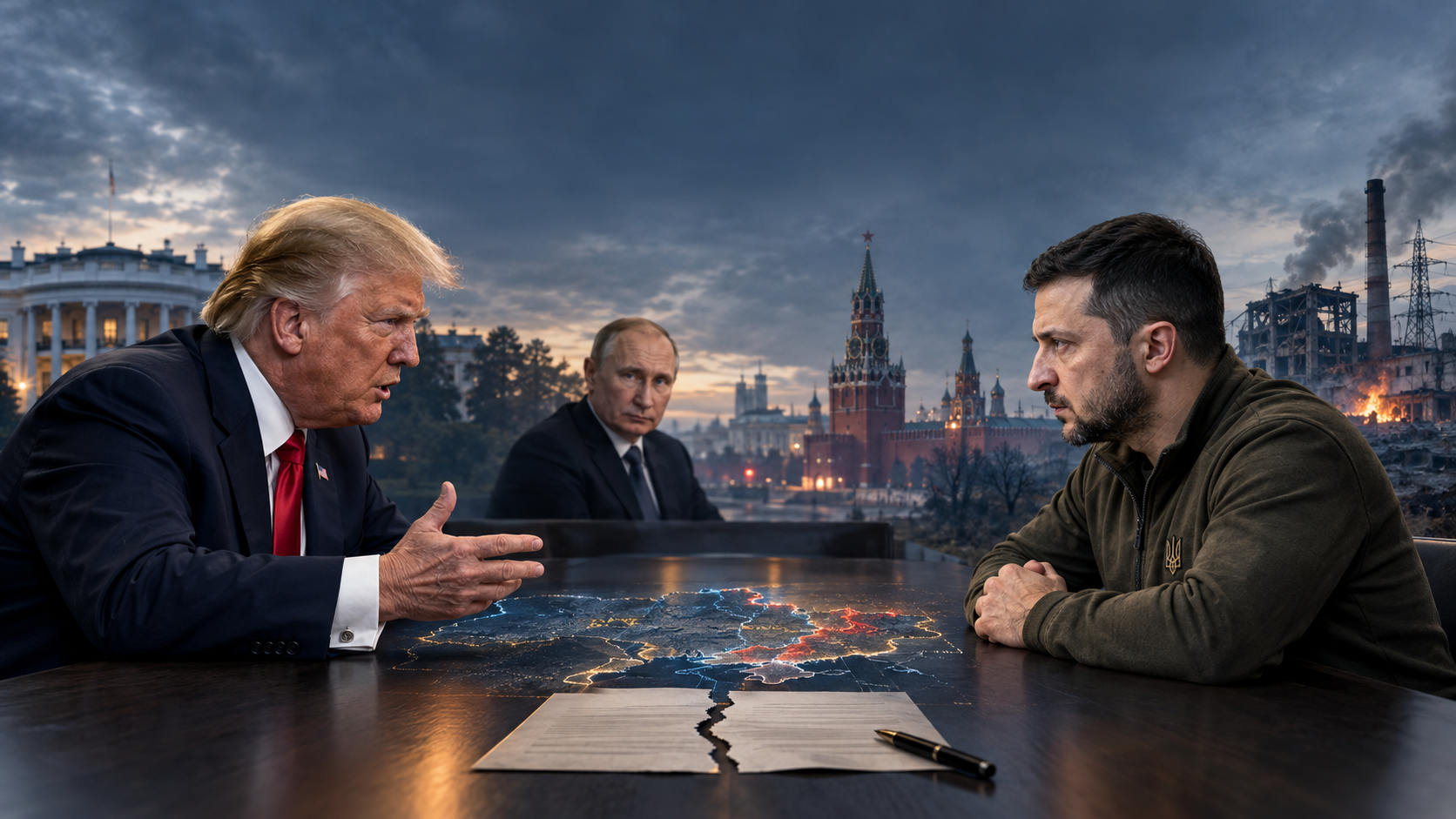
Trump accuses Zelenskyy of lacking the will for peace – but his logic has a crucial flaw – Creative image on the topic, with AI: Xpert.Digital
Why Trump criticizes Zelenskyy more harshly than Putin
Putin willing to negotiate, Zelenskyy not? What's behind Trump's accusation?
Ukraine war: Trump's blame game shifts the focus to the crucial question
Donald Trump claims that Volodymyr Zelenskyy does not want to end the war, while Vladimir Putin is ready for peace. But this portrayal conflates a willingness to talk with a genuine readiness to compromise – and ignores the fact that Russia started the war of aggression and continues to occupy Ukrainian territory. At the same time, Trump is pursuing his own political and economic goals: He wants to demonstrate a swift negotiating success, lower energy prices, and limit American commitments to Ukraine. Zelenskyy, in turn, fears that a ceasefire without solid security guarantees could merely buy Russia time for another attack. A closer look at the negotiations reveals why Trump is putting more pressure on the Ukrainian president than on the Russian leader, what role energy prices and US domestic politics play in this, and why a quick deal does not necessarily guarantee lasting peace.
Trump's reversal of blame in the Ukraine war
Those who ignore the attack risk declaring the attacked party an obstacle to peace
Donald Trump's claim that Ukrainian President Volodymyr Zelenskyy does not want to end the war, while Vladimir Putin is supposedly ready for peace, is not a casual provocation. It is the result of a political logic that focuses not on responsibility for initiating and continuing a war of aggression, but rather on which interlocutor will submit to the American president more quickly. Trump judges the willingness to make peace less by military conduct, verifiable concessions, or standards of international law than by personal readiness to cooperate, the economic consequences for the United States, and the prospect of a quickly demonstrable negotiating success.
From this perspective, the one who has been attacked but rejects a proposed ceasefire due to a lack of security guarantees can appear as an obstacle to peace. The aggressor, on the other hand, seems willing to compromise as soon as they participate in talks, even if their conditions amount to territorial concessions, neutralization, and the military weakening of the attacked state. This shift is precisely the crux of Trump's statement. It reveals less about who actually wants to end the war than about what kind of peace Trump considers politically, economically, and personally viable.
A sound analysis must therefore distinguish between three levels. First, it concerns the verifiable question of what conditions Russia and Ukraine are setting for an end to the war. Second, it concerns Trump's particular negotiating and communication logic. Third, it concerns the domestic political and economic interests that shape Washington's position. Only the interplay of these levels makes it understandable why Trump is attacking Zelenskyy more harshly than Putin, even though Russia launched the full-scale war in February 2022 and continues to occupy Ukrainian territory.
The immediate trigger lies in the dispute over energy, sanctions, and negotiating power
Trump's latest accusations did not arise in a vacuum. They followed a renewed escalation of the conflict between Washington and Kyiv over Ukrainian attacks on Russian refineries, the handling of Russian energy exports, and additional sanctions against Moscow. Ukraine has been attacking refineries, fuel depots, pipelines, and export facilities for some time because the Russian oil and gas sector provides both foreign currency for the state budget and fuel for the armed forces and logistics. From the Ukrainian perspective, these facilities are therefore economic and military targets in a war of attrition in which Kyiv is conventionally outmatched.
The impact of these attacks is significant. Russian refineries temporarily lost a large portion of their available processing capacity. Production of diesel and other petroleum products declined, repairs were hampered by sanctions and a lack of specialized components, and Moscow restricted exports to supply its domestic market. Before the most severe disruptions, Russia was among the world's leading diesel suppliers. When several hundred thousand barrels of daily export volume are lost, it's not just regional prices that rise. Such a disruption tightens the globally traded fuel supply and increases refinery margins in the United States and Europe as well.
Trump's criticism therefore has a real economic basis. Ukrainian attacks on Russian refineries can tighten the international diesel market, thus burdening American farmers, trucking companies, construction firms, and consumers. Diesel is particularly sensitive to the economy because it is used in agriculture, freight transport, construction, mining, and parts of industry. Price increases therefore have an impact across many supply chains and can raise inflation. However, it is an oversimplification to attribute the price increase solely to Ukraine. Production losses in the Middle East, transportation disruptions, low inventories, limited global refinery reserves, and Russian export bans also exacerbated the situation. The Ukrainian attacks were a significant contributing factor, but not the only cause.
For Trump, this distinction is politically less appealing than a clear assignment of blame. High fuel prices are easily understood and immediately noticeable in the context of an American election campaign. A complex global refinery shock is harder to communicate than the claim that Zelenskyy's attacks are harming American companies. At the same time, Trump can portray protecting Russian energy facilities as a contribution to peace and justify his reluctance to impose sanctions by claiming he doesn't want to drive Moscow from the negotiating table. In this way, energy policy, inflation control, and peace rhetoric merge into a single narrative.
The conflict over refineries is therefore more than a dispute over target selection. For Ukraine, attacks on Russia's energy complex are one of the few means by which it can exert asymmetric pressure on the Russian war economy. For Trump, these same attacks disrupt his efforts to lower energy prices, keep Russia open to dialogue, and present himself as a successful mediator. Zelenskyy's refusal to abandon this strategy entirely appears to Trump not as an expression of military necessity, but as a disregard for American priorities.
Trump confuses willingness to make peace with willingness to accept his deal
Trump's understanding of international negotiations is strongly transactional. States appear less as bearers of long-term security interests, historical experiences, and legal obligations, and more as parties to a deal. Those who accept an offer are considered constructive. Those who demand additional guarantees, reject conditions, or point to risks are considered difficult. In trade negotiations, this simplification can occasionally generate leverage. However, in a war between a larger aggressor and a smaller attacked state, it leads to a systematic distortion.
Russia can relatively easily signal to Trump that it is interested in talks. It doesn't have to withdraw its troops or relinquish its territorial demands. Putin's willingness to engage in phone calls, summits, or negotiations is already seen as a sign of personal approachability. Zelenskyy, on the other hand, has to explain why a ceasefire without solid safeguards could only postpone the next Russian offensive. He has to point to domestic political constraints, the Ukrainian constitution, public sentiment, the security of the still-controlled territories, and experiences with previous agreements. This makes his position more complex and, in Trump's eyes, less businesslike.
Added to this is the United States' asymmetric pressure potential. Washington can directly impact Kyiv by restricting arms deliveries, intelligence data, communications services, or financial aid. It also possesses considerable sanctions and energy pressure against Moscow, but their use causes international repercussions and carries the risk of escalation. This creates a pattern typical of mediators, but problematic: pressure is primarily exerted on the dependent party because it takes effect more quickly there. However, the fact that Kyiv is easier to pressure than Moscow does not mean that Kyiv represents the greater obstacle to peace.
In Trump's logic, negotiating power becomes a moral judgment. He views Ukraine's weaker military position as proof that Zelenskyy should be able to demand less. If Kyiv insists on security guarantees despite territorial losses, personnel strains, and dependence on Western aid, this appears to him as an overestimation of its own capabilities. From the Ukrainian perspective, however, this weaker position is precisely why a mere promise is insufficient. The weaker one's deterrent capability, the more crucial contractual and militarily credible guarantees become.
Thus, Trump and Zelenskyy are talking about different things. Trump primarily means a swift end to major hostilities by peace. Zelenskyy means a situation in which Russia cannot attack again after a pause under more favorable conditions. A ceasefire can fulfill Trump's definition without solving Zelenskyy's security concern. Anyone who ignores this difference risks misinterpreting Ukrainian caution as a will to go on.
Moscow's willingness to talk should not be equated with a willingness to compromise
The central factual weakness of Trump's account lies in the fact that Russian willingness to negotiate is frequently equated with a Russian willingness to make substantial concessions. Moscow has not ruled out negotiations in principle, but links a ceasefire to far-reaching demands. These include the recognition or at least the permanent acceptance of Russian territorial gains, Ukraine's renunciation of NATO membership, the exclusion of Western troops, restrictions on Ukrainian armed forces, and a relaxation of Western sanctions. In some cases, Russia is even demanding the Ukrainian withdrawal from territories that Russian troops have not yet fully conquered.
A state may wish to end a war and yet only accept peace on its own terms. This applies to both sides. Therefore, what matters is not the abstract declaration of a desire for peace, but the price each side imposes on the other. Russia is essentially offering to cease hostilities if key outcomes of its military violence are politically secured and Ukraine's future defense capabilities are limited. This position may be rational from a Russian power perspective. However, it is not automatically moderate simply because it is presented in a negotiation format.
Putin also benefits from time. As long as Russia believes it can gain further territory militarily, damage Ukrainian infrastructure, and erode Western support, there is only limited incentive for quick compromises. At the same time, the Kremlin can demonstrate a willingness to negotiate in order to delay sanctions, divide Western alliances, and make Ukraine appear intransigent. In this case, talks are not the opposite of war, but rather another instrument of warfare.
This does not mean that every Russian initiative is merely deceptive or that negotiations are pointless. Wars usually end through a combination of military exhaustion, political pressure, and diplomatic compromise. Moscow also has economic reasons for eventually reducing hostilities. The Russian war economy generates high budget deficits, inflationary pressure, labor shortages, rising interest rates, and an increasing dependence of civilian regions and businesses on arms contracts. The state must allocate ever-larger shares of its resources to defense, internal security, military pay, and arms production. Nevertheless, Russia has so far treated this burden as manageable and continues to plan for high military expenditures.
The available data therefore do not support a clear Russian preference for peace, but rather a dual strategy. Moscow is maintaining military pressure while simultaneously signaling diplomatic openness, provided its core objectives are met. Trump interprets the second part of this strategy more strongly than the first. Zelenskyy, on the other hand, primarily assesses the continued attacks and the substance of the Russian demands. Both perceive the same behavior through different criteria.
Kyiv's red lines are not merely Zelenskyy's personal decision
Trump's rhetoric personalizes the Ukrainian position. It creates the impression that Zelenskyy could end the war with a signature, but refuses to do so out of personal interest, because of Western financial aid, or out of a political will to survive. In reality, the Ukrainian president cannot cede territory like private property, nor can he decide security matters unilaterally. Territorial changes affect the constitution, parliament, the population, the armed forces, and the legitimacy of the entire state.
Ukrainian polls paint a nuanced picture. A clear majority supports negotiations, and a growing segment of the population can envision a ceasefire along the existing front line or territorial concessions. However, this willingness is almost always conditional. These conditions include Western security guarantees, continued arms deliveries, the possibility of rebuilding the army, a commitment not to legally recognize Russian annexations, and a public vote on final territorial issues. Only a very small percentage favors unconditional concessions.
These data refute the sweeping claim that the Ukrainian leadership or society wants to continue fighting on principle. Rather, they show that many Ukrainians are weighing the desire for an end to the violence against their fear of an unsafe peace. A freeze on the front lines might seem acceptable if the rest of Ukraine remains militarily protected and economically integrated. In contrast, an agreement that limits the armed forces and excludes a Western presence is perceived as an invitation to a future attack.
Zelenskyy is thus navigating a narrow political corridor. If he rejects too much, he risks losing American support. If he accepts too much, he risks domestic opposition, military resistance, and accusations of surrendering national sovereignty. Even a personally accommodating president could not permanently implement a far-reaching agreement if the population and armed forces perceive it as a capitulation. Peace, therefore, requires not just an agreement between three presidents, but a political construct that is considered legitimate and secure in Ukraine.
The accusation of a lack of democratic legitimacy is also too simplistic. Under martial law, elections are suspended for security and legal reasons. Millions of people live abroad, in occupied territories, or are serving on the front lines. Polling stations would be targets for attacks, registration records are incomplete, and a fair election campaign would be virtually impossible. An election under these conditions could not strengthen democracy but rather create new legitimacy conflicts. The postponement of elections is therefore not proof that Zelenskyy needs to prolong the war to secure his power.
The claim of missed opportunities for peace simplifies the 2022 talks
A key element of Trump's argument is the assumption that Zelenskyy could have negotiated a better agreement earlier. He thus echoes the narrative that a nearly finalized peace agreement existed in the spring of 2022, which Kyiv rejected under Western influence. This account contains a kernel of truth, but exaggerates the state of negotiations at that time.
In 2022, Russian and Ukrainian delegations did indeed discuss neutrality, security guarantees, troop levels, the status of occupied territories, and possible withdrawals. Working drafts were presented, and there were discernible signs of rapprochement. Ukraine considered renouncing NATO membership if several states were to provide binding security guarantees. Russia signaled at one point that a neutral Ukraine could still join the European Union. These were serious negotiations, not merely diplomatic posturing.
However, a treaty ready for signing did not exist. Key questions remained unanswered: the precise mechanism of the security guarantees, potential Russian veto rights, the permissible size and armament of the Ukrainian armed forces, the status of Crimea and Donbas, the terms of a ceasefire, and the sequence of withdrawals and political decisions. The security guarantees, in particular, proved problematic. A promise of protection is of little value if the guaranteeing states must act unanimously in the event of an attack, and Russia, as the potential aggressor, effectively has a say in the decision-making.
The situation also changed due to the Russian withdrawal from the Kyiv region and the reported killings and mistreatment in previously occupied areas. Trust in Russian commitments plummeted. At the same time, Ukraine gained the impression that it could defend itself militarily with Western support. Western governments were skeptical of a treaty that would have imposed far-reaching mutual assistance obligations on them without Ukraine becoming a NATO member. These factors diminished the chances of a deal being reached.
It is legitimate to ask whether an opportunity was missed at the time. Equally legitimate is the counter-question whether a treaty with unclear guarantees and a weakened Ukrainian army would have actually ended the war or merely postponed it. The claim that Zelenskyy rejected a ready-made peace transforms a complex, incomplete negotiation into a simple blame game. Politically, this simplification is useful to Trump because it supports his current demand: Kyiv should not again hope for better terms, but rather accept the current power dynamic.
Hub for Security and Defense - Advice and Information

Hub for Security and Defense - Image: Xpert.Digital
The Security and Defence Hub offers expert advice and up-to-date information to effectively support companies and organizations in strengthening their role in European security and defence policy. Working closely with the SME Connect Defence Working Group, it particularly promotes small and medium-sized enterprises (SMEs) that wish to further develop their innovative capacity and competitiveness in the defence sector. As a central point of contact, the Hub thus creates a crucial bridge between SMEs and European defence strategy.
Related to this:
New dynamics in the relationship between Trump and Zelenskyy
The personal history has strained the relationship since 2019
Trump's distrust of Zelenskyy has a long history. The relationship between the two presidents was already strained in 2019 by the phone call that led to Trump's first impeachment proceedings. Trump wanted investigations that could damage his then-domestic political opponent, Joe Biden. This placed Ukraine at the center of an American power struggle, even though it depended on military support from Washington. For Trump, the issue of Ukraine has since been linked to the accusation that Democrats and government institutions have politically persecuted him.
This experience shapes his perception of Zelensky, even though the Ukrainian president did not publicly attack Trump at the time. In Trump's political world, personal loyalty, visible gratitude, and recognition of his leadership are highly valued. While Zelensky regularly tries to praise Trump and emphasize American support, he simultaneously disagrees with him on key issues, particularly regarding his assessment of Putin and the reliability of Russian commitments. Trump quickly perceives this open disagreement as a lack of gratitude or an obstruction of his mediation efforts.
The public dispute in the White House in February 2025 intensified this dynamic. Zelenskyy argued that a ceasefire without security guarantees was dangerous because Russia had violated previous agreements. Trump and his vice president interpreted his objections as disrespectful and a lack of willingness to make peace. Thus, a substantive difference of opinion regarding deterrence became a question of personal loyalty. Since then, periods of pragmatic cooperation have alternated with sharp public attacks.
Putin takes a different approach in personal interactions. The Russian president treats Trump as the leader of a major power, offers direct talks, and conveys the impression that key issues can be decided between a few powerful men. This approach aligns with Trump's self-image as an exceptional negotiator. Zelenskyy, on the other hand, inevitably points out that Ukraine has its own rights, that European allies are involved, and that details concerning security, territory, and enforcement remain crucial. What is objectively necessary appears, in Trump's personalized diplomacy, as a restriction of his freedom of action.
This does not mean that Trump's Russia policy is based solely on sympathy for Putin. Personal chemistry is a factor, but not a complete explanation. More importantly, Putin is offering Trump a negotiating format in which major powers define spheres of influence and economic relations. Zelenskyy, on the other hand, demands a rules-based format in which the sovereignty of a smaller state is not traded for a quick deal. Trump is clearly more drawn to the first model.
Domestically, a tough stance against Zelenskyy is more worthwhile than one against Putin
Trump's statement is also tailored to the American audience. Support for further aid to Ukraine is significantly weaker within the Republican Party than among Democrats. Many conservative voters view European allies as free riders, oppose long-term foreign deployments, and want to see public funds used more at home. In this context, Ukraine is often associated with the Biden administration, the foreign policy establishment, and an open-ended financial commitment without a clear end date.
When Trump accuses Zelensky of not wanting peace because of Western money, he is pursuing several political goals simultaneously. He portrays himself as an opponent of endless wars, distances himself from Biden, criticizes Europe, and justifies a reduction in American commitments. This accusation transforms Ukraine from an attacked partner into a recipient that supposedly profits from the war and therefore demands ever more support. This portrayal is emotionally powerful, even though it distorts the actual use of the aid.
A large portion of American spending on Ukraine does not flow to Kyiv as readily available funds. These resources are used to replenish American weapons stockpiles, award contracts to US defense contractors, and support logistics, training, intelligence, and the military presence in Europe. By March 2026, total US appropriations related to Ukraine and the expanded response amounted to approximately $195 billion. Of this, about $116 billion had actually been disbursed. Directly pledged defense equipment and military services were significantly lower. Nevertheless, the large overall sum lends itself to the political impression that Zelenskyy receives virtually unlimited American funding.
Economically, the balance sheet is mixed. The spending supports parts of the US defense industry, creates orders, and accelerates the modernization of domestic arsenals. At the same time, it creates real fiscal costs and military bottlenecks. Strategically, the aid weakens Russia without sending American troops to war. Critics counter that Europe should take on a larger share and that Washington needs resources for the Indo-Pacific. Trump takes up this criticism but links it to a personalized indictment of Zelenskyy.
Added to this are the midterm elections and voters' sensitivity to energy prices. A president who promises lower diesel and gasoline prices has an incentive to attack any actor who causes additional shortages. If Ukrainian refinery attacks can be portrayed simultaneously as a military escalation and as a burden on American consumers, a politically attractive enemy image is created. Sanctioning Putin, on the other hand, would carry the risk of further energy price increases. From Trump's perspective, a tough stance against Zelenskyy is more cost-effective and easier to control.
Europe's growing role changes Trump's cost accounting
European states have significantly increased their support since the widespread withdrawal of new American aid. In 2025, European military contributions were considerably higher than the average for the years 2022 to 2024; financial and humanitarian aid also rose sharply. By mid-2026, EU member states and European institutions together had provided more military aid than the United States. At the same time, Europe remains dependent on American technology for certain capabilities, such as air defense, reconnaissance, satellite communications, and long-range precision munitions.
For Trump, this development has two opposing consequences. On the one hand, it confirms his argument that Europe can and must assume more responsibility. The United States can reduce its direct funding without Ukraine immediately collapsing. On the other hand, European support diminishes American leverage over Zelenskyy. The more Kyiv can rely on European funding and weapons, the less it has to accept every American proposal.
Trump's accusation that European money is prolonging the war is therefore also indirectly directed at Brussels, Berlin, Paris, London, Warsaw, and the Nordic countries. He suggests that support reduces Ukraine's willingness to make concessions. From a negotiation theory perspective, there is some truth to this: aid improves Kyiv's options outside of a treaty and allows it to reject unfavorable conditions. However, this is precisely the purpose of such support. A negotiated outcome is not automatically better simply because it is reached more quickly under maximum pressure on the weaker party.
Europe views the costs differently. For many European states, it's not just about Ukraine, but about the future credibility of borders and deterrence on the continent. An agreement that rewards military conquests and leaves Ukraine permanently vulnerable could trigger further arms and security costs. From this perspective, continuing aid, despite high short-term costs, can be economically rational if it limits a greater future security risk.
The dispute between Trump and Zelenskyy is therefore also a transatlantic conflict over time horizons. Trump prioritizes a short-term ceasefire, lower energy prices, and reduced American commitments. Many Europeans prioritize a security order that makes a renewed Russian attack as unlikely as possible. Both sides speak of peace, but calculate the resulting costs differently.
The war is ruinous for Ukraine, yet it cannot be ended at will
Economically, Ukraine has the strongest incentive to end the war. Direct damages amounted to more than $195 billion by the end of 2025. The need for reconstruction and recovery over ten years was estimated at nearly $588 billion, roughly three times Ukraine's economic output in 2025. Costs are particularly high for transportation, energy, housing, industry, trade, and agriculture. Approximately 14 percent of the housing stock was damaged or destroyed, affecting millions of households.
Real growth remained weak and is expected to be only slightly above one percent in 2026. Investment is hampered by attacks, insecurity, insurance problems, and labor shortages. The state relies on foreign aid for budget financing, defense, and reconstruction. Millions of people have been displaced, companies have lost assets and markets, and the demographic consequences will be felt for decades. No rational Ukrainian state can have a macroeconomic interest in allowing this situation to continue.
However, a poor peace could lead to even higher long-term costs. If Russia were to attack again after an unsecured truce, Ukraine would simultaneously have to finance reconstruction, defense, and renewed mobilization. Private investors would hesitate even after a ceasefire as long as the risk of renewed destruction remains high. Capital does not flow back simply because there is less shooting. Crucial factors include insurability, air defense, legal stability, market access, and credible security guarantees.
This economic logic explains why Kyiv does not evaluate a ceasefire solely based on the short-term reduction of military losses. A sustainable agreement must reduce the overall expected costs over many years. This includes ensuring that Ukraine maintains sufficient military strength, that Western support does not end abruptly, and that reconstruction is protected against renewed attacks. Russia's demand to limit the size of the Ukrainian armed forces directly contradicts this.
Zelenskyy's political behavior is also more readily explained by these structural constraints than by personal financial interests. International aid replaces some of the war-related losses, but it does not make the country wealthier than it would be in peacetime. It finances basic state functions, weapons, infrastructure repairs, and social spending. The notion that Kyiv is prolonging the war to receive more transfers confuses survival financing with profit.
Russia incurs high costs, but possesses a longer-term strategic perspective
The Russian economy is also paying a rising price. State military spending reached approximately 16 trillion rubles in 2025, or about 7.5 percent of GDP. Initially, lower spending was projected for 2026, but in reality, the burden increased again over the course of the year. The budget deficit was revised significantly upwards, while the government prepared additional loans, tax increases, and cuts to civilian programs. Inflation remained high, investments outside the defense sector weakened, and there was a labor shortage in both industry and the military.
Nevertheless, economic pressure does not automatically equate to a willingness to embrace political peace. A war economy creates its own vested interests. Arms manufacturers, regions with military bases, security apparatuses, suppliers, and families receiving high military salaries become dependent on government spending. An abrupt peace could jeopardize contracts, incomes, and political justifications. At the same time, the Kremlin can distribute social burdens longer through repression, propaganda, capital controls, and prioritized government spending than an open democracy could.
Putin is also making relative calculations. The crucial factor is not just how much Russia suffers, but whether Ukraine becomes exhausted more quickly and the West loses patience sooner. Even weak Russian growth can be sufficient from the Kremlin's perspective if Kyiv encounters major financing and staffing problems without external assistance. The Russian leadership can therefore be genuinely interested in negotiations while still believing that further fighting will improve its position.
Trump's assumption that Putin wants peace may be true in a narrow sense: Putin would likely prefer a peace that secures Russian territorial gains, neutralizes Ukraine, eases sanctions, and prevents a Western military presence. However, this does not mean he would accept a compromise that leaves Ukraine sovereign, defensible, and closely tied to the West. The difference between a desire for peace and a desire for victory through a treaty is crucial.
Conversely, Zelenskyy wants to end the war but cannot accept any agreement that leaves the Ukrainian state unprotected in the long term. The question, therefore, is not which president wants peace. All the governments involved plausibly claim this in some form or another. The crucial question is what kind of order should exist after the fighting ends and which side must bear which risks.
Trump's blame game is a tool to lower the price of Ukrainian resistance
From a negotiation theory perspective, Trump's attack on Zelenskyy serves a clear function: to increase the costs of a Ukrainian rejection. If Washington publicly declares that Kyiv is preventing peace, it becomes politically easier to limit arms aid, suspend intelligence cooperation, restrict access to communications, or pressure Europe to exert greater pressure. At the same time, the diplomatic costs of rapprochement with Russia decrease.
Public blame is thus part of the negotiation and not merely a description. Trump is attempting to shift the perception of the conflict so that a Ukrainian "no" is no longer seen as a legitimate security decision, but rather as a morally questionable prolongation of the war. This weakens Zelensky's international position and forces him to constantly demonstrate his willingness to make peace. Putin, on the other hand, must primarily signal his readiness for dialogue in order to be considered a constructive partner.
This asymmetry can create movement in the short term. A Ukraine fearing the loss of American support might be more inclined to agree to a ceasefire or territorial compromises. In the long term, however, there is a significant risk. If Russia realizes that Washington is primarily pressuring Kyiv, Moscow's incentive to make its own concessions will decrease. The Kremlin can maintain higher demands and wait for the Western coalition to further disintegrate.
Successful mediation usually requires convincing both sides that rejection incurs costs and agreement brings benefits. Trump's approach focuses coercion primarily on Ukraine and offers Russia potential early relief from sanctions and energy trade. While this may make a deal faster, it does so under conditions that diminish its stability. A peace perceived by a large majority of the population as imposed and insecure remains politically fragile.
What aspects of Trump's criticism are justified and where they are misleading
An objective assessment cannot completely dismiss Trump's argument. Zelenskyy and the Ukrainian leadership have their own political interests. Every wartime government develops institutional dependencies, protects its narrative authority, and can overemphasize the risks of negotiations. In Kyiv, there is corruption, a concentration of power, conflicts over mobilization, and an understandable interest on the part of the political leadership not to go down in history as the losers of a war. Western aid can also reduce the incentive to accept painful compromises early on.
It is also true that Ukraine's military and economic position has deteriorated compared to earlier phases. A later agreement could be less favorable than an earlier one. Negotiations should therefore not be blocked by the unrealistic goal of recapturing every occupied region militarily in the short term. The Ukrainian population itself is now showing greater openness to a frozen conflict or limited territorial compromises, provided that security and the state's capacity to act are maintained.
Trump's criticism is misleading, however, if it concludes from this that there is a lack of will to make peace. The central Ukrainian problem is not a refusal to talk about peace, but rather uncertainty about the enforcement of an agreement. Kyiv has repeatedly advocated ceasefires, direct talks, and conditional negotiations. At the same time, it rejects demands that would curtail its defense capabilities or relinquish territory not yet captured. This stance is tough, but not irrational.
Even more problematic is the equal treatment of aggressor and defender. A mediator may urge both sides to compromise, but must accurately identify the cause and structure of the conflict. Russia can end the war at any time by ceasing its attacks and withdrawing its forces. Ukraine can only end it by either being successfully defended or by accepting conditions that Russia deems sufficient. These options are not symmetrical.
Trump's perspective is therefore understandable, but incomplete. It follows a short-term cost-benefit analysis: whoever blocks a quick deal is the problem. A sustainable peace order, on the other hand, requires a long-term calculation: Which agreement reduces the likelihood of a new war, protects investments, and prevents military conquest from becoming a successful business model?
The realistic way out lies between capitulation and an endless war of attrition
A sustainable peace process would have to reconcile Trump's legitimate desire for an end to the fighting with Zelensky's legitimate security concerns. A first step could be a verifiable ceasefire along the existing front line, without Ukraine legally recognizing Russian annexations. This would postpone final territorial issues while reducing immediate losses and destruction. Such an arrangement would be politically more acceptable than the formal cession of territory.
Crucial would be robust monitoring and sanction mechanisms. Violations must be detectable quickly, and a renewed Russian offensive must automatically trigger economic and military consequences. Security guarantees should not consist solely of political declarations. They must include multi-year arms financing, air defense, training, intelligence gathering, secure munitions production, and clear response plans. Ukraine must be allowed to retain and modernize its armed forces.
At the same time, Russia would need to be offered comprehensible incentives. Sanctions relief could be gradually and reversibly linked to verifiable implementation steps. Humanitarian issues, prisoner exchanges, the return of abducted children, the protection of energy facilities, and trade security in the Black Sea could be addressed before comprehensive territorial decisions are made. An immediate, complete normalization would be risky because it would mean relinquishing Western leverage too soon.
European states would have to shoulder a larger share of the financial and military burden, while the United States would provide essential capabilities. This would fulfill Trump's demand for a fairer burden-sharing arrangement without leaving Ukraine defenseless. At the same time, Kyiv and its supporters would have to openly acknowledge that a short-term return to the 1991 borders is hardly achievable militarily. However, realism must not be confused with recognizing a Russian right to conquer.
Such a model would be neither a clear Ukrainian victory nor the complete fulfillment of Russian war aims. It might not resolve the conflict definitively, but it would reduce violence and increase the cost of a renewed attack. This is precisely the difference between a mere deal and a robust peace architecture.
Behind Trump's statement lies a question of power, not a confirmed factual assertion
The claim that Zelenskyy does not want to end the war, while Putin does, cannot be convincingly substantiated by the available facts. It rests on a specific definition of the will to peace: Putin is considered willing to make peace because he is talking to Trump and offering a settlement on Russian terms. Zelenskyy is considered unwilling to make peace because he does not accept these terms, attacks Russian energy facilities, and insists on security guarantees.
The underlying reasons are a combination of factors. Trump wants a quick foreign policy success, low energy prices, and reduced American commitments. He believes personal diplomacy and major power deals are more effective than lengthy institutional processes. His relationship with Zelenskyy has been strained since 2019, while Putin is offering him a prestigious negotiating format. Domestically, Trump can mobilize his Republican base and differentiate himself from Biden by criticizing Kyiv. From a negotiating perspective, Ukraine is easier to pressure than Russia.
Economically, Trump has a real cause for concern because Ukrainian refinery attacks are tightening the global diesel market. However, this effect does not justify the conclusion that Kyiv wants to prolong the war. The attacks are an attempt to weaken Russia's war financing and logistics. Likewise, Russian offers of dialogue do not demonstrate a willingness to reach a balanced peace as long as Moscow maintains far-reaching territorial, military, and geopolitical demands.
The most accurate assessment is therefore this: Trump is not neutrally describing the motives of Putin and Zelensky, but rather attempting to alter the negotiating position. His statement increases the pressure on Ukraine, legitimizes restraint towards Russia, and prepares the American public for a peace that could include significant Ukrainian concessions. Whether such an agreement truly ends the war or merely prepares for the next phase depends on the security guarantees, their enforcement, and Ukraine's future defense capabilities.
In this conflict, peace is not a straightforward opposite of war. A swift ceasefire can save lives while simultaneously shifting strategic risks. Protracted resistance can strengthen the negotiating position but also destroy further lives, infrastructure, and economic futures. The political art lies in honestly weighing these costs against each other. Trump's blame game reduces this difficult assessment to the loyalty of a single president. Precisely for this reason, it is communicatively powerful but analytically too simplistic.
Consulting - Planning - Implementation

Markus Becker
I would be happy to serve as your personal advisor.
Head of Business Development
Chairman SME Connect Defense Working Group
Consulting - Planning - Implementation
Konrad Wolfenstein
I would be happy to serve as your personal advisor.
You can contact me at wolfenstein∂xpert.digital or
Just call me on +49 7348 4088 965 .