
German is the new AI programming language: Why precision in prompting is crucial – The underestimated competitive advantage
Xpert Pre-Release

Available in 27 languages 📢
Prefer Xpert.Digital on GoogleⓘPublished on: June 3, 2026 / Updated on: June 3, 2026 – Author: Konrad Wolfenstein
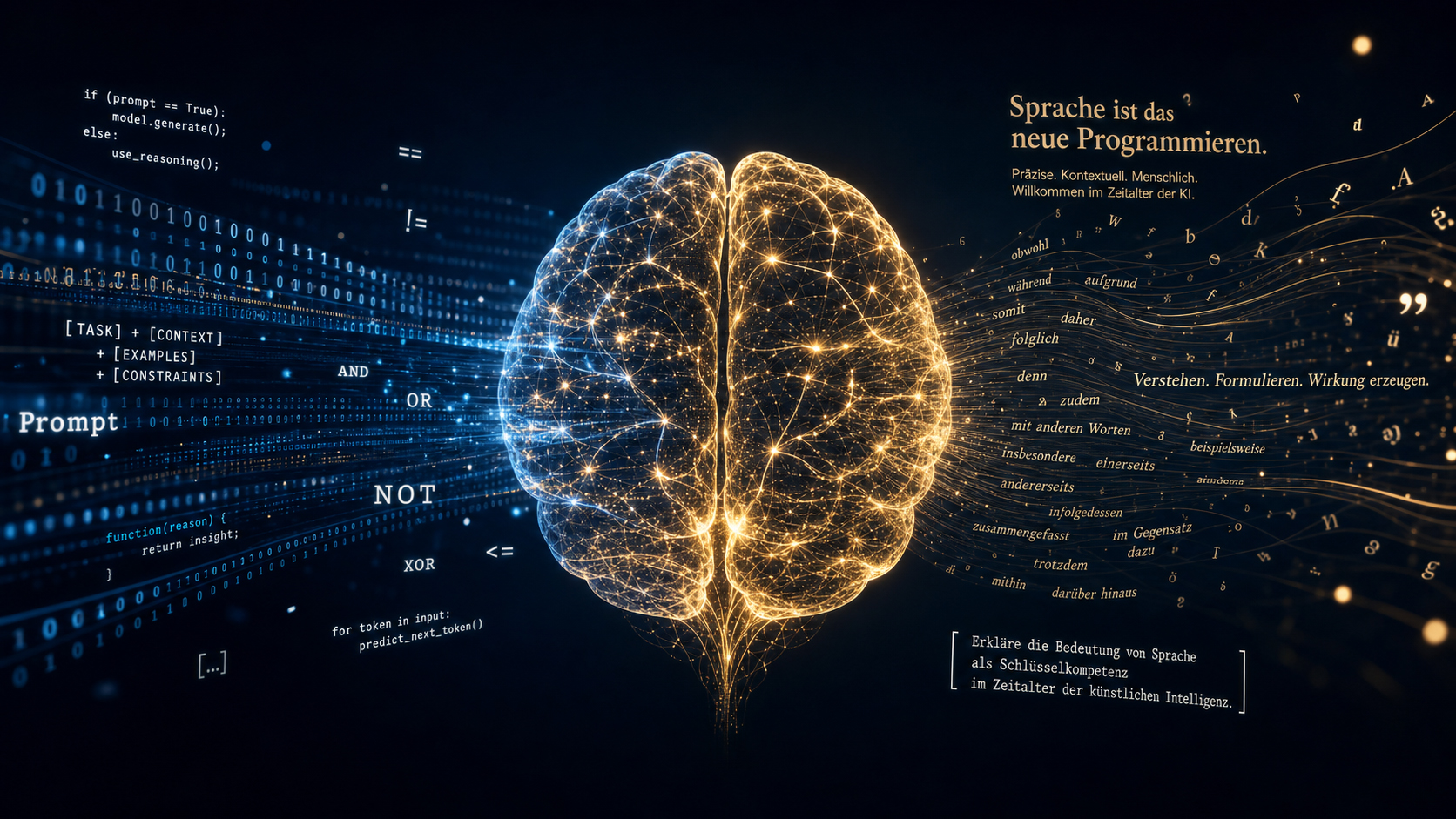
German is the new AI programming language: Why precision in prompting is crucial – The underestimated competitive advantage – Image: Xpert.Digital
When inaccuracies become costly: Why one wrong word in a prompt costs companies thousands of euros
In the age of AI, those who think precisely and formulate clearly hold the power – not the coder, but the master of language
For years, an unwritten rule prevailed in the professional world: anyone who wanted to actively shape digitalization and advance their career had to learn to program. Python, Java, and C++ were the undisputed keys to success, while linguistic, analytical, and humanities skills were often dismissed as nice but secondary "soft" competencies. However, with the rapid breakthrough of generative artificial intelligence and large language models, we are currently experiencing a tectonic shift. Suddenly, the crucial bottleneck is no longer access to computing power or mastery of code. It's the prompt—the precise, structured, and context-rich instruction to the machine.
The following article delves deeply into why human language—especially precise, nuanced German—has risen to become the most important "programming language" of our decade. It reveals why companies make fatal strategic errors when they treat AI as a purely IT project and impressively demonstrates why the ability to work hermeneutically with texts now measurably determines efficiency, quality, and salary increases. Welcome to a new working reality where it is not the coder, but the language expert who controls the machines.
The end of an old misconception: Why language suddenly matters technologically
For decades, an unwritten rule prevailed in German business: anyone who wanted to succeed in digitalization had to master Python, understand databases, and be able to write algorithms. Humanities scholars were, at best, considered a necessary accessory in this narrative, and at worst, an obsolete model. The engineer, the computer scientist, the data scientist – they were at the heart of digital progress. Linguists and cultural studies scholars sat in the background.
This narrative is crumbling in real time with the introduction of Large Language Models (LLMs). What began in 2022 with the public breakthrough of ChatGPT has fundamentally shifted the basic conditions for productive work with machines. The bottleneck today is no longer access to computing power, nor is it mastery of a programming language. The bottleneck is the ability to communicate precisely, contextually, and purposefully to a machine what it should do. This is a profoundly linguistic achievement.
When a lawyer, project manager, or journalist gives an AI a task and precisely defines what it needs—goal, context, constraints, evaluation criteria—this person achieves qualitatively superior results compared to someone who gives the same AI vague instructions. The quality of the output depends directly on the quality of the input. And this quality is not a technical skill, but rather a linguistic and analytical competence. In this sense, German—precise, nuanced, structured German—has indeed become the most important programming language of the current decade.
When ambiguity becomes expensive: The economics of the prompt
What initially sounds like a culturally pessimistic or humanistically tinged thesis can be rigorously proven from an economic perspective. Researchers at the University of Duisburg-Essen are systematically investigating, in a project funded by the German Research Foundation (DFG), how linguistic ambiguities in prompts influence the quality of AI-generated results. The project, known as ReSPro, explores the concept of so-called "requirements smells": linguistic weaknesses such as ambiguities, contradictions, and vague formulations, long recognized as problems in classical software engineering, but now being systematically examined for the first time in terms of their impact on AI systems. The result is hardly surprising, but empirically significant: Imprecise descriptions lead to AI systems producing unsuitable or misleading results—regardless of the model's own performance.
This realization has immediate economic consequences. If a company uses AI systems in processes where employees are unable to formulate precise instructions, it is wasting potential efficiency. Worse still, it produces seemingly plausible but flawed outputs that require costly corrections or inadvertently influence decision-making. The macroeconomic consequences of widespread prompt incompetence are still difficult to quantify, but their structural impact is undeniable.
The opposite is equally clear: Anyone who constructs a prompt in such a way that it clearly defines the goal, context, assumptions, limitations, and test criteria not only achieves better results but also makes these results verifiable and reproducible. From a technical perspective, these are quality assurance steps. From a linguistic perspective, it is simply good writing – thoughtful, structured, and focused on impact. The fact that this ability can now also be used by machines gives it a new economic value that has long been underestimated.
The anatomy of the perfect prompt: 7 reasons why German works like code
The German language is so superior as a tool for prompting because it is precisely structured, logically sound, and enormously nuanced – it offers precisely those qualities that once defined excellent programming code. Mastering these linguistic tools is essentially writing a highly compressed, error-resistant algorithm. The following seven attributes demonstrate why German is the perfect "code" for artificial intelligence:
1. Structural precision (The enemy of vagueness)
The German language compels speakers and writers to adhere to a very precise structure. The ability to form highly specific compound nouns and to assign concepts with grammatical accuracy drastically reduces ambiguity. In software development—and in prompting—this is known as eliminating "requirement smells." Those who use German precisely leave AI no room for misinterpretation.
2. Logical precision (Setting guardrails)
At its core, programming consists of "if-then" relationships, loops, and clear dependencies. German syntax, with its well-developed system of conjunctions (weil, obwohl, alleine, insofern) and strict sentence structure, provides precisely the tools to represent such dependencies linguistically. A good German sentence functions like a clean algorithm: it defines conditions, exceptions, context, and the precise goal without the logic breaking down.
3. Hermeneutic depth (Mastery of the context)
The German language possesses an enormous wealth of vocabulary for abstract, conceptual, and qualitative nuances. AI requires not just a command, but also context, objective, constraints, and evaluation criteria. The ability to accurately formulate subtle nuances of tone, intention, and target audience in German (hermeneutic competence) provides the language model with precisely the input it needs to deliver not just average, but outstanding and perfectly tailored results.
4. High information density (The power of compound words)
The German language is famous for its compound nouns. Words like "Zielgruppenanalyse" (target group analysis), "Qualitätssicherungsschritt" (quality assurance step), or "Entscheidungskompetenz" (decision-making competence) compress complex concepts that would require entire subordinate clauses in other languages into a single term. For an AI language model, this means you can pack an enormous amount of context and meaning into a short paragraph. This semantic compression not only saves tokens (the AI's processing units) but also keeps the prompt focused. Compounds function in prompts like predefined variables in programming.
5. Syntactic Unambiguity (The Case System as a Guidepost)
When programming, it's crucial to define precisely which variable accesses which data (who does what with whom?). In English, this is often only clear through strict word order in sentences. German, on the other hand, uses four cases (nominative, genitive, dative, accusative). These endings unambiguously assign the roles of subject and object – even in complex sentences. This grammatical rigor prevents AI from losing track of relationships or confusing actors in complex, multi-stage tasks.
6. Differentiated modality (Precise control of system boundaries)
A good prompt defines not only what the AI should do, but also what it must not do (so-called "guardrails"). German possesses an extremely refined system of modal verbs (müssen, sollen, dürfen, können) and subjunctive moods. The distinction between "Du sollst Quellen geprüft" (You should check sources) and "Du musst Quellen verpflichtet geprüft" (You absolutely must check sources) is essential for controlling AI. Furthermore, the subjunctive II allows for the precise delineation of if-then scenarios and hypotheses ("Assuming the customer would reject, then generate…"). It is the perfect language for encoding rules, boundaries, and exceptions.
7. Cultural Explicitness (The “Low-Context” Advantage)
This is a linguistic and cultural attribute: German language and communication culture are considered a "low-context culture" in linguistics. This means we tend to state things directly, completely, and explicitly, instead of relying on unspoken context or mere polite phrases between the lines. For AI models, this is precisely what's crucial. Machines lack intuition. If context is assumed but not explicitly stated, AIs begin to "hallucinate" (they invent things). The typically German, very direct and detailed style of explanation is literally the definition of a perfect prompt.
Four trillion and a language problem: What's at stake
The economic impact of AI transformation in Germany has now been quantified, and it is breathtaking. A joint analysis by the Institute for Employment Research (IAB), the Federal Institute for Vocational Education and Training (BIBB), and the Society for Economic Structural Research (GWS) concludes that widespread AI adoption over the next 15 years could lead to an additional increase in value creation of around €4.5 trillion. Annual economic growth would be an average of 0.8 percentage points higher than the reference scenario without AI diffusion. This increase is primarily due to higher labor productivity, material savings, and new business models.
At the same time, a look at current usage practices reveals how far Germany still is from realizing this potential. According to a survey conducted by the ifo Institute in June 2025, 40.9 percent of German companies use AI in their business processes, a significant increase compared to the previous year's 27 percent. Bitkom data from the same year determined a figure of approximately 36 percent for all companies. However, behind these growth figures lies a structural problem: Only 37 percent of the companies surveyed in the IW Future Panel actually use AI, and its use is often limited to standardized tools such as chatbots. According to the McKinsey HR Monitor 2025, just 28 percent of employees in Germany use AI regularly, compared to 76 percent in the USA.
This dramatic gap is not a sign of a lack of technological availability. AI tools are just as accessible in Germany as in the USA. The difference lies in application skills – and thus precisely in that linguistic and analytical ability that was so long dismissed as a "soft" skill. Those who cannot articulate their thoughts cannot use AI. Those who do not use AI lose productivity and competitive advantages. The connection between linguistic precision and economic performance is therefore no longer merely cultural, but technologically direct.
A new dimension of digital transformation with 'Managed AI' (Artificial Intelligence) - Platform & B2B solution | Xpert Consulting

A new dimension of digital transformation with 'Managed AI' (Artificial Intelligence) – Platform & B2B solution | Xpert Consulting - Image: Xpert.Digital
Here you will learn how your company can implement customized AI solutions quickly, securely and without high entry barriers.
A managed AI platform is your all-inclusive, worry-free solution for artificial intelligence. Instead of dealing with complex technology, expensive infrastructure, and lengthy development processes, you receive a ready-made solution tailored to your needs from a specialized partner – often within just a few days.
The key advantages at a glance:
⚡ Rapid implementation: From idea to ready-to-use application in days, not months. We deliver practical solutions that create immediate added value.
🔒 Maximum data security: Your sensitive data stays with you. We guarantee secure and compliant processing without sharing data with third parties.
💸 No financial risk: You only pay for results. High upfront investments in hardware, software, or personnel are completely eliminated.
🎯 Focus on your core business: Concentrate on what you do best. We take care of the entire technical implementation, operation, and maintenance of your AI solution.
📈 Future-proof & scalable: Your AI grows with you. We ensure continuous optimization and scalability, and flexibly adapt the models to new requirements.
More information here:
Why precise language is more important than code: How prompt competence pays off
The productivity test: What companies really gain
That a sharp prompt has economic value is no longer just an assertion – it's now supported by data. The "PwC AI Jobs Barometer 2025," based on the analysis of nearly one billion job postings from 24 countries, demonstrates with unprecedented empirical breadth how AI expertise translates into economic results. In sectors with strong AI adoption, such as financial services or software publishing, productivity growth has increased from 7 percent to 27 percent between 2018 and 2024 since the breakthrough of generative AI in 2022 – almost quadrupling. In contrast, in sectors with low AI adoption, such as mining or hospitality, productivity growth fell from 10 to 9 percent during the same period.
The wage effects are equally striking. Employees with AI skills, specifically skills like machine learning or prompt engineering, earned an average of 56 percent more globally in 2024 than comparable colleagues without these skills – twice as much as the previous year, when the premium was 25 percent. In Germany, the demand for prompt engineering skills grew so rapidly in December 2024 that almost twice as many job postings mentioned these skills as explicitly searched for "prompt engineers." This demonstrates that the skill itself is in demand, but the job title is not. The skill is becoming a cross-functional competency, permeating all roles.
Particularly revealing is the decline in the relevance of formal qualifications. In professions heavily influenced by AI, the proportion of jobs requiring a degree fell from 66 to 59 percent, and for automatable tasks, it dropped even further to 44 percent. Practical skills, including the ability to communicate precisely with AI systems, are increasingly replacing formal qualifications as a hiring criterion. This represents a tectonic shift in the economics of education, the effects of which are only just beginning to become apparent.
Not Python, but understanding: What Prompt Engineering really means
Despite the economic importance of AI's linguistic competence, a persistent misconception in public debate needs to be corrected: Prompt Engineering is not a recognized profession. The German Economic Institute (IW Cologne) determined in 2025 that "Prompt Engineer" plays virtually no role as a standalone job title in the German labor market. From January 2023 to December 2024, a mere 130 positions were explicitly advertised for Prompt Engineers in Germany – compared to approximately 70,000 positions for IT experts during the same period. A Microsoft company survey confirms this: Prompt Engineers rank second to last in planned new hires.
The conclusion is both paradoxical and illuminating: the ability to formulate precise prompts has not established itself as a specialized skill, but rather as a fundamental competency across all professional fields. Much like writing an email or using a spreadsheet program, prompting has become second nature, something no one explicitly advertises, yet it determines the quality and efficiency of daily work. A McKinsey study from December 2025 found that the demand for "AI fluency" in US job postings increased sevenfold in just two years – faster than for any other skill, and across all industries.
This shifts the question from "Who is a prompt engineer?" to "Who in this company is good at prompting and who isn't?" This question remains unasked in most German companies, let alone systematically answered. AI is used in specialist departments, law firms, editorial offices, and public administrations – often unsystematically, often without clear guidelines, often with suboptimal results because the task definition remains vague. The economic damage caused by poor prompt quality is diffuse, but real.
What humanities scholars have always known: The rehabilitation of hermeneutic thinking
Those who seek meaning in texts, notice nuances, reconstruct contexts, and resolve ambiguities—in short, those who think hermeneutically—have a structural advantage when working with language models. This insight is not nostalgic, but functionally grounded. A historian or a Germanist who has learned to critically read sources, examine claims for reliability, and question arguments about their implicit assumptions possess precisely the basic cognitive structure necessary for productive work with AI systems.
The earlier education debate in Germany was characterized by concerns about a competitive struggle between STEM education and the humanities. AI competence was interpreted within this context as a further advantage for STEM graduates. This assessment wasn't implausible in the early stages of digitalization, when writing code was indeed a prerequisite for many digital jobs. However, with the rise of LLMs, the situation has fundamentally changed. The barriers to entry for using generative AI are low for individuals without extensive IT skills, as simple text commands are usually sufficient. Writing code is no longer a requirement – the quality of the input is.
At the same time, it's important to emphasize what this shift does not mean. A feel for language is no substitute for expertise. Anyone who demands a business analysis from an AI without understanding what a business analysis actually achieves and which key performance indicators (KPIs) are relevant for which purpose will not produce a usable result, even with the most precise formulation. What's required is a combination: expertise in the respective field, a fundamental understanding of the technological possibilities and limitations of AI systems, and the ability to translate complex requirements into operational instructions. This triad is neither purely technical nor purely humanistic – it is interdisciplinary.
The blind spot of companies: AI as an IT project is a strategic mistake
German companies make a characteristic mistake when dealing with AI: they treat it as an IT project. New systems are procured, licenses are distributed, IT security issues are resolved – and then they wait. The fact that the productivity gains fail to materialize or are disappointingly small is often interpreted as confirmation of skepticism, although it actually points to a different bottleneck: the lack of application skills among the workforce.
This mistake is not without consequences. The KPMG study "Generative AI in the German Economy 2025" states that AI has become a key prerequisite for competitiveness, innovation, and efficiency, and explicitly warns: waiting is not an option, because the gap between companies that successfully use AI and those that do not is widening. According to the AI Trends Report 2024, the establishment of interdisciplinary AI teams and the integration of AI skills into education and training are crucial success factors for the economic benefits of AI. Companies that view AI as purely technological overlook the fact that its practical benefits arise in the specialist departments – in editorial offices, law firms, administrations, and factory floors – and are generated there by people who are familiar with concrete problems and have the language to describe them.
This is not a trivial shift. It means that the return on investment of AI investments depends less on the quality of the models used than on the quality of the people who guide those models. And this quality is not an IT issue. It is a matter of education, a culture of thinking, and the ability to communicate with linguistic precision. Those who treat AI as an IT project will not close the skills gap in business departments.
Where the decision is made: The first assignment as a guidepost
An often overlooked mechanism significantly amplifies the impact of precise language on AI results: When an AI system doesn't generate a single answer but conducts a longer analysis, researches multiple sources, or structures a multi-stage task, the initial task definition determines not only the first step but the entire process. A vaguely formulated task sets the AI on a path that doesn't correct itself during processing—it becomes increasingly complex. This leads to seemingly plausible but misguided detours that cost the user time, produce errors, or steer decisions in the wrong direction.
Precise prompts, on the other hand, act like well-set switches. They meaningfully limit the solution space, create verifiability, allow for the review of intermediate results, and permit decisions to be critically evaluated instead of being accepted unreflectively. This critical evaluation skill is another element structurally anchored in the hermeneutic tradition of the humanities: reading a text not as passive consumption, but as an active process of interpretation, questioning, and validation.
A study by the University of Hohenheim concludes that skills such as critical thinking, decision-making, analytical thinking, and problem-solving are gaining in importance through the use of AI. This initially seems counterintuitive—why should a technology that takes over many cognitive tasks make critical thinking more important? The answer lies in the responsibility for oversight: the more AI makes decisions, the more humans must ensure that the right questions are being asked. This is not a technical, but an intellectual task.
The new division of labor: humans control, machines execute
The McKinsey Global Institute predicts that by 2030, around 30 percent of current working hours could be automated through technology, including generative AI. In Germany, up to 3 million jobs would be affected by this scenario, representing about 7 percent of total employment. The most significant disruptions will affect administrative office work: up to 54 percent of the expected job changes in Germany fall into this category. Secretarial and typing services, call centers, routine analyses – these are precisely the tasks that AI can easily take over if properly programmed.
What remains is what machines cannot do: context-rich judgment, a sense of responsibility, the ability to make ethical considerations, and an understanding of implicit social expectations and cultural nuances. In technical terms, McKinsey calls this "social and emotional skills" and predicts that demand for these skills will increase by 11 percent in Europe by 2030, and by as much as 14 percent in the US. Demand for positions requiring empathy and leadership qualities is expected to grow by 20 percent.
This outlines a new division of labor in which AI handles execution and humans control. This control is primarily exercised through language. Those who want to control must be able to articulate their needs. The economic reward will no longer lie with those who build or maintain machines, but with those who set machines in motion according to their tasks, interpret their results, and draw the appropriate conclusions. This is a question of language, analysis, and ultimately, education policy.
Why Germany needs this debate now
Germany faces a dual challenge. On the one hand, studies demonstrate the enormous economic potential of AI: According to a study commissioned by Google and conducted by IW Consult and Implement Consulting Group, Germany could generate an additional €440 billion in economic output by 2034, €330 billion of which would come from productivity gains alone. On the other hand, the ifo Institute shows that only 40.9 percent of companies are currently using AI, with another 18.9 percent planning to implement it. For small and medium-sized enterprises (SMEs), the figure is a mere 38 percent, and for micro-enterprises, it is only 31 percent. This means that the potential for economic transformation is significantly underutilized.
The structural reasons for this lag are complex, but one factor stands out more than is often acknowledged: the lack of connection between the availability of AI technology and human application skills. According to TU Darmstadt, AI competence is "more than technical knowledge: it also encompasses the ability to critically evaluate AI results, reflect on them ethically, and integrate them responsibly into decision-making." Companies that understand AI competence as a permanent organizational capability and promote it at all levels achieve faster and more sustainable implementation.
The educational policy implications are clear: Germany needs more computer science, yes. But it also urgently needs people who think precisely, articulate clearly, and critically evaluate. These two things are not contradictory, but rather essential. The question is not whether language or technology is needed, but how both can be fostered together as complementary skills in education, professional development, and corporate culture. The McKinsey HR Monitor 2025 shows that 44 percent of employees in Germany did not invest a single day in training and professional development last year – a structural problem that will become particularly costly in the AI era.
Linguistic excellence as a competitive advantage
The most important skill in the age of AI is not knowing or being able to do everything oneself. It is combining expertise, technical understanding, and linguistic competence in such a way that machines perform useful work and humans make responsible decisions. This combination is the real lever for productivity – and, contrary to popular belief, it cannot be achieved through purely technical training or purely humanistic education alone.
For companies, this means: those who treat AI transformation as an IT project are penny-wise and pound-foolish. Investing in language skills, analytical thinking, and interdisciplinary training is not a soft corporate philosophy, but a hard competitive strategy. PwC puts the global salary premium for AI-savvy employees at 56 percent, and the industries that use AI most intensively achieve three times the revenue growth per employee compared to those that hardly use it. The economic logic is clear.
In this sense, German is indeed the new programming language. Not because Python or SQL are obsolete—they retain their relevance. But because the interface between human thought and machine execution increasingly runs through natural language, and because the quality of this interface determines economic success or failure. Those who think precisely and formulate clearly program more effectively in the AI age than some who write code without understanding the problem they are actually supposed to solve.
Your global marketing and business development partner
☑️ Our business language is English or German
☑️ NEW: Correspondence in your native language!

Konrad Wolfenstein
I and my team are happy to be available to you as your personal advisor.
You can contact me by filling out the contact form here simply call me at +49 7348 4088 965. My email address is [email protected]:or
I'm looking forward to our joint project.
☑️ SME support in strategy, consulting, planning and implementation
☑️ Creation or realignment of the digital strategy and digitization
☑️ Expansion and optimization of international sales processes
☑️ Global & Digital B2B trading platforms
☑️ Pioneer Business Development / Marketing / PR / Trade Fairs
🎯🎯🎯 Data-driven B2B industry hub as a quasi-in-house solution

The quasi-in-house solution: How Xpert.Digital closes operational gaps in B2B marketing and sales – Smart Content-Driven Business - Image: Xpert.Digital
Xpert.Digital is a data-driven B2B industry hub led by Konrad Wolfenstein . The company acts as an external, quasi-in-house solution for industrial partners, closing operational gaps in marketing, content, and sales – without requiring additional resources on the client side.
More information here:









