SEO was yesterday? Why Agentic Engine Optimization (AEO) now determines your visibility
Xpert Pre-Release

Available in 27 languages 📢
Prefer Xpert.Digital on GoogleⓘPublished on: April 25, 2026 / Updated on: April 25, 2026 – Author: Konrad Wolfenstein
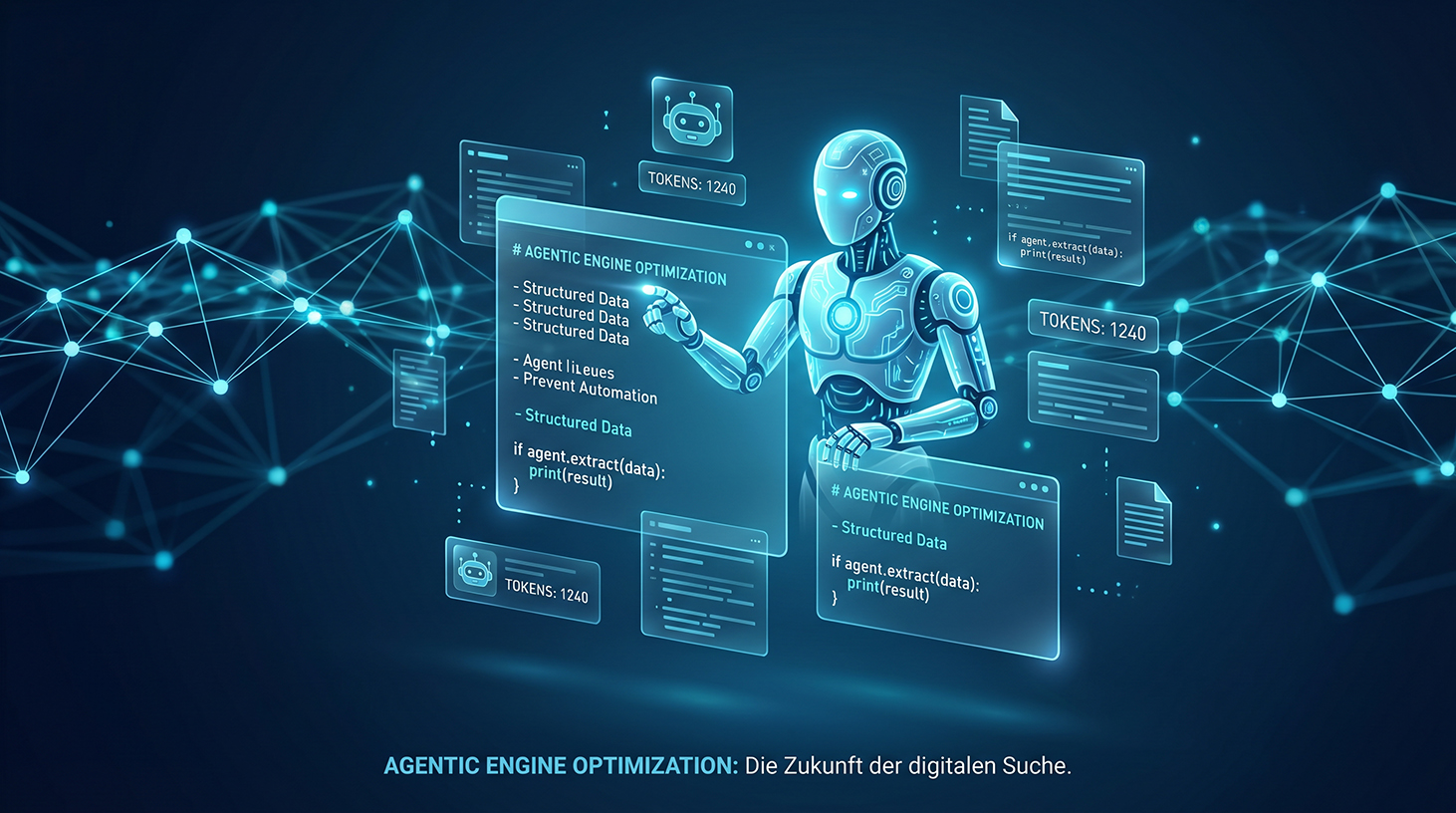
SEO was yesterday? Why Agentic Engine Optimization (AEO) now determines your visibility – Image: Xpert.Digital
When AI agents remain blind: 5 fatal mistakes that make your website invisible
More than half of the traffic is automated: Is your website ready for the AEO era?
The silent revolution on the web: How the "Agency Web" is replacing classic Google searches
For decades, we optimized websites for the human eye and click behavior—the domain of classic search engine optimization (SEO)—but now, increasingly, autonomous AI agents are taking over web browsing. They scour the web on behalf of their users, extract data, and prepare complex decisions. But therein lies the problem: Most modern websites are an unreadable labyrinth of scripts, design elements, and unstructured text for these machine visitors. The result? Their content is simply overlooked. This is precisely where Agentic Engine Optimization (AEO) comes in. This article explores why the age of the "agentic web" is already well underway, how AEO differs from existing disciplines like SEO and GEO, and what concrete technical steps you can take to prepare your website for the invisible machine readers of tomorrow.
When machines surf the web: Why your website is invisible to AI agents – and how to change that
The internet is undergoing fundamental change. Not slowly, not gradually – but at a speed that surprises even seasoned digital strategists. The next major shift has a name that hardly anyone knew two years ago: Agentic Engine Optimization, or AEO for short. Anyone who dismisses this term as just another marketing abbreviation in a long line of SEO derivatives is making a strategic error. AEO is not a hype term – it is the answer to a fundamental restructuring of the internet that is already well underway.
From human click to autonomous agent – how the internet is changing its user base
The web was built for humans. Pages that the eye wanders across, menus that you tap with your finger, images that evoke emotions – all of this was created over decades of iterative development for the human user. But this user is increasingly disappearing from the direct browsing process. AI agents are taking their place: autonomous software systems that, on behalf of their human clients, scour the web, extract information, prepare decisions, and perform tasks.
This development is measurable. Automated bot traffic exceeded 51 percent for the first time in 2025 – more than half of all internet queries now originate from automated systems. Traffic from AI agents alone increased by 7,851 percent year-on-year. OpenAI bots account for approximately 69 percent of all AI traffic, followed by Meta with 16 percent and Anthropic with 11 percent. These figures are not a prediction of the future – they describe the present.
Google CEO Sundar Pichai succinctly summarized this development: Search will evolve from simply gathering information to completing tasks. Search engines will function less like a link directory and more like a manager for AI agents that execute tasks on behalf of the user. At the Google Cloud conference, he signaled to investors that AI agents are the linchpin of the company's entire AI monetization strategy. No company with an online presence can ignore these statements.
The consequence for digital content is sobering: If websites continue to be optimized exclusively for human users, a growing – and soon dominant – segment of the audience will remain invisible to the tools used. Addy Osmani, Senior Software Engineer at Google and responsible for Google Cloud and Gemini, has precisely elucidated this connection. Websites that are not optimized for machine processing are simply overlooked or misinterpreted by AI agents – without this being reflected in traditional analytics tools.
Clearing the conceptual jungle – AEO, GEO and SEO in a system comparison
Before understanding the technical implications of AEO, a clear conceptual classification is worthwhile – because the market often uses these abbreviations inconsistently, and confusion leads to incorrect strategic decisions.
Search Engine Optimization (SEO) is the classic discipline: content is optimized so that traditional search engines like Google or Bing rank the corresponding pages as high as possible in the organic search results. The goal is clicks, traffic, and conversions. Backlinks, technical cleanliness, loading times, and EEAT signals—these are the tools that have shaped SEO for two decades. SEO isn't dead, but it's no longer the only factor.
Answer Engine Optimization (AEO) – in an older usage – describes the optimization for systems that provide direct answers: Featured Snippets, Google's AI Overviews, Bing Copilot, or voice assistants like Alexa and Siri. Here, the goal isn't ranking in the search results, but rather being displayed as the direct answer to a question – often without the user even visiting a website. However, in its more recent and broader sense, AEO encompasses more: the complete optimization for autonomous AI agents that act independently, conduct research, and perform tasks.
Generative Engine Optimization (GEO), in turn, aligns content with generative AI systems like ChatGPT, Perplexity, Google Gemini, or Claude. These systems synthesize answers from sources they deem trustworthy—without displaying a traditional results list. GEO asks: How is my brand, my expertise, my product represented as a citable source in AI-generated answers?
| discipline | Target audience | Main goal | Performance measurement |
|---|---|---|---|
| SEO | Classic search engines | Organic traffic and clicks | Rankings, CTR, Conversions |
| AEO | AI agents, voice assistants | Direct response, machine usability | Snippet visibility, AI traffic share |
| GEO | Generative AI systems | Citation quality in AI answers | Mentions in AI Overviews, Share of Voice |
These three disciplines are not mutually exclusive – they build upon each other. Without a solid SEO foundation, the technical basis is lacking. Without GEO, you remain invisible to generative systems. Without AEO, autonomous AI agents will either ignore your content, misinterpret it, or simply not find it.
What AEO really means – the definition behind the acronym
Agentic Engine Optimization (AEO) means structuring, formatting, and delivering content in a way that allows it to be used effectively by AI agents—not just human readers. The comparison with traditional SEO is revealing: While SEO for years aimed to optimize content for web crawlers and human click behavior, AEO addresses the same fundamental idea for a different consumer—namely, AI agents that autonomously retrieve and process content and translate it into their own actions.
The crucial difference lies in the processing mode. A human user scrolls, reads selectively, follows links out of curiosity, and uses visual hierarchies for orientation. An AI agent, on the other hand, typically makes only one or two HTTP requests, selectively extracting structured information and making decisions or generating answers based on this data. Navigation menus, footers, banner ads, decorative graphics – all of these are not only useless for AI agents but actively disruptive because they waste valuable token capacity and obscure relevant information.
An AI agent, for example, researching suppliers of industrial components on behalf of a user, isn't looking for appealing design or a compelling brand story. It's looking for structured, machine-readable information: What does this supplier offer? What are the technical specifications? What limitations exist? Can I access the API? If even one of these pieces of information is missing in machine-readable form, the agent skips the supplier – without an error message, without leaving a trace in the analytics.
Five vulnerabilities that make your website invisible to AI agents
Addy Osmani's research and practical experience have identified five critical factors that determine whether AI agents can successfully use a website. These factors are not optional – if even one of them fails, agents often skip the content entirely or produce erroneous results.
The first factor is discoverability: Can AI agents find a website's content without having to render JavaScript? Many modern websites rely heavily on JavaScript-based rendering, which is optimized for browsers but cannot be processed by AI agents without headless browser support. Content that only becomes visible after JavaScript is executed is simply non-existent for many agents.
The second factor is analyzability: Is the content machine-readable without requiring visual layout interpretation? HTML with deeply nested div structures, CSS-based content blocks, or image-based text poses a significant hurdle for AI agents. Clean, semantic HTML and especially Markdown formats are considerably more agent-friendly.
The third factor is token efficiency: Does the content fit into the typical context windows of agents without being truncated? AI agents have a limited context window – in practice usually between 100,000 and 200,000 tokens. If an agent encounters a document that is too long, it can either truncate important information, skip the document, or react with so-called hallucinations – that is, draw incorrect conclusions.
The fourth factor is capability signaling: Does the website or documentation explain to an AI agent what a service or API does—and not just how to technically call it? The difference is fundamental: Technical reference documentation lists endpoints and parameters. An agent-friendly capability document explains which specific tasks a service can perform, what inputs it requires, and what limitations exist.
The fifth factor is access control: Does the robots.txt file even allow access by AI agents? Many website operators have reflexively blocked AI crawlers in recent years – for understandable reasons related to data privacy and content monetization. However, anyone who wants their content to be found and used by AI agents must explicitly allow this access.
The AEO architecture stack – five layers for agent-friendly websites
The conceptual model of AEO can be divided into five successive levels, which together form a complete agent architecture:
Level 1 is access control via the robots.txt file. This is the gateway: Without explicit permission for known AI agent user agents like GPTBot, ClaudeBot, Google Extended, or anthropic-ai, no content reaches its machine consumers. Many website operators are unaware that restrictive robots.txt configurations unintentionally limit their own visibility on the agent-based web.
Level 2 is discoverability via an llms.txt file. This simple Markdown file in a website's root directory acts as a structured sitemap specifically for AI agents. It provides language models with a clear map of the most important content—similar to a VIP guide that shows AI systems where to find the most relevant information. A good llms.txt should also include the number of tokens per page so that agents can make informed decisions before even loading a page. It's important to note that the usefulness of llms.txt is still debated and no official standard exists—many common AI crawlers don't actively consider it yet.
Level 3 is capability signaling via skill.md files. These files declaratively tell an agent which specific tasks and functions a service or API can perform. Each described skill should include its capabilities, required inputs, existing limitations, and links to further documentation.
Level 4 is agent-based content formatting. Documentation and content are provided as clean, structured Markdown to optimize machine reading. Headings follow a consistent hierarchy (H1 → H2 → H3), each page begins with a clear result statement in the first 200 words, and code examples follow directly after the prose description. Parameter tables replace nested text.
Level 5 is token allocation. Explicitly stating the number of tokens per page helps agents decide whether the entire content fits within their limited context window. No single page should exceed 30,000 tokens without implementing a chunking strategy that divides the content into manageable segments.
🎯🎯🎯 Data-driven B2B industry hub as a quasi-in-house solution

The quasi-in-house solution: How Xpert.Digital closes operational gaps in B2B marketing and sales – Smart Content-Driven Business - Image: Xpert.Digital
Xpert.Digital is a data-driven B2B industry hub led by Konrad Wolfenstein . The company acts as an external, quasi-in-house solution for industrial partners, closing operational gaps in marketing, content, and sales – without requiring additional resources on the client side.
More information here:
Token efficiency as a competitive advantage: How to protect your content from AI hallucinations
The token problem – the invisible resource scarcity of the agentic web
The concept of token economics is unfamiliar to traditional web developers, but central to AEO. Tokens are the units into which AI models break down text for processing – put simply, one token corresponds to roughly three to four letters in German. A sentence typically has 15 to 30 tokens, and a standard website with navigation, text, and footers can quickly reach 5,000 to 50,000 tokens.
The problem: AI agents don't have an unlimited context window. In practice, the usable context limits range between 100,000 and 200,000 tokens. That sounds like a lot—but it isn't, especially when an agent has to process dozens of pages during a task. If it encounters an inefficiently structured document bloated with navigation menus, cookie banners, ads, and redundant text elements, it consumes tokens on worthless content—and may ultimately lack the capacity to process the truly relevant part.
The consequences are serious: The agent either cuts off important information, skips the document entirely, or begins to hallucinate—that is, to draw conclusions that are not supported by the document's content. All of this happens without any visible error message, without any entry in the analytics, and without any possibility of correcting it afterward. Token efficiency is therefore not a technical subtlety, but a core strategic issue for any website that wants to be found and correctly processed by AI agents.
New protocols for the agentic web – MCP, WebMCP and the infrastructure of the future
Behind the immediate AEO practice lies a more profound technological shift: the emergence of a new infrastructure layer of the Internet, specifically designed for communication between AI agents and web services.
The Model Context Protocol (MCP) is the fundamental building block. Developed by Anthropic and released as open source at the end of 2024, MCP has rapidly become the de facto standard for connecting AI agents to external systems. The transfer of the protocol to the Agentic AI Foundation, under the umbrella of the Linux Foundation, further solidifies its status as a universal industry standard. MCP consists of three core components: executable functions that an AI can call; data access to files, databases, and APIs; and predefined instruction templates for specific tasks.
The practical significance of MCP for the Agentic Web can be illustrated using the image of a telephone directory: MCP gives AI agents a kind of standardized telephone number for external services so that they can obtain the information they need to perform their tasks – without having to program proprietary individual interfaces for each combination.
WebMCP, a new browser API initiative, takes this a step further, enabling websites to communicate directly and systematically with AI agents. Instead of AI systems having to interact via DOM scraping, screenshot analysis, or UI automation, they can call specifically defined website functions as machine-readable tools. Developers define functions like "search product," "apply filter," or "submit order" with clear parameters, and agents call these directly without having to interpret the visual layout. This isn't the future of the web—it's its immediate present in its early stages of rollout.
Identify, measure, and strategically utilize AI traffic
One of the biggest practical challenges of AEO is measurement. Classic analysis methods such as scroll depth, dwell time, click paths, or session duration don't work for AI agents – they often compress their navigation into one or two HTTP requests, leaving a completely different fingerprint pattern than human users.
To detect AI traffic, website operators must actively search their server logs for specific HTTP fingerprints of known AI agents. These fingerprints differ significantly from one another:
| agent | HTTP runtime | Pre-flight behavior | signature |
|---|---|---|---|
| Claude Code | Node.js / Axios | On-demand GET | axios/1.8.4 |
| cursor | Node.js / got | HEAD probe → GET | got (sindresorhus/got) |
| Cline | curl | GET OpenAPI/Swagger-Scan | curl/8.4.0 |
| Aider | Headless Chromium | On-demand GET | Full Mozilla/Safari user agent |
| Windsurf | Go / Colly | On-demand GET | colly |
Beyond pure log analysis, the introduction of dedicated AI referral segments in web analytics is recommended, as well as establishing a baseline value for the ratio of AI to human traffic. Only by knowing this baseline can the success of AEO measures be measured and the content strategy mix adjusted based on evidence.
The “Copy for AI” button – a small feature with a big impact
One of the most pragmatic recommendations from AEO practice is the "Copy for AI" button – an interface element that serves as a bridge between human developers and AI assistants. When a developer is working with an AI assistant in an integrated development environment (IDE) and wants to use documentation content as context, they typically copy text from the rendered HTML of the website. The problem with this is that they copy not only the actual content but also navigation menus, footers, and other layout elements – as distracting noise in the agent's context window.
The "Copy for AI" button solves this problem by copying only clean Markdown to the clipboard when clicked. This significantly improves the quality of the context that an AI agent receives for processing. It's a simple UX improvement with a measurable impact – and at the same time, it signals to professional users that the website is being taken seriously in an agent context.
The economic dimension – what's at stake
The question of whether to take AEO's technical recommendations seriously is ultimately a business decision – and the numbers are clear. Gartner predicted back in 2024 that traditional search engine traffic would decline by 25 percent by 2026, primarily due to AI chatbots and virtual agents. Given that AI traffic has increased sevenfold within a year, this forecast now seems more conservative than exaggerated.
Search traffic through AI-powered search engines has increased by 527 percent compared to the previous year. ChatGPT alone records over 5 billion visits per month and is among the four most visited websites worldwide. According to Semrush data, Google's AI Mode results in 93 percent of search queries ending without a single click on an external website. 60 percent of traditional Google searches also already end without a click. Between January 2024 and May 2025, news-related queries on ChatGPT increased by 212 percent, while comparable Google searches decreased by 5 percent.
These figures describe a structural shift in information demand that is irreversible. Companies that have optimized their digital presence solely for human browsing behavior are gradually losing visibility—not because their content is getting worse, but because the audience has changed. And this new audience—the AI agent—has different requirements than its human counterpart.
The economic logic is clear: If a significant and growing proportion of all pre-purchase research, product comparisons, supplier searches and service requests are carried out by AI agents on behalf of human users, then visibility and success are no longer primarily determined by Google ranking – but by the ability of a website to be correctly found, read and processed by these agents.
Critical appraisal – what AEO can and cannot do
A balanced analysis requires acknowledging the limitations and uncertainties of AEO. Firstly, not all AEO concepts are yet mature standards. The llms.txt, for example, is a proposal without official status and is not currently actively considered by common AI crawlers. Its practical significance is currently limited – even though its conceptual value for future developments is plausible.
Secondly, the relevance of AEO varies greatly depending on the industry and website type. For developer documentation, technical APIs, B2B information pages, and knowledge-intensive offerings, AEO is already highly relevant. For highly visual e-commerce sites or locally focused service providers, the immediate effects are less clear in the short term – although the long-term trend is also evident here.
Thirdly, the measurement of AEO success is not yet standardized. Established KPIs, certified audit methods, and long-term studies that quantify the ROI of AEO measures are lacking. Those who invest in AEO do so with the awareness that they are investing in a still-evolving standard – with all the associated opportunities and uncertainties.
However, these limitations do not diminish the fundamental strategic message: The direction of development is clear, the speed of change is surprisingly high, and the time for proactive action is now more favorable than after complete market penetration.
The practical AEO checklist – first steps towards agent visibility
For companies that are serious about pursuing AEO certification, a structured approach focusing on the following key areas is recommended:
In the area of discoverability, this includes: checking and, if necessary, adjusting the robots.txt to avoid unintentionally blocking known AI agent user agents; creating an llms.txt as a structured table of contents for AI agents; and setting up an AGENTS.md in code repositories.
In terms of content structure, these measures are key: making documentation pages available as clean Markdown, not just as rendered HTML; starting each page with a clear statement of results in the first 200 words; structuring headings consistently and hierarchically correctly; using tables instead of nested text for parameter references.
In the area of token economics, the following applies: track token counts per documentation page; do not allow any single page with more than 30,000 tokens without a chunking strategy; report token counts for key pages in the llms.txt file.
In the area of skill signaling: create skill.md files that describe what each service does – not just how to use it technically; equip each skill with capabilities, required inputs, limitations, and further links.
In the area of analytics: Segment AI referral sources in web analytics; monitor server logs for known AI agent HTTP fingerprints; establish a baseline for the ratio of AI to human traffic; include a "Copy for AI" button on documentation pages; make the Markdown source accessible via a URL convention.
Those who optimize for agents today will win tomorrow
AEO is not a technical gimmick for early adopters. It is a strategic response to a fundamental shift in the nature of the internet itself. The web is becoming agentic – not because it's a buzzword, but because the data proves it, because the infrastructure is being built for it, and because the decision-makers at the world's largest technology companies are explicitly defining it as their core strategy.
For companies with a serious digital presence, this translates into a clear course of action: Optimization for human users remains important – but it is no longer sufficient on its own. Those who provide structured, machine-readable, token-efficient, and clearly signaled content are positioning themselves for the next generation of digital visibility. Those who wait until AEO is fully standardized and measurable risk missing the boat – just as many companies once underestimated the importance of mobile-optimized websites.
The good news: The effort required for a solid AEO implementation is manageable. Many of the recommended measures – clean semantic HTML, consistent heading hierarchies, structured documentation, and robots.txt maintenance – are quality features that also benefit traditional SEO. AEO is therefore not an either-or proposition, but rather an extension of proven practices for a new reality. This reality has already begun.
Your global marketing and business development partner
☑️ Our business language is English or German
☑️ NEW: Correspondence in your native language!

Konrad Wolfenstein
I and my team are happy to be available to you as your personal advisor.
You can contact me by filling out the contact form here or simply call me at +49 7348 4088 965. My email address is : [email protected]
I'm looking forward to our joint project.
☑️ SME support in strategy, consulting, planning and implementation
☑️ Creation or realignment of the digital strategy and digitization
☑️ Expansion and optimization of international sales processes
☑️ Global & Digital B2B trading platforms
☑️ Pioneer Business Development / Marketing / PR / Trade Fairs
B2B support and SaaS for SEO and GEO (AI search) combined: The all-in-one solution for B2B companies

B2B support and SaaS for SEO and GEO (AI search) combined: The all-in-one solution for B2B companies - Image: Xpert.Digital
AI search changes everything: How this SaaS solution will revolutionize your B2B ranking forever.
The digital landscape for B2B companies is undergoing rapid change. Driven by artificial intelligence, the rules of online visibility are being rewritten. For companies, it has always been a challenge not only to be visible in the digital mass, but also to be relevant to the right decision-makers. Traditional SEO strategies and managing local presence (geo-marketing) are complex, time-consuming, and often a battle against constantly changing algorithms and intense competition.
But what if there were a solution that not only simplified this process but also made it smarter, more predictive, and far more effective? This is where the combination of specialized B2B support with a powerful SaaS (Software as a Service) platform comes into play, specifically designed for the demands of SEO and GEO in the age of AI search.
This new generation of tools no longer relies solely on manual keyword analysis and backlink strategies. Instead, it leverages artificial intelligence to more accurately understand search intent, automatically optimize local ranking factors, and conduct real-time competitive analysis. The result is a proactive, data-driven strategy that gives B2B companies a decisive advantage: they are not only found, but perceived as the leading authority in their niche and location.
Here's the symbiosis of B2B support and AI-powered SaaS technology that transforms SEO and GEO marketing, and how your company can benefit from it to grow sustainably in the digital space.
More information here: