
People's Republic of Narva: Kindergarten or war preparation? A flag, a coat of arms, and a frighteningly familiar script
Xpert Pre-Release

Language selection 📢
Published on: March 19, 2026 / Updated on: March 19, 2026 – Author: Konrad Wolfenstein
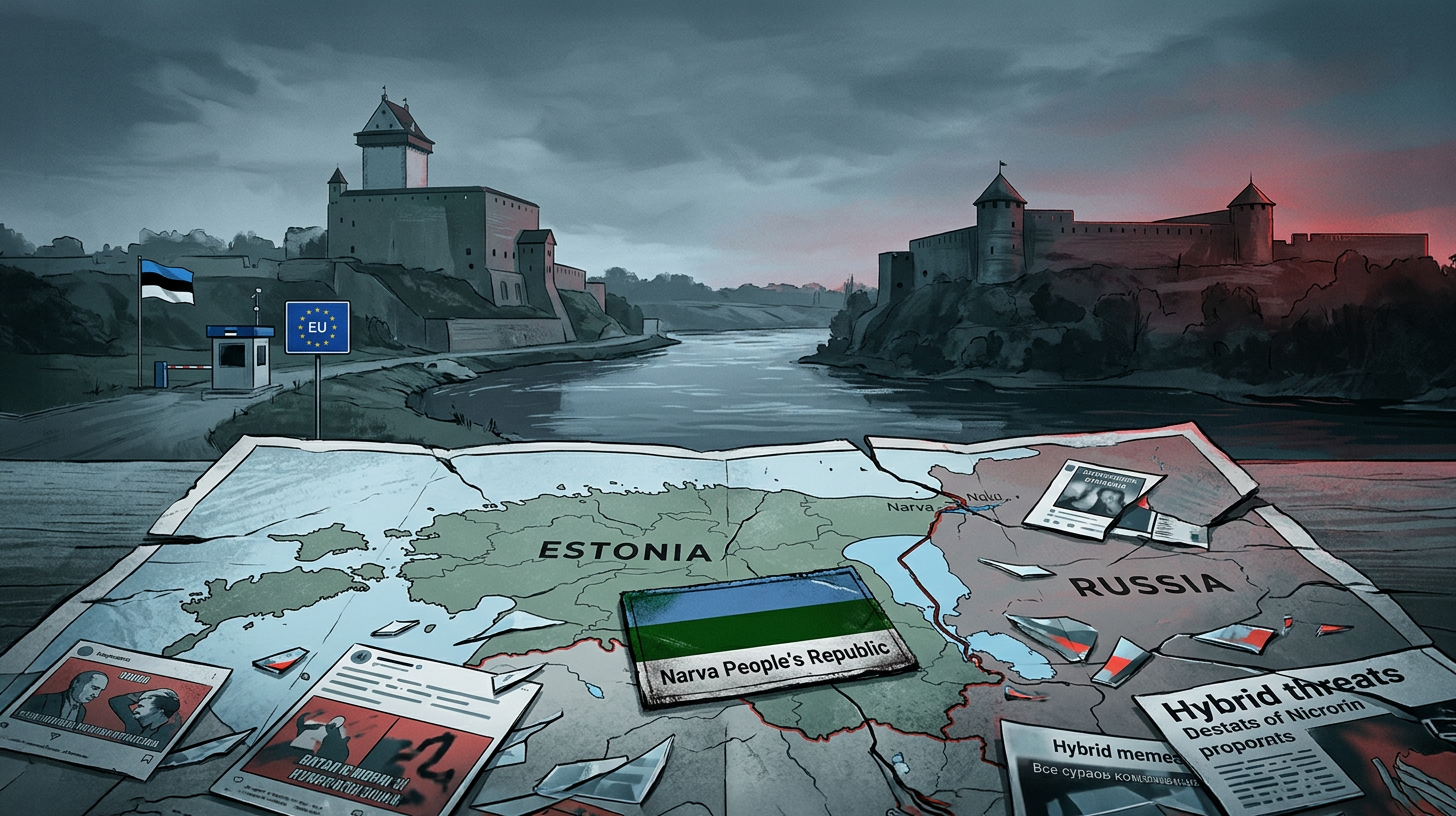
People's Republic of Narva: Kindergarten or war preparation? A flag, a coat of arms, and a frighteningly familiar script – Image: Xpert.Digital
Putin's old script? What's behind the new "People's Republic of Narva" in Estonia?
Shock scenario in the Baltics: Is the Crimean disaster of 2014 repeating itself in Estonia?
In the Estonian border town of Narva, a dark chapter of recent history seems to be repeating itself. Flags, coats of arms, and daily military routines of a fictitious "People's Republic of Narva" are suddenly circulating on social media platforms. What at first glance appears to be an absurd internet trend or a bad joke, on closer inspection reveals itself to be a highly targeted, hybrid destabilization strategy by Russia. Using methods that are frighteningly reminiscent of the preparations for the annexation of Crimea and Donbas in 2014, Moscow is testing the resilience of a NATO and EU member. The following article analyzes how memes are becoming a geopolitical weapon, why the predominantly Russian-speaking city of Narva is in the crosshairs of propaganda, and what this perfidious game with strategic ambiguity means for the security of Europe.
When memes become a geopolitical weapon – Russia's hybrid destabilization strategy against a NATO member
Since February 2026, content proclaiming a so-called "Narva People's Republic" has been circulating on Telegram, TikTok, and VKontakte – complete with its own green-black-white flag, a self-designed coat of arms, and maps depicting new borders. The third-largest Estonian city, Narva, located directly on the Russian border, is being portrayed as an independent political entity. At first glance, the campaign appears to be amateurish internet noise – a few hundred followers, poorly produced memes, and absurd daily schedules of a fictitious militia. But anyone familiar with the pattern Russia used in the Donbas and Crimea in 2014 will be taken aback.
The most prominent Telegram channel, "Narva Republic," was founded on July 14th of last year, but it has only been actively posting since February 18th, 2026. It currently has over 700 subscribers, while another channel has only 60 to 70 followers. Its reach is therefore small at present. But that was also the case in the Donbass at the beginning – before narratives became reality.
Narva: A city between two worlds
To understand the strategic importance of this campaign, one must know Narva's demographic and historical background. The city has a population of approximately 50,000 to 54,000, over 90 percent of whom are Russian-speaking – a direct legacy of Soviet settlement policies that, after World War II, systematically relocated ethnic Russian workers to the industrial centers of northeastern Estonia. The original Estonian population had largely fled or been expelled during the Soviet recapture in 1944.
Narva lies not only geographically but also culturally on a fault line: to the west, Estonia's EU and NATO membership; to the east – separated only by the narrow Narva River – the Russian city of Ivangorod. Many residents have family ties to Russia, consume Russian state media, and feel caught between two identities. At the same time, reports from the area document that the younger generation in Narva is increasingly embracing Estonian statehood and does not see the Russian language as contradicting a European identity. Despite the contrasting demographic reality, residents interviewed by Euronews in 2022 reported that they do not feel discriminated against because of their Russian language.
The narrative propagated by Russian state media of a systematically oppressed Russian-speaking minority in Estonia is therefore without factual basis. International organizations such as the Council of Europe, the UN High Commissioner for Human Rights, and the OSCE have found no evidence whatsoever of systematic persecution of ethnic Russians by the Estonian authorities. Nevertheless, programs like "60 Minutes" on Rossiya 1 have for years broadcasting the image of manipulated criminal proceedings against Russian-speaking compatriots in the Baltic states into Russian living rooms.
The script for destabilization: Parallels to 2014
The architecture of this campaign is no accident – it follows a precise, already proven pattern. In the spring of 2014, the self-proclaimed "People's Republics" of Donetsk and Luhansk emerged in rapid succession in the Donbas region, supported by pro-Russian separatists and Russian armed forces without insignia – the so-called "little green men." The approach followed a clear scheme: first, narrative preparation through media and social networks, then the mobilization of local sympathizers, and finally, military intervention under the guise of protecting the Russian-speaking population.
In parallel, Russia annexed Crimea in March 2014 – also citing the need to protect the Russian-speaking majority population there. What began as a local protest was, in reality, a meticulously planned operation in which narratives were established months in advance. Political scientist Nico Lange succinctly summarizes this mechanism: the proclamation of a "Narva People's Republic" lays the groundwork for subsequent propaganda about alleged oppression and the necessity of Moscow's support – and for Western actors to further disseminate this narrative. The logic of legitimation is always the same: first the narrative, then the intervention.
The crucial difference compared to 2014 lies, of course, in the geopolitical context: Narva is located on the territory of a NATO and EU member state. Military action following the Crimea model would automatically trigger Article 5 of the NATO Treaty. This is precisely why the current campaign should be understood less as preparation for an immediate attack and more as psychological warfare in the lead-up to escalation.
Memes as a weapon: The mechanics of psychological warfare
What at first glance appears to be harmless internet humor is, upon closer inspection, a highly effective tool for destabilization. The content of the "Narva People's Republic" channels combines cat pictures and memes with separatist symbolism, militaristic imagery, and clear political messages. Particularly revealing is a post that depicts a fictional daily routine of the "Narva militia": At 9 a.m., the "storming of Narva" begins; at noon, the towns of Sillamäe and Kohtla-Järve are "captured"; in the evening, there is a concert by the pro-Russian propaganda rapper Akim Apachev. The day ends with a salute.
Military expert Carlo Masala from the Bundeswehr University classifies this methodology as part of a broader Russian psychological warfare campaign. The mixture of provocative jokes, propaganda elements, and martial rhetoric aims to make the target society nervous and hysterical – without presenting a concrete military threat that would require immediate action. This calculated ambiguity is the strategy: the campaign can be taken both as a joke and as serious, which complicates reactions and provokes debate about the appropriate response.
The Estonian Security Police (Kapo/ISS) confirms this assessment and assumes a coordinated information campaign is underway. A spokesperson told the Baltic news portal Delfi that such tactics have been used before, both in Estonia and in other countries: a simple and cheap method to provoke and intimidate society. Marta Tuule of the Estonian Security Police calls it simply a deliberate strategy to sow uncertainty and undermine social cohesion.
Hub for Security and Defense - Advice and Information

Hub for Security and Defense - Image: Xpert.Digital
The Security and Defence Hub offers expert advice and up-to-date information to effectively support companies and organizations in strengthening their role in European security and defence policy. Working closely with the SME Connect Defence Working Group, it particularly promotes small and medium-sized enterprises (SMEs) that wish to further develop their innovative capacity and competitiveness in the defence sector. As a central point of contact, the Hub thus creates a crucial bridge between SMEs and European defence strategy.
Related to this:
How a distorted quote is supposed to provoke a war on the NATO border
Distorted facts: The manipulated quote from the foreign minister
A particularly revealing example of the mechanics of this propaganda is provided by a post from February 19, 2026, on the "Narva Republic" channel. It quotes Estonian Foreign Minister Margus Tsahkna as saying that the Estonian army would cross the border and take the war to Russian territory should Russia invade Estonia. The post concludes with the question: "Are you afraid?"
The quote has been taken out of context. In an interview with the British newspaper "The Telegraph," Tsahkna had stated that in the event of a Russian attack on the Baltic states, the war would be carried onto Russian territory, and attacks would be launched in the hinterland – a defensive reaction strategy, not a preemptive attack. This distinction is fundamental: through selective quoting, a statement of deterrence is being transformed into a declaration of attack, intended to incite fear among the Russian-speaking population.
The technique of selective quotation is a classic propaganda method: True statements are taken out of their context and inserted into a new narrative framework that creates a completely different – and false – meaning. The fact that this is done systematically and in an apparently coordinated manner underscores the Estonian intelligence service's assessment that it is a targeted information campaign.
Autonomy demand as an escalation ladder
The Telegram channels also reveal a clear strategic logic: The separatists describe their approach as a gradual escalation. First, they will advocate for autonomy; if this is denied, the situation will escalate into a full-blown armed conflict and the establishment of an independent state within the borders of Ida-Viru. Ida-Viru is the county in northeastern Estonia that borders Russia and contains the town of Narva.
This rhetorical progression – first autonomy, then independence, and finally conflict – is not a new invention. It mirrors the mobilization rhetoric of the Donbass separatists in 2014, who also initially demanded federalization and autonomy before proclaiming people's republics. Propastop, the Estonian anti-propaganda platform of the volunteer defense organization Kaitseliit, sees this pattern as a deliberate strategy to normalize the idea of Estonian territorial secession.
It is noteworthy that the campaign also includes calls for acts of sabotage and armed resistance, accompanied by slogans such as "Russians, we are not alone!". This crosses the line between political propaganda and direct incitement to crime – an aspect that is being taken very seriously by the Estonian authorities.
The NATO dimension: When will the brigade intervene?
The military-strategic dimension of this campaign cannot be separated from German security policy. The German Armed Forces' Panzer Brigade 45 is stationed in Pabradė, Lithuania, approximately 400 kilometers from Narva. Since February 2026, the brigade has commanded the Multinational Battlegroup Lithuania and is thus firmly integrated into NATO command structures. The German Armed Forces also plan to permanently expand their presence in Lithuania to 5,000 soldiers, likely by the end of 2027.
Its mission formally extends beyond the country of deployment: As part of the Enhanced Forward Presence (eFP), it serves to secure NATO's entire eastern flank – with the Baltic states as the first line of defense. Masala explains the scenario for a crisis: Initially, the forces stationed in Estonia as part of the eFP would be responsible. Afterward, it could not be ruled out that the German presence in Lithuania would be requested immediately as reinforcements. At the same time, Masala points out that the brigade might remain at its current location due to concerns about possible further Russian actions against Lithuania.
The central strategic question posed by Masala in his 2025 book, "When Russia Wins," is: Will NATO risk a full-scale conflict against potentially 1.5 million Russian soldiers—a conflict constantly teetering on the brink of nuclear war—for the liberation of a city of 50,000 inhabitants? In his scenario, Masala describes a Russian attack in March 2028, in which Russian troops capture Narva and the Baltic island of Hiiumaa in a single night—an attack that catches NATO off guard because Europe has failed to modernize its military capabilities. The fact that this thought experiment is now being underpinned by an ongoing propaganda campaign with real-world relevance lends Masala's scenario an uncanny urgency.
Hybrid warfare as a system strategy
The "Narva People's Republic" campaign is not an isolated phenomenon, but rather a component of a systematic Russian strategy of hybrid warfare against Western democracies. For years, Russia has been intensifying its repertoire: sabotage operations against critical infrastructure (most recently, submarine cables in the Baltic Sea), cyberattacks, election interference, the manipulation of migration, and targeted disinformation campaigns. In February 2026, Swedish military intelligence chief Thomas Nilsson stated that Russia had intensified its hybrid warfare and was prepared to take greater risks – including advanced acts of sabotage, assassination plots, and attacks on critical infrastructure.
Brussels-based researcher Joris Van Bladel of the Egmont Institute precisely identifies the strategic calculation behind this approach: Hybrid actions are cheaper for Russia than a direct war, which it cannot afford militarily or economically. Disinformation and psychological warfare are therefore an extremely profitable form of intervention – highly effective with minimal risk. An analysis by the Bundeswehr University Munich describes Russia's strategy as a flexible, adaptable process aimed at gradually adopting the adversary's perception of reality.
As early as 2022, immediately after the start of the major offensive against Ukraine, Putin declared that Narva was historically part of Russia and had to be reclaimed. This statement established the narrative framework; the current social media campaign fills it with concrete symbols and a mobilizing narrative.
Between attention trap and trivialization: The right answer
Herein lies a key dilemma for the affected states and their media: Ignoring the campaign means surrendering the field to propagandists. Amplifying it too much, however, turns a channel with 700 subscribers into an international news story – something Propastop editor-in-chief Indrek Kiisler has openly criticized. In his view, the countermeasure could unintentionally act as an amplifier, giving obscure pro-Russian accounts a reach they would never have achieved organically.
The correct response to this campaign therefore requires a nuanced strategy: education about the mechanisms without sensationalizing the issue; legal prosecution where concrete crimes have been committed (calls for sabotage, incitement to violence); investment in media literacy and social resilience within the Russian-speaking community of northeastern Russia; and the active combating of influence networks and the expulsion of Russian intelligence actors. Political scientist Nico Lange succinctly summarizes the answer: expose propaganda, combat influence networks, and expel Russian intelligence services.
The integration of Estonia's Russian-speaking community remains the most effective long-term countermeasure. As long as a segment of Narva's population feels a stronger emotional connection to Moscow than to Tallinn, vulnerabilities to precisely such campaigns remain. From a security policy and socio-political perspective, deterrence and integration are mutually reinforcing.
A worst-case scenario as a thought experiment: What if?
Carlo Masala currently rules out an immediate military escalation in Narva – the assessment that Russia would not open a second front alongside the ongoing war against Ukraine is shared by most Western military experts. The logistical, military, and political costs of a direct attack on NATO territory are simply too great. But "currently" is a key word.
Masala's thought experiment from "If Russia Wins" therefore deserves special attention: A Russian lightning attack on Narva would have a dual strategic logic – the city's demographic composition (88 percent Russian-speaking population) provides the propagandistic justification, while its geographical location directly on the Russian border makes a rapid occupation militarily plausible. NATO would face the question of whether to trigger an Article 5 invocation – with all its nuclear implications – or whether to accept a reality that would call into question the entire deterrence framework of the alliance.
The true impact of the current propaganda campaign lies precisely in this strategic ambiguity: it sows doubt, undermines trust in state institutions, exerts pressure on the Russian-speaking community, and tests the responsiveness of Western publics. Whether it's childish nonsense or preparation for war is therefore not a question of either/or. It is both – and that is precisely what makes it so dangerous.
Consulting - Planning - Implementation

Markus Becker
I would be happy to serve as your personal advisor.
Head of Business Development
Chairman SME Connect Defense Working Group
Consulting - Planning - Implementation
Konrad Wolfenstein
I would be happy to serve as your personal advisor.
contact me at wolfenstein ∂ xpert.digital
Just call me on +49 7348 4088 965 (Munich) .





