
More robots don't solve warehouse problems: Daifuku connects warehouses and robotics – where the real productivity boost comes from
Xpert Pre-Release

Available in 27 languages 📢
Prefer Xpert.Digital on GoogleⓘPublished on: October 23, 2026 / Updated on: October 23, 2026 – Author: Konrad Wolfenstein
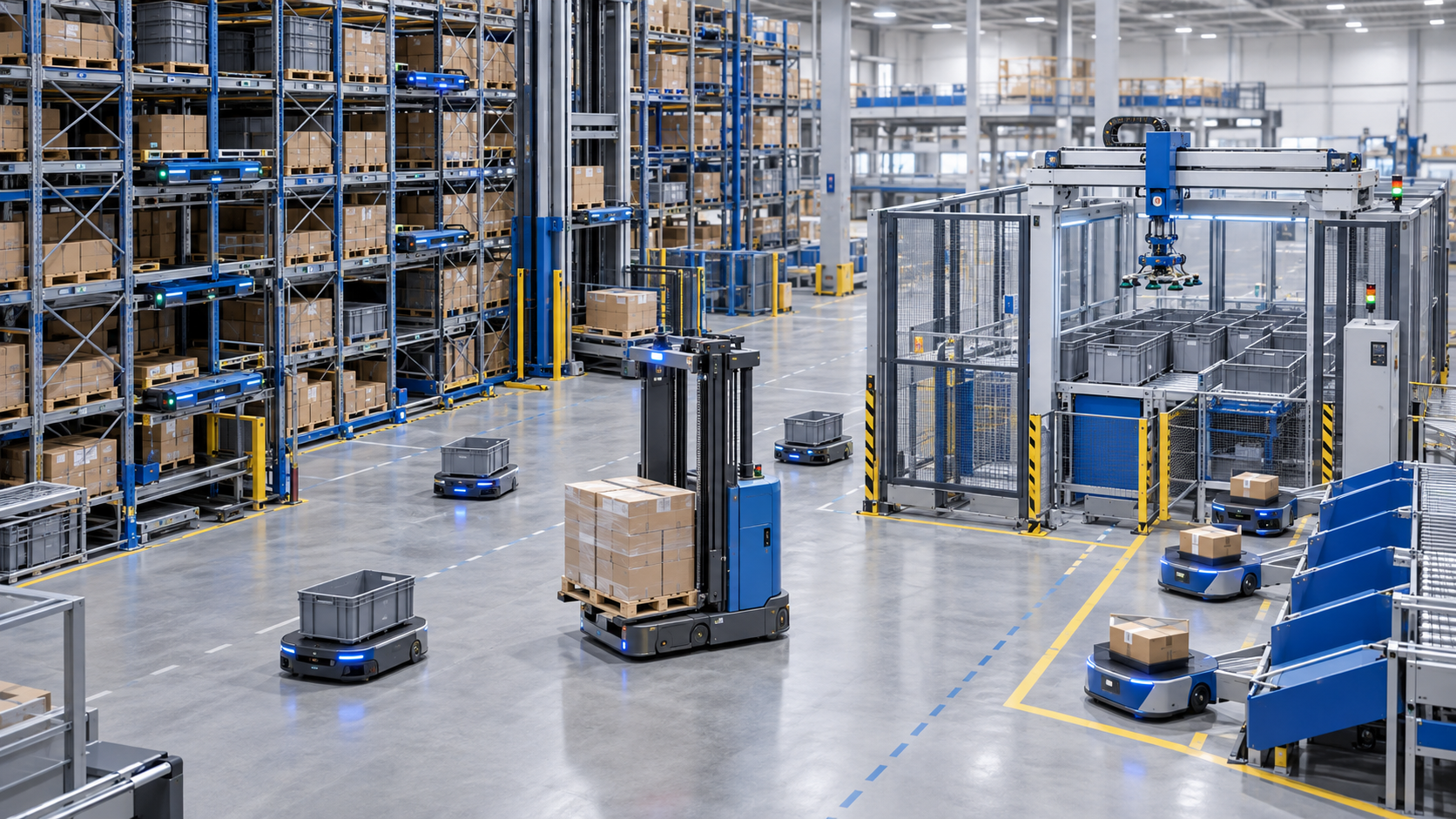
More robots won't solve your warehouse problem: Daifuku connects warehouses and robotics – where the real productivity boost comes from – creative image on the topic, with AI: Xpert.Digital
Warehouses of the future: Why the number of robots doesn't determine success
Automated warehouse: How Daifuku connects pallets, containers and individual items
Daifukus warehouse technology under review: When networked robotics makes economic sense
More robots don't automatically mean a more efficient warehouse. The crucial factor is whether storage, transport, order picking, and sorting work together in such a way that orders are completed reliably and at reasonable costs. Daifuku presented precisely this approach at Logis-Tech Tokyo 2026: Under the motto "Robotics in Motion," the Japanese intralogistics specialist combined automated pallet and container storage, mobile transport robots, robotic order picking, and sorting technology into coordinated process steps.
The underlying idea is economically relevant: if individual systems operate quickly, but their transfers are stalled or downstream processes can't keep up, a large portion of potential productivity remains untapped. Networked robotics can help reduce such inefficiencies – but it's not a guaranteed success. Space requirements, software, reliability, personnel organization, and the actual product range all influence whether an investment pays off. Daifuku's presentation therefore not only demonstrates which tasks robots can perform, but also what's crucial for the integration and objective evaluation of an automated warehouse.
Daifuku's networked warehouse: The economics of coordinated robotics
When robotics, warehousing, transport, and order picking work together as a networked operational process, the economic logic of a warehouse changes: What matters is no longer solely how fast a machine works, but how reliably the entire system completes saleable orders. The central thesis, therefore, is that the greatest productivity gains often lie not in the next robot, but in the better coordination of processes that can already be automated.
Daifuku showcased this approach at Logis-Tech Tokyo 2026, which took place in Tokyo from September 8th to 11th. Under the theme "Robotics in Motion," the company combined automated warehouse technology, mobile transport robots, robotic picking and sorting into coordinated process steps. The economic significance of this integration extends beyond a product presentation: it impacts investment decisions, space utilization, work organization, capital commitment, and the ability to deliver reliably under fluctuating demand.
From machinery to operating model
The presentation encompassed seven different systems that worked together in two areas: one for pallets and the other for containers and individual items. On the pallet side, the focus was on the four-way shuttle warehouse Shuttle Rack LX, the autonomous forklift SOTR-F, and the pallet transport and sorting system SOTR-L. In the second area, Daifuku combined the container warehouse Fine Shuttle with the transport robot SOTR-M, the XY picking robot, and the single-item sorting system SOTR-S.
This distinction is important: What was shown was not simply a universal robot that performs all tasks, but rather a division of labor architecture comprised of specialized machines. Economically, this makes sense. A system for moving heavy pallets must meet different requirements than a gripper for small products. Specialization can therefore be more cost-effective and reliable than attempting to solve every task with the same class of machine.
Equally important is defining the limits of the presentation. The two demonstration areas must not be mistaken for proof that all work steps in any given distribution center are already fully automated. Between pallet storage and individual item picking, for example, lie depalletizing, opening cartons, receiving, and, if necessary, transferring the contents. A reliable evaluation must explicitly consider such transitions, instead of concluding that a completely unmanned warehouse is the result of a successful partial process.
The market is growing, the bar is rising
The scale of demand demonstrates that mobile robotics is no longer a niche market. In 2025, 117,500 service robots for transport and logistics applications were recorded worldwide; this application accounted for 47 percent of all professional service robots. The reported growth compared to the previous year was 21 percent. Overall, registered sales of professional service robots rose to nearly 250,000 units.
These figures require precise interpretation. The transport and logistics category encompasses not only warehouse robots but also other transport applications in various indoor and outdoor environments. Furthermore, sales volumes are neither installed stock nor market revenue. A small sorting robot and a heavy transport vehicle can each appear as a single unit in a unit count, even though their investment volume and operational impact differ significantly.
Even comparing data over time is methodologically challenging: The 2024 publication cited 102,900 units, while the comparative graph in the 2026 edition shows approximately 97,000 units for 2024. Therefore, the 117,500 units for 2025 should not simply be divided by the previously published figure to derive a supposedly corrected growth rate. For economic interpretation, what matters is the robust finding of a large and growing application category, not an artificial precision achieved through differently defined publications.
Labor shortage without false alarm figures
Japan is an insightful market for this development. Logistics policy addresses population decline, labor shortages, and the safeguarding of logistics services as interconnected structural challenges. Under these conditions, automation appears not only as a tool for rationalization but also as a way to maintain existing services despite limited human resources.
It would be misleading to continue using older bottleneck forecasts unchanged. Previous scenarios had described a potential gap of around 34 percent in road transport capacity for 2030 if no appropriate countermeasures were taken. The updated forecast for 2026, however, indicates a potential shortfall of approximately 7 to a maximum of 25 percent, depending on the assumptions. Measures already implemented and a decrease in transport demand compared to the earlier starting point influence this reassessment.
The economic consequences are twofold. First, the pressure to modernize persists. Second, a national transport forecast cannot be used to directly predict the profitability of a single warehouse. Driver shortages, waiting times at loading docks, and internal transport operations are related but not identical. An automated warehouse primarily benefits the overall transport chain when it actually speeds up and improves the reliability of processing and order fulfillment.
Productivity arises between the plants
A goods flow can consist of high-performance individual machines and still be economically weak. If the warehouse delivers goods faster than the downstream order picking system can process them, intermediate stocks accumulate. If the robot fleet transports containers particularly quickly while the packaging department is overloaded, the bottleneck is merely shifted geographically. Such interactions explain why local machine performance is not a sufficient measure of success.
A more sensible approach is to consider the entire order processing workflow. Storage, transport, picking, sorting, and packaging should be coordinated so that the limiting process is neither unnecessarily delayed nor overloaded. Comparable integration approaches from other providers therefore explicitly link inventory management, order release, and machine control with the available downstream capacity. This underscores that coordination is not an exclusive, specialized topic for a single manufacturer.
From an economic perspective, an investment should therefore be evaluated based on how much it improves the overall system's performance. Additional vehicle capacity is of little value if an unchanged transfer station is already limiting maximum throughput. Conversely, improved sequencing can make existing systems more productive without immediately requiring additional hardware. The primary investment question is not which piece of equipment is the most modern, but rather which bottleneck is causing the greatest economic damage.
Pallet storage becomes a space strategy
The Shuttle Rack LX combines multi-deep storage channels, four-way shuttle vehicles, and vertical lifters. The published rated load per shuttle is 1,500 kilograms, with a maximum travel speed of up to 100 meters per minute. According to specifications, the lifters achieve a lifting speed of up to 72 meters per minute.
These values describe technical characteristics, but do not yet guarantee an hourly pallet throughput. Travel paths, acceleration, load changes, warehouse occupancy, order structure, and lifter utilization must be considered for that. The connection between horizontal movements within the racking and vertical transfers deserves particular attention. More shuttle vehicles only increase overall performance if the remaining resources can accommodate the additional movements.
The combination of storage density and expandability is particularly attractive from an economic perspective. Daifuku envisions the addition of racks, shuttles, and lifts as a path for expansion. This can enable companies to gradually adapt their warehouse structure to growing volumes. However, spatial and technical expansion remains dependent on certain prerequisites: available warehouse space, suitable load-bearing capacity, adequately sized transfer points, and an expandable control system must all be considered during the planning phase.
The correct key performance indicator (KPI) is therefore not simply the maximum achievable number of storage spaces. A more meaningful metric is how many actually usable storage spaces are available, with what access speed and total costs. A particularly dense warehouse is not an advantage if additional relocations or unsuitable product structures significantly impair the required performance.
Mobile handovers close automation gaps
In the pallet demonstration, the SOTR-F handled the transport of pallets that had been moved out of the warehouse; the SOTR-L was also integrated into the further transport process via a transfer station. This highlighted a process segment that is often underestimated from an economic perspective: the connection between the stationary warehouse and the subsequent operational area.
An automated warehouse can only operate at a limited capacity if humans have to subsequently pick up, buffer, or restock each pallet. Mobile systems can standardize such recurring transfers. Their importance then lies less in a spectacular single movement than in reducing manual interruptions and unpredictable waiting times.
However, the complexity doesn't disappear. It shifts to the design of the transfers. Load carriers must be suitable, their position must be correct, and the systems involved must reliably detect whether a transfer is completely finished. Damaged pallets or unstable loads are therefore not a minor issue, but potential sources of disruption to the entire process.
For cost-effectiveness analysis, this means that it's not just the number of replaced forklift trips that should be counted. Equally relevant are the avoided setup work, the required personnel reserves, and the effort involved in exceptional cases. Only a complete process analysis reveals whether mobile handovers actually reduce costs or merely shift them between organizational units.
Container storage gains new degrees of freedom
Fine Shuttle utilizes a racking system with an integrated operator that travels along the racking structure, eliminating the need for floor-mounted rails. Storage is double-deep; up to two operator units can be used per aisle. Technical specifications include special plastic containers measuring 650 x 450 x 320 millimeters, a load capacity of 30 kilograms, and an aisle width of 750 millimeters.
In conjunction with SOTR-M, containers can be automatically transported between warehouse transfer points and picking stations. This corresponds to the goods-to-person principle: employees no longer search for goods in long rows of shelves, but rather the required stock is delivered to stationary workstations. This separation between storage location and processing location can fundamentally change work organization.
However, economic viability depends on more than just the saved walking distance. Crucial factors include replenishment, item allocation, container circulation, achievable workstation output, and the number of orders that can be processed simultaneously. Transferring items into standardized containers also generates labor and requires space. If this effort is overlooked during the planning phase, the subsequent order picking process will appear more cost-effective than the overall process actually is.
The container dimensions also demonstrate that standardization is an operational decision. Items that fit well into the designated load carrier are easier to automate. Bulky or unusually shaped products, on the other hand, may require a separate process. An economically sound concept must accept these differences instead of forcing every product into the same architecture.
Gripping is more demanding than driving
In the demonstrated unit load handling process, the XY picking robot identified items in the container using AI-supported object recognition and transferred them to the SOTR-S sorting system with a suction gripper. The robot is designed as a three-axis handling system with image recognition. Here, classic automation is combined with an area where the characteristics of the individual product are particularly important.
A container typically has a defined geometry. Individual items, however, can have different surfaces, deformations, and packaging. Handling soft and irregularly shaped items remains a challenge on the path to further automation. Therefore, it would be wrong to assume that successful image recognition guarantees universally reliable physical picking.
For operators, the central question should be what proportion of their own product range can be processed with what reliability and at what cost. High performance with easily accessible test items has limited relevance for a mixed basket of goods. Tests with the actual products, packaging conditions, and storage conditions are needed.
From an economic perspective, recovery after a mistake is also crucial. A system that identifies a difficult item and routes it to a manual workstation in an orderly manner can be more advantageous than a nominally faster solution that repeatedly causes unplanned interruptions. Robust handling of limitations is often more valuable than achieving a particularly impressive peak performance under ideal conditions.
Sorting must match demand
SOTR-S transports individual items to their respective destinations using a fleet of small vehicles. The vehicles receive their tasks via the warehouse management system and a Robot Traffic Controller, which coordinates movements and routes. In the trade fair application, this system connected to the robotic picking process and sorted the picked products according to their shipping destination.
The potential advantage lies in a capacity that can be adapted to the workload by adjusting the number and deployment of vehicles. Such an architecture can be particularly attractive when sorting targets, item quantities, and order profiles change frequently. Furthermore, the maintenance of individual vehicles can be organized fundamentally differently than the maintenance of a central, continuous transport line.
However, this does not imply a general superiority of mobile sorting. For consistently high, uniform volumes and stable routes, permanently installed conveyor and sorting technology can remain a suitable solution. Modern conveyor systems can also deactivate individual zones as needed. Therefore, the comparison should not be between intelligent robotics and a conveyor technology that is deliberately portrayed as outdated.
The most economically viable solution can be a hybrid approach: stationary technology where consistently high performance is required, and mobile robotics where layout changes and fluctuating volumes are advantageous. The crucial factor is the fit to the load profile, not the latest technological trend.
Software determines the overall value
The coordination of networked warehouse technology can be divided into different task levels. A Warehouse Management System manages, among other things, inventory and warehouse processes; a Warehouse Control System controls the material flow technology. A Warehouse Execution System can optimize execution and resource utilization between these levels, although the actual functional boundaries overlap.
The core economic challenge lies in releasing the right work at the right time. An urgent order shouldn't be expedited simply because its initial transport route is clear. The system must also consider whether the necessary items, processing stations, and shipping options are subsequently available. Otherwise, the result will simply be an accelerated queue.
Daifuku integrates its material handling technology with warehouse management software and the connection to higher-level enterprise systems. However, the long-term value of such an architecture depends on data quality, transparent priorities, and manageable interfaces. A physically correctly transported container is of little use if its contents or order assignment are incorrectly recorded in the system.
Therefore, investment decisions should not treat software as a minor addition to the mechanical components. Key factors to consider are maintainability, error diagnosis, restart capability, testing options, and whether the company can further develop its processes later with reasonable effort. A low hardware price can be offset by long-term dependencies and costly customizations.

Expert partner in warehouse planning and construction
The limits of the robot fleet: Why more isn't always better
More vehicles can bring less benefit
A larger robot fleet does not increase performance indefinitely. Studies of robotic storage systems show that increasing the number of vehicles causes more frequent blockages and can eventually lead to throughput saturation. The location of workstations and the design of the storage structure also influence the performance of such systems.
The economic explanation is simple: vehicles require shared traffic areas, transfer points, and processing resources. When these become scarce, an additional robot spends an increasing amount of time waiting. At the same time, acquisition, maintenance, and potentially charging requirements increase. Therefore, the technical expandability of a fleet does not automatically translate into a proportional improvement in its economic benefits.
A robust planning process should examine different demand patterns and disruptions. These include simultaneous goods receipt and dispatch, an unusually high number of orders for the same product group, blocked transfers, and temporarily unavailable workstations. The models must be compared with real-world process data. A simulation does not replace a reliable operational test, but it can reveal which resources will reach their limits first.
The optimal expansion point is reached when the additional capacity provides sufficient benefit and no cheaper alternative solves the same bottleneck. Sometimes an additional transfer station is more economical than a larger fleet. Sometimes a modified order release process is sufficient. These alternatives should be examined equally.
Flexibility comes at an economic price
Mobile robotics is often associated with scalability. However, at least three different forms of scalability must be distinguished: additional storage space, increased processing capacity, and a modified layout. A system can be flexible in one of these dimensions and reach its limits in another. This is precisely where a key difference lies between a technically modular product and a truly adaptable operation.
For companies, flexibility has value as an option. Those who can add capacity later may not have to invest as early in uncertain demand. This reduces the risk of permanently unused facilities. However, the benefit of this option depends on whether additional modules are available in time and whether their integration can be achieved without disproportionate operational disruptions.
Even a decommissioned portion of the fleet remains a tied-up asset. While temporarily disusing it may save on wear and tear and some energy costs, it doesn't automatically eliminate financing, aging, and all service expenses. This distinction is crucial for seasonal business models. Companies requiring peak performance for only a few weeks should assess whether additional shifts, organizational streamlining, or external capacity are more cost-effective than maintaining equipment permanently.
Flexible automation is therefore not synonymous with minimizing fixed costs. It is an investment in adaptability. The value of this adaptability depends on the company's specific demand and risk profile.
Return on investment begins with total costs
A sound cost-benefit analysis considers the entire life cycle. Initial capital requirements include not only robots and shelving, but also planning, software integration, a security concept, network infrastructure, charging equipment, structural modifications, and training. During operation, maintenance, spare parts, software updates, technical support, energy, and handling of exceptional cases are added. These items should be determined on a project-specific basis, rather than using generalized empirical values as a seemingly reliable calculation.
On the benefits side, actual avoided costs must be distinguished from theoretical productivity gains. Savings in working time only lead to financial relief if, for example, overtime is reduced, external staff are no longer needed, or additional growth is managed without corresponding new hires. While redeploying employees to other tasks can be valuable, it does not automatically constitute the same type of saving.
Additional revenue does not automatically equate to additional profit. More processed orders only create added economic value if there is corresponding demand and the additional contribution margin remains positive. Furthermore, commissioning, ramp-up time, and any potentially necessary parallel operation must be factored into the payment plan.
The simple payback period can serve as a starting point. However, for larger projects, discounted cash flows and multiple scenarios are more meaningful. At a minimum, lower capacity utilization, longer start-up time, rising operating costs, and a less favorable product range development should be considered. A project is not robust simply because it looks particularly good in the optimistic scenario.
Practical figures need a suitable benchmark
Logisteed East Japan's Kashiwa Platform Center demonstrates how significant improvements can be achieved through process integration. There, previously distributed processes across multiple locations were reorganized and integrated with automated warehousing, batch picking, sorting, and goods-to-person processes. A productivity increase of 140 percent is reported for the affected processes.
This figure is interesting, but it's not a general performance metric for Daifuku's new robotics systems. It refers to a specific change in the operating model and is not an independently verified industry standard. A 140 percent improvement mathematically means 2.4 times the initial value, not simply 140 percent of the initial level. This does not, therefore, translate into a correspondingly high reduction in personnel costs.
The real value of the findings lies in the combination of organizational and technical changes. The goods were not simply moved using different machines; the site structure, order picking logic, and order consolidation also changed. Therefore, anyone who focuses solely on the installed technology would overlook some of the underlying causes.
For new investments, a different question is crucial: How great is the potential for improvement compared to current operations? A well-organized plant starts from a different foundation than a fragmented, highly manual process. Therefore, comparable key performance indicators (KPIs) must encompass the same activities, timeframes, and quality requirements.
Labor costs change the location calculation
In a European comparison, average labor costs in 2025 were €34.90 per hour in the EU and €38.20 in the Eurozone (in its current composition). The range extended from €12 in Bulgaria to €56.80 in Luxembourg. These are macroeconomic averages, not specific costs for warehouse labor.
These differences illustrate why the same technical solution must be evaluated differently at different locations. If labor costs determine the predominant benefit, identical automation will amortize faster at a high-wage location under otherwise identical conditions. However, otherwise identical conditions are rare in practice. Staff availability, shift work, land costs, delivery quality, and growth can significantly alter the calculation.
Even low-wage locations are not a static entity. In Bulgaria, reported labor costs rose by 13.1 percent in 2025 compared to the previous year. This does not allow for a prediction of a consistently similar increase, but it does highlight the need to base investment calculations not solely on current cost advantages.
Automation and nearshoring are therefore not simply opposites. A locally based, semi-automated warehouse can offer a different combination of service, labor costs, and delivery times than a largely automated central warehouse. The right solution depends on the entire supply chain, not just on the hourly wage or the number of robots installed.
Energy efficiency requires a system balance
The Shuttle Rack LX is available in a standard temperature version for 0 to 40 degrees Celsius and a cold-weather version for -25 to 0 degrees Celsius. The Fine Shuttle, on the other hand, is specified for a range of 0 to 40 degrees Celsius. These differences must be taken into account when adapting an automation concept to different temperature zones.
Refrigerated logistics clearly demonstrates why space utilization, working conditions, and energy consumption should be considered together. At Nikko Sangyo Transport, automated warehouse technology enables order picking to be carried out in a 0°C zone instead of in a deep-freeze warehouse at -25°C. This creates benefits that go beyond mere time savings: the most physically demanding tasks are reorganized spatially.
Higher storage density can help limit the required refrigerated volume under suitable structural conditions. However, whether the overall system actually consumes less energy also depends on the refrigeration system, building envelope, door openings, transport movements, and utilization. The robots' electricity consumption is only one part of this equation.
Several key performance indicators are therefore meaningful: total energy consumption, energy per processed order, and, if necessary, energy per stored unit. A decreasing consumption intensity can coincide with an increasing absolute consumption if the business grows. Without this distinction, efficiency is easily mistaken for an actual reduction in total consumption.
Reliability is not a vehicle characteristic
Multiple independently deployed vehicles can support continued operation during maintenance or failure of individual units; this redundancy is also part of the Shuttle-Rack LX concept. However, this does not mean that the entire warehouse no longer has a central point of failure. Shared lifts, controls, network components, transfer stations, or power supplies can still create critical dependencies.
For operators, the remaining capacity in the event of a malfunction is therefore more important than the mere number of available backup vehicles. How many jobs can still be completed if a lift fails? Can blocked loads be safely recovered? Can a section of the operation continue independently? These are the kinds of questions that translate technical redundancy into operational resilience.
A distinction must be made between functionality and economically sufficient performance. A system can continue to operate technically and still miss its delivery deadlines. Conversely, a deliberately planned performance reserve may appear more expensive, but it avoids high subsequent costs. The appropriate level of redundancy therefore depends on delivery obligations, lead times, and the potential damage from an interruption.
A meaningful assessment should explicitly include restart and inventory reconciliation. After a shutdown, simply restarting vehicles is insufficient. The system must also know which goods are located where and which work steps have been fully completed. Only then can operations be resumed in a controlled manner.
Openness limits long-term dependencies
An integrated overall solution can consolidate responsibilities. This can be attractive for the operator because errors at interfaces shouldn't be passed back and forth between multiple suppliers. At the same time, dependence on a single provider may increase if plant control, data access, and future expansions are tightly tied to their proprietary environment.
Version 3.0 of the VDA 5050 communication interface, released in 2026, expands the requirements for cross-manufacturer mobile robot fleets and gives greater consideration to freely navigating vehicles. This includes, among other things, zone rules and the ability to exchange planned routes between the vehicle and the higher-level control system. However, a common communication interface does not replace a complete review of the actual cooperation within a specific project.
Therefore, it should not be assumed without proof that every desired third-party component can be integrated into a Daifuku system via this interface. Supported versions, functionality, responsibilities, and practical testing would need to be examined. An open protocol is an important prerequisite, but not a ready-made mixed operation.
From an economic perspective, openness should be evaluated over the entire lifespan of the system. Relevant factors include data export, documented interfaces, spare parts availability, and the effort required for later modifications. A system that initially appears particularly user-friendly can become expensive in the long run if every adaptation is only possible under restrictive conditions. Conversely, a unified architecture can be valuable if it demonstrably reduces integration effort and operational risks.
Networking makes security economically relevant
The closer warehouse technology and information systems work together, the more important a manageable security architecture becomes. For industrial control environments, this includes, among other things, separate network segments, controlled transitions, and particularly secure remote access. For remote access, this includes encrypted communication and strong authentication.
For a networked warehouse, these measures are not solely the responsibility of the IT department. A disrupted remote access, a compromised control system, or an inadequately secured interface can disrupt physical order processing. Therefore, operational reliability, information security, and restart capability should be planned together.
In addition, there is the regulatory perspective. The European Machinery Directive will generally be mandatory from January 20, 2027, and places greater emphasis on autonomous systems and safety-relevant digital technologies. For projects involving the placing on the market or commissioning of such equipment, the relevant requirements must be considered in a timely manner.
A sound economic safety concept not only prevents damage, but can also avoid later modifications and delays. At the same time, safety requires realistic operational procedures: employees must be able to troubleshoot malfunctions and perform maintenance without circumventing safety measures due to time constraints. Technical regulations and practical usability therefore go hand in hand.
Humans remain part of the system
Networked automation changes tasks instead of automatically eliminating all human work. In Daifuku's own product architecture, fully robotized sub-processes exist alongside goods-to-person concepts with human workstations. This is not a contradiction, but can be an expression of an economically sound division of labor.
People can be particularly valuable where products change, unusual damage occurs, or ambiguous situations arise. At the same time, demands are placed on technical support, process analysis, and data management. Those who assess profitability solely based on the elimination of transport activities may underestimate the development of these skills.
For companies, this means planning training early on. Employees should understand which malfunctions they are allowed to resolve themselves, when they need support, and how to document errors transparently. Organizational responsibility is equally important: unclear lines of accountability between warehouse operations, maintenance, and IT can turn a minor technical fault into a lengthy downtime.
The most challenging change often lies in the management of the business. When performance and downtime become visible in detail, the data must be used to improve processes. A one-sided focus on individual work paces, on the other hand, can create new perverse incentives. Productivity remains a characteristic of the overall system and not solely the result of faster-working employees.
Daifuku's strength needs sober assessment
The company's economic strength is substantial. In the first half of 2026, Daifuku achieved consolidated sales of approximately 355.5 billion yen and an operating profit of approximately 56.7 billion yen. The operating margin was 15.9 percent; order intake reached approximately 440.2 billion yen. Sales increased by 8.9 percent and order intake by 31.6 percent compared to the same period of the previous year.
However, these figures do not provide isolated evidence of the success of warehouse robotics. Growth was largely driven by cleanroom systems for semiconductor production; exchange rates also influenced the reported group figures. Therefore, the newly introduced warehouse products should not be equated with all the positive developments of the group as a whole.
The service business is also interesting. Daifuku projects service revenues of 176.6 billion yen for 2025, representing approximately 27 percent of the group's total revenue. This demonstrates that material flow automation is not economically viable until the sale of the equipment. Maintenance, modernization, and support form an important part of the business model.
For customers, a well-developed service organization can increase long-term benefits. At the same time, its services are part of the overall ongoing costs. The relevant question, therefore, is not whether service is inherently good or expensive, but rather what availability, response time, and further development the company actually receives in return. Company size is an important selection criterion, but it does not replace the evaluation of the specific solution.
The correct order of modernization
A convincing modernization begins with a reliable description of current operations. This includes orders and positions, product geometries, workload distributions over time, actual operating hours, and the causes of downtime. Average values alone are insufficient if the system fails during a few peak hours. Likewise, the busiest peak day is not a sufficient basis for every investment.
This should be followed by a bottleneck analysis. Some difficulties can be significantly reduced through improved storage location allocation, standardized load carriers, or a modified replenishment organization. Automation should reinforce a viable process, not simply speed up unclear procedures.
At existing sites, the transition requires special attention. New technology must be installed and tested while maintaining delivery capacity. A phased rollout can limit risks but requires clear interfaces with existing operations. The final state alone says little about the effort required for the conversion.
For later verification, clear key performance indicators (KPIs) should be agreed upon from the outset: orders completed on time, cost per order item, error rate, exception costs, and total available output for a realistic product range. These metrics link technical functionality with economic results. They prevent a system from appearing formally successful while new burdens accumulate in day-to-day operations.
Coordination becomes the real competitive advantage
The strategic importance of Robotics in Motion lies not in running as many robots as possible simultaneously. It lies in combining specialized technology into a manageable operation. Daifuku's presentation showcased concrete building blocks for this, ranging from pallet storage and container transport to robotic picking and individual item sorting.
The most compelling economic perspective is therefore neither unbridled enthusiasm for automation nor fundamental skepticism. Networked robotics is particularly interesting when regularly recurring tasks, suitable load carriers, sufficient utilization, and a clear bottleneck converge. It becomes problematic when uncertain assumptions about demand and product range are replaced by supposed technical universality.
Daifuku's opportunity lies in translating its broad technical capabilities, software, and support into demonstrable customer value. Operators' challenge is to measure this value across complete processes and real-world financial impact. The goal should not be the highest level of automation, but rather an operation that reliably delivers its services at reasonable costs and allows for further development.
The warehouse of the future doesn't have to be completely unmanned. Above all, it must generate less friction: between inventory and orders, between stationary systems and mobile vehicles, and between technical feasibility and economic necessity. The decisive progress begins where movement becomes a reliable flow of materials.
Your intralogistics experts

Consulting, planning and implementation of complete solutions for high-bay warehouses and automated storage systems - Image: Xpert.Digital
More information here:
Your global marketing and business development partner
☑️ Our business language is English or German
☑️ NEW: Correspondence in your native language!

Konrad Wolfenstein
I and my team are happy to be available to you as your personal advisor.
You can contact me by filling out the contact form here [email protected]:or simply call me at +49 7348 4088 965. My email address is
I'm looking forward to our joint project.
☑️ SME support in strategy, consulting, planning and implementation
☑️ Creation or realignment of the digital strategy and digitization
☑️ Expansion and optimization of international sales processes
☑️ Global & Digital B2B trading platforms
☑️ Pioneer Business Development / Marketing / PR / Trade Fairs
Our global industry and economic expertise in business development, sales and marketing

Our global industry and economic expertise in business development, sales and marketing - Image: Xpert.Digital
Industry focus areas: B2B, digitalization (from AI to XR), mechanical engineering, logistics, renewable energies and industry
More information here:
A thematic hub offering insights and expertise:
- Knowledge platform covering global and regional economies, innovation and industry-specific trends
- A collection of analyses, insights, and background information from our key areas of focus
- A place for expertise and information on current developments in business and technology
- A hub for companies seeking information on markets, digitalization, and industry innovations










