

Mission military mobility: How Tomáš Zdechovský and Markus Becker want to reconnect Europe's logistics hubs
Xpert Pre-Release

Available in 27 languages 📢
Prefer Xpert.Digital on GoogleⓘPublished on: July 13, 2026 / Updated on: July 13, 2026 – Author: Konrad Wolfenstein
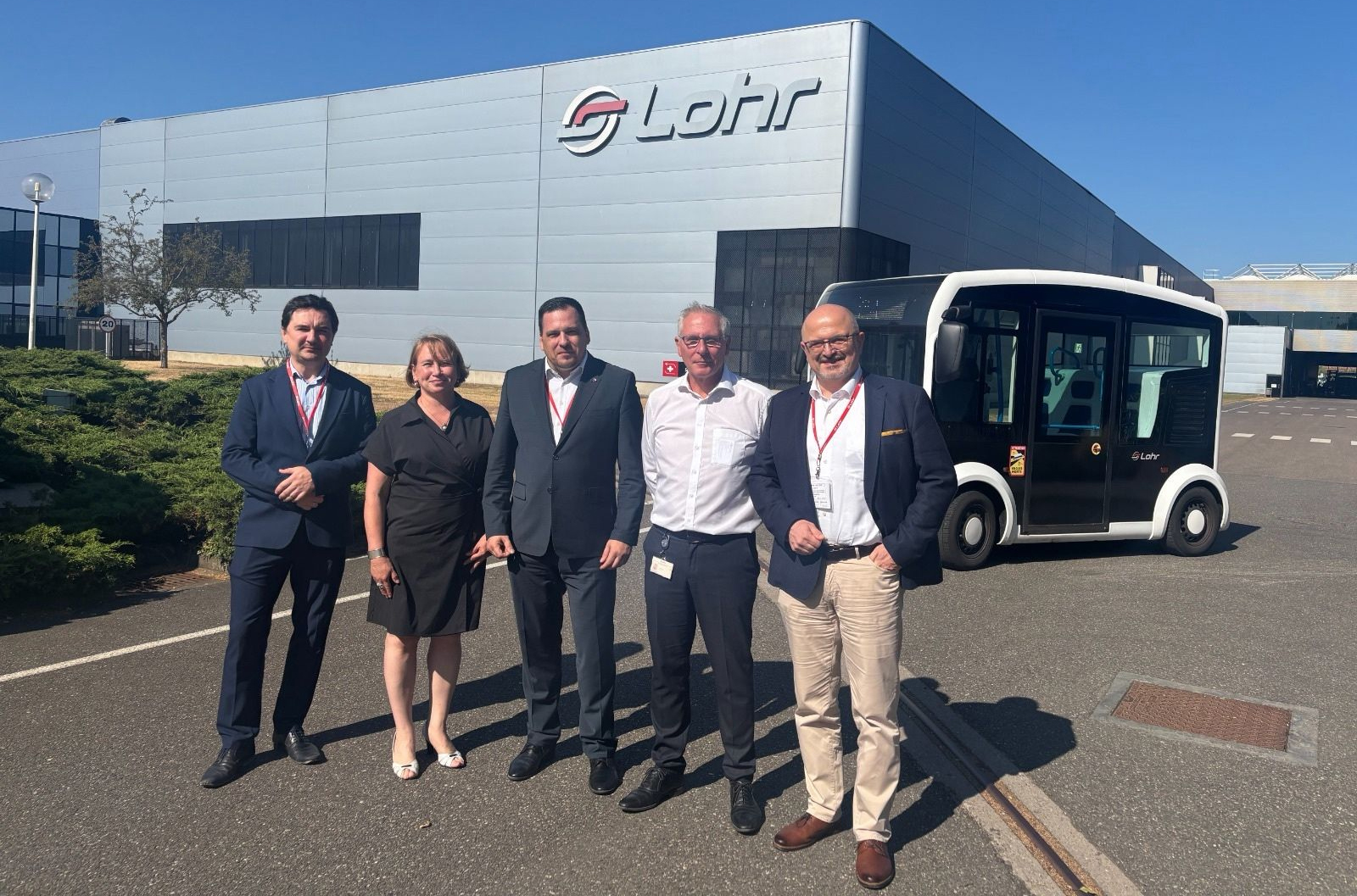
Mission military mobility: How Tomáš Zdechovský and Markus Becker want to reconnect Europe's logistics hubs – Image: Tomáš Zdechovský
European resilience is not a slogan – it is a systemic issue
The missing piece for Europe's security: Why integrated logistics decides between war and peace – and why Europe is only just beginning to understand this
The European Union is rearming and investing billions in military mobility – but building new corridors and procuring faster trains alone will not make the continent safe. A groundbreaking visit to the LOHR Group in Duppigheim, Alsace, reveals the true blind spot of the European defense strategy: Europe doesn't lack transport resources, but rather intelligent logistics hubs and systems thinking.
How civilian innovations – from fully automated city modules to revolutionary intermodal rail systems – can create a highly responsive "dual-use" network that reduces costs in everyday civilian life and secures troop movements in emergencies is revealed by a closer look at an often overlooked engine of European industry: small and medium-sized enterprises (SMEs). This in-depth strategic analysis explores why Europe's future ability to act will be determined at the interface of road and rail – and why a 70-billion-euro problem cannot be solved with purely military means.
Related to this:
Civilian technology for emergencies: The revolutionary logistics concept that Europe needs now
It could have been a completely ordinary industry visit. The LOHR Group in Duppigheim, a small town in Alsace near Strasbourg, is a well-known name in the European transport and logistics sector. Founded in 1963 and now employing around 2,000 people on three continents, the company is the world market leader in car carriers and has been developing solutions at the interface between road and rail for decades. But what actually took place in Duppigheim that day was more than just a product demonstration. It was a discussion about the strategic future of Europe – and about whether the continent is capable of combining its technological strengths in such a way as to create genuine decisiveness.
Tomáš Zdechovský, Member of the European Parliament and newly appointed Co-Chair of the SME Connect Defence Working Group, attended the LOHR site presentation in Duppigheim together with Markus Becker. The SME Connect Defence Working Group aims to integrate small and medium-sized enterprises (SMEs) into the European defense ecosystem – thereby mobilizing precisely that segment of industry which is often more technologically innovative than large corporations, but receives significantly less political attention. Zdechovský, a crisis manager and strategist with a military background in the Czech Army, brought a perspective that day that extends far beyond the industrial context. What he saw in LOHR's products and concepts was not a vehicle or a railcar – but a potential link in a European security system that remains fragmented and incomplete.
CRISTAL and DRAISY: More than new vehicles
To understand the strategic potential of this meeting, it is worthwhile to first take a closer look at the specific technological solution that was the focus of the day. LOHR presented CRISTAL and DRAISY, two complementary mobility systems that at first glance seem to have little to do with security policy – but on closer inspection directly address issues of territorial cohesion, infrastructure resilience, and operational availability.
CRISTAL is a modular, all-electric transport system for urban and peri-urban areas. It dynamically adjusts its capacity to passenger demand by coupling between one and four vehicle modules into a convoy – a principle familiar from public transport, but realized here on a new scale through automated mechanisms and a particularly compact design. With a range of up to 170 kilometers, a full charging cycle of two and a half hours, and a top speed of 50 km/h, CRISTAL is primarily designed for urban first-line services. It complements existing modes of transport such as subways, trams, and buses without encroaching on their capacity and is explicitly aimed at people with reduced mobility.
DRAISY addresses another, structurally at least equally significant challenge: connecting rural areas to the national rail network. The battery-powered light rail vehicle, developed by a consortium of SNCF, LOHR, Stations-e, Kiepe Electric, and the research institute IRT Railenium, weighs only around 20 tons, making it considerably lighter than conventional regional trains. This reduced axle load of under 10 tons is not merely a technical detail, but has direct economic consequences: Many of the approximately 9,000 kilometers of small regional railway lines in France – and comparable networks in Germany, Austria, Poland, and the Czech Republic – suffer from outdated, heavily worn track infrastructure that is simply no longer suitable for heavy vehicles. DRAISY circumvents this problem through frugal design principles from the automotive industry, steerable wheelsets, and an uncompromising focus on cost-effectiveness: Operating and maintenance costs are expected to be reduced by around 60 percent compared to conventional regional trains.
Starting in 2026, DRAISY will be tested on a prototype line in Alsace, with series production for the French market planned for 2028. The Grand Est region already plans to allocate around one billion euros for the deployment of DRAISY on approximately 15 regional lines by 2030. What begins in France as a national initiative has the potential to become the European standard for peripheral rail connections – not least because the technical challenges are structurally similar in many EU member states.
The structural failure of spatial development and its economic consequences
Behind these technical data lies an economic policy problem of considerable scope. The progressive decoupling of rural and structurally weak regions from efficient transport links is not merely an infrastructure problem – it is a driver of economic divergence, social alienation, and political instability.
In large parts of Eastern Europe, but also in structurally weak regions of France, Germany, and Italy, the closure of branch lines in recent decades has triggered a vicious cycle: Without rail, places become less attractive to young people and commuters; the population shrinks; tax revenues decline; and the political will to reinvest dwindles. What began as fiscal rationalization is turning into structural decline. DRAISY does not interrupt this mechanism through political voluntarism, but through economic logic: When a vehicle halves operating costs, the operation of small lines becomes financially viable again. The social return—greater mobility, less isolation, stronger connections to labor markets—is merely a byproduct of a sober business calculation.
In parallel, the last-mile issue represents one of the most pressing unresolved challenges in urban economic areas. Depending on the study, the last mile accounts for between 28 and 53 percent of total delivery costs – while simultaneously increasing complexity due to the fragmentation of deliveries resulting from the e-commerce boom. In city centers, delivery vehicles compete with public transport, creating congestion, increasing emissions, and negatively impacting the quality of life. Modular, electrically powered transport systems like CRISTAL offer a structurally different perspective: they can transport both people and small goods, thus merging two separate infrastructure pathways into a single system. The economic revitalization of city centers increasingly depends on how efficiently and cleanly the flow of goods to these areas can be managed – a realization that is often underrepresented in political discourse.
MODALOHR: The bridge between road and rail
While CRISTAL and DRAISY are primarily mobility solutions for people, the strategic link in LOHR's freight transport portfolio lies with the MODALOHR system. This intermodal loading system allows standard road semi-trailers to be loaded directly onto rail wagons without transshipment and transported across the European rail network. Although the principle of rolling road transport is not new, MODALOHR's unique design – a swiveling low-floor section that allows trailers to enter from the side – has significantly accelerated and simplified the transshipment process.
MODALOHR is already in use on several commercial routes in Europe, including the France-Italy connection and the route along the Pyrenees. Approval for its use in the Channel Tunnel has also been granted. The system is particularly attractive economically when road infrastructure reaches its capacity limits – for example, on high-traffic corridors, in alpine bottlenecks, or on cross-border routes that are seeking a shift to rail for both environmental and logistical reasons.
However, MODALOHR's true strategic significance lies not solely in commercial freight transport. It is at the interface between civilian intermodal transport and military logistics. Those who can transport standard semi-trailers by rail can, under modified operating conditions, also move military equipment in civilian packaging or standardized form across the rail network – without requiring specific military infrastructure. This is precisely the idea behind the concept of dual-use infrastructure, which is gaining increasing importance in the European Commission's strategic planning documents.
Europe's military mobility gap: A 70 billion euro problem
In recent years, Europe has recognized that its ability to rapidly deploy troops is dangerously limited. In March 2025, EU Defense Commissioner Andrius Kubilius estimated the initial investment required to adapt European corridors for military use at around €70 billion. This figure is not political exaggeration, but the result of a sober assessment: bridges are too low or too weak for battle tanks, tunnel cross-sections too narrow for heavy transport vehicles, railway lines not designed for military axle loads, and border crossing procedures far too slow for a real emergency.
In November 2025, the European Commission presented the Military Mobility Package 2025, a comprehensive set of measures to create an EU-wide military mobility zone. At its core is the idea of a "Military Schengen Area": Authorizations for cross-border troop movements should be obtainable within three working days in all 27 member states – a process that currently often takes weeks. For emergency situations, a simplified notification procedure without the need for traditional authorization is to apply.
The financial backing of these ambitions is as remarkable as it is politically hotly contested. Under the Connecting Europe Facility 2028–2034, the Commission plans to allocate €17.65 billion specifically for military mobility – a tenfold increase over the €1.7 billion originally earmarked for the current MFF period of 2021–2027. In the draft MFF presented in July 2025, Military Mobility is enshrined for the first time as a separate budget category with €17.6 billion. At the same time, auditors from the European Court of Auditors warn that even this sum will not be sufficient given the more than 500 critical bottlenecks identified along the four prioritized military corridors.
In November 2025, eight EU member states – Belgium, the Czech Republic, Germany, Luxembourg, the Netherlands, Poland, Slovakia, and Lithuania – signed a declaration of intent to create a joint military mobility region in Central and Northern Europe. The aim is to harmonize permitting procedures, jointly monitor movement corridors, and coordinate the development of critical infrastructure. Lithuania, which borders Belarus and the Russian exclave of Kaliningrad and is therefore in direct strategic exposure, has defined this corridor as a national priority and is already investing heavily in upgrading the Via Baltica to military standards.
The real problem begins after the train
However, it would be a dangerous mistake to believe that the problem is solved by building corridors and procuring faster trains. This realization was central to the discussion in Duppigheim – and it is the analytically crucial point that still too rarely surfaces in the public debate.
Military mobility is not a transportation problem. It is a logistics system problem. Transportation—whether by road, rail, air, or water—is merely the movement phase. What matters is what happens before and after: how equipment and materials arrive at a hub, how they are sorted, buffered, secured, and prioritized there, and how they are then redistributed in the direction and at the time that is tactically required.
This is precisely where Europe's real shortcomings begin. Investments in transport corridors are sensible and necessary. But without efficient, flexible, and robust logistics hubs at the key points of these corridors—border crossings, transshipment stations, and multimodal hubs—no system emerges, only a rapid influx of materials into a bottleneck situation. In the worst-case scenario, a well-developed corridor leads to equipment arriving quickly, only to then waiting for hours or days because the receiving infrastructure is overloaded, lacks sufficient capacity, or is inadequately protected.
The White Paper on European Defence Readiness 2030, presented by the Commission in March 2025, addresses precisely this system dimension. It describes the need for an infrastructure that not only enables movement, but movement under operational conditions – that is, during disruptions, under time pressure, and in zones with potential threats. This requires more than wider tunnels and stronger bridges. It requires intelligent, modular logistics infrastructure that functions under diverse conditions.
Hub for Security and Defense - Advice and Information

Hub for Security and Defense - Image: Xpert.Digital
The Security and Defence Hub offers expert advice and up-to-date information to effectively support companies and organizations in strengthening their role in European security and defence policy. Working closely with the SME Connect Defence Working Group, it particularly promotes small and medium-sized enterprises (SMEs) that wish to further develop their innovative capacity and competitiveness in the defence sector. As a central point of contact, the Hub thus creates a crucial bridge between SMEs and European defence strategy.
Related to this:
Dual-use potential: Why civilian nodes make military decisions
LOHR as a link: Why systems competence is crucial
From corridors to nodes: How European resilience becomes a reality
At this point, the strategic relevance of the LOHR Group becomes apparent in a different dimension. LOHR is not just a vehicle manufacturer. With its business units – car transporters, the MODALOHR rail system, new mobility solutions such as CRISTAL and DRAISY, and the defense subsidiary Soframe for tactical and logistical protection vehicles – the company covers a spectrum ranging from urban passenger transport to military combat logistics.
This breadth is not diversification for diversification's sake. It is the functional basis for an integrated system offering. A company that offers both intermodal road-rail solutions and light rail vehicles for peripheral networks, modular urban mobility, and specialized security vehicles can conceive and develop system combinations that a focused niche company cannot realize.
The strategic discussion in Duppigheim revealed that it is precisely this systemic perspective that Europe currently lacks. The Commission is investing in corridors; NATO member states are investing in equipment; individual industrial companies are developing solutions. What is largely missing is the architecture that connects these elements into a coherent, deployable overall system.
The MODALOHR system bridges the gap between truck-based road transport and the rail network. But what happens at the terminals before and after? What infrastructure accommodates large flows of goods when they arrive at a multimodal hub? How are these flows buffered, sequenced, prioritized, and then redistributed? These questions are not merely technical or academic. In a defense context, they are directly decisive for warfare – and in a civilian logistics context, they are equally relevant to competition.
Double benefit: The strength of the dual-use approach
A key characteristic of the concepts discussed in Duppigheim is that they were not primarily developed for military applications – and are therefore particularly valuable strategically. Dual-use infrastructure, that is, infrastructure that serves both civilian and military purposes, offers crucial economic and political advantages.
Economically, dual-use means that investment costs are spread across a broad user base. A terminal facility that normally serves commercial freight handling pays for itself through user fees, berthing charges, and handling services. If the same facility is certified and prepared for military logistics, additional costs arise, but there is no duplication of infrastructure. From a budgetary perspective—whether national or EU-wide—this is a significantly more efficient allocation than the separate development of parallel military logistics facilities.
Politically, dual-use infrastructure has the advantage of building broader parliamentary coalitions. Investments in transport infrastructure are popular in almost all EU member states; pure defense spending is significantly less so. A program that increases the efficiency of civilian logistics corridors while simultaneously ensuring military connectivity has a broader basis of legitimacy.
The European Commission has explicitly enshrined this principle in the Military Mobility Package 2025. The approximately 500 identified hotspot projects along the four prioritized military corridors are all to be developed according to dual-use standards – every improvement serves both civilian transport and military mobility. This is not only economically sound; it is also the only politically sustainable strategy in a union of 27 member states with very different foreign and defense policy cultures.
The European system gap and the role of SMEs
One of the structural reasons why Europe has not yet fully achieved this system integration lies in the way procurement and industrial policy are organized in the EU. Large defense contracts go to large arms manufacturers. Innovative infrastructure solutions often originate in medium-sized companies like LOHR, which are less politically visible and have less direct access to the relevant decision-making bodies.
The SME Connect Defence Working Group, co-chaired by Zdechovský, addresses precisely this structural imbalance. Small and medium-sized enterprises (SMEs) are responsible for a disproportionately high share of technological innovation in the European defense industry – from autonomous drones and cybersecurity systems to innovative logistics solutions. At the same time, they are structurally disadvantaged when it comes to participating in large-scale, long-term procurement programs, which in the defense sector often last for decades.
The answer is not to lower the requirements for SMEs. Rather, it is to create consortium models in which medium-sized innovators can contribute their strengths without having to bear the full burden of the disadvantages of their company size. What LOHR presented in Duppigheim is clear proof that the crucial technological building blocks for a European rapid deployment system do not originate in the laboratories of large defense companies – but rather in the practical combination of civilian transport expertise and military systems competence, as embodied by medium-sized industries like the Alsatian group of companies.
Rapid deployment as a systemic concept, not as a transport category
The debate about military mobility is reduced in the media and often in political debates to a single question: How quickly can we move troops? That is the wrong question – at least as the sole criterion.
Rapid deployment is not a question of travel speed. It is a question of overall throughput time: from the mobilization decision, through transport from the base, transit through multiple states, receiving at a hub, intermediate buffering and prioritization, to handover to the operational unit that actually needs the equipment or troops. In this chain, the fastest train is as worthless as a race car stuck in traffic if the downstream logistics stages cannot maintain the flow.
The NATO concept of JSEC – Joint Support and Enabling Command – describes precisely this requirement: a higher-level control architecture that coordinates not individual means of transport, but the entire logistical support flow of a multinational force. For Europe, this means that investment in transport corridors will only achieve its full strategic impact if simultaneous investment is made in the logistics hubs that connect these corridors.
This is the gap that was identified in Duppigheim. And it is a gap whose closure is not only militarily relevant, but also of civil and economic importance: A well-functioning intermodal logistics hub system accelerates the flow of goods, reduces storage costs, enables just-in-time deliveries over longer distances, and strengthens the competitive position of European production sites vis-à-vis non-European supply chains.
Networking as a geo-economic principle
The findings from Duppigheim can be summarized on a more abstract level into a geo-economic principle: Europe's strength lies not in the isolated excellence of individual technologies, but in the quality of their networking.
Europe possesses efficient rail networks, but they are historically focused on national priorities and often incompatible. Europe has a strong commercial vehicle and logistics systems industry, but the links in the chain are rarely considered as a system. Europe has highly developed multimodal hubs such as Rotterdam, Hamburg, and the Brenner Base Tunnel, but integration with military mobility requirements is rudimentary. Each of these elements is respectable on its own. Combined, they fall far short of their potential.
The White Paper on European Defence Readiness 2030 represents a significant paradigm shift in this respect. For the first time, it explicitly states that defence capability is not solely a matter of military hardware, but rather a function of the entire systemic environment: infrastructure, the industrial base, logistics chains, digital networking, and regulatory harmonization. This insight is not new, but its institutionalization as an official guiding principle of European defence policy is a significant step.
The next step – the operationalization of this principle in concrete systems – is still pending. And this is precisely where the relevance of the discussion in Duppigheim lies. Not as an endpoint, but as the starting point of a debate that is far from being conducted with the necessary depth by the responsible political and industrial actors.
Political responsibility and institutional consequences
The question of what follows from this understanding is a profoundly political one. The European Commission has established financing frameworks; member states have signed declarations of intent; the European Parliament is debating dual-use infrastructure and military mobility with increasing intensity. However, a gap exists between political declarations of intent and the actual development of the system, a gap that can only be closed through coordinated, industrially competent action.
Zdechovský succinctly summarized his assessment: What was presented in Duppigheim could be the missing link in European military logistics – an integrated approach that connects strategic transport corridors with a new generation of highly reactive logistics hubs. This assessment is not naive. It is sober and technology-based. And it identifies a function that is indeed lacking in the current European security architecture.
The institutionalization of this function requires several parallel developments: firstly, the inclusion of logistics hub infrastructure as an independent category in European funding programs for military mobility; secondly, the development of dual-use certification standards that enable civilian logistics facilities to also meet military requirements; thirdly, the inclusion of medium-sized system integrators in strategic procurement planning at EU and NATO levels.
None of these steps is easy. All three are necessary. And the talks in Duppigheim – between a European parliamentarian, representing the political dimension, and an industry strategist, driving technological networking – are precisely the kind of dialogue that leads to political decisions rooted not in Brussels committees, but in the lived reality of industrial expertise.
Europe's resilience is not a question of resources – but of systems thinking
Europe is rich in technologies, resources, and institutional capacity. What it has too rarely practiced is the art of combining individual solutions into a coherent system. This applies to the energy transition as well as to digital sovereignty and, indeed, to logistics and defense infrastructure.
CRISTAL improves urban mobility and enables cleaner goods delivery in city centers. DRAISY reactivates rural rail lines and closes the last-mile rail gap for peripheral regions. MODALOHR bridges the structural divide between road and rail logistics, making intermodal transfer faster and more standardized. And the new integrated logistics hubs that LOHR and its partners are working on could be the connecting element that transforms these individual technologies into a rapidly deployable system.
This is not a promise or a marketing message. It is a sober analysis of the systems. Europe does not need any more isolated, isolated solutions, no matter how efficient they may be individually. It needs the intelligence to forge the right connections – between rail and road, between urban and rural areas, between civilian and military use, between industrial expertise and political decision-making responsibility.
The visit to Duppigheim was a small step in this direction. The steps that must follow are of a completely different order of magnitude. The financial foundation – €17.65 billion for military mobility alone within the CEF framework for 2028–2034, in addition to the ambitious goals of the White Paper Readiness 2030 – is in principle available. What is lacking is the systemic will to invest these funds not in individual projects, but in the architecture of a coherent, integrated, and truly deployable European logistics and mobility system.
Europe's resilience will not be achieved through the fastest train or the most modern warehouse. It will be determined by the quality of its connections.
Consulting - Planning - Implementation

Markus Becker
I would be happy to serve as your personal advisor.
Head of Business Development
Chairman SME Connect Defense Working Group
Consulting - Planning - Implementation
Konrad Wolfenstein
I would be happy to serve as your personal advisor.
You can contact me at wolfenstein∂xpert.digital or
Just call me on +49 7348 4088 965 .





