

Amazon's mega cold storage facility in Fort Pierce, Florida: More than just a distribution center
Xpert Pre-Release

Available in 27 languages 📢
Prefer Xpert.Digital on GoogleⓘPublished on: September 14, 2026 / Updated on: September 14, 2026 – Author: Konrad Wolfenstein
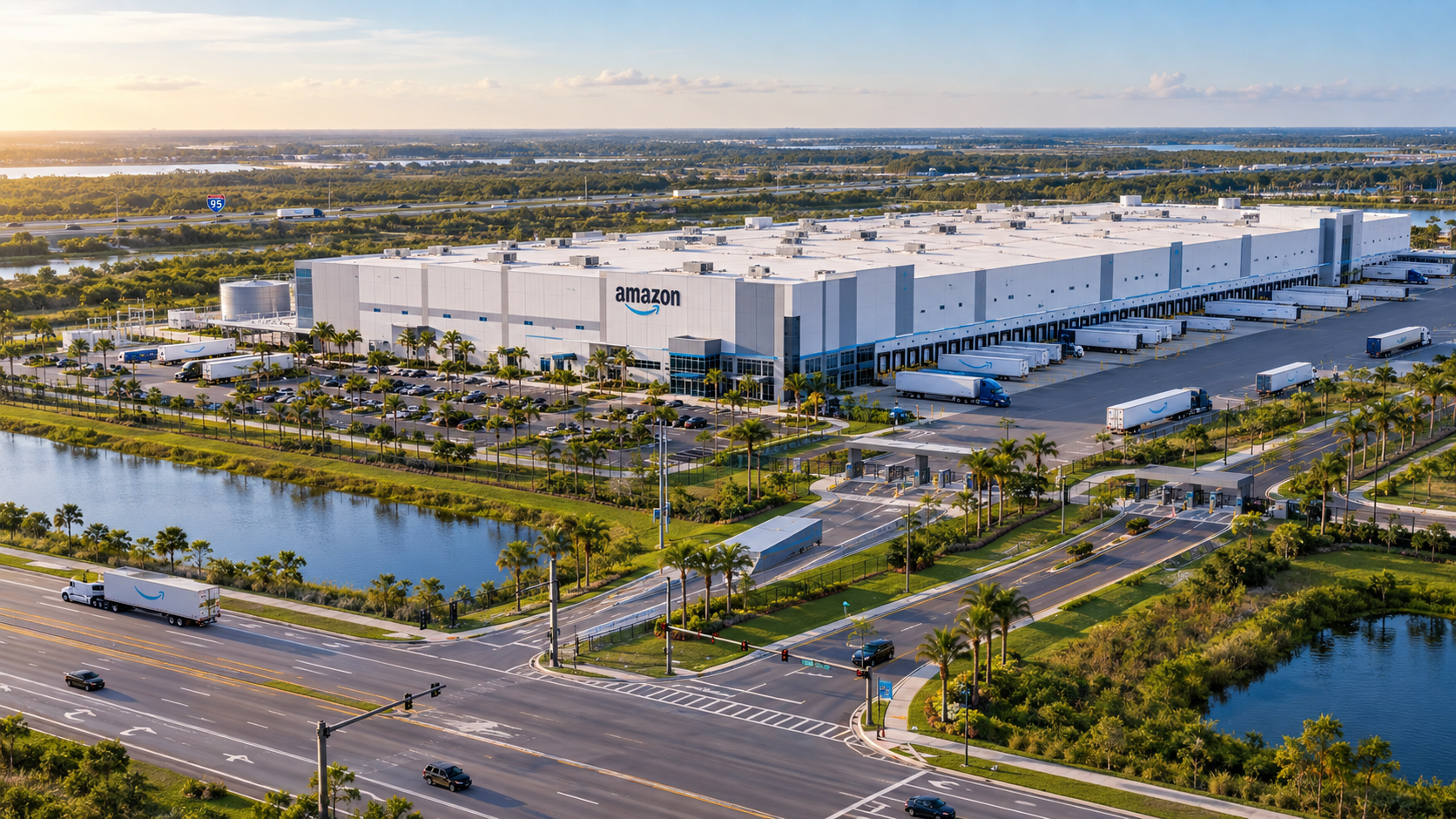
Amazon's mega cold storage facility in Fort Pierce, Florida: More than just a distribution center – Creative image on the topic, created with AI: Xpert.Digital
Mega-project with a catch: The true costs of Amazon's $240 million warehouse revealed
100,000 square meters, 745 jobs: This is what the first glance at Amazon's new logistics center doesn't reveal
An investment of $240 million, roughly 100,000 square meters of floor space, and the prospect of 745 new jobs: Amazon's planned temperature-controlled distribution center in Fort Pierce is undoubtedly one of the most ambitious logistics projects in the region's recent history. But behind these impressive figures lies far more than just a simple success story for the local job market. The mega-project is a complex gamble on the future of online retail and the resilience of the city's infrastructure. From massive demands on the power grid and local traffic to the pitfalls of extensive automation and unclear long-term fiscal effects – the true cost and actual benefits for the region only become apparent upon closer examination. An in-depth analysis reveals why more warehouse jobs don't automatically translate into more prosperity and why Fort Pierce now urgently needs a proactive strategy to avoid becoming overly dependent.
Amazon's $240 million bet on Fort Pierce: 745 new jobs – but the real calculation only begins after the opening
Fort Pierce has cleared the way for one of the largest logistics projects in the city's recent history. A temperature-controlled distribution center, representing an investment of $240 million, is planned for a previously undeveloped site on South Kings Highway. The dimensions are extraordinary: the officially proposed building complex will encompass 1,070,080 square feet (approximately 99,400 square meters) and will be built on 69.19 acres. This equates to roughly 28 hectares, not the nearly 70 hectares that some summaries have misleadingly stated. The figure 70 refers to acres. The plans include 1,010,080 square feet of warehouse space and 60,000 square feet of office space. According to the applicant's documents, approximately 745 permanent jobs are expected.
From an economic perspective, the permit is neither merely a local success story nor automatically proof of sustainable structural policy. Rather, it represents a bet on three interconnected developments: the further expansion of online retail for groceries and everyday goods, the regional densification of Amazon's delivery network, and Fort Pierce's capacity to absorb additional industrial value creation without succumbing to traffic, energy demands, land use, or one-sided dependence on a single large corporation. The project can provide a significant boost to the region. However, its true quality will not be measured solely by the investment amount or the announced number of employees, but also by wages, local procurement, sustained tax revenue, subsequent infrastructure costs, and whether it attracts other businesses or merely displaces existing economic activity.
A project of extraordinary scale
The now-approved plan is significantly larger than the previous development concept for the site. In September 2021, a project with two buildings and a total of 485,000 square feet of office and distribution space had been approved. The new design more than doubles the planned area. The site was formerly used for orange cultivation, was incorporated into the city limits in 2005, and rezoned in 2021 as the current CP-1 zone. This zone is designated for large-scale office, commercial, and certain industrial uses along major access roads. Warehousing and freight activities are generally permitted there, which is why the current political decision focused primarily on the specific site planning and not on a fundamental reorganization of permitted uses.
The building's size can also be assessed based on its land use. According to the planning documents, approximately 35.6 percent of the site will be occupied by the building itself, and roughly 34.9 percent by paved traffic and parking areas. Only about 29.4 percent will remain as open space, including three retention basins, drainage ditches, and landscaped areas. In absolute terms, the presentation lists 24.17 acres for paving and parking, 20.36 acres for open space, 5.30 acres for retention and infiltration areas, 7.42 acres for water features, and 7.64 acres for landscaping. The building is projected to reach a height of 56.5 feet, or approximately 17.2 meters.
The investment volume equates to roughly US$224 per square foot of building space and approximately US$322,000 per announced permanent job. While neither of these figures are strictly economic indicators, they do illustrate the capital intensity of the project. The project is not a simple warehouse with shelves and loading docks, but rather a technically sophisticated infrastructure with cooling, power supply, office space, security systems, traffic areas, drainage, and, presumably, extensive automation. The high capital outlay per job is therefore not surprising. However, it suggests that the economic benefits for Fort Pierce must stem more from productivity, property and corporate taxes, supplier contracts, and the stability of regional supply chains than solely from the number of employees.
Cold chain logistics changes the equation
The key difference compared to a standard shipping warehouse lies in its temperature-controlled operation. Refrigerated and deep-freeze warehouses require sophisticated building envelopes, insulated floors, high-performance refrigeration systems, fire protection, emergency plans, and a significantly more robust power supply. Industry analyses often estimate the national construction costs of modern cold storage facilities at approximately $240 to $350 per square foot, two to three times that of a standard dry warehouse. Such projects can also take several months longer because the technical equipment is more complex and commissioning requires more rigorous testing.
Against this backdrop, the investment figure of approximately US$224 per square foot does not appear excessive. However, a direct comparison remains imprecise because it is unclear which cost components are included in the US$240 million figure, what proportion of the space is refrigerated, deep-freeze, or only air-conditioned, and whether land acquisition, financing costs, automation, or future tenant improvements have been fully factored in. Especially with large-scale industrial projects, differing definitions can easily create the impression that a project is particularly inexpensive or particularly expensive. Without a detailed cost structure, it can only be stated that the scale is consistent with a capital-intensive cold chain logistics facility.
Economically, the refrigeration function has a dual significance. On the one hand, it ties the center more closely to the food trade, fresh food logistics, and time-critical goods flows. This demand is less dependent on economic cycles than the shipping of many durable consumer goods because food and everyday necessities are purchased regularly. On the other hand, it increases fixed costs and makes the system more vulnerable to electricity prices, grid congestion, and technical failures. Studies indicate that refrigerated warehouses consume several times more electricity than typical industrial buildings; at the same time, the refrigeration system is often responsible for the majority of the electrical load.
For Fort Pierce, this raises an often underestimated infrastructure issue. Roads are visible and therefore central to public debate. However, the availability of sufficient electrical power can be equally important for construction time, operating costs, and scalability. A cooling center of this size must operate reliably even during peak loads and requires robust emergency and redundancy plans. Should the region simultaneously attract other energy-intensive businesses, grid connections, transformer capacity, and generation reserves could become key location factors. The economic evaluation of the project should therefore not end with road construction but should also include the power grid, water, wastewater, emergency power, and climate resilience.
The location follows a clear logic
The site is located west of Interstate 95 in the so-called Kings Highway Jobs Corridor. It is bordered by South Kings Highway to the west, White Road to the north, and Peters Road to the east. This places it within a corridor designated for job-intensive commercial development and with excellent connections to Florida's major transportation routes. Other commercial and residential projects have already been approved in the vicinity, including a Thermo King plant, a 488-unit residential complex, and expansions to an RV dealership.
For Amazon, the location makes strategic sense because a distribution center needs to be as close as possible not only to customers, but also to highways, regional suppliers, and other levels of its own network. Refrigerated goods are particularly sensitive to long detours. The shorter the distance between the warehouse, downstream stations, and households, the lower the time loss, risk of spoilage, and transportation costs. A regional facility can also keep a wider range of products close to customers and enable faster delivery windows. Amazon's 2025 annual report explicitly describes lower costs, faster delivery, and increased product availability as key objectives for further network and robotics investments.
The locational advantage, however, comes at a price. Proximity to a highway reduces long-distance traffic routes but concentrates heavy goods and commuter traffic on a few local access points. Furthermore, large logistics facilities, due to their shift systems, can lead to pronounced peak loads. Hundreds of employees often begin or finish work within narrow time windows, while truck traffic operates in parallel, sometimes around the clock. The economic value of the location therefore depends not only on the distance to the interstate but also on how effectively long-distance traffic, local traffic, commuter traffic, and adjacent land uses can be separated.
745 jobs subject to reservation
The announced 745 permanent jobs would undoubtedly be significant for Fort Pierce. In July 2026, the working-age population in St. Lucie County comprised approximately 170,263 people; roughly 161,007 were employed and 9,256 were unemployed. The non-seasonally adjusted unemployment rate was therefore 5.4 percent, exceeding both the Florida and national averages. Purely mathematically, 745 positions would represent approximately 0.46 percent of the county's employment or roughly eight percent of the number of unemployed at that time.
This calculation should not be misinterpreted as a forecast. Not every new position will be filled by a previously unemployed resident of the county. Some employees may commute from neighboring regions, transfer from existing jobs, or come from other Amazon locations. Conversely, new jobs can attract additional people to the area. Furthermore, the figure of 745 positions is not a contractually confirmed result, but according to the official report, it originates from the applicant's documents. Neither the precise distribution across full-time, part-time, temporary, and contract work, nor wage levels, qualification profiles, and shift patterns are detailed in the publicly available planning documents.
It is precisely this missing information that determines the social benefit. According to the most recent available multi-year census data, Fort Pierce has a median household income of approximately $47,000 and a poverty rate of around 26 percent. This clearly demonstrates a need for stable jobs that are accessible even without a university degree. If a large proportion of the new positions offer reliable working hours, health insurance, opportunities for advancement, and wages above regional low-wage employment, the center can strengthen the local labor market. Conversely, if a significant portion is based on fluctuating hours, high turnover, or external service providers, the positive impact on well-being will be considerably smaller.
Another factor to consider is workplace density. Based on the total building area, this equates to roughly one workplace per 1,436 square feet, or 133 square meters. While this is plausible for a large-scale, automated distribution center, it also illustrates the space-intensive nature of the work. Other uses could accommodate significantly more jobs on the same area, but might require a different location, different qualifications, and different market conditions. Therefore, the relevant alternative is not a theoretical office tower, but rather the best, realistically achievable use for this specific corridor.
Automation is not a fringe topic
The employment commitment must also be read in the context of Amazon's automation strategy. The company reported plans to have more than one million robots in its logistics centers by 2025. These robots will handle tasks such as storage, order picking, sorting, and internal transport. Amazon describes robotics as a key driver for faster processes, lower costs, and a reduction in physically demanding tasks. At the same time, the company announced its intention to further expand automation.
This does not mean that the 745 jobs will disappear in the short term. Modern facilities will continue to require employees for receiving goods, quality control, plant operation, maintenance, safety, administration, refrigeration technology, and handling exceptions. However, automation is changing the nature of the work. Routine tasks may decrease, while technical and supervisory functions will become more important. Therefore, it will be crucial for the region whether local schools, vocational colleges, and continuing education providers can impart the necessary qualifications.
A recent example from the same region illustrates why caution is warranted. In 2026, Amazon announced a roughly $200 million expansion of its existing center in Port St. Lucie, incorporating advanced robotics. During the temporary closure, 494 employees were laid off, while the reopening was later projected to create more than 1,000 jobs. The Fort Pierce investment is separate from this expansion, but both projects are part of a broader restructuring of the regional network.
This context changes the interpretation. The new jobs in Fort Pierce should not be viewed in isolation, but rather in conjunction with relocations, modernizations, and temporary closures of other locations. For individual workers, the transition period can cause considerable hardship, even if Amazon later employs more people regionally. For economic policy, this means not only counting employment on a single opening date, but observing it over several years as a net development across the entire regional labor market.
Your intralogistics experts

Consulting, planning and implementation of complete solutions for high-bay warehouses and automated storage systems - Image: Xpert.Digital
More information here:
The secret stress test: How the new logistics center is changing traffic in Fort Pierce
More warehouse jobs do not automatically mean more prosperity
Large logistics centers generate direct, indirect, and induced effects. Direct effects include the employees working in the center and the company's spending at the location. Indirect effects arise from construction companies, transport firms, maintenance providers, security services, packaging suppliers, and technical specialists. Induced effects occur when employees spend their income in the region. This chain of effects is real, but its extent depends on how much is actually procured locally and the level of income.
In a specialized project, a significant portion of the construction and equipment expenditures can flow to suppliers outside the region. Refrigeration systems, automation technology, conveyor technology, and digital control systems are not necessarily manufactured in St. Lucie County. Even during operation, centralized procurement contracts can result in revenue generated outside the region. Therefore, the investment of $240 million should not be equated with $240 million of local added value. What matters is the regional share, not the total value of the installed technology and real estate.
The employment impact must also be considered in net terms. A widely cited study of Amazon logistics centers concluded that warehouse employment in the affected counties increased significantly, while no statistically significant positive effect could be demonstrated for overall private-sector employment. Possible explanations include displacement effects in other sectors or an overall impact that is too small relative to the overall labor market. The study does not specifically address Fort Pierce and does not account for every recent automation development or the specific characteristics of a cold storage facility. Therefore, it is not proof against the project, but rather a cautionary tale against the simplistic equation that 745 announced positions automatically translate to 745 additional net jobs for the region.
A distribution center can put pressure on local retailers and competing logistics providers, while simultaneously improving delivery quality for consumers and businesses. It can attract drivers, technicians, and warehouse workers from existing companies, thereby increasing wages or creating labor shortages there. This can be positive if competition for labor improves incomes and working conditions. It can be negative if smaller companies can no longer fill vacancies and lose market share. The overall economic balance, therefore, is comprised of productivity gains, consumer benefits, wage effects, and potential displacement, not simply the isolated addition of new jobs.
Traffic becomes a stress test
The developer has committed to a total of $4.2 million in road investments. Of this, approximately $3 million is earmarked for converting the currently unpaved White Road into a paved three-lane road between Kings Highway and Peters Road. An additional $700,000 is set aside as a reserve for future traffic lights at the intersection of White Road and Kings Highway, once the necessary traffic conditions are met. The remaining amount appears to be allocated to other measures, the precise breakdown of which is not fully explained in the summary report.
The access plan separates passenger vehicles and heavy goods vehicles. Employees and visitors are to use the northern entrance on Kings Highway. Due to the median strip, this entrance and exit are designed for right-hand traffic only. A more southerly entrance is designated for semi-trailer trucks; within the site, they will drive counter-clockwise around the building and exit exclusively via White Road. Separate turning lanes are also planned. The public presentation specifies a 450-foot right-turn lane for trucks approaching from the south and a 400-foot left-turn queuing area for trucks coming from the opposite direction.
This planning is sensible, but it doesn't eliminate all risks. A traffic light that isn't installed immediately means that traffic safety initially depends on traffic volume, driving behavior, visibility, and the capacity of the turning lanes. The responsible road authority therefore requires monitoring of the intersection and documentation of safety parameters so that the traffic light can be installed once the relevant thresholds are reached. It's crucial for the municipality that monitoring, trigger values, responsibilities, and timelines remain transparent. Otherwise, there's a risk of a period where the increased traffic is already noticeable, but the formal requirements for the traffic light are still being discussed.
The $4.2 million represents only about 1.75 percent of the stated total investment volume. While this is a substantial private contribution, it doesn't guarantee that it will cover all long-term costs. Roads wear down due to heavy axle loads, intersections may need to be widened later, and police, fire, and emergency services may require adjustments. At the same time, other properties and future projects will also benefit from the expansion of White Road. The road construction is therefore partly about preventing future damage to the project and partly about general site development.
The tax base remains an open question
In political discourse, the project is portrayed as strengthening the municipal tax base. This is fundamentally plausible: a previously undeveloped plot of land will receive a high-priced building and technical facilities, thereby increasing the taxable assets. Additionally, the construction phase, employment, and operating expenses can generate further public revenue. However, the investment sum is not identical to the taxable value, and the publicly available documents do not provide a reliable forecast of the annual net revenue for the city, county, school district, and other entities.
A sound fiscal assessment would require several pieces of information: the expected taxable value of the property after completion, the treatment of movable assets, depreciation, potential exemptions or subsidies, the date of full assessment, and public operating and maintenance costs. It is also necessary to examine whether road, utility, or security costs will be partially borne by the public in the future. Only the difference between additional revenue and additional expenditure reveals the fiscal benefit.
It is noteworthy that the Fort Pierce documents reviewed do not specify any concrete tax breaks for this project. This should not be interpreted as conclusive proof that no subsidies exist, as land deals, infrastructure agreements, or funding programs may be addressed in other documents. In contrast, the regional economic development officer explicitly stated that Amazon had not received any economic development subsidies or tax breaks for its separate, existing center in Port St. Lucie.
The city should therefore publish an annual project report. This report should include actual staffing levels, total wages, taxable income, tax payments, public investments, road maintenance, deployment of municipal services, and any subsidies received. Such a report would depoliticize the debate. It would protect both the public from exaggerated promises and the company from blanket criticism if the actual benefits turn out to be higher than anticipated.
Land consumption creates irreversible costs
The project, including buildings, parking lots, and traffic areas, seals off approximately 70 percent of the 69.19-acre site. While retention basins, biosphere reserves, and green spaces are planned, the project is not a minor intervention. The former orange grove was not a pristine ecosystem, but the conversion to large-scale logistics use is largely permanent. A later return to agricultural use would be economically and practically unrealistic.
The plan aims to limit environmental and drainage impacts. Rainwater is to be filtered through planted drainage ditches and then directed into aerated retention basins. The planting plan includes oak trees, saber palms, and plants suitable for riparian and filter zones. The permit also requires a final review of the tree inventory and compensation calculations, a gopher tortoise survey at least 90 days prior to clearing, and the necessary approvals from federal and state authorities.
Such regulations are important, but they do not replace consideration of climate risks. Florida is exposed to heavy rain, heat, hurricanes, and potential power outages. For a cold storage facility, operational interruptions can quickly lead to significant losses of goods. At the same time, large roof and parking areas can generate considerable heat loads. Therefore, economically sensible measures would include resilient energy and drainage systems, efficient refrigeration technology, leakage monitoring, emergency power, load management, and, where possible, the use of suitable roof areas for solar power, provided that structural integrity, grid connection, and operational profile permit.
Cold chain logistics offers an interesting approach for photovoltaics and battery storage. Electricity demand is high and relatively constant, while the large roof theoretically provides sufficient generating area. Solar power alone cannot cover the nighttime and weather-dependent load, but it could reduce daytime consumption. Storage systems can smooth peak loads and provide short-term backup for critical systems, but they do not replace a full-fledged emergency power supply. Whether such solutions are planned is not entirely clear from the evaluated documents. Their evaluation would be worthwhile from a cost, grid, and resilience perspective.
The second phase is an option, not a promise
Scannell Properties has indicated a potential second expansion phase of 500,000 square feet and approximately 500 additional jobs. If implemented, the total complex would theoretically grow to about 1.57 million square feet, or roughly 145,900 square meters, and the projected employment would increase to approximately 1,245 positions. While the second phase is therefore economically significant, it should not be treated as if it is already financed, fully approved, and scheduled.
Expansion options serve several functions in project communication. They demonstrate long-term confidence in the location, increase the attractiveness of adjacent properties, and justify efficient development. At the same time, they defer some of the expected benefits to the future. Whether construction actually takes place depends on customer demand, network planning, capital costs, automation, competition, energy costs, and the success of the initial phase.
This creates a planning dilemma for the municipality. If roads and utility networks are only designed for phase one, a later expansion could trigger new bottlenecks. If they are built immediately for the maximum expansion stage, overcapacity threatens if phase two doesn't materialize. The solution lies in modular infrastructure and clear trigger criteria. Certain expansions should only become mandatory when area, number of employees, truck journeys, or traffic volumes exceed defined thresholds.
The real estate market is also likely to react. The planned road improvements and the presence of a global anchor tenant could increase the value of neighboring commercial properties. In fact, adjacent land is already being marketed due to its proximity to the approved Amazon project, the 745 jobs it will create, and the planned road improvements. This effect could attract further investment, but it could also drive up land prices and make it more difficult for smaller companies to acquire suitable sites. Whether a diverse business environment or a logistics cluster predominantly focused on Amazon develops depends on local land-use and development policies.
Construction time and implementation remain challenging
According to the published plans, the building shell is scheduled for completion by September 2027; final occupancy approval is expected in March 2028. This means that between municipal approval in May 2026 and the planned commissioning, there will be a construction and expansion phase of approximately two years. For a standard warehouse, this would already be ambitious; for a temperature-controlled facility with complex technology, roadworks, and multiple permitting levels, the timeline is particularly demanding.
Risks include increased construction costs, supply shortages of cooling and automation technology, weather disruptions, grid connection issues, and delays in road and environmental permits. The official resolution therefore includes conditions stipulating that signage must be approved separately, tree and clearing issues must be finalized, the turtle survey must be submitted on time, and the necessary permits must be obtained before each construction phase. Furthermore, St. Lucie County approval for the roadway is required before vertical construction can begin.
Economically, the construction phase provides a distinct stimulus. It creates temporary demand for earthworks, concrete construction, road construction, electrical installations, refrigeration technology, and project management. A media report cites approximately 1,200 temporary construction jobs; however, this figure is not consistently documented in the central municipal records and should therefore be considered supplementary information rather than a guaranteed employment figure. The local impact, in turn, depends on what proportion of the contracts go to regional companies and workers.
Fort Pierce needs an active strategy
The municipality should not view this project as the endpoint of its economic development efforts. A single large employer can create visibility, infrastructure, and demand, but also increases the risk of concentration. If Amazon later changes its network structure, automates operations, or consolidates facilities, a highly specialized building can be difficult to repurpose. While cold storage facilities are valuable specialized properties, finding new tenants is more challenging than with flexible, standard warehouses.
A sound strategy should therefore leverage the Amazon site as an anchor for a broader ecosystem. This includes food processing, packaging, refrigeration technology, plant maintenance, fleet services, software, energy optimization, and professional development. Companies that are not solely dependent on Amazon and simultaneously develop capabilities applicable across numerous industries would be particularly valuable. In this way, a single location could evolve into a regional center of expertise for temperature-controlled supply chains.
The city and county should also agree on measurable training and employment targets with Amazon, even if these are not mandatory components of the building permit. Published information on starting salaries, full-time employment rates, local recruitment, technical apprenticeships, safety metrics, and career advancement opportunities would be beneficial. Given the increasing prevalence of robotics, training should not be limited to basic warehouse processes but should encompass mechatronics, data analytics, refrigeration technology, workplace safety, and plant control.
For traffic management, transparent metrics are recommended: daily truck journeys, peak hours, queue lengths, accident trends, road conditions, and the timing of traffic light installation. For energy and environmental management, electricity consumption, peak load, refrigerant use, emergency power capacity, water runoff, and compensatory planting should be tracked. Not all data needs to disclose sensitive business details. A concise annual impact report would suffice to compare promises with reality.
The sober findings
The Amazon center represents a significant economic opportunity for Fort Pierce, but it's not a guaranteed success. The $240 million investment, the planned 745 permanent jobs, and the private contribution to road improvements are substantial. The location fits into a regionally connected employment corridor, and its refrigerated facility positions it within a technically demanding segment of the logistics industry. For a city with relatively low household incomes and a high poverty rate, such a development could be more significant than for an already wealthy and fully utilized region.
At the same time, the most frequent success claims are still predictions. The number of jobs comes from the applicant, the quality of these jobs is not sufficiently documented, the specific tax revenue remains unclear, and the second phase is merely a possibility. Traffic, electricity demand, and land sealing incur real costs. Furthermore, Amazon's extensive automation demonstrates that a large investment does not automatically guarantee a proportionally high or sustainably stable employment rate.
The most convincing perspective is therefore neither euphoric nor dismissive. Fort Pierce acted prudently by approving a large-scale project that was fundamentally appropriate for the location and by formulating specific traffic and environmental requirements. Now, the public sector must move from being a mere approver to an active impact manager. The crucial factor is whether it measures job quality, infrastructure, tax revenue, training opportunities, and environmental consequences over the years and makes adjustments during a potential second phase.
True success wouldn't be achieved simply by opening the doors in March 2028. It would be achieved if, ten years later, the center is still operating competitively, generating good regional incomes, largely covering its own transportation and energy costs, and having attracted other productive businesses. If this integration fails, what remains is a huge, highly automated warehouse with heavy traffic and limited local value creation. If it succeeds, Fort Pierce can become more than just a warehouse from an Amazon facility: a starting point for a diversified logistics, cold chain, and technology hub.
Your global marketing and business development partner
☑️ Our business language is English or German
☑️ NEW: Correspondence in your native language!

Konrad Wolfenstein
I and my team are happy to be available to you as your personal advisor.
You can contact me by filling out the contact form here [email protected]:or simply call me at +49 7348 4088 965. My email address is
I'm looking forward to our joint project.










