
Microsoft Copilot vs. local server: From this point on, local AI is suddenly cheaper than ChatGPT and similar solutions.
Xpert Pre-Release

Available in 27 languages 📢
Prefer Xpert.Digital on GoogleⓘPublished on: August 26, 2026 / Updated on: August 26, 2026 – Author: Konrad Wolfenstein
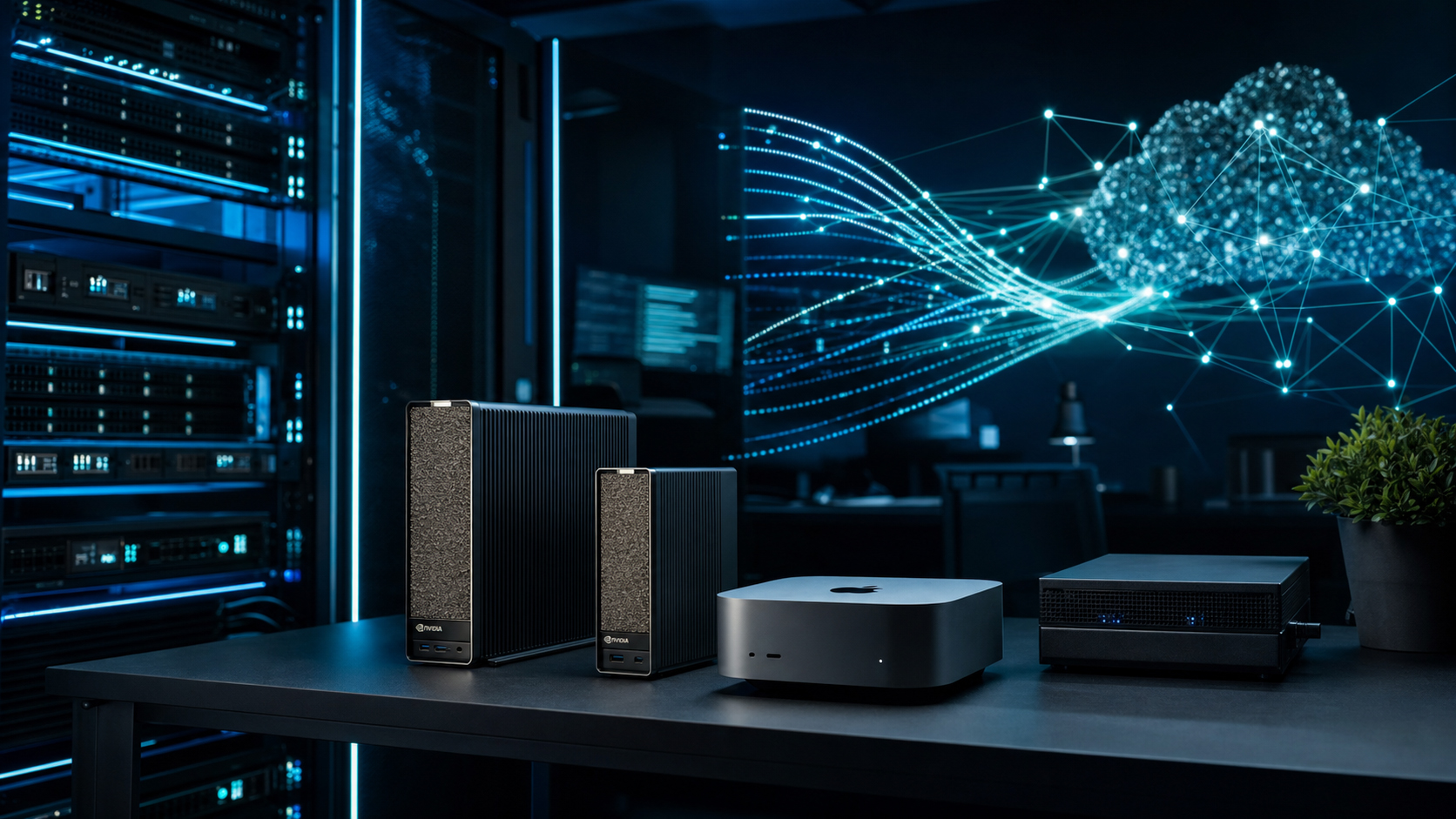
Microsoft Copilot vs. local server: From this point on, local AI is suddenly cheaper than ChatGPT and similar solutions. – Image: Xpert.Digital
AI costs radically reduced: How an e-commerce retailer saves tens of thousands of euros with its own hardware
Open Source instead of OpenAI: Why the real AI revolution is taking place in hidden batch processing
Artificial intelligence is generally considered a huge cost driver – but it doesn't have to be. While many companies are currently almost reflexively purchasing expensive cloud subscriptions like Microsoft 365 Copilot for their entire workforce or accumulating uncontrolled API costs with providers like OpenAI and Anthropic, practice has long shown a far more effective approach. A recent case from e-commerce proves it: With a one-time investment in local hardware, billions of tokens can be processed without any further ongoing costs. Such an in-house AI infrastructure often pays for itself within just a few months – provided you understand the secret to proper system utilization. The following detailed analysis shows why high-performance open-source models are becoming a real game-changer, especially for everyday routine tasks, what hidden dependencies lurk in the cloud, and at what point moving away from external data centers truly makes financial sense for your company.
Related to this:

Local AI instead of cloud subscriptions: Why companies should now buy their own servers instead of using external data centers
What if the calculation doesn't add up in the end?
Nearly five billion tokens processed since March, with no API costs incurred – that's the stark reality of a case study currently causing a stir in industry circles. A business consultant and e-commerce operator describes how he and a colleague purchased two Nvidia GX10 systems and a Mac Mini to run AI models entirely on their own hardware, instead of using the application programming interfaces of major providers like OpenAI, Google, or Anthropic. The investment of around ten thousand euros seems substantial at first glance, but after just four months, one of the two systems alone had already paid for itself. This is no longer an isolated case, but rather a symptom of a profound shift in how companies operationally deploy artificial intelligence. While the public debate mostly revolves around chatbots, co-pilots and agent programming assistants, the real economic revolution is taking place behind the scenes: in dull but massively repetitive processing work that many companies have thoughtlessly outsourced to expensive cloud subscriptions.
The underestimated category of routine work
The use cases mentioned in the example seem unspectacular at first glance: extracting product attributes from raw data, generating product descriptions, translating texts into multiple languages, and automatically analyzing product images for color or orientation. However, the economic leverage lies precisely in this apparent banality. These are repetitive, well-structured tasks with high volume and low latency tolerance, making them ideally suited for automation. In traditional organizations, these tasks are often performed manually or semi-automatically by employees. Companies operating such processes on a large scale, such as online retailers with extensive product catalogs in multiple languages, quickly generate tens or even hundreds of millions of tokens per month. This type of continuous, round-the-clock batch processing without human intervention is fundamentally different from the sporadic use of a chat interface by a single employee. And this difference is precisely what determines whether or not investing in dedicated hardware is worthwhile.
Why the back-of-the-envelope calculation is usually wrong
The comparative prices for batch processing mentioned in the article for the cheapest proprietary models range from approximately five to seven thousand US dollars for the described token volume. Current independent cost analyses confirm that this basic calculation does indeed shift in favor of local hardware in many scenarios, but with one crucial caveat: it depends almost exclusively on the volume and utilization rate. Analyses from 2026 show that local GPU investments pay for themselves within three to eight months compared to cloud providers like GPT-4o or Claude for daily volumes in the range of two to ten million tokens, while they practically never become economical for lower, irregular volumes. A study published in the summer of 2026 concludes that the break-even point for typical extraction and classification tasks is around two to three million tokens per month. Below this threshold, the calculation usually favors the cloud; above it, it increasingly tips significantly in favor of on-premises infrastructure because the marginal cost per additional token approaches zero for in-house hardware, while it continues linearly for cloud providers. Therefore, anyone processing several billion tokens continuously, as in the described case, is operating well within the realm where local systems are clearly superior.
The downside: High occupancy is a prerequisite, not a given
At the same time, several recent expert analyses warn against oversimplifying the comparison. A detailed cost breakdown from the summer of 2026 shows that the break-even point for local hosting with Frontier models containing seventy billion parameters or more is only reached with a utilization rate of at least seventy percent in 24-hour operation, and even then, only after twelve to eighteen months. With a utilization rate of fifteen to twenty-five percent, typical for many office environments, the cloud almost always wins in this calculation. The decisive factor is therefore not just the absolute token volume, but the consistency and continuity of the load. A company that only uses its GPU for a few hours a day and leaves it idle the rest of the time ties up capital without realizing its full value. Conversely, a company that, as in the practical example described, continuously utilizes its hardware in batch mode because new product data, images, and translation orders are constantly being generated, is using precisely the scenario in which the investment actually pays for itself rapidly. This differentiation is crucial because it explains why many companies that naively invest in their own AI hardware end up disappointed, while others realize significant savings within a few months.
A price tag that halves in weeks
Another aspect often overlooked in the public debate is the dramatic speed at which the overall cost of AI inference has fallen. According to the Stanford AI Index, processing one million tokens with a GPT-3.5-level model cost around twenty US dollars at the end of 2022, but only about seven US cents by the end of 2024 – a decrease of more than 285-fold in just two years. This price drop affects both cloud offerings and the hardware costs for on-premises inference, as more powerful chips and more efficient quantized models become increasingly affordable. For companies, this presents a paradoxical situation: those investing today must assume that the same computing power will be significantly cheaper in one to two years, which tends to shorten the payback period but also increases the temptation to postpone the purchase. The original purchase price of around three thousand five hundred euros for one of the two systems mentioned in the initial article was already significantly lower than what comparable hardware would have cost a year earlier, which shows how dynamically this market is developing.
A new dimension of digital transformation with 'Managed AI' (Artificial Intelligence) - Platform & B2B solution | Xpert Consulting

A new dimension of digital transformation with 'Managed AI' (Artificial Intelligence) – Platform & B2B solution | Xpert Consulting - Image: Xpert.Digital
Here you will learn how your company can implement customized AI solutions quickly, securely and without high entry barriers.
A managed AI platform is your all-inclusive, worry-free solution for artificial intelligence. Instead of dealing with complex technology, expensive infrastructure, and lengthy development processes, you receive a ready-made solution tailored to your needs from a specialized partner – often within just a few days.
The key advantages at a glance:
⚡ Rapid implementation: From idea to ready-to-use application in days, not months. We deliver practical solutions that create immediate added value.
🔒 Maximum data security: Your sensitive data stays with you. We guarantee secure and compliant processing without sharing data with third parties.
💸 No financial risk: You only pay for results. High upfront investments in hardware, software, or personnel are completely eliminated.
🎯 Focus on your core business: Concentrate on what you do best. We take care of the entire technical implementation, operation, and maintenance of your AI solution.
📈 Future-proof & scalable: Your AI grows with you. We ensure continuous optimization and scalability, and flexibly adapt the models to new requirements.
More information here:
The Price of Convenience: Why Companies Should Reconsider Their Reliance on AI Cloud Providers
Microsoft Copilot as an expensive convenience solution
The debate becomes particularly heated when it focuses on the question of whether companies should purchase Microsoft 365 Copilot for their entire workforce, as many IT departments currently do. List prices for the Copilot add-on, billed annually, range from approximately 18 to 22 euros per user per month, in addition to the already required Microsoft 365 base license. However, actual enterprise prices, depending on the contract, can reach around 26 euros per user per month. For a company with 50 employees, this adds up to a low six-figure sum over three years, and these costs increase linearly with each new position, regardless of whether the individual actually uses the AI functions extensively or productively. A comparative calculation from the summer of 2026 concludes that a local server, considered over three years, costs approximately three to four thousand five hundred euros plus maintenance. With around ten users, the cost is already comparable to a cloud subscription, but with twenty-five users, it is significantly lower because the cloud bill increases per user, while the local cost base remains largely fixed. However, this calculation primarily applies to generic office support functions, not to the highly specialized batch applications described in the original article, where the cost advantage is even more pronounced.
Related to this:

The real risk premium is called dependency
Beyond the pure cost issue, the original article rightly points to a number of strategic risks associated with the long-term dependence on external, mostly US-based, cloud providers. So-called vendor lock-in occurs when a company embeds its entire workflows, prompt libraries, and integrations so deeply in a specific API ecosystem that switching to another provider later would involve considerable effort and risk. Added to this is the uncertainty surrounding future price adjustments, which have been observed repeatedly with almost all major providers in recent years – whether through changed pricing models, new usage limits, or the introduction of paid add-ons. For companies operating within the European Union that handle sensitive customer, product, or personnel data, the issue of data sovereignty and data protection arises, particularly with regard to the General Data Protection Regulation (GDPR) and the possibility that data could be processed on servers outside the European Union or accessed by foreign authorities under certain legal frameworks. While these risks cannot be quantified in a simple cost-benefit analysis, they represent a real economic value that smart corporate strategies should factor into their investment decisions.
Open-source models have closed the quality gap
A crucial reason why local AI is now a realistic option for businesses lies in the rapid improvement in the quality of open language models. Models like the systems mentioned in this article, such as Gemma and Qwen, have now achieved a level of quality that is perfectly adequate for clearly defined, specialized tasks like text classification, feature extraction, or multilingual translation, even if they may still lag behind the largest proprietary models when it comes to complex, free reasoning or highly current world knowledge. This very division of labor—specialized, smaller models for clearly defined, high-volume tasks and larger cloud models for more complex, less frequent requests—forms the basis for an economically viable hybrid operating model. Expert analyses from 2026 explicitly emphasize that cloud AI remains the better choice when the request volume is low, no internal IT capacity is available for operation, or the task requires true multimodality and complex reasoning with current training data. For everything else, especially high-volume, repetitive and clearly structured tasks, economic logic increasingly favors local operation.
Why the window of opportunity for latecomers is closing
Any entrepreneur who still believes that local AI is only for tech enthusiasts or large corporations with their own data centers is underestimating the speed of development. According to current market overviews, complete systems for getting started with local language models are available from around €1,800, used but powerful graphics cards with 24 gigabytes of video memory can be found for around €700, and the specialized AI workstations used in the original article cost around €3,500 per unit. Given these comparatively moderate entry costs and the amortization periods described above, which can be as short as a few months for certain volumes, it's clear that the barrier to entry for local AI infrastructure has dropped dramatically in the past two years. At the same time, several analysts point out that hardware prices are likely to rise rather than fall in the near future, partly due to the sharp increase in global demand for graphics processors for AI training and inference purposes. Therefore, anyone who has a suitable deployment scenario with sufficient, predictable volume has good reasons to act now instead of waiting any longer.
From cost factor to strategic decision
How the discussion surrounding artificial intelligence in companies should shift: away from simply choosing which chat tool to provide employees, and towards a systematic examination of which specific, often inconspicuous, work processes can be economically mapped through automated processing with locally operated models. The knee-jerk decision to purchase a blanket cloud subscription like Microsoft Copilot for the entire organization may seem convenient in the short term, but in many cases, it forfeits significant potential savings and creates additional strategic dependencies. A careful, data-driven analysis of one's own token volume, the regularity of utilization, and the sensitivity of the processed data provides the necessary foundation to decide whether and to what extent an investment in in-house AI hardware is worthwhile. For companies with high, consistent processing volumes, such as in product data maintenance, automated translation, image analysis, or similar repetitive mass processes, there is now no way around this audit, because the potential savings, as the example described at the beginning shows, can easily amount to several thousand to tens of thousands of euros within a few months.
📈🚀 From visibility to trust 👀🤝 Your scalable path with Xpert.Digital

From visibility to trust: Your scalable path with Xpert.Digital - Image: Xpert.Digital
In industrial B2B, sustainable business relationships rarely emerge overnight. They develop step by step – through visibility, professional relevance, recurring touchpoints, and growing trust. Xpert.Digital's 4-stage model addresses precisely this: It offers a structured path that begins with a manageable entry point and can evolve into deeper collaboration in business development if needed.
Instead of relying on loud marketing promises, this model puts the relationship at the forefront. Companies start with clearly defined, easily calculable measures and then decide, based on their own experience, how far they want to expand the collaboration. A key factor for this undisturbed trust-building process: The platform completely avoids annoying advertising ads, so the editorial focus remains solely on the companies' expertise.
More information here:
Your global marketing and business development partner
☑️ Our business language is English or German
☑️ NEW: Correspondence in your native language!

Konrad Wolfenstein
I and my team are happy to be available to you as your personal advisor.
You can contact me by filling out the contact form here [email protected]:or simply call me at +49 7348 4088 965. My email address is
I'm looking forward to our joint project.









