
Latin America's warehouses are becoming intelligent: 400 robots for one warehouse and 310,000 boxes a day – Walmart Chile is relying on a new logistics system
Xpert Pre-Release

Available in 27 languages 📢
Prefer Xpert.Digital on GoogleⓘPublished on: November 2, 2026 / Updated on: November 2, 2026 – Author: Konrad Wolfenstein
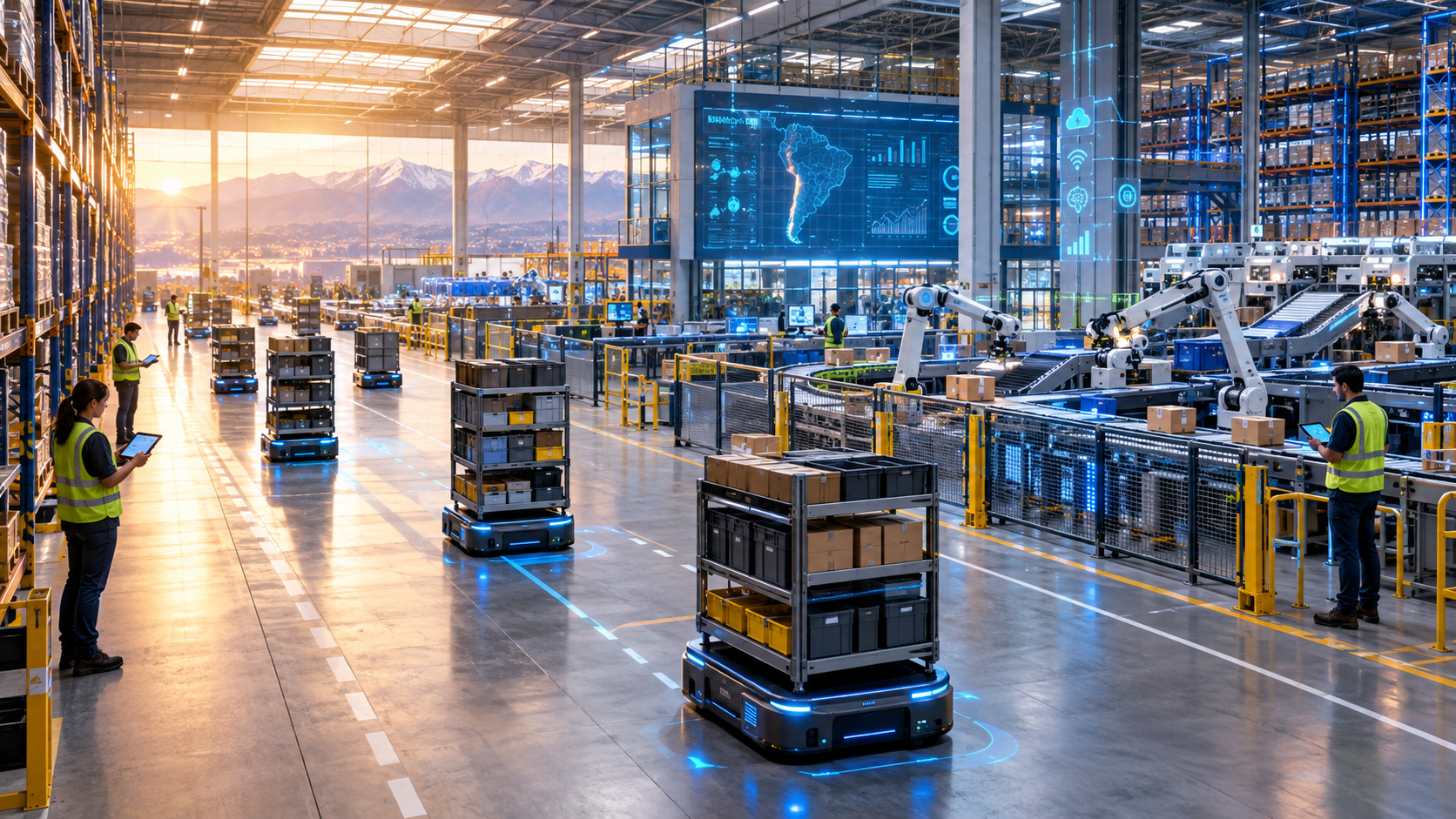
Latin America's warehouses are becoming intelligent: 400 robots for one warehouse and 310,000 boxes a day – Walmart Chile relies on a new logistics system – Creative image on the topic, with AI: Xpert.Digital
Those who still pick orders manually today could lose out tomorrow
Faster, more precise, scalable: Latin America's logistics is on the verge of a transformation
Robots instead of long walking distances: How automation is changing warehouses in Latin America
Robots, intelligent software, and automated sorting systems are fundamentally changing logistics in Latin America. What was long considered primarily a future prospect is increasingly becoming a reality: companies are automating warehouses to move goods faster, better manage inventory, and respond more flexibly to fluctuating demand. The transformation is particularly evident in Chile: Walmart is investing $200 million in expanding its Lo Aguirre logistics center. More than 1,400 autonomous robots are expected to increase productivity by 40 percent and process over 310,000 boxes daily.
Mercado Libre also relies on automated sorting technology to process orders faster. This development makes it clear that modern warehouses are far more than just places where goods are stored. They are evolving into data-driven production systems where software, machines, and employees work closely together. This can shorten delivery times and strengthen competitiveness – but it also demands a lot from companies: clean data, significant investments, new skills, and reliable technology integration. Not every business needs a fully automated warehouse. But those who fail to digitize their processes and ignore access to automated logistics could increasingly fall behind the competition.
Latin America's warehouses are becoming intelligent: Those still picking orders manually today will fall behind tomorrow
Latin America's logistics sector is at a turning point. Automated warehouses in the region have long been seen primarily as a promise of the future, a demonstration project by international technology companies, or a solution for a few particularly large locations. This picture is now fundamentally changing. Autonomous mobile robots, automated sorting systems, robotic arms, high-density storage, and AI-supported control systems are no longer just being tested, but are being permanently deployed in business-critical processes. This is shifting the economic logic of the industry: The decisive factor is no longer solely who can provide sufficient warehouse space, personnel, and transport capacity. Competitive advantages increasingly arise where companies can recognize the flow of goods in real time, make data-driven decisions, and scale their capacity at short notice.
This development is particularly evident at Walmart Chile's Lo Aguirre logistics center. $200 million has been earmarked for its expansion and automation. The expansion encompasses more than 65,000 square meters, a significant portion of which will be fully automated. More than 1,400 autonomous robots are expected to increase productivity by 40 percent and process more than 310,000 boxes daily. With automated management of more than 10,000 stock keeping units (SKUs), the center will also serve as an example of how physical infrastructure, software, and data architecture can merge into a cohesive production system for retail logistics.
This scale is more than just a spectacular individual project. It signals to suppliers, competitors, logistics providers, real estate developers, and technology providers what performance levels will be considered achievable in the future. As soon as a market-leading retailer reduces its lead times, improves its inventory availability, and increases its volume without proportionally increasing its workforce, the benchmark for the entire industry shifts. Other companies don't need to deploy the same technology on the same scale. But they do need to find a compelling answer to how they intend to remain competitive in terms of speed, reliability, cost, and transparency.
Warehouses are being transformed into production systems
The traditional warehouse primarily served as a buffer between procurement, production, sales, and customers. Its economic function was to absorb fluctuations and maintain product availability. The intelligent warehouse takes on a significantly more active role. It prioritizes orders, forecasts bottlenecks, optimizes routes, controls machinery, dynamically manages inventory, and transmits information to purchasing, sales, and transportation planning. A static warehouse is transformed into a continuously optimized production system for the movement of goods.
This transformation is made possible by the integration of multiple technologies. A warehouse management system manages inventory, orders, and storage locations. Sensors and the Internet of Things provide status and location data. Algorithms predict demand, workload, and potential disruptions. Autonomous mobile robots transport containers or shelves, while automated conveyor and sorting technology handles high volumes. Robotic arms can perform standardized gripping, packing, or palletizing tasks. Only the integration of these elements generates the true economic benefit.
Therefore, it's too simplistic to understand warehouse automation as simply buying robots. A robot is merely an executing piece of equipment. Value is created through a coordinated overall system in which master data, software, processes, equipment, and employees work together reliably. A company with inconsistent article numbers, unclear storage locations, incorrect dimensions, and poorly maintained inventory won't automate efficiency otherwise, but rather the existing disorganization. The higher the degree of automation, the lower the tolerance for incomplete data and improvised exception processes.
This increases the strategic importance of data quality. Weight, dimensions, turnover rate, minimum stock levels, packaging units, and hazardous material properties of a product must be accurately recorded. Order data must also be structured uniformly. Only then can systems determine optimal storage locations, select containers, plan capacities, and coordinate robot routes. The physical modernization of the warehouse therefore often begins with a less visible but crucial cleanup of the digital infrastructure.
Lo Aguirre sets a new standard
Walmart Chile's investment demonstrates how automation, expansion, and network strategy are intertwined. While the additional space creates more physical capacity, the key productivity leap is expected to come from increased process density and automated goods movement. A conventional warehouse typically grows by adding more storage locations, longer aisles, and extra shifts. In contrast, an automated warehouse strives to extract more performance from every square meter, every labor hour, and every transport unit.
The planned goods-to-person principle is particularly relevant in this context. With conventional order picking, employees walk to the goods. In a goods-to-person system, shelves, containers, or pallets are automatically delivered to the workstation. This reduces the amount of unproductive walking, which consumes a significant portion of working time in many manual warehouses. At the same time, ergonomics are improved because heavy carts, long walking distances, and repetitive searches are reduced. Employees can then focus more on picking, quality control, and handling exceptions.
The target volume of more than 310,000 boxes per day underscores that this is not just about technological advancement. Such capacity impacts store deliveries, shelf availability, and the ability to handle peak demand. When the center operates faster and more precisely, inventory can be distributed more effectively and vehicles can be utilized more efficiently. The economic benefits thus extend from warehousing and transportation to the sales floor.
The expected 40 percent increase in productivity does not automatically translate into a corresponding cost reduction. Factors to consider include depreciation, financing, maintenance, software licenses, energy, spare parts, system integration, and qualified technical personnel. Nevertheless, the investment can be attractive if it processes high volumes over many years, reduces error costs, better handles peak loads, and allows for future expansion. The key metric is not the purchase price of a robot, but rather the total cost impact per reliably processed unit over the system's lifecycle.
Mercado Libre turns time into currency
Mercado Libre also demonstrates that the economic value of modern logistics lies primarily in reducing processing time. Automated sorting systems can process up to 105,000 items daily and shorten the processing cycle by up to 25 percent. This is particularly important for multi-item orders, as individual items must first be gathered from different storage areas. Every unnecessary stop increases the space required, the probability of errors, and the time until shipment.
Shortening the processing cycle changes the competitive position on several levels. First, later order deadlines can be offered. Second, the likelihood of goods leaving the logistics center on the same day increases. Third, the number of orders waiting between processing stages and blocking space decreases. Fourth, the predictability of handover to parcel services and the company's own delivery network improves. Time thus becomes an economic resource that can be managed similarly to capital or space.
This effect is particularly pronounced for platform companies. Their attractiveness depends not only on product range and price, but also on the reliability of the entire marketplace. Faster processing increases customer satisfaction and can encourage repeat purchases. At the same time, retailers benefit because their goods reach the customer more quickly, without each supplier having to build their own high-performance logistics network. Automation thus becomes an integral part of a platform advantage: the higher the volume, the better the utilization of facilities; the better the logistics, the more attractive the platform becomes; and the more attractive the platform, the greater the volume.
This cycle can intensify market concentration. Large platforms possess the capital, data, and order volumes to operate automated systems economically. Smaller retailers struggle to compete if they rely solely on their own logistics. Fulfillment services, specialized third-party logistics providers, and shared infrastructure are therefore becoming increasingly important for them. The key strategic question is not necessarily whether a company should acquire its own robots, but rather whether it has direct or indirect access to automated services.
E-commerce is pushing the performance limits
The rise of online retail is changing the demands placed on logistics. Store deliveries often involve larger, more predictable units to a limited number of destinations. E-commerce, on the other hand, generates many small orders, volatile product mixes, high return rates, and a large number of individual delivery addresses. Warehouses must therefore not only move more units but also make significantly more decisions per unit of time.
Added to this is the expectation of short delivery times. In densely populated metropolitan areas, next-day or even same-day delivery is increasingly becoming the benchmark. This expectation has significant economic consequences because it leaves little room for errors, rework, or unclear inventory levels. An item that is in the system but physically cannot be located can delay an entire order. A missorted shipment causes additional transport, customer service, and potentially a refund. With increasing volume, small process errors multiply into substantial costs.
Automation offers three advantages here: it increases throughput, improves repeatability, and generates usable process data. The third point is often underestimated: every container movement, every removal, and every malfunction can be logged. This reveals where orders are backed up, which items are poorly positioned, and when maintenance is required. The warehouse becomes more measurable and therefore more controllable.
Demand remains volatile, however. Discount campaigns, holidays, weather events, and viral products can all cause short-term fluctuations in order volume. Rigid, full automation is therefore not always the best solution. Flexible systems comprised of modular conveyor technology, autonomous mobile robots, and scalable software can be more economically viable because they can be expanded incrementally or supplemented as needed. Robotics as a service, where capacity is rented rather than purchased, is particularly interesting. It can lower capital barriers but shifts costs into ongoing contracts and may increase dependence on the provider.
The market is entering the scaling phase
The global market for mobile robots has transformed from a niche market into a significant technology sector within just a few years. Previous forecasts predicted an increase from approximately one billion US dollars in 2017 to around seven billion US dollars in 2022. Regardless of the precise definition of the respective market model, this development demonstrates how rapidly autonomous transport systems have moved from pilot projects to commercial applications.
Current market estimates for Latin America vary considerably. This is because some analyses focus exclusively on warehouse robotics, while others also include conveyor technology, automated storage and retrieval systems, software, or the entire automated material handling process. Depending on the definition used, this results in significantly different market volumes. More reliable than an isolated figure is the overall trend: most forecasts predict high single-digit to well into the double digits of annual growth for the coming years.
Worldwide, transportation and logistics are now the largest application area for professional service robots. This underscores the technological maturity of mobile robotics. At the same time, only a small proportion of global installations are located in North and South America, while the Asia-Pacific region dominates. This presents a dual perspective for Latin America. The region lags behind in terms of installed base, but precisely for this reason possesses considerable potential for catching up.
Growth will not be uniform. Brazil and Mexico have particularly favorable conditions due to their market size, industry, metropolitan areas, and logistics networks. Despite its smaller population, Chile offers attractive conditions thanks to a relatively developed retail sector, high urban concentration, and large, market-leading companies. Other markets will follow, but financing costs, network quality, the availability of skilled workers, import dependency, and political uncertainty could slow adoption.
High logistics costs increase the pressure
Latin America's interest in automation cannot be explained by technological enthusiasm alone. The region suffers structurally from high logistics costs, inconsistent infrastructure quality, long distances, and sometimes slow border and customs processes. Added to this are expensive security measures, fluctuating transport quality, and a high need for safety stocks. Companies therefore often have to tie up more capital in inventory to compensate for the uncertainty of upstream supply chains.
Automated warehouses cannot completely solve these problems. A smart distribution center won't fix a damaged road, speed up customs, or prevent port congestion. However, it can make the consequences of external uncertainty more manageable. More accurate inventory data, better forecasts, and faster internal processes reduce the portion of delays that the company itself can control. Furthermore, goods can be prioritized more effectively when shortages are imminent.
The economic impact thus arises from the interplay of speed and reliability. A system that operates very quickly on average but fails regularly is less valuable to the supply chain than a somewhat slower, but predictable system. In markets with uncertain infrastructure, resilience is therefore a crucial selection criterion. Redundant networks, emergency procedures, local spare parts, and manual fallback options are just as much a part of the investment as robots and software.
At the same time, automation can improve space utilization. Land near major cities, ports, and transportation hubs is scarce and expensive. High-density storage, taller racks, and dynamic storage location allocation increase the number of units per square meter. This allows companies to increase their volume without proportionally expanding their footprint. This effect is particularly valuable when a poor location would result in longer last-mile delivery routes and permanently higher transportation costs.
Your intralogistics experts

Consulting, planning and implementation of complete solutions for high-bay warehouses and automated storage systems - Image: Xpert.Digital
More information here:
Automation as the key to efficiency in logistics
Capital replaces improvisation
The transition to automated logistics is capital-intensive. Large systems require not only machinery, but often also building modifications, fire protection, energy supply, network technology, and new security concepts. Consulting, simulation, software integration, training, and start-up costs are also necessary. The investment therefore begins long before the first productive robot run.
For large retailers, capital intensity is both a barrier to entry and a strategic advantage. They can utilize facilities with high volumes, pool financing, and transfer experience to multiple locations. Smaller companies, on the other hand, face a less favorable ratio of fixed costs to order volume. An underutilized facility can be more expensive than an efficiently organized manual process.
Therefore, the goal should not be the maximum possible degree of automation, but rather the most economically appropriate one. A company with few standardized items and stable volumes can benefit from classic conveyor technology. A supplier with a frequently changing product range is more likely to need flexible, mobile systems. In a warehouse with many hard-to-reach products, human labor may remain the superior option for longer. The right solution depends on the product structure, order profile, peak loads, space costs, labor market, and service commitments.
A sound investment analysis must consider more than just labor savings. Relevant factors include throughput, error costs, returns, shrinkage, accident risks, training expenses, space efficiency, energy consumption, maintenance, downtime, and the cost of lost sales. The residual value of the equipment and the risk of technological dependency must also be factored into the calculation. Scenario analysis is particularly important: How will profitability change if volume growth slows, financing becomes more expensive, or the supplier increases its license fees?
Automation begins with data hygiene
For many companies, the biggest hurdle isn't purchasing technology, but standardizing their processes. Excel spreadsheets, local custom solutions, and manually maintained product master data often work as long as experienced employees fill in the gaps with their personal knowledge. Automated systems, however, cannot readily leverage this implicit experience. They require clear rules and reliable data.
The first step, therefore, is to take stock. What data is available? How up-to-date is it? Where do media breaks occur? Which decisions are made based on intuition? Which exceptions occur frequently? Only then should a decision be made about which processes should be standardized, digitized, or automated. This sequence prevents expensive technology from having to be adapted to unclear processes.
The integration of the warehouse management system with inventory management, ordering platform, transport management, and, if applicable, production planning is particularly important. If systems exchange information with delays or inconsistencies, incorrect priorities arise. A robot might then act technically correctly, but make the wrong economic decisions. Real-time capability therefore means not only fast data transmission, but also clear responsibility for data quality and decision rules.
Cybersecurity is becoming an integral part of operational security. The more interconnected machines, sensors, and cloud platforms are, the larger the potential attack surface. A successful attack can not only steal information but also disrupt the physical flow of goods. Access rights, network segmentation, security updates, backups, and tested recovery plans are therefore not solely the responsibility of the IT department, but rather prerequisites for continuous supply chain capability.
Humans remain the bottleneck solver
The idea of a completely unmanned warehouse is unrealistic for most applications in the foreseeable future. Modern systems primarily automate repeatable, clearly defined, and physically demanding tasks. Humans remain essential when damaged packaging, unusual items, system malfunctions, or short-notice changes in priorities occur. They also handle maintenance, process improvement, quality control, and the management of complex exceptions.
This changes the qualification structure. The need for purely manual transport work may decrease, while demand for mechatronics, data analysis, system support, and operational control grows. At the same time, hybrid roles are emerging. Employees don't need to be able to program, but they do need an understanding of how digital work orders are generated, how malfunctions are reported, and how humans and machines can work together safely.
The transition carries social risks. Productivity gains can displace jobs or increase performance pressure if technology is used solely to intensify work. A development in which companies create highly productive formal cores while outsourcing insecure tasks to subcontractors or the last mile would be particularly problematic. A responsible strategy therefore combines automation with further training, ergonomic improvements, and transparent performance indicators.
From an economic perspective, further training is not an add-on program, but rather an investment protection measure. Systems only achieve their planned performance if employees recognize errors, understand their causes, and continuously improve processes. High employee turnover or a lack of acceptance can significantly diminish the expected productivity gains. Early employee involvement facilitates implementation because practical knowledge from ongoing operations is incorporated into the system design.
Third-party logistics providers are democratizing technology
Third-party logistics providers can play a key role in making automated services accessible to small and medium-sized enterprises (SMEs). Instead of building their own logistics centers, retailers purchase warehousing, order picking, and shipping as a service. This spreads the fixed costs of automation across multiple customers and larger volumes. For young companies, capacity becomes flexible: they can grow without tying up large sums in buildings and equipment early on.
DHL Supply Chain and other international providers are investing in Latin America in facilities, robotics, and digital systems. Such investments not only expand the capacity of individual service providers but also transfer proven standards, interfaces, and operating models to regional markets. When a provider connects robot fleets to its warehouse management system and then rolls it out to other customers, integration costs per project decrease.
However, a new dependency arises. Outsourcing logistics means relinquishing some direct process control. Data access, service levels, price adjustments, liability, and switching options must therefore be clearly defined in the contract. A low initial cost can become expensive in the long run if the provider uses proprietary interfaces or if relocating is only possible with considerable effort.
For medium-sized companies, a hybrid approach can be beneficial. Strategic core processes and customer data remain under their own responsibility, while standardized fulfillment services are outsourced. This requires open interfaces and an internal team that monitors performance, costs, and data quality. Outsourcing does not replace in-house logistics expertise; it merely shifts its focus from operational execution to managing a partner network.
The new power of platforms
With automation, the importance of economies of scale and synergies grows. Large trading platforms have access to millions of transactions, from which they can derive demand, regional patterns, and seasonal variations. This data improves forecasting, inventory placement, and capacity planning. Smaller competitors may have better products or stronger local relationships, but rarely a comparable data foundation.
Logistics thus becomes a tool for shaping the market. A platform that combines fast delivery, integrated payment, and fulfillment can bind merchants more closely to its ecosystem. For individual providers, the organizational effort decreases, while at the same time their dependence on fees, rules, and visibility algorithms increases. The convenience of an integrated infrastructure therefore comes at a strategic price.
Suppliers are also under pressure to adapt. Automated centers demand standardized packaging, clear labels, reliable delivery windows, and accurate electronic data. Those who fail to meet these requirements cause disruptions and may face additional costs or less favorable terms. The productivity boost in the warehouse thus shifts demands to the upstream supply chain.
In the long term, a logistics economy will emerge in which not only goods but also data quality will become tradable. Suppliers who provide accurate forecasts, clean master data, and timely shipping information will facilitate automation and become more attractive. Data competence will therefore become a competitive factor for traditional manufacturers, importers, and wholesalers as well.
Sustainability requires a full cost accounting
Automation can be ecologically beneficial if it makes better use of space, avoids incorrect shipments, reduces inventory, and increases vehicle utilization. Fewer search trips within the warehouse and more precise route planning lower resource consumption. Packaging can also be selected more accurately when systems reliably know product dimensions.
At the same time, robotics, conveyor technology, cooling, computing power, and constantly available networks all require energy. Added to this are the production of electronic components, batteries, and systems, as well as their eventual disposal. An automated warehouse is therefore not automatically sustainable. Its environmental impact depends on utilization, the energy mix, lifespan, repairability, and the actual amount of waste avoided.
A sound evaluation considers the entire life cycle. If a system becomes technically obsolete after just a few years and can only be operated with proprietary spare parts, its overall performance deteriorates. Modularity, replaceable batteries, software support, and the possibility of refurbishment therefore become procurement criteria. Economic and environmental interests can complement each other here, because durable and flexible systems reduce investment risk.
The potential for improvement is particularly significant in transport and inventory management. Higher truck loads, fewer express deliveries, and improved availability simultaneously reduce costs and emissions. However, these benefits only materialize when warehousing and transport planning are integrated. A fast-track warehouse that releases shipments at inconvenient times or in underutilized vehicles merely shifts the inefficiency to the road.
The risks behind the shiny technology
Automation projects rarely fail due to a single, spectacular cause. Often, small problems accumulate: incomplete data, underestimated exceptions, construction delays, missing interfaces, or an overly optimistic ramp-up curve. Large projects, in particular, risk simultaneously transforming buildings, processes, software, and the organization. The more dependencies exist, the more crucial phased testing and realistic buffers become.
Another risk is being tied to a single technology provider. Proprietary robot controllers, closed data models, and long-term software contracts can make switching providers difficult later on. Companies should therefore pay attention to documented interfaces, data portability, and clear rules for support and further development. The provider's financial stability is also relevant, as young robotics companies can disappear from the market despite having good technology.
Currency risks are particularly important to consider in Latin America. Many plants, spare parts, and licenses are invoiced in US dollars or euros, while revenues are generated in local currencies. A devaluation can significantly increase operating and financing costs. Local maintenance, spare parts inventories, and training facilities reduce this dependency, but they do not replace financial hedging.
Finally, there is the risk of over-automation. Processes with low repetition rates, highly fluctuating product ranges, or numerous special cases may only be automated with disproportionate effort. A good strategy accepts that manual labor remains economically viable in certain areas. The goal is not a warehouse without people, but a complete system with an optimal balance of capital, labor, flexibility, and service quality.
A realistic roadmap for businesses
Companies should begin their transformation with a clear definition of their economic problem. A technology decision only makes sense if the bottleneck to be solved is known. This could be excessively long picking times, high space consumption, staff shortages, a high error rate, or a lack of scalability. Without a prioritized goal, automation quickly becomes a prestigious but poorly managed investment project.
Next, data and processes must be stabilized. Item master data, storage locations, order profiles, and performance metrics form the basis of a reliable simulation. Instead of using average values, peaks, seasonal patterns, and exceptional cases should be considered. A system that works efficiently on normal days but collapses during the Christmas season fails to fulfill its core function.
The next step is a modular pilot project within a clearly defined process. Areas with high volume, repeatable processes, and measurable baseline values are suitable. The pilot should not only test technical functionality but also capture productivity, errors, safety, employee acceptance, and integration effort. Scaling will only follow once these factors are stable.
When selecting partners, companies shouldn't focus solely on purchase price and spectacular performance promises. References under comparable conditions, local service, spare parts availability, interfaces, and a realistic migration plan are more important. The provider's ability to collaboratively develop processes with the customer is also crucial. Automation doesn't end with commissioning; it requires ongoing optimization.
Winners and losers of the next phase
The winners will be companies that understand automation as an organizational capability. They build clean data structures, standardize processes, train employees, and choose technology that fits their business model. They don't use robotics in isolation, but integrate it with inventory planning, transport management, and customer experience. This creates a competitive advantage that is harder to replicate than a single machine.
Specialized technology providers also have opportunities. Latin America's warehouse landscape is heterogeneous and demands solutions that can cope with existing buildings, fluctuating network quality, and varying labor costs. Flexible retrofit systems, local integration, and financing models will often be more important than the most technically sophisticated turnkey systems. Providers that combine standardization with regional adaptability can experience disproportionate growth.
Companies that consistently operate with opaque inventory, manual lists, and non-integrated systems are under pressure. Their disadvantages extend beyond higher personnel costs. They lose speed, cannot make reliable delivery commitments, and recognize bottlenecks too late. With rising customer expectations and more efficient competitors, this gap is becoming increasingly difficult to close.
However, size does not automatically equate to success. Large automation projects can destroy capital if they are based on unrealistic volume assumptions or are poorly implemented. Smaller companies can remain competitive if they know their niche, manage processes with discipline, and intelligently outsource automated services. Ultimately, what matters is not so much owning the technology, but rather having access to productive, scalable, and data-driven logistics.
Logistics in Latin America is becoming a question of productivity
Warehouse automation is part of a larger economic challenge. Latin America needs to increase its productivity without exacerbating social inequality, regional divisions, and technological dependency. Modern logistics can help distribute goods more cheaply and reliably, connect businesses to larger markets, and make better use of scarce space. However, it can only be effective if digital infrastructure, education, energy supply, and transportation systems are developed concurrently.
The example of Lo Aguirre shows how far industrial logic has already penetrated the retail sector. A distribution center with more than 1,400 autonomous robots, a 40 percent higher target productivity, and a capacity of over 310,000 boxes per day is no longer a supporting, ancillary operation. It is a highly complex production facility whose output is measured in product availability, delivery speed, and customer satisfaction.
Mercado Libre simultaneously highlights that it's not just size that matters, but also processing time. When sorting technology handles up to 105,000 items daily and reduces processing cycles by up to 25 percent, it transforms the economics of every single order. The value arises from millions of small time savings that add up to higher throughput, lower inventory levels, and improved delivery reliability.
The provocative conclusion is this: Manual logistics won't disappear, but ambiguity, media breaks, and improvised management will become increasingly unaffordable. Not every company needs a fully automated warehouse. However, every company needs a digital database, measurable processes, and a strategy for accessing automated services. Those who build these foundations today can implement technology gradually and cost-effectively. Those who ignore them risk faster competitors not only delivering packages sooner but also permanently capturing entire market shares.
Your global marketing and business development partner
☑️ Our business language is English or German
☑️ NEW: Correspondence in your native language!

Konrad Wolfenstein
I and my team are happy to be available to you as your personal advisor.
You can contact me by filling out the contact form here [email protected]:or simply call me at +49 7348 4088 965. My email address is
I'm looking forward to our joint project.