French start-ups: Europe's defense through high technology with laser communication technology as an alternative to Starlink? – Image: Xpert.Digital
Faster than fiber optics, more secure than radio: This laser innovation from France could become Europe's new lifeline
Europe's Plan B for emergencies: This French laser technology is intended to end dependence on the USA
The changing geopolitical landscape is forcing Europe to fundamentally reorient its defense strategy. At the heart of this transformation are innovative companies and forward-looking technologies that have the potential to shape the continental security architecture in a lasting way.
Related to this:


Why is France developing an alternative to Starlink?
The reliance on American technologies in strategic areas has proven to be a critical vulnerability. Starlink, Elon Musk's satellite internet system, demonstrated its central importance to modern warfare during the Ukraine war. At the same time, however, it revealed a problematic dependence on a single private provider.
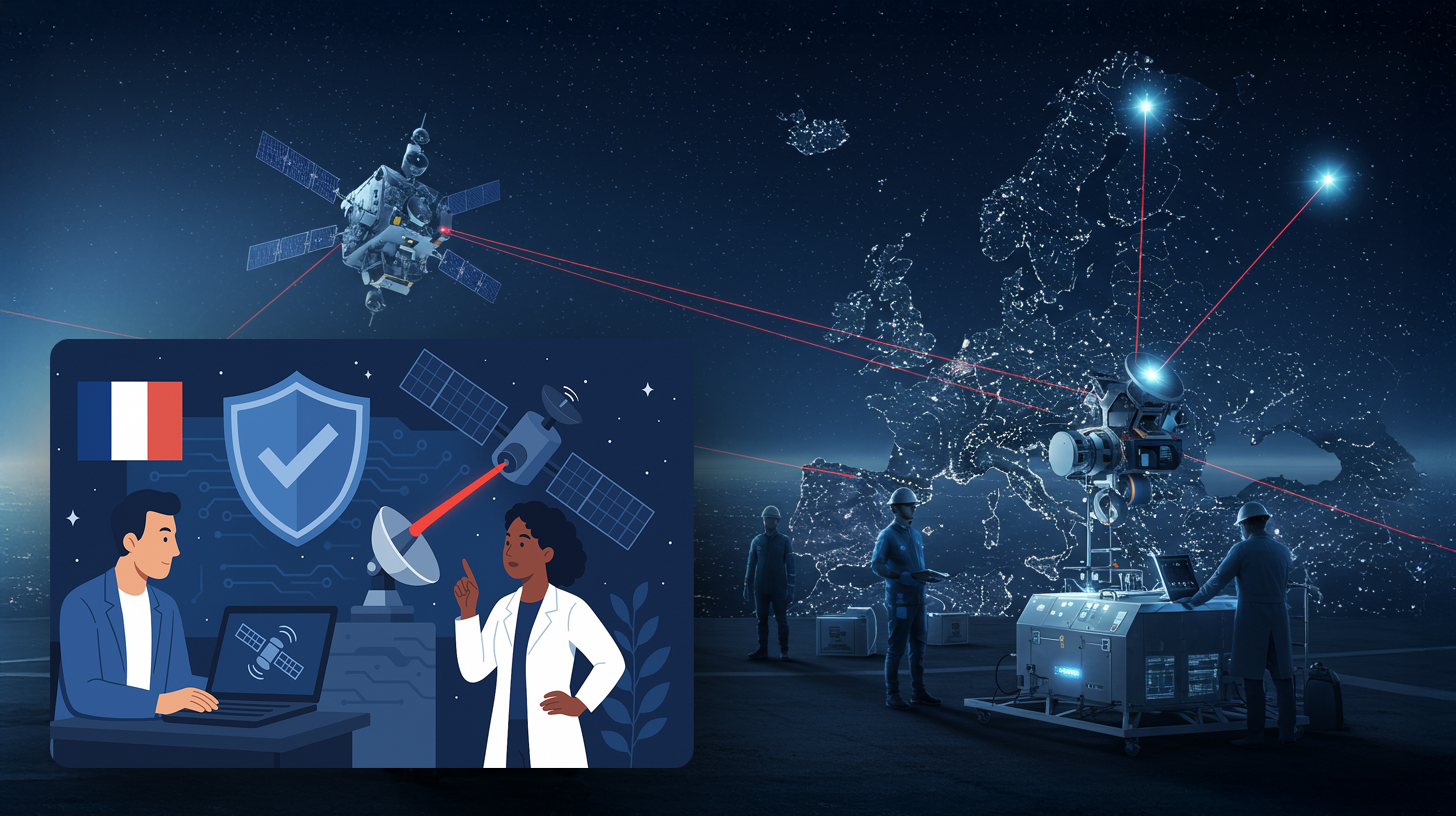
The French answer to this challenge is embodied in the Rennes-based company Cailabs, which has developed an innovative alternative. Instead of relying on conventional radio links, the French start-up uses laser technology for data transmission between satellites and ground stations.
Cailabs' TILBA (Turbulence-Induced Link Budget Adaptation) system offers significant advantages over conventional systems. By utilizing Multi-Plane Light Conversion (MPLC) technology, the optical ground stations can compensate for atmospheric turbulence, thereby establishing stable data links with speeds exceeding 10 gigabits per second.
How does French laser communication technology work?
The technological innovation behind Cailabs' system lies in overcoming one of the biggest challenges in optical space communication: the disruptive effects of the atmosphere on laser signals. While conventional adaptive optics systems require complex mechanical components, Cailabs uses a purely optical approach.
The TILBA-ATMO system splits incoming laser beams into different modes and coherently recombines them into a standard single-mode fiber. This technology makes it possible to correct distortions caused by atmospheric turbulence without relying on moving parts.
For satellite-to-ground communication, Cailabs develops mobile and stationary ground stations capable of tracking moving satellites and maintaining stable laser links. The systems are compatible with international standards such as CCSDS and SDA and can support various data rates, protocols, and modulation formats.
Practical testing of this technology was carried out through the KERAUNOS project, a collaboration between Cailabs, the French start-up Unseenlabs, and the French Defense Innovation Agency (AID). In 2024, a stable laser link between a nanosatellite in low Earth orbit and a commercial ground station was successfully established for the first time.
Why is the EU investing 800 billion euros in defense?
The European Union has adopted an unprecedented rearmament program that envisages investments of around €800 billion by 2030. This sum is divided into various instruments and national contributions, which together are intended to fundamentally strengthen Europe's defense capabilities.
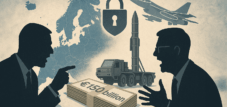
The centerpiece of the EU initiative is the SAFE program (Security Action for Europe), which provides €150 billion in loans for joint procurement. In addition, member states should be able to mobilize up to €650 billion for national defense spending by relaxing debt rules.
The urgency of these measures stems from several factors. The EU Commission is issuing a stark warning about the possibility of a large-scale war with Russia, emphasizing that "history will not forgive our inaction." Analysts believe that if Russia succeeds in Ukraine, it could further expand its territorial ambitions by 2030.
The strategic realignment is further accelerated by the uncertain American security guarantee under President Trump. European security experts emphasize that the continent can no longer rely on unconditional US support.
Related to this:
What role does France play in the European defense strategy?
France is positioning itself as a driving force behind European defense integration and is planning a massive increase in its military capabilities. The French defense budget is to be doubled from its current 50 billion euros to approximately 100 billion euros by 2030.
The French defense industry already provides an impressive foundation for this expansion. More than 4,500 companies are active in the defense sector, directly employing around 200,000 people. The industry's annual revenue reached approximately €41.6 billion in 2022, with an upward trend due to geopolitical tensions.
France's strategic importance is also reflected in the diversity of its defense capabilities. The country possesses a complete military-industrial base, ranging from nuclear weapons and fighter jets to state-of-the-art electronics. Companies such as Thales, Safran, MBDA, and Naval Group are among Europe's leading defense contractors.
Particularly noteworthy is France's focus on innovation and start-up support in the defense sector. The Definvest fund, endowed with €100 million, supports French technology companies whose expertise is crucial for military systems.
How is the collaboration between established corporations and start-ups developing?
The European defense industry is experiencing a renaissance of innovation through collaboration between traditional arms manufacturers and agile startups. These collaborations combine the experience and resources of established companies with the innovative strength and flexibility of young technology companies.
A prime example is the partnership between the German AI company Helsing and the French language model developer Mistral. This collaboration aims to develop artificial intelligence specifically optimized for defense purposes, thereby strengthening European technological sovereignty.
Helsing itself impressively demonstrates the potential of defense startups. Founded in 2021, the company reached a valuation of €1.7 billion as early as 2023, thus becoming Europe's first defense unicorn. The Munich-based company specializes in modernizing outdated weapons systems through software and AI.
Investment in European defense startups has increased dramatically. In 2024 alone, investments doubled to $630 million. German startups such as Quantum Systems, Stark, and ARX Robotics are among the most promising candidates in the industry.
What technological breakthroughs will shape the future of defense?
The next generation of defense technologies will be characterized by several groundbreaking innovations. Optical communication is at the forefront of this, as it forms the basis for secure, high-speed data transmission in military applications.
Besides Cailabs, German research institutions are also working on comparable solutions. The Fraunhofer Institute for Applied Optics and Precision Engineering in Jena has developed telescopes for the European ScyLight program that can be mass-produced. These components enable bandwidths of up to 100 gigabits per second over distances of up to 80,000 kilometers.
Artificial intelligence is also fundamentally transforming warfare. Start-ups like the French company Comand AI are developing AI-powered platforms for military operational planning that can learn from past operations and optimize decisions. These systems promise to significantly increase the speed and precision of military operations.
Drone technology is experiencing a tremendous boom thanks to European innovations. The Austrian company Auterion is developing autonomous drones that can independently locate and attack pre-marked targets. Such systems could revolutionize warfare just as tanks or fighter jets once did.
Hub for Security and Defense - Advice and Information

Hub for Security and Defense - Image: Xpert.Digital
The Security and Defence Hub offers expert advice and up-to-date information to effectively support companies and organizations in strengthening their role in European security and defence policy. Working closely with the SME Connect Defence Working Group, it particularly promotes small and medium-sized enterprises (SMEs) that wish to further develop their innovative capacity and competitiveness in the defence sector. As a central point of contact, the Hub thus creates a crucial bridge between SMEs and European defence strategy.
Related to this:
Defense industry in transition – satellites, drones, strategies: Europe's fight for military independence
How is the European procurement strategy changing?
The traditionally fragmented European defense procurement is undergoing a fundamental transformation towards coordinated, joint programs. The EU has established several instruments to intensify cooperation between member states and reduce dependence on non-EU suppliers.
The EDIRPA program (European Defence Industry Reinforcement through Common Procurement Act) provides €300 million for joint procurement. This instrument aims to incentivize coordinated procurement of critical defense equipment and thereby improve interoperability between armed forces.
The subsequent EDIP program (European Defence Industry Programme) expands this approach with €1.5 billion until 2027. However, the strict “Buy European” rules have led to controversy, as ten EU member states fear that important systems such as the American Patriot air defense system could be excluded from funding.
As part of this realignment, the European Defence Agency (EDA) will receive expanded powers. In addition to its traditional tasks, it will in future act as a central procurement body and pool the demand for joint procurement.
Related to this:
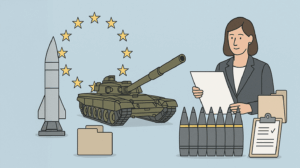
What challenges exist for European defense cooperation?
Despite political agreement on the need for increased cooperation, significant practical obstacles remain in the implementation of the European defense strategy. Sylvie Matelly, director of the Jacques Delors Institute and an expert in international defense economics, emphasizes that no single European country can muster the necessary resources alone.
The question of financing presents one of the biggest challenges. While EU programs mobilize considerable sums, national budgetary constraints must also be taken into account. France, for example, is struggling with a national debt of over 110 percent of GDP and a public deficit of over five percent.
Industrial capacity represents another critical constraint. The European defense industry must significantly expand its production capacity to meet increased demand. At the same time, there is a shortage of qualified specialists needed for this expansion.
Technological dependence on non-European suppliers further complicates the desired strategic autonomy. Many critical components and raw materials originate from countries affected by sanctions against Russia or that appear politically unreliable.
How is the Trump administration affecting Europe's defense strategy?
Donald Trump's re-election as US president is significantly accelerating Europe's pursuit of military independence. Trump's repeated expressions of doubt about NATO and his demand for drastically increased European defense spending are forcing the continent to reassess its security strategy.
Surveys show that 73 percent of the German population does not consider Trump a reliable partner for European security. This skepticism is reflected in concrete political initiatives: Germany, France, and Great Britain are working on a trilateral security agreement intended to complement NATO structures.
Security experts like Ronja Kempin from the German Institute for International and Security Affairs (SWP) warn that Europe must prepare for a time without American security guarantees. The "Trump era" requires swift decisions and decisive action to ensure the continent's strategic autonomy.
NATO states have already responded to Trump's demands and agreed on a new spending target of five percent of GDP by 2035. This ambitious goal is forcing European governments to make unprecedented investments in their defense capabilities.
What alternatives to Starlink are Europe developing?
In addition to the French initiative by Cailabs, Europe is pursuing several parallel approaches to reduce its dependence on American satellite communication systems. The EU program IRIS² (Infrastructure for Resilience, Interconnectivity and Security via Satellite) plans to build a European satellite network with 282 satellites by 2030.
Leading European telecommunications companies such as Deutsche Telekom, Orange, and satellite operators SES, Eutelsat, and Hispasat are participating in IRIS². The project is expected to cost a total of eleven billion euros, with the EU contributing seven billion euros and the private sector four billion euros.
Eutelsat OneWeb already represents a viable alternative to Starlink, but focuses primarily on business customers and governments. With approximately 634 satellites in low Earth orbit, the system offers speeds of up to 195 megabits per second and latencies of around 100 milliseconds.
Hughes and other providers position themselves as professional Starlink alternatives for businesses and public institutions. These systems are characterized by higher reliability, professional support, and dedicated bandwidth, but are more expensive than consumer-oriented solutions.
How is the start-up landscape developing in the defense sector?
The European defense tech scene is experiencing an unprecedented boom, driven by geopolitical tensions and rising defense budgets. German investors alone invested over one billion euros in defense startups in 2025, a historic record.
Cailabs exemplifies the success of European defense startups. Founded in 2013, the company has already raised €26 million in a Series C funding round and sold at least seven optical ground stations to customers in South Korea, Australia, Greece, France, and the USA.
The financing landscape for defense startups is becoming increasingly professionalized. Specialized investors like Defense Angels in Paris have already funded 23 companies since 2021 and expect to support almost 30 more startups by 2025. Traditional venture capital funds are also discovering the defense sector as an attractive investment area.
Governments are supporting this development through targeted funding programs. France's Definvest fund provides €100 million for strategically important technology companies, while Germany largely exempts its defense spending from the debt brake.
What impact is the war in Ukraine having on the European arms industry?
The Russian attack on Ukraine is acting as a catalyst for the transformation of the European defense industry. French defense companies like Eurenco have doubled their revenue since 2022 and filled their order books until 2029.
Production capacities are being massively expanded. KNDS in Bourges has tripled its production of Caesar artillery systems and delivers approximately 90 percent of its output directly to Ukraine. Similar expansions are taking place at munitions manufacturers such as Rheinmetall, which is building a new 400-million-euro factory in Unterlüß.
The war also demonstrates the critical importance of modern communication technologies. Starlink's role in Ukraine's defense highlights the strategic importance of secure satellite communications. At the same time, Russian jamming attempts with systems like Kalinka and Tobol demonstrate the vulnerability of even advanced technologies.
The experiences in Ukraine are significantly accelerating the development of new weapons systems. Drone technology, electronic warfare, and autonomous systems are receiving top priority in European development programs.
🎯🎯🎯 Benefit from Xpert.Digital's extensive, five-fold expertise in one comprehensive service package | BD, R&D, XR, PR & Digital Visibility Optimization

Benefit from Xpert.Digital's extensive, five-fold expertise in a comprehensive service package | R&D, XR, PR & Digital Visibility Optimization - Image: Xpert.Digital
Xpert.Digital possesses in-depth knowledge across various industries. This allows us to develop tailored strategies precisely aligned with the requirements and challenges of your specific market segment. By continuously analyzing market trends and monitoring industry developments, we can act proactively and offer innovative solutions. The combination of experience and expertise generates added value and provides our clients with a decisive competitive advantage.
More information here:
The Future of Security: How AI and Communication Are Redefining Military Systems
How does strategic communication change in military conflicts?
Modern warfare is fundamentally dependent on secure, high-speed communication. The experience in Ukraine shows that communication infrastructure has become a primary target and its failure can cripple military operations.
Starlink's importance to Ukrainian defense highlights both the opportunities and the risks of satellite-based communications. With 50,000 terminals in Ukraine, the system not only supports military operations but also keeps civilian infrastructure such as schools, hospitals, and railways operational.
However, dependence on a private provider carries significant risks. Elon Musk's unilateral shutdown of the system during Ukrainian operations in 2022 and his repeatedly expressed political positions highlight the problems.
European alternatives like Cailabs' optical communication systems aim to reduce this strategic dependency. Laser communication allows for higher data rates than conventional radio technologies, while simultaneously offering increased security against eavesdropping.
Related to this:
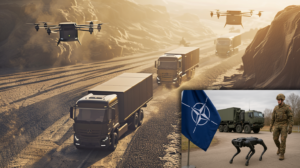
What role do small and medium-sized enterprises play in the defense industry?
Small and medium-sized enterprises (SMEs) are becoming increasingly important in the European defence industry. EU defence support instruments are explicitly designed to give these companies better access to financing and markets.
French examples vividly illustrate this development. Plubeau & Cie, originally specializing in railway technology, was encouraged by the Ministry of Defense in 2021 to produce ammunition for special forces. The company has already opened a new production facility and is developing two approved types of ammunition.
Forges de Tarbes, a 60-person operation, is the sole French manufacturer of large hollow shells for 155mm grenades and supplies KNDS exclusively. Such highly specialized niche manufacturers are becoming increasingly critical for the European defense industry.
However, the challenges for SMEs in the defense sector are considerable. Raw material procurement, lengthy certification processes, and complex security requirements present significant hurdles. At the same time, rising defense budgets are opening up unprecedented growth opportunities.
How is the industrial base for European defense autonomy developing?
Creating a sustainable industrial base for European defense autonomy requires coordinated efforts at multiple levels. In addition to expanding existing capacities, entirely new industries must be established and critical dependencies reduced.
France's integrated approach demonstrates the complexity of this task. The country possesses a complete military-industrial chain, from basic research to mass production. The French nuclear industry, aerospace, and electronics manufacturing form synergistic clusters that reinforce each other.
Germany focuses on complementary strengths, particularly in tank and artillery production as well as in advanced sensor technologies. The collaboration between German and French companies in joint ventures such as KNDS demonstrates the potential of European integration.
The challenge lies in scaling these collaborations to a continental level. While bilateral projects are successful, coordination among the 27 EU member states proves considerably more complex. Differing industrial traditions, regulatory frameworks, and strategic priorities complicate integration.
What technological trends will shape the future of defense?
Several converging technology trends will define the next generation of defense systems. Artificial intelligence, optical communication, autonomous systems, and additive manufacturing will form the backbone of future military capabilities.
AI systems are already revolutionizing target acquisition, mission planning, and weapon control. The partnership between Helsing and Mistral aims to develop AI models specifically optimized for European defense requirements. These systems are intended to support human operators without completely taking over decision-making authority.
Optical communication is becoming the standard for military data transmission. Its advantages over radio links – higher bandwidth, better security, and resistance to interference – make this technology indispensable for modern armed forces.
Autonomous systems are evolving from remotely controlled to semi-autonomous and finally fully autonomous platforms. European companies like Auterion and Quantum Systems are working on drone systems capable of carrying out complex missions without human intervention.
Additive manufacturing enables the decentralized production of spare parts and even complete weapon systems. MBDA and KNDS already use 3D printing for complex metal components, thereby reducing delivery times and dependencies.
How does demographic development affect Europe's defense strategy?
Europe's aging population and declining birth rates fundamentally challenge traditional concepts of national defense. The German armed forces are already struggling with recruitment problems, and similar challenges are emerging in other European countries.
Technological solutions are increasingly being used to compensate for personnel shortages. Autonomous systems, AI-supported operations, and robotic platforms can replace human soldiers in dangerous or repetitive tasks.
The defense industry itself is affected by similar demographic trends. The shortage of skilled workers is forcing companies to recruit former automotive suppliers and their employees for defense applications. At the same time, the automation of production is accelerating.
Education and training are gaining strategic importance. The complex technologies of the next generation require highly qualified specialists whose training takes years. European universities and research institutions must significantly expand their capacities in defense-related disciplines.
What impact do sanctions have on the European arms industry?
The sanctions imposed against Russia have far-reaching consequences for European supply chains and raw material markets. Many critical materials for arms production traditionally came from Russian or Russian-controlled sources.
French companies like Plubeau & Cie are struggling with raw material procurement and are searching for alternative suppliers in Europe. This shift requires not only new trading relationships but often also adjustments to production processes.
However, the sanctions are also accelerating the European integration of the defense industry. Companies are forced to develop intra-European suppliers and establish new collaborations. In the long term, this process strengthens the continent's strategic autonomy.
At the same time, new market opportunities are opening up for European producers. Countries that previously bought Russian weapons systems are looking for Western alternatives and are contributing to the growth of European arms exports.
European defense efforts are at a historic turning point. Innovative startups like Cailabs demonstrate that the continent possesses the technological capabilities to overcome strategic dependencies and develop independent security solutions. The massive investment of €800 billion by 2030 underscores the political determination to realize this vision.
The success of this transformation, however, depends on the ability to reconcile national interests with European cooperation. While individual projects like KERAUNOS achieve impressive technical successes, continental defense integration requires unprecedented political and industrial coordination.
The coming years will determine whether Europe can achieve its ambitious defense goals. The foundations have been laid – innovative technologies, substantial financial resources, and political will. Now it is up to implementation to combine these elements into a coherent and effective defense strategy that equips the continent for the challenges of the 21st century.
Consulting - Planning - Implementation

Markus Becker
I would be happy to serve as your personal advisor.
Head of Business Development
Chairman SME Connect Defense Working Group
Consulting - Planning - Implementation
Konrad Wolfenstein
I would be happy to serve as your personal advisor.
You can contact me at wolfenstein∂xpert.digital or
Just call me on +49 7348 4088 965 .