

Battle for space: How Europe's Ariane 6 plans to compete against SpaceX and China
Xpert Pre-Release

Language selection 📢
Published on: June 17, 2026 / Updated on: June 17, 2026 – Author: Konrad Wolfenstein
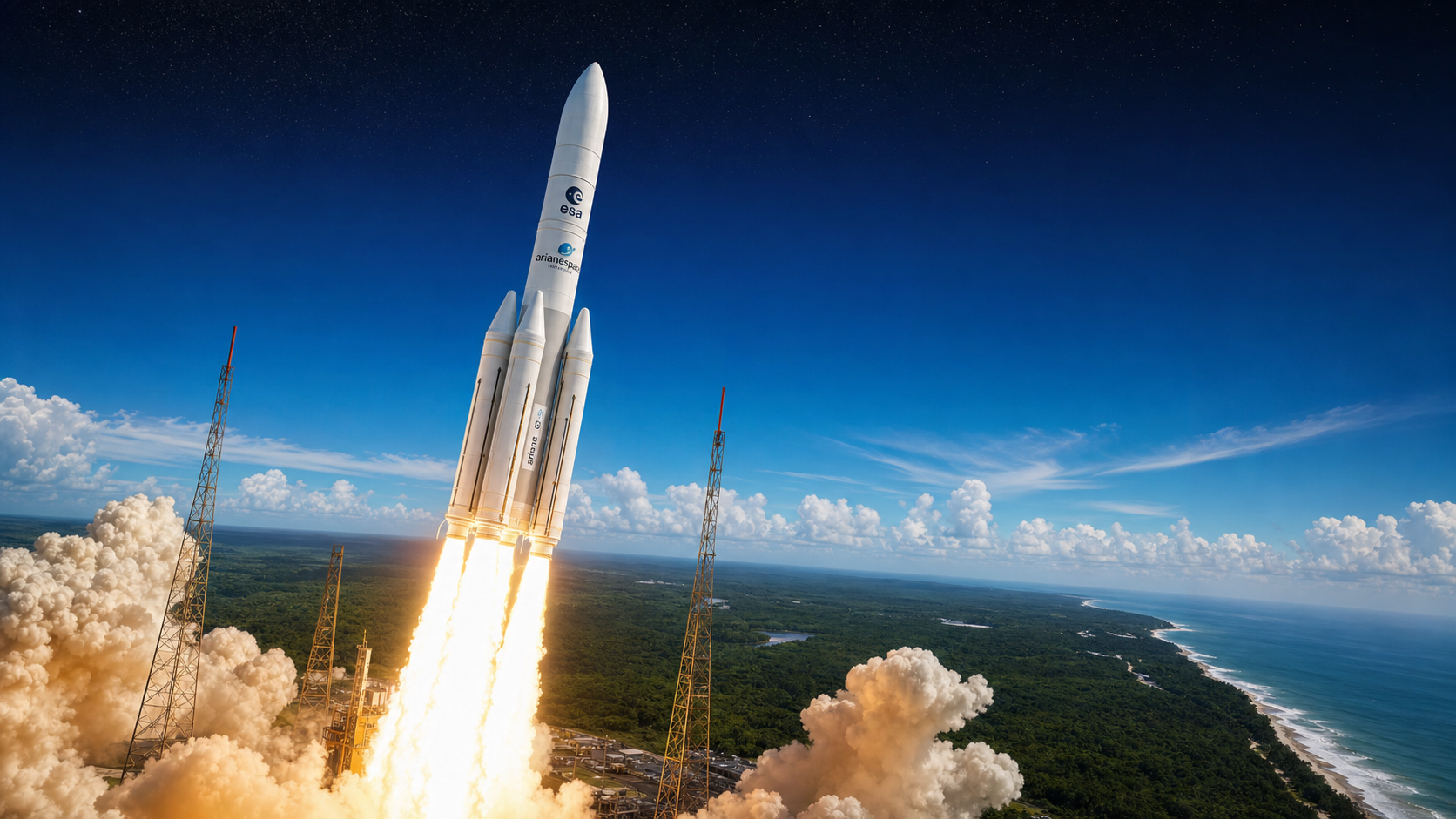
Battle for space: How Europe's Ariane 6 plans to compete against SpaceX and China – Image: Xpert.Digital
Europe's last chance in space? What's really at stake in the historic launch from Kourou?
Project Kuiper: Gigantic: Why Amazon now needs Europe's Ariane 6 of all things
Will Europe's space program make a triumphant comeback today? With the upcoming launch of mission VA269, the Ariane 6 is poised for a historic milestone. Powered by the new, high-performance P160C solid rocket boosters, the European launch vehicle is set to carry the heaviest payload in its history into space – 36 satellites for Amazon's ambitious Kuiper project. But behind the planned, spectacular launch over the rainforest of French Guiana lies far more than just technological progress. It represents a potential geopolitical breakthrough in a relentless global space race. While SpaceX is driving down prices with reusable rockets and China is massively expanding its state power, Europe is fighting for its independence in space. Learn why Amazon's mega-contract is like an economic lifeline for Arianespace, why every launch becomes a strategic tightrope walk, and what's at stake for Europe's sovereignty in space in the coming decade.
Why the Ariane 6 launch VA269 is more than a rocket – it is proof of survival
Technical core: What sets the Start VA269 apart from the rest
Today, an Ariane 6 rocket in the Ariane 64 configuration, carrying 36 satellites for the Amazon-LEO constellation, will launch from the European Spaceport in Kourou, French Guiana. The launch window opens at 1:53 p.m. CEST and closes at 2:22 p.m. What technically distinguishes this mission from all previous ones is the use of the new P160C solid rocket boosters for the first time – four of them, which together generate a total thrust of approximately 19,120 kilonewtons.
The P160C booster is the technical heart of this performance upgrade. It builds upon the proven P120C, but is one meter longer (14.5 meters) and holds approximately 156 to 157 tons of solid propellant – around 10 percent more than its predecessor. Each individual booster burns for about 137 seconds, generating a thrust of approximately 4,780 kilonewtons. The upgrade to the P160C increases the maximum payload capacity of the Ariane 64 to low Earth orbit (LEO) by more than two tons, from around 21.65 tons to up to 24 tons. With 36 satellites on board – four more than the first two Amazon missions – the VA269 mission will carry the heaviest payload ever launched into space by a European rocket.
The name P160C is no coincidence: "P" stands for "Poudre" (French for powder, i.e., solid propellant), "160" refers to the propellant quantity of almost 160 tons it carries, and "C" signifies its compatibility with both the Ariane 6 and the Vega C. The booster was jointly developed by ArianeGroup and the Italian defense company Avio in their joint venture Europropulsion. It is one of the world's largest solid rocket boosters made from a single block of carbon fiber – an industrial engineering masterpiece that Europe, in this form, truly alone has achieved.
Strategic weight: What's at stake
VA269 is the third Ariane 6 mission for Amazon LEO and the eighth Ariane 6 launch overall. It marks the beginning of a far-reaching partnership: Amazon has booked a total of 18 Ariane 6 launches with Arianespace. Of these 18 flights, 16 are to be carried out with the more powerful P160C boosters. For Arianespace, the order volume from Amazon is nothing less than a financial lifeline for the coming years.
But the strategic nature of this mission extends far beyond a single commercial contract. Between 2022 and 2024, Europe faced a profound crisis in space access: the Russian Soyuz rocket was no longer a viable partner after the attack on Ukraine, the Ariane 5 was decommissioned, and the Ariane 6 was delayed for years. As a result, Europe was temporarily unable to launch its own Galileo navigation satellites independently. The ESA's Strategy 2040, which aims for a fully autonomous European space access system, hinges directly on the reliability of the Ariane 6.
The German Federal Ministry of Defence states unequivocally in its 2025 Space Security Strategy: Europe must ensure independent and resilient access to space in the future with several competitive launch vehicles. Every successful Ariane 6 launch strengthens this position, while every failed launch would once again push Europe into dependence on foreign launchers – with all the geopolitical and military-strategic consequences that entails.
The setting: Kourou, between rainforest and rocket technology
The European spaceport is located in the northeastern corner of South America, in French Guiana – a French overseas territory and therefore also part of the European Union; the currency is the euro, and phone calls are made via the EU roaming network. Its geographical location near the equator is no coincidence, but rather an aerodynamic calculation: launches near the equator utilize the Earth's rotation as additional thrust – a physical advantage that saves fuel and significantly increases payload capacity compared to launches from higher latitudes.
The site near Kourou covers an area comparable to the city of Hamburg and is protected by strict security measures. Its proximity to Suriname and Brazil, through whose rainforests drug and smuggling routes run, necessitates a large military presence on launch day. With each passing day, the French military presence is intensified. Anyone wishing to access the actual launch area undergoes multiple security checks, including biometric verification. Barbed wire, surveillance cameras, and armored vehicles define the security perimeter around launch pad ELA-4.
The starting year 2026: A catch-up program in fast forward
Up to eight Ariane 6 launches are planned for 2026, a significant increase compared to the previous year. The number is expected to rise to around ten launches in 2027. By comparison, in 2024, around 150 rockets were launched in the US alone – mostly by SpaceX – about 70 in China, and Europe managed just three. Ariane CEO Pierre Godart spoke openly in early 2026 about the goal of doubling the launch frequency. Even if this goal is fully achieved, Europe will remain a dwarf compared to the US in terms of sheer launch frequency.
The success of the launch year 2026 is based on two important previous milestones: On February 12, 2026, an Ariane 64 – the four-booster version – launched for the first time with mission VA267, successfully placing 32 Amazon LEO satellites into orbit. A few months later, on April 30, 2026, VA268 followed with another 32 satellites. These consecutive successes demonstrated the operational resilience of the Ariane 64 and created the confidence for the move to the even more powerful P160C configuration.
The client: Amazon under time pressure in the LEO competition
Amazon is pushing ahead with Project Kuiper, a project whose scale can hardly be overstated. The US Federal Communications Commission (FCC) has approved a constellation of 3,236 satellites in low Earth orbits between 590 and 630 kilometers in altitude. According to FCC regulations, at least 1,600 of these satellites must be operational in orbit by the end of July 2026. This deadline is non-negotiable: Failure to meet it risks the partial or complete revocation of the FCC license.
Amazon's bandwidth target is also ambitious: up to 400 megabits per second should be available for private users, and up to one gigabit per second for businesses. Integration with Amazon Web Services (AWS) is intended to give Kuiper a decisive strategic advantage over Starlink – those who already host their cloud infrastructure with Amazon can seamlessly access the satellite network without having to solve interface problems with a third-party infrastructure.
Amazon secured launch capacity for its constellation from several providers simultaneously: in addition to Arianespace with its Ariane 6, it also secured launch capacity from Blue Origin and, surprisingly, from SpaceX – its direct competitor in the satellite internet market. This diversification strategy is economically astute, but it also puts Amazon in a strong negotiating position with its contractors. For Arianespace, it is therefore all the more crucial to execute each of the 18 agreed-upon missions reliably and on time.
SpaceX: Its structural cost advantage and its limits
The competitive pressure facing the Ariane 6 cannot be understood without analyzing SpaceX and the principle of reusability. The Falcon 9 revolutionized the space industry with a concept that may seem trivial to aircraft operators but was long considered physically impossible in rocket technology: the return and reuse of the first stage. By reusing a single booster up to 30 times, SpaceX has reduced launch costs by an estimated 70 to 80 percent compared to conventional expendable rockets. According to industry analysts, the effective cost per kilogram of payload to orbit has fallen to around $2,720 – a fraction of what competing systems charge.
Consequently, SpaceX offers commercial Falcon 9 launches for under €60 million, although the exact price depends heavily on the client and the mission. An Ariane 6 launch was originally estimated at around US$77 million – already significantly cheaper than the Ariane 5, which cost up to US$200 million. However, even with this cost reduction, the Ariane 6 remains structurally more expensive than SpaceX as long as it does not implement first-stage reuse. The development costs for the Ariane 6 amounted to approximately €4 billion; Germany alone contributed around 22 percent of this. This investment is irreversible and must be recouped through launch contracts.
To be fair, however, the comparison needs to be differentiated. SpaceX does not operate in a completely free market. The Falcon 9 is sold for well over $100 million for US government contracts, while commercial customers benefit from a subsidized price. Furthermore, Europe retains a fundamental interest in not entrusting launches for military, scientific, and institutional European payloads to a foreign provider – not least for reasons of data security and geopolitical independence. The real question, therefore, is not simply: Who is cheaper? But rather: What is strategic sovereignty worth?
Our EU and German expertise in business development, sales and marketing

Our EU and German expertise in business development, sales and marketing - Image: Xpert.Digital
Industry focus areas: B2B, digitalization (from AI to XR), mechanical engineering, logistics, renewable energies and industry
More information here:
A thematic hub offering insights and expertise:
- Knowledge platform covering global and regional economies, innovation and industry-specific trends
- A collection of analyses, insights, and background information from our key areas of focus
- A place for expertise and information on current developments in business and technology
- A hub for companies seeking information on markets, digitalization, and industry innovations
Amazon vs. Starlink: Why Kuiper is becoming an opportunity for Arianespace
China: A quiet catch-up with government support
China's space program is often underestimated in Western analyses – an error that is hardly justifiable in light of recent developments. In 2024 alone, China conducted around 70 rocket launches. The state-owned China Aerospace Science and Technology Corporation (CASC) operates the proven Long March family of rockets and is consistently developing them further. On June 1, 2026, China launched its new Long March 12B launch vehicle – a rocket that directly competes with the Falcon 9 in its payload class and whose first stage is designed to be reusable in principle. Even though no reuse test was conducted during the maiden flight, the design demonstrates the direction China is heading.
At the same time, China is building its own satellite constellation, "Qianfan," which directly competes with Starlink. Another constellation, called "Spacesail," was reinforced in May 2026 with a successful Long March 6 launch. The Chinese state is massively supporting this program because it's not just about internet access, but also about global data infrastructure, military communications, and geopolitical influence. China is able to offer launches at prices that are heavily subsidized by the state—comparable to how China subsidized its steel industry for decades.
For Europe, this is the more difficult-to-calculate risk: While SpaceX has achieved efficiency gains through a private-sector innovation culture that are fundamentally understandable and potentially imitable, China operates according to an industrial policy logic that uses market prices as a political instrument. European launchers, which have to compete in commercial markets against state-subsidized Chinese competitors, are in a structurally disadvantageous position – unless Europe responds with a similarly strategic industrial policy.
Russia: The once powerful competitor in free fall
Russia's space program is in a state that would have been unthinkable just a few years ago. The Soyuz rocket – for decades the most reliable workhorse in space – has largely disappeared from the Western market as a commercial offering since the beginning of the war in Ukraine. The commercial marketing company Starzem, which also offered Soyuz launches from the European spaceport in Kourou, effectively ceased operations; the last Soyuz launch from French Guiana took place in February 2022.
The new Russian Soyuz-5 launch vehicle, capable of carrying a payload of up to 17 tons into Earth orbit, finally had its first suborbital test launch on April 30, 2026, after multiple delays, which Roscosmos declared a success. However, this does little to address a seemingly insurmountable problem: Russia simply lacks solvent, Western-oriented customers. International isolation, combined with the exodus of European and North American clients, has plunged Roscosmos into a severe financial and technological crisis. As a symptom of this predicament, Putin has permitted commercial advertising on Russian spacecraft since the beginning of 2026. The potential for Russia to compete commercially with Arianespace remains minimal for the foreseeable future.
European dependencies: A structural vulnerability
Europe's real economic problem in the space sector is not a lack of technology – it is the chronic underestimation of strategic dependencies. For decades, Europe used Russian Soyuz rockets as complementary launch capacity, even at its own spaceport in Kourou. When Russia failed, Europe lacked sufficient backup capacity. Europe was suddenly no longer able to launch its own Galileo satellite groups independently. Relinquishing control over access to space means relinquishing a degree of state power – in times of peace as well as in times of crisis.
The EU Council emphasizes unequivocally in several strategy papers that the EU's autonomous access to space is of central importance for the resilience of European space infrastructure. The IRIS² program, which aims to launch nearly 300 of its own European communications satellites into orbit by 2030 and is positioned as a European alternative to Starlink, requires reliable European launch capabilities for its development. If the Ariane 6 cannot reliably fulfill this role, IRIS² is at risk – and with it, the entire strategy for European digital sovereignty.
Added to this is an urgency created by the changed geopolitical context of the 2020s: With the change of power in the White House and the increasingly transactional US foreign policy, Europe can no longer be certain that American Starlink and Falcon 9 capacities will be fully available in a crisis. Dependence on SpaceX – a company led by a man who has unequivocally positioned himself as a political actor – has become a risk in its own right for European security strategists.
Amazon Kuiper vs. Starlink: A duel with European implications
The market for satellite internet access in low Earth orbit is developing into the most important growth market for the space industry. SpaceX currently dominates it with Starlink in a way that seems to leave little room for competitors: Over 9 million subscribers worldwide by the end of 2025, available in more than 70 countries, with over 5,700 active satellites in orbit. Starlink revenue alone amounted to around €8.5 billion in 2025 – almost two-thirds of SpaceX's total group revenue of approximately €13 billion.
Amazon Kuiper is entering this market as a financially powerful and serious technological challenger. However, it's already becoming clear that the FCC licensing requirement of 1,600 satellites in orbit by the end of July 2026 is extremely ambitious. Amazon has booked not only the Ariane 6 but also the Atlas V, Vulcan Centaur, and SpaceX Falcon 9 for the constellation – every available launcher is needed. Any delay in one of these launches pushes the licensing requirement further into the future and could have regulatory consequences.
This presents a historically rare opportunity for Arianespace and Europe: Amazon needs the Ariane 6. Not as a political goodwill project, but because launch capacity is simply scarce on the market. The Ariane 6 provides essential mission capability during a critical phase for Amazon's Kuiper program. Successful completion of mission VA269 would therefore also send a signal to future major customers: Arianespace is reliable, European, and technologically state-of-the-art. This reputation is worth more than any single mission reward.
Industrial perspective: Reusability as a matter of survival
The elephant in the room remains the question of reusability. SpaceX has proven that individual Falcon 9 boosters can be launched up to 30 times. The resulting cost reduction is not linear, but exponential: Spreading the development costs of a booster over 20 launches means paying a fraction per launch of what a disposable booster costs. Booster B1067 alone is said to have saved more than $450 million in manufacturing costs over its lifetime.
The Ariane 6 is a disposable rocket. Every launch consumes a new rocket – literally and figuratively. ArianeGroup is working on concepts for a reusable booster, but a concrete, operational system isn't expected before the end of the 2020s. In the meantime, the Ariane 6 is trying to remain competitive through scaling and production optimization: assembly time is intended to be half that of the Ariane 5, with correspondingly lower unit costs. But this is ultimately a rearguard action against a competitor that has redefined the fundamental parameters of the game.
Europeans are therefore increasingly focusing on parallel program development: Isar Aerospace, RFA (Rocket Factory Augsburg), and the German company HyImpulse are developing smaller, partially reusable launch vehicles. These New Space initiatives could diversify Europe's launch infrastructure in the medium term, but they do not solve the problem in the heavy-lift class, where the Ariane 6 operates. For the foreseeable future, Europe will remain dependent on the Ariane 6 – a dependency that enormously increases the pressure on every single mission.
Assessment: How good are Europe's chances?
A sober economic assessment of Europe's starting position reveals a nuanced picture. In the institutional segment – that is, launches for ESA itself, the EU Commission, national space agencies, and the military – the Ariane 6 is unrivaled. No political decision-maker in Europe will voluntarily entrust security-critical payloads to a foreign launcher that is potentially under the political influence of other governments. This institutional market segment alone secures a foundational business for the Ariane 6.
The situation is more difficult in the commercial segment. Amazon Kuiper has demonstrated that a large order of 18 launches is possible – but only because the market is temporarily tight. If SpaceX further expands its capacity via Starship and operates the Falcon 9 with an even higher reuse rate, price pressure on the Ariane 6 will increase further. While China, as a potential third-party supplier for Western customers, has been temporarily pushed out of this market by geopolitical tensions, it remains structurally present.
The decisive turning point lies in the next decade: If Europe can develop a competitive, partially reusable, next-generation heavy-lift rocket by 2030 – whether as a successor to the Ariane 6 or as an evolutionary development – there is a realistic chance of long-term competitiveness. The launch year of 2026, with up to eight Ariane 6 missions, the successful introduction of the P160C boosters, and the major contract with Amazon, provides an important foundation for this. VA269 is not an endpoint – it is a stress test that Europe must pass to remain in the race.
🎯🎯🎯 Data-driven B2B industry hub as a quasi-in-house solution

The quasi-in-house solution: How Xpert.Digital closes operational gaps in B2B marketing and sales – Smart Content-Driven Business - Image: Xpert.Digital
Xpert.Digital is a data-driven B2B industry hub led by Konrad Wolfenstein . The company acts as an external, quasi-in-house solution for industrial partners, closing operational gaps in marketing, content, and sales – without requiring additional resources on the client side.
More information here:
Your global marketing and business development partner
☑️ Our business language is English or German
☑️ NEW: Correspondence in your native language!

Konrad Wolfenstein
I and my team are happy to be available to you as your personal advisor.
You can contact me by filling out the contact form here [email protected]:or simply call me at +49 7348 4088 965. My email address is
I'm looking forward to our joint project.










