
Is buying a robot worthwhile? How quickly does automation really pay off for companies?
Xpert Pre-Release

Available in 27 languages 📢
Prefer Xpert.Digital on GoogleⓘPublished on: May 8, 2026 / Updated on: May 8, 2026 – Author: Konrad Wolfenstein
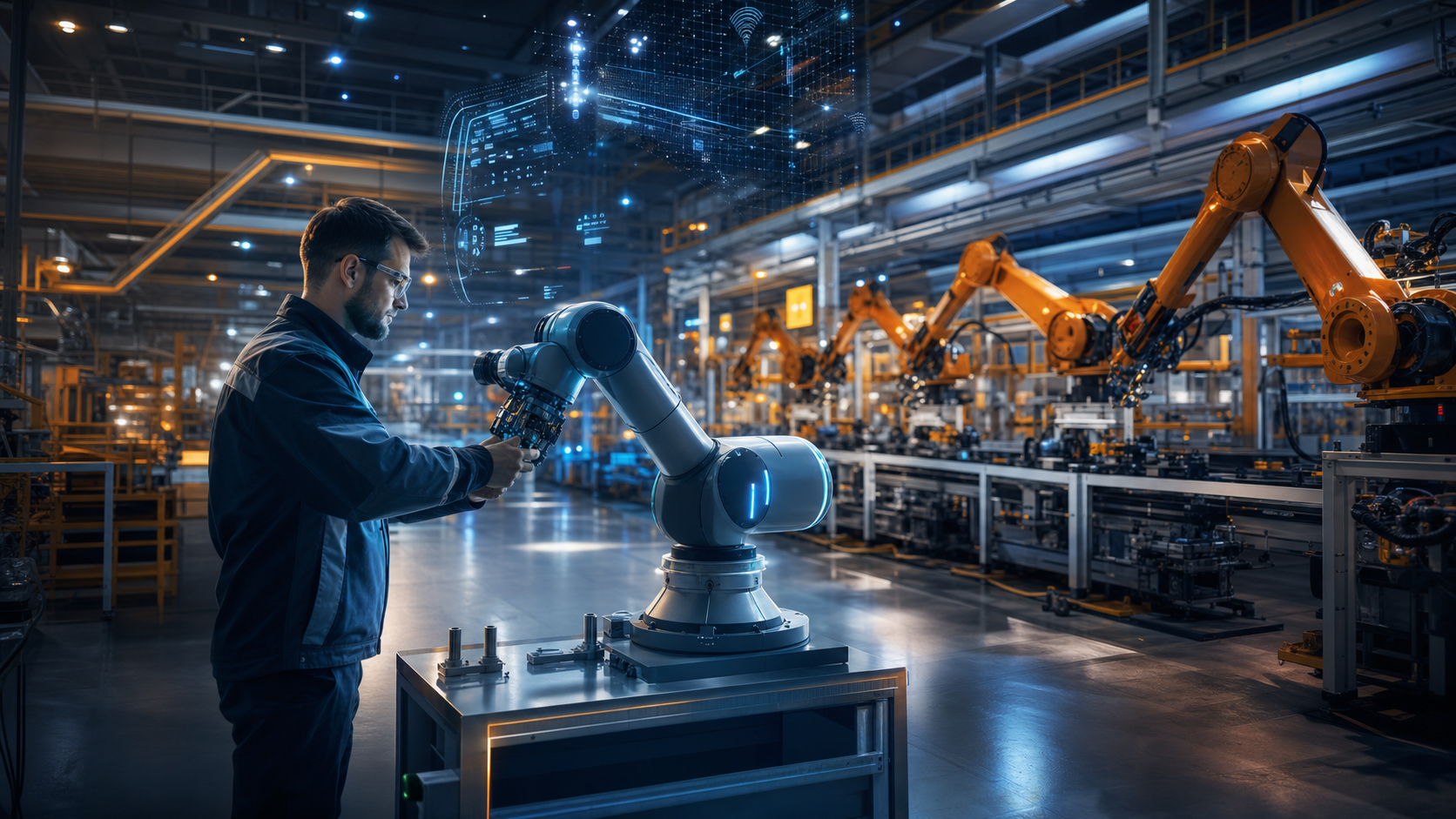
Is buying a robot worthwhile? How quickly does automation really pay off for companies – Image: Xpert.Digital
From cobots to humanoid robots: These are the real levers against the skilled worker shortage
More than just machines: How artificial intelligence is fueling the robot boom in Germany
The shortage of skilled workers is intensifying, production costs are rising continuously, and global competition – particularly from Asia – is accelerating rapidly. For German industry, from multinational corporations to agile, medium-sized family businesses, future competitiveness is at stake. In this existential climate of tension, robotics is currently transforming from a niche technological topic into the ultimate economic imperative. Whether it's smart, collaborative cobots in manufacturing, autonomous transport systems in logistics, or AI-supported inspection robots for predictive maintenance: automation is no longer a question of "if," but rather determines the "how" and "when" of entrepreneurial success. The following article delves deeply into why time is of the essence for SMEs, which technologies are currently achieving breakthroughs, how artificial intelligence is changing the rules of the game, and why investments in robotics often pay for themselves much faster than many expect. A comprehensive look at a key technology that will significantly shape the future of Germany as a business location.
Robotics as an economic imperative – Automation potential in German industry
From niche application to industrial backbone
The use of robotics in industry has evolved over the past few decades from a specialty of the automotive sector to a cross-industry productivity tool. What was once only seen in the fully automated production lines of major vehicle manufacturers is now accessible to almost every manufacturing company – and increasingly economically attractive. The technological maturity of the systems, decreasing acquisition costs, and the rapid integration of artificial intelligence have created a new dynamic that extends far beyond traditional applications.
It's no longer just about accelerating production processes. Robotics has become a strategic tool for addressing several existential challenges facing the German and Hessian economies: rising cost pressures, a demographically driven shortage of skilled workers, stricter quality requirements, and volatile markets. At the end of 2024, nearly eight out of ten decision-makers identified rising cost pressures as their biggest challenge in the PwC Mechanical Engineering Barometer. The shortage of skilled workers came in second, with three-quarters of respondents describing it as urgent. These findings explain why, for a growing number of companies, the question of whether to implement robotics is no longer a question of "if," but rather "how" and "when.".
A global market with a clear growth trend
The global market for industrial robotics has recently been experiencing a period of strong structural growth. According to the International Federation of Robotics' (IFR) World Robotics Report 2025, the operational stock of industrial robots in factories worldwide rose to 4.66 million units in 2024 – an increase of nine percent compared to the previous year. This marked the fourth consecutive year that the number of newly installed units exceeded half a million. These figures represent more than just statistics: they reflect a structural shift in the global production paradigm, in which human labor and machine performance are being systematically redistributed.
Regionally, growth is concentrated in Asia: 75 percent of all newly installed robots in 2024 were installed in the Asia-Pacific region and Australia. Europe follows with a market share of 16 percent, and the Americas with nine percent. China, in particular, has developed into a robotics superpower in this respect, ranking third globally with a robot density of 470 installed units per 10,000 employees – and has already overtaken Japan. South Korea leads by a wide margin with 1,012 units, followed by Singapore with 770.
For Germany, the figures require a more nuanced view. After the record year of 2023 with 28,355 new installations, the number fell by five percent to around 27,000 units in 2024. This is not a cause for alarm, but rather a return to normal after an exceptional year. The crucial finding is the structural one: the operational stock of robots in German industry rose to 278,900 units, an increase of four percent. Germany remains the largest robot market in Europe and the only European economy among the world's top five. Within the European Union, 40 percent of all factory robots are operated in Germany. With a robot density of 429 units per 10,000 employees, Germany ranks fourth worldwide – an impressive position, which, however, also demonstrates that Asian competitors are significantly further ahead in terms of automation.
The IFR projects annual installation growth of five percent for Europe through 2028 – a pace that lags behind Asia (eight percent) but underscores the continued relevance of the European market. The overall industrial robotics market is estimated to exceed US$48 billion in 2025 and is projected to reach over US$90 billion by 2030, representing annual growth of approximately 13 percent. While significantly smaller – estimated at US$4.49 billion in 2025 – the autonomous mobile robot (AMR) market is growing considerably faster, with a projected annual growth rate of 15 percent.
Economic pressure as a driving force: Why time is of the essence
In practice, the motivation for automation is usually an economic necessity, not a technological gimmick. The cost structure of manufacturing companies in Germany is under considerable pressure: labor costs are rising continuously, energy and raw material prices remain volatile, and global competition – especially from Asia – forces companies to constantly improve efficiency. In this context, robotics unfolds its economic impact on several levels simultaneously.
Direct cost savings result from reduced labor intensity in repetitive processes. Robots operate around the clock without breaks, sick days, or employee turnover – a business advantage that is immediately reflected in the return on investment calculation. Indirect benefits arise from improved product quality: robots perform tasks with high precision and consistent repeatability. Less scrap and rework mean less material consumption and lower complaint costs – economically relevant factors that are often underestimated in traditional ROI calculations.
In addition, there are capacity effects. Companies that implement fully automated night shifts – so-called "ghost shifts" – can increase their revenue without having to hire additional staff. This is a powerful strategic lever, especially for SMEs with limited recruiting budgets and low attractiveness in the job market. The economic potential can be summarized in four core dimensions: cost savings, reduced lead times, increased capacity, and improved quality. The fact that these dimensions extend far beyond a mere cost-cutting logic is an important conceptual point: robotics is not a rationalization tool, but a growth driver.
The amortization paradox: Between sprint and marathon
One of the most frequently asked questions regarding robotics implementation concerns the payback period – and the answer is more nuanced than many expect. The range is considerable. For simple, highly standardized applications such as machine loading, automation solutions can pay for themselves in as little as six to twelve months; in extreme cases, even within a single month. These short timeframes are possible when high repetition frequency, low process variance, and long waiting times for operators between tasks coincide – all factors that maximize the economic impact of a robot.
More complex applications present a different picture. For individual systems with higher technical complexity, such as in assembly, typical amortization periods of two to four years are realistic. Linked production lines – that is, integrated manufacturing systems with several interconnected robot units – can have amortization periods of five to seven years. The example of Junghans Kunststoffwaren-Fabrik GmbH & Co. KG from Hessisch Lichtenau vividly illustrates this effect: The originally planned amortization period of six years increased to nine years due to building expansions and complex networking requirements – a result that the company nevertheless considers a success, because the strategic independence from the skilled labor market and the increase in quality outweigh the disadvantages.
The crucial trend is that amortization periods will become shorter in the future. This is due to a scissor effect: On the cost side, personnel costs continue to rise due to demographic change and a shortage of skilled workers, while on the other hand, prices for automation solutions are falling due to economies of scale and technological advancements. Affordable entry-level cobots are already available for under €3,000 – although this only covers the hardware price, and peripherals, integration, safety certification, and training costs are additional. Anyone calculating amortization based on current personnel costs is being conservative; the actual profitability of the investment is likely to be better in a few years than currently projected.
Industry under scrutiny: Who invests where and why
The industry distribution of robot installations in Germany reveals structural shifts that go far beyond cyclical fluctuations. Traditionally, the automotive industry dominated the landscape: in 2023, there were 9,190 new installations in Germany, while in 2024 this number fell to 6,932 units – a decline that reflects the structural adjustment processes within the sector. Nevertheless, the automotive industry remains the largest single user.
What makes this development particularly noteworthy is the dynamic growth in other sectors. The metal industry increased its robot installations in Germany from 4,916 (2023) to 6,034 units (2024), thus approaching the automotive sector considerably. The food sector is even more striking: from 418 new installations in 2023, the number jumped to 1,389 units in 2024 – more than tripling within a single year. This leap signals that robotics in the food industry has passed a tipping point, where the technology is perceived for the first time as reliable and economically viable. The plastics and chemicals sector in Germany also recorded a significant increase, from 1,832 to 3,125 units.
Globally, the picture is somewhat different: In 2024, the electronics industry led the global ranking with 129,000 new installations, followed by the automotive industry with 126,000 units. The divergence between Germany and the global trend – where automotive continues to lead – can be explained by Germany's unique industrial structure, in which the automotive industry and its supplier network play an exceptional role. However, diversification is also progressing in Germany, opening up new markets for integrators, manufacturers, and technology providers.
Collaborative robots: Small and medium-sized enterprises discover the cobot
A technological development has fundamentally changed the economic accessibility of robotics for small and medium-sized enterprises: the collaborative robot, or cobot for short. Unlike traditional industrial robots, which operate in enclosed work areas, cobots are characterized by their ability to work directly alongside humans. This makes them space-saving, flexible in their deployment, and significantly cheaper to purchase and integrate.
While cobots currently represent only around ten percent of all installed industrial robots – 57,000 out of 541,000 units worldwide in 2023 – their growth rate is exceptional: the cobot market has more than doubled compared to 2020. The relatively low unit numbers are not due to a lack of interest, but rather to the historically established dominance of fully automated large-scale systems, primarily operated in the automotive industry and by multinational corporations. For small and medium-sized enterprises (SMEs), however, cobots are an ideal entry-level technology: they can be integrated more quickly into existing processes, do not require costly restructuring of factory infrastructure, and, thanks to intuitive programming via drag-and-drop editors, enable productive commissioning even without in-depth programming knowledge.
The Hessian example of Pfeifer und Seibel GmbH illustrates this approach. In 2023, the lighting company, with around 50 employees, deployed a six-axis cobot from Universal Robots in final assembly. The cobot grips components, assembles luminaires, and passes them on for final inspection. The cobot operates in the same work environment as the human workforce – a true human-machine collaboration. The project also highlights the realities of the implementation process: initial plans had to be adjusted when it became clear that the cobot could not autonomously grip tangled bulk materials. The solution was pragmatic – manual pre-sorting by employees – and demonstrates that successful robotics projects must proceed iteratively and continuously align expectations with what is technically feasible.
Autonomous Mobile Robots: Logistics in Motion
Alongside stationary industrial robots, a second class of robots is rapidly gaining importance: Autonomous Mobile Robots, or AMRs for short. They navigate independently in production environments, detect obstacles, and dynamically select optimized routes – a capability that fundamentally distinguishes them from their predecessors, the track-bound automated guided vehicles (AGVs). While an AGV simply stops when its path is blocked, the AMR independently seeks an alternative route – a small technical difference with significant economic consequences.
Worldwide, 199,000 new units of professional service robots, including AMRs, were installed in 2024 – a growth of nine percent. The transport and logistics sector accounted for more than half of all new AMR installations, with 102,925 units, representing a 14 percent increase compared to the previous year. The growth drivers are clear: the technological maturity of sensor systems is increasing, autonomous driving algorithms are benefiting from developments in the field of self-driving vehicles, and the demographic-driven shortage of skilled workers is making manual tasks, particularly in intralogistics, increasingly difficult to fill.
The market volume for automated guided vehicles (AGVs) is estimated at US$4.49 billion for 2025 and is projected to rise to US$9.26 billion by 2030 – an annual growth rate of over 15 percent. This dynamic also explains the growing interest from companies that previously relied on traditional logistics. The example of the Junghans plastics factory demonstrates how an automated guided vehicle system with nearly 50 units can function as the central nervous system of a fully automated production infrastructure, handling material movements around the clock without breaks or personnel costs.
🎯🎯🎯 Sino-Cooperation

Sino-Cooperation is a platform based in China and Germany
Sino-Cooperation is a platform based in China and Germany that promotes exchange and cooperation between German and Chinese companies, especially through events, digital formats and an online cooperation exchange for market entry and partnerships.
More information here:
Hybrid Automation: How Selective Robotics Productively Unites Humans and Machines – From Pilot Projects to Production Leap
From inspection robots to walking robots: The economic potential of maintenance
An often underestimated application of robotics is industrial inspection and predictive maintenance. At its Darmstadt plant, Merck KGaA demonstrates how the Boston Dynamics Spot walking robot takes over autonomous inspection rounds that previously had to be performed by human personnel. Equipped with infrared cameras, LiDAR sensors, zoom lenses, and microphones, Spot continuously collects condition data from valves, pumps, and other plant components – even in hard-to-reach areas with stairs or narrow passageways.
The economic value of this approach lies not primarily in saving personnel hours, but in shifting from reactive to proactive maintenance. By continuously monitoring wear indicators, the robot avoids unplanned downtime – and the costs of unplanned downtime in the process industry often far exceed a year's total personnel costs. Predictive maintenance based on real-time data collected by robots is therefore less a convenience feature than an economically measurable resilience factor. The fact that human measurements are inherently limited in this respect due to personnel availability, measurement inconsistencies, and fluctuating repeatability underscores the systemic advantage of the robotic solution.
Humanoid robots: The next quantum leap
Within the robotics spectrum, humanoid robots represent a conceptually fascinating and economically significant area of development. Humanoids are specially designed autonomous mobile robots whose morphology and movement patterns are modeled on humans – with camera eyes, grasping hands, and pairs of legs for locomotion. Their decisive strategic advantage lies in their ability to operate in environments originally designed for human work without requiring costly infrastructural modifications.
Today, these systems are still in early stages of deployment and development. Current pilot projects focus on transport and simple handling tasks such as sorting packages in logistics centers. Leading manufacturers include Tesla with the Optimus, the German company NEURA Robotics from Metzingen with the 4NE1, Boston Dynamics with Atlas, and Figure AI and Agility Robotics from the USA. The three-dimensional agility of humanoid systems—spatial mobility on varying surfaces, manual dexterity through sensor-based gripping technology, and process flexibility across multiple workstations—will open up new fields of application in the medium term that will remain inaccessible to traditional industrial robots.
The most significant economic factor is the future prospect: if humanoid robots can reliably and cost-effectively take over complex assembly tasks, the marginal costs of industrial production will shift fundamentally. The entire calculation of production locations, labor intensity, and value chains would have to be reassessed. For Germany, as a high-wage country, this would represent a twofold opportunity: securing existing production sites and bringing back previously outsourced activities.
Artificial Intelligence: The Multiplier of Robotics Returns
No future topic is changing the economic calculations of robotics as fundamentally as artificial intelligence (AI). AI not only expands the technical capabilities of individual robots – it is fundamentally changing the logic of their deployment, programming, and economic viability calculations.
AI has its most immediate impact in the automation of visual processes. Image recognition systems based on neural networks now enable automated quality control at the end of production lines – a task previously performed by employees in time-consuming and tiring inspection work. With increasing image recognition accuracy and simplified training of AI systems, this application will become even more economically attractive. High-precision screwdriving processes also benefit from AI-supported sensor analysis: If excessive force is applied when tightening a screw, indicating that the position has not been correctly achieved, the system can react immediately and learn from the error – a quality-assuring feedback loop that is virtually impossible to replicate manually.
However, the most strategically significant prospect is that of AI-driven robot programming in natural language. If robots could be trained for new tasks through verbal instructions, instead of time-consuming manual programming, implementation times would be dramatically reduced, thus positively impacting the return on investment. The barriers to entry for SMEs, which currently fail due to a lack of technical expertise, would decrease considerably. Platform solutions that network different robot systems via standardized interfaces, provide digital twins for simulations, and aggregate predictive maintenance data form the infrastructural basis for this – even though this market is still in its early stages of development.
Practical examples: What the numbers behind the numbers say
The entrepreneurial struggle with robotics implementation cannot be captured solely in amortization curves and market data. It is always also an organizational transformation process that requires courage, patience, and the ability to correct mistakes. TROX X-FANS GmbH from Bad Hersfeld, part of the globally operating TROX Group, invested around €790,000 in a customized robotic cell for welding and brazing fan components. The result after implementation in 2022: Production time was reduced by 45 percent, setup times decreased, and sensors monitor weld seams in real time. A manual, physically demanding production process was transformed into a precise, flexible production process that can react to portfolio changes just in time.
The system is not a testament to a smooth implementation: Four years passed from the initial feasibility study in 2018 to regular operation in 2022. Close collaboration with EDAG Production Solutions, a technology developer also based in Hesse, along with step-by-step simulations and test setups, proved crucial. This illustrates a principle common to all successful robotics projects: The quality of the partner network is often the decisive difference between a well-intentioned investment and a commercially effective transformation.
The limits of automation: What robots cannot do
An economically objective analysis cannot ignore the limitations of the technology. Robots, in their current stage of development, rely on standardized, repetitive, and stable processes. High product variety, unstructured work environments, and the handling of flexible materials such as cables or hoses still pose significant technical challenges. At Pfeifer und Seibel GmbH, the initial plan to automatically grip bulk materials failed because entangled parts blocked the robot – a classic example of how real-world requirements are more complex than any planning simulation.
From an economic perspective, this leads to an important recommendation: Complete automation of analogous human tasks is not always the goal, nor is it always economically viable. Often, selective partial automation—the transfer of repetitive process components to robots, while the flexible and judgment-dependent parts remain with humans—is both technically more practical and economically superior. Rethinking the process before automation is a key value-creation lever: For example, introducing pre-sorting of components eliminates the need for expensive AI-supported image processing for position recognition.
Added to this is the question of acceptance. Employees who perceive robots as a threat to their jobs will slow down implementation processes and disrupt operations. However, practice reveals something interesting: In companies that communicate early and transparently about objectives and role distribution, robotics is perceived by the workforce as a relief – not a threat. Employees who previously performed heavy, monotonous, or dangerous tasks are freed up by robots for more demanding, creative, and valuable work – a transformation process that yields both economic and socio-political benefits.
The structured path to automation: From potential to return on investment
Economically successful robotics implementations follow a consistent pattern that has repeatedly proven successful in practice. The starting point is always an analysis of the company's own business objectives and the question of what specific contribution automation should make – cost reduction, quality improvement, capacity expansion, or protection against skills shortages. This objective is not trivial: it determines which processes are prioritized and according to which criteria several automation options are chosen.
The economic analysis based on the amortization period method forms the methodological core of the decision-making process. This involves comparing ongoing savings – reduced labor intensity, less waste, and higher contribution margins through increased productivity – with operating and investment costs. Investment costs include not only the robot itself but also peripherals, safety technology, software, programming, training, service costs, and dismantling and disposal at the end of the service life. For SMEs that have to manage this process without extensive internal resources, external integrators and distributors offer crucial support – they bring both process knowledge and market overview that would be extremely difficult to acquire internally.
From the initial concept to a fully operational system, the time required varies depending on complexity: Standard solutions such as simple palletizing systems can be implemented in under three months, individual systems of low complexity in three to six months, more complex assembly systems in six to twelve months, and linked production lines require more than a year. These timeframes are not theoretical – they represent consolidated experience from actual implementations and provide a realistic basis for planning.
The robotics ecosystem: Alliances as a prerequisite for success
No robotics project succeeds in isolation. Between the manufacturer of a robot unit and the user company lies a complex ecosystem of integrators, distributors, technology partners, research institutions, and consulting firms. Integrators play a key role: They translate the manufacturers' technical capabilities into practical solutions for specific manufacturing environments, handle CE certification, train the workforce, and ensure integration with existing IT systems.
Hessian and German universities are expanding this ecosystem with a knowledge component that is often underestimated by SMEs. Institutions such as the Mittelstand-Digital Zentrum Darmstadt at TU Darmstadt or the ZUKIPRO digital lab at the University of Kassel offer companies access to demonstrators, laboratories, and practical consulting. The opportunity to test a robotics application in a controlled laboratory environment before making an investment decision significantly reduces entrepreneurial risk. At the national level, the Robotics Institute Germany (RIG), funded by the Federal Ministry of Education and Research since 2024, coordinates 14 leading universities and research institutions, thereby creating an infrastructure intended to strengthen Germany's international visibility as a robotics hub.
Geopolitics of automation: Germany in global competition
Beyond the business calculations of individual companies, robotization has a geopolitical dimension of considerable importance for Germany as an export nation. The VDMA (German Engineering Federation) sees robotics and automation as drivers of innovation and productivity that can sustainably secure Germany's economic position. This assessment is not mere rhetoric, but rather a sound economic analysis: In a world where countries like China are massively increasing the robot density in their industries and multiplying the labor cost advantages of Asian locations through automation, Germany must consistently expand its own automation rate to effectively defend its competitive advantages – engineering expertise, a culture of quality, and proximity to demanding end markets.
At the same time, the current European position is ambivalent. While the number of newly installed robots in Europe fell to 85,000 units in 2024, this still represents the second-best result on record, after the peak in 2023. The projected annual growth of five percent until 2028 is solid, but remains significantly behind Asia's eight percent. This gap will widen structurally if no deliberate counter-strategy is formulated. Investment incentives, funding programs, and the simplification of approval processes for new production technologies are just as relevant as the training of skilled workers who can develop, integrate, and operate robotics solutions.
Robotics as a strategic question of destiny
Robotics is not an optional convenience for industrial companies – it is a strategic imperative. The convergence of skills shortages, increasing cost pressures, intense global competition, and technological availability has created a situation where not automating has become a high-risk economic strategy. The data from the World Robotics Report 2025, practical examples from Hessian companies, and market projections for AMR and industrial robots speak a clear language: The market for automation solutions is growing strongly worldwide, and companies that adopt these technologies early and strategically will gain structural competitive advantages over hesitant competitors.
Robotics is not a binary phenomenon – not an either-or choice between fully automated factories and manual production. The reality of successful implementations is more nuanced: selective automation of standardizable process components, human-machine collaboration in hybrid manufacturing cells, and gradual scaling based on pilot projects. Companies that pursue this pragmatic approach will leverage the technology's advantages without being derailed by exaggerated expectations or overly ambitious technical ambitions. The message from the Hessian Ministry of Economic Affairs to companies in the region is as simple as it is clear: be bold. Only in this way can high-quality products be developed and manufactured economically and successfully in Germany during challenging times.
Your global marketing and business development partner
☑️ Our business language is English or German
☑️ NEW: Correspondence in your native language!

Konrad Wolfenstein
I and my team are happy to be available to you as your personal advisor.
You can contact me by filling out the contact form here simply call me at +49 7348 4088 965. My email address is [email protected]:or
I'm looking forward to our joint project.
☑️ SME support in strategy, consulting, planning and implementation
☑️ Creation or realignment of the digital strategy and digitization
☑️ Expansion and optimization of international sales processes
☑️ Global & Digital B2B trading platforms
☑️ Pioneer Business Development / Marketing / PR / Trade Fairs
🎯🎯🎯 Data-driven B2B industry hub as a quasi-in-house solution

The quasi-in-house solution: How Xpert.Digital closes operational gaps in B2B marketing and sales – Smart Content-Driven Business - Image: Xpert.Digital
Xpert.Digital is a data-driven B2B industry hub led by Konrad Wolfenstein . The company acts as an external, quasi-in-house solution for industrial partners, closing operational gaps in marketing, content, and sales – without requiring additional resources on the client side.
More information here:









