
Networked distribution centers – intralogistics 4.0

Available in 27 languages 📢
Prefer Xpert.Digital on GoogleⓘPublished on: September 29, 2020 / Updated on: September 29, 2020 – Author: Konrad Wolfenstein
Over five years ago (March 23, 2015), we published this article about networked logistics centers and called it Intralogistics 4.0. What has happened since then? We haven't changed the article; it's still relevant and has been updated with new information, which we highlighted in blue .

Networked distribution centers – Intralogistics 4.0 – Images: @shutterstock|Zapp2Photo
Technological progress doesn't stop at intralogistics. Due to the rapid development in the IT sector, new concepts and solutions will be needed in the coming years to enable even more efficient handling of ever-increasing order volumes. However, this is just the beginning of a development that will, in the medium term, Intralogistics 4.0 , which we define as the complete IT networking of warehouse systems.
Nowadays, there are primarily three factors that significantly influence and accelerate developments in logistics:
1. The continuous increase in international information flow , facilitated by ever-closer networking due to the increasingly powerful internet. Searching worldwide for the perfect product, ordering it, and arranging its transport – all of this can already be done with a mouse click. Besides the accelerated data exchange, this development has a significant impact on warehouse logistics, particularly regarding how the increasing flow of goods can be received and processed even more effectively.
2. The increasing globalization of the world economy leads to a further convergence of geographically distant market participants. The exchange of information and goods is intensified, which for logistics companies means handling larger volumes of diverse origins and types.
3. The increasing focus of companies on their core processes is driving further outsourcing of non-core areas. For many companies, intralogistics is one such area (keyword: 3PL), leading to the emergence of entirely new providers in the logistics sector who take these tasks off the companies' hands.
Closely linked to these three influencing factors is the ongoing development of IT, which will lead to a transformation of logistics processes in the medium term. While the objects involved in the logistics chain are currently only rudimentarily or not at all interconnected, they will soon evolve into fully automated components of a comprehensive logistics system whose flow of goods is controlled by vast amounts of information: Big Data.
Making processes more effective with Big Data
With a turnover of €230 billion and nearly 2.9 million employees, the logistics sector was already the third largest economic sector in Germany in 2013. The growth of this sector is roughly twice that of the overall economy. A significant obstacle to this development is the partially outdated transport infrastructure, which cannot keep pace with the rapid economic upswing and the resulting demands. Examples include dilapidated motorway bridges and overcrowded ports, where ships sometimes lie at anchor for days before they can finally be processed.
It can take years to eliminate such bottlenecks. A faster approach is to provide participants with better information and manage traffic flows more efficiently so that such congestion doesn't occur in the first place. Intralogistics companies also benefit from this development, as they can use this information to calculate incoming and outgoing shipments much more accurately.
The advancement of the so-called Internet of Things (the integration of electronic sensors with an increasing number of everyday items) means that market participants can exchange data such as location coordinates, weather conditions, and the condition of goods to optimize the flow of goods. The necessary IT infrastructure for handling these enormous volumes of data is currently being developed to make the analysis of this rapidly growing stream of big data manageable.
A number of big data applications are already in use in logistics, primarily in fleet management by transport companies. The main goal is to increase vehicle travel times while simultaneously minimizing downtime. In the future, in addition to the already existing possibilities for efficient distribution of goods within warehouses, the use of big data will play a particularly important role.
The software-controlled warehouse management system is always precisely informed about when a new delivery of goods will arrive at the warehouse. This information is used to allocate the necessary resources for handling the new items: Storage areas that are both free and optimally located for the further processing of the different parts are identified, and personnel and machinery are deployed to transport the goods from receiving to the dynamic storage systems. for now , because with increasing process automation, the proportion of human labor in warehouse operations is expected to decrease further.
The increase in performance in information technology is at least partly responsible for this: Where conventional shelving was the norm ten years ago, semi- or even fully automated warehouses and storage lifts have become commonplace in many sectors. With the help of these systems, storage and retrieval, picking, and order fulfillment can usually be carried out faster, more accurately, and, in the medium term, more cost-effectively than would be possible with human labor. This is made possible by the use of sophisticated software solutions that effectively manage the flow of goods.
Fully automated warehouses – Images: @shutterstock|Chesky
Amazon has long been fully committed to automation and is driving its robotics efforts forward. Combined with autonomous power supply, these measures represent Amazon's key priorities for the future. Something that wasn't on our radar five years ago: autonomous power supply. Topics like green logistics and energy efficiency were concerns for environmental protection and energy conservation, but not yet a focus for strategic economic advantages and brand protection and expansion. And this was even before political issues like the Green Deal and Fridays for Future emerged.
Suitable for:
Full automation has long been a topic of discussion in Japan. This relates to issues such as urbanization and Japan's aging and shrinking population. The expansion of RFID technology and other measures are examples of how Japan is already preparing for the future. And then there's Fast Retailing, which, together with the global intralogistics market leader DAIFUKU, is driving the full automation of all 78 warehouses in Japan and overseas. Investments of US$917 million are planned for this.
Suitable for:
With the Autonomous Retail Systems (ARS), DAIFUKU another milestone in the field of automation and autonomization of logistics for e-commerce and no-line commerce or unified commerce, the next logical step after multi-channel and omni-channel.
Suitable for:
Transport robots as accelerators of material flow
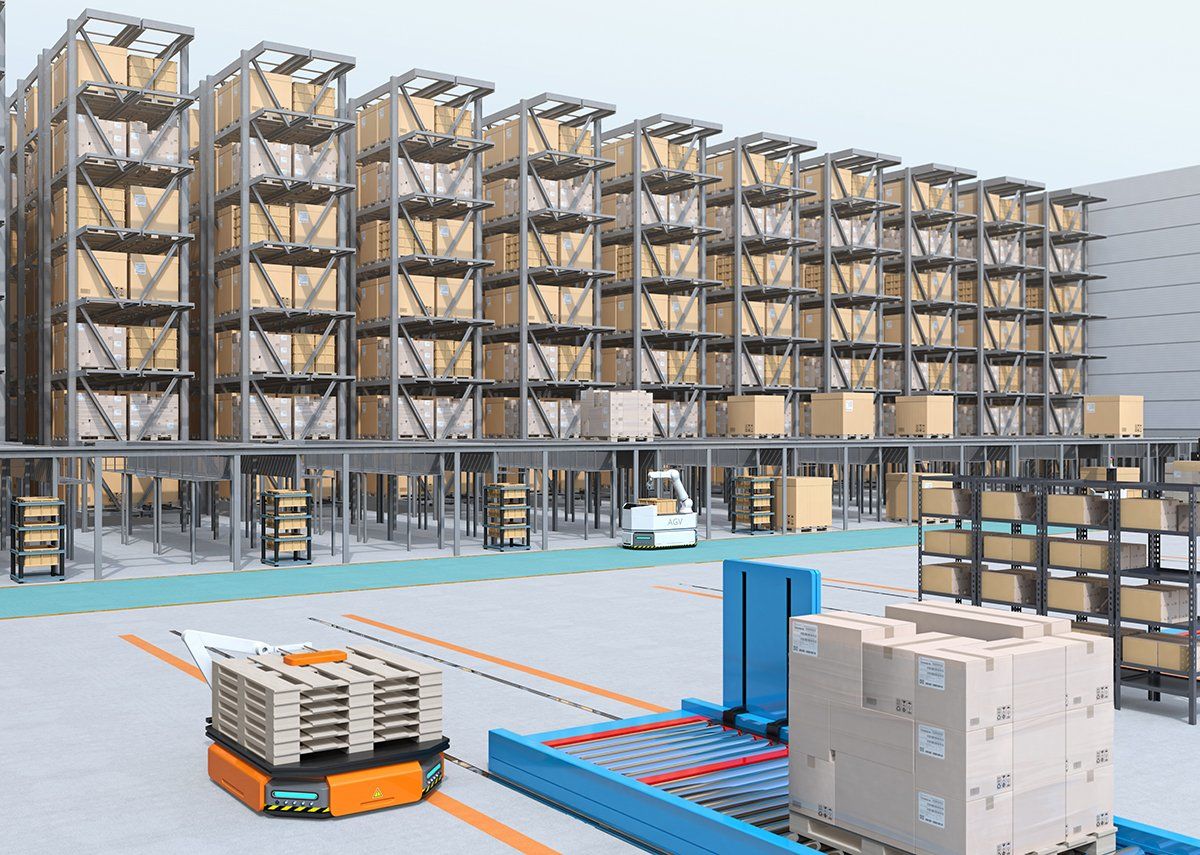
The next step is the intelligent automation of material flow, which will enable faster transport of items from warehouses to workstations and production areas. The primary goal is to intelligently integrate warehousing, retrieval, assembly, and production, thereby creating a fully automated material flow between all storage, production, and assembly areas. This is achieved through the introduction of "cellular transport systems" in the warehouse. These systems consist of swarms of autonomously operating vehicles that use laser scanners, infrared sensors, and RFID chips to independently perceive their surroundings and move autonomously to their respective destinations. Without a central control system, these vehicles negotiate incoming transport orders among themselves, establish right-of-way rules, and exchange data about their current position within the warehouse. Because each shuttle processes its information decentrally, the entire control system is distributed across many virtual units. If malfunctions occur, the swarm of vehicles reacts independently and resolves the problem.
Despite all the automation, the concept of a buffer stock must always be kept in mind. The COVID-19 pandemic has shown that in times of crisis, temporary disruptions in the supply chain must be absorbed by logistics and intralogistics.
Suitable for:
Cyber-physical systems go a step further : intelligent transport vehicles and cargo containers that communicate with each other and operate according to the principle of swarm intelligence. Central control of these systems is unnecessary, as the devices operate autonomously, assign or accept tasks, and transport goods to the required locations.
At the start of the development, which is being significantly supported by the Fraunhofer Institute , the focus was on constructing autonomously operating transport vehicles. These cellular transport systems are now being combined with intelligent transport containers (so-called smart objects ) equipped with sensors and cameras. Using their integrated 3D sensors, the devices can perceive their environment and thus react to changes in real time, for example, by avoiding other transport robots. Furthermore, the containers can constantly monitor their contents and, if necessary, independently initiate an order process. In the next step, these automated assistants will communicate to machines or even humans what should happen to them, or which process step is next.
In the future, entire swarms of these units will be able to navigate autonomously through the warehouse without requiring human intervention. One challenge – for now – is managing these numerous devices; they generate a data stream that is currently difficult to process economically, even with modern computers. However, experts at the Fraunhofer Institute are confident that the necessary computing power will be available within a few years. At that point, nothing will stand in the way of the breakthrough of Intralogistics 4.0.
Suitable for:
► Contact me or discuss with me on LinkedIn
What will be crucial for the future will be how we secure the infrastructure of our key industries!
Three areas are of particular importance here:
- Digital Intelligence (Digital Transformation, Internet Access, Industry 4.0 and Internet of Things)
- Autonomous power supply (CO2 neutrality, planning security, safety for the environment)
- Intralogistics/logistics (full automation, mobility of goods and people)
Xpert.Digital delivers you here from the Smart AUDA series
- Autonomization of energy supply
- urbanization
- Digital transformation
- Automation of processes
always new information that is updated regularly.

Keep in touch










