
Better networking of business development with logistics managers and planners (3PL & 4PL)

Available in 27 languages 📢
Prefer Xpert.Digital on GoogleⓘPublished on: November 19, 2020 / Updated on: November 21, 2020 – Author: Konrad Wolfenstein
Logistics expertise in e-commerce needs improvement – The role of logistics manager and planner has become one of the most challenging professions in the last 20 years – 5 key points to consider

Improved networking between business development, logistics managers, and planners – Image: wavebreakmedia|Shutterstock.com
Globally recorded merchandise exports increased more than 19-fold between 1960 and 2017. From 1970 to 2014, the volume of world trade rose from 0.3 trillion to 18.9 trillion US dollars.
The globalization of politics opened markets to a globalization of culture and language. The number of telephone connections on the global telephone network has increased tenfold since 1960. Alongside the telephone, new communication technologies are developing, including mobile phones, VoIP telephony, IP videoconferencing, fax machines, and the internet. Internet-based telephony enables globally networked collaboration through a cost-effective, permanent, and high-quality communication connection. Cross-border communication processes have multiplied, particularly via the internet, and the number of internet connections continues to grow exponentially.
While only a few thousand computers were connected to each other at the beginning of the 1990s, today there are well over 30 million in Germany alone. When the internet played no significant role in private use in 1990, the number of internet users had already reached 495 million by 2001. Around 2 billion people used the internet in 2010, and more than 3 billion by 2015.
In 1988, only eight countries were connected to the internet; by 1993, this number had risen to 55, and by 1995, for the first time, more than half of all countries (115) were connected. It wasn't until the beginning of this millennium that all countries were connected to the internet.
The mobility of goods and people increased to the same extent. Uninterrupted urbanization and the seamless supply of rural regions are further key aspects of the modern global era.
Suitable for:
- Smart Cities – The solution for mega-urbanization?
- Closing supply gaps in rural regions
- Last Mile Logistics – Facts you should know
In 1991, Germany exported goods worth €340.43 billion. According to preliminary figures, the value of German exports in 2019 amounted to approximately €1.33 trillion. During the same period, German imports totaled €329.23 billion in 1991 and approximately €1.1 trillion in 2019.
This immense increase is no coincidence. Besides all the factors mentioned above, e-commerce plays a particularly significant role. Sales of goods via e-commerce increased more than 70-fold between 2000 and 2019! And that doesn't even include sales through online marketplaces or digital platforms such as eBay, Zalando, or Amazon.
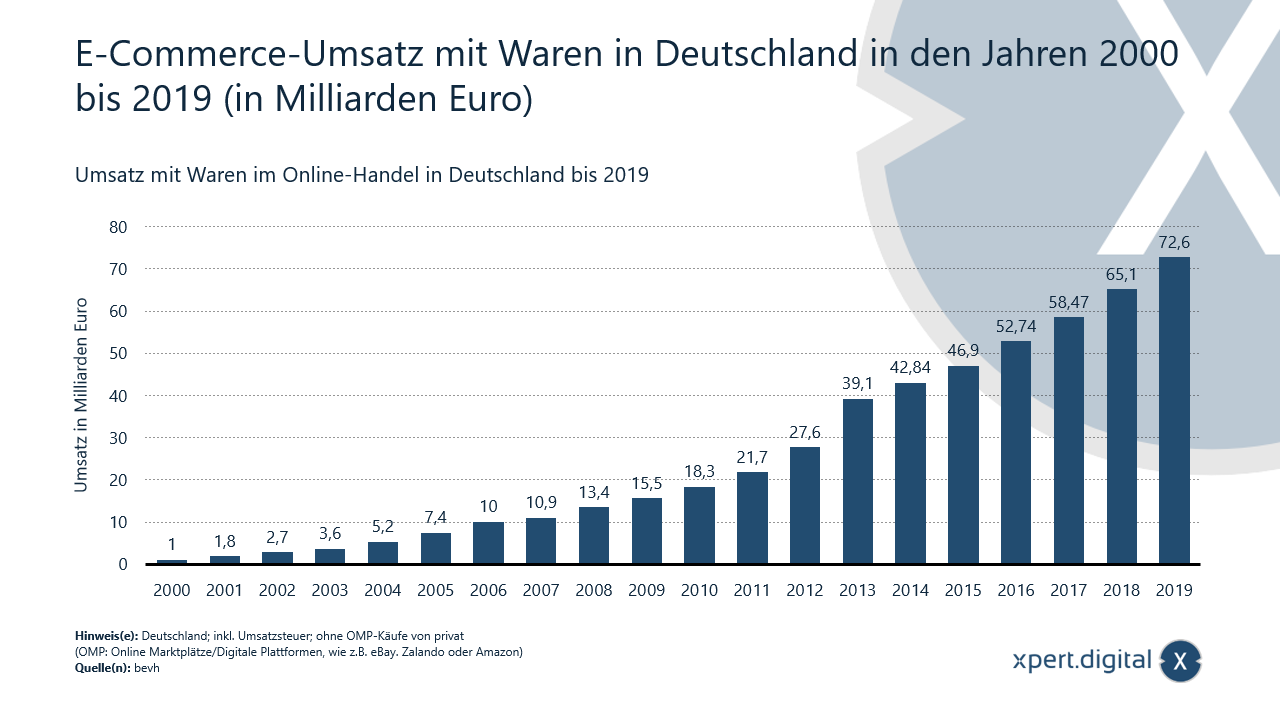
E-commerce revenue with goods in Germany – 2000 to 2019 (in billion euros) – Image: Xpert.Digital
In parallel, for comparison: At the online retailer Amazon, shipping and fulfillment costs have skyrocketed in the last ten years: Total logistics costs between 2009 and 2019 increased more than 20-fold.
Suitable for:
While Amazon is already fully committed to automation and autonomous power supply , there is still a great need for solutions and customized concepts in this country. Market demand is diametrically opposed to the experts who have a comprehensive view of global and digital issues, including logistical requirements.
Here are five important points:
1. The logistics industry's know-how in e-commerce needs to be improved.
When I switched from a leading intralogistics company in the field of warehouse logistics to the pharmaceutical industry, I encountered a completely new world despite my many years of experience in logistics and the digital sector. The complexity and interrelationships, as well as the almost daily innovations and changes, presented the greatest and most exciting challenge for me.
Logistics and e-commerce are a completely different world from what I've known before. Ideally, logistics managers should spend several months here as trainees. The insights gained are enormous for any company and irreplaceable.
Konrad Wolfenstein
2. Now: Modernization and digitalization of supply chains
The possibilities offered by digitalization are blurring the lines between the advantages of different storage methods and formats. It's no longer possible to make a blanket statement about what is more cost-effective or better. While the focus was once on organizing and implementing a smooth supply chain, the job profile has changed due to growing customer demands and expectations.
3. Green Logistics – Individual Measures Not Enough:
Environmentally friendly and resource-conserving intralogistics requires highly efficient and well-designed material handling systems. This refers not only to the energy consumption of the systems themselves, but also to the efficiency of individual components within a logistics center. When optimizing and designing logistics buildings and facilities, it is not enough to simply improve individual components. Even if logistics halls are constructed according to current energy efficiency standards, their internal structures must be included in the energy planning.
4. Autonomous power supply, simultaneously reducing CO2 emissions and achieving EU climate targets
The EU has set an ambitious goal of becoming the world's first climate-neutral continent by 2050. This involves green intralogistics, sustainability, CO2 reduction, and decarbonization. The CO2 balance, also known as the greenhouse gas balance or carbon footprint, will become increasingly important in the future, as it will be subject to tax and cost surcharges in the CO2 labeling of goods and services.
5. The logistical challenges and tasks are enormous.
The main tasks of the warehouse manager and warehouse supervisor are warehouse management, storage area, inventory management, order picking and transport, as well as the distribution of goods.
Market developments have led to the need for scalability of the warehouse and flexibility.
To a certain extent, flexibility can be compensated for through the automation of certain processes. Energy efficiency, in light of the EU's target of 100% CO2 reduction by 2050, remains a key issue.
Smart Factory is the solution that cannot be implemented without digitalization. As early as 2014, we described Smart Factory as the future of production logistics .
Suitable for:
Growth is good, but companies must be careful that the demands don't overwhelm them. Sales and business development must adapt their goals to logistical capabilities or ensure that logistics are prepared for these developments.
Smart Factory
Let's be honest, the Smart Factory is the next level, and everyone needs to work together on it. From management and business development to the warehouse manager themselves.
The EU regulations alone, which aim for CO2 reduction up to climate neutrality in combination with renewable energies, point in this direction.
Smart Factory is a term from research in the field of manufacturing technology. It is part of the German Federal Government's high-tech strategy as part of the Industry 4.0 future project. It describes the vision of a production environment in which manufacturing plants and logistics systems largely organize themselves without human intervention.
Smart Factory:
The networking of embedded production systems and dynamic business and engineering processes enables profitable manufacturing of products even for individual customer requirements, down to batch size.
Smart Logistics:
In connection with the Smart Factory, similar concepts are now being developed in areas directly related to product manufacturing. Particularly in transportation and internal logistics and material flow, systems are being developed that can move and transport materials autonomously, enabling, for example, autonomous supply of production. Communication, location, and identification technologies such as the internet, Wi-Fi, GPS, and RFID play a crucial role in this.
Smart grid:
This encompasses the communicative networking and control of power generators, storage facilities, electrical consumers, and grid equipment in energy transmission and distribution networks. This enables the optimization and monitoring of the interconnected components. The goal is to ensure energy supply based on efficient and reliable system operation.
Photovoltaics will typically be used here. Likewise, company-owned energy storage systems will ensure the smooth operation of the factory and logistics during temporary voltage drops.
How far along is your company on the path to becoming a smart factory?

How far along is your company on the path to becoming a smart factory? – Image: Xpert.Digital
Are you already pursuing smart factory initiatives?
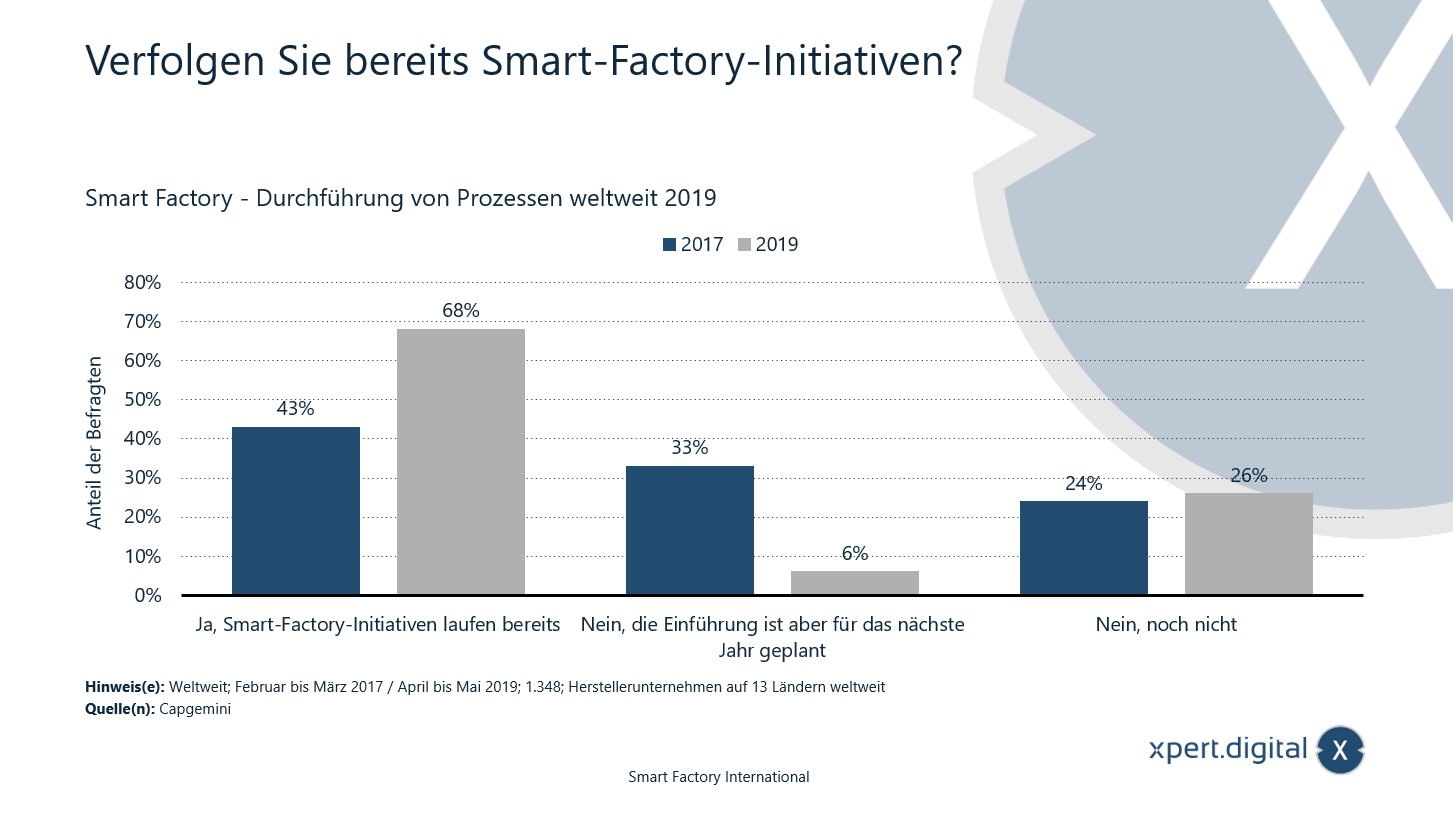
Are you already pursuing smart factory initiatives? – Image: Xpert.Digital
Have you already implemented smart factory processes in your company? (Percentage of "yes" votes by industry)
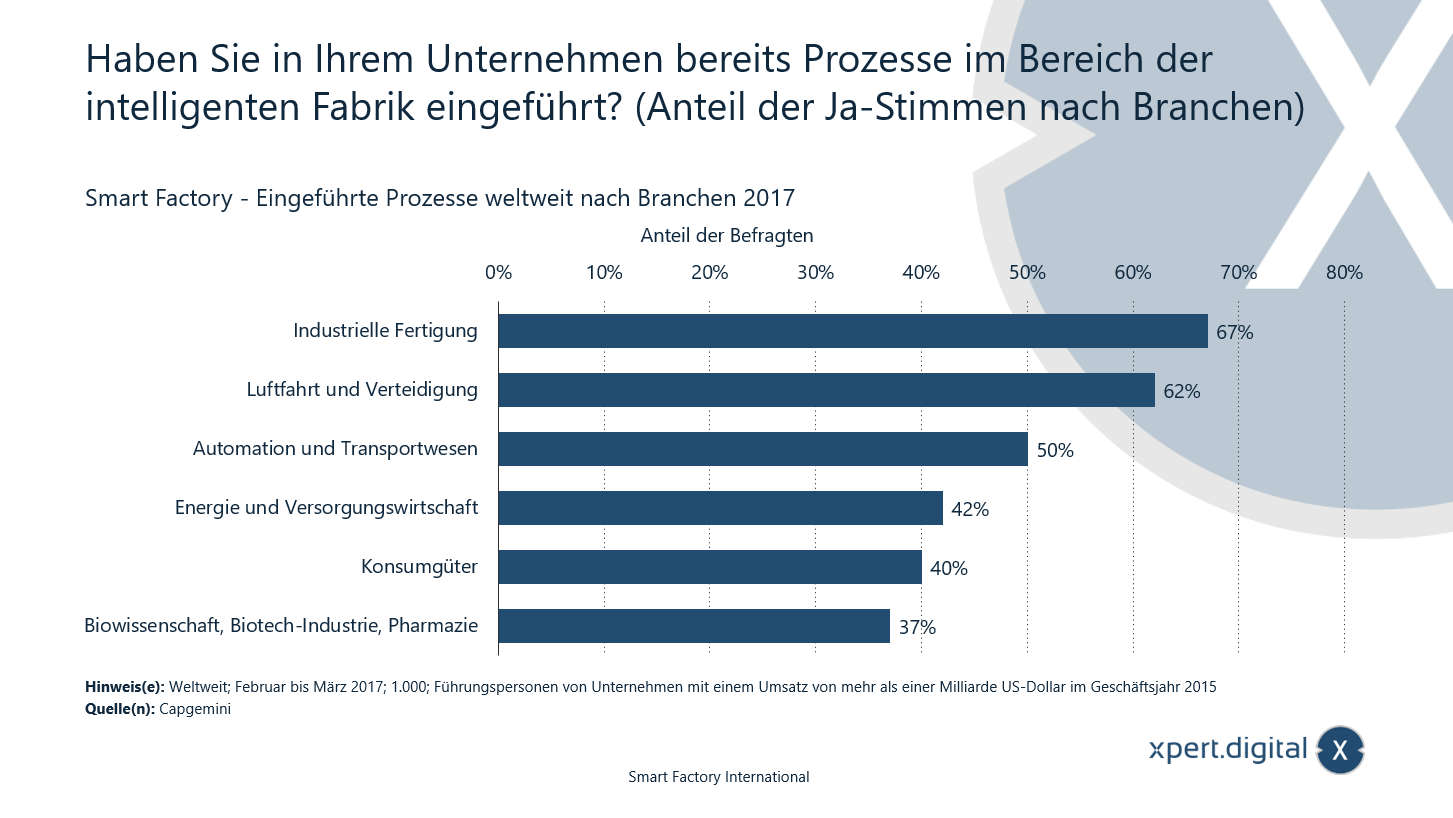
Have you already implemented smart factory processes in your company? – Image: Xpert.Digital
What are the biggest challenges in strategy planning for smart factories?
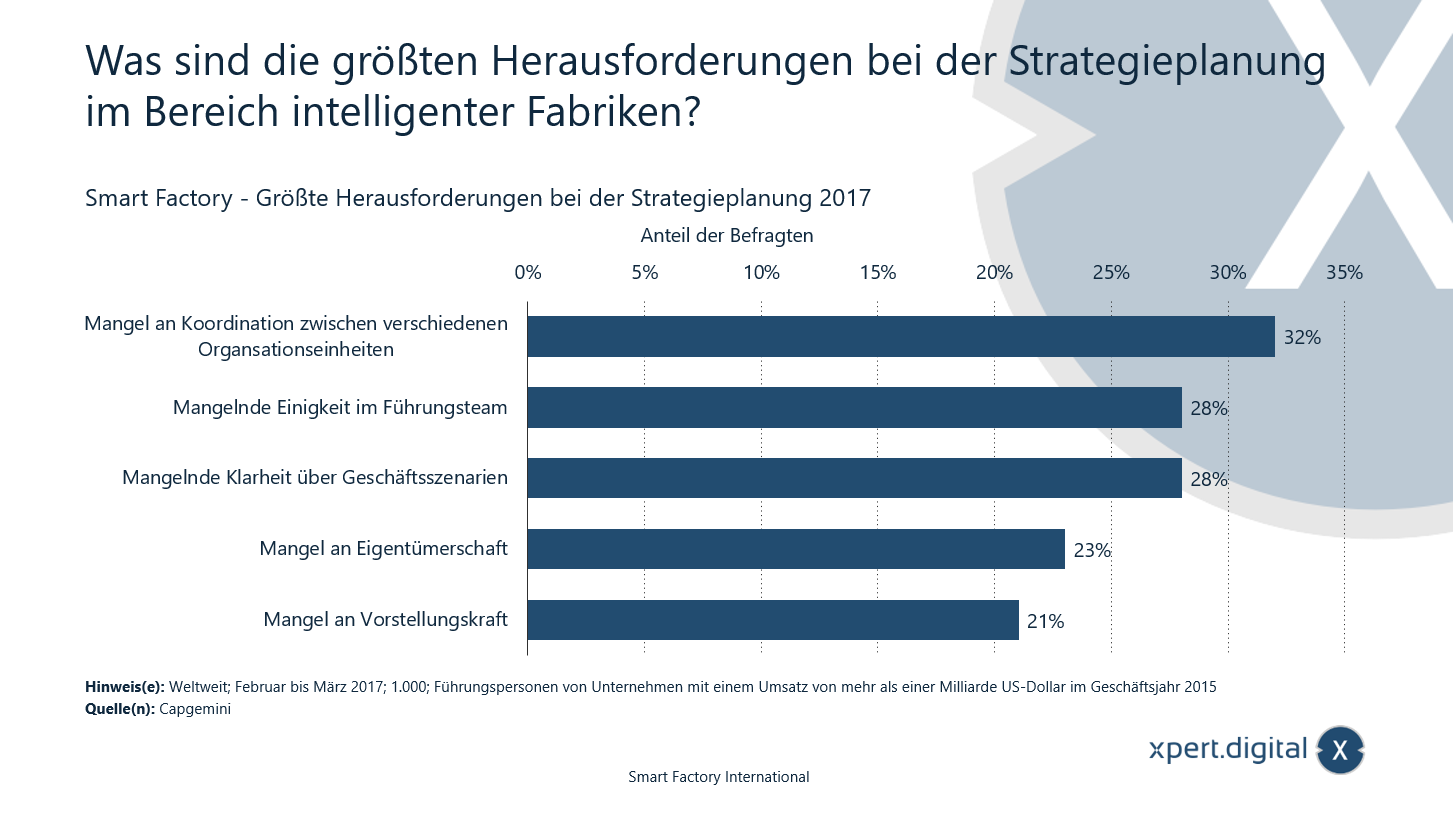
What are the biggest challenges in strategy planning for smart factories? – Image: Xpert.Digital
Further information and data can be found here:
Smart Factory – Statistics and Facts
Important note: The PDF is password protected.
Please get in contact with me. Of course, the PDF is free of charge. Important note: The PDF is password protected. Please contact me. Of course the PDF is free of charge.
German version – To see the PDF, please click on the image below.
German Version – To view the PDF, please click on the image below.

Smart Factory PDF Download
Smart factories – Statistics & Facts
Important note: The PDF is password protected.
Please get in contact with me. Of course, the PDF is free of charge. Important note: The PDF is password protected. Please contact me. Of course the PDF is free of charge.
English version – To view the PDF, please click on the image below.
English Version – To view the PDF, please click on the image below.

Smart Factories PDF Download

Xpert.Plus – Material Handling & Autonomous Power Supply (Photovoltaics) Support
► Contact me or discuss with me on LinkedIn
What will be crucial for the future will be how we secure the infrastructure of our key industries!
Three areas are of particular importance here:
- Digital Intelligence (Digital Transformation, Internet Access, Industry 4.0 and Internet of Things)
- Autonomous power supply (CO2 neutrality, planning security, safety for the environment)
- Intralogistics/logistics (full automation, mobility of goods and people)
Xpert.Digital delivers you here from the Smart AUDA series
- Autonomization of energy supply
- urbanization
- Digital transformation
- Automation of processes
always new information that is updated regularly.

Keep in touch










