
The future of intralogistics: From forklift traffic to intelligent pallet automation
Xpert Pre-Release

Available in 27 languages 📢
Prefer Xpert.Digital on GoogleⓘPublished on: October 5, 2026 / Updated on: October 5, 2026 – Author: Konrad Wolfenstein
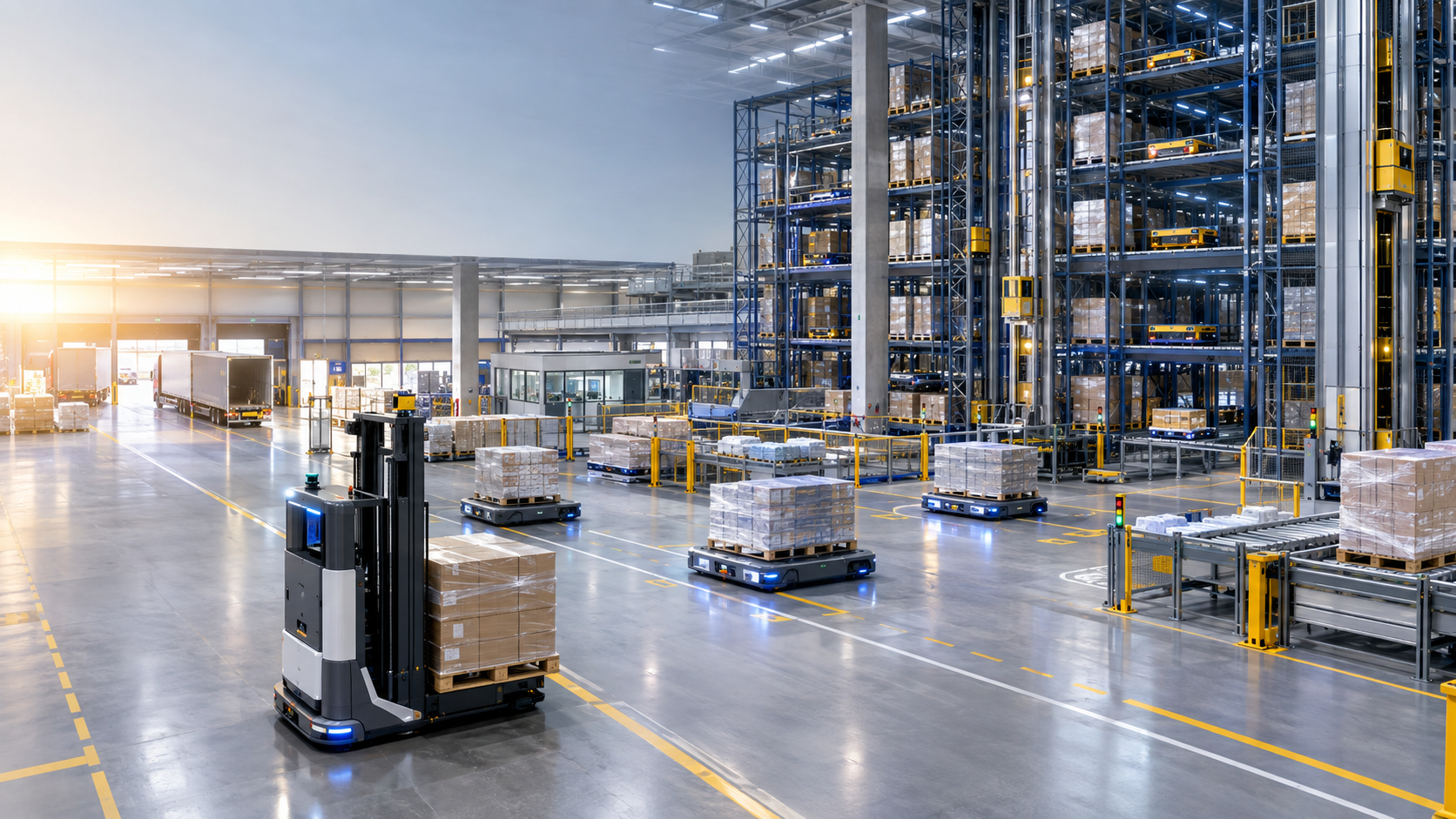
The future of intralogistics: From forklift traffic to intelligent pallet automation – creative image on the topic, with AI: Xpert.Digital
Why companies need not just machines, but entire material flow architectures
Flexibility in logistics: How companies respond to changing requirements
Robots and safety: How autonomous systems reduce risks in intralogistics
The automation of intralogistics is undergoing a crucial transformation. While in the past the focus was primarily on individual machines and clearly defined conveyor lines, today the end-to-end control of the entire material flow is taking center stage. Companies are increasingly recognizing that not only the speed and reliability of individual devices are decisive, but also the interplay of all components within an integrated system. In this context, mobile robots, such as the Sorting Transfer Robot L (SOTR-L) and the autonomous forklift SOTR-F, are gaining in importance. These technologies make it possible to design logistics processes more efficiently and adapt flexibly to changing requirements. By combining fixed and mobile automation solutions, bottlenecks can be eliminated and overall efficiency increased. The following sections will examine the various aspects of this new era of intralogistics in more detail, from the economic advantages of automated systems to the challenges associated with the implementation and integration of new technologies.
From forklift traffic to the autonomous pallet network
Moving pallets in isolation does not automate logistics, but only its bottlenecks
The automation of intralogistics is entering a new phase. For many years, investments focused primarily on individual machines, clearly defined conveyor lines, or automated storage blocks. Today, the economic focus is shifting to the end-to-end control of the entire material flow. The crucial factor is no longer solely how quickly a storage and retrieval machine can store a pallet or how reliably an automated guided vehicle (AGV) can cover a distance. The decisive factor is whether transport, sorting, buffering, and storage function as a cohesive system and can adapt to changing quantities, products, and building layouts.
Three pallet solutions from Daifuku illustrate this transformation: The Sorting Transfer Robot L, or SOTR-L for short, handles the automated sorting and transport of pallets. The SOTR-F combines the functionality of a forklift with the autonomous navigation of a mobile robot. The Shuttle Rack LX organizes high-density storage with four-way moving pallet shuttles. Each technology, on its own, covers a distinct process. The combination becomes economically attractive because it can bridge the gaps between goods receiving, production supply, warehousing, order picking, and shipping.
This also changes the investment logic. Instead of designing rigid conveyor technology for a long-term projected maximum load, companies can combine fixed and mobile automation more effectively. High-density storage handles predictable, high-volume core processes. Mobile robots process variable transport and sorting tasks. An autonomous forklift accesses transfer points that would be difficult to reach with ground-level transport robots or conventional conveyors. The central question, therefore, is not which device is the most efficient, but rather which architecture generates the greatest overall benefit over the entire lifecycle.
Three systems, one material flow
The technical principle is based on division of labor. The SOTR-L is designed for heavy load carriers and flexible horizontal pallet flow. It can move loads of up to 1,000 kilograms and replaces fixed conveyors or rail-guided systems where variable paths, sorting decisions, and changing transfer points are prevalent. Its economic value lies less in a spectacular single movement than in its ability to streamline pallet flows without extensive mechanical infrastructure. If layouts, shipping zones, or production lines are changed, the fleet can be adapted via software and expanded with additional vehicles as needed.
The SOTR-F takes on a different role. As a compact forklift AMR, it can pick up pallets directly from the floor and transfer them to conveyors and transfer stations. Its minimal turning radius of approximately one meter is ideal for existing buildings that lack wide aisles or ample maneuvering space. It has a rated load of one ton. Navigation is based on the SLAM principle, where the vehicle determines its position while simultaneously using and updating a map of its surroundings. This eliminates the need for magnetic tracks or floor markings for guidance. Automated loading enables largely continuous operation.
The Shuttle Rack LX forms the storage density level. Four-directional shuttle vehicles move pallets within multi-deep racking channels, while lifts handle level changes. The system is designed for loads up to 1,500 kilograms. Depending on the configuration, the shuttle vehicles can travel at speeds of up to 100 meters per minute, and the maximum lifting height of the lifts is 20 meters. Operation down to minus 25 degrees Celsius is planned for deep-freeze applications. Crucially, the interplay between the systems is key: The SOTR-F accesses ground-level sources and sinks, the SOTR-L sorts and distributes, and the Shuttle Rack LX provides compact storage. Thus, three machine classes combine to create a seamless pallet architecture.
The end of conveyor technology is not in sight
New robotics does not make traditional conveyor technology obsolete. Roller conveyors, chain conveyors, and stacker cranes remain economically superior when large quantities are moved along stable, repetitive routes at high cycle rates. A permanently installed system can achieve high throughput with comparatively low variable costs on a clearly defined route. Its weakness only becomes apparent when material flows change frequently, new transfer points are added, or a building needs to be modified while operations continue.
Mobile systems are therefore not a blanket replacement technology, but rather a tool for reducing structural rigidity. Their strength lies in the flexible allocation of vehicles to tasks. During an early shift, a larger portion of the fleet can handle incoming goods, later support production supply, and in the evening expedite shipping. A fixed-route system does not offer this multi-purpose capability. However, with a constant throughput, it is often energy-efficient, mechanically robust, and offers predictable costs. The most economically compelling solution is therefore usually a hybrid approach.
An integrated concept can separate tasks according to their volatility. High, stable volumes are consolidated in an automated storage and conveying system. Fluctuating or frequently changing volumes are handled by automated material handling systems (AMRs). This division is particularly valuable when the warehouse is not built from scratch but must be integrated into an existing factory or established distribution center. In such cases, structural modifications are expensive, operational disruptions are risky, and traffic areas are scarce.
The provocative thesis of the conveyor belt's demise is therefore too simplistic. What is actually ending is the era in which a company subordinates its entire process logic to a single transport technology. Competitive advantages arise from the intelligent combination of fixed, high-performance axles, mobile distributors, automated forklifts, and high-density storage cells. It's not the machine that wins, but the architecture.
Labor shortage becomes a capital argument
The economic dynamics behind mobile robotics are not solely driven by technology. According to data from the International Federation of Robotics, approximately 102,900 professional service robots for transport and logistics were sold worldwide in 2024. This represented a 14 percent increase compared to the previous year. Around 81,800 units were mobile robots for intralogistics applications. Transport and logistics thus accounted for more than half of the recorded market for professional service robotics. However, this statistic is based on a sample of 294 suppliers and is not a complete projection of the global market. Nevertheless, it clearly illustrates where investments are flowing.
The key driver is the availability of personnel. Warehouses and factories need not only a sufficient number of employees, but also those available during off-peak hours, peak periods, and sometimes under challenging conditions. Particularly demanding are monotonous journeys, heavy loads, shift work, and work in refrigerated or deep-freeze areas. Even with rising wages, the staffing problem cannot be solved everywhere simply through higher pay. Demographics, regional labor markets, and skills shortages structurally limit the supply.
Automation doesn't simply replace a certain number of employees. It changes staffing needs. Repetitive transport tasks are transferred to the machine, while monitoring, troubleshooting, quality control, maintenance, and process optimization become more important. The economic effect therefore consists of several components: less unproductive travel time, greater operational stability, reduced dependence on short-term staffing, and better performance planning.
This difference is crucial for investment calculations. Anyone who only compares current labor costs with the purchase price of a robot underestimates the benefits. Overtime, bonuses, employee turnover, training, temporary workers, unfilled shifts, and production losses due to a lack of drivers must also be considered. The labor shortage thus becomes a key financial argument: companies are investing not only to reduce costs but also to ensure their ability to deliver.
Area efficiency becomes a balance sheet factor
In many logistics regions, space is scarce and expensive. High land prices, lengthy permitting processes, and land-use conflicts hinder expansion. At the same time, the number of product variants is growing, safety stock levels are being reassessed based on geopolitical and pandemic-related experiences, and customers expect short delivery times. This increases the pressure to accommodate more inventory and higher throughput in existing buildings.
The Shuttle Rack LX addresses precisely this issue. Multi-deep storage channels and small traffic areas increase volumetric density. Conventional forklift truck warehouses require wide aisles to allow vehicles to maneuver, position loads, and pass each other safely. In a shuttle structure, compact vehicles handle movement within the rack. Lifts connect the levels, while storage and retrieval points are concentrated at defined interfaces. The area in front of the warehouse can then be flexibly accessed by mobile robots.
Economically, densification has three effects. First, the space required per pallet space decreases. Second, building expansion can be avoided or postponed. Third, internal routes are shortened, provided the material flows are efficiently organized. The value of an additional pallet space therefore extends beyond simply avoiding rent. It also includes the debt service of a new building, development costs, energy, insurance, maintenance, and the risk of inaccurate forecasts.
However, high density comes at a price. Multi-deep storage reduces direct access to each individual pallet. It works particularly well with larger stock levels per item, suitable batch structures, and an intelligent storage strategy. For an extremely broad product range with very small stock levels, a less dense but more selective solution can be advantageous. Therefore, storage density should not be maximized in isolation. The crucial factor is the balance between volume, access frequency, product structure, and turnover.
Four-way shuttle systems expand this flexibility because vehicles don't just operate in a fixed aisle. However, software cannot completely compensate for an unsuitable inventory structure. Therefore, an economically viable concept begins with order, inventory, and movement data, not with the selection of a specific rack.
Flexibility comes at a measurable price
Flexibility is often used as a generally positive term in automation projects. However, for a sound investment decision, it must be translated into concrete economic effects. A mobile system is valuable when adjustments are actually expected and the costs of these changes would be high with a rigid alternative. This includes new production lines, altered shipping zones, seasonal fluctuations, changing customer contracts, or an expanding product range.
The SOTR-L can expand fleet capacity incrementally without requiring a complete overhaul of the conveyor system for each additional unit. The SOTR-F can unlock new routes using digital mapping, provided the safety concept, floor quality, and transfer points are suitable. Similarly, the Shuttle Rack LX allows the number and distribution of shuttles, as well as the design of lifts and rack channels, to be adapted to varying performance requirements. This modularity reduces the risk of paying on day one for peak demand that isn't expected for years to come.
At the same time, flexibility comes at a price. Mobile robots require traffic areas, charging infrastructure, radio coverage, fleet management, and a precise set of rules for priorities. As the number of vehicles increases, intersections, bottlenecks, and transfer stations can become limiting factors. Doubling the fleet, therefore, does not automatically lead to a doubling of throughput. Beyond a certain point, congestion and coordination losses increase more than the additional transport capacity.
The correct metric is therefore not the number of vehicles, but the system performance per euro invested and per square meter occupied. This includes throughput, availability, response time, maintenance costs, and the ability to handle peak demand. Flexibility has an option value: The company pays today for the ability to react tomorrow without major restructuring. This option value is particularly high in industries with uncertain growth, frequent product changes, or short-term customer contracts. For processes that have remained stable for decades, however, a more permanently installed solution may be more cost-effective.
The business case is decided within the overall system
A sound cost-benefit analysis cannot stop at the acquisition costs. The total operating costs over the planned service life are relevant. These include hardware, racking systems, lifts, chargers, safety equipment, software, interfaces, project planning, installation, training, maintenance, spare parts, energy, insurance, and subsequent modifications. Transition costs during commissioning must also be considered, as old and new processes must be operated in parallel for a period of time.
On the benefits side, these include saved or avoided working hours, lower error rates, less product and building damage, higher inventory density, additional capacity, more predictable lead times, and a potential extension of operating hours. Another factor is the avoided loss of revenue. If a company cannot accept orders due to insufficient capacity, staff shortages, or slow shipping, additional throughput has a direct impact on its bottom line.
Payback period alone is not a sufficient metric. A project with a short payback period can still be strategically weak if it is inflexible or generates high default risks. Conversely, a longer payback period can be justifiable if the plant prevents costly expansion and delivers stable performance over many years. Therefore, it is advisable to analyze several scenarios, including net present value, internal rate of return, and sensitivities to wages, production volumes, energy prices, and capital costs.
Considering the boundaries is particularly important. The first vehicle in a fleet often requires a disproportionately high investment in software, security, and integration. Additional vehicles can then be added to capacity relatively cheaply. The curve is different for warehouse technology: racking, lifts, and building modifications result in high initial investments, while additional shuttle vehicles within the existing structure can increase throughput. Combining both principles allows for a phased investment approach.
The business case is therefore not a product comparison, but a system analysis. Anyone who simply compares the price of an AMR with the wages of a forklift driver overlooks most of the economic impact. Equally misleading is equating maximum technical performance with the actual daily average. What matters is the throughput under realistic peaks, disruptions, loading cycles, and order patterns.

Expert partner in warehouse planning and construction
Security concepts for autonomous logistics systems
Software becomes the actual bottleneck control system
The more autonomous vehicles and automated warehouse components work together, the more value creation shifts to the control software. A single robot can operate reliably from a technical standpoint but still generate low productivity within the overall system if orders are incorrectly prioritized, transfer points are blocked, or buffers are inadequately sized. Therefore, the central intelligence must not only calculate routes but also optimize the material flow as a whole.
The warehouse management system determines which pallet is stored where and when it is needed. A warehouse control system coordinates the technical execution. Fleet management distributes transport orders among available vehicles, takes battery levels into account, and prevents conflicts. Production and order data provide the priorities. Only when these levels work seamlessly together can a pallet move from goods receipt through storage or production to shipping without manual intervention.
Orchestration is particularly challenging when disruptions occur. If a shuttle fails, alternative routes or vehicles must be available. If a transfer point is occupied, the arriving AMR must not block the main traffic route. If a production batch is delayed, upstream pallets may need to be reordered or buffered. The economic value of the software therefore lies in its ability to manage deviations, not just to model the ideal process.
Data quality becomes a key production factor. Incorrect dimensions, unclear pallet conditions, delayed bookings, or non-standardized load carriers create physical problems that cannot be digitally optimized away. A damaged pallet can impair sensors, fork attachment, and transfer technology. Therefore, companies must treat master data, pallet quality, and process discipline as integral parts of their automation projects.
Manufacturer loyalty is also gaining importance. The more integrated vehicles, warehouse technology, and control systems are, the higher the switching costs can be. Open interfaces, documented data models, and clear regulations for accessing operational data are therefore economically relevant. The best mechanical system loses its strategic value if expansions are only possible with disproportionate effort.
Security is transformed from a cost center into a productivity factor
Pallet handling is among the riskiest areas of intralogistics. Heavy loads, limited visibility, crossings between people and vehicles, and time pressure create a problematic combination. Conventional forklifts are flexible, but require qualified drivers and sufficient traffic space. Accidents not only cause personal injury, but also business interruptions, investigations, repairs, insurance claims, and reputational damage.
Autonomous systems can reduce risks if properly planned. Sensors detect obstacles, speeds can be limited depending on the zone, and travel paths are followed consistently. The SOTR-F is designed to be so compact that sight lines in the work area are obstructed as little as possible. The SOTR-L reduces the need for manual forklift traffic for recurring pallet transport. In the shuttle warehouse, pallets move within a shielded, automated area where no regular human traffic is required.
Safety and productivity are not mutually exclusive. A clearly structured traffic model reduces braking, blockages, and improvised evasive maneuvers. Better spatial and temporal separation of people and vehicles improves predictability. At the same time, safety assumptions must not be overly optimistic. AMRs often operate in mixed-use areas where people, manual forklifts, and other machinery are present. Obscured transitions, open gates, or poorly placed buffers can remain problematic even with modern sensors.
The economic evaluation should therefore include safety costs and benefits. This includes safety fences, scanners, emergency stop systems, fire protection, evacuation routes, and recurring inspections. Benefits include avoided damage, a lower probability of accidents, and fewer downtimes due to malfunctions. A system that theoretically travels very fast but has to brake frequently due to constant pedestrian crossings is poorly designed. Good safety is primarily achieved through the layout and only secondarily through sensors.
Frozen food logistics exacerbates the problem
Automated pallet logistics offers particularly high economic potential in refrigerated and deep-freeze warehouses. Working at very low temperatures is physically demanding, staffing is more difficult to recruit, and time spent in the warehouse is limited. At the same time, every additional storage volume incurs ongoing refrigeration costs. High storage density and low personnel movement therefore directly impact personnel and energy costs.
The Shuttle Rack LX is available in a refrigerated version suitable for temperatures as low as -25 degrees Celsius. This allows for storage in a compact, largely enclosed area. Mobile robots or conveyor systems transfer pallets at defined stations, eliminating the need for forklifts to continuously drive deep into the refrigerated zone. Narrower aisles and improved use of building height reduce the volume of refrigerated goods required per pallet space.
The energy impact is complex, however. Automation itself requires electricity and generates heat, which must be dissipated in a deep-freeze environment. Therefore, lightweight vehicles, efficient drive systems, intelligent charging, and coordinated building technology are crucial. Door openings, airlocks, loading zones, and maintenance access points also influence consumption. A high-density system is not automatically efficient if its transfer points are poorly insulated or processes are frequently interrupted.
This combination is particularly economically attractive with high inventory levels, sufficient throughput, and consistently stable long-term usage. Expensive full automation for small quantities can tie up capital without generating sufficient labor or space savings. In contrast, simply shifting recurring transport from frozen goods storage to an automated process can yield significant benefits. Besides direct costs, the reduction of ergonomic strain is also a key factor.
Frozen food logistics clearly demonstrates why a systems approach is superior. Storage density, transport, transfer technology, building envelope, and energy supply must be planned together. An isolated robot cannot solve the problem. An integrated architecture, on the other hand, can optimize space, work, and energy simultaneously.
Resilience arises from distributed effort
Traditional high-performance systems achieve impressive throughputs but can be vulnerable to central failures. If a single main conveyor, lift, or stacker crane stops working, a large area of the system can be affected. Mobile fleets and multiple independently operating shuttles distribute the workload across numerous units. If one vehicle fails, others can partially take over its tasks.
This redundancy has real economic value. It reduces the risk of a complete shutdown and allows maintenance of individual units while operations continue. With the Shuttle Rack LX, several vehicles operate in parallel. The SOTR-L is scalable as a fleet system, so a single maintenance task does not necessarily stop the entire pallet flow. The SOTR-F can also be used in multi-vehicle configurations, provided the transfer points and traffic routes are adequately sized.
Redundancy, however, should not be confused with invulnerability. Common dependencies remain. A failure of the central control system, the wireless network, the power supply, or a critical elevator can still affect large parts of the system. Cyberattacks or faulty software updates can also affect distributed hardware simultaneously. Resilience therefore requires backup strategies at multiple levels.
This includes redundant servers, secure networks, local security features, spare parts, trained maintenance personnel, and defined emergency procedures. A particularly important question is which tasks can be continued manually during a prolonged outage. A complete return to manual operation is usually impossible in highly automated warehouses. Therefore, alternative picking points, controlled restart procedures, and a clear prioritization of critical goods are all the more important.
Economically, resilience can be assessed as avoided anticipated damage. The probability of a failure occurring is multiplied by the potential costs of production downtime, delivery delays, and spoilage. This value can be substantial, especially in food, pharmaceutical, or just-in-time production chains. Distributed robotics improves the situation when it creates not just additional components, but truly independent performance pathways.
The factory benefits differently than the distribution center
In a distribution center, storage, replenishment, order picking, sorting, and shipping are the dominant processes. Volumes often fluctuate depending on the time of day, day of the week, or season. The SOTR-L can sort pallets according to their destination and move them between storage, buffers, and shipping. The SOTR-F is suitable for handling pallets placed near the floor and for transferring them to conveyors and loading points. The Shuttle Rack LX keeps inventory compact and makes it available as needed.
In a factory, the focus is different. Here, raw materials, components, semi-finished goods, and finished products must flow between receiving, storage, and production stages. Production interruptions are costly, which is why on-time delivery can be more important than simply maximizing warehouse throughput. Mobile robots can deliver materials to lines as needed and return empty pallets or finished goods. An automated pallet warehouse serves as a buffer between processes with different cycle times.
The economic priorities differ accordingly. In the distribution center, order processing time, shipping windows, space utilization, and seasonal scaling are paramount. In the factory, line availability, inventory control, and synchronization with the production plan are key. Therefore, an identical technical system can be configured differently.
The combination of these two worlds in integrated locations is particularly interesting. A company can automatically store incoming materials, then deliver them to production as needed, buffer intermediate products, and send finished pallets directly to shipping. This reduces the number of manual transfers. At the same time, inventory becomes more transparent because every movement is digitally initiated and confirmed.
The prerequisite is sound process standardization. Production areas change frequently, machines are added, and pathways are temporarily blocked. Mobile systems offer advantages here, but require reliable floor space, defined transfer points, and disciplined parking regulations. Using traffic areas as arbitrary temporary storage areas negates the benefits of autonomous navigation. Therefore, technology and operational organization must be developed jointly.
Existing buildings are becoming the most important market
Most future automation will not take place in ideally planned new buildings. Many companies will have to modernize existing warehouses, factories, and cold storage facilities. In these buildings, column grids, ceiling heights, fire compartments, floor qualities, and traffic routes are already predetermined. Completely rigid automation under these conditions can be very expensive or practically impossible.
The compact SOTR-F addresses precisely this problem. A turning radius of approximately one meter expands its use in confined spaces. Because navigation requires no permanently installed magnetic guides, structural modifications are reduced. The SOTR-L can transport and sort pallets along variable routes without requiring a comprehensive conveyor network. The Shuttle Rack LX can be adapted to different building shapes through the combination of rack channels, main and secondary routes, and lifts.
Nevertheless, retrofitting is more demanding than new construction. Floors must meet load-bearing capacity and flatness tolerances, wireless connections must not be destabilized by shelving or building structures, and ongoing operations must be disrupted only to a limited extent. Transfer stations often have to be integrated into existing processes whose data quality and timing are not designed for automation.
A phased rollout is therefore often economically sensible. Initially, a clearly defined transport corridor can be automated. This is followed by the automation of additional routes, vehicles, and storage areas. This generates real-world operational data before large capacities are tied up. At the same time, the pilot phase must not end as an isolated, standalone solution. Interfaces and the security concept should be designed for scalability from the outset.
Existing buildings increase the value of flexible technology, but also the planning requirements. Eliminating mechanical guidance does not mean that infrastructure is unnecessary. Charging points, networks, markings, safety zones, and transfer points remain essential. The economic advantage lies in using this infrastructure in a more targeted and adaptable way.
The competition is shifting towards integration
The market for mobile logistics robots is growing, and with it, the number of suppliers. Price competition is intensifying, especially for smaller AMRs. Hardware components such as sensors, drives, batteries, and computers are becoming more powerful and widespread. This threatens a degree of standardization for individual vehicle types in the long term. Differentiation will then arise less from the mere presence of a robot than from its integration into complex material flows.
Daifuku's approach with SOTR-L, SOTR-F, and Shuttle Rack LX demonstrates a strategic response to this development. The offering combines mobile robotics with classic warehouse automation and transfer technology. For customers, an integrated provider can reduce interface risks because mechanics, control, and service all originate from a coordinated architecture. At the same time, however, dependence on this ecosystem increases.
In this competitive landscape, four capabilities are therefore becoming increasingly important. First, a provider must be able to reliably industrialize and globally maintain hardware. Second, they need software expertise for fleets, warehouses, and data integration. Third, they must be able to manage existing buildings and heterogeneous processes. Fourth, they require industry knowledge because the food, automotive, retail, and pharmaceutical industries have different requirements regarding pallets, batches, hygiene, temperature, and traceability.
For the customer, this means that a low vehicle price alone is not very informative. An inexpensive fleet can become costly if integration, availability, or spare parts supply are poor. Conversely, an established overall system does not justify an arbitrary price premium. What matters are demonstrable performance, contractually guaranteed availability, expandability, and transparent lifecycle costs.
Competition is thus shifting from the machine itself to orchestration. Companies that only sell vehicles will face greater price pressure. Those who control the material flow can capture a larger share of the added value. Operators face the challenge of leveraging integration advantages without unnecessarily committing themselves technically and commercially.
Limits of the autonomous pallet world
Despite its great potential, not every process is suitable for mobile pallet robotics. Uneven floors, damaged pallets, loose film, protruding loads, or widely varying dimensions make reliable operation difficult. High levels of contamination, humidity, or extreme temperature fluctuations can also strain sensors and mechanics. Therefore, load carriers, packaging quality, and environmental conditions must be standardized before automation.
Another limitation is throughput. Mobile robots share traffic areas. For very high, constant volumes, fixed conveyors or conventional storage and retrieval systems can be more efficient. Congestion occurs not only on the paths themselves, but especially at transfer points. If a lift, a control station, or a shipping gate limits performance, additional vehicles offer little benefit.
The organizational complexity is also frequently underestimated. Employees must learn to work with autonomous vehicles, keep lanes clear, and handle malfunctions correctly. Maintenance personnel need expertise in mechanics, electrical systems, networks, and software. Without clear responsibilities, minor problems can cause lengthy downtimes.
Financially, there is a risk of overestimating growth. Modularity reduces this risk, but does not eliminate it. Shelving, lifts, fire protection, and building modifications remain long-term investments. An operator should therefore assess how the system performs at lower volumes and whether components can be used for other purposes.
Ultimately, automation must not perpetuate flawed process logic. Unnecessary transport doesn't become valuable simply because a robot handles it. Before technical planning begins, material flows should be simplified, inventory levels reviewed, and transfers reduced. The greatest economic gains often arise from combining process optimization and automation. Simply digitizing manual waste results in a precise, but still wasteful, system.
Three products become a strategic platform
The true significance of these three pallet solutions lies not in their individual specifications, but in the concept of a modular operating system for physical goods flows. The Shuttle Rack LX creates a dense and efficient storage system. The SOTR-L flexibly distributes pallets between functional areas. The SOTR-F connects floor storage locations, transfer stations, conveyor technology, and automated storage systems. Together, they can cover a significant portion of the transport chain from goods receipt to shipping.
Economically, this shifts the focus from maximum individual output to adaptable overall output. Companies can deploy fixed technology where volumes are stable and high, and mobile technology where uncertainty and change prevail. This division of labor reduces overinvestment without sacrificing automation. It also creates the possibility of expanding capacity gradually.
The concept offers the strongest prospects in existing buildings, where there is a shortage of labor, high space costs, and fluctuating material flows. It is particularly attractive in production sites, distribution centers, and temperature-controlled warehouses where manual pallet handling is expensive, burdensome, or risky. However, complex, full integration is less convincing for low volumes, unstable processes, or insufficiently standardized load carriers.
The strategic decision should therefore begin with process data. This requires movement profiles by hour and day, inventory structures, peak loads, pallet quality, travel distances, disruption data, and realistic growth assumptions. Based on this information, it can be determined what proportion of the system should be fixed, mobile, or remain manual.
The future of pallet logistics is neither entirely rigid nor entirely free-floating. It is hybrid, data-driven, and modular. Planning the three levels of transport, sorting, and storage together allows for more productive use of personnel, space, and capital. Conversely, procuring each machine in isolation risks creating new interfaces and automated bottlenecks. The crucial advancement, therefore, does not lie in robots moving pallets. It lies in thinking of the entire pallet flow as a dynamic economic system.
Your intralogistics experts
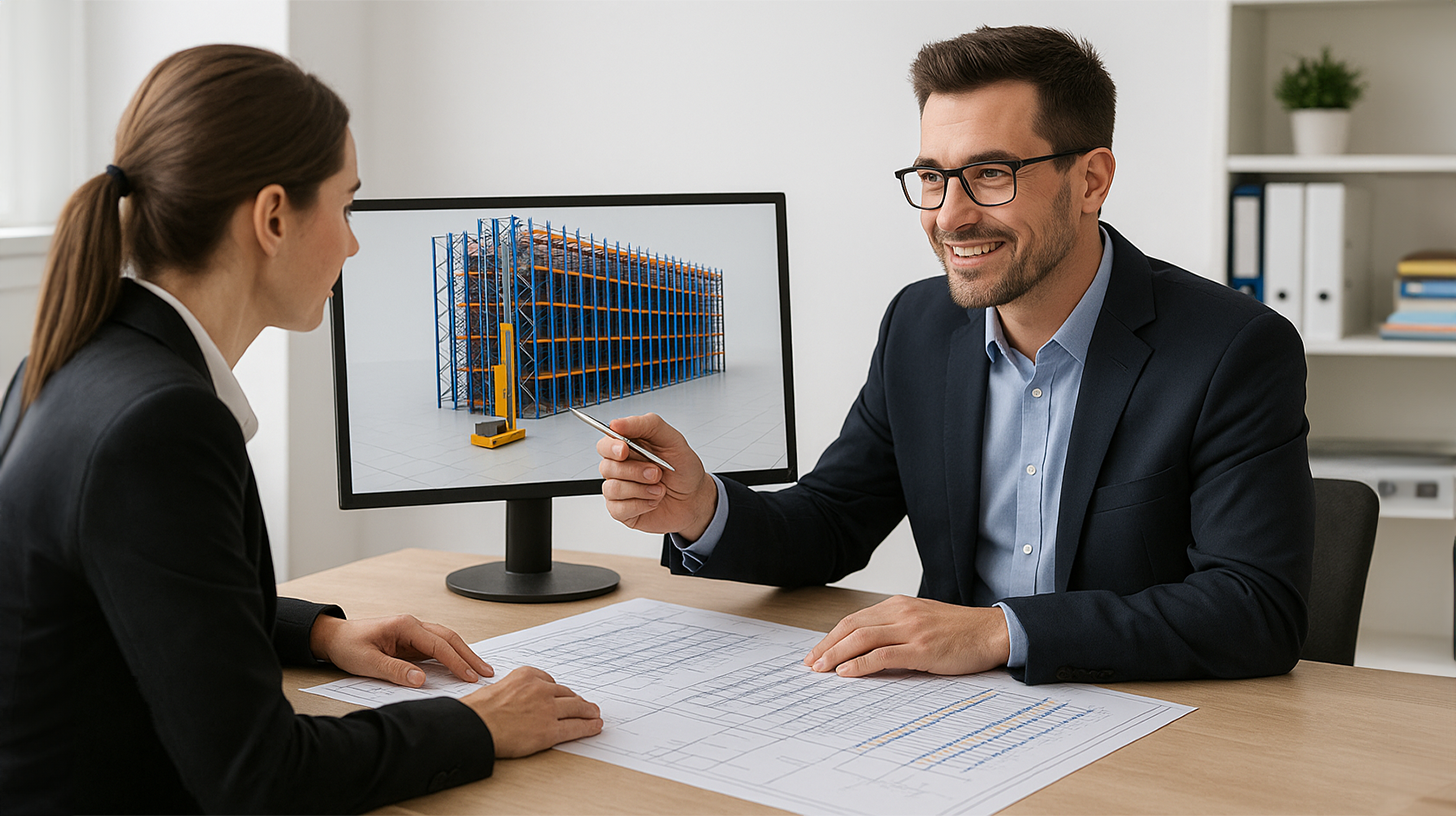
Consulting, planning and implementation of complete solutions for high-bay warehouses and automated storage systems - Image: Xpert.Digital
More information here:
Your global marketing and business development partner
☑️ Our business language is English or German
☑️ NEW: Correspondence in your native language!

Konrad Wolfenstein
I and my team are happy to be available to you as your personal advisor.
You can contact me by filling out the contact form here [email protected]:or simply call me at +49 7348 4088 965. My email address is
I'm looking forward to our joint project.
☑️ SME support in strategy, consulting, planning and implementation
☑️ Creation or realignment of the digital strategy and digitization
☑️ Expansion and optimization of international sales processes
☑️ Global & Digital B2B trading platforms
☑️ Pioneer Business Development / Marketing / PR / Trade Fairs
Our global industry and economic expertise in business development, sales and marketing

Our global industry and economic expertise in business development, sales and marketing - Image: Xpert.Digital
Industry focus areas: B2B, digitalization (from AI to XR), mechanical engineering, logistics, renewable energies and industry
More information here:
A thematic hub offering insights and expertise:
- Knowledge platform covering global and regional economies, innovation and industry-specific trends
- A collection of analyses, insights, and background information from our key areas of focus
- A place for expertise and information on current developments in business and technology
- A hub for companies seeking information on markets, digitalization, and industry innovations










