
More storage space isn't always better: Cheap pallet racking, expensive consequences? These ten manufacturers are shaping the market
Xpert Pre-Release

Available in 27 languages 📢
Prefer Xpert.Digital on GoogleⓘPublished on: October 23, 2026 / Updated on: October 23, 2026 – Author: Konrad Wolfenstein
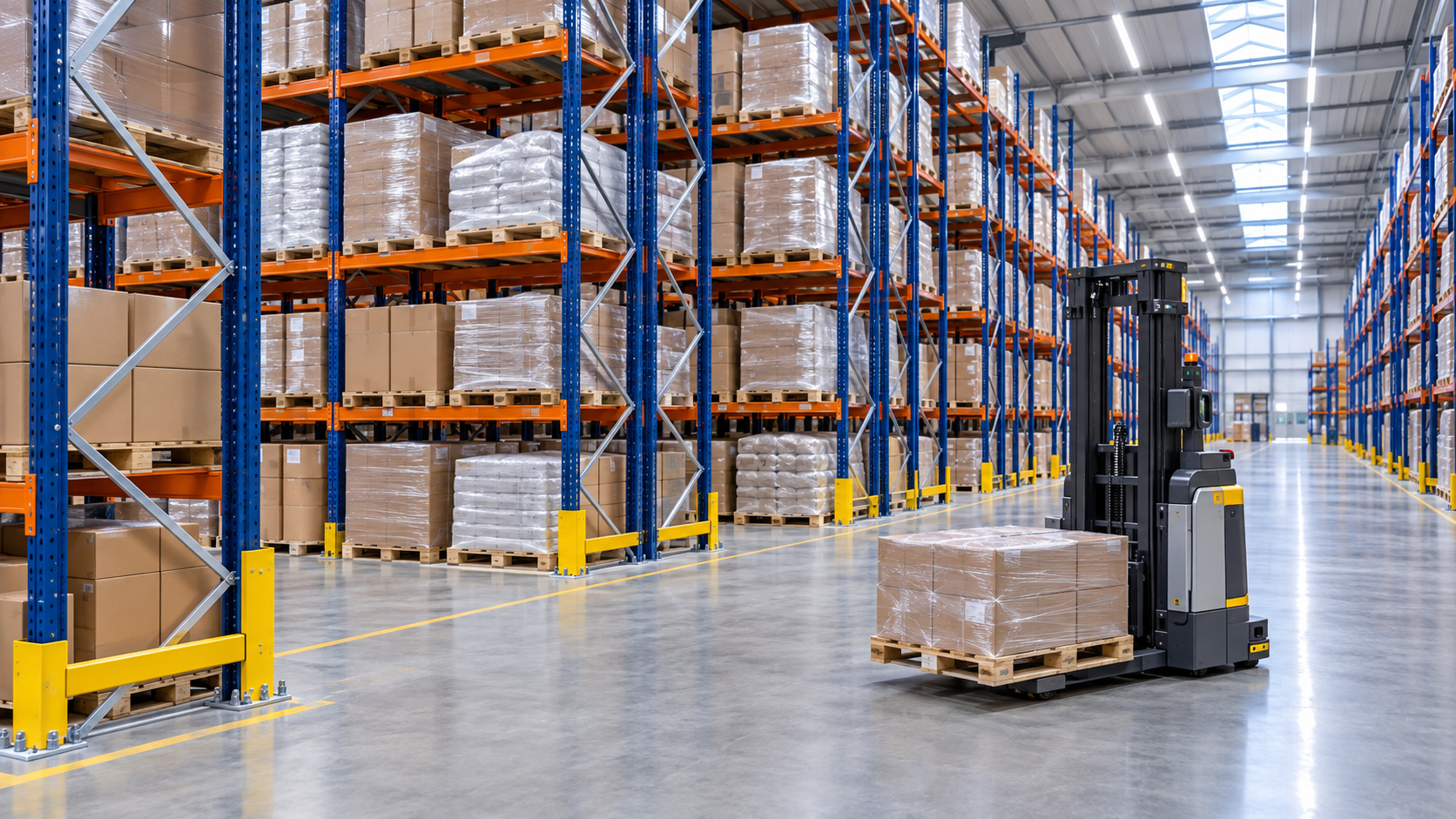
More storage space isn't always better: Cheap pallet racking, expensive consequences? These ten manufacturers are shaping the market – a creative image on the topic, created with AI: Xpert.Digital
Pallet racking for warehouses: When do compaction and automation pay off?
Warehouse technology 2026: Why the lowest price is rarely the best choice
Pallet racking is a key investment for companies that store and move goods. It not only affects how many pallets can fit in a warehouse, but also how quickly employees and technical systems can access inventory. A low purchase price is therefore only one part of the equation: planning, assembly, maintenance, safety, and subsequent modifications also impact cost-effectiveness.
The market ranges from conventional racking systems to high-density and automated solutions. Suppliers such as SSI Schäfer, stow, Mecalux, Nucor, Gonvarri Material Handling, AR Racking, NEDCON, Frazier, Steel King, and Ridg-U-Rak differ not only in their products but also in their manufacturing structures, regional presence, and expertise in software and automation. A general ranking is therefore insufficient: what matters is which solution best suits a company's material flow, location, and investment budget.
This overview categorizes ten manufacturers and corporate groups and highlights key aspects for comparison. It explains why the highest number of pallet spaces does not automatically equate to the best warehouse performance, when automation can be economically viable, and the role of safety requirements and life cycle costs. This clarifies why the lowest price per pallet space does not necessarily lead to the most cost-effective warehouse.
Cheap shelves, expensive mistakes
Pallet racking systems are far more than just a structure made of steel uprights and beams. They determine how efficiently a company utilizes storage space, how reliably material flows function, and how flexibly a location can adapt to changing requirements. The market ranges from conventional racking systems and high-density storage to increasingly automated solutions.
The crucial question, therefore, is not which manufacturer is the largest or best-known. What matters is which supplier offers the most economically compelling solution for a specific product range, location, and available investment budget. An inexpensive shelving system can be a sensible choice. However, it can also be the starting point for consistently high operating costs if its design focuses solely on maximizing storage capacity and minimizing the purchase price.
For a reliable manufacturer comparison, market size, technical capabilities, regional presence, automation expertise, and long-term operational reliability must be considered together. A blanket ranking would obscure these differences rather than explain them. The following ten manufacturers and corporate groups therefore constitute an analytical comparison, not a purported global ranking by revenue or market share.
A market with blurred boundaries
The sheer size of the market alone necessitates careful classification. The global market for warehouse racking systems is projected to reach approximately US$12.4 billion in 2030, with an assumed average annual growth rate of 4.2 percent between 2025 and 2030. These figures represent a market estimate and not an officially compiled overall statistic.
The market volume for warehouse racking systems in the USA is estimated at around US$1.75 billion in 2024; by 2030, it is expected to reach approximately US$2.17 billion, with an average annual growth rate of 3.7 percent. This is also a model-based estimate, the validity of which depends on the market definition used.
Economically, this distinction is crucial. A market for warehouse racking is not the same as the market for pallets, the market for warehouse automation, or the entire intralogistics market. Mixing these categories creates seemingly impressive figures but results in a loss of analytical precision.
Similarly, a growing market value does not automatically translate into a corresponding increase in the number of new storage spaces. Higher steel prices, more sophisticated designs, or additional technical equipment can increase sales without a proportional increase in physical storage capacity. Therefore, price trends, sales volume, and technological advancements must be considered separately when evaluating the industry.
Why rankings are often misleading
A manufacturer with extensive automation, software, and service operations is structured differently than a company that primarily produces shelving components. Both can appear in a supplier comparison, even though their revenues reflect different services. The product ranges of SSI Schäfer, Mecalux, and Gonvarri Material Handling illustrate this overlap between shelving systems, automation, and complementary services.
SSI Schäfer provides a particularly illustrative example: For 2025, the company reported sales of approximately €1.7 billion and order intake of €2.1 billion. However, this does not allow for the calculation of market share in the global pallet racking market, as the company's figures encompass a significantly broader range of services.
Furthermore, there is the distinction between corporation, brand, and legally independent manufacturer. Several well-known names can belong to the same corporate group. If they are ranked as independent competitors, the market appears more fragmented than it actually is economically.
A sound market analysis should therefore focus less on finding a universal winner and more on different competitive models. Relevant examples include broadly positioned system providers, specialized shelving manufacturers, regionally high-performing producers, and suppliers with extensive expertise in automated warehouse structures.
Demand arises from the flow of goods
Online retail remains a key structural driver. In the second quarter of 2026, seasonally adjusted retail sales in US e-commerce reached approximately $340.2 billion, representing 17.1 percent of total retail sales and a nominal increase of 12.2 percent compared to the same quarter of the previous year. These figures are not adjusted for inflation and therefore should not be directly interpreted as real volume growth.
For pallet racking, the connection is also indirect. Individual customer orders are often assembled from cardboard boxes or containers. However, the upstream supply of these processes can still be pallet-based, for example, during goods receipt, for reserve stock, or for replenishment of picking areas.
Therefore, what matters is not just the number of online orders, but the entire structure of the flow of goods. A growing product range may require more separate storage areas. Conversely, a higher turnover rate can make additional technology more economical without a corresponding increase in inventory levels.
Improved inventory planning can also limit the need for storage space. This leads to an important limitation for growth forecasts: higher sales volume does not automatically translate into a proportional increase in shelving. Actual demand depends on sales volume, inventory coverage, product variety, service commitments, and replenishment organization.
Vacancy does not prevent the need for modernization
The situation on the real estate market also affects the demand for racking systems. For the US industrial market, a clear split between older existing buildings and more modern, functionally better-suited spaces was predicted for the course of 2026; at the same time, stronger leasing activity was expected, particularly from logistics providers and manufacturing companies.
There is no contradiction in the fact that spaces may be vacant while companies are simultaneously installing new warehouse technology. An available building may be unsuitable for a specific user, for example, due to its location, ceiling height, floor quality, or internal layout. A low rent does not necessarily compensate for functional disadvantages.
This creates two distinct business areas for shelving manufacturers. The first is equipping new locations. The second is the economic improvement of existing buildings through new layouts, increased density, or adapted material flows.
From a warehouse operator's perspective, the decision between relocation and modernization should not be reduced to just the rent. A comprehensive comparison must be made of all the resulting consequences: additional transport routes, construction interruptions, staff productivity, building technology, and the possibility of future adjustments to the warehouse.
SSI Schäfer: Breadth as a system advantage
SSI Schäfer combines an extensive intralogistics business with warehouse automation and services; for 2025, a strong development of logistics and service activities was particularly highlighted.
The economic advantage of such a business model potentially lies in the coordination of multiple subsystems. When racking structure, conveyor technology, control systems, and operational organization are planned together, conflicting assumptions can be identified earlier. This coordination effort is a valuable asset, especially for complex systems.
However, breadth does not automatically equate to the best solution for every application. A manageable manual warehouse may not require a comprehensive system architecture. In such cases, simplicity, short delivery routes, and straightforward expansions may be more important.
For a comparison with SSI Schäfer, companies should therefore determine their specific integration needs. The more a site's performance depends on the interplay of various technical components, the more relevant the ability to plan comprehensively becomes. The more standardized the project, the more a comprehensive offering must be economically justified compared to simpler alternatives.
stow: Bringing together shelves and robotics
The stow Group combines the brands stow and Movu Robotics and boasts a presence in more than 60 countries, ten factories, and 29 sales offices. The group thus represents a competitive model that merges classic racking systems with automated storage solutions.
The potential link between scaled-up manufacturing and technological advancement is economically interesting. A large production network can facilitate the supply of international projects. At the same time, the proximity between racking construction and robotics can help to coordinate mechanical structures and automated motion sequences.
However, the precise expansion logic is crucial for customers. A system currently operated manually cannot be economically automated later simply because the same supplier also sells robotics. The geometry, load-bearing capacity, transfer points, and the future operating concept must already be suitable.
The key question, therefore, is: Which development opportunities are actually being kept open in a constructive manner? A credible answer should specify concrete technical requirements. General statements about future viability are insufficient for a long-term investment decision.
Mecalux: Combining mechanics and software
Mecalux offers conventional pallet racking, drive-in and drive-through racking, mobile racking, flow and push-in systems, as well as shuttle solutions, automated warehouses and warehouse management software.
This combination is attractive for companies that view their warehouse technology not in isolation, but as part of a comprehensive inventory and process control system. Ultimately, the economic impact of a racking system also depends on which goods are assigned to which location, how replenishment is triggered, and how reliably stock is available.
An integrated solution can reduce coordination problems. However, it can also increase vendor lock-in. The more closely software, control systems, and mechanics are integrated, the more important documented interfaces, data access, and a transparent approach to future expansions become.
Therefore, when comparing Mecalux solutions, the comparison should not only focus on the visible storage technology. Equally relevant are ongoing software costs, the effort required to implement changes to new business processes, and the ability to integrate existing company systems. A technically elegant solution is only economically convincing if it also remains manageable from an organizational perspective in the long term.
Nucor: Steel expertise meets storage technology
Nucor acquired Hannibal in 2021 and Elite Storage Solutions in 2022; these operations were consolidated under Nucor Warehouse Systems. This illustrates the link between the upstream steel industry and downstream storage technology.
Such industrial integration can be significant for competitiveness. Material procurement, production capacities, and investment capacity are among the factors that can determine delivery reliability and scalability in larger projects.
However, it would be an oversimplification to conclude that this automatically translates into price or quality leadership. Even a vertically integrated supplier must efficiently organize design, manufacturing, logistics, and assembly. Furthermore, a robust material base cannot compensate for inadequate inventory planning.
For North American sites, the specific regional capabilities must therefore be examined. For projects outside this region, transportation, local technical requirements, and available support must also be considered. The size of a parent company is an indicator of stability, but not a substitute for evaluating the specific project.
Gonvarri: Brand diversity with a common structure
Gonvarri Material Handling brings together brands including Dexion, Constructor, Kasten, Kredit and Almaceno; the product range extends from manual and semi-automated racking systems to support structures for automated warehouses.
The economic strength of this model potentially lies in combining regional customer proximity with shared technical and industrial resources. For companies with multiple locations, it can be advantageous to address similar requirements through a group while still maintaining local contacts.
However, such a structure is only truly useful if collaboration functions smoothly in day-to-day operations. Uniform product names, comparable technical documentation, and clear responsibilities are more important than a shared brand identity.
An international comparison should therefore examine the extent of standardization. Are spare parts available across national borders? Can expansions be planned according to the same technical principles? Are there consistent testing and maintenance concepts? The economic value of a group is reflected less in the number of its brands than in the reduction of operational inefficiencies.
AR Racking: Manufacturing and traceability
AR Racking is part of the Arania Group and develops, manufactures, and installs industrial storage systems ranging from conventional racking to automated solutions. Furthermore, the company's greenhouse gas balance for 2025 was verified by DNV in April 2026 according to ISO 14064-1.
For economic evaluation, these two levels must be considered separately. Industrial experience can provide a basis for reproducible manufacturing processes. A verified emissions balance, on the other hand, primarily improves the traceability of environmental company data.
This does not automatically provide a conclusion about the CO₂ footprint of a specific racking system. Factors such as the amount of material, the origin of the steel, transport, service life, and the specific calculation method would be relevant for that.
AR Racking is therefore an example of a manufacturer where, in addition to the technical solution, the quality of the documentation should also be considered in the comparison. For larger industrial companies in particular, obtaining reliable data for internal investment approvals, customer requirements, and sustainability assessments can be economically relevant.
LTW Intralogistics Solutions

LTW Intralogistics – Engineers of Flow - Image: LTW Intralogistics GmbH
LTW offers its customers not individual components, but integrated complete solutions. Consulting, planning, mechanical and electrotechnical components, control and automation technology, as well as software and service – everything is networked and precisely coordinated.
In-house production of key components is particularly advantageous. This allows for optimal control of quality, supply chains, and interfaces.
LTW stands for reliability, transparency, and collaborative partnership. Loyalty and honesty are firmly anchored in the company's philosophy – a handshake still means something here.
Related to this:
Market analysis of leading shelf manufacturers
NEDCON: Precision for demanding structures
NEDCON is part of voestalpine's warehouse technology business and offers, among other things, manual pallet racking, drive-in racking and automated pallet and shuttle systems.
This profile focuses on the optimal design integration between the steel structure and the storage process. In an automated system, the racking is not merely a passive storage solution. It forms part of the spatial and mechanical framework within which the rest of the technology must operate reliably.
The economic value of precise planning often only becomes apparent during operation. If mechanical structures, movement areas, and transfer points don't match, additional adjustments or performance limitations can arise.
When considering a supplier like NEDCON, the price per storage space should not be the only factor to consider. Equally important are the quality of the technical design, the documentation of load assumptions, and collaboration with other system partners. Especially with complex warehouse structures, a higher level of planning from the outset can be more economical than later adjustments.
Frazier: Structural steel as a specialization
According to its own statements, Frazier focuses on racking solutions made from hot-rolled steel profiles and has ten manufacturing sites in North America, including Canada and Mexico.
This profile is particularly interesting where operators place a high value on robust construction and regional manufacturing proximity. A denser production network can offer a practical advantage for large or time-critical projects, provided it actually results in shorter and more reliable delivery routes.
However, the design should not be confused with a general judgment of quality. A heavier construction is not necessarily more economical. Additional material usage must be justified by the actual benefit.
Therefore, the load profile, operational stress, repair concept, and life cycle costs are crucial for comparison. The distinction between structural robustness and safe handling in the bearing is particularly important. No design makes systematic overloading or repeated impact damage an acceptable operating condition.
Steel King: Evaluating different designs
Steel King offers, among other things, structural pallet racking made from hot-rolled steel profiles, as well as drive-in, flow-through, push-in and automation-related racking solutions.
The interesting point of comparison here lies in the selection of the building type for a specific operation. A distribution warehouse with many daily movements has different requirements than a quiet reserve warehouse. At the same time, the same building can contain areas with very different levels of stress.
This provides an economic argument for differentiated rather than uniform planning. Not every area requires the same technical design. A targeted combination can be more sensible than a consistently heavy or consistently particularly inexpensive construction.
Therefore, when dealing with Steel King and similar specialists, it should be examined whether the proposed design reflects the actual operating profile. A good manufacturer comparison not only asks about the maximum available load capacity, but also how comprehensibly the chosen solution is derived from the specific requirements.
Ridg-U-Rak: Access or compaction
Ridg-U-Rak offers, among other things, selective pallet racking, drive-in racking, flow racking, push-in racking, narrow aisle and double-deep solutions, as well as complementary planning and installation services.
This breadth highlights a fundamental conflict of objectives: Increased storage density is often associated with altered access conditions. Whether this is economically viable depends primarily on how many pallets are available per item and in what sequence they are required.
A warehouse with many different items and small stock levels requires a different structure than a location with few items and large quantities of each item. The same consolidation approach can cause additional movement in the first case and work perfectly in the second.
For comparing manufacturers, this means that product variety alone does not guarantee benefit. The crucial factor is whether a suitable combination can be achieved from the available systems. A high-performing supplier should also be able to explain why a technically feasible compaction is not advisable under certain conditions.
The correct price scale is often missing
The price per pallet space is an easily understood metric. However, it is insufficient as the sole basis for decision-making because it reflects neither the actual utilization rate nor the effort involved in storage and retrieval.
A cheap storage space can generate consistently high follow-up costs if the goods can only be reached with additional movements. Conversely, a more expensive storage space can be economical if it saves space, simplifies processes, or avoids the need for building expansion.
A more sensible approach is to consider the total costs over a uniform usage period. This includes the initial investment, assembly, technical adjustments, inspections, repairs, energy, personnel costs, and subsequent modifications. The residual value or potential for reuse after the planned use should also be taken into account.
The comparison becomes particularly meaningful when costs are related to the actual storage performance. A storage space that is little used over the years has a different economic value than a frequently used space that is crucial for delivery capability.
Density does not equal productivity
Selective racking allows direct access to individual pallets, while drive-in and other high-density systems reduce aisles and can accommodate multiple pallets in succession. This results in a conflict of business objectives between space utilization and access flexibility.
The highest calculated number of storage locations is therefore not automatically the best warehouse layout. If inventory has to be distributed across many items, batches, or shelf-life groups, unused residual spaces can arise in deep channels. A facility that appears densely packed may therefore offer less capacity in practice than the plan suggests.
Material flow also limits the economically usable density. Fewer lanes can lead to longer distances, greater mutual obstruction, or additional redistribution. The space gained must be weighed against these consequences.
A convincing plan therefore doesn't just assess how many pallets fit into a hall. It examines how many pallets can be stored and moved under realistic conditions without jeopardizing the required delivery performance.
Automation is not an end in itself
The growing importance of automated material handling is evident in robotics data: In the sample collected, approximately 102,900 service robots for transport and logistics tasks were sold in 2024, an increase of 14 percent; around 81,800 units were mobile robots for intralogistics. The underlying data is based on a sample of companies and was not extrapolated to the entire industry.
For pallet racking, this means an increasing need for coordinated mechanical and digital solutions. However, this does not mean that every warehouse should be fully automated.
Automation can be particularly economical when processes are sufficiently stable and the technology is utilized effectively over a long period. However, simpler systems can offer greater economic flexibility when requirements fluctuate significantly or the location perspective is short.
The key calculation, therefore, is not how many employees could theoretically be replaced. What needs to be examined is what the total costs are for a given level of performance and how robust this calculation remains in the face of fluctuations in demand, technical malfunctions, and changes in the product range.
Small steps can be more valuable
There is a wide spectrum between a fully manual warehouse and a highly automated system. This includes, for example, semi-automated shuttle solutions and various forms of high-density storage.
Economically, such intermediate stages can be attractive because they spread investments over time. A company doesn't have to finance every conceivable future requirement immediately. It can first improve the areas where a tangible benefit is evident.
However, even a phased expansion requires an overall concept. If early decisions are made without considering later changes, the supposedly flexible solution can become expensive. Existing structures then have to be replaced or transitions have to be adapted in a costly manner.
The value of modular planning therefore does not lie in a general promise of unlimited expandability. It lies in specifically prepared options: suitable space reserves, comprehensible load assumptions, compatible handovers, and a clear understanding of which changes are possible later and which are not.
Security protects profitability
For the design and operation of racking systems, DIN EN 15512, DIN EN 15620, and DIN EN 15635 are among the relevant standards; they cover static design, tolerances, application, and maintenance. Regular expert inspections are essential for safe racking operation.
The economic implications extend beyond the immediate prevention of accidents. Damage can block storage areas, endanger goods, and disrupt operations. A cost-effective design quickly loses its price advantage if repairs are logistically complex or suitable spare parts are unavailable.
Therefore, safety considerations should be factored into the investment decision from the outset. The evaluation should encompass not only load-bearing capacity data, but also the protection concept, documentation, accessibility for inspections, and the practical implementation of repairs.
The organizational aspect is equally important. A racking system remains economically viable only if its operational limitations are understood. Load specifications, clear responsibilities, and traceable change processes are therefore not bureaucratic add-ons, but rather integral parts of professional asset management.
Cold storage facilities exacerbate the problem
To assess the energy efficiency of cold storage facilities, indicators are used that relate electricity consumption to the cooled volume; for reliable comparisons, facilities are grouped according to size and temperature range.
For shelving planning, this means that space cannot be evaluated solely based on rent or construction costs. It is also necessary to examine the impact of the layout on the operation of the temperature-controlled building.
Higher density can be economically advantageous if it reduces the building volume required for the same quantity of goods. However, this does not automatically translate into a specific level of energy savings. Goods handling, door openings, temperature requirements, and operational procedures can all significantly influence the outcome.
The relevant question, therefore, is whether a different warehouse structure would make the entire site more efficient. Simply considering the number of storage spaces is insufficient, especially in cold storage, because investment, energy, and process costs are particularly closely intertwined.
Sustainability requires appropriate reference points
Sustainability only becomes relevant for decision-making when the data is comparable. A company-specific emissions balance, a product-specific environmental assessment, and a statement about the operational energy of a warehouse describe different things.
AR Racking's verified corporate balance sheet, for example, serves as proof of the company's emissions reporting, not automatically as an environmental assessment of each individual system delivered. This distinction is important to prevent a reliable document from being used to justify claims it doesn't cover.
For an economically sound comparison, operators should therefore base their calculations on the same functional performance. What matters is not only the amount of steel used, but also the resulting load-bearing capacity, service life, and adaptability.
Reuse also warrants careful consideration. While it can conserve resources and capital, it requires a technical assessment of the existing components and their intended use. Acquiring used components at a lower cost is only advantageous if it results in a properly documented and effectively operated system.
Local strength beats global recognition
An international production and distribution network can be an advantage, as the structures of stow, Gonvarri, and Frazier demonstrate. However, for individual operators, the most important factor is the capacity available at the specific location.
A globally recognized brand is of little use if assembly capacity is lacking or spare parts can only be procured with considerable effort. Conversely, a less prominent supplier can be economically compelling if it has a good grasp of regional requirements and provides consistently reliable support.
Therefore, in international projects, a distinction should be made between global reach and local executability. Crucial factors include technical competence, assembly quality, responsiveness, and the availability of suitable components.
Transport costs and delivery times must also be considered. A low ex-works price can be offset by logistical factors. The relevant point of comparison is the operational, documented, and continuously supported system, not the isolated component at the production site.
Uncertainty demands reliable scenarios
A long-term investment should not be based solely on a single demand forecast. A shelving system can be technically excellent and still disappoint economically if inventory levels, product structures, or operating times deviate significantly from the original assumptions.
Therefore, it is advisable to consider several scenarios. In the conservative scenario, quantities and capacity utilization fall short of expectations. In the moderate scenario, the site develops largely as planned. In the expansive scenario, inventory or throughput increases faster than expected.
The important thing is not to produce seemingly precise future figures. What matters is to identify the vulnerable points of the investment. What costs remain if capacity utilization declines? Where will bottlenecks first arise during growth? What adjustments are possible with reasonable effort?
A robust system is not necessarily the cheapest solution in every scenario. However, it should not generate unacceptable follow-up costs or difficult-to-manage operational risks in any plausible scenario.
Competition shifts to lifespan
The integration of shelving, automation, software, and services demonstrates that suppliers can no longer position themselves solely through manufactured steel structures. For operators, this makes the quality of support throughout the entire service life increasingly important.
Economically, the focus is shifting from purchasing a product to managing a productive infrastructure. Planning, operation, maintenance, and change should not be treated as separate issues.
This also creates a more demanding role for the manufacturer. They must not only be able to deliver, but also provide verifiable support for subsequent use. This includes robust technical documentation, transparent assumptions, and a realistic understanding of the system's limitations.
The rationale for 2026 is therefore this: The greatest economic benefit is not necessarily offered by the supplier with the lowest steel price, the broadest prospectus, or the highest group revenue. The most convincing manufacturer is the one whose solution fits the actual flow of goods, functions under realistic conditions, and remains economically adaptable even after several years.
Header image for the article
The header image visualizes conventional pallet racks and automated storage technology in a modern logistics hall.
I cannot confirm that this image was created with Gemini 3.1 Pro.
Consulting - Planning - Implementation

Konrad Wolfenstein
I would be happy to serve as your personal advisor.
You can contact me at wolfenstein∂xpert.digital or
Just call me on +49 7348 4088 965 .
Your intralogistics experts

Consulting, planning and implementation of complete solutions for high-bay warehouses and automated storage systems - Image: Xpert.Digital
More information here:










