
Brownfield retrofit versus greenfield new builds: Increasing storage capacity through automated pallet storage systems
Xpert Pre-Release

Available in 27 languages 📢
Prefer Xpert.Digital on GoogleⓘPublished on: January 24, 2026 / Updated on: January 24, 2026 – Author: Konrad Wolfenstein
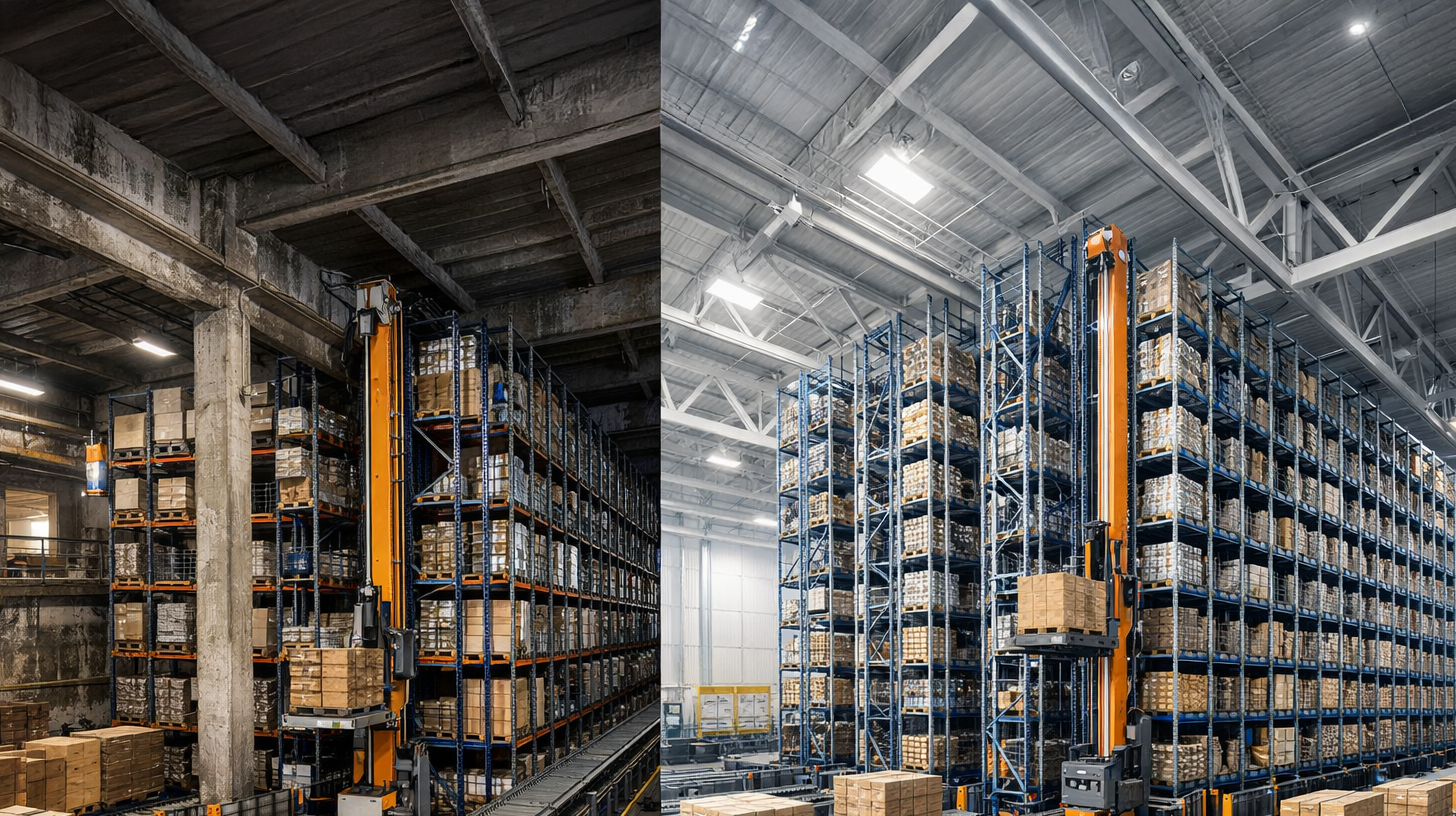
Brownfield retrofit versus greenfield new builds: Increasing storage capacity through automated pallet storage systems – Creative image: Xpert.Digital
How space compaction and high-frequency processes are fundamentally transforming the cost economics of warehousing
The economic foundation of automation
The decision to automate pallet warehouses is fundamentally economic. While conventional storage systems operate with forklifts that rely on aisles and typically achieve a space utilization of around 45 to 55 percent, automated pallet storage systems, especially those with shuttle technology, achieve space utilization efficiencies of up to 98 percent. This fundamental difference results from the elimination of storage aisles, which in conventional systems must be considered mandatory investments that generate no direct return. The space savings are not marginal – they form the core of the economic case for automated systems.
Investment costs for fully automated high-bay warehouses typically range from five to twenty million euros, depending on scale and complexity. Unit-load systems for pallet logistics require investments of at least one million euros, while miniaturized systems are available starting at 750,000 euros. This investment scale underscores the critical importance of optimal system planning. A cost saving of just five percent in the planning phase equates to direct investment savings of 250,000 to one million euros. The operating costs of an automated high-bay warehouse consist of annual maintenance (one to three percent of the investment), energy consumption, personnel costs, and system downtime. In well-designed systems, modern high-bay warehouses achieve a return on investment of two to four years. This implies that efficiency gains in the initial phase directly reduce the amortization period, and cost savings over a 15- to 20-year operating period increase exponentially.
Automated systems versus manual warehouse management – operational performance differences
The performance disparity between automated and manual warehouse systems is significant in practice. Analyses show that warehouse automation can reduce personnel costs by up to 30 percent and lower error rates from the typical 66 percent in manual warehouses to below one percent. Automated systems routinely achieve accuracy rates of over 99.9 percent, while manual processes typically remain at 96 to 97 percent accuracy. This error reduction is highly relevant from an economic perspective. An average incorrect order costs a company approximately 22 euros, not including the opportunity costs associated with customer availability, reputational damage, and handling complaints.
Vertical optimization significantly increases space utilization efficiency – a direct mechanism for reducing fixed costs per stored unit. While conventional pallet racks allow access to all pallets but are spatially inefficient, multi-deep automated systems can increase storage capacity two to four times on the same footprint. Automation reduces throughput times by 20 to 40 percent. The absolute throughput is model-dependent: the basic version of automated shuttle systems achieves more than 100 pallets per hour, with scalable configurations reaching up to 300 double cycles per hour.
Market dynamics and European growth trajectory
The European warehouse automation market is experiencing structural growth. Estimated to reach US$5.76 billion to US$6.845 billion in 2025, the market is projected to grow to US$6.79 billion to US$7 billion by 2026. Growth rates vary between 10.9% and 16.9% per year (CAGR), depending on the source and forecast period. Market volumes are expected to reach US$27.94 billion to US$52.58 billion by 2035, depending on the modeling method and geographic aggregation. This disparity reflects the uncertainty in market calibration but clearly indicates the direction and magnitude of the trend.
Germany dominates the European warehouse automation market with 29.35 percent of total revenue in 2025, followed by the UK, France, and the Netherlands. The UK is projected to become the largest market for warehouse automation in Europe by 2025, with an annual growth rate of 24 percent. Spain is expanding at a CAGR of 19.3 percent, driven by micro-fulfillment strategies in urban centers and its position as a logistics hub in Southern Europe. The drivers of this growth are diverse: the e-commerce sector and food logistics will account for 32.45 percent of revenue in 2025, while the manufacturing sector is growing at a CAGR of 19.15 percent. The manufacturing segment is being boosted by brownfield retrofits that integrate shop floor planning systems with warehouse management systems.
Technological topologies – shuttle versus stacker crane systems
The technological landscape of automated pallet storage systems is defined by two dominant architectures: shuttle systems and stacker crane systems. Shuttle systems operate on the principle of self-contained, battery-powered mobile units that travel on rails in storage aisles and manage pallets autonomously for up to ten hours. Their operation is based on the goods-to-person principle, where material is transported to picking stations rather than the other way around. Lithium-ion battery systems enable charging times of a maximum of three hours and operating frequencies that optimize shift dynamics.
In contrast, stacker crane systems operate according to a centralized coordination principle, in which one or more large machines operate on different levels and move pallets to defined storage locations. At HHLA's Hamburg Container Terminal (CTB), a globally unique three-gantry crane architecture has been implemented, allowing the gantry cranes to pass over each other. This technology optimizes crane control and travel efficiency to such an extent that productivity is significantly increased. With the three new storage blocks, block storage capacity has been expanded by almost 6,000 TEU to 45,000 TEU, while the footprint has been reduced by more than 50 percent compared to conventional van carrier yards.
The choice between shuttle and automated guided vehicle (AGV) systems is not technology-neutral. Shuttle systems offer redundancy through multiple mobile units, while AGV systems, due to their centralized nature, represent a potential source of failure. Shuttle systems allow for unlimited aisle depths and variable loading depths, whereas AGVs require a standardized warehouse geometry. The investment per unit is higher for AGVs, while the system complexity of shuttle solutions lies in the software orchestration.
LTW Solutions

LTW Intralogistics – Engineers of Flow - Image: LTW Intralogistics GmbH
LTW offers its customers not individual components, but integrated complete solutions. Consulting, planning, mechanical and electrotechnical components, control and automation technology, as well as software and service – everything is networked and precisely coordinated.
In-house production of key components is particularly advantageous. This allows for optimal control of quality, supply chains, and interfaces.
LTW stands for reliability, transparency, and collaborative partnership. Loyalty and honesty are firmly anchored in the company's philosophy – a handshake still means something here.
Suitable for:
Automation isn't always the answer: Beyond this point, it's really worth it
Artificial intelligence as an optimization multiplier
The storage optimization potential of modern automated warehouse systems is substantially increased through the integration of artificial intelligence. Modern high-bay warehouses incorporate specially developed AI modules that use machine learning to determine optimal storage locations for containers. This algorithm minimizes energy-intensive restacking by reducing repositioning activities. At the CTB, this intelligent control system has reduced the average energy consumption per operation while simultaneously making processes more efficient.
AI-powered route optimization algorithms calculate the most efficient transport routes for automated guided vehicles (AGVs) and warehouse mechanisms. This reduces both energy consumption and process times through empirical route optimization. Demand and replenishment forecasts are dynamically updated using machine learning models, thereby reducing inventory levels, preventing bottlenecks, and minimizing overstocking. The speed of these algorithms is operationally critical: SYNAOS software calculates 250,000 solutions per second using scalable cloud technology, continuously and without interruption. The use of such systems reduces the required number of AGVs by 20 to 30 percent, generating cumulative savings in purchase price, maintenance costs, and space requirements.
Energy efficiency as a structural cost reduction element
Especially in deep-freeze warehouses, energy efficiency is becoming a primary cost driver. Automated high-bay warehouses can reduce energy consumption per stored unit by up to 40 percent by reducing the heated or cooled floor space. This is economically significant, as energy consumption accounts for approximately 50 to 60 percent of operating costs in deep-freeze storage. The increased density achieved through vertical space utilization fundamentally reduces the perimeter area per pallet.
Modern stacker cranes operate according to the so-called double-cycle principle, in which storage is immediately combined with retrieval to minimize empty runs. The kinetic energy released when braking or lowering loads can be recovered through recuperation and either buffered within the system or fed into the power grid, which significantly reduces operating costs. These systems are also powered by renewable energy – the CTB uses electrified storage cranes that are supplied exclusively with electricity from renewable sources.
Amortization performance and return-on-investment horizons
The payback periods for automated warehouse systems vary depending on the implementation scenario and operational intensity. Typical payback periods range from 18 months to four years, with conservative analyses suggesting two to four years. A return on investment (ROI) of 79 percent is typically achieved over 18 months for automation systems. In high-volume throughput scenarios with multi-shift operations, payback periods decrease to 12 to 18 months.
A critical success factor for rapid amortization is the combination of hardware investments with optimized software planning. A cost saving of five percent through improved initial planning immediately reduces the amortization period by approximately 25 percent. In fully automated scenarios with three shifts and 150 driverless transport vehicles, total savings in the first year can reach four to five million euros through reductions in vehicle purchases, maintenance costs, and IT infrastructure. Over a five-year period, these savings accumulate to 4.8 million euros.
Critical thresholds for automation decisions
Automation isn't worthwhile for every warehouse scenario – there are critical thresholds. Systems typically only become profitable with volumes of around 1,000 picks per day or more than 2,000 SKUs. If volumes remain below these thresholds or many picks are concentrated on a few items, a well-organized, manual shelving system continues to offer the most flexible and cost-effective solution. A total cost of ownership (TCO) analysis over several years is essential – while manual storage has lower fixed costs, automated systems pay for themselves in the long run through operational cost reductions.
The break-even point is not just a cost function, but also an error rate function. If the error rate in manual warehouses is 66 percent or higher, and incorrect picking is costly, the benefits of automation are substantially supported by quality gains. Similarly, labor shortage scenarios accelerate automation—the inability to recruit and retain full-time equivalents increases the profitability of automation investments.
Brownfield retrofit versus greenfield new builds
A significant differentiating factor is the implementation method: brownfield retrofits (modernization of existing warehouses) versus greenfield new builds. HHLA's CTB is characterized as one of the most ambitious brownfield projects in the industry. The complexity lies in maintaining ongoing operations during the modernization, which requires phasing strategies and redundant architectures. Brownfield projects are therefore more expensive than greenfield new builds, but are justified by existing land portfolios and infrastructure.
Concluding remarks – Transformation dynamics and strategic implications
The European market for automated pallet storage systems is undergoing a structural transformation. With CAGR rates of 10.9 to 16.9 percent and projected market volumes of US$27 billion to US$52 billion by 2035, this is not a marginal segment shift, but a fundamental paradigm shift in warehousing. The drivers are multifaceted: labor shortages, the dynamics of e-commerce volume, EU decarbonization targets, and technological maturation are creating a confluence that makes automation a strategic necessity, not a tactical add-on.
The economic benefits lie in space optimization (efficiency gains of 50+ percent), error reduction (from 66 to under 1 percent), personnel cost savings (up to 30 percent), and energy efficiency gains (up to 40 percent in deep-freeze warehouses). Payback periods of two to four years position automated systems as highly profitable capital investments with operating horizons of 15 to 20 years. The integration of artificial intelligence multiplies these gains through optimizations that reduce empty runs, energy consumption, and warehouse movement times.
The modernization wave has Germany, Great Britain, France, and the Netherlands as its anchor points, while Eastern Europe plays a role as a growth frontier and Southern Europe through micro-fulfillment strategies. Companies that do not proactively shape this transformation risk structural competitive disadvantages due to higher cost structures, lower process quality, and reduced scalability. The automation path is irreversible—it is an infrastructural commitment decision with long-term implications.
Advice - planning - implementation

Konrad Wolfenstein
I would be happy to serve as your personal advisor.
contact me at wolfenstein ∂ xpert.digital
Just call me on +49 7348 4088 965 (Munich) .
Our global industry and economic expertise in business development, sales and marketing

Our global industry and business expertise in business development, sales and marketing - Image: Xpert.Digital
Industry focus: B2B, digitalization (from AI to XR), mechanical engineering, logistics, renewable energies and industry
More about it here:
A topic hub with insights and expertise:
- Knowledge platform on the global and regional economy, innovation and industry-specific trends
- Collection of analyses, impulses and background information from our focus areas
- A place for expertise and information on current developments in business and technology
- Topic hub for companies that want to learn about markets, digitalization and industry innovations










