
Hybrid systems instead of isolated solutions: The secret strategy of top logistics companies
Xpert Pre-Release

Available in 27 languages 📢
Prefer Xpert.Digital on GoogleⓘPublished on: April 4, 2026 / Updated on: April 4, 2026 – Author: Konrad Wolfenstein
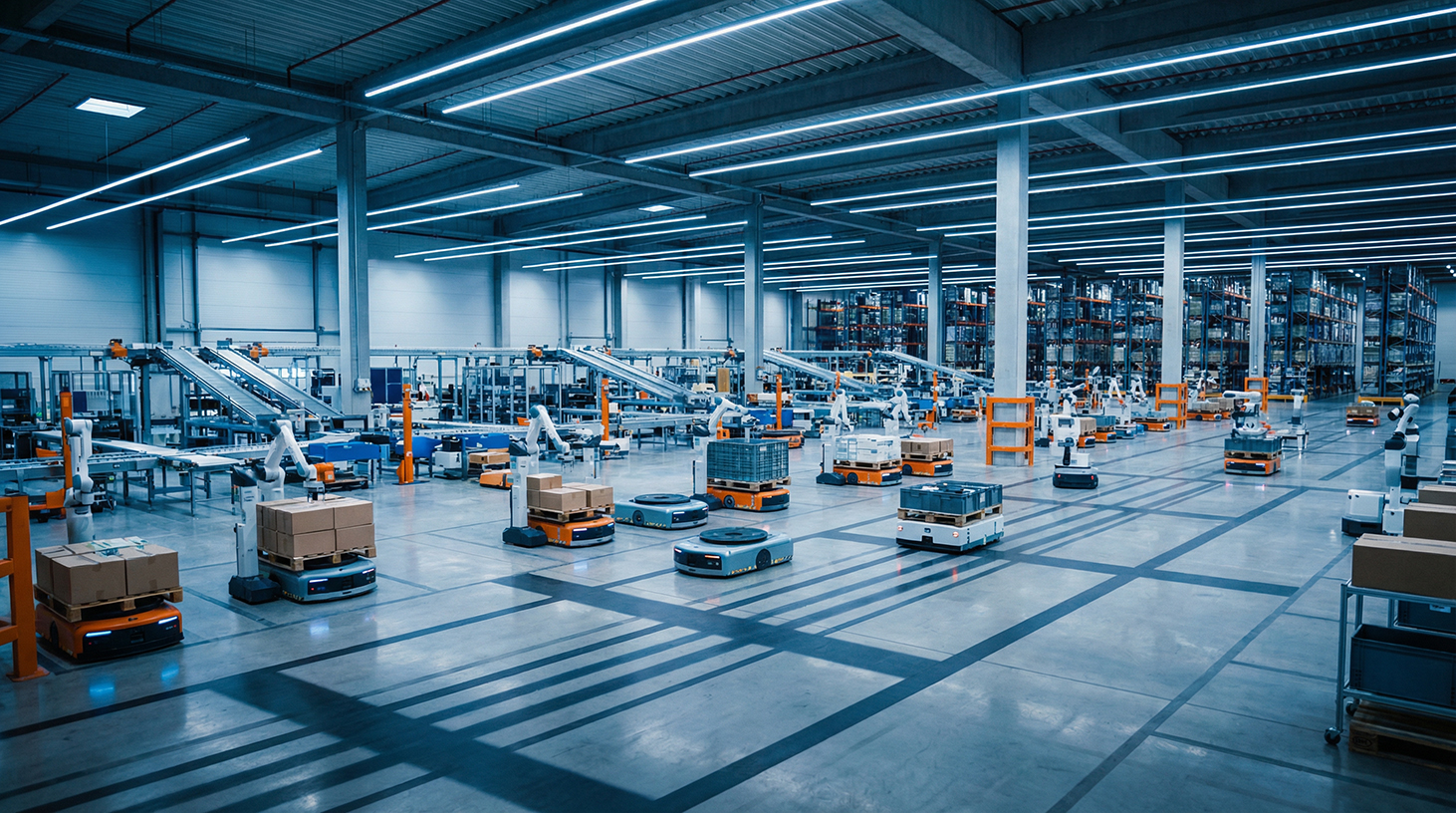
Hybrid systems instead of isolated solutions: The secret strategy of top logistics companies – Image: Xpert.Digital
From pilot project to mandatory discipline: The industrial maturation of robotics in intralogistics
Those who don't automate now will lose their connection tomorrow – and the market the day after
Intralogistics is no longer at the beginning of a transformation – it's in the eye of a technological storm. What was yesterday considered an ambitious pilot project in the research labs of major tech companies is today the simple survival strategy for an entire industry. Driven by a dramatic shortage of skilled workers, exploding shipment volumes, and enormous cost pressures, an unprecedented wave of automation is sweeping through warehouses. Autonomous mobile robots (AMRs) navigate completely freely through aisles, artificial intelligence calculates the most efficient flow of goods in milliseconds, and humanoid robots begin their shift work in real-world production environments. But this transformation is not merely a technological end in itself. The drastically reduced payback periods and measurable efficiency gains make one thing clear: the use of intelligent, hybrid robotic systems is no longer a question of "if," but rather a crucial factor in determining who will dominate the supply chains – and thus the markets – of tomorrow. Anyone still relying on rigid, manual processes is simply wasting time.
The silent revolution in the warehouse: Why automation is becoming a matter of survival
Intralogistics is no longer at the beginning of a technological revolution – it's right in the middle of it. What was considered an ambitious pilot project by progressive corporations just a few years ago is now operational reality in many companies: Autonomous vehicles glide through warehouse aisles, AI-supported systems control material flows in real time, and humanoid robots are leaving the laboratories to begin their shifts in real production environments. The global market for logistics robots grew to a volume of approximately US$17.2 billion in 2025 and is projected to expand to US$72.6 billion by 2034 – an average annual growth rate of 17.3 percent. These figures are not the predictions of naive technological optimists, but rather reflect a fundamental economic transformation process driven by several simultaneous crises.
The decisive driver behind this development is not technological enthusiasm, but rather hard-nosed economic pressure. Germany currently has a shortage of over 80,000 skilled workers in the logistics sector – and this number is rising. At the same time, shipment volumes are growing relentlessly: A major European parcel service provider recorded around 1.4 billion shipments in 2025, an increase of 25 percent year-on-year. The German last-mile market had a volume of over US$30 billion in 2025 – and more than US$31 billion is projected for 2026. Anyone relying on manual processes under these conditions is betting on a business model with an expiration date.
The economic logic behind automation is becoming increasingly predictable. According to BCG, manufacturers can reduce their internal logistics and warehousing costs by around 30 percent through the use of advanced logistics solutions, while McKinsey estimates the warehouse automation market is growing at approximately 10 percent annually. Payback periods for automation investments, once considered prohibitive, have shrunk to just a few years – with cobots and AMRs exhibiting particularly favorable ROI profiles. Self-driving forklifts start at $35,000 to $50,000 per unit, but can be recouped within a manageable timeframe through savings in personnel costs and reduced error rates.
From rigid tracks to free navigation: The technological emancipation of autonomous vehicles
The history of driverless transport systems is a history of the gradual liberation from physical limitations. Since the early 1950s, when the first floor-bound vehicle was introduced, the technology has evolved from fixed guide rails to magnetic strips and finally to fully autonomous, sensor-based navigation. Modern AMRs navigate their environment completely autonomously using LiDAR sensors, cameras, and AI algorithms – without floor markings, rigid routes, or infrastructural modifications to existing buildings.
The global AMR market was valued at US$3.17 billion in 2024 and is projected to grow to US$39.8 billion by 2035 – an annual growth rate of 25.9 percent. In 2023, over 76,500 AMR devices were deployed worldwide, representing a 48 percent increase compared to 2022. By 2024, over 32 percent of e-commerce fulfillment centers in Europe had integrated AMRs, and individual warehouses operated an average of 25 to 85 such systems. In the manufacturing industry, over 62 percent of smart factories now use AMRs for intralogistics.
In parallel, the traditional AGV market remains robust: The global market for automated guided vehicles (AGVs) had a volume of over US$3.23 billion in 2025 and is projected to grow to US$8 billion by 2035, while another market research institute estimated the AGV market at US$8.5 billion as early as 2024 and projects it reaching US$22.1 billion by 2032. This discrepancy in the estimates of different providers is symptomatic of a rapidly evolving market whose boundaries – for example, between AGVs and AMRs – are fluid. The European AGV market alone is expected to reach US$1.69 billion in 2025 and grow at an annual rate of 11.5 percent to US$2.92 billion by 2030.
A particularly relevant aspect for operational practice is the concept of so-called brownfield integration. While previous automation projects often required the construction of a new facility (greenfield), AMRs can now be integrated into existing warehouses without extensive construction work. SLAM (Simultaneous Localization and Mapping) technology enables the vehicles to map their surroundings in real time and adapt dynamically. The SLAM navigation market itself had a volume of approximately US$1.5 billion in 2025 and is projected to grow at an annual rate of 18 percent until 2033. For companies, this means that automation is no longer tied to new construction projects but can be gradually introduced into ongoing operations.
The market for autonomous pallet trucks – an often underestimated but high-volume segment – is also developing dynamically. More than 38 percent of modern warehouse projects integrate autonomous pallet trucks as part of modernization initiatives. The market in this segment is projected to grow from US$711 million in 2026 to US$1.21 billion by 2035. These systems take over precisely those monotonous, physically demanding transport tasks for which qualified personnel are both too expensive and pose a health risk.
AI as the invisible nervous system of modern logistics
Robot hardware is visible, tangible, impressive. However, the true transformative power of the present is invisible: Artificial intelligence forms the cognitive foundation upon which the entire automation architecture of intralogistics is built. Without AI algorithms for route planning, inventory optimization, and decision-making, an autonomous vehicle would be nothing more than an expensive piece of machinery.
In warehouse management, AI-based systems analyze movement, inventory, and order data in real time, identify patterns, predict bottlenecks, and automatically optimize storage strategies and material flows. Dynamic route planning for automated guided vehicles (AGVs) is particularly relevant: AI reacts flexibly to changes in the warehouse environment—blocked aisles, priority shifts, capacity bottlenecks—and calculates new optimal paths in fractions of a second. Specialized AI solutions capture operational data from ERP and TMS systems, analyze delivery orders in real time, and identify, for example, the reasons for shortages based on historical patterns.
One-third of the world's warehouse management systems (WMS) already utilize AI support, as shown in the Fraunhofer IML WMS market report. At LogiMAT 2025 in Stuttgart, AI was one of the three central themes, and four of the fifteen expert forums explicitly addressed AI applications in intralogistics. German companies are continuously increasing their AI investments: 80 percent of German respondents in an IBM study reported making progress in implementing their AI strategies. Germany is still catching up in terms of ROI: So far, 41 percent of German companies are achieving a positive return on AI investments, compared to a global average of 47 percent – with 38 percent describing their strategies as equally driven by innovation and return on investment.
The digital twin is a particularly powerful tool at the intersection of AI and logistics optimization. The Otto Group is testing an AI-driven virtual control system at a Hermes fulfillment center in Löhne, Germany. This system uses a digital twin of the warehouse as an exact virtual representation, allowing various fleets of autonomous transport robots from different manufacturers to learn and coordinate within it. The global market for digital twins is projected to reach €242 billion by 2032, with an annual growth rate of around 40 percent. Already, 42 percent of executives recognize the concrete benefits of this technology, and 59 percent plan to integrate it by 2028.
Humanoid robots: The leap from the laboratory to the warehouse
Few recent technological developments have garnered more attention—and yet require a more sober assessment—than the integration of humanoid robots into industrial work environments. The global market for humanoid robots is projected to grow from $3.28 billion in 2024 to a projected $66 billion by 2032. This boom stems from the convergence of several factors: advances in AI, sensor technology, and propulsion systems are coinciding with a worsening skills shortage and rising labor costs.
The decisive advantage of humanoid systems over traditional industrial robots lies in their structural compatibility with infrastructure designed for humans. Unlike conventional automation solutions, humanoid robots can operate in existing warehouse structures without requiring costly modifications. In early 2026, the British AI company Humanoid, in collaboration with Siemens, tested a humanoid robot in a real electronics factory: The system autonomously destacked containers at a rate of 60 units per hour in continuous operation – not a demonstration, but a full shift. In the spring of 2026, Humanoid's HMND-01 completed a test run at an automotive supplier's plant, where it moved loads of up to 8 kilograms under real-world conditions and was controlled directly from the company's operational software.
The US-based contract logistics provider GXO Logistics uses various humanoid robots in its logistics centers. The bipedal robot Digit from Agility Robotics transports boxes of Spanx women's clothing from a transport robot to a conveyor system in a warehouse near Atlanta, while GXO also collaborates with the Apollo robot from Apptronik. In the automotive industry, BMW is testing systems for inserting sheet metal parts, and Mercedes-Benz is experimenting with the Apollo robot. The Hyundai Motor Group plans to gradually deploy Boston Dynamics humanoid robots in logistics and manufacturing starting in 2028 – evolutionarily, not disruptively.
Objectively speaking, despite these impressive individual examples, humanoid robotics is still in the early stages of industrial scaling. IDTechEx predicts that the logistics and warehousing sector will likely become the second-largest application area for humanoid robots – but the industry is still far from widespread adoption. Warehouse automation will reach a mature, industrially viable stage by 2026, rather than a revolutionary one: The hype surrounding fully autonomous systems will have largely faded, leaving behind a pragmatic approach that deploys robotics where it reliably delivers added value – and leaves humans in place where flexibility and situational judgment are required.
Mobile manipulation and cognitive robotics: The next evolutionary step
While automation is still often associated with simple transport vehicles, a crucial development is taking place in practice: the integration of manipulation into mobile platforms. At LogiMAT 2026 in Stuttgart, NEURA Robotics demonstrated an application for mobile manipulation in intralogistics for the first time: The driverless transport platform X MOVE 1200 was combined with the cognitive cobot MAiRA M, enabling material not only to be transported, but also directly grasped, provided, and stored/retrieved.
This marks a conceptual shift for robots: they are no longer merely means of transport, but active agents capable of independently performing operational tasks. Typical applications include not only traditional intralogistics, but also line supply, order picking, and demanding last-mile load handling and delivery processes. The symbiosis of decades of experience in transport robotics and cognitive AI, which enables autonomous decision-making, signifies the paradigm shift that David Reger, CEO of NEURA Robotics, describes as follows: systems must not only move, but also understand relationships and make independent decisions.
These cognitive abilities are made possible by the so-called Neuraverse – a platform that connects robots, enables collective learning, and thereby continuously improves systems. The concept of a networked, learning robot swarm is not only technologically interesting but also economically significant: the more systems learn on a shared platform, the faster the performance of all connected units improves – a network effect that gives market leaders considerable advantages.
LTW Intralogistics Solutions

LTW Intralogistics – Engineers of Flow - Image: LTW Intralogistics GmbH
LTW offers its customers not individual components, but integrated complete solutions. Consulting, planning, mechanical and electrotechnical components, control and automation technology, as well as software and service – everything is networked and precisely coordinated.
In-house production of key components is particularly advantageous. This allows for optimal control of quality, supply chains, and interfaces.
LTW stands for reliability, transparency, and collaborative partnership. Loyalty and honesty are firmly anchored in the company's philosophy – a handshake still means something here.
Related to this:
Cost pressures and opportunities: How Europe is regaining ground in the robotics competition
Hybrid systems instead of isolated solutions: The architecture of future-proof logistics
A common misconception is that automation solutions will replace traditional conveyor technology. The empirical reality in leading logistics centers is more nuanced: hybrid systems are emerging that utilize different technologies according to their respective strengths. Conveyor systems handle high throughput on fixed, defined routes, while automated guided vehicles (AGVs) take over flexible transport and last-mile distribution. Shuttle systems transport goods from the high-bay warehouse to a transfer station, from where AGVs handle further distribution.
The partnership between Dematic and Hai Robotics exemplifies this system logic for the European market: Mobile robots handle transport, while autonomous storage and retrieval systems manage high-density storage and rapid retrieval. The result is measurable improvements in storage density, increased picking performance, and enhanced scalability. The AirRob system from Libiao Robotics follows a similar approach: Climbing and driving robots expand existing warehouses without structural modifications. Existing buildings remain usable, and investment risks are minimized.
REWE demonstrated the economic logic of such hybrid solutions with its €250 million logistics center in Magdeburg, which automates 50 percent of its intralogistics and processes 286,000 packages per day. According to a study by Unitechnik, three out of four companies in Germany plan to invest in robotics in the future – with the pressure to act being driven equally by a shortage of skilled workers, increasing efficiency demands, and the desire for future-proof processes. At the same time, a TMG study that surveyed over 2,500 companies reveals a significant implementation deficit: 63 percent of companies have not automated their intralogistics at all or only to a limited extent, and only 4 percent have reached the level of autonomous intralogistics – even though 94 percent of the companies that have already invested report positive results.
Market consolidation as a driver: When specialists become platforms
A look at M&A activity in the sector reveals a structural dynamic that extends beyond individual technology trends: the market is consolidating. In the global transportation and logistics industry, 199 mergers and acquisitions valued at at least US$50 million were announced worldwide in 2024, with a total value of US$96.3 billion – an increase of 27 percent compared to the previous year. Experts predicted a further increase in this activity for 2025 and 2026, and in factory automation alone, 102 transactions were recorded in the first half of 2025.
A prime example of this consolidation dynamic is NEURA Robotics' acquisition of ek robotics in October 2025. ek robotics, a leading manufacturer of automated guided vehicles (AGVs) with over 60 years of experience in mobile robotics, was acquired by the rapidly growing Metzingen-based company NEURA during a restructuring process. The transaction combines proven intralogistics expertise with an innovative cognitive robotics platform: ek robotics – now operating as Neura Mobile Robots GmbH – retains its brand as an independent entity and its operational management under Managing Director Andreas Lindemann. Integration into the Neuraverse makes all systems part of a networked platform that enables continuous collective learning.
Consolidation is also taking place at the corporate level: In January 2025, Toyota Material Handling and Raymond announced their merger to combine their development of advanced automation, robotics, and intelligent warehouse systems. This merger of two established players in the intralogistics market signals that the industry has moved beyond the experimental phase and is now focusing on strengthening market positions through economies of scale and technology pooling.
The pattern behind these acquisitions is consistent: Larger companies with strong platform strategies integrate specialized providers to complete their technology stack while consolidating market share. For smaller and medium-sized providers of individual solutions, the pressure is increasing to either join a larger ecosystem or make acquisitions attractive through niche specialization. The market rewards platform thinking – integrated systems that combine various automation components into a coherent whole enjoy valuation premiums compared to point solutions.
Geopolitical upheavals and their repercussions on automation supply chains
The automation industry is not an isolated technology sector, but rather embedded in global economic and political tensions. The Trump administration's tariff policies imposed significant surcharges on imports of robot components from China, increasing manufacturing costs for US producers and reducing the adoption rate of AMRs and AGVs by small and medium-sized enterprises. In response, manufacturers are diversifying their component supply chains and shifting parts of their production to other regions—Chinese mobile robot manufacturers, for example, expanded their production capacity in Latin America to obtain tariff exemptions in the US market.
For Europe, and especially for Germany as the most important single market, these shifts have differentiated consequences. On the one hand, the trade conflicts offer opportunities for European manufacturers to regain market share in the mid-sized automation solutions segment – particularly if American and Chinese suppliers are burdened by tariff regimes. On the other hand, many European system integrators themselves rely on components from Asia and are facing rising costs. The European AGV market benefits structurally from the EU Green Deal, which incentivizes low-emission intralogistics equipment, and from the e-commerce fulfillment boom in urban centers – with Germany's role as Europe's largest e-commerce market being particularly relevant.
The resilience of the German intralogistics sector stems from a unique combination: Industry 4.0 infrastructure in the automotive industry, a dense network of medium-sized companies with high automation needs, and a strong research landscape with institutes such as the Fraunhofer IML. The DACH region – particularly locations in Baden-Württemberg, North Rhine-Westphalia, and Bavaria – benefits from structural advantages due to its industrial density.
The labor market in flux: Between fear of displacement and the logic of complementarity
No economic analysis of the robotization of intralogistics would be complete without an honest examination of its impact on the labor market. The simplistic assertion that robots will replace human workers en masse does not reflect reality—but it cannot be entirely dismissed either. A more nuanced view reveals a picture of structural change in which certain job profiles disappear while new ones emerge.
The primary driver of automation in German logistics is not the desire to reduce workforce, but rather the difficulty of finding enough workers. A shortage of over 80,000 skilled workers in the sector creates investment pressure that cannot be met without automation. Robots and AMRs primarily take over monotonous, ergonomically challenging, or potentially dangerous tasks – precisely where traditional industrial robotics has reached its limits and where the skilled worker shortage is most acute. This frees up employees for more customer-oriented and value-adding activities.
Roland Berger warned early on that up to 1.5 million jobs for unskilled workers in the Eurozone could be at risk due to robotization if no appropriate accompanying measures are taken. This structural challenge remains real, even if the acute shortage of skilled workers dampens the immediate pressure to replace unskilled labor. The crucial socio-political question is less whether, but how quickly and to what extent the transformation will take place – and what investments in training and retraining are needed to make it socially acceptable. The BVL study "Triple Transformation" shows that almost all companies have now begun to digitize their business processes – the transformation can no longer be stopped, only shaped.
Investment decisions under uncertainty: The rationality of the early mover
From a corporate strategy perspective, the question arises as to how investment decisions can be made rationally under technological uncertainty. Companies that invest too early in the wrong technology tie up capital in suboptimal systems; companies that wait too long lose competitive advantages to more agile competitors. This balancing act is particularly challenging in intralogistics because the technological landscape is changing rapidly.
Empirical evidence supports an early, phased approach. Ninety-four percent of companies that have already invested in automation solutions report positive results—an exceptionally high figure that puts the real uncertainty about the specific ROI into perspective. The cost curve for industrial robots is trending downwards in the long term: Average costs have fallen from $46,000 in 2010 to a projected $10,856 in 2025, continuously lowering the barrier to entry for medium-sized businesses. Companies investing today are accumulating not only technological advantages but also operational learning know-how, which will prove to be a crucial competitive advantage in the medium term.
The concept of modular, scalable systems has established itself as a pragmatic middle ground between overinvestment and strategic underinvestment. AMRs can be activated or deactivated as needed, and fleets can be expanded gradually. When companies plan to increase their automation spending to an average of 25 percent of their capital expenditures over the next five years, this signals an attitude that no longer views automation as a discretionary additional expense, but rather as a core element of capital expenditure planning.
Intralogistics between scaling, normalization, and cognitive maturity
Where is intralogistics headed in the coming years? The BVL study "Trends and Strategies 2026" identifies cybersecurity and the digitalization of business processes as current top trends in logistics and supply chain management – an indication that the technological debate is increasingly shifting from individual innovations to systemic integration. Three development paths are highly likely to emerge.
First, the standardization and interoperability of systems is becoming a key challenge. When a warehouse needs to integrate robots from different manufacturers, WMS software, digital twins, and AI planning modules, the ability to communicate seamlessly between heterogeneous system landscapes becomes a crucial success factor. The Otto Group's pilot project, in which robot fleets from different manufacturers are coordinated via a shared AI platform, points the way forward.
Secondly, generative AI and the concept of large behavioral models will fundamentally change the cognitive capabilities of logistics robots. Covariant's robotic basic models and similar approaches enable robots to learn and generalize complex skills across various logistics environments – manipulation, navigation, and decision-making merge into an integrated skill set previously reserved for human workers.
Thirdly, the regulatory dimension will gain importance. The EU AI Regulation introduces new compliance requirements for AI-supported systems in logistics, and companies that do not align their automation strategies with regulatory compliance early on risk costly retrofitting. At the same time, the EU's Green Deal is creating targeted incentives for low-emission, sustainable intralogistics solutions, which further improves the return on investment for electric AGVs and AMRs.
The global market for mobile robots – aggregated across all segments – had a volume of US$15.5 billion in 2024 and is projected to grow at an annual rate of 14.7 percent until 2034. Worldwide, approximately 102,900 robots for transport and logistics tasks were sold in 2024, most of them from the Asia-Pacific region. These figures do not mark the peak, but rather the beginning of a long growth trajectory. The real strategic question, therefore, is not whether, but at what speed and with what system architecture companies will undergo this transformation. The data speaks for itself: those who wait will pay more later – and not just financially.
Consulting - Planning - Implementation

Konrad Wolfenstein
I would be happy to serve as your personal advisor.
contact me at wolfenstein ∂ xpert.digital
Just call me on +49 7348 4088 965 .
Your intralogistics experts

Consulting, planning and implementation of complete solutions for high-bay warehouses and automated storage systems - Image: Xpert.Digital
More information here:










