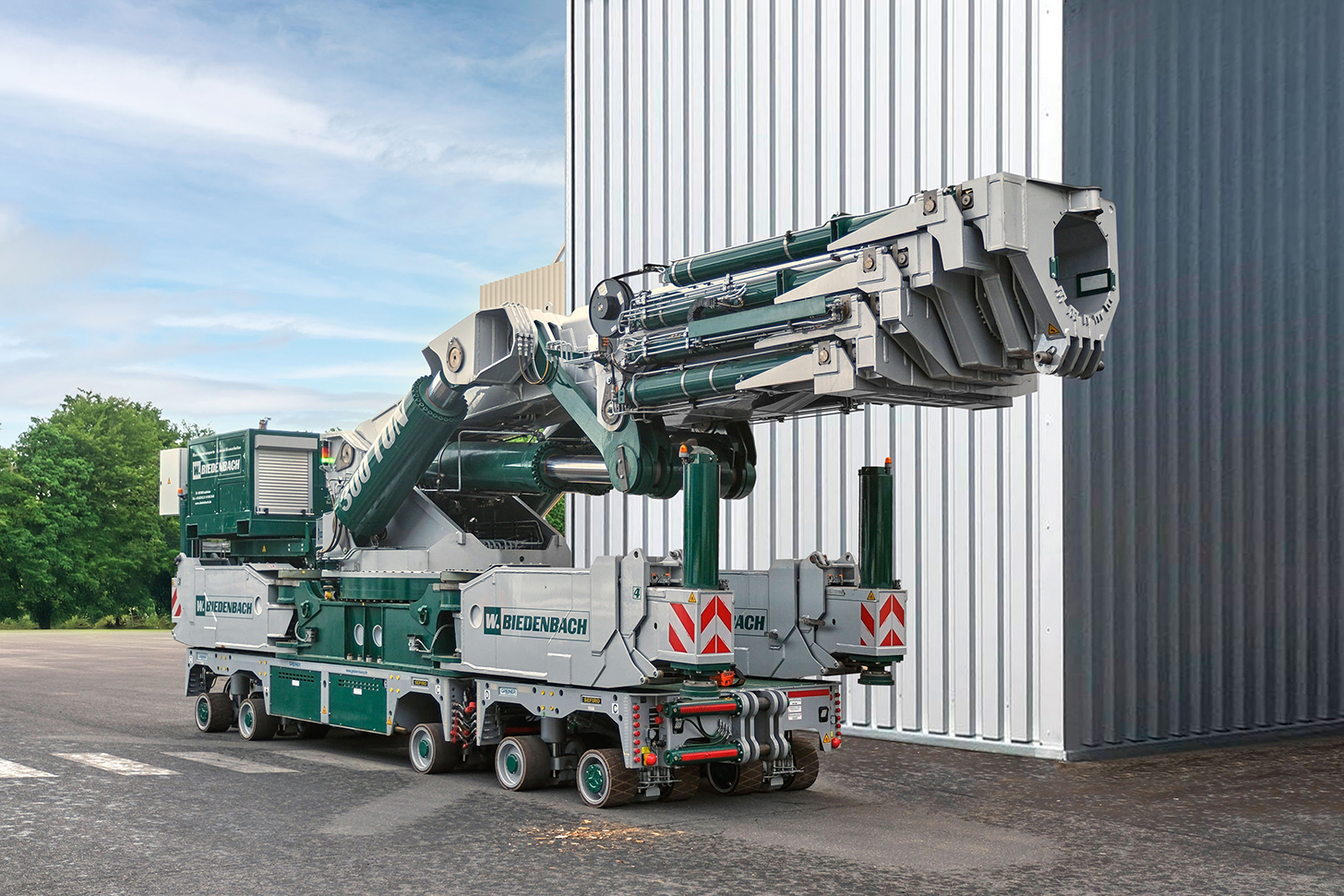
German engineering marvel: The HS 850 hybrid heavy-duty crane from ematec with 850 ton-meters of lifting capacity in a width of only two meters – Image: ematec
Removing factory roof tiles is a thing of the past: A Bavarian special crane saves industry millions
Too heavy, too big, too narrow? How an Allgäu hybrid crane is pushing the boundaries of machine transport
Why this new electric heavy-duty crane from the Allgäu region is the solution to a huge industrial problem
Industrial production facilities are becoming increasingly larger and more complex, but existing factory buildings aren't growing with them. When the latest generation of heavy-duty machines needs to be installed, manufacturing companies often face an extremely costly dilemma: Conventional heavy-duty cranes are simply too large for the existing factory doors, frequently requiring the costly dismantling of roofs or entire walls. A remarkable piece of German engineering now solves precisely this bottleneck in internal machine transport: the HS 850 hybrid heavy-duty crane, developed by the Neu-Ulm-based engineering firm Teco and built by ematec AG from the Allgäu region. It combines a massive lifting capacity of 850 ton-meters with an astonishingly compact width of just 2.42 meters. The following analysis examines how this emission-free, Bavarian niche innovation not only minimizes costly operational disruptions but also has the potential to significantly disrupt a multi-billion-dollar market dominated by global corporations.
When tons of precision meet two meters of width
For years, Germany's industrial SMEs have been under a dual pressure: production facilities are becoming ever larger, more complex, and heavier, while the skilled workers who need to move and install these facilities are becoming increasingly scarce. In this context, ematec's new HS 850 hybrid heavy-duty crane positions itself as a remarkable technological solution to a structural problem that has received little attention in economic analysis to date. The crane was jointly developed by the engineering firm Teco from Neu-Ulm and is now manufactured and distributed worldwide by ematec AG from Memmingerberg in the Allgäu region. This analysis places this innovation within the broader context of the crane market, special-purpose machinery manufacturing, and industrial location policy, and assesses where the HS 850 truly unfolds its economic potential and where the limitations of this technology lie.
A multi-billion dollar market in transition as a stage for niche products
The global market for mobile cranes is experiencing solid growth. Depending on the market research institute, the market volume for 2026 is estimated at between approximately US$17 billion and US$22 billion, with annual growth rates of around 5 to 8 percent until the early 2030s. This growth is primarily driven by infrastructure projects, the expansion of renewable energies, and increasing investments in industrial manufacturing capacities. The broader crane market as a whole, which also includes stationary and tower cranes, is even estimated at nearly US$36 billion for 2026 and is expected to grow to over US$43 billion by 2031. Within this broad sector, however, the market remains heavily dominated by a few established large corporations, including Liebherr, Manitowoc, SANY, Tadano, XCMG, and Zoomlion, which together control a significant share of the global market. For a special machine manufacturer like ematec, which has primarily been known in the field of automation technology and rotor blade traverses for wind turbines, entering this segment represents a conscious strategic diversification into a niche that has so far been hardly served by the industry giants: the compact, hall-suitable heavy-duty crane for in-plant machine transport.
Why conventional cranes are reaching their limits
The true economic relevance of the HS 850 only becomes apparent when one understands the underlying problem it is designed to solve. Modern, state-of-the-art manufacturing systems, such as milling and drilling centers or injection molding machines, increasingly combine multiple machining steps in a single machine. This trend toward process integration and automation almost inevitably results in increased size and weight. Traditional overhead cranes, gantry cranes, or conventional mobile cranes often reach their physical limits in these situations because they either cannot provide the necessary lifting capacity in confined spaces or simply cannot fit through existing factory doors. The previous practice in such cases often involved temporarily dismantling building sections, walls, or roof structures to even be able to set up the necessary crane infrastructure. These structural interventions not only incur direct costs but, above all, significant indirect costs due to operational interruptions and production downtime, which can quickly reach six figures per day in capital-intensive manufacturing environments.
Technical indicators as an expression of a well-thought-out compromise
With a load moment of up to 850 ton-meters, the HS 850 achieves a lifting capacity that enables it to handle even current and future, heavier generations of machinery. At the same time, with a width of just 2,420 millimeters and a transport height of 2,550 millimeters, the crane remains so compact that it fits through virtually any standard warehouse door. This combination of high lifting capacity and small dimensions represents a considerable engineering balancing act, as a crane's weight and footprint typically increase significantly with its lifting capacity. This conflict is resolved by a five-section telescopic knuckle boom, which achieves load handling through variable geometry instead of relying on a rigid, oversized crane structure. This is complemented by telescopic outriggers that can be extended from 6,000 to 10,000 millimeters, ensuring stability even in halls with very limited space.
Electric drive as a business and ecological argument
A key differentiating feature of the HS 850 is its battery-electric and therefore emission-free drive. In times when companies are increasingly bound by ESG criteria, operational emissions balances, and occupational safety regulations, a crane that can operate without a combustion engine in enclosed production halls is more than just a technological gimmick. It reduces the need for complex exhaust systems, lowers noise levels for personnel, and avoids compliance with complex regulations for operating combustion engines indoors. Power is supplied by a high-voltage battery, which can be charged either via a stationary 380-volt power supply with currents of 16, 32, or 63 amps, or alternatively via a detachable power pack with its own combustion engine and generator, which can also function as an emergency power generator if required. This hybrid charging logic gives the operator maximum flexibility, allowing for both pure electric operation in sensitive environments and self-sufficient power supply at locations without adequate grid infrastructure, such as construction sites or rural industrial areas.
From factory floors to tunnel construction: A surprisingly wide range of applications
While the HS 850's origins clearly lie in the internal transport of machinery within the manufacturing industry, closer examination reveals a significantly broader range of economic applications. Its use in the multi-row arrangement of heavy battery storage systems is particularly interesting – a market segment that is likely to gain considerable importance in the coming years in light of the energy transition and the massive expansion of stationary storage capacities. In track and rail construction, where space is limited and strict timeframes for construction work are typical, as well as in tunnel systems where access heights and widths are often severely restricted, the compact design of the HS 850 offers a genuine functional advantage over conventional lifting solutions. This diversity of applications suggests that with the HS 850, ematec has not only created a niche product for the automotive and mechanical engineering industries, but a potentially cross-industry tool whose market potential could extend far beyond its original target group.
The hidden cost accounting behind every machine relocation
Perhaps the most significant economic benefit of the HS 850 lies in the near-complete elimination of dismantling building components and plant equipment. In practice, installing particularly large or heavy machinery has often required the temporary removal of parts of the building structure, windows, doors, or even roof segments to position a suitable crane or maneuver the load through existing openings. Such structural modifications not only incur direct labor costs but also tie up considerable planning resources and extend the overall installation time by days or even weeks. Since manufacturing companies cannot access the affected plant components or entire sections of the building during this period, lost revenue, penalties for late order fulfillment, and opportunity costs add up to a total burden that far exceeds the pure construction costs. A crane whose compact geometry allows it to fit through existing factory doors and virtually eliminates operational interruptions thus directly alters the cost calculation for any major plant investment by a manufacturing company.
From commissioned development to series production: The HS 850's journey to the market
What is also remarkable about the HS 850 is its development path, which exemplifies successful innovation processes in German SMEs. Originally, the engineering firm Teco, under the direction of graduate engineer Robert Haid, developed a prototype for W. Biedenbach GmbH, a specialist provider of machine transport, machine relocation, and indoor crane services. This customer-specific project subsequently evolved into a production-ready product, which has now found an experienced and financially and technically strong partner for global marketing in ematec. This constellation, in which a specialized engineering firm handles the technical development and an established special-purpose machine manufacturer with almost thirty years of experience and over sixty employees ensures industrial scaling and global sales, is a frequently underestimated but highly effective innovation model in German mechanical engineering. It combines the agility of small, specialized engineering teams with the sales reach, service network, and manufacturing capacity of a larger industrial company.
🎯🎯🎯 Data-driven B2B industry hub as a quasi-in-house solution

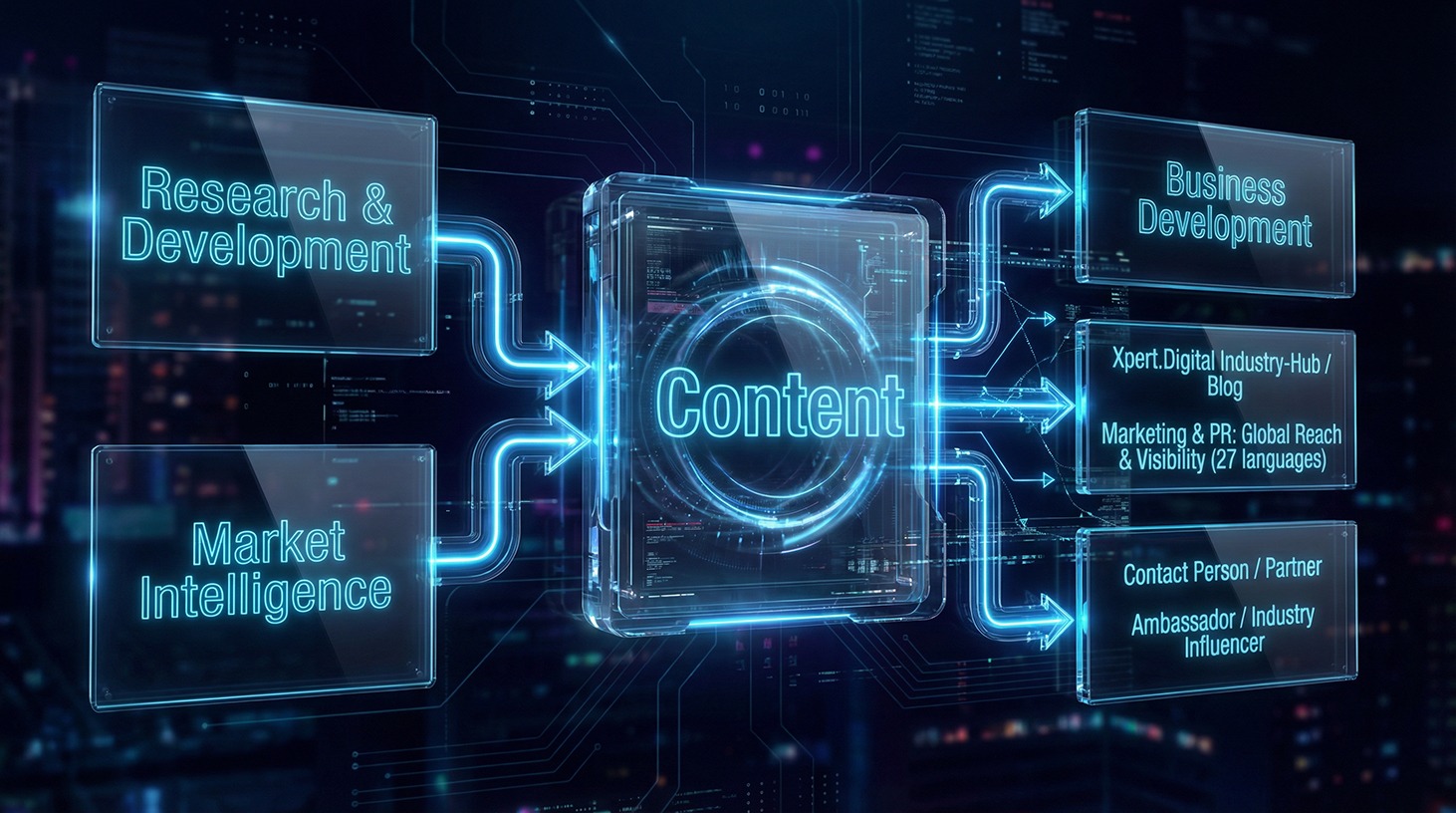
The quasi-in-house solution: How Xpert.Digital closes operational gaps in B2B marketing and sales – Smart Content-Driven Business - Image: Xpert.Digital
Xpert.Digital is a data-driven B2B industry hub led by Konrad Wolfenstein . The company acts as an external, quasi-in-house solution for industrial partners, closing operational gaps in marketing, content, and sales – without requiring additional resources on the client side.
More information here:
Innovation as a way out of the industry crisis: Why the HS 850 is a role model for medium-sized businesses
Ematec as a reference case for successful portfolio diversification
To fully understand the strategic importance of the HS 850 for ematec, it's worth looking at the company's previous positioning. Over the past nearly thirty years, ematec has primarily made a name for itself as a provider of automation and handling technology and counts virtually the entire German and international automotive industry among its reference customers, including Daimler, BMW, Volkswagen, Porsche, Ford, and General Motors. In addition, the company supplies major players in the mechanical and plant engineering sector such as Liebherr, GROB-Werke, Zeppelin, and Airbus. ematec's position in the wind power sector is particularly noteworthy: The RBC-D rotor blade traverse developed by the company is considered a global benchmark for lifting equipment used to install rotor blades and is used by Germany's largest wind turbine manufacturer, Enercon, in a fleet of over thirty units. This experience with highly specialized lifting equipment for extreme load cases forms a plausible technological bridge to the new heavy-duty crane segment and suggests that ematec has significant internal know-how in the design of load moment monitoring, load capacity calculation and safety-critical control technology, which is now being transferred to a new product segment.
Structural change in German special-purpose machinery manufacturing as a background image
The market launch of the HS 850 comes at a time when the German special-purpose machinery sector as a whole is under considerable pressure. Machinery production in Germany already shrank by 5.7 percent in 2024, while a further decline of 0.6 percent was expected for 2025, even though global industry growth reached 3.6 percent during the same period. This discrepancy between global growth and domestic stagnation illustrates that German mechanical engineering companies are increasingly under pressure in international competition, particularly from Chinese suppliers. At the same time, a recent analysis by the management consultancy H&Z shows that cost pressures, a shortage of skilled workers, and global market changes are forcing the industry to undergo a strategic realignment, in which digitalization, service orientation, and the development of new market niches are considered key success factors. Against this background, ematec's decision to open up a new, clearly differentiated product niche with the HS 850, instead of competing in the price competition of existing standard segments, appears to be strategically logical and exemplary of the path that many German medium-sized companies must take in order to maintain their competitiveness.
Safety and usability as an underestimated competitive factor
In addition to its load-bearing capacity and size parameters, the HS 850's control technology also deserves attention. Operation is via a radio remote control, allowing users to precisely control crane movements, while integrated load moment monitoring reliably prevents overloads. Furthermore, various pre-programmed operating modes are available, which automatically optimize the reach of the individual telescopic segments depending on the application and load weight. This level of automation significantly reduces the operator qualification requirements, representing a considerable economic advantage given the widespread shortage of skilled workers in the construction and mechanical engineering sectors. Companies that rely on specialized crane operators with years of training are increasingly facing personnel shortages, while intuitive, software-supported systems can noticeably alleviate this dependency.
Logistics and transportability as a practical success factor
An often underestimated, yet highly relevant economic aspect of heavy-duty cranes is their ability to be transported to their respective work sites. The HS 850 has been consistently designed for flexibility in this regard: a conventional low-loader is sufficient for road transport, while self-propelled all-terrain chassis are available for use in rough terrain. For everyday operation in factory halls on level, firm ground, a chassis with all-wheel steering and its own drive is used. Thanks to integrated outriggers, the crane is immediately ready for operation after unloading, without the need for time-consuming assembly work on site. This feature significantly reduces setup times and makes the HS 850 economically attractive even for short-term, project-based assignments where renting a specialized, but time-consuming, large crane simply wouldn't be cost-effective.
Modularity as an answer to heterogeneous customer requirements
The HS 850's expandability through various accessories underscores its ambition to cover the broadest possible range of applications with a single base machine. For vertical load movements, a specially developed Teco winch with a roller head is available, which can be attached to the sixth telescopic arm. For work directly under the ceiling, a heavy-duty jib with a load hook and roller head offers additional precision in vertically confined spaces. For particularly large working areas in terms of height and width, such as when lifting over obstacles, a jib extension completes the portfolio. This modular configurability allows ematec to serve a broad customer base, from the automotive industry and plant engineering to specialized transport companies, with a single basic platform, without having to develop a completely new machine for each application. From an economic perspective, this increases economies of scale in production and significantly improves the return on development costs.
Market opportunities between euphoria and realistic assessment
The statements made by the participating company representatives regarding the market potential of the HS 850 are naturally optimistic, with CEO Manfred Eberhard of ematec speaking of enormous potential for a product that is unprecedented in this form. A sober economic assessment should put this euphoria into perspective. While the overall market for mobile cranes is large, with global sales of around 17 to 22 billion US dollars, it is dominated by established corporations whose core products focus on standard segments such as truck cranes, tower cranes, and crawler cranes. In contrast, the HS 850 addresses a very specific niche segment: heavy-duty cranes for in-plant use in confined, hall-bound environments with extremely high load moments. This segment is likely to be significantly smaller than the overall market, but due to the limited number of direct competitors, it probably offers above-average margins and lower price sensitivity, as customers primarily consider the avoidance of operational disruptions and modifications as their deciding factor, rather than the pure purchase price.
Limits and open questions of the new technology
Despite its impressive technical innovation, some questions naturally remain regarding the HS 850's economic potential. For example, it is unclear how the crane's acquisition and operating costs compare to alternative solutions such as hiring specialized heavy-lift crane services or making targeted structural modifications to factory buildings. Similarly, it remains uncertain how large the actual target customer base is that regularly handles such heavy and bulky loads in confined spaces, and whether ematec can develop a viable business model encompassing sales, rentals, and service for the HS 850. The question of international scalability, particularly in markets with different building regulations and occupational safety standards than Germany, is also likely to be crucial for the product's long-term commercial success. These uncertainties do not diminish the technical achievement of the development, but they do warrant a more nuanced approach to expectations regarding actual market penetration.
A prime example of successful niche strategies in German mechanical engineering
Overall, the HS 850 hybrid heavy-duty crane provides a vivid example of how German medium-sized companies in the special-purpose machinery sector can tap into new growth areas through targeted technological differentiation, despite a challenging economic environment. Instead of competing with large international corporations in the fiercely competitive and price-sensitive mass market for standard cranes, ematec, together with the engineering firm Teco, deliberately chose to develop a narrow but technically demanding niche where compactness, lifting capacity, and emission-free operation make all the difference. The economic value of this innovation lies less in short-term production volumes than in avoiding costly operational downtime when making investment decisions for new, larger machine generations – a cost factor that is rarely explicitly addressed in traditional market studies but ties up considerable sums in the day-to-day operations of manufacturing companies. Whether the HS 850 will actually become the new standard for the installation of heavy industrial plants, as its developers hope, will have to be shown in the coming years by the actual market penetration and the first reliable practical references beyond the pilot customer Biedenbach.
📈🚀 From visibility to trust 👀🤝 Your scalable path with Xpert.Digital

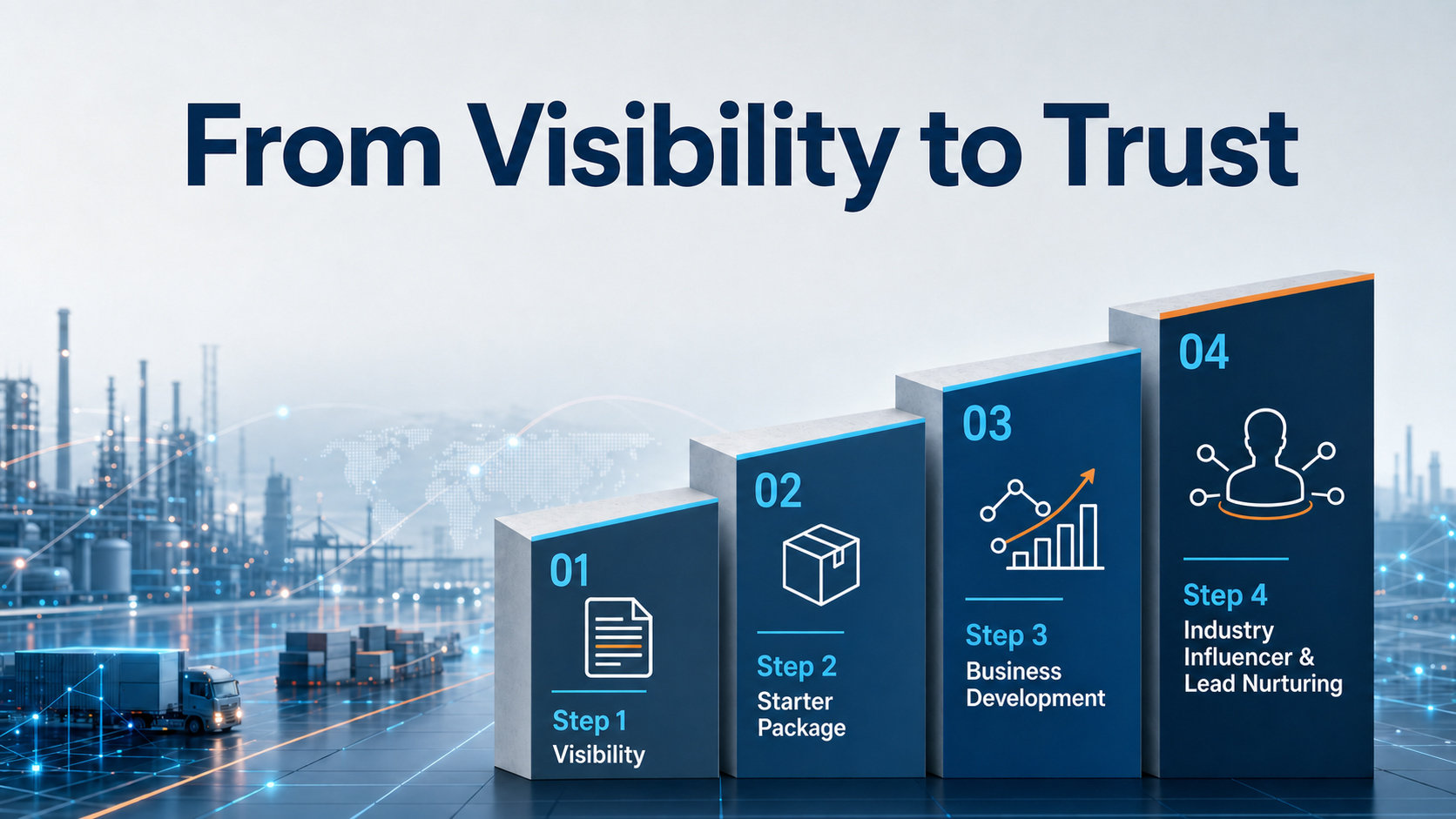
From visibility to trust: Your scalable path with Xpert.Digital - Image: Xpert.Digital
In industrial B2B, sustainable business relationships rarely emerge overnight. They develop step by step – through visibility, professional relevance, recurring touchpoints, and growing trust. Xpert.Digital's 4-stage model addresses precisely this: It offers a structured path that begins with a manageable entry point and can evolve into deeper collaboration in business development if needed.
Instead of relying on loud marketing promises, this model puts the relationship at the forefront. Companies start with clearly defined, easily calculable measures and then decide, based on their own experience, how far they want to expand the collaboration. A key factor for this undisturbed trust-building process: The platform completely avoids annoying advertising ads, so the editorial focus remains solely on the companies' expertise.
More information here:
Your global marketing and business development partner
☑️ Our business language is English or German
☑️ NEW: Correspondence in your native language!

Konrad Wolfenstein
I and my team are happy to be available to you as your personal advisor.
You can contact me by filling out the contact form here wolfenstein@xpert.digital:or simply call me at +49 7348 4088 965. My email address is
I'm looking forward to our joint project.