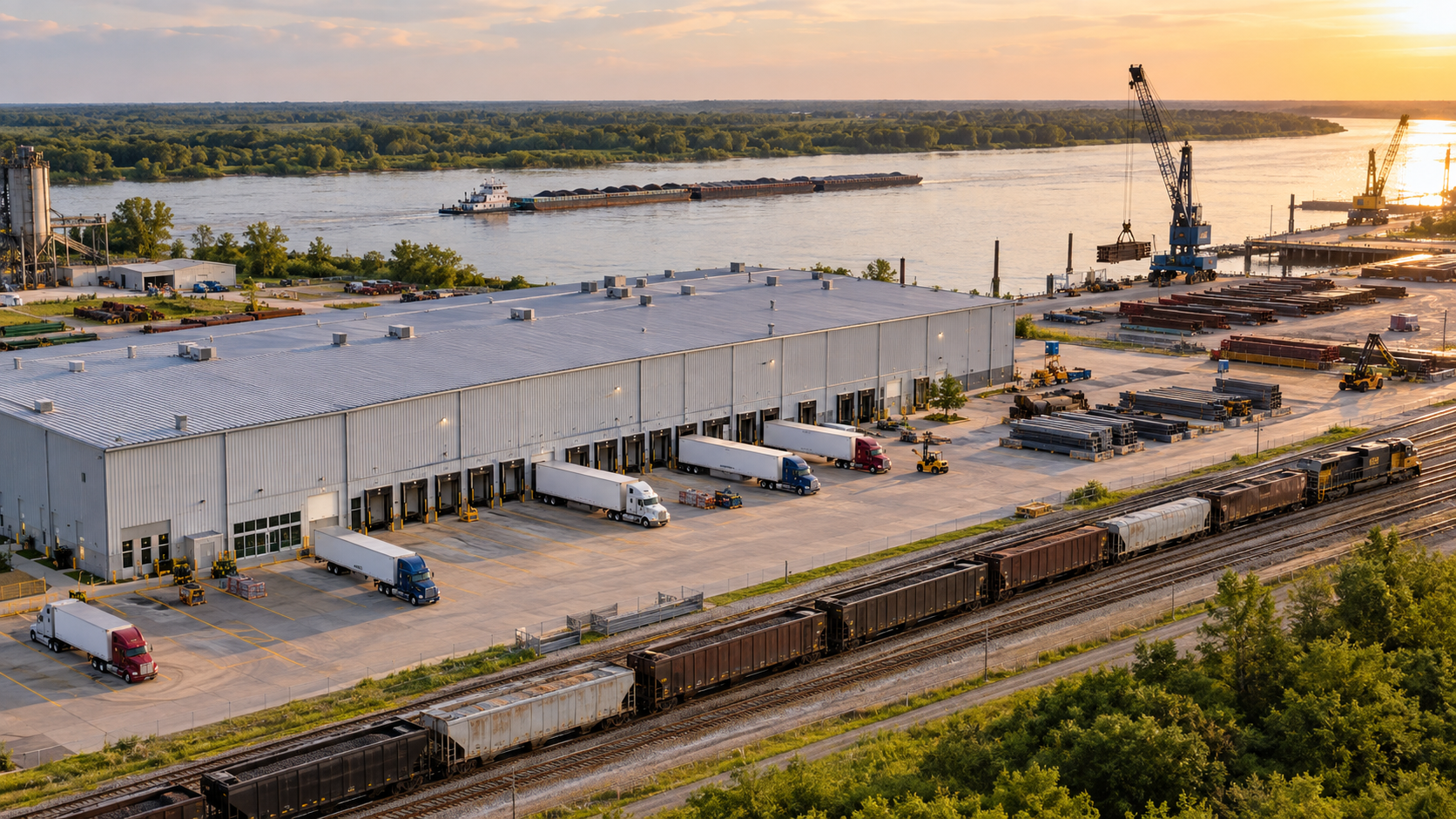
Small ports, huge leverage: Why Louisiana is pumping millions into inland logistics – Creative image on the topic, with AI: Xpert.Digital
Location advantage through preparation: How the “FastSites” program attracts new US industry – Louisiana’s smart bet on small inland ports
Multimodality as insurance: Why small US inland ports are suddenly becoming strategically important
From reacting to preparing: Louisiana's radical transformation of economic development
In the fierce national and international competition for industrial development, the US state of Louisiana is radically changing its strategy: Instead of waiting to expand infrastructure until an investor signs a contract, the state is making massive upfront investments. The key concept of this new industrial policy is "Site Readiness." Through the "FastSites" program, which has been increased to $200 million, land, utility connections, and warehouses are being specifically prepared for construction, offering companies looking to locate there what is arguably the most important asset in today's location competition: time. It is no coincidence that the focus is not only on the major maritime ports on the Mississippi, but also on smaller, multimodal inland ports in the hinterland, such as those in Natchitoches and Alexandria. With seemingly unspectacular investments in foundations, buildings, and paved heavy-load areas, Louisiana is removing crucial bottlenecks. It is the creation of a new, resilient industrial axis, where flexibility, smart logistics, and a revolving financing model are intended to make local regions future-proof.
Louisiana's small ports, big bet: A few million for concrete and warehouses – or the beginning of a new industrial axis?
Louisiana is realigning its industrial policy: Instead of waiting until an investor is already on the scene to plan roads, rail lines, storage areas, and utility connections, selected sites will be made operational in advance. At Natchitoches Parish Port in Campti, $2.55 million is being invested in additional storage capacity. At Central Louisiana Regional Port in Alexandria, nearly $2 million is being added for a paved heavy-load area. Together, this brings the total investment to more than $4.5 million for two inland ports that, at first glance, can hardly compete with the major maritime hubs on the Mississippi. Economically, this is precisely the interesting point: Louisiana is trying to develop not only its well-known deep-water ports, but also smaller, multimodal hubs in the hinterland into industrial growth platforms.
The sums involved seem modest compared to multi-billion-dollar factories, energy projects, or container terminals. Nevertheless, their potential leverage is considerable because they address bottlenecks that can determine the realization of private investments. A missing warehouse, an unsuitable open space, or an inadequately prepared construction site can disqualify a location from consideration, even if land prices, wages, and transport connections appear attractive. The projects in Natchitoches and Alexandria should therefore be seen less as isolated construction projects and more as building blocks of a strategy that links public infrastructure investment, industrial land provision, and private expansion.
From reacting to preparing
The core of the new location policy is so-called site readiness, meaning the actual development maturity of an industrial site. Available land alone is no longer sufficient in today's competition for business locations. Companies want to know whether permitting risks are limited, access roads are reliable, utilities are available, soils have been investigated, and expansion areas are usable. Especially for production and logistics projects, the time until operations commence increasingly determines profitability. Every month of delay ties up capital, postpones revenues, and increases the risk that cost assumptions will become outdated.
Louisiana is therefore attempting to finance some of this preliminary work itself. The Site Investment and Infrastructure Improvement Fund, operating under the name FastSites, has been increased by $50 million to a total of $200 million. This amount signals that the focus is not on two individual projects, but rather on building a statewide portfolio of prepared industrial sites. In the first round of the program, 19 sites in 16 parishes were selected. Besides ports, these include airport grounds, industrial parks, and other areas suitable for manufacturing, logistics, energy projects, and new technologies.
This approach postpones the timing of government intervention. Traditional economic development often supports a pre-selected company with tax breaks or subsidies. Land acquisition planning begins earlier, sometimes even before a specific user has been identified. While this increases the risk of a bad investment, it can simultaneously improve the selection prospects for an entire region. By providing pre-existing infrastructure, Louisiana is essentially buying time, reliability, and visibility in the investment market.
Natchitoches doubles its scope of action
Natchitoches Parish Port currently has approximately 62,000 square feet of storage space, equivalent to about 5,760 square meters. The planned expansion will nearly double this capacity. Funding will cover site preparation, foundations and base slabs, as well as additional warehouse space. Construction is scheduled to begin at the end of 2026, with completion expected in 2027. The new area will not only accommodate traditional storage but also manufacturing, processing, assembly, cargo handling, and industrial services.
This mix of uses is crucial. A warehouse at an inland port is more economically valuable if it doesn't merely store goods but supports multiple stages of the value chain. Pre-assembly, packaging, quality control, customer-specific processing, and cargo consolidation can transform a simple logistics property into a production component. This increases the number of potential users. Agricultural producers, wood processors, machine manufacturers, building material companies, and project logistics providers have different requirements but can utilize the same multimodal infrastructure.
The port already possesses features that support this development. It is situated on the Red River, has more than five miles of its own rail yards, including extensive sidings, and is connected to regional economic centers by road. It is approximately ten miles from Interstate 49. In addition, it offers transshipment facilities between barge, rail, and truck, a 62,000-square-foot existing transit hall, a barge dock, a covered rail transshipment area, its own locomotives, and space for further development. The expansion, therefore, does not create an entirely new logistics function, but rather eliminates a capacity bottleneck at an existing platform.
An inland port as an industrial interface
Natchitoches is the only port on the Red River with a backwater protected from the main current. This locational advantage is relevant for certain cargoes and operational procedures because loading and unloading are less directly affected by currents and shipping traffic. The Red River, in turn, connects northern and central Louisiana to the larger Mississippi waterway system. While the waterway does not replace road or rail, it can offer significant cost advantages for heavy, bulky, or time-sensitive goods.
The economic function of a port therefore lies not primarily in maximizing cargo throughput, but in combining different transport routes. A company can receive raw materials by inland waterway, transport intermediate products by rail, and distribute finished goods regionally by truck. This flexibility increases resilience to disruptions and creates room for negotiation on freight rates. It is particularly valuable when individual modes of transport are affected by low water levels, construction sites, a shortage of rolling stock, a lack of drivers, or capacity bottlenecks.
Multimodality, however, is not automatic. Every change of transport mode necessitates additional handling, scheduling, and documentation. For short distances or high-value express goods, direct road transport often remains the superior option. The port can therefore only leverage its advantages if sufficiently large shipment volumes are consolidated, transshipment processes are efficient, and warehouse space is located close to the rail yard and quay. The planned expansion will improve precisely this spatial and operational integration.
Alexandria is building for the energy sector
The second project at the Central Louisiana Regional Port follows a different logic. There, nearly $2 million is being invested in a ten-acre heavy-load storage area. Ten acres is roughly equivalent to four hectares; the occasionally used figure of ten hectares would more than double the area and is factually incorrect. The so-called hardstand is a highly durable, paved outdoor area where heavy raw materials, assemblies, and finished equipment can be stored, moved, and prepared for transport.
The primary user of this space is DisTran Packaged Substations, a manufacturer of pre-assembled electrical substation solutions. The company is expanding at the port as part of a larger industrial complex. Production and storage buildings, as well as extensive outdoor areas for heavy-load storage and staging, are planned or under construction. The FastSites financing thus closes a specific capacity gap within an already initiated private and public investment. Parts of the site were completed and in use by mid-August 2026; the remaining work was scheduled for completion by the beginning of November.
The economic significance extends beyond a single operation. The expansion of the power grid in the US is increasing the demand for transformers, switchgear, substations, and pre-assembled systems. This demand is driven by aging grid infrastructure, new industrial developments, data centers, renewable energy sources, electrification, and rising power requirements. A port location can offer advantages for large and heavy components because it allows for the spatial integration of transport, intermediate storage, and assembly. The site in Alexandria therefore serves simultaneously as production infrastructure and a logistics reserve for a market of strategic importance.
Concrete is not trivial
Paved heavy-duty areas rarely feature prominently in political debates. For industrial users, however, they can be among the most valuable assets of a site. Large steel structures, transformers, pre-assembled modules, or cable drums cannot be stored permanently on unprepared ground. Settlement, drainage problems, and limited load-bearing capacity hinder cranes, heavy vehicles, and the safe flow of materials. A sufficiently sized area shortens distances, prevents damage, and allows production and shipping to be decoupled.
This is particularly important in project-based manufacturing. Substations and similar systems are not produced in consistent quantities like consumer goods. Order receipt, completion, and shipment can be staggered. Without buffer space, production would have to be throttled as soon as finished systems await shipment. The hard stand therefore acts as a physical buffer, increasing the factory's effective output without requiring every additional unit to leave the plant immediately.
At the same time, storage space should not be confused with productivity. High inventory levels can also indicate delayed deliveries, transportation problems, or inefficient planning. Economic benefits only arise through professional space management, digital inventory control, safe transport routes, and coordinated transport windows. The investment provides the necessary hardware; productivity depends on operational processes.
The state becomes a patient co-investor
The revolving financing model is particularly interesting. The port partners must return the invested capital to the fund so that it can be used again later for infrastructure projects. This distinguishes FastSites from a traditional non-repayable grant. The government provides upfront financing, assumes a portion of the initial risk, and expects the funds to become available again as the economy develops.
Such a model can extend the impact of a single public dollar across multiple investment cycles. If $200 million is issued as a one-time payment and not repaid, the immediate funding capacity ends after the first round. If a large portion flows back, the same capital can successively prepare several sites. In theory, this creates a continuous infrastructure cycle. In practice, its stability depends on repayment terms, project success, contract terms, and the quality of the selected sites.
The model also disciplines project selection. An area for which there is no realistic demand cannot reliably generate a return on investment. Therefore, market potential, infrastructure deficits, timelines, and economic viability must be considered together. Nevertheless, a conflict of objectives remains: If the state were to finance only secure and quickly profitable projects, structurally weak regions could be left out. However, economic development is intended to create additional opportunities precisely where private capital alone is too hesitant to invest. The fund must therefore balance the need for a return on investment with its regional policy mandate.
Small sums with potential leverage
The $2.55 million in Natchitoches and nearly $2 million in Alexandria are not full-scale industrial investments. Rather, they finance those components that enable or accelerate further investment. With good utilization, a new warehouse can generate revenue through rent, handling fees, services, and increased demand for land. At the same time, users benefit from lower initial costs and shorter start-up times. The macroeconomic leverage arises when public upfront investments mobilize significantly more private capital.
In addition, there are indirect effects. Construction companies, planners, maintenance firms, transporters, and local suppliers receive contracts. New or expanding businesses pay wages, purchase services, and increase the local tax base. Employees spend a portion of their income in the region. Such multiplier effects are real, but are often overestimated in location debates. Not every contract remains local, not every new job is filled by a previously unemployed person from the community, and some of the additional spending flows to other regions.
A reliable assessment should therefore not begin with the largest possible job creation promises. More important are capacity utilization, subsequent private investment, wage levels, job security, and the amount of funds actually recouped. Since no concrete number of new jobs has yet been announced for the Natchitoches expansion, any precise job forecast would be speculative. The reliable statement is: The investment improves the conditions for employment, but does not guarantee it.
Structural policy in a vulnerable region
Natchitoches Parish has approximately 37,000 residents and struggles with economic challenges typical of many rural areas in the United States. The median household income is significantly below the national average, and about a quarter of the population lives below the poverty line. The population has been declining since 2010. For such a region, industrial infrastructure has a different significance than for an already overburdened metropolitan area. It is intended not only to facilitate growth but also to secure economic stability and limit outmigration.
The port can act as an anchor in this context, attracting site-specific facilities and long-term uses. A company that utilizes warehouses, rail sidings, cranes, and specially prepared areas is less likely to relocate its operations than a purely office-based business. Furthermore, industrial jobs can offer attractive incomes even for employees without academic degrees. The benefits increase when regional educational institutions provide qualifications in maintenance, welding, warehouse management, machine operation, and transport management.
However, a warehouse alone cannot solve structural problems. Population decline, low labor force participation, educational deficits, health problems, and limited housing also affect the quality of a location. When skilled workers are lacking, companies must recruit employees from further afield or automate processes. A successful port strategy therefore requires complementary measures in education, childcare, mobility, and community quality of life. Otherwise, while the attractiveness of the area may increase, the participation of the local population is not necessarily guaranteed.
Speed becomes a location factor
Companies today increasingly evaluate locations based on the speed with which they can be built and commissioned. This trend has several causes. Supply chains are becoming more regionally organized, geopolitical risks are changing procurement strategies, and market share in future-oriented industries is often gained within short investment windows. At the same time, construction costs and financing have become more expensive. Delays therefore have a direct impact on net present value and competitive position.
A prepared warehouse can significantly shorten market entry time. Instead of first having to organize soil investigations, drainage, foundations, and structural work, a user can adapt existing spaces. A prepared heavy-load area also reduces lead times because materials can be safely stored even during the ramp-up phase. For location consultants, this likelihood of successful implementation is often more important than a nominally low land price.
Louisiana is supplementing FastSites with certified industrial sites and standardized site information. More than 120 prepared or certified sites are intended to offer investors comparability. The state is thus attempting to reduce information costs. The clearer the data on utilities, environment, ownership, transportation, and costs, the lower the risk of unpleasant surprises. Infrastructure investment and data strategy are therefore two sides of the same coin: First, a site is physically prepared; then its readiness must be credibly documented and marketed.
Your intralogistics experts

Consulting, planning and implementation of complete solutions for high-bay warehouses and automated storage systems - Image: Xpert.Digital
More information here:
Multimodality as the key to logistics optimization
Multimodality as insurance
The past few years have shown that supply chains must be able to react not only to average costs but also to disruptions. Ports have become congested, rail networks have suffered from bottlenecks, truck capacities have fluctuated, and extreme weather events have interrupted transport routes. An inland port with water, rail, and road access does not offer complete security, but it does provide more contingency options than a location that relies solely on trucks.
For companies, this flexibility can be invaluable. Even if inland waterway transport isn't always the fastest option under normal operating conditions, its availability limits dependence on other modes of transport. For heavy bulk goods, it can simultaneously reduce transport costs and energy consumption per ton-kilometer. Rail, in turn, is suitable for larger, regular shipments over longer distances, while trucks handle the final distribution.
This advantage must be weighed against infrastructural risks. The Red River is a controlled waterway system with locks and limited channel depth. Maintenance, water levels, and the reliability of the facilities affect its usability. Similarly, a rail connection is only valuable if wagons are available, service frequencies are adequate, and the connection to the regional network functions properly. Site readiness, therefore, does not end at the property line. It encompasses the quality of the entire corridor.
Industrial policy without a blank check
Public upfront investments are economically justifiable when they correct market failures. Infrastructure often benefits multiple users, has long amortization periods, and requires high initial investments. A single company may not finance a public access road, a port facility, or a comprehensive site assessment, even though several subsequent users would benefit. The government can bridge this coordination gap.
Nevertheless, infrastructure policy must not become a blanket assumption of private costs. If a facility serves almost exclusively one company, the question arises as to how much that company should contribute itself. FastSites requires equity contributions, the share of which can range between 50 and 80 percent depending on the type of project, and links the financing to a return of capital. This improves the alignment of interests: Local stakeholders and users must contribute their own money and cannot shift the entire investment to the state.
Transparency regarding results remains crucial. Meaningful key performance indicators (KPIs) would include rented square meters, turnover volume, number and quality of users, private follow-up investments, newly created and secured jobs, average wages, loan repayment status, and additional local revenue. Environmental and traffic impacts should also be recorded. Only in this way can it be assessed after a few years whether the sites have actually become more productive or simply have more space.
The port as a platform, not as a solitary structure
The greatest economic benefit arises when a network of complementary businesses develops around a port. Manufacturers need suppliers, packaging companies, repair services, freight forwarders, testing laboratories, and staffing agencies. Warehouse space can serve as an entry point, as new companies can initially rent and gradually increase their investment. With growing demand, specialization and shared labor markets emerge.
Natchitoches could attract industries that align with the existing economic structure and infrastructure. These include forestry and timber products, agricultural goods, building materials, metal processing, machine components, project cargo, and regional distribution. The warehouse should not be too narrowly tailored to a single user. Flexible doors, sufficient floor load capacity, crane options, modular floor plans, and good connections increase reusability and reduce the risk of vacancy.
Alexandria already has an industrial anchor tenant in DisTran. This facilitates the formation of a cluster around power grid technology and heavy-duty manufacturing. Suppliers could establish themselves nearby if order volume and available space are suitable. At the same time, a concentration risk arises: If the anchor tenant runs into difficulties or demand shifts, specially designed spaces could be underutilized. Here, too, the broadest possible utilization is economically advantageous.
Jobs between craftsmanship and automation
Industrial and logistics developments are often associated with job growth. However, the nature of this employment is changing. Modern warehouses require less manual labor per square meter than older facilities. Digital inventory management, automated conveyor technology, sensors, and semi-autonomous vehicles increase productivity. In manufacturing, machines are taking over repetitive or dangerous tasks. This doesn't necessarily reduce overall employment, but it does shift demand toward technically skilled jobs.
For Natchitoches and Central Louisiana, therefore, it's not just the number of jobs that matters, but also the skill set required. Mechatronics engineers, welders, electricians, crane operators, maintenance personnel, dispatchers, and digital warehouse management specialists are becoming increasingly important. These professions offer career advancement opportunities but require training and ongoing professional development. Without a coordinated skills development strategy, companies may be unable to fill vacancies, while a portion of the local population would still be excluded from these new opportunities.
Collaboration with schools, colleges, and regional employers should therefore begin concurrently with construction. Curricula can be adapted to real-world facilities and processes, internships organized, and certificates offered for specific tasks. A shared training model is particularly attractive for smaller companies, as they often cannot operate their own programs economically. The port can thus not only share physical infrastructure but also become a platform for skills development.
The competition between locations will be decided before the groundbreaking ceremony
Louisiana is not alone in its strategy. US states are competing fiercely for manufacturing projects, distribution centers, battery plants, data centers, and energy facilities. Besides taxes and subsidies, factors such as available power, water, rail connections, permitting certainty, and readily available land are crucial. States with large, prepared sites can offer companies multiple alternatives and thus more frequently make the shortlist.
Louisiana already has 125 active certified sites and is expanding its position with FastSites. The new funding not only increases the number of sites available but also aims to bridge the gap between formal certification and practical construction readiness. A property can be surveyed and marketed without a building, a viable outdoor area, or a reliable utility connection. FastSites focuses on those final, often expensive steps that transform a suitable property into a production site ready for immediate use.
For Natchitoches, competition comes not only from other parishes, but also from locations in Arkansas, Texas, Mississippi, and other southern states. While proximity to major markets is less than in metropolitan areas, land acquisition, traffic congestion, and land use conflicts can be less expensive. The port must combine this cost advantage with credible infrastructure. The new terminal improves its position, but it doesn't replace proactive location marketing or a clear industry strategy.
The 200 million program requires rigorous selection
As the fund grows to $200 million, so does its political and economic responsibility. A large program can generate economies of scale, establish standardized testing procedures, and advance multiple regions simultaneously. However, it can also tempt developers to over-promote industrial sites without sufficient demand. Industrial areas are long-term; a poor decision ties up capital and incurs maintenance costs for years, even if no tenant moves in.
A rigorous selection process should therefore combine several factors. First, there must be plausible demand from defined sectors. Second, transportation, energy, water, labor, and permitting capabilities must be compatible. Third, the infrastructure should be flexible enough to accommodate other users if the original interested party withdraws. Fourth, every project needs realistic revenue streams. Finally, it should be examined whether the public investment actually stimulates additional private activity or merely replaces expenditures that were already planned.
The revolving structure offers some protection but does not eliminate risk. Interest-free or very low-cost public funds have economic value, even if they are formally repaid. Delayed repayments reduce the fund's ability to finance new projects. Therefore, not only nominal amounts but also time value, default risk, and administrative costs are relevant. Professional portfolio management must combine successful, low-risk projects with more structurally demanding initiatives.
Political coordination as a factor of production
These projects demonstrate the many institutions involved in regional economic development. Louisiana Economic Development provides the financial and strategic framework. Under the leadership of Susan B. Bourgeois, land acquisition is treated as a long-term competitive challenge. Locally, the Natchitoches Parish Port, under Executive Director Travis Tyler, is responsible for planning, construction, and subsequent marketing. The Central Louisiana Regional Port plays a similar role in Alexandria.
Political support from the region, including from Representative Jack McFarland, and the work of the North Louisiana Economic Partnership under President and CEO Justyn Dixon connect local interests with state-sponsored location promotion. These stakeholders have distinct roles: the state reviews and funds projects, port authorities develop and operate projects, regional economic development agencies seek users, and elected representatives ensure political legitimacy. The model will only be economically successful if these roles are effectively integrated and decisions are not delayed by jurisdictional conflicts.
Good coordination is itself a location factor. For investors, it matters whether questions are answered quickly, approval processes are explained, and reliable timelines are adhered to. A modern warehouse loses value if a company has to mediate between authorities for months. Conversely, an efficient central contact point can partially compensate for the disadvantages of a smaller location.
The next round increases the pressure to succeed
The next application round for the FastSites program begins on October 1, 2026. Applicants must demonstrate their own financial contribution, explain the benefits to Louisiana, and submit a feasible timeline. Depending on the project type, the expected contribution ranges from 50 to 80 percent of the total costs. Funding amounts between $500,000 and $25 million are available. Construction is generally expected to begin within nine months of the agreed-upon schedule.
With each new round, the benchmark becomes more stringent. Future projects should not be judged solely on whether they have been structurally completed. Crucially, previous sites have attracted users, drawn in private capital, and generated returns. Natchitoches and Alexandria thus become test cases for the credibility of the entire program. If they achieve their operational targets, this strengthens the case for further investment. If the halls and sites remain underutilized, criticism of supply-side industrial policy will intensify.
The timing is favorable, but challenging. In Alexandria, the facility's use is already closely linked to an ongoing industrial expansion. This reduces the marketing risk. In Natchitoches, construction will not begin until the end of 2026 and is scheduled for completion in 2027. There, tenant acquisition must occur concurrently with construction to ensure the new capacity isn't only offered to the market after completion.
Success begins with the right hall design
The economic performance of the Natchitoches expansion depends heavily on technical details. Floor loads must be suitable for heavy goods, gates and maneuvering areas must be adequately sized, and the hall should be able to separate different users. Fire protection, lighting, power supply, data connectivity, and drainage influence usability just as much as the sheer square footage. If construction is focused solely on the lowest possible cost, the facility may be unsuitable for attractive industrial clients.
The location within the port is also crucial. Short distances to the rail yard, truck access points, and the quay reduce internal transport costs. Areas for temporary storage and safe traffic management prevent different operational processes from interfering with each other. Forward-looking planning also takes future expansions into account without unnecessarily increasing the cost of current investments.
Flexibility is more important than maximum specialization. A universally usable hall may not achieve perfect efficiency for every single process, but it reduces the risk of long-term vacancy. Mobile partitions, retrofittable crane systems, multiple loading options, and modular utility connections broaden the pool of potential tenants. For a smaller market, this adaptability is a key economic asset.
Environment and infrastructure must be considered together
Shifting heavy goods to inland waterways and rail can relieve road congestion and be more efficient per ton transported. At the same time, every industrial development impacts land use, drainage, and local traffic flows. New sealed surfaces increase the need to manage rainwater, and storing industrial materials requires strict safety standards. Therefore, sustainability is not automatically achieved simply by being located near water.
Flood and extreme weather risks should be considered during planning and operation. Louisiana is regularly affected by heavy rain, storms, and other weather events. Critical facilities, electrical systems, and stored goods must be positioned to minimize operational disruptions. Redundant power and data supply can be just as important in modern logistics processes as the load-bearing capacity of the foundation slab.
A robust investment is initially more expensive, but can result in lower failure and insurance costs over its lifetime. This life-cycle perspective is particularly important for a revolving public fund. Short-term savings during construction must not lead to high repair costs or rapid technological obsolescence, as this would jeopardize the repayment and reuse of capital.
What the numbers really say
More than $4.5 million for two ports is a visible signal, but not yet proof of economic success. The $2.55 million in Natchitoches initially buys construction work and additional capacity. The nearly $2 million in Alexandria initially creates usable land. Only utilization, throughput, and private investment will transform these physical assets into regional value creation.
The nearly doubled storage capacity also needs to be put into perspective. Starting from approximately 62,000 square feet, an almost complete doubling would be significant for the port. However, in the national logistics real estate market, the total area remains comparatively small. This is not a disadvantage if it is tailored to regional demand. A small, well-utilized, and multimodally integrated site can be more productive than a large, speculative building without suitable tenants.
The ten acres in Alexandria are also not a huge area, but they are operationally relevant for heavy-duty manufacturing. Their impact stems from their integration into a larger industrial campus and the expansion of DisTran. The comparison reveals two different funding logics: Natchitoches expands a generally usable infrastructure with open development potential, while Alexandria eliminates a specific bottleneck for an existing growth trajectory. The second option is less risky in the short term, while the first can open up broader options in the long term.
A sober assessment of the opportunities
The strongest justification for the investments lies in their perfect fit. Natchitoches already has water, rail, and road connections, as well as experience in handling large quantities of materials. Additional warehouse space complements existing assets, rather than creating a new logistics environment on undeveloped land. Alexandria, in turn, connects the heavy-load area with an expanding manufacturer in a strategically growing market. Both projects thus address real operational needs.
The greatest risks lie in demand, implementation, and regional capacity. Natchitoches needs to attract enough users to fully utilize the additional capacity. Alexandria must avoid becoming overly dependent on a single company or investment cycle. Both regions require skilled workers and reliable interregional transport corridors. At the same time, the government must ensure that repayments are not only contractually stipulated but also economically viable.
Under these conditions, FastSites is more than classic subsidy policy. The program treats prepared industrial sites as public capital that should be used productively and reinvested. This perspective is economically compelling as long as selection, monitoring, and reinvestment remain consistent. It is not compelling if political visibility replaces demand assessment or if success is measured solely by the amount of money spent.
The real gamble is on future viability
Louisiana's investments in Natchitoches and Alexandria are not just in warehouses and paved areas. The state is betting that speed, multimodality, and prepared sites will become scarce commodities in the next phase of US industrialization. This assumption is plausible. Companies that are bringing production back to the US, regionalizing supply chains, or expanding network infrastructure need space that is ready for use without years of preparation.
Whether the gamble pays off, however, won't be decided at the opening. Success will only be evident when the Natchitoches hall is in regular use, goods are transferred between water, rail, and road, companies invest, and local workers find skilled employment. In Alexandria, the heavy-load facility must contribute to scaling manufacturing and shipping without becoming an expensive storage area. Ultimately, the return of capital to the fund will test whether a political idea translates into a sustainable investment system.
These projects therefore deserve neither euphoria nor disdain. $4.5 million is too small to generate major headlines; however, for the affected ports, it could be structurally significant. Louisiana is pursuing a sensible approach: eliminating bottlenecks before they hinder investment and deploying public capital as many times over as possible. The crucial challenge now lies in converting construction readiness into actual industrial demand. Concrete and warehouses create opportunities. Value creation only occurs when companies, workers, and logistics networks utilize these opportunities sustainably.
Your global marketing and business development partner
☑️ Our business language is English or German
☑️ NEW: Correspondence in your native language!

Konrad Wolfenstein
I and my team are happy to be available to you as your personal advisor.
You can contact me by filling out the contact form here wolfenstein@xpert.digital:or simply call me at +49 7348 4088 965. My email address is
I'm looking forward to our joint project.