
From bottleneck to high-performance warehouse at Daifuku: The logistics transformation of SLS Bearings Singapore
Xpert Pre-Release

Language selection 📢
Published on: March 26, 2026 / Updated on: March 26, 2026 – Author: Konrad Wolfenstein
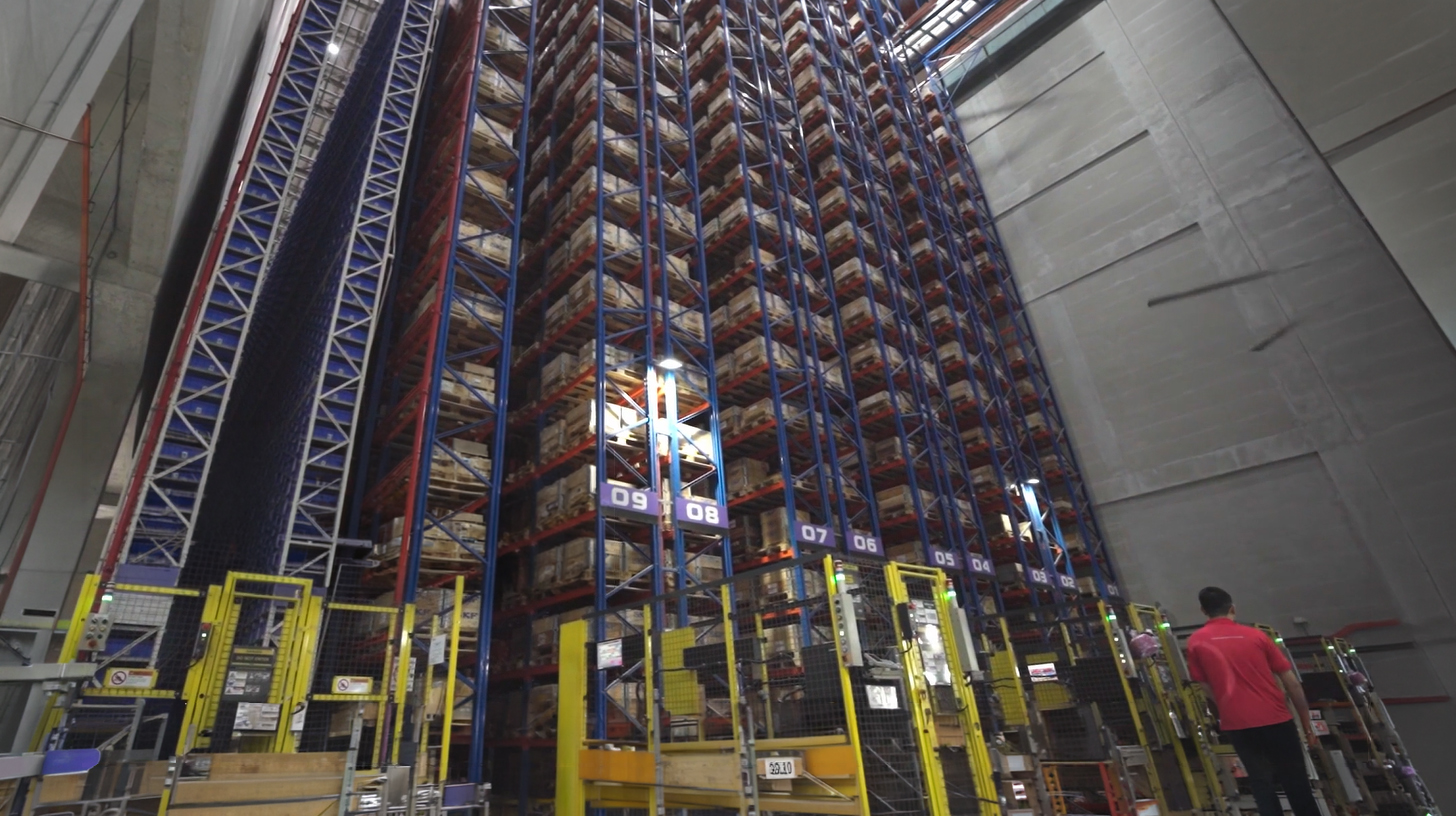
From bottleneck to high-performance warehouse by Daifuku: The logistics transformation of SLS Bearings Singapore – Image: Daifuku
Why a warehouse determines market leadership – and what industry can learn from it
Singapore as Asia's logistical epicenter
To understand why a medium-sized rolling bearing distributor in Singapore is investing several million euros in a highly automated distribution center, one must first grasp the economic and geographical context in which SLS Bearings operates. Singapore is no ordinary city-state, but rather the logistical nerve center of Southeast Asia. The metropolis lies at the crossroads of the most important sea routes between Europe, the Middle East, and the Asia-Pacific region, and with the Port of Singapore, it boasts one of the busiest and most efficient port infrastructures in the world. As early as 2024, the port's aggregate throughput exceeded 40 million TEU, while the ongoing expansion of the mega-port of Tuas is expected to increase the total capacity to 65 million TEU in the long term.
For international companies, Singapore is now the logistical gateway to Southeast Asia, or even the entire Asia-Pacific region. Political stability, a transparent legal system, low taxes, a multilingual workforce, and a dense network of free trade agreements create an environment that is hard to beat for globally operating trading and logistics companies. At the same time, this attractiveness creates a disadvantage that puts pressure on the entire warehousing and logistics sector: space is a scarce and expensive commodity in the city-state, which covers only about 730 square kilometers. According to one industry expert, warehouses are bursting at the seams, and many logistics companies are therefore investing in expanding and technologically upgrading their capacities.
SLS Bearings (Singapore) Pte. Ltd. operates precisely within this economic landscape. Founded in 1963, the company has established itself over more than six decades as a significant intermediary in the field of rolling bearings and drive technology. It sources its products from manufacturers in Japan, China, and Europe, supplying a diverse clientele in the automotive, food processing, and mining industries in Singapore and neighboring Malaysia, China, and Indonesia. The company's strategic strength lies precisely in what makes Singapore such an attractive location: its ability to function as an efficient hub within a complex regional trade network.
The failure of the old system – a growth trap of the classical type
Growth is rarely the problem itself, but it ruthlessly exposes existing weaknesses in structures. SLS Bearings experienced precisely this for many years at its old location. The automated storage system already installed there by a previous supplier had initially been sufficient to handle the volumes at the time. However, with the continued business boom, the system reached its capacity limits. As a quick fix, conventional racking was added to bridge the storage gap – a reaction frequently observed in practice, providing short-term relief but exacerbating operational problems in the long run.
The real structural flaw, however, lay deeper. Information and material flow had not been designed coherently at the old location. The layout did not allow for continuous process optimization, and the spatial separation of storage areas forced employees to move from aisle to aisle when picking orders. In addition, the picking stands were not ergonomically adjusted to the employees' height – a seemingly small detail with a major impact on work speed, error rate, and, in the long term, on the physical strain on the workforce.
The combination of these factors had a number of well-documented negative consequences: Order picking was among the most labor-intensive and error-prone areas of warehouse logistics. Studies show that this process step can account for up to 55 percent of total operational warehouse costs. In a manual environment, every non-ergonomic workplace design and every unnecessary walking distance leads directly to productivity losses. For a company processing around 3,000 orders per day, these inefficiencies add up to significant financial losses.
The strategic conclusion drawn by SLS Bearings was therefore not only technical, but also profoundly entrepreneurial: Moving into the new facility in Tuas was not simply about creating more space, but about embarking on a conceptual restart. The requirement was clear – the new system had to follow the "goods-to-person" principle and overcome all the design shortcomings of its predecessor.
The new building in Tuas – site selection based on strategic logic
In March 2017, SLS Bearings relocated its headquarters to a new site in the Tuas district of western Singapore. This decision was by no means trivial. Tuas is the area where Singapore is implementing its most ambitious infrastructure project to date: the construction of the Tuas Mega Port, which, upon completion, will be the world's largest fully automated container port. The choice to locate the new distribution complex in close proximity to this emerging port infrastructure is strategically sound. It shortens transport routes for imported goods from overseas, accelerates the outbound logistics for international customers, and positions the company within a growth corridor that will only increase in importance over the long term.
Alongside the new headquarters, a fully operational 24/7 distribution center was built, equipped with a large-scale automated high-bay warehouse. Singapore's freight market is projected to reach approximately US$24.5 billion by 2025, with a projected growth rate through 2030 fueled by the expansion of the TUAS (Transportation and Logistics Services) network, digitalization initiatives, and the increasing relocation of production facilities from China to ASEAN countries. For a company like SLS Bearings, which directly benefits from the intensity of regional freight exchange as an intermediary, the timing of the investment in state-of-the-art warehouse infrastructure was ideal from a market strategy perspective.
The unit-load high-bay warehouse – impressive dimensions
The centerpiece of the new distribution center is a large-scale automated high-bay warehouse for palletized goods. The facility offers space for 19,950 pallets and extends over a length of 105 meters, a width of 21 meters, and a height of 27 meters. These dimensions reflect what Daifuku, as a leading global provider of intralogistics solutions, has pursued in its product development for decades: the maximum density of storage capacity in vertical space while simultaneously optimizing throughput speed.
The system allows loading and unloading from both the front and the opposite side of the facility. Two high-speed shuttle sorting vehicles are installed at the front, processing goods for international customers via 18 storage stations. Domestic customers are served from the rear. A detail that underscores the sophistication of the system design is the pallet consolidation capability: Pallets with low fill levels are combined into a fully filled unit at a pick-and-deposit station on the second floor to maximize storage space utilization.
Daifuku, the systems supplier, is not a niche player. For years, the company has topped the ranking of the 20 largest intralogistics providers by the US trade magazine "Modern Materials Handling" and most recently achieved a business volume of more than four billion US dollars. Since introducing its first automated storage and retrieval system in 1966, Daifuku has delivered more than 34,000 storage and retrieval machines worldwide. This market position has a direct impact on the quality of product development, the availability of spare parts, the reliability of after-sales support, and ultimately, the long-term operational success of installations like the one at SLS Bearings.
The Mini-Load system – intelligence in small-format storage
Alongside the large pallet racking warehouse, SLS Bearings initially planned a conventional mezzanine racking concept for the high-frequency items handled in its domestic business. This plan seemed logical: multi-tier racking systems are tried and tested, cost-effective to purchase compared to fully automated systems, and allow for rapid scaling through the use of additional order pickers. However, after a visit to Daifuku's Hini Arata Kan demonstration center, the company fundamentally revised this assessment.
The actual speed of modern mini-load high-bay racking systems experienced there significantly exceeded expectations. A Daifuku system with high-speed double telescopic forks was able not only to replace the mezzanine level with equivalent efficiency, but to surpass it with significantly reduced personnel. The economic rationale behind this is clear: warehouse automation typically halves personnel costs, virtually eliminates error costs, and reduces the cost per picking location – in sample calculations from around €0.60 in manual operation to approximately €0.24 in the automated system.
The "goods-to-person" principle, which served as the guiding principle for the new overall concept, is particularly evident in the mini-load system. Instead of order pickers traversing endless aisles, the system automatically calls the required goods to the workstation. Errors caused by reaching into the wrong shelf are eliminated, search times are reduced, and the ergonomic stress caused by monotonous walking routes and awkward reach heights – a major problem identified in the old warehouse – is structurally resolved.

Expert partner in warehouse planning and construction
How warehouse automation in Singapore reduces space costs by up to 85%
Economic impact analysis: What automation actually brings
The quantitative results of the transformation are impressive. Storage capacity more than doubled compared to the previous level, within the same or a comparable building footprint. SLS Bearings now stores 70,000 different items and picks around 3,000 orders daily at full system capacity. For comparison, industry literature generally considers warehouse automation a worthwhile investment only when picking rates reach approximately 1,000 picks per day. SLS Bearings is therefore exceeding this threshold threefold.
The global market for automated storage and retrieval systems exceeded US$5.7 billion in 2024 and is projected to continue growing at a compound annual growth rate (CAGR) of 5.8 percent through 2034. The overall warehouse automation market was valued at approximately US$26.5 billion in 2024 and is expected to expand further through 2034, driven by e-commerce growth, rising labor costs, and an increasing shortage of skilled workers. Automated storage and retrieval systems alone held a 26.3 percent market share within this overall category in 2024. SLS Bearings anticipated this structural shift early on.
One of the most economically significant effects lies in the drastic reduction in floor space required per stored unit. ASRS systems, through vertical stacking and the elimination of wide aisles, enable a reduction in floor space requirements of up to 85 percent compared to conventional storage solutions. In a high-price market like Singapore, where commercial real estate is among the most expensive in Asia, this space efficiency has a direct impact on the rental cost or depreciation rate per stored item. Every square meter that doesn't need to be occupied represents a measurable cost advantage in the Singaporean context.
In addition, the standardization of operational processes is a key benefit. The new system allows for precise timely order picking based on the shipping schedule – a prerequisite for reliable delivery commitments to customers in Malaysia, Indonesia, and China. Paperless order picking, made possible only through system integration, not only reduces consumable costs but, more importantly, the error rate in order fulfillment. Studies show that manual warehouses without additional quality control measures can incur annual costs of around €150,000 due to errors; automated systems structurally reduce this error rate to the single-digit per mille range.
The "goods-to-person" principle as a strategic paradigm shift
What SLS Bearings has achieved in Tuas goes beyond a simple technical system replacement. It represents the practical implementation of a paradigm shift in warehouse logistics, a concept discussed in the industry as "goods-to-person." This principle reverses the traditional logic of order picking: instead of people moving to the goods, the goods are automatically brought to the people. The consequences are not only economic but also socio-economic in nature.
Physical strain caused by long walking distances, lifting in awkward positions, and monotonous reaching movements is reduced through intelligent system design. This is particularly relevant in countries with a limited labor supply and rising wage levels—both realities that apply especially to Singapore. Singapore's city-state model, with its limited resident population dependent on foreign skilled workers, creates chronic pressure on the labor market, making automation not only economically but also structurally inevitable.
The interplay of mini-load and unit-load systems at SLS Bearings resulted in a two-tiered system architecture that meets the different requirements of domestic and international business. High-frequency picked domestic items are managed in the mini-load area, while high-volume palletized goods for international markets are handled via the large high-bay warehouse. This structural differentiation demonstrates a mature understanding of logistics concepts that do not seek a one-size-fits-all solution, but rather treat different goods flows according to their specific requirements.
Daifuku as a system partner: Technology meets service quality
In intralogistics, choosing a system supplier is a decision with long-term implications. Highly automated warehouse systems are maintenance-intensive, software-wise complex, and potentially involve significant follow-up costs in the event of a malfunction. It is therefore no coincidence that Yeo Seng Huat, Logistics Distribution Manager at SLS Bearings, explicitly highlights Daifuku's first-class after-sales service in his evaluation, alongside the technical performance. In an industry where smooth 24/7 operation is essential, this aspect carries just as much weight as the investment itself.
Daifuku's global positioning should not be underestimated. As a leading company in the intralogistics ranking, with annual sales exceeding four billion US dollars and a global installation base of more than 34,000 storage and retrieval machines, the Japanese systems provider boasts a scale that combines deep technological innovation with a worldwide service presence. This combination is particularly important for internationally operating customers like SLS Bearings, as it ensures system updates, spare parts supply, and technical support throughout the entire lifespan of a system, typically 15 to 25 years.
Warehouse automation as a competitive strategy in Asia
The SLS Bearings case study is a well-documented example of how warehouse automation is evolving from a mere efficiency tool into a strategic weapon in regional competition. In the ASEAN region, which is increasingly positioning itself as a production and trade alternative to China, the demand for reliable distribution partners with high delivery quality and short response times is rising. In this context, the ability to process 3,000 orders daily flawlessly, on time, and paperlessly is not merely operational convenience, but a tangible differentiator from competitors still relying on conventional warehousing processes.
At the same time, this investment positions SLS Bearings for a growth phase structurally favored by external factors. The relocation of supply chains out of China, the so-called "China-plus-x" strategy of many multinational companies, strengthens Singapore as an alternative hub and increases the demand for high-performance warehousing and distribution infrastructure in the region. In parallel, the Singaporean government is continuously investing in the modernization of logistics infrastructure and incentivizing the digitalization and automation of warehouse processes through funding programs.
The global market for warehouse automation was valued at US$16.4 billion in 2022 and is projected to grow to over US$67 billion by 2032, representing an average annual growth rate of approximately 15 percent. This growth is being driven not only by large corporations but also increasingly by medium-sized businesses that recognize that manual warehouse processes are no longer a competitive option in the long term, given rising labor costs, increasing order volumes, and shorter delivery times.
Economic indicators at a glance
| Key figure | Old location | New location Tuas |
|---|---|---|
| Storage capacity for pallets | < 19,950 (limited) | 19,950 pallet spaces |
| Stored item positions | Significantly less than 70,000 | 70,000 SKUs |
| Daily order picking | Not optimized | ~3,000 orders/day |
| Operating hours | Restricted | 24-hour operation |
| picking principle | Person to goods (manual) | Goods to person (automated) |
| Paper picking | Yes | Paperless |
| Space efficiency | Conventional | Up to 85% area reduction possible |
| System utilization | Overloaded / supplemented | Full capacity utilization |
The economic indicators show significant improvements at the new Tuas site compared to the old one: Storage capacity increases from less than 19,950 to 19,950 pallet spaces, and the number of stored item positions rises from well under 70,000 to 70,000 SKUs. While order picking at the old site was not optimized, the new site enables approximately 3,000 orders per day. Operating hours have changed from limited operation to continuous 24-hour operation. The order picking principle is also being modernized—from manual "person-to-goods" to automated "goods-to-person"—and paper-based order picking is being replaced by a paperless system. Furthermore, space efficiency improves considerably (with a potential reduction in floor space of up to 85%), and system utilization increases from overloaded or supplementary operation to full capacity utilization.
The broader lesson: Systems thinking instead of piecemeal solutions
What makes the story of SLS Bearings particularly instructive is the consistent shift away from incremental repair measures in favor of a systemic redesign. Retrofitting conventional racking at a conceptually overstretched site had indeed created temporary capacity, but it didn't address any of the root causes of the problem. This approach—treating symptoms instead of addressing structural deficiencies—is widespread and costly in business practice. It produces hybrid solutions that offer neither the flexibility of manual systems nor the efficiency of automated solutions, but instead combine the disadvantages of both.
The decision to systematically analyze all operational weaknesses of the old site during the move to the new building and translate these into the system requirements of the new warehouse is a textbook example of conceptual clarity. The result – a coherent system of unit-load ASRS and mini-load ASRS, supplemented by shuttle transfer vehicles and paperless process integration – not only solves the original capacity problem but also creates a scalable infrastructure that equips the company for its next phase of growth.
For decision-makers in comparable companies – medium-sized retailers with growing order volumes, regional supply chain complexity, and limited space – SLS Bearings provides a well-documented case study. Payback periods for warehouse automation investments typically range from two to five years, with well-designed systems often reaching profitability within 18 to 36 months. This requires a thorough process analysis beforehand, a well-defined set of requirements, and the selection of a system partner with proven installation and service quality.
Automation as an answer to structural megatrends
SLS Bearings' investment decision is not merely a reaction to past capacity bottlenecks, but an anticipation of structural megatrends that will have a lasting impact on the logistics industry in the coming years. Rising wages, demographic change, and a shortage of skilled workers are increasing the pressure for automation worldwide. In Singapore, where the cost of qualified warehouse personnel is particularly high, this pressure is especially noticeable. At the same time, customer expectations regarding delivery accuracy, order tracking, and response speed are rising to such an extent that manual systems are structurally overwhelmed.
Technological advancements are opening up new possibilities: AI-driven warehouse management systems, digital twins for simulation planning, and the integration of robotic order picking into existing ASRS infrastructures represent the next evolutionary stage of intralogistics. Companies like SLS Bearings, which already rely on a high-performance automated infrastructure, are structurally much better positioned for these technological advancements than competitors who are only at the beginning of their automation journey. The new distribution center in Tuas is therefore not only a response to the challenges of 2017, but also a platform for competitiveness in the coming decade.
Your intralogistics experts

Consulting, planning and implementation of complete solutions for high-bay warehouses and automated storage systems - Image: Xpert.Digital
More information here:
Your global marketing and business development partner
☑️ Our business language is English or German
☑️ NEW: Correspondence in your native language!

Konrad Wolfenstein
I and my team are happy to be available to you as your personal advisor.
You can contact me by filling out the contact form here or simply call me at +49 7348 4088 965. My email address is: [email protected]
I'm looking forward to our joint project.
☑️ SME support in strategy, consulting, planning and implementation
☑️ Creation or realignment of the digital strategy and digitization
☑️ Expansion and optimization of international sales processes
☑️ Global & Digital B2B trading platforms
☑️ Pioneer Business Development / Marketing / PR / Trade Fairs
Our global industry and economic expertise in business development, sales and marketing

Our global industry and economic expertise in business development, sales and marketing - Image: Xpert.Digital
Industry focus areas: B2B, digitalization (from AI to XR), mechanical engineering, logistics, renewable energies and industry
More information here:
A thematic hub offering insights and expertise:
- Knowledge platform covering global and regional economies, innovation and industry-specific trends
- A collection of analyses, insights, and background information from our key areas of focus
- A place for expertise and information on current developments in business and technology
- A hub for companies seeking information on markets, digitalization, and industry innovations










