
Sengkang General Hospital: How Daifuku in Singapore automates and transforms sterile logistics in the operating room
Xpert Pre-Release

Available in 27 languages 📢
Prefer Xpert.Digital on GoogleⓘPublished on: February 6, 2026 / Updated on: February 6, 2026 – Author: Konrad Wolfenstein
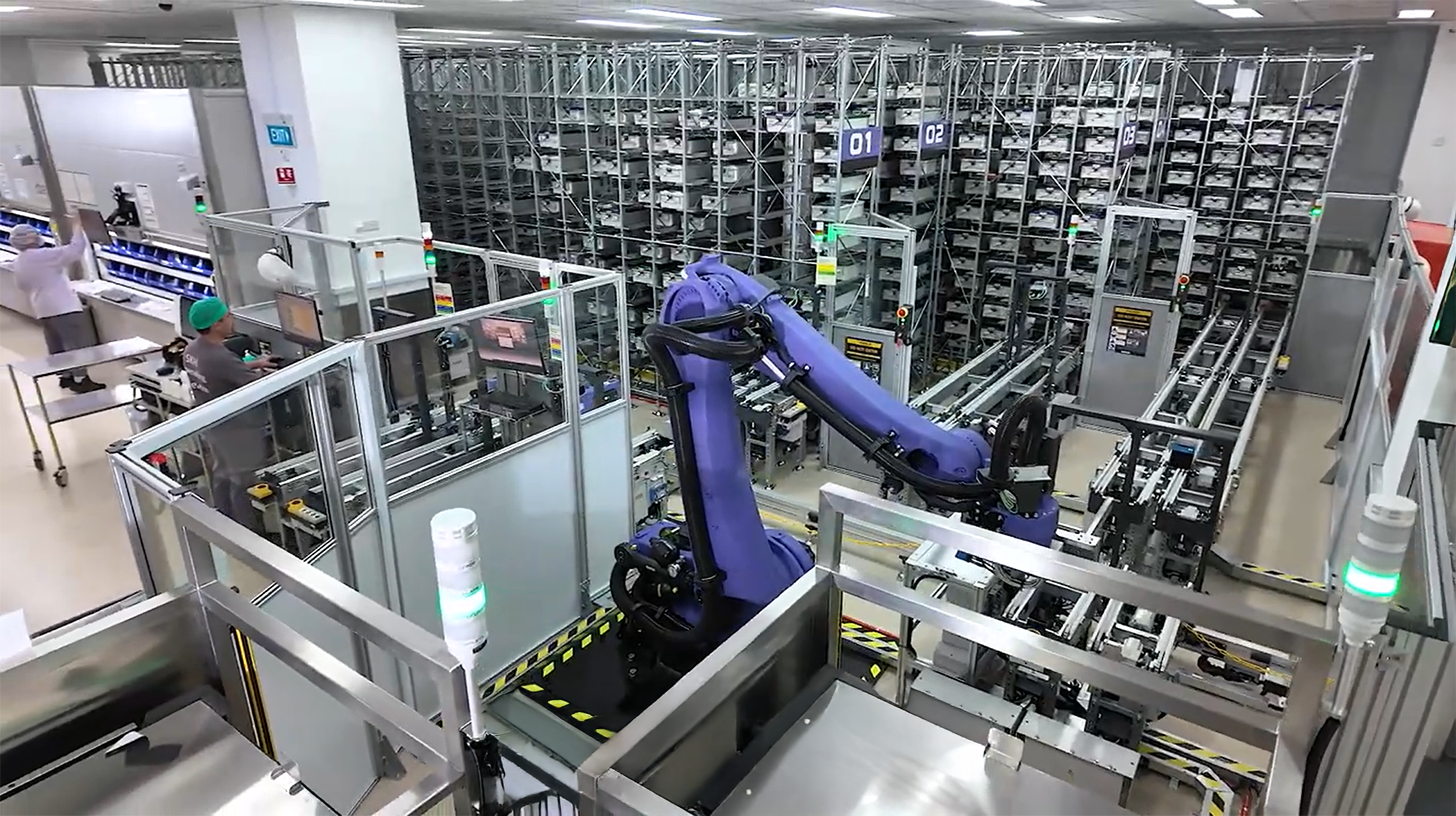
Sengkang General Hospital: How Daifuku in Singapore automates and transforms sterile logistics in the operating room – Image: Daifuku/YouTube
High-tech in the hospital basement: How Daifuku optimizes instrument supply in Singapore
The invisible lifeline of the hospital: How warehouse automation redefines patient safety
No more searching in the CSSU: Daifuku's automated solution for maximum patient safety
In every modern hospital, there is an area that usually remains invisible to the patient, but which determines life and death as well as the success of surgical procedures: the Central Sterile Supply Unit (CSSU). Here, at the heart of instrument supply, thousands of scalpels, clamps, and implants must be cleaned, sterilized, and made available on time for the next operation every day. Yet in many hospitals, this process still resembles a race against time, characterized by manual sorting, disorganized storage areas, and the constant risk of human error.
Sengkang General Hospital in Singapore faced precisely this challenge. With increasing patient numbers and ever more complex procedures, traditional, manual intralogistics was reaching its limits. Lengthy search times for instrument sets jeopardized operating schedules, and limited space made efficient storage almost impossible. The solution lay not in more staff, but in intelligent technology.
In collaboration with intralogistics specialist Daifuku, the hospital implemented a state-of-the-art Automated Storage and Retrieval (AS/RS) system. This conversion marks a paradigm shift in hospital logistics: instead of open shelves, robot-assisted systems now provide vertical, space-saving storage. Controlled by the intelligent WareNavi software and seamless barcode tracking, each instrument set is precisely managed and dispensed within seconds.
This article highlights how the use of Daifuku technology has not only increased efficiency and reduced costs, but above all, how automation has raised hygiene standards and patient safety to a new level. Learn how the interaction between humans and machines has revolutionized modern clinical practice at Sengkang General Hospital.
Related to this:
What role does intralogistics play in the modern hospital?
Hospital intralogistics encompasses all logistical processes that ensure materials, medications, disposable products, and especially surgical instruments are available at the right time and in the right place. This involves not only simple transport but also streamlined processes, high hygiene standards, and maximum availability. In a surgical clinic like Sengkang General Hospital, patient safety depends directly on the timely sterilization, testing, and provision of the necessary instruments.
Traditionally, such processes are largely manual: Instruments are collected after use in the CSSU (Central Sterile Supply Unit), cleaned, disinfected, sterilized, and sorted into boxes or cases. The search for specific instrument sets is then often done visually or via simple lists, which creates potential errors and long waiting times. Especially in large hospitals with many operating rooms, the workload increases exponentially.
With increasing pressure to reduce costs, maintain quality standards, and simultaneously accelerate care, many hospitals have begun automating intralogistics processes. The goal is to minimize human error, utilize capacities more efficiently, and increase the traceability of instruments – precisely the characteristics that define a modern healthcare organization.
What specific challenges did Sengkang General Hospital face?
Sengkang General Hospital in Singapore is a modern, large hospital offering a wide range of surgical procedures. As patient numbers and the complexity of procedures increased, so did the need for high-quality surgical instruments that were readily available. At the same time, strict adherence to patient safety and hygiene standards was essential. This led to several key challenges in the area of intralogistics:
First, the manual storage and search for instrument sets in large sterilization areas was extremely time-consuming. If specific instruments were needed shortly before an operation, staff often had to search extensively for the correct boxes, jeopardizing the planned operating time. Second, there was a high risk of errors, such as taking the wrong sets or omitting certain instruments from a set. Third, the traceability of individual instruments was limited, which could lead to major problems in the event of infection risks or quality issues.
Additionally, space at CSSU was limited, while the number of different instruments and instrument sets was constantly growing. This led to an overload of storage areas, sometimes even to chaotic piles that compromised hygiene and quick accessibility. Sengkang General Hospital therefore sought a solution that would not only accelerate processes but also reduce the error rate, increase traceability, and utilize existing space more efficiently.
Why is the Central Sterile Supply Unit (CSSU) a critical hub?
The Central Sterile Supply Unit is essentially the heart of instrument supply in many hospitals. All instruments returned after surgical use pass through several stages here: first decontamination, then inspection, followed by packaging and sterilization, and finally proper storage and distribution. An error at the beginning – such as insufficient cleaning or incorrect sorting – can have catastrophic consequences all the way to the end of the chain, including infections in patients.
At CSSU, instruments are often grouped into sets specifically tailored to certain procedures: cardiac surgery, orthopedics, urology, neurosurgery, etc. Each set consists of numerous differently shaped instruments that must be handled according to specific cleaning and sterilization protocols. At the same time, it must be ensured that no instrument is lost, that no corrosion or damage is overlooked, and that the sterilization process is documented.
In this environment, monitoring and efficiency are crucial. Staff must handle enormous quantities of instruments, some very heavy, some in confined spaces. Time pressure arises not only from the surgical schedule but also from the limited capacity of the sterilizers. Inefficient processes in the CSSU can therefore lead to waiting times in the operating room, delayed procedures, or even postponed surgeries.
How does an automated warehouse/order picking (AS/RS) solution change these processes?
The automated storage and retrieval system (AS/RS) represents a significant technological innovation at CSSU. Instead of storing instrument sets in open shelves or stacks, they are stored in closed, addressed containers within an automated system. A mechanical carrier or a special interface retrieves the required set from storage at the push of a button and delivers it to the dispensing area.
This change has numerous effects. Firstly, search times are dramatically reduced. Where previously an employee needed several minutes to find and check a specific set, this now happens in seconds. The high precision of the computer control ensures that the correct set is always requested. Furthermore, the vertical integration allows for significantly more efficient use of storage space – the system can extend to the height of the hall without overloading the floor area.
Another advantage is hygiene. Closed systems reduce the instruments' exposure to dust and ambient air. Controlled loading and unloading eliminates the need for lengthy processes or chaotic relocation. Furthermore, the atmosphere in the storage environment can be controlled, extending the shelf life of sterilized sets.
Another important aspect is the integration of data into the system. Each set can be uniquely identified, and every access to the warehouse is logged. This makes it possible to see when a set was delivered, stored, removed, and returned. This strengthens traceability and quality assurance.
How does the AS/RS system work in the day-to-day operations of CSSU?
The implementation of an AS/RS system at CSSU fundamentally changes the typical workflow. The effects of the system can be readily understood by examining the instrument flow – from decontamination and sterilization to dispensing.
After the cleaning process, the instruments are assembled into prescribed sets. Each set receives a unique identifier, usually via a barcode or RFID tag. This identifier is entered into the central system, which determines where the set is physically stored. The employee checks the set at the receiving station, and the system automatically routes the container to the storage area.
As soon as a set is needed, for example, because a specific procedure is scheduled, the request is entered into the system. The AS/RS system then calculates which set is stored at which location and controls the transport of the container to the dispensing point. There, the employee can retrieve the set and deliver it to the appropriate station. The entire process is controlled with just a few clicks and requires no manual searching.
Much has also changed in the return process: After use, the instruments are returned to decontamination, cleaned, and then reintroduced into the system. The system detects that the set is available again, updates its status, and can restock it as needed. This creates a completely closed loop, coordinated by the AS/RS system.
What role do barcode tracking, WMS and WareNavi play?
Automation via AS/RS does not operate in isolation, but rather integrates with an existing infrastructure of software solutions. Three components are central here: barcode tracking, the Warehouse Management System (WMS), and the WareNavi Warehouse Control System from Daifuku.
Barcode tracking ensures that every instrument, set, and package is uniquely identifiable. Scanning barcodes at entry or exit documents all movements. This enables seamless traceability – in the event of infection outbreaks or quality issues, it is possible to precisely determine which set was used at what time and which patients might be affected.
The Warehouse Management System (WMS) is the software layer that governs warehouse logic. It manages inventory levels, controls inbound and outbound movements, and optimizes the warehouse strategy. It determines where a set is stored, when it is reserved, and which set assignments are intended for specific operations. The WMS then communicates with the warehouse's actual control system.
WareNavi, Daifuku's warehouse control system, directly controls mechanical processes. It translates the WMS commands into concrete movements of the AS/RS components: which axis moves, which gripper engages, and which position is loaded or unloaded. WareNavi ensures that physical actions are precise and fast, and that malfunctions or errors are handled appropriately. The close integration of barcode tracking, WMS, and WareNavi creates end-to-end digitalization, connecting everything from the data level to the mechanical action.
How are unusually large or irregularly shaped instruments handled?
Not all surgical instruments fit into standard sets or regular containers. Specialized instruments, such as large implants, specialized surgical aids, or specific sets, often have different dimensions or shapes. This is where another technology comes into play: vertical carousels.
Vertical carousels are automated storage solutions that rotate vertically, moving containers up and down along a vertical axis. They are particularly suitable for heterogeneous, sometimes irregularly shaped items, as they can be flexibly adapted. At CSSU, such carousels can be used to store special instruments or larger sets that do not fit into the standard drawers or containers of the central AS/RS.
Operation remains simple: An employee selects the desired set via a terminal, and the carousel automatically moves the container to the dispensing position. Simultaneously, the corresponding barcode is scanned, ensuring traceability. The combination of a central AS/RS system and vertical carousels allows the hospital to handle both large quantities of standard instruments and rare, unusual instruments efficiently and safely.

Expert partner in warehouse planning and construction
The quiet transformation in healthcare: Logistics is becoming a strategic success factor
What role does the human play in this automated system?
Although the system achieves a high degree of automation, humans remain indispensable. However, the role of employees is changing: they are becoming less like manual warehouse workers and more like skilled operators and control personnel. They monitor the systems, conduct inspections, troubleshoot problems, and intervene when unusual situations arise.
Automation relieves employees of physically demanding tasks such as lifting heavy boxes or repeatedly searching through large racking systems. At the same time, it creates a higher level of responsibility: employees must understand the processes, operate the systems correctly, and recognize errors. They are responsible for ensuring that no incorrect set or damaged instrument ever enters the operating area.
Human decisions are also required when it comes to priorities. For example, the system can automatically recognize that a specific set is urgently needed, but a human must decide whether another set should be prioritized if multiple procedures are pending simultaneously. The balance between automation and human oversight is therefore crucial: technology handles repetition and precision, while humans remain responsible for judgment and accountability.
How does automation affect patient safety and the quality of care?
Automation directly contributes to patient safety. By reducing errors in kit assembly and dispensing, the risk of missing or incorrect instruments is minimized. In many cases, even minor errors can lead to significant problems, such as when a specific instrument is missing or the wrong instrument is used.
Traceability improves quality assurance. Each set can be traced back to a specific point in time and a specific patient, which is particularly important when dealing with chains of infection or product recalls. This supports not only internal quality assurance but also external audits and certifications.
In addition, the reliability of scheduling increases. When instruments are available on time, operations can begin promptly and be performed without unnecessary interruptions. This reduces stress for surgeons and the operating room team and contributes positively to the success rate of procedures. Patients benefit from shorter waiting times, fewer postponements, and overall greater continuity of care.
What advantages does the hospital gain from operating this system?
The hospital benefits on several levels: operationally, financially, and in terms of its image. Operationally, processes become faster, more reliable, and less prone to errors. The need for manual labor decreases, while throughput increases. Resources can be used differently, for example, for additional quality controls or staff training.
Economically, the increased efficiency offers an advantage. Shorter waiting times reduce the costs associated with delayed interventions. Furthermore, the costs of material defects or losses decrease because the system manages inventory more precisely. Existing spaces are used more efficiently, eliminating the need to automatically rent or construct additional areas.
In terms of its public image, the hospital positions itself as innovative and quality-oriented. The public and the professional community recognize such pioneering projects, which has a positive impact on the hospital's reputation. Patients can have greater confidence in their care when they know that state-of-the-art systems are used to minimize errors.
What role does Daifuku play as a manufacturer in this context?
Daifuku is a global specialist in material handling solutions, encompassing material handling and intralogistics. In hospitals, the company offers systems that precisely bridge the gap between high precision, stringent hygiene standards, and efficient processes. In cases like Sengkang General Hospital, Daifuku provides not only the hardware-based automation technology, but, more importantly, a fully integrated system comprising control software, mechanical engineering, and process consulting.
The company brings many years of experience in industrial warehouse automation – for example, from the automotive, electronics, and logistics sectors – and is transferring this expertise to the medical field. A key difference in the hospital environment, however, is the specific requirement for hygiene, patient safety, and traceability. Daifuku's solutions are therefore designed to enable both high throughput and to meet the stringent requirements of medical quality assurance.
Daifuku frequently accompanies its customers from planning and implementation through commissioning and maintenance. This means that the processes within the CSSU are analyzed, requirements are defined, and the appropriate combination of AS/RS, vertical carousels, and software solutions is developed. The result is a system that not only works on paper but is also reliable and robust in daily practice.
How will this project influence the future of healthcare logistics?
The implementation of an automated intralogistics system, like the one at Sengkang General Hospital, marks an important step towards a digitized and networked healthcare system. It demonstrates how technology can help make hubs like CSSU more efficient, secure, and transparent. In the future, such systems will no longer be isolated projects but will increasingly become standard equipment in larger hospitals.
Automation and digitalization also create new data sources that can be used for optimization. For example, the usage frequency of individual instrument sets can be analyzed to adapt processes, optimize inventory, or identify bottlenecks early on. Integration into higher-level hospital information systems is also possible, allowing for the synchronized coordination of operating room planning, instrument availability, and inventory levels.
In addition, automation will help to structurally relieve the burden on staff. Hospitals are increasingly under pressure to compensate for staff shortages. Automated systems can take over repetitive, physically demanding tasks, allowing qualified personnel to focus on higher-value tasks – such as quality control, consultation, or training.
What other applications for Daifuku solutions in healthcare are conceivable?
Although the CSSU project describes a central application area, Daifuku solutions can also be transferred to other areas within a hospital. For example, automated storage and picking systems can be used in the pharmacy to ensure medications are provided safely and quickly. Here, the combination of AS/RS, barcode tracking, and WMS would offer similar advantages: reduced error rates, faster availability, and improved traceability.
Further applications are conceivable in supply storage – for example, for sterile disposable items, surgical gowns, or dressings. Here, too, the same principles apply: high hygiene requirements, limited storage space, and the need to quickly and reliably provide materials separated by expiration date or lot number. An automated system can help monitor expiration dates and ensure that older stocks are used first.
Furthermore, such systems can be used in central logistics or supply centers of hospital networks. Here, materials for multiple locations are stored and distributed jointly. Automation simplifies the management of large inventories, distribution, and transport to the individual clinics. This makes the entire supply chain – from the central office to the patient's bedside – more efficient.
What challenges arise when introducing such systems?
Despite all the advantages, the introduction of automated intralogistics solutions also presents challenges. Firstly, the technical and organizational effort is considerable. Integrating an AS/RS system into an existing hospital requires renovations, process adjustments, and staff retraining. The disruption during the transition phase can lead to short-term uncertainty.
Another point to consider is the investment cost. Automated systems are expensive to purchase, and the cost-benefit analysis must be carefully examined. Hospitals must weigh the operational savings, the reduction of errors, and the long-term maintenance of services. In many cases, however, the long-term savings outweigh the initial investment, especially since the systems can be used for several decades.
Technical requirements regarding safety and availability must also be considered. In a worst-case scenario, a system failure could disrupt the supply of operating rooms. Therefore, redundant systems, regular maintenance, and emergency procedures are essential. Furthermore, manufacturers like Daifuku must guarantee long-term service and support to ensure the systems remain stable for years to come.
What does this project mean for other hospitals?
The project at Sengkang General Hospital serves as a model for other hospitals addressing the question of how to improve intralogistics in the CSSU. It demonstrates that modern automation solutions can be successfully implemented not only in industry but also in the highly sensitive medical environment.
For other hospitals, the project provides a basis for conducting their own analyses. They can examine whether their processes exhibit comparable weaknesses – such as long search times, high error rates, or insufficient traceability. Subsequently, they can consider similar technologies, adapted to their specific circumstances. Not every hospital necessarily needs a complete AS/RS system, but many can achieve significant improvements through partial solutions – such as barcoding, simple automated storage, or vertical carousels.
Furthermore, the project serves as a reference for investors, policymakers, and health insurers. It demonstrates that investments in automation not only incur costs but also lead to higher quality of care and greater efficiency in the long run. In an environment of increasing cost pressures and staff shortages, this could contribute to such projects receiving greater funding and support in the future.
How is the role of intralogistics changing in healthcare?
The introduction of an automated intralogistics system, like the one at Sengkang General Hospital, marks a paradigm shift in healthcare logistics. Intralogistics is moving from a purely backstage function—the silent transport of instruments and materials—to the forefront of patient care quality. The way instruments are stored, cleaned, sterilized, and made available now directly determines surgical outcomes, patient safety, and the efficiency of hospital operations.
Automation and digitalization form the basis for a new generation of hospitals – not only outwardly modern, but also with consistently optimized processes. Hospitals that implement such solutions set standards for quality, safety, and efficiency. At the same time, new demands are placed on staff, processes, and IT infrastructure, which must be addressed professionally.
Overall, the case of Sengkang General Hospital demonstrates that intralogistics in healthcare should no longer be viewed solely as a cost factor, but rather as a strategic competitive advantage. Those who invest in this area and implement innovative solutions are not only preparing for today's challenges, but also for tomorrow's demands.

Xpert.Plus Warehouse Optimization - High-bay warehouses and pallet warehouses: Consulting and planning
Your global marketing and business development partner
☑️ Our business language is English or German
☑️ NEW: Correspondence in your native language!

Konrad Wolfenstein
I and my team are happy to be available to you as your personal advisor.
You can contact me by filling out the contact form here or simply call me at +49 7348 4088 965. My email address is: [email protected]
I'm looking forward to our joint project.
☑️ SME support in strategy, consulting, planning and implementation
☑️ Creation or realignment of the digital strategy and digitization
☑️ Expansion and optimization of international sales processes
☑️ Global & Digital B2B trading platforms
☑️ Pioneer Business Development / Marketing / PR / Trade Fairs
Our global industry and economic expertise in business development, sales and marketing

Our global industry and economic expertise in business development, sales and marketing - Image: Xpert.Digital
Industry focus areas: B2B, digitalization (from AI to XR), mechanical engineering, logistics, renewable energies and industry
More information here:
A thematic hub offering insights and expertise:
- Knowledge platform covering global and regional economies, innovation and industry-specific trends
- A collection of analyses, insights, and background information from our key areas of focus
- A place for expertise and information on current developments in business and technology
- A hub for companies seeking information on markets, digitalization, and industry innovations










